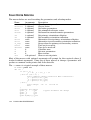
1
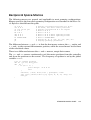
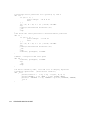
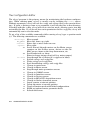
group any number of lines together to form just one parse tree. A significant consequence of the parse tree mechanism is limitation of the scope of a nonglobal variable
to the statement block in which it is referenced.
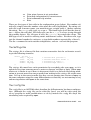
spec may detect error conditions during each of the phases described above. Most of
these errors (and the interrupt character, usually a ˆC ) reset spec to the commandlevel prompt.
spec manages a memory arena that is used as storage for parse trees, macro and
variable symbol tables and command history. In earlier versions of spec, this memory arena was fixed in size. spec now allows the arena to grow up to the maximum
data-space size allowed by the system. The memstat command displays spec’s memory usage.
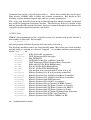
spec also manages some auxiliary files. The user’s state file stores the important
parts of the memory arena. This file is used to let the user exit and restart spec
without losing the program’s state. Another file stores the current data points and
data group configuration, so that they, too, will be available after exiting and restarting spec. These files are placed in the userfiles subdirectory of each configuration’s
auxiliary file area.
Syntax Description
Comments
A # introduces a comment. Everything following a # on an input line is ignored
(unless the # is within a string). Comments are retained in macro definitions and are
counted in the macro length.
Identifiers
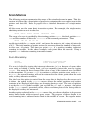
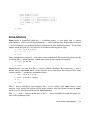
An identifier is a name — it can be a variable name, a macro name or an array name.
An identifier may begin with the letters a-z , A-Z or _ (underscore). The remaining
letters in a name may be those characters or the digits 0-9 . There is no limit to the
number of characters in a variable name. In the syntax rules described later, such
names are represented by the term identifier.
46
REFERENCE MANUAL