1
timestep, then the PV will never be asked to supply more power than it can. Slightly
more involved is the scenario where the dispatcher asks for less power than the PV is
supplying. Here, some electronic intervention is required, by diverting the surplus
power into a dump load, where it is wasted as heat, or by changing the loading on the
PV module so that it is operating under a less efficient condition. The former method
is more simple, because in this case the power incoming from the PV is always the
maximum possible power, which is therefore easy to measure for dispatching.
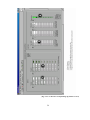
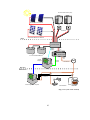
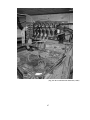
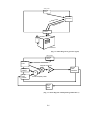
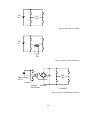
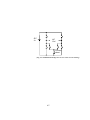
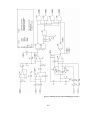
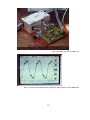
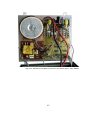
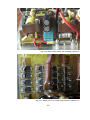
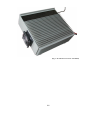
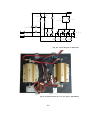
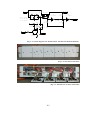
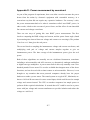
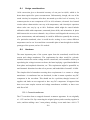
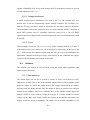
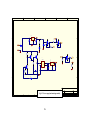
A dispatchable dump load was built for the purposes of this experiment. The circuit
and construction are described in Appendix B.
6.2.2 Using batteries
Batteries bring a major advantage, in that they act as a short-term energy store. This
means that the dispatching software does not have to keep the energy balance perfect
at every instant in time; as long as it adds up on average, any transient errors will be
soaked up by the battery. To use an informal analogy, they are a place for the energy
to pile up while the dispatcher decides what to do with it. This is a direct analogue to
the LFC functions proposed earlier for distributed systems. Obviously it is not quite
the same, since a DC system has no frequency. But if voltage is taken as the
stabilised parameter instead, then the correspondence is exact: the battery is an
energy store that automatically lets out or takes in power to keep the DC control area
stable. It does this without any formal control algorithm as such, merely by being a
voltage source with low internal resistance.
Having such a flexible and forgiving kind of “LFC” allows liberties to be taken with
other aspects of the control software. In particular, dispatching for the PV is a case of
measuring the actual power fed into the battery by the PV, and setting the maximum
available power (Pmax) for dispatching purposes equal to this. If the dispatcher
decides that the whole of the PV power is not required, then a dump load can be
activated to draw the surplus power out of the battery.
As well as being a stabilising influence, batteries are also an energy store, and this
aspect will need to be managed too. In order to do this, the battery will have to
appear to the dispatching algorithm as two entities; one source and one demand. The
76