1
Simulator Reference Manual
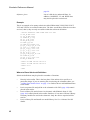
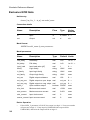
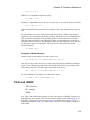
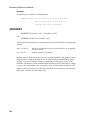
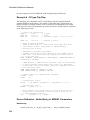
Decade sweep resistor RSource from 100 to 10K with 25 points per decade. Frequency
= 1kHz
.NOISE DEVICE RSource DEC 25 100 10k F=1K
.OP
.OP
This control instructs the simulator to perform a DC operating point analysis. Note that
a DC operating point analysis is carried out automatically for transient (unless the UIC
parameter is specified), AC, DC, transfer function and noise analyses.
DC operating point analysis attempts to find a stable bias point for the circuit. It does
this by first applying an initial guess and then uses an iterative algorithm to converge
on a solution. If it fails to find a solution by this method the simulator then attempts
three further strategies.
For the first, a method known as ‘source stepping’ is employed. For this all voltage and
current sources in the circuit are initially set to near zero and the solution found. The
sources are then gradually increased until they reach their final value.
If this approach fails a second strategy ‘GMIN stepping’ is invoked. This conditions
the solution matrix by increasing the diagonal term such that it is dominant. If large
enough, convergence is virtually guaranteed. If successful then the diagonal term is
reduced and a further solution sought using the previous solution as a starting point.
This procedure is repeated until the diagonal term is returned to its correct value.
Increasing the diagonal term is in a way similar, but by no means identical, to placing a
small resistance at each node of the circuit.
If source stepping fails a final strategy, ‘pseudo transient analysis’ is invoked. This is
the most powerful technique employed and nearly always succeeds. However, it is also
the slowest which is why it is left until last. For more information on DC convergence
see “Convergence and Accuracy” on page 228.
If the final approach fails then the analysis will abort.
IMPORTANT: It is not necessary to include .OP if other analyses are specified. All
other analysis modes will perform an operating point anyway so including .OP will
simply cause it to be done twice. However, with .NOISE, .TF, .SENS and .PZ the
results of the operating point analysis are not output. If the bias point of the circuit is
required when running one of these analysis modes, a .OP will be needed.
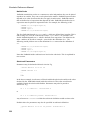
‘OFF’ Parameters
Some semiconductor devices feature the device parameter OFF. If there are devices in
the circuit which specify this parameter, the bias point solution is found in two stages.
In stage 1 the devices with OFF specified are treated as if their output terminals are
open circuit and the operating point algorithm completes to convergence. In stage 2,
The OFF state is then released and the solution restarted but initialised with the results
of stage 1.
194