1
If we are sequentially programming pages within a sector then this problem never arises.
However, if we are randomly updating (reprogramming) pages, then it is necessary to
ensure that we refresh each page in each sector at least once every 10,000 updates of
pages within that sector.
In the worst case a total page by page refresh of one of the larger (512 page) sectors using
the Auto Rewrite command can take over 10 seconds, so this is an issue that might justify
some design creativity to resolve.
The SPI Interface
The Serial Peripheral Interface, or SPI, is a protocol supported by the ATmega 169
hardware and used by the DataFlash chip. In the Butterfly the MCU’s SPI lines are
connected to the DataFlash and brought out to solder pads. Unfortunately, in the
ATmega 169 the SPI pins are also Port B pins 0 – 3. This means that if we use the
DataFlash in one of our programs, we must (for that program) sacrifice the lower four
bits of Port B. Normally this would not be a problem, but in the Butterfly so few I/O pins
are externally available (because of the wealth of other features), it may hamper some
designs.
SPI works by exchanging data between two devices, one of which is designated the
master and the other is designated the slave. In the Butterfly the DataFlash chip will
always be the slave. The ATmega 169 is capable of assuming either role, and even
switching on the fly. The master sends commands to the slave and provides the clock for
the data exchange. The slave does not initiate communication.
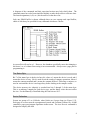
Essentially SPI sets up a pair of registers, one in the master and one in the slave, and
shifts data bits between them. Bits that leave the master end up in the slave’s register,
and bits that leave the slave end up in the master’s register. When the master hardware
sends 8 clock pulses, the two devices exchange a byte.
So we will access the DataFlash by loading an ATmega 169 SPI output register with a
command byte which will then be automatically clocked (shifted) to the slave. We will
usually follow this byte with some addressing bytes. For each byte sent we will also
receive a byte in return, but we will ignore these.
Then, if we expect a response to our command (for example, when we read the
DataFlash), we will send one or more “don’t care” bytes which clock the DataFlash
additional times and allows us to receive the response. The phrase “don’t care” means
the contents is irrelevant; it is the number of bits that counts. The idea of having to send
something to receive something is a little foreign for normal peripheral interactions (like
reading a joystick switch).
Before we can use the SPI we must initialize its hardware by writing to some internal
MCU registers. After initialization, we use the MCU’s SPI registers to send the
5