1
Current Source/Measure Module 52956 User’s Manual
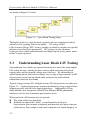
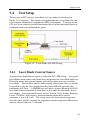
are shown in Figure 3-1 below.
Figure 3-1
Laser Diode Testing Stages
The higher up the test stage the more expensive the test equipment involved
and the cost of rejecting faulty laser diodes. DC testing, called
Light-Current-Voltage (LIV) testing, provides an initial test which can typically
measure several key laser parameters. LIV testing can also eliminate
below-par lasers which could ultimately fail higher up the testing chain, where
failure is more expensive.
3.3
Understanding Laser Diode LIV Testing
Semiconductor laser diodes are current driven devices and as the name implies
LIV testing involves altering the drive current while measuring the optical
output power and the forward voltage across the laser. By measuring the
optical output power and forward voltage over a range of input currents an LIV
characteristic can be built up which when analyzed can yield valuable
information about the laser diode.
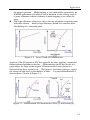
Typical voltage-current (VI) and light-current (LI) characteristics are shown in
Figure 3-2. Optical output power can measured directly using an optical fiber
aligned precisely with the laser diode output facet. Additionally all laser
diode modules also incorporate a Back-Facet Monitor (BFM) photodiode,
which can also be used to monitor optical power levels.
When analyzed a LI characteristic can provide:
The value of the laser threshold.
Evidence of undesirable “kinks” or non-linearities in the laser
characteristic that can point to inherent problems that will mean rejection
of the device. For example a kink can be indicative of “mode hopping” in
3-2