1
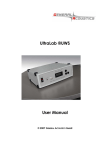
UltraLab ULS User Manual 2. Introduction 2.1 Overview Ultrasound measurement of distances in laboratory measurement technology has become increasingly established in recent years. The advantages gained are quite clear: particularly in small-scale experimental set-ups, it is imperative to avoid any mechanical intervention that may affect the experiment, but at the same time, parameters must be measured and evaluated. This not only applies to laboratory operation and the medium of water. As the distance to an object is measured by sound propagation time measurement, and not by intensity measurement, as is the case in optical methods, ultrasound sensors have excellent background suppression. Almost all materials that reflect sound are reliably detected, irrespective of their colour. Even transparent materials and thin foils present no problems for our ultrasound sensors. As a result of their high sensitivity, our sensors are also predestined for the detection of liquid surfaces. GENERAL ACOUSTICS USS ultrasound sensors permit distance measurement from 30 mm to 3.4 m and, thanks to high-resolution propagation time measurement, measure with sub-millimetre resolution. The sensors with a range up to 1.3 m can even resolve the measured distance down to an impressive 0.18 mm. In addition, the unit features a high measurement rate up to 75Hz, allowing highly dynamic processes to be recorded. The sensors measure in dusty air as well as through fine fog. Even thin deposition on the sensor membrane does not impair the sensor’s function. These characteristics, combined with extremely slender sound cones (with no secondary cones), make for completely new laboratory applications. The ULS series of ULTRALAB® sensors are based on an ultrasound pulse echo technique. They have been developed for temporally and spatially high-resolution measurement of distances in air. The easy-to-use ULTRALAB® ULS laboratory instrument excels as a consequence of the diverse functions implemented, making it suitable for use in complex measurement tasks without having to set a series of parameters. The measurement object can be, for example, the water surface as a level or the moving water surface as a wave. This is where the temporally highly resolved distance measurement comes into its own. A complex measurement algorithm ensures high measurement accuracy and resolution, as well as a high degree of data security. The analogue measurement voltage, proportional to distance, is output at a BNC socket on the front of the instrument. This facilitates easy integration of the ULS system into an existing data acquisition system. Page 7