1
Introduction
General Description
General
Description
The IRIS 4100 is designed to provide the user with continuous
measurements of the absolute concentrations of carbon dioxide.
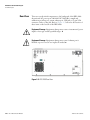
The IRIS 4100 samples the air through a 1/4-inch outer diameter inlet,
which can be plumbed to appropriate sampling fixtures. The IRIS 4100
employs a solenoid actuated gas manifold such that the system can switch
between gases from different sources including the calibration and sampled
gases. The sampled air stream passes through two particulate filters at the
inlet, one of which can be replaced outside of the case. The second, 0.2
micron particulate filter is located under the case cover. Downstream of the
gas manifold, a flow controller is used to maintain a constant gas flow
during the measurement.
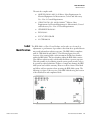
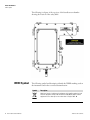
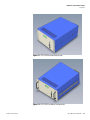
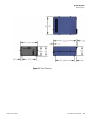
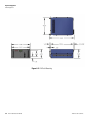
Reference should be made to Figure 2–4 and Figure 2–5 of this manual for
the location and identification of various components and interface
elements of the IRIS 4100, described in this and subsequent sections of this
manual.
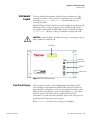
The IRIS 4100 analyzer is controlled via an internal computer, which can
be accessed via the Ethernet port on the front panel, which provides the
basic user control and diagnostic interfaces. The averaging time, for
example, can be controlled via the software interface by connecting the
system to an external computer using Windows Remote Desktop.
After the inlet assembly, the stream enters the optical sensing cell where the
instantaneous concentration of carbon dioxide gas is measured by high
resolution laser absorption spectroscopy in the mid-infrared spectral region.
The associated carbon dioxide concentration is determined using a standard
“Beer’s Law” analysis, which relates the strength of the measured optical
absorption to the absolute carbon dioxide concentration. Both temperature
and pressure are simultaneously measured to enable precise calculation of
the carbon dioxide concentration. The IRIS 4100 analyzer measures
discrete “rovibrational” absorption “fingerprints” for carbon dioxide at
extremely high frequency resolution across the full absorption lineshape,
providing an unambiguous and highly quantitative carbon dioxide
concentration measurement. The laser is approximately 100 times narrower
in frequency than the intrinsic absorption linewidth, and sweeps
continuously in frequency through the associated lines at a repetition rate
of 500Hz. Carbon dioxide absorption lines are measured with each sweep,
providing an instantaneous measurement of the two gases to produce the
dry mole fraction carbon dioxide data.
After the carbon dioxide has been sensed in the optical cell, the air stream
passes through the diaphragm pump and out of the exit port. The pump is
used in a “puller” mode to avoid particulate contamination from the
diaphragm membrane as it wears. The sample cell pressure is maintained at
Thermo Fisher Scientific
IRIS 4100 Instruction Manual
1-3