1
In addition, the TP-410:
•
Can automatically differentiate between RS-232/RS-485 commands that
control the unit itself and commands that are destined for end-user
equipment (see Section 6)
•
Is housed in a 19” 1U rack mountable enclosure, with rack “ears” included,
and is fed from a 100-240 VAC universal switching power supply.
3.1
Shielded Twisted Pair (STP) / Unshielded Twisted Pair
(UTP)
We recommend that you use Shielded Twisted Pair (STP) cable, and stress that
the compliance to electromagnetic interference was tested using STP cable. There
are different levels of STP cable available, and we advise you to use the best
quality STP cable that you can afford. Our non-skew-free cable, Kramer BC-STP
is intended for analog signals where skewing is not an issue.
In cases where there is skewing, our Unshielded Twisted Pair (UTP) skew-free
cable, Kramer BC-XTP, may be advantageous, and UTP cable might also be
preferable for long range applications. In any event when using UTP cable, it is
advisable to ensure that the cable is installed far away from electric cables, motors
and so on, which are prone to create electrical interference.
3.2
Defining EDID
The Extended Display Identification Data (EDID) is a data-structure provided by a
display, to describe its capabilities to a graphics card (that is connected to the
display’s source). The EDID enables the TP-410 to “know” what kind of monitor is
connected to the output. The EDID includes the manufacturer’s name, the product
type, the timing data supported by the display, the display size, luminance data
and (for digital displays only) the pixel mapping data.
EDID is defined by a standard published by the Video Electronics Standards
Association (VESA).
3.3
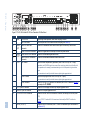
Defining the TP-410 UXGA-Audio-RS-232 Line Transmitter
/ DA
This section defines the TP-410.
4
TP-410 - Overview