1
SIU Errata
1) Program SIUMCR[EARP] to zero.
2) Increase the refresh rate to compensate for the potential cancellation of refresh cycles. Treated
probabilistically, it should be possible to keep the refresh rate above a minimum intended rate. This is
difficult to model exactly, but can be roughly estimated. For the following discussion:
N = proportion of bus bandwidth used by internal MPC850 masters (other than refresh)
E = proportion of bus bandwidth used by external masters
A = proportion of bus bandwidth available for refresh
By definition, N + E + A = 1.
The proportion of time that a refresh request can occur is (E+A).
The probability that a refresh request will be cancelled is E / (E+A). If P is the probability that the refresh
request will be successfully transacted, the P = 1 - [E / (E+A)].
Therefore, to compensate for cancellation of requests, increase the refresh request rate by 1/P.
For a numerical example, assume that internal and external masters each use 30% of the bus bandwidth.
Thus, N = 0.3, E = 0.3, and A = 0.4. In this example, set the refresh rate to 1.75 times the intended rate.
Note, however, that this workaround becomes impractical as A approaches zero.
3) Implement a software-controlled refresh, initiated by a periodic timer request. The user should program
the PIT timer (or a CPM timer) to provide a periodic interrupt. The interrupt service routine should
incorporate a software routine to refresh a memory block. This software refresh routine can consist of either
reads from the appropriate DRAM page or, more simply, execution of the UPM’s refresh routine via a RUN
command to the MCR. The second method is recommended, as it is simpler and uses the DRAM’s internal
counter to keep track of the row to be refreshed. The user should choose the size of memory block to be
refreshed per interrupt in order to minimize the impact of the interrupt overhead.
Let’s look at an example at one extreme. Assume a system with two 4Mx32 DRAM banks controlled by
CS2 and CS3. Each bank has 2048 pages (rows) and each page must be refreshed every 15.6 ms. If the UPM
refresh pattern called by the software refresh routine is set up to loop 16 times (and therefore can refresh 16
rows per call), the timer interrupt should occur every (16/2048)*15.6ms, or approximately 120µs. If one
iteration of the UPM refresh pattern is 5 clocks, the total time required to execute the software refresh
routine (plus overhead for fetching instructions) for both banks is 5*16*2+20 = 180 clocks. Assuming an
interrupt service routine entry/exit overhead of 1200 clocks, each refresh interrupt would take approximate
1400 clocks, or 28µs (assuming a 50MHz system clock). An ISR consuming 28µs out of every 120µs period
would consume 23.3% of the CPU, with 8200 interrupts per second.
At the other extreme, we could refresh the entire memory (2048 refresh cycles per bank) every 15.6ms. In
this case, the software refresh routine would require 1200+(2048/16*180) = 24240 clocks, or 485µs. In this
case, the ISR would consume 485µs out of every 15.6ms, or 3% of the CPU, and would require only 64
interrupts per second. However, system tasks would be stalled for 485µs while waiting for the refresh task
to complete.
The best compromise lies between. For example, at 64 pages per interrupt, the software refresh routine will
consume 1200+(64/16*18) = 1920 clocks, or 38.5µs. The CPU bandwidth consumed will be
38.5µs/(120µs*4) or about 8%, with about 2000 interrupts per second.
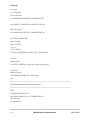
Example code implementing this software refresh follows below:
#=================================================================
#This code initialize the PIT timers to interrupt (number 0) every ~24000 clocks
MOTOROLA
MPC850 Device Errata Reference
21