1
Lattice Semiconductor
Reed-Solomon Encoder User’s Guide
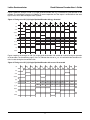
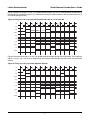
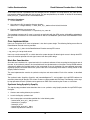
Figure 9 explains the timing of an RS (7,3) double-pipelined encoder with start re-asserted during the operation
of the encoder. The handshaking signal, rdy, indicates the encoder is ready to receive a new set of data when
start is re-asserted during encoding.
Figure 9. Timing of an RS (7,3) Double Pipelined Encoder with start Re-asserted
clk
rstn
start
enable
byp
D6
d_in
D5
D4
d_out
X3
D6
D5
D4
X3
X2
X1
D6
D5
D4
C3
D6
D5
D4
status
rdy
dvalid
Signal Definitions
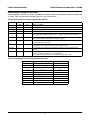
Table 1 shows the input and output signals for the Reed-Solomon Encoder core. Refer to the ispLEVER™ Software
User’s Manual for additional information.
Table 1. Reed-Solomon Encoder Signals
Signal Name
d_in[s-1:0]
I/O Type
Active
State
Input
N/A
Input data
Signal Description
rstn
Input
Low
Asynchronous reset input
enable
Input
High
Enables the encoder to process data on d_in. When low, the input data is
ignored and d_out holds its state.
byp
Input
High
Indicates the data on d_in should pass directly through to d_out after the
latency. This signal is ignored if enable is low.
start
Input
High
Indicates that the data on d_in is the first information symbol of a new codeword.This signal is ignored if byp is high or enable is low.
clk
Input
Rising Edge Master clock input
d_out[s-1:0]
Output
N/A
Output data
status
Output
High
Indicates the information symbols are present on d_out or byp is asserted.
dvalid
Output
High
Indicates valid data on d_out.Not available with continuous configuration
rdy
Output
High
Indicates the encoder is ready to receive data.Active when rstn is asserted or
when ready to receive data or start is asserted. Inactive when sufficient data
has been received and check symbols are being calculated. Not available with
continuous configuration
7