1
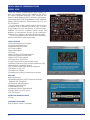
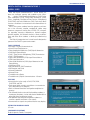
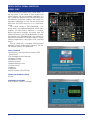
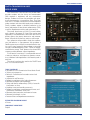
Building Training Systems
for the Global Workplace
For over four decades, Lab-Volt has provided state-ofthe-art systems for technician training in the basic and
most advanced applications of electricity and fluid power,
microprocessors and controls, process instrumentation,
and telecommunications.
Today, Lab-Volt’s highly effective approach to training
and education has earned us the distinction as the leading
North American producer of hands-on technical training
systems. Key to our success has been our ability to anticipate
the applications of new technologies and develop modular
training systems that allow us to address the basic, as well as
specialized, needs of industry and education. In our
approach to training and education, we begin by carefully
defining each new training need. Next, we methodically
design and create the best curriculum, instrumentation,
delivery method, management platform, and laboratory
furniture and configuration to suit real-world training goals
and the real needs of students and instructors.
Lab-Volt training systems are carefully balanced to
provide a solid theoretical grounding in the subject matter,
along with numerous and diverse hands-on applications.
By design, our first-quality, industry-standard training sys-
tems are modular and open-ended so that students may
enter or exit a program at many points. Lab-Volt training
systems bring technical theory to life, teaching the latest
technologies along with valuable troubleshooting, critical
thinking, and reasoning skills.
Lab-Volt maintains a staff of educators, instructional
system designers, and engineers who are always available
to assist teachers, training directors, and administrators in
designing program content, selecting or modifying equipment and software, and providing professional teacher
training.
In designing our laboratory equipment, we ensure
compatibility with international power requirements that
prevail throughout North America, Africa, Asia, Europe,
the Middle East, South America, and Southeastern Asia.
Whether at a high school or community college in the
United States, an air traffic control center in Saudi Arabia,
or a technical institute in the Philippines, Lab-Volt training
systems provide state-of-the-art teaching and classroom
management tools built on computer-mediated platforms
that deliver, manage, and control the educational process.
Lab-Volt’s systems have been used to train technicians
who are successfully employed in leading multinational
companies such as General Telephone & Electronics,
Lockheed Aviation, United States Steel, Western Electric
and Westinghouse, Intel and Micron Semiconductor, Ford
Motor Company, General Motors, IBEW, Bell Telephone of
New Jersey, and many others. In addition, Lab-Volt-trained
technicians hold positions throughout the world at leading
colleges, universities, educational ministries, and military
installations.
FACET®, Lab-Volt Simulation Systems®, Lab-Volt
Automation®, and Tech-World® by Lab-Volt are among the
most widely used integrated technology education systems
today. Trainees in over 30,000 schools, industrial sites, and
military installations in over 50 countries worldwide use
Lab-Volt systems to learn the skills that are necessary to
keep up with the world’s rapid technological growth well
into the next millennium.
••Tech-Design®
••Electric Power and Control
»» Electromechanical
»» Power Electronics and Drives
»» Power Transmission, Distribution, and
Protection
»» Industrial Controls
••Telecommunications
»» Digital and Analog Telecommunications
»» Radar Technology
»» Microwave Technology
»» Antenna
»» Telephony
»» Fiber Optic Communications
••Manufacturing/Mechatronics
»» Automation and Robotics
»» Fluid Power
»» Instrumentation and Process Control
»» Refrigeration, Air Conditioning, and
Heating
»» Exploratory Technology
»» Communications
»» Transportation
»» Construction
»» Manufacturing
»» Bio-Related
»» Family & Consumer Sciences
••Tech-World®
»» Applications in Manufacturing
••Computer-Based Electronics
Training System (FACET®)
»» Basic Principles of Electricity and
Electronics
»» Circuit Simulations
»» Digital and Microprocessor Electronics
»» Telecommunications
»» Industrial Electronics
CENTRAL SALES & MANUFACTURING OFFICES
LAB-VOLT SYSTEMS, INC.
Farmingdale, New Jersey, USA 07727
Telephone (732) 938-2000 Fax (732) 774-8573
Toll Free U.S. Telephone (800) LAB-VOLT
E-MAIL: [email protected]
LAB-VOLT LIMITED
Québec, Québec, CANADA G2N 2K7
Telephone (418) 849-1000 Fax (418) 849-1666
Toll Free Canada Telephone (800) LAB-VOLT
E-MAIL: [email protected]
LAB-VOLT’S WEB SITE
www.labvolt.com
©Copyright 2008 , Lab-Volt Systems, Inc. All rights reserved. All products featured in this guide are subject to change without
notice. Lab-Volt recognizes all product names used herein as trademarks or registered trademarks of their respective holders.
Lab-Volt is not responsible for typographical errors.
TELECOMMUNICATIONS
Technical Training Systems
Known for Excellence in
Technical Training
Introducing Lab-Volt’s Award-Winning Training
Systems for Analog & Digital Communications
Lab-Volt’s Telecommunications
Training Systems form an essential training program for students with interest
in the dynamic and growing communications industry. Because the Lab-Volt
Telecommunications program is completely modular in design, students may enter it
at any level according to their career goals
and abilities.
The Telecommunications curriculum
incorporates hands-on experience with
the basic principles and operations of
electric and electronic communications
systems. Through computer-assisted
learning, students are able to progress
from intermediate to advanced levels of
analog and digital systems, to applications
in microwave, fiber optics, antenna, and
radar technologies.
Simulation-assisted training is now
offered for the Analog and Digital
Communications Training Systems
under the innovative LVSIM®-ACOM
and LVSIM®-DCOM platforms, the virtual instrumentation of Lab-Volt’s Data
Acquisition and Management (LVDAM®COM) software, and the Lab-Volt Virtual
Instrumentation package, Model 1250.
Using LVSIM-ACOM and LVSIM-DCOM
Microsoft® Windows®-based programs,
students are able to set up a virtual workstation using the computer desktop as a
laboratory for demonstrating the principles
of analog and digital communications.
Both platforms are Windows® Vista compatible. This innovative approach reduces
lab time and costs while increasing student learning and retention.
FACET®
Seven modules in the Telecommunications
program derive from Lab-Volt’s awardwinning Computer-Based Electronics
Training System (FACET). These include:
• Analog Communications
• Digital Communications 1
• Digital Communications 2
• Fiber Optic Communications
• Digital Signal Processor
• Transmission Lines
• QPSK/ OQPSK/ DPSK
4
FACET is a modular program
available as a manual or computer-based (Windows) system.
Each module requires a FACET
base unit in order to power and
control the circuit board.
For more information on the
integrated FACET learning
system and the exciting opportunities it offers students in the
study of advanced telecommunications technology, please
see pages 5 to 15 or contact
Lab-Volt or your representative for the Electronics Product
Guide.
With the aid of the FACET
electronic classroom-management system, GradePoint
2020™, instructors are able to
perform on-line vital management tasks such as generating
multiple class rosters, analyzing test results, storing previous work, converting data to
numerical grades, monitoring
unit-by-unit progress, averaging group grades, providing
comparative data for curving or
weighting class grades, tracking competency achievement
and producing detailed competency reports, and more.
TELECOMMUNICATIONS
Table of Contents
Product Highlights
Communications Technologies
Training System………………………………....6
Computer-Based Electronics Training
System (FACET®) . . . . . . . . . . . . . . . . . . . . . . . 7
Modules feature a powerful management system and
simulation software.
FACET® TELECOMMUNICATIONS SYSTEMS
FACET System Base Units . . . . . . . . . . . . . . . ..9
FACET Analog Communications . . . . . . . . . . . 10
FACET Digital Communications 1 . . . . . . . . . . 11
FACET Digital Communications 2 . . . . . . . . . . 12
FACET Fiber Optic Communications . . . . . . . 13
FACET Digital Signal Processor . . . . . . . . . . . . 14
FACET Transmission Lines . . . . . . . . . . . . . . . 15
FACET QPSK/OQPSK/DPSK . . . . . . . . . . . . . . . 16
Virtual Instrument Package . . . . . . . . . . . . . . . 17
ANALOG & DIGITAL COMMUNICATIONS SYSTEMS
Communications Technologies
Training System………………………………...18
Analog Communications Training System
20
Digital Communications Training System . . . 21
LVSIM-ACOM & LVSIM-DCOM . . . . . . . . . . . 22
Simulation and Virtual Instruments for Analog &
Digital Communications
LVDAM-COM Data Acquisition and Management for Telecommunications . . . . . . . . . . . . . . . . . . 26
TELEPHONY, MICROWAVE, AND RADAR
TECHNOLOGIES
Telephony Training System . . . . . . . . . . . . . . . 28
Microwave Technology Training System . . . . 31
Antenna Training and Measuring System . . . 32
Radar Training System . . . . . . . . . . . . . . . . . . . 34
ORDERING INFORMATION
Courseware . . . . . . . . . . . . . . . . . . . . . . . . . . . . 39
5
Communications Technologies Training Systems
“Communications Training System with tremendous flexibility at a reduced cost.”
The Lab-Volt Communications Technologies Training
System, Model 8087, is a complete, state-of-the-art, digital
communications training system, including instruments.
Specially designed for hands-on training, this system
facilitates the study of many different types of digital
modulation/demodulation technologies such as PAM,
PWM, PPM, PCM, Delta Modulation, ASK, FSK, and BPSK
as well as spectrally efficient technologies such as QPSK,
QAM, and ADSL. Advanced communications technologies such as Spread Spectrum (direct sequence and frequency hopping) and CDMA are also covered. The system
is designed to reflect the standards commonly used in
modern communications systems.
The Reconfigurable Training Module, Model 9431-1,
used in the 8087 System is the same platform used for
many other Lab-Volt Training Systems, such as the 8086
Telephony Training System and 8096 Radar Training
System. Unlike conventional, hardware-based training
systems that use a variety of physical modules to
demonstrate different technologies and instruments, the
Communications Technologies Training System uses the
Lab-Volt Communications Technologies (LVCT) software
along with a Reconfigurable Training Module (RTM) to
implement hardware; together these components provide
tremendous flexibility at a reduced cost.
The Windows®- based LabVolt Communications Technologies (LVCT) software
provides the user interface
and configures the RTM to
implement the communications technology selected by
the user.
The Communications Technologies Training System
is based on a Reconfigurable Training Module (RTM)
and the Lab-Volt Communications Technologies (LVCT)
software. This approach allows for tremendous flexibility
at a reduced cost. Each of the communications technologies to be studied is provided as an application that can
be selected from a menu. Once loaded into the LVCT
software, the selected application configures the RTM
to implement the communications technology hardware
and presents a specially-designed user interface for the
student.
The courseware for the Communications Technologies
Training System consists of a series of student manuals
covering the different technologies as well as instructor guides that provide the answers to procedure step
questions and to review questions. The Communications
Technologies Training System and the accompanying
courseware provide a complete study program for these
important technologies.
Designed to reflect the standards commonly used in
practical digital communications systems.
• System-Oriented
• Real System and real frequencies – not simulations
• Modular
• Based on current technologies and standards
• MATLAB® Import/Export in ADSL applications
• Compatible signal levels
• Front-panel access to signals
• Fault insertion capabilities
• Low-power for safety and compatibility
• Short-circuit-proof
6
The RTM
Connections
diagram identifies
the RTM inputs
and outputs and
shows the physical
connections.
The LVCT software
components include:
•• Oscilloscope
•• True RMS Voltmeter
•• Logic Analyzer
•• Spectrum Analyzer
•• Constellation Viewer
TELECOMMUNICATIONS
FACET®
Modules Feature Powerful Management System and Simulation Software*
The following Telecommunications modules** are part
of Lab-Volt’s award-winning Computer-Based Electronics
Training System (FACET®):
• Analog Communications
• Digital Communications 1
• Digital Communications 2
• Fiber Optic Communications
• Digital Signal Processor
• Transmission Lines
• QPSK/ OQPSK/ DPSK
With these modules, instructors can use the following features to enhance their teaching effectiveness and customize
their curriculum:
Tech-Lab® FACET® System Utility
• Application Launch: A single click activates software
applications – those included with the curriculum and others that instructors may add.
GradePoint 2020™ Electronic Classroom Manager
and Gradebook
• Real-time data collection: Students’ performance data on
tests and activities is automatically collected in the software. This enables instructors to provide instant feedback
on students’ achievements, as well as areas in need of
additional support.
• Teacher Annotations: Teachers can add supplementary
information, notes, or instructions within the curriculum.
• Easy grade viewing: Instructors can examine grades
from pre- and post-tests, on-line activities and assignments, and overall grades in one grid.
• Course Content Editing: Easy-to-use graphical tools enable the addition of information (transfer annotations to
curriculum screens), audio and video content, and even new modules.
• Automatic computing and recording of grades.
• Assessment Editing: Instructors can edit pre- and posttests, competencies, and scenario-based assessment grading with rubrics; and create tests with linked competencies.
• Manual setting of grade weights and competency
thresholds.
• Preferences for curriculum operation: Teachers can
activate media features, such as narration, closed captioning, MPEG videos, and teacher annotations; topic preferences such as prerequisites and quiz aids; and several
more options.
• Access to students’ electronic journals: Instructors can
communicate with students about notes they save in the
journals, projects, their progress, etc.
• Simple report generation: A click of a button will generate any of 20 reports.
NetOp School® Networked- Classroom Software
A single click within GradePoint 2020 provides access to
these additional capabilities:
• Supervision and Control: From their own computers,
instructors can observe students as they work, identify who
needs assistance, and provide one-on-one instruction via
remote-control access to a student’s computer.
• Demonstration broadcasts: Instructors can teach by
example from their own or a student’s computer, to any
number of students.
Upon enrollment in the class, students receive the journals
and these other online, learning-enhancement tools to maximize their training experiences:
• Announcement posting: Teachers can send messages
to the entire class in one easy step.
• Internet Link Resource: An educational portal provides
links to related web sites to expand and reinforce learning.
• Real-time chats: Instructors can communicate with
selected students in writing or audio (with headphones)
without interrupting others.
• Text-to-Speech: Once activated by the instructor, students
can click on selected text to have the text narrated.
Narration is possible in multiple languages for both existing
content and any text that teachers add.
• Attention button: Instructors can bring the class to
attention with a single click.
** See pages 9 to 17 for details on these modules.
7
NetOp School® also minimizes administrative
time by:
• Launching programs on students’ computers with a
single command.
• Remotely rebooting students’ computers after
modifying the system.
State-of-the-Art Circuit-Simulation Software
with FACET Modules
The FACET curriculum incorporates state-of-the-art
software for studying, testing, and designing analog and
digital circuits: MultiSIM from Electronics Workbench.
This software features easy-to-use Electronic Design
Automation (EDA) tools for design engineers, educators,
and students.
MultiSIM offers the following features:
• Schematic Capture
This graphic is a basic screen shot of the workspace of MultiSIM
when it is opened and a circuit has been created and is being
analyzed. The window in the lower right corner of the screen is an
instrument (oscilloscope), and the two palettes (gray rectangles)
along the left side are opened component bins.
• Advanced Component Database
• SPICE Simulation
• RF Design Kit
• Comprehensive selection of options for analysis and
display of results
• VHDL for fast, high-performance simulations;
includes a product manager, built-in text editor, and a
tool that writes custom shell codes
• Verilog, a fast, accurate simulator for operation at the
behavioral, gate, and switch levels
• Co-simulation, for designing central logic in the
middle of printed circuit boards, or the interfacing
between digital chips and the rest of the board
• Project and Team Design, facilitates information
sharing and a tighter design integration.
8
MultiSIM’s Internet Design Sharing allows colleagues in different
locations to work on the same circuit as if they were in the same
room, controlling and examining the circuit together in real time.
Users can be around the corner, across town, or on opposite sides
of the globe.
TELECOMMUNICATIONS
FACET® System Base Units
Model 91000-30,
manual base unit
with built-in power
supply
The FACET base units provide students with a means
of operating, analyzing, and troubleshooting each FACET
circuit board. Additionally, the base units provide protection and voltage conditioning circuitry to run each FACET
board. Base units are available for manual or computerbased systems.
GENERAL FEATURES
• Distributed ±15 and variable ±10 Vdc power to the
various circuit training blocks. Coarse and fine controls are provided to adjust the variable ±10 Vdc supplies.
• Self-protection against short-circuit, reverse-voltage,
and over-voltage conditions.
• Long-life zero insertion force (ZIF) connector, with a
rotary knob that locks the training module into the
base unit. The ZIF connector itself is protected from
damage by built-in stops.
• The fingers on the connectors are gold-plated for
added durability.
Model 91000-50, USB
base unit with computer interface and
built-in power supply
fault is activated. In the troubleshooting exercises, faults
are inserted automatically by the computer, thereby freeing
the instructor to assist students with individual activities.
COMPUTERIZED FACET SYSTEM REQUIREMENTS
All systems require:
• FACET Base Unit
• Multimeter
• Dual-Trace Oscilloscope
• Audio Function Generator
• Courseware: manual (hard copy) or computer-based
(Windows)
• 100% compatible Windows® PC, Microsoft®
Windows 2000 Professional with Service Pack 3 or
higher, Pentium III class CPU (500 or higher), 512
MB RAM, 40 GB hard drive (minimum 2000 MB free
space), CD/DVD-ROM combo, SVGA Monitor capable of 32-bit color display at 1024 x 768 resolution, 16
MB video card, 16 Bit Sound Blaster-compatible, fullduplex sound card
MANUAL BASE UNIT FEATURES
The manual system base unit (Model 91000-30) comes
with an accessory kit containing terminal posts, connectors, adapters, and patchcords required to perform experiments on each FACET training module. Power is connected to the base by standard banana-plug test cables.
Two light-emitting diodes (LEDs) the base unit also
indicate the presence of an external power source and the
appropriate power conditions to perform experiments. A
locking cover houses 12 fault-insertion switches; 32 toggle
switches are available for student circuit modification.
COMPUTERIZED BASE UNIT FEATURES
The computerized base unit (91000-50) contains 32 reed
relays controlled by commands from the host microcomputer. Model 91000-50 is linked to the microprocessor
via a USB port. Circuit modifications (CMs) and faults are
switched in and out automatically by the software. A message on a student’s computer screen indicates that a CM or
9
FACET® ANALOG COMMUNICATIONS
MODEL 91018
With the Analog Communications circuit board, students can configure, operate, and troubleshoot the following circuits: Amplitude Modulation (AM) Transmitter and
Receiver, Single-Sideband (SSB) Transmitter and Receiver,
Frequency Modulator (FM), Phase Modulator (PM), Quadrature
Detector (FM Demodulation), Phase-Locked Loop (PLL), and
PLL FM Detector.
In this course, students receive hands-on circuit training
and acquire skills to measure radio signals with an oscilloscope. Students also learn the functions of oscillators, filters,
amplifiers, LC networks, modulators, limiters, mixers, and
detectors in communication circuits. Circuit modifications
and faults allow students to develop troubleshooting skills.
The Analog Communications circuit board is designed to
operate in the FACET system environment.
TOPIC COVERAGE
• Analog Communications Concepts
• Circuit Board Familiarization
• Amplitude Modulation (AM)
• RF Power Amplifier
• Balanced Modulator
• RF Stage
• Mixer, IF Filter, and Envelope Detector
• Balanced Modulator and LSB Filter
• Mixer and RF Power Amplifier
• RF Stage, Mixer, and IF Filter
• Product Detector and Automatic Gain Control
• Frequency Modulation (FM) and Phase Modulation (PM)
• Demodulation (Quadrature Detector)
• PLL (Phased-Locked Loop) Circuit and Operation
• FM Detection with a PLL
• Troubleshooting Basics
• Troubleshooting Analog Communications Circuits
FEATURES
Seven circuit blocks:
• Amplitude Modulation (AM) Transmitter and SingleSideband (SSB) Transmitter
• AM Receiver and SSB Receiver
• Frequency Modulator (FM)
• Phase Modulator (PM)
• Quadrature Detector (Demodulation)
• Phase-Locked Loop (PLL) Circuit
• PLL FM Detector
ESTIMATED PROGRAM HOURS
35 hours
LANGUAGE VARIATIONS
English, Spanish, French, Portuguese
10
TELECOMMUNICATIONS
FACET® DIGITAL COMMUNICATIONS 1
MODEL 91022
With the Digital Communications 1 circuit board, students can configure, operate, and troubleshoot the following
circuits: Pulse-Amplitude Modulation (PAM), PulseTime Modulation (PTM), Pulse-Code Modulation (PCM),
Pulse- Amplitude Modulation/Time-Division Multiplexing
(PAM-TDM), and Delta Modulation (DM). Each circuit block
contains a modulator for transmission and a demodulator for
reception.
Also in this course, students learn the operation and function of the following: sampler, sample/hold, adder, ramp
generator, comparator, limiter, filter, CODEC, PLL, compressor, expander, integrator, differentiator, latched compare,
speaker amplifier, and channel simulator. Circuit modifications and faults allow students to develop troubleshooting
skills.
The Digital Communications 1 circuit board is designed to
operate in the FACET system environment.
TOPIC COVERAGE
• Concepts of Digital Communications
• Circuit Board Familiarization
• Pulse-Amplitude Modulation (PAM) Signal Generation
• PAM Signal Demodulation
• PAM - Time-Division Multiplexing (TDM) Transmission
• PAM - TDM Reception
• Pulse-Time Modulation (PTM) Signal Demodulation
• PTM Signal Generation
• Pulse-Code Modulation (PCM) Signal Generation and
Demodulation
• PCM Signal TDM
• Delta Modulation (DM) Transmitter
• DM Receiver and Noise
• Channel Bandwidth
• Channel Noise
• Troubleshooting Basics
• Troubleshooting Digital Communications 1 Circuits
FEATURES
• Circuit blocks for the study of PAM, PTM, PCM,
PAM-TDM, and DM
• Each circuit block contains a modulator for transmission
and a demodulator for reception.
• Built-in Channel Simulation and speaker amplification
circuitry.
• The Channel Simulator circuit block enables students to
investigate the effects of noise and channel bandwidth on
pulse and digital modulation signals.
• The Speaker Amp circuit block permits students to
connect a speaker and listen to the signals.
• Communication signals are synchronized for easy display.
ESTIMATED PROGRAM HOURS
35 hours
LANGUAGE VARIATIONS
English, Spanish, French, Portuguese
11
FACET® DIGITAL COMMUNICATIONS 2
MODEL 91023
With the Digital Communications 2 circuit board, students can configure, operate, and troubleshoot the following
circuits: NRZ, RZ, Manchester encoding and decoding,
clock synchronizer, frequency-shift keying (FSK) generation, FSK asynchronous and synchronous detection, phaseshift keying (PSK) generation, PSK synchronous detection,
amplitude-shift keying (ASK) generation, ASK asynchronous
and synchronous detection, channel effects, and FSK/DPSK
(differential phase-shift keying) modem.
Following a carefully designed instructional program,
students will become familiar with all components of the
board; will be able to isolate, identify, and test a series of
circuits; and will perform troubleshooting exercises to demonstrate mastery of the course objectives.
The Digital Communications 2 circuit board is designed to
operate in the FACET system environment.
TOPIC COVERAGE
• Circuit Board Familiarization
• Introduction to Digital Transmission
• Encoding
• Decoding
• Frequency-Shift Keying (FSK) Signal Generation
• FSK Asynchronous Detection
• FSK Synchronous Detection
• Phase-Shift Keying (PSK) Signal Generation
• PSK Synchronous Detection
• Amplitude-Shift Keying (ASK) Signal Generation
• ASK Asynchronous Detection
• The Channel Simulator
• Effects of Noise on ASK and PSK Signals
• Effects of Noise on Asynchronously and Synchronously
Detected FSK Signals
• Operation of an FSK Modem
• Operation of a DPSK (differential phase-shift keying)
Modem
• Troubleshooting Basics
• Troubleshooting Digital Communications 2 Circuits
FEATURES
• Circuit blocks allow for the study of line encoding, modulators, channel simulator, sync. detector, and modems.
• The Channel Simulator circuit block and a bit error rate
(BER) counter enable students to evaluate the effects of
noise on ASK and PSK modulated carrier signals.
• The Modem circuit block contains an FSK/DPSK modem
IC, which students use in a loop-back mode to observe
the entire signal path.
• Communication signals are synchronized for easy display.
ESTIMATED PROGRAM HOURS
40 hours
LANGUAGE VARIATIONS
English, Spanish, French, Portuguese
12
TELECOMMUNICATIONS
FACET® FIBER OPTIC COMMUNICATIONS
MODEL 91025
The Fiber Optic Communications circuit board provides
students with a solid foundation in the theory and practice
of fiber optic communications technology. The eleven circuit
blocks provide hands-on experimentation with several varieties of fiber optic transmission and reception.
Through the interactive CBL (computer-based learning)
format, the student learns the principles of both analog and
digital transmission and reception using fiber optic communication links. The circuit board may be used with the
FACET base unit or as a stand-alone trainer.
TOPIC COVERAGE
• Circuit Board Familiarization
• Introduction to Fiber Optic Communications
• Scattering and Absorption Losses
• Connectors and Polishing
• Numerical Aperture and Core Area
• Bending Loss and Modal Dispersion
• Light Source
• Driver Circuit
• Source-to-Fiber Connection
• Light Detector
• Output Circuit
• Fiber Optic Test Equipment
• Optical Power Budgets
• Analog Communications
• Digital Communications*
• Troubleshooting
FEATURES
• Circuit blocks include a fiber optic transmitter and
receiver, analog and digital transmitters, analog and digital receivers, an RS-232 interface, a photo-transistor, lightemitting diodes (LEDs), and more.
• FACET base unit or stand-alone operation
• ST connections
• Multimode 62.5/125 cm glass, and 980/1000 cm plastic
cables
• High-speed 820 nm transmitter
• Integrated PIN photodiode receiver
• Digital and analog communications channels
• Full handshake RS-232 interface using Time-Division
Multiplexing (TDM) and Manchester coding
• On-board microphone and speaker
ESTIMATED PROGRAM HOURS
• 30 hours
LANGUAGE VARIATIONS
English, Spanish, French, Portuguese
* For this exercise, the computer interface requires optional
equipment: FACET 32-Bit Microprocessor module (91017-20)
plus accessories: 9V power supply (91730), Cable (31217-00)
and Adapter (31216-00). Additional option includes Polishing Kit
(92026).
13
FACET® DIGITAL SIGNAL PROCESSOR
MODEL 91027
The Digital Signal Processor (DSP), Model 91027, is
the first trainer on the market to teach students the
control devices and data-processing capabilities of a
DSP. Through the operation of the DSP circuit board and
accompanying courseware, students gain insight into
the internal architecture of a DSP. The unit can be used
either with the FACET base unit or as a stand-alone
trainer.
The module contains a DSP (TMS320C50), a DC
power source, a microphone preamplifier, and an audio
amplifier. An eight-position dipswitch, a four-digit
display, push-button switches, and analog input and
output connections to the DSP enable students to probe
the structure of the TMS320C50 DSP. The auxiliary I/O
circuit block has headers that enable students to design
additional experiments or prototypes of DSP-controlled
circuits.
Through a serial link to a computer, Windows-based
debugger software enables direct interaction with the
DSP registers, memory, and peripherals.
TOPIC COVERAGE
• Introduction to the Digital Signal Processor (DSP)
Circuit Board
• The Assembler and the Debugger
• Numerical Formats
• Arithmetic in a DSP
• Memory Structure
• Address Generation Unit
• Program Control
• Pipelining
• Peripherals
• Signal Processing: The FIR Filter
ESTIMATED PROGRAM HOURS
25 hours
LANGUAGE VARIATIONS
English, Spanish, French, Portuguese
14
TELECOMMUNICATIONS
FACET® Transmission Lines
MODEL 91028
The Transmission Lines circuit board, Model 91028,
provides students with the theory and measurement
skills required to implement and test transmission
designs. Students first learn the principles and operational characteristics of transmission lines. They then
learn how to conduct transmission line measurements
under transient and sinusoidal steady-state conditions.
Finally, students acquire a valuable foundation in the
theory and practice of time-domain reflectometry (TDR),
as well as impedance matching and transformation.
The circuit board uses two RG-174 coaxial cables,
each a length of 24 meters (78.7 feet). They can be used
separately or connected end-to-end. Each line has five
probing points that permit observation and measurements of signals along the line, using an oscilloscope.
Two generators are provided to study the transmission line behavior: a step generator that produces a
50-kHz square-wave voltage for transient behavior testing, and a signal generator that produces a sinusoidal
voltage of variable frequency (5 kHz - 5 MHz) for steadystate behavior testing. Each generator has several BNC
outputs providing different output impedances.
A load section, consisting of a configurable network
of resistors, inductors, and capacitors, permits connection of different load impedances to the receiving end of
each line.
The circuit board may be used in the FACET base
unit, or as a stand-alone unit.
TOPIC COVERAGE
• Introduction to the Transmission Lines Circuit Board
• Velocity of propagation
• Behavior of transmission line under various load impedances
• Attenuation and Distortion
• Reflection coefficient at the load and generator
• Measuring complex load impedances
• Using time domain reflectometry (TDR) to locate dis
continuities on a line
• Standing waves and standing-wave ratio
• Reflection coefficients, return/mismatch losses, and
transmission coefficients at the load
• Measuring line attenuation and insertion losses
• Measuring the length of a line
• Resonant lines and impedance transmission
ESTIMATED PROGRAM HOURS
25 hours
LANGUAGE VARIATIONS
English
15
FACET® QPSK/OQPSK/DPSK
MODEL 91029
Phase-shift keying (PSK) is a method of digital communication in which the phase of a transmitted signal
is varied to convey information.
The QPSK/OQPSK/DPSK board provides students
with the theory and measurement skills required to
implement and test different types of PSK modulation
and demodulation techniques used in pulse-coded
modulation (PCM) schemes.
The student first learns the principles and operational characteristics of unipolar and bipolar signals in
a baseband transmission. Next, the student measures
and compares BPSK, QPSK, OQPSK, and DPSK signals
in the time and frequency domains using an oscilloscope and spectrum analyzer, respectively. Lastly, the
student becomes familiar with all components of the
board; isolates, identifies, and tests a series of circuits;
and performs troubleshooting exercises to demonstrate
mastery of the course objectives.
TOPIC COVERAGE
• Digital modulation
• Baseband signals
• Passband signals
• Partitioning of pulse streams
• Signal constellations for MPSK
• General MPSK equations
• Heterodyning baseband signals with a carrier
• Unipolar and bipolar signals in time domain
• Unipolar and bipolar signals in the frequency domain
• Binary PSK (BPSK) modulation and demodulation
• Quadratic PSK (QPSK modulation and demodulation
• Offset QPSK (OQPSK) modulation and demodulation
• Differential PSK (DPSK) encoding and decoding
Additional Features
• Communication signals are synchronized for easy display
• Digital signals observed in both time and frequency domains
• Courseware interfaces with the Lab-Volt Virtual Instrument, Model 1250
• Built-in adjustable NRZ GENERATOR provides
various bit pattern streams
• Adjustable bandwidth channel simulator
ESTIMATED PROGRAM HOURS
20 hours
LANGUAGE VARIATIONS
English
16
TELECOMMUNICATIONS
VIRTUAL INSTRUMENT PACKAGE
MODEL 1250
The Lab-Volt Virtual Instrument Package, Model 1250,
is a lightweight, compact, and portable desktop unit that
replaces standard desktop test equipment (FACET Digital
Multimeter/AF Generator, Model 1247, and oscilloscope)
with a powerful, space-saving instrumentation package
and software that gives students state-of-the-art tools
to measure, analyze, observe, and report the results of
electronic circuit tests. It can be used with the following
Microsoft® Windows operating systems: 95, 98, NT 4.0
(with service pack 6), 2000, Me, and XP.
Fully integrated with the FACET Electronics Training
program, the Lab-Volt Virtual Instrument Package enables
students to conduct all experiments that would otherwise
be performed with separate testing instruments.
The complete Lab-Volt Virtual Instrument Package
includes a desktop unit containing the following instruments:
• Digital Storage Oscilloscope
• Multimeter
• Function Generator
• Spectrum Analyzer
• Transient Recorder
The package also includes all necessary software,
cables, a user manual, two oscilloscope probes (switchable 1:1 - 1:10), test leads, and a data acquisition instrument that can be connected to the parallel printer port
of a personal computer. The Lab-Volt Virtual Instrument
Package can be powered from 110 to 240 Vac (50/60 Hz)
or 12 to 24 Vdc for portability.
Students use the keyboard, mouse, and computer
screens to control and display the five measuring instruments. The Windows-based software menu and tool bars
allow inexperienced students to carry out measurements
easily. Measured data can be printed out or stored on a
floppy disk or network.
With the Lab-Volt Virtual Instrument Package, students gain experience using modern measurement techniques that prepare them for real jobs in today’s electronics industries.
DUAL-CHANNEL
OSCILLOSCOPE
The dual-channel
oscilloscope has a
25 MS/s sampling
rate in dual-channel mode, and
50 MS/s sampling
rate in single-channel mode. Cursors
are available to
perform voltage, time, phase, and frequency
measurements on the displayed signal. An
external trigger input is located at the back
of the unit.
MULTIMETER
The Multimeter measures voltage (AC/DC),
current (AC/DC), resistance, and frequency.
The maximum AC frequency response is 5
MHz. Several types of
measurements -- such
as true RMS, peak-topeak, mean, dBm, max,
min, power, and duty
cycle --are available.
SIGNAL GENERATOR
The single-channel
Signal Generator produces sine, square, and
triangle waveforms with
a frequency range of 0.01
Hz to 500 KHz. The output amplitude is
0-20 Vp-p (no load) with
an output impedance of
50 W.
SPECTRUM
ANALYZER
The dual-channel
Spectrum Analyzer
graphically displays
voltage as a function
of frequency. It has a
maximum frequency
range of 25 MHz with
an accuracy of 0.1%.
The software supports
six window functions.
TRANSIENT RECORDER
The dual-channel
Transient Recorder
measures slowly changing events, such as temperature and pressure
changes. Measuring
time between events
is 0.01 sec to 300 sec.
Cursors are available to
analyze the measured
signals.
17
COMMUNICATIONS TECHNOLOGIES TRAINING SYSTEM
MODEL 8087
The Lab-Volt Communications Technologies Training
System is a state-of-the-art communications training
system, including instruments. Specially designed for
hands-on training, this system facilitates the study of
many different types of digital modulation/demodulation technologies such as PAM, PWM, PPM, PCM, Delta
Modulation, ASK, FSK, and BPSK as well as spectrally
efficient technologies such as QPSK, QAM, and ADSL.
Advanced communications technologies such as Spread
Spectrum (direct sequence and frequency hopping) and
CDMA are also covered. The system is designed to reflect
the standards commonly used in modern communications
systems.
The Communications Technologies Training System is
based on a Reconfigurable Training Module (RTM) and
the Lab-Volt Communications Technologies (LVCT) software. One of the benefits of this approach is flexibility at
a reduced cost. Each of the communications technologies to be studied is provided as an application that can
be selected from a menu. Once loaded into the LVCT
software, the selected application configures the RTM
to implement the communications technology hardware
and presents a specially-designed user interface for the
student.
You can upgrade your system at any time to cover
additional technologies simply by purchasing additional
communications technology applications. This approach
effectively “future-proofs” your training system.
TOPIC COVERAGE
• PAM/PWM/PPM
• PCM/DPCM/Delta Modulation
• ASK/FSK/BPSK
• QPSK/ DQPSK
• QAM/DQAM
• ADSL
• Spectrum Analysis
• Advanced Telecommunications such as CDMA and Spread Spectrum (FHSS and DSS)
18
FEATURES
• Flexible, future-proofed, open system using a high performance DSP-based Reconfigurable Training Module
(RTM) with slots for up to three plug-in interface modules.
• Two plug-in interface modules are included: the Data
Acquisition Interface and the Analog/Digital Output
Interface.
• Applications include on-screen block diagrams of circuits with numerous Test Points and/or Test Busses for
connecting virtual instruments.
• The LVCT software includes a number of virtual instruments, such as an oscilloscope, logic analyzer, spectrum
analyzer, and a true RMS voltmeter (depending on the
application). The ADSL application provides two constellation viewers.
• Fault-insertion capability allows the teaching of troubleshooting.
• Comprehensive courseware provides theory and stepby-step laboratory procedures for each technology.
•• Applications such as ADSL include provision for exporting and importing tables of data in a MATLAB®compatible format.
REQUIRED EQUIPMENT
Computer (Pentium 4 or better), running Windows® XP or
Windows® Vista, including a 3D graphics card (dual monitor support is recommended) and a Fast Ethernet (100Mb/s)
network interface adapter.
SYSTEM ENHANCEMENT
• Communications Technologies Host Computer (with dual
monitors, LVCT software pre-installed)
• Dual trace oscilloscope
SYSTEM VOLTAGES
120, 220, 240 V - 50/60 Hz
TELECOMMUNICATIONS
ESTIMATED PROGRAM HOURS
• Volume 1
35 Hours
• Volume 2
40 Hours
• Volume 3
25 Hours
• Volume 4
20 Hours
• Volume 5
20 Hours
• Volume 6
20 Hours
LANGUAGE VARIATIONS
English, Spanish, French
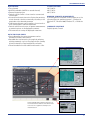
The Lab-Volt Communications Technologies (LVCT)
software provides the user interface and configures
the RTM to implement the communication
technology selected by the user.
The System Diagram shows the overall system and
interconnections for the selected application.
Probes can be dragged from the Probes bar and
connected to circuit Test Points in order to observe
signals using the virtual instruments.
The RTM Connections diagram identifies the
RTM inputs and outputs and shows the physical
connections.
Circuit diagram shows the functional blocks of
each circuit. Pan and Zoom functions allow easy
navigation.
19
ANALOG COMMUNICATIONS TRAINING SYSTEM
MODEL 8080
The Lab-Volt Analog Communications Training System
is the first in a comprehensive series of advanced systems-level programs that use the latest communications
technologies to teach analog communications theories
and practices in a variety of training environments.
The system consists of six instructional modules supported by six instrumentation modules, and courseware
that provides hands-on exercises in the generation,
transmission, and reception of amplitude, double sideband, single sideband, frequency, and phase-modulated signals [Amplitude Modulation (AM), Double-Sided
Modulation (DSB), Single-Sideband Modulation (SSB),
Frequency Modulation (FM) and Pulse Modulation (PM)].
A door on the top of each instructional module provides
access to circuit boards, test points, and fault-insertion
switches.
Model 8080-A0, an alternate system, includes the
LVDAM-COM software and interface, Model 9407,
which replaces three of the six instrumentation modules
(Frequency Counter, True RMS Voltmeter/Power Meter,
and Spectrum Analyzer) of the standard system and an
oscilloscope, with a set of computer-based instruments.
See page 24 for additional information.
TOPIC COVERAGE
VOLUME 1, INSTRUMENTATION
• Concepts and Equipment
• Spectral Analysis
• Modulation Fundamentals
VOLUME 2, AM/DSB/SSB
• Amplitude Modulation (AM) Fundamentals
• The Generation of AM Signals
• Reception of AM Signals
• Double-Sideband (DSB) Modulation
• Single-Sideband (SSB) Modulation
• Troubleshooting AM Communications Systems
VOLUME 3, FM/PM
• Frequency Modulation (FM) Concepts
• Fundamentals of Frequency Modulation
• Narrowband Angle Modulation
• Wideband Frequency Modulation
• Generation of FM Signals
• Reception of FM Signals
• Frequency Division Multiplexing
• Noise in Frequency Modulation
• Troubleshooting FM Communications Systems
20
FEATURES
• System applications cover the areas of generation,
transmission, and reception of amplitude, double sideband, single sideband, frequency, and phase-modulated
signals.
• Instructor-enabled fault switches enhance and develop
students’ troubleshooting skills.
• System design allows performance of voltage and signal
measurements, alignment, calibration, and signal tracing.
• Coaxial cables eliminate radiation and noise interference.
• System can be wireless with the use of antennas in place
of coaxial cable.
• Noise can be introduced to simulate atmospheric disturbances, and to provide realistic signal-to-noise evaluation.
• A Power Supply/Dual Audio Amplifier is the base of the
complete system.
REQUIRED EQUIPMENT
Oscilloscope (not required with alternate system 8080-A0)
SYSTEM ENHANCEMENT
X-Y Recorder
SYSTEM VOLTAGES
120, 220, 240 V - 50/60 Hz
ESTIMATED PROGRAM HOURS
• Volume 1
30 hours
• Volume 2
50 hours
• Volume 3
60 hours
LANGUAGE VARIATIONS
English, Spanish, French
TELECOMMUNICATIONS
DIGITAL COMMUNICATIONS TRAINING SYSTEM
MODEL 8085
The Lab-Volt Digital Communications Training System
incorporates the latest IC technology with state-of-the-art
signal modulators and demodulators to teach basic and
advanced principles of digital communications.
The basic system contains 13 instructional modules
supported by 16 instrumentation modules. The advanced
system contains seven add-on modules: Baseband
Channel/Brickwall Filter; Time-Division Multiplexer;
Time-Division Demultiplexer; T1/CEPT PCM Transceiver;
Clock Recovery; Line Coder; and Line Decoder.
Model 8085-B0, an alternate system, includes the
LVDAM-COM software and interface, Model 9407,
which replaces three of the six instrumentation modules
(Frequency Counter, True RMS Voltmeter/Power Meter,
and Spectrum Analyzer) of the standard system and an
oscilloscope, with a set of computer-based instruments.
See page 24 for additional information.
TOPIC COVERAGE
BASIC DIGITAL COMMUNICATIONS
VOLUME 1, PULSE MODULATION AND SAMPLING
• Pulses
• Pulse Amplitude Modulation (PAM)
• Demodulating PAM Signals
• Pulse-Time Modulation (PWM/PPM)
• Demodulating PWM/PPM Signals
• Troubleshooting PAM/PWM/PPM Systems
VOLUME 2, DIGITAL MODULATION
• Analog-to-Digital and Digital-to-Analog Conversion
• Distortion and Quantization Noise
• Pulse Code Modulation (PCM)
• Differential Pulse Code Modulation (DPCM)
• Delta Modulation (DM)
• Troubleshooting Digital Communications Systems
VOLUME 3, MODEMS AND DATA TRANSMISSION
• Baseband Data Transmission
• Amplitude-Shift Keying (ASK)
• Frequency-Shift Keying (FSK)
• FSK Communications Standards
• Binary Phase-Shift Keying (BPSK)
• Troubleshooting Digital Communications Systems
FEATURES
• Latest IC technology and signal modulators/demodulators
• Easy access to test points and fault-insertion switches
• Safety shielding and full short-circuit protection
• Silk-screened block diagrams and component labels
• System enclosure eliminates power cable clutter.
REQUIRED EQUIPMENT
Oscilloscope (not required with alternate system
8085-B0)
SYSTEM ENHANCEMENTS
• Storage Cabinet
• FM/PM Receiver
SYSTEM VOLTAGES
120, 220, 240 V - 50/60 Hz
ESTIMATED PROGRAM HOURS
• Volume 1
50 hours
• Volume 2
60 hours
• Volume 3
50 hours
• Baseband Data Transmission 10 Hours
LANGUAGE VARIATIONS
English, Spanish, French
ADVANCED DIGITAL COMMUNICATIONS
BASEBAND DATA TRANSMISSION
• Principles of Time-Division Multiplexing and
Demultiplexing
• T1 (PCM-24) and CEPT (PCM-30 Multiplexing)
• Clock Recovery
• Line Coding
21
LVSIM®-ACOM and LVSIM®-DCOM:
Simulation and Virtual Instruments for Analog & Digital Communications
Realistic, Computer-Based Training Saves Time,
Facilitates In-Lab Tasks, and Increases Student
Motivation
In response to the need for more efficient and costeffective training, Lab-Volt has developed a simulation approach to technical training that transfers
training to the computer desktop until students have
had enough practice to apply their skills on actual
laboratory equipment. LVSIM-ACOM is specifically
for analog communications, and LVSIM-DCOM is for
digital communications. Both software programs:
• Enable students to set up the same equipment
required for the Lab-Volt Analog Communications
(Model 8080) or Digital Communications (Model
8085) Training System. Using the mouse, students
manipulate realistic images of Lab-Volt equipment
on the computer screen and make connections by
dragging icons of virtual leads.
• Can be copied onto several personal computers so
that students can become familiar with the equipment configuration before they enter the lab. In this
way, the time spent on in-lab tasks is reduced by
50%, along with the need for physical hardware per
student. With limited investment, institutions can
now deliver high-standard training in both Analog
and Digital Communications.
•Are bundled with the Lab-Volt Data Acquisition
and Management System for telecommunications (LVDAM-COM) to further enable students to
observe and accurately measure voltage, frequency,
and RF power. LVDAM-COM also enables students
to plot graphs and analyze waveforms and frequency spectra.
• Speed the learning process by eliminating the need
to connect actual equipment. Virtual instrumentation also reduces the need for desktop and storage
space for laboratory equipment.
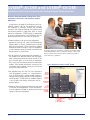
Working in pairs or by themselves, students use LVSIM-ACOM
and LVSIM-DCOM to gain a working knowledge of analog and
digital communications systems before testing their skills on
actual laboratory equipment.
Typical Equipment Setup in LVSIM®-ACOM
Indirect
FM / PM
Generator
1
RF/Noise
Generator
2
AM/DSB/SSB
Generator
Dual
Function
Generator
Power Supply/
Dual Audio
Amplifier
3
4
1. FM/PM Receiver
2. Direct FM Multiplex
Generator
3. SSB Receiver
4. AM / DSB Receiver
22
Data
Acquisition
Interface
TELECOMMUNICATIONS
LVSIM®-ACOM VIRTUAL LABORATORY EQUIPMENT
FOR ANALOG COMMUNICATIONS
MODEL 9480
LVSIM-ACOM is a Windows-based simulation program that covers the same courseware associated with
the Analog Communications Training System, Model
8080. With LVSIM-ACOM, all the standard Analog
Communications laboratory equipment is replaced with
three-dimension replicas of modules that students can
manipulate on the computer screen. Using the mouse,
students can identify and set up equipment for a given
exercise, make the necessary connections between
modules, and verify the connections made without ever
touching a physical module.
LVSIM-ACOM comes bundled with Lab-Volt’s Data
Acquisition and Management for Telecommunications
(LVDAM-COM) software, which enables students to
perform voltage, frequency, and power measurements,
as well as waveform analysis, in both the time and
frequency domains. See page 26 for additional information.
TOPIC COVERAGE
• Basic Concepts and Equipment
• Spectral Analysis
• Modulation Fundamentals
• Amplitude Modulation (AM) Fundamentals
• The Generation of AM Signals
• Reception of AM Signals
• Double-Sideband (DSB) Modulation
• Single-Sideband (SSB) Modulation
• Frequency Modulation Concept
• Fundamentals of Frequency Modulation
• Narrowband Angle Modulation
• Wideband Frequency Modulation
• Generation of FM Signals
• Reception of FM Signals
• Frequency Division Multiplexing
• Noise in Frequency Modulation
SIMULATED EQUIPMENT
• Power Supply/Dual Audio Amplifier
• Dual Function Generator
• RF/Noise Generator
• Virtual Test Equipment Interface
• AM/DSB/SSB Generator
• AM/DSB Receiver
• SSB Receiver
• Direct FM Multiplex Generator
• Indirect FM/PM Generator
• FM/PM Receiver
FEATURES
Special features of LVSIM-ACOM enable students to
perform the following tasks from the desktop:
• Install, move, and remove modules
• Select colored wires to connect modules to each
other
• Modify or remove connections at any time
• Change the color of wires
• Launch and run the LVDAM-COM application within
LVSIM-ACOM
• Zoom in or out to adjust the view
• Apply virtual power to the equipment
• Generate AF/RF signals
• Perform measurements of voltage, frequency, and
power with virtual digital meters
• Observe waveforms on a virtual oscilloscope
• Observe spectral information on a virtual spectrum
analyzer
• Record measurements in a data table
• Plot graphs using recorded data
• Print display screens
• Save and restore environments (equipment setups),
data and waveforms
MINIMUM COMPUTER REQUIREMENTS
A Pentium personal computer, running under one of the
following Microsoft operating systems − Windows 98,
Windows NT, Windows 2000, Windows XP, or Windows
Me. A CD-ROM drive and a sound card are also required
to use the Visual Tour multimedia tool.
SYSTEM VOLTAGES
120, 220, 240 V - 50/60 Hz
ESTIMATED PROGRAM HOURS
120 Hours
LANGUAGE VARIATIONS
English, Spanish, French
23
LVSIM®-DCOM VIRTUAL LABORATORY EQUIPMENT
FOR DIGITAL COMMUNICATIONS
MODEL 9481
LVSIM-DCOM is a Windows-based simulation program that covers the same courseware as the Digital
Communications Training System, Model 8085. LVSIMDCOM recreates a three-dimensional classroom laboratory on a computer screen. The laboratory equipment of the Digital Communications Training System
is replaced with three-dimensional replicas (images),
which students can manipulate on the computer screen.
Using the mouse, students can install virtual Digital
Communications equipment in the laboratory, connect the equipment, perform a lab exercise, and obtain
the same results as with the actual Lab-Volt training
equipment. Sophisticated mathematical models accurately simulate the characteristics of the actual Digital
Communications modules. All modules contained in the
LVSIM-DCOM software feature the same functionality
and appearance as the actual equipment.
LVSIM-DCOM comes bundled with Lab-Volt’s Data
Acquisition and Management for Telecommunications
(LVDAM-COM) software, which enables students to
perform voltage, frequency, and power measurements,
as well as waveform analysis, in both the time and
frequency domains. See page 26 for additional information.
TOPIC COVERAGE
• Pulses
• Pulse Amplitude Modulation (PAM)
• Demodulating PAM Signals
• Pulse-Time Modulation (PWM/PPM)
• Demodulating PWM/PPM Signals
• A/D and D/A Conversions
• Distortion and Quantization Noise
• Pulse Code Modulation (PCM)
• Differential Pulse Code Modulation (DPCM)
• Delta Modulation (DM)
24
• Baseband Data Transmission
• Amplitude-Shift Keying (ASK)
• Frequency-Shift Keying (FSK)
• FSK Communications Standards
• Binary Phase-Shift Keying (BPSK)
SIMULATED EQUIPMENT
• Power Supply/Dual Audio Amplifier
• Dual Function Generator
• RF/Noise Generator
• Virtual Test Equipment Interface
• Enclosure/Supply Regulator
• Clock Generator
• Pseudo-Random Binary Sequence Generator
• Bit Error Rate Indicator
• Logic Analyzer
• DC Voltmeter/DC Source
• Low Pass Audio Filter
• Synchronous Audio Generator
• Signal Interrupter/Selector
• Noise Measurement Filters
• PAM/ASK Generator
• PAM/ASK Receiver
• PWM/PPM Generator
• PWM/PPM Receiver
• PCM Encoder
• PCM Decoder
• DPCM Encoder
• DPCM Decoder
• FSK Modem
• BPSK Modulator
• BPSK Demodulator
• Delta/CVSD Encoder
• Delta/CVSD Decoder
• Cables and Accessories
• Table
TELECOMMUNICATIONS
SYSTEM VOLTAGES
120, 220, 240 V - 50/60 Hz
FEATURES
Special features of LVSIM-DCOM enable students to perform the following tasks from the desktop:
• Install, move, rotate, and remove Digital
Communications equipment.
• Connect Digital Communications components.
• Modify or remove Digital Communications component
connections.
• Change the color of cables.
• Launch and run the LVDAM-COM application within
LVSIM-DCOM.
• Zoom in or out to adjust the view.
• Apply virtual power to the equipment.
• Observe waveforms on a virtual oscilloscope.
• Observe spectral information on a virtual spectrum analyzer.
• Perform voltage and power measurements using a virtual true RMS voltmeter/power meter.
• Perform frequency measurements using a virtual frequency counter.
• Record measurements in a data table.
• Plot graphs using recorded data.
• Print display screens.
• Save and restore equipment setups, data, and waveforms.
ESTIMATED PROGRAM HOURS
140 Hours
LANGUAGE VARIATIONS
English, Spanish, French
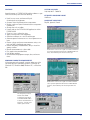
Quantization noise at the output of a PCM communication system implemented with the LVSIM-DCOM software, observed using the virtual oscilloscope.
MINIMUM COMPUTER REQUIREMENTS
A Pentium personal computer, running under one of the
following Microsoft operating systems − Windows 98,
Windows NT, Windows 2000, Windows XP, or Windows
Me.
Quantization noise at the output of a PCM communication system implemented with the LVSIM-DCOM
software, observed using the virtual spectrum analyzer.
The Frequency Counter
and the True-RMS
Voltmeter/Power Meter
in LVDAM-COM enable
accurate measurements of
frequency, voltages, and
relative power levels.
25
LVDAM®-COM DATA ACQUISITION AND MANAGEMENT
FOR TELECOMMUNICATIONS
MODEL 9407
The Lab-Volt Data Acquisition and Management for
Telecommunications (LVDAM-COM), Model 9407, is a
computer-based system for measuring, observing, and
analyzing signals in telecommunications systems. It allows
training in both analog and digital telecommunications systems using modern and versatile measuring instruments.
The LVDAM-COM system consists of the LVDAMCOM software and the Virtual Test Equipment Interface
(VTEI) module. It can replace the Lab-Volt conventional instruments (Frequency Counter, Model 9403, TrueRMS Voltmeter/Power Meter, Model 9404, and Spectrum
Analyzer, Model 9405) and an oscilloscope in the Analog
Communications Training System, Model 8080, and Digital
Communications Training System, Model 8085.
The VTEI module links the personal computer running
the LVDAM-COM software with the Lab-Volt Analog and
Digital Communications Training Systems. Data exchange
between the VTEI module and the personal computer is
made through a standard parallel port. The VTEI module is
designed to meet the high-frequency signal requirements
for telecommunications systems. It provides the necessary hardware to implement a dual-trace oscilloscope, a
spectrum analyzer, a true-RMS voltmeter, and a frequency
counter. All inputs are fitted with BNC connectors and are
fully protected against short circuits and misconnections.
The LVDAM-COM software consists of a complete set
of instruments that runs on an IBM®-compatible personal
computer under the Microsoft Windows operating environment. Each instrument appears as a window on the computer screen.
The LVDAM-COM software can operate in either an
Acquisition or Simulation mode. In the Acquisition mode,
the input signals are measured by the VTEI module and
then transmitted to the LVDAM-COM software through
the computer’s parallel port. In the Simulation mode, input
signals are generated by the computer using user-defined
26
simulation parameters. When used in conjunction with
simulation software, LVSIM-ACOM or LVSIM-DCOM, a
third mode, referred to as Virtuality, is available. In this
mode, input signals are generated by the computer using
simulation parameters that are produced by the LVSIMACOM or LVSIM-DCOM software.
FEATURES
FREQUENCY COUNTER
• 10-Hz to 200-MHz frequency range
• Measures either the frequency or period of the input
signal
• Can be used as an event counter
• Frequency resolution adjustable in decade steps from
0.1 to 100 Hz
• Three input signal attenuation settings (0 dB, 20 dB, and
40 dB)
TRUE-RMS VOLTMETER
• Measures voltage or relative power level of signals ranging from 50 Hz to 12 MHz
• Manual or automatic measuring range selection
SPECTRUM ANALYZER
• Two frequency ranges: 0 to 30 MHz and 85 to 115 MHz
• Selectable frequency span from 2 kHz/DIV to 1 MHz/DIV
• Window showing the spectrum of the overall frequency
range selected
• Easy center-frequency setting using the keyboard or the
“seek” function
• Linear or logarithmic vertical scales. Several vertical
scale settings can be selected.
• Vertical and horizontal cursors for precise measurements at particular points on the displayed spectrum
• Two memories for saving displayed spectra
TELECOMMUNICATIONS
OSCILLOSCOPE
• Two channels
• 40-MHz bandwidth (20 MHz for second channel)
• External triggering input
• Vertical controls similar to those found on conventional
oscilloscopes
• Automatic scale setting function allowing the sensitivity
of each channel to be set automatically according to the
magnitude of the observed parameter
• Time base and trigger controls similar to those found on
most oscilloscopes to facilitate adjustment
• Vertical and horizontal cursors for precise measurements
at particular points on the displayed waveforms
• Two memories for saving the displayed waveforms
SYSTEM VOLTAGES
120 V, 60 Hz
220 V, 50 Hz
240 V, 50 Hz
MINIMUM COMPUTER REQUIREMENTS
A Pentium personal computer, running under one of the
following Microsoft operating systems -- Windows 98,
Windows NT, Windows 2000, Windows XP, or Windows
Me.
LANGUAGE VARIATIONS
English, Spanish, French
DATA TABLE AND GRAPH
• Data indicated by the various instruments can be
recorded in the data table window.
• Recorded data can be used to plot graphs by selecting
which parameter(s) to plot in the graph window, thereby
allowing lab results to be plotted quickly and easily.
• Values recorded in the data table can be saved to a file.
Using LVDAM-COM, students perform accurate measurements and become familiar with
real electronic equipment and high-tech
instrumentation.
27
TELEPHONY TRAINING SYSTEM
MODEL 8086
The Lab-Volt Telephony Training System (TTS), Model
8086, is a powerful learning tool that provides training
on modern telephone networks and digital private automatic branch exchanges (PABX). The TTS is built upon
state-of-the-art, programmable equipment that operates
real-world devices, including telephone sets and phone
lines. The TTS courseware covers the following fields
of telephony: analog access to the telephone network,
central office operation, digital PABX, PABX analog
trunk, and digital trunk.
The cornerstone of the TTS is the Reconfigurable
Training Module, Model 9431. This module, which
uses digital signal processor (DSP) technology, can be
programmed to act as different parts of a telephone network, such as a digital central office (CO) of the public
switched telephone network (PSTN) or a digital PABX.
Analog and digital interface cards, which the students
install in the training module, allow connection of real
analog and digital telephone sets and trunk lines.
For example, a digital CO is easily implemented by
inserting an analog line interface card into a training module programmed to act as a central office.
Similarly, a digital PABX is implemented by inserting a
digital telephone interface card into a training module
programmed to act as a PABX. Furthermore, a simple
telephone network, like the one shown in Figure 1, can
be set up quickly by adding analog and digital trunk
interface cards to two COs, and a PABX implemented
with three training modules, and interconnecting the
modules with trunk lines. Such a telephone network
allows establishment of both intra- and inter-exchange
calls, as well as tandem-switched calls.
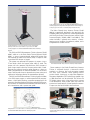
Fig. 1
Example of a simple telephone network
A Pentium-type host computer is required for connection to the training module through a high-speed
data link (Ethernet link with TCP/IP protocol). The host
computer is used to configure the training module as a
digital CO or a digital PABX, using the included LabVolt Telephony Training System (LVTTS) software. This
Windows-based software has an intuitive user interface
that allows the following training activities:
28
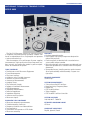
8086-1 Basic Telephony Training System
(Shown with computer, not included.)
• Display the functional block diagram of the telephony
equipment (CO, digital PABX, etc.) implemented in the
Reconfigurable Training Module (see Figure 2).
• Change various system settings and options, such as the
telephone ringing cadence, companding type, subscriber
names and phone numbers, etc. (see Figure 3).
• Perform step-by-step observation of call-routing
sequences.
• Observe real signals throughout the system in both the
time and frequency domains using modern virtual instruments (see Figure 4).
• Insert faults in the system (password-protected feature)
for troubleshooting purposes.
The Telephony Training System is also an essential tool
to introduce students to the Integrated Services Digital
Network (ISDN). This is due to the fact that the digital
PABX which can be set up with the TTS uses digital telephone sets of the ISDN type and ISDN basic rate interfaces.
Furthermore, the digital trunk that can be set up to interconnect two COs implemented with the TTS uses ISDN
primary rate interfaces. Thus, while performing the courseware material for the digital PABX and the digital trunk,
students are introduced to the following two major aspects
of ISDN: the physical layer (layer 1) and the network layer
(layer 3). A powerful data-logging instrument in the LVTTS
software allows recording of all ISDN layer-3 messages
exchanged between ISDN entities (call processor in a CO or
PABX, digital telephone sets) during telephone calls. This
instrument enables students to perform a thorough investigation of the ISDN signaling protocol.
TELECOMMUNICATIONS
TOPIC COVERAGE
VOLUME 1, ANALOG ACCESS TO THE
TELEPHONE NETWORK
• The Telephone Set
• Telephone Ringing
• The Telephone Switch-Hook and Handset
• Tone Dialing
• Pulse Dialing
• The Line Interface
• Battery Feed Power Supply
• Hybrid Function
• Pulse Code Modulation
• Companding
• Time-Division Multiplexing
• Signaling and Supervision
VOLUME 2, CENTRAL OFFICE OPERATION
• Signaling Circuit
• Hook Status Signal Demultiplexing and Storage
• Dialed Number Detection
• Call Progress Tone and Ringing Signal Generation
• Digital Switching
• Time-Division Switching
• Space-Division Switching
• Two-Dimensional Switching
• System Control
• Call Processor Functions
• Intra-Exchange Call-Routing Sequence
• Central Office Configuration
• Supplementary Services
• Caller Identification
VOLUME 3, PRIVATE AUTOMATIC BRANCH
EXCHANGE (PABX)
• Architecture and Basic Operation
• Architecture of a Digital PABX
• Telephone Set Portability
• Internal Call Establishment Procedure
• Call Progress Indication
• Call Functions
• Call Holding and Multiple Call Control
• Call Transfer
• Conference Calling
• Intercom (Broadcast Function)
Fig. 2
Part of the functional block diagram of a CO as
observed in the LVTTS software
Fig. 3
System settings and options are configured through
windows in the LVTTS software.
VOLUME 4, PABX ANALOG TRUNK
• Familiarization with the Lab-Volt PABX Analog Trunk
• Analog Trunk Interface
• Call Routing Over a PABX Analog Trunk
• External Call Answering and Termination
• External Call Establishment (Overlap Sending Method)
• External Call Establishment (En-Bloc Sending Method)
• PABX Configuration
• Configuring the Lab-Volt PABX
VOLUME 5, DIGITAL TRUNK
• Multiplexing Format and Basic Operation
• Familiarization with the Lab-Volt Digital Trunk
• Digital Trunk Interface
• Alarm Indication
• Inter-Exchange Signaling
• Outgoing Inter-Exchange Call Routing Sequence
• Incoming Inter-Exchange Call Routing Sequence
• Multiple Inter-Exchange Call Control
Fig. 4
Real signals can be observed in both the time
and frequency domains using virtual instruments
included with the LVTTS software.
29
FEATURES
• The Reconfigurable Training Module can be configured as a
digital CO of the public switched telephone network (PSTN)
or a digital PABX.
• A DSP executes downloaded programs and reads or produces external signals that are used to operate real-world
devices (telephone sets, phone lines, etc.)
• Flexibility of software simulation plus realism of hardware
operation
• Real-time, real-signal operation
• Provides real-life operation that is much more motivating
than simple simulation
• Flexibility is enhanced by eliminating front panel controls
and diagrams. These are all moved to a personal computer’s
screen.
• System can be configured for different international
standards (e.g., telephone ringing cadence can be adjusted
to each country’s requirements).
• Reconfigurability prevents obsolescence of the system. As
new standards and systems emerge, they need only be
programmed and then downloaded into the training module.
• Simple interface cards designed to be installed into the
training module allow connection of real analog and digital
telephone sets and trunk lines.
• Analog telephone sets come with speakerphone, LCD
display, tone/pulse switch, caller identification function,
ringer on/off switch, multiple phone number memory, and
one-touch call buttons.
• Digital telephone sets come with basic ISDN functions,
programmable call appearance/function buttons, tiltable LCD
display, and semi-duplex speakerphone.
• When configured as a digital PABX or when a digital trunk is
set up, system allows study of the physical and network
layers (layers 1 and 3 respectively) of ISDN.
SYSTEM VOLTAGES
120, 220, 240 Vac - 50/60 Hz
The Dual Analog Line Interface, Model 9475, is a simple
interface card (module) to be installed in the reconfigurable
Training Module, Model 9431. Two conventional telephone
sets can be connected to this module.
Actions performed by the central office (CO) call processor
during a telephone call can be recorded and played back,
thereby making the observation of call-routing sequences
fast and easy.
ESTIMATED PROGRAM HOURS
100 Hours
MINIMUM COMPUTER REQUIREMENTS
A Pentium personal computer, running under one of the following Microsoft operating systems: Windows 98, Windows
NT, Windows 2000, Windows XP, or Windows Me is required
to run the Lab-Volt Telephony Training System software. A
PCI slot must be available in the computer for installation of an
Ethernet adapter (network card) if none is available.
To observe real signals, virtual instrument probes are connected to test points in the functional block diagram displayed in the LVTTS software window.
30
TELECOMMUNICATIONS
MICROWAVE TECHNOLOGY TRAINING SYSTEM
MODEL 8090
The Lab-Volt Microwave Technology Training System is
a completely integrated package providing students with
hands-on experimentation in the principles and practices
of microwave technology.
With the exception of an oscilloscope, all power supplies,
instrumentation, high-quality microwave components, student manuals, and accessories needed to perform experiments are included in the system.
TOPIC COVERAGE
• Familiarization with Microwave Equipment
• Power Measurements
• The Gunn Oscillator
• Calibration of the Variable Attenuator
• Detection of Microwave Signals
• Attenuation Measurements
• Standing Waves
• The Directional Coupler
• Reflection Coefficient Measurement
• SWR Measurements
• Impedance Measurements
• Reactive Impedances
• Impedance Matching
• Antennas and Propagation
• Microwave Optics
Enhanced Topic Coverage
• Microwave frequency measurements
• Variable-freguency oscillators
• Frequency modulation and demodulation
• Data acquisition
• Construction and operation of PIN diodes
• Microwave switching
FEATURES
• Produces repeatable results
• Uses rugged, high-quality components designed for
educational purposes
• Each component is identified with a standard microwave symbol and part number.
• Microwave devices and components are fabricated from
electroless-plated brass to standard X-band waveguide
dimensions.
• Waveguide flanges, joined by precision quick fasteners
allow rapid assembly and disassembly of system configurations.
REQUIRED EQUIPMENT
Oscilloscope
SYSTEM ENHANCEMENTS
• Voltage Controlled RF Oscillator
• Resonant-Cavity Frequency Meter
• Hybrid Tee
• PIN Diode Modulator
• Video Amplifier
• PIN Diode/RF Oscillator Controller
SYSTEM VOLTAGES
120, 220, 240 V - 50/60 Hz
ESTIMATED PROGRAM HOURS
45 Hours
LANGUAGE VARIATIONS
English, Spanish, French
31
ANTENNA TRAINING AND MEASURING SYSTEM
MODEL 8092
The Lab-Volt Antenna Training and Measuring System
(ATMS) not only provides teachers and students with an
innovative tool for hands-on experimentation on antennas in the 1-GHz and 10-GHz bands, but can also be
used by design and research teams.
The ATMS includes sets of antennas, an RF generator,
and a receiving system with a rotating antenna positioner, linked to a data acquisition interface. Also included
with the system is a user-friendly software that operates
under the Microsoft Windows environment.
The system is designed for low-power safe operation,
both in the 1-GHz and 10-GHz bands (specifically at
915 MHz and at 10.5 GHz), allowing measurements
of antenna characteristics (radiation pattern) in these
bands. The data acquisition interface controls the antenna positioner and acquires the received antenna signal.
The system software provides a toolbox for controlling antenna rotation and data acquisition, as well as
for displaying measured antenna characteristics in the
E and H planes. It can combine the E and H plane
characteristics to display tridimensional (3D) radiation
patterns. The software also includes algorithms for estimating beamwidth and antenna gain from measured
characteristics.
TOPIC COVERAGE
• Measurement of Radiation Pattern Parameters
• Measurement of Antenna Gain
• Experiments with Dipoles (1 GHz)
• Impedance Transformation with Baluns
• Directive Gain of Horn Antennas
• Monopole Antennas
• Loop Antenna (1 GHz)
• Circularly Polarized Antennas (10 GHz)
• Yagi Antennas
• Planar Patch Antennas
• Array Antennas
• Experiments with a 10-GHz Slot Antenna
32
• Parallel Fed 10-GHz Planar Antenna Array
• Series Fed 10-GHz Planar Antenna Array
• Multi-Beam Array Antenna (MBAA)
• MBAA Gain and Performance Evaluation
• MBAA Multi-Beam Operation
FEATURES
• Stand-alone system requires no other microwave
equipment.
• System is compatible with the 10.5-GHz Lab-Volt
Microwave Technology Training System (Model
8090).
1-GHz ANTENNAS
• Dipoles (l/2, l, 3l/2)
• Folded Dipole
• Folded Dipole with Balun
• Monopole l/4
• Drooping Monopole
• Loops
• Yagi (fixed, adjustable)
10-GHz ANTENNAS
• Open Waveguide
• Slotted Waveguide
• Horns
• Array Antenna
• Serial Patch
• Parallel Patch
• Helicals
Optional Equipment
• Antenna Positioner
• Directional Coupler, 1 GHz
• Multi-Beam Array Antenna
• Parabolic Reflector
• Log-Periodic Antenna
• Two-Element Phasing Kit
TELECOMMUNICATIONS
SYSTEM VOLTAGES
120, 220, 240 V - 50/60 Hz
ESTIMATED PROGRAM HOURS
50 Hours
LANGUAGE VARIATIONS
English, Spanish, French
The E- and H-plane patterns can also be combined to
produce a full 3D radiation pattern.
The E-plane and the H-plane are acquired separately.
These patterns can be plotted on either polar or Cartesian
graphs (shown above: polar coordinate graph; shown on
right: Cartesian coordinate graph).
The acquired E- and H-plane patterns can be displayed
simultaneously on a tridimensional (3D) display (shown
above: dipole antenna pattern; shown right: helical antenna pattern).
33
RADAR TRAINING SYSTEM
MODEL 8096
The Lab-Volt Radar Training System consists of six
subsystems (Models 8096-1 to 8096-6). Subsystems 8096-1
to 8096-3 provide students with hands-on training in the
principles and operation of analog and digital radar, as well
as radar tracking systems. Subsystem 8096-4 trains students in the principles and scenarios of Electronic Warfare
(EW). Subsystem 8096-5 is a sophisticated, pulse-mode,
radar cross-section (RCS) measurement training system,
with inverse synthetic aperture radar (ISAR) imagery
capability, that is designed for operation at close range.
Subsystem 8096-6 provides students with training in the
principles of electronically steered antennas. The Radar
Training System uses patented technology to detect and
track passive targets at very short range in the presence
of noise, clutter, and interference. The very low transmitter power allows for safe operation in a variety of training
environments.
The Basic Radar Training System, Model 8096-1
(shown above), is a complete set of hardware, courseware, and all necessary accessories, such as targets and
interconnecting cables, that allows the principles of pulse,
CW Doppler, and FM-CW radar systems to be studied. An
oscilloscope is required for target echo visualization on an
A-scope display as well as time-domain observation of signals at outputs and test points.
The Radar Processor/Display, Model 8096-2, is used in
conjunction with the Basic Radar Training System, Model
8096-1, to form a complete, modern pulse radar system.
The Radar Processor/Display adds the following elements:
radar echo signal processing functions, PPI display functions, on-screen block diagrams of the complete radar and
radar processor/display subsystem, and computer-based
instructions. The Radar Processor/Display consists of a
reconfigurable training module (RTM), a power supply
34
The Radar Processor/Display (Model 8096-2) provides
all the equipment required to convert the Basic Radar
Training System (Model 8096-1) into a modern pulse
radar training system.
for the RTM, three interface modules, a set of accessories
including the Lab-Volt Radar Training System (LVRTS)
software, two comprehensive student manuals, and a
user guide. A Pentium-type host computer (to be purchased separately) is required with the RTM.
The Radar Tracking Training System, Model 8096-3,
adds on to the pulse radar implemented with the Basic
Radar Training System and the Radar Processor/Display
(Models 8096-1 and 8096-2, respectively), to form a continuous tracking radar. This radar can track a passive
target that moves in the classroom laboratory. The Radar
Tracking Training System includes an interface module to
be installed in the RTM of the Radar Processor/Display, a
special dual-feed parabolic antenna, a joystick-type hand
controller, a set of accessories, and a student manual.
TELECOMMUNICATIONS
The active jamming pod and its remote controller are the
cornerstone of the RAT Training System.
The Radar Tracking Training System (Model 8096-3) contains
all equipment required to set up a continuous tracking radar.
The Radar Active Target (RAT) Training System,
Model 8096-4, is used in conjunction with the three
previous subsystems (Models 8096-1, 8096-2, and 80963) to train students in the principles and scenarios of
Electronic Warfare (EW). This is a truly unique system
that places real-time, safe, and unclassified EW demonstrations into the hands of students. The RAT Training
System consists of an active jamming pod trainer, an
elaborate set of accessories, and a comprehensive student manual.
The jamming pod is a Self-Screening Jammer (SSJ)
target that can perform both direct and modulated noise
jamming, as well as repeater jamming. It includes a
remote controller to select the type of jamming and adjust
the jamming parameters. The jamming pod trainer and
the included accessories are designed for use with the
Lab-Volt tracking radar to implement real EW situations.
This provides an effective means of introducing students to a real-time jamming situation that necessitates
a response, that is, the use of an appropriate electronic
counter-countermeasure (ECCM) to prevent losing track
of the target.
The active jamming pod and accessories in the RAT Training
System enable realistic EW demonstrations to take place in a
classroom laboratory.
Stealth accessories in the RAT Training System allow reduction of the jamming pod trainer’s radar cross section.
Antenna replacement is quick and easy thanks to miniature
plug-in connectors in the antenna frame and pedestal’s shaft.
Effect of barrage noise jamming produced by the
jamming pod trainer of the RAT Training System as
observed on the Lab-Volt radar PPI display.
35
In the ISAR imagery mode, the RCS and ISAR Measurement
Training System can produce images that show the shape of
a target (top front view of a 777 Boeing aircraft shown).
The Radar Phased Array Antenna Trainer, Model
8096-6, is specifically designed to be used with the
complete pulse radar system that can be implemented
with the Basic Radar Training System and the Radar
Processor/Display (Models 8096-1 and 8096-2). The
trainer includes a phased array antenna, a beamsteering control module, the necessary cables, and a
comprehensive student manual.
The RCS pattern of an actual aircraft can be obtained by
placing a reflective scale model on top of the low-RCS
rotating support of the RCS and ISAR Measurement Training
System.
The RCS and ISAR Measurement Training System, Model
8096-5, adds on to the Basic Radar Training System, Model
8096-1, to form a computer-based, pulse-mode system that
can measure the radar cross section (RCS) of targets as well
as produce ISAR images of targets.
The system can generate RCS patterns of targets of up to
75-cm length when the longest pulse width is used. The
system can also generate high-resolution ISAR images of
much larger targets when the shortest pulse width is used.
Because the system is based on pulse operation, it does not
need to be operated in an anechoic chamber or in an outdoor
range. Background clutter is rejected using time-gating and
subtraction techniques during the measurement process.
The RCS and ISAR Measurement Training System includes
a low-RCS target support to achieve precise RCS measurements; a high-quality desktop computer equipped with the
necessary interface cards and RCS measurement/ISAR imagery software; an RCS/ISAR measurement interface module; a
set of accessories, and a system user guide.
RCS pattern of a scale model of a Boeing 777 aircraft obtained using
the RCS and ISAR Measurement Training System.
36
The Radar Phased Array Antenna Trainer, Model 8096-6
Beam steering in the Radar Phased-Array Antenna
Trainer is achieved through a microwave switch
coupled to a Rotman lens and microstrip tapered
slot array (TSA) antennas. Beam steering control
can be manual, continuous or radar Pulse Repetition
Frequency dependent (PRF locked). Scan speeds of up
to 1080 scans/min can be achieved. This allows the
PPI display (sector scan) of the radar training system
to be refreshed at much higher rates than with the
conventional mechanically rotated parabolic antenna.
Targets can thus be followed in near real time.
The Radar Phased-Array Antenna Trainer is fully compatible with the
Lab-Volt radar training system. It allows sector-scan operation with no
antenna motion.
TELECOMMUNICATIONS
TOPIC COVERAGE
Volume 5, Radar in an Active
Target Environment
Volume 1, Principles of Radar Systems
• Familiarization with the Radar Jamming Pod
• Spot Noise Jamming and Burn-Through Range
• Frequency Agility and Barrage Noise Jamming
• Video Integration and Track-On Jamming (TOJ)
• Antennas in EW: Sidelobe Jamming and Space
Discrimination
• Deception Jamming using the Radar Jamming Pod
• Range Gate Pull-Off (RGPO)
• Stealth Technology: The Quest for Reduced RCS
• Deceptive Jamming Using Amplitude-Modulated
Signals
• Cross-Polarization Jamming
• Multiple-Source Jamming Techniques
• Chaff Clouds
• Chaff Clouds Used as Decoys
• Basic Principles of Pulsed Radar
• The Range-Delay Relationship
• Radar Antennas
• The Radar Equation
• Radar Transmitter and Receiver
• Antenna Driving System
• CW Radar and the Doppler Effect
• Frequency-Modulated CW Radar
• Troubleshooting a CW Radar
• Troubleshooting an FM-CW Radar
• Troubleshooting a Pulsed Radar: The RF Section
Volume 2, Analog MTI Processing
• Familiarization with the Analog Pulse Radar
• The PPI Display
• Phase-Processing MTI
• Vector-Processing MTI
• Staggered PRF
• MTI Limitations
• Threshold Detection
• Pulse Integration
• Sensitivity Time Control
• Instantaneous Automatic Gain Control
• The Log-FTC Receiver
• Constant-False Alarm Rate
• Troubleshooting the MTI Processor
• Troubleshooting the Display Processor
• Troubleshooting the MTI Radar System
Volume 3, Digital MTD Processing
• Familiarization with the Digital Pulse Radar
• The PPI Display
• Cell Mapping
• Fast Fourier Transform (FFT) Processing
• Constant False-Alarm Rate (CFAR)
• Correlation and Interpolation (C&I) Processing
• Surveillance (Track-While-Scan) Processing
• Troubleshooting the Digital MTD/PPI Processor
Volume 4, Tracking Radar
• Manual Tracking of a Target
• Automatic Range Tracking
• Angle Tracking Techniques
• Automatic Angle Tracking
• Range and Angle Tracking Performance (RadarDependent Errors)
• Range and Angle Tracking Performance (Target-Caused
Errors)
• Troubleshooting an Analog Target Tracker
Volume 6, The Radar Phased-Array Antenna
• Basic Principles, Operation and Adjustments
• The True Time-Delay Rotman Lens
• The Switching Matrix
• Beamwidth Measurement
• Radiation Pattern Measurement
• Angular Separation Measurement
• Phased Array Antenna Gain Measurement
• Maximum Scan Angle Measurement
• Target Bearing Estimation
• Target Speed Estimation
FEATURES
• Active, real-time radar system operating in a classroom
laboratory
• Low power, safe operation
• Latest technology, e.g., microstrips, surface-mounted
devices (SMDs), digital signal processing (DSP) and fast
Fourier transform (FFT)
• Pulsed, continuous wave Doppler, and frequency-modulated continuous wave (FM-CW) modes of operation
• A-scope and plan position indicator (PPI raster and vector scan) display outputs
• Sensitive moving target detection (MTD) processor that
differentiates between fixed and slowly moving targets
at short range
• Surveillance processor for track-while-scan (TWS) operation
• Split range-gate tracker
• Leading-edge range tracker
• Lobe-switching angle tracker
• O-scope display output
37
REQUIRED EQUIPMENT
Oscilloscope (2)
Digital Multimeter
Function Generator
Frequency Counter
True-RMS Voltmeter/Power Meter
SYSTEM VOLTAGES
120, 220, 240 V - 50/60 Hz
ESTIMATED PROGRAM HOURS
• Volume 1
50 Hours
• Volume 2
60 Hours
• Volume 3
25 Hours
• Volume 4
20 Hours
• Volume 5
40 Hours
• Volume 6
20 Hours
LANGUAGE VARIATIONS
English, Spanish, French
38
TELECOMMUNICATIONS
Courseware Ordering Information
CBL = Computer-Based Learning
N/A = Not Available at time of printing
120 V - 60 Hz
220 V - 50 Hz
240 V - 50 Hz
MODEL DESCRIPTION
ENGLISH
FRENCH
SPANISH
ENGLISH
FRENCH
SPANISH
ENGLISH
90877-01
N/A
N/A
N/A
N/A
N/A
N/A
N/A
N/A
N/A
N/A
N/A
N/A
N/A
N/A
N/A
N/A
N/A
90877-00
91578-00
90877-10
91578-10
90877-40
90877-50
90877-60
90877-70
91018-W0
90877-01
N/A
N/A
N/A
N/A
N/A
N/A
N/A
N/A
N/A
N/A
N/A
N/A
N/A
N/A
N/A
N/A
N/A
90877-00
91578-00
90877-10
91578-10
90877-40
90877-50
90877-60
90877-70
91018-W0
N/A
N/A
N/A
N/A
N/A
N/A
N/A
N/A
N/A
91733-02
N/A
91733-12
N/A
N/A
N/A
N/A
N/A
N/A
91733-00
91581-00
91733-10
91581-10
91733-40
91733-50
91733-60
91733-70
91022-W0
N/A
N/A
N/A
N/A
N/A
N/A
N/A
N/A
N/A
91733-02
N/A
91733-12
N/A
N/A
N/A
N/A
N/A
N/A
91733-00
91581-00
91733-10
91581-10
91733-40
91733-50
91733-60
91733-70
91022-W0
N/A
N/A
N/A
N/A
N/A
N/A
N/A
N/A
N/A
91739-02
N/A
91739-12
N/A
N/A
N/A
N/A
N/A
N/A
91739-00
91582-00
91739-10
91582-10
91739-40
91739-50
91739-60
91739-70
91023-W0
N/A
N/A
N/A
N/A
N/A
N/A
N/A
N/A
N/A
91739-02
N/A
91739-12
N/A
N/A
N/A
N/A
N/A
N/A
91739-00
91582-00
91739-10
91582-10
91739-40
91739-50
91739-60
91739-70
91023-W0
91967-01
N/A
N/A
N/A
N/A
N/A
N/A
N/A
N/A
N/A
N/A
N/A
N/A
N/A
N/A
N/A
N/A
N/A
91967-00
91584-00
91967-10
91584-10
91967-40
91967-50
91967-60
91967-70
91025-W0
91967-01
N/A
N/A
N/A
N/A
N/A
N/A
N/A
N/A
N/A
N/A
N/A
N/A
N/A
N/A
N/A
N/A
N/A
91967-00
91584-00
91967-10
91584-10
91967-40
91967-50
91967-60
91967-70
91025-W0
31946-00
31946-J0
31946-10
31946-L0
91027-W0
31946-01
N/A
N/A
N/A
91027-W1
31946-02
31946-J2
31946-12
31946-L2
91027-W2
31946-00
31946-J0
31946-10
31946-L0
91027-W0
31946-01
N/A
N/A
N/A
91027-W1
31946-02
31946-J2
31946-12
31946-L2
91027-W2
31946-00
31946-J0
31946-10
31946-L0
91027-W0
36970-00
36970-J0
36970-10
36970-L0
91028-W0
N/A
N/A
N/A
N/A
N/A
N/A
N/A
N/A
N/A
N/A
36970-00
36970-J0
36970-10
36970-L0
91028-W0
N/A
N/A
N/A
N/A
N/A
N/A
N/A
N/A
N/A
N/A
36970-00
36970-J0
36970-10
36970-L0
91028-W0
39158-00
39158-J0
39158-I0
39158-L0
39158-W0
N/A
N/A
N/A
N/A
N/A
N/A
N/A
N/A
N/A
N/A
39158-00
39158-J0
39158-I0
39158-L0
39158-W0
N/A
N/A
N/A
N/A
N/A
N/A
N/A
N/A
N/A
N/A
39158-00
39158-J0
39158-I0
39158-L0
39158-W0
91018FACET® ANALOG COMMUNICATIONS
Student Manual
CBL Student Workbook
Instructor Guide
CBL Instructor Guide
Pre-test
Pre-test Answer Key
Post-test
Post-test Answer Key
Software
90877-00
91578-00
90877-10
91578-10
90877-40
90877-50
90877-60
90877-70
91018-W0
91022FACET® DIGITAL COMMUNICATIONS 1
Student Manual
CBL Student Workbook
Instructor Guide
CBL Instructor Guide
Pre-test
Pre-test Answer Key
Post-test
Post-test Answer Key
Software
91733-00
91581-00
91733-10
91581-10
91733-40
91733-50
91733-60
91733-70
91022-W0
91023FACET® DIGITAL COMMUNICATIONS 2
Student Manual
CBL Student Workbook
Instructor Guide
CBL Instructor Guide
Pre-test
Pre-test Answer Key
Post-test
Post-test Answer Key
Software
91739-00
91582-00
91739-10
91582-10
91739-40
91739-50
91739-60
91739-70
91023-W0
91025FACET® FIBER OPTIC COMMUNICATIONS
Student Manual
CBL Student Workbook
Instructor Guide
CBL Instructor Guide
Pre-test
Pre-test Answer Key
Post-test
Post-test Answer Key
Software
91967-00
91584-00
91967-10
91584-10
91967-40
91967-50
91967-60
91967-70
91025-W0
91027FACET® DIGITAL SIGNAL PROCESSOR
Student Manual
CBL Student Workbook
Instructor Guide
CBL Instructor Guide
Software
91028FACET® TRANSMISSION LINES
Student Manual
CBL Student Workbook
Instructor Guide
CBL Instructor Guide
Software
91029 FACET® QPSK/OQPSK/DPSK
Student Manual
CBL Student Workbook
Instructor Guide
CBL Instructor Guide
Software
39
120 V - 60 HZ
220 V - 50 HZ
240 V - 50 HZ
MODEL DESCRIPTION
ENGLISH
FRENCH
SPANISH
ENGLISH
FRENCH
SPANISH
ENGLISH
31498-E0
31559-D0
N/A
N/A
31498-E0
31559-D0
N/A
N/A
31498-E2
31559-D2
31498-E0
31559-D0
36220-E0
36220-E1
31498-E2
31559-D2
N/A
36220-E2
36220-E0
36220-E1
36220-E2
36220-E0
26866-00
26867-00
26866-10
26868-00
32359-E0
36220-E0
26866-01
26867-01
26866-11
26868-01
32359-E1
36220-E1
26866-02
26867-02
26866-12
26868-02
32359-E2
36220-E2
26866-00
26867-00
26866-10
26868-00
32359-E0
36220-E0
26866-01
26867-01
26866-11
26868-01
32359-E1
36220-E1
26866-02
26867-02
26866-12
26868-02
32359-E2
36220-E2
26866-00
26867-00
26866-10
26868-00
32359-E0
36220-E0
26866-00
26867-00
26868-00
26866-10
26866-01
26867-01
26868-01
26866-11
26866-02
26867-02
26868-02
26866-12
26866-00
26867-00
26868-00
26866-10
26866-01
26867-01
26868-01
26866-11
26866-02
26867-02
26868-02
26866-12
26866-00
26867-00
26868-00
26866-10
27695-00
27696-00
27697-00
27695-10
32359-E0
36220-E0
27695-01
27696-01
27697-01
27695-11
32359-E1
36220-E1
27695-02
27696-02
27697-02
27695-12
32359-E2
36220-E2
27695-00
27696-00
27697-00
27695-10
32359-E0
36220-E0
27695-01
27696-01
27697-01
27695-11
32359-E1
36220-E1
27695-02
27696-02
27697-02
27695-12
32359-E2
36220-E2
27695-00
27696-00
27697-00
27695-10
32359-E0
36220-E0
27695-00
27696-00
27697-00
27695-10
27695-01
27696-01
27697-01
27695-11
27695-02
27696-02
27697-02
27695-12
27695-00
27696-00
27697-00
27695-10
27695-01
27696-01
27697-01
27695-11
27695-02
27696-02
27697-02
27695-12
27695-00
27696-00
27697-00
27695-10
32964-00
33646-00
33647-00
35611-00
35815-00
32964-01
33646-01
33647-01
35611-01
35815-01
32964-02
33646-02
33647-02
35611-02
35815-02
32964-00
33646-00
33647-00
35611-00
35815-00
32964-01
33646-01
33647-01
35611-01
35815-01
32964-02
33646-02
33647-02
35611-02
35815-02
32964-00
33646-00
33647-00
35611-00
35815-00
32964-10
33646-10
33647-10
35611-10
35815-00
32964-11
33646-11
33647-11
35611-11
35815-11
32964-12
33646-12
33647-12
35611-12
35815-12
32964-10
33646-10
33647-10
35611-10
35815-00
32964-11
33646-11
33647-11
35611-11
35815-11
32964-12
33646-12
33647-12
35611-12
35815-12
32964-10
33646-10
33647-10
35611-10
35815-00
32964-E0
32964-E1
32964-E2
32964-E0
32964-E1
32964-E2
32964-E0
9407 LVDAM®-COM
LVDAM®-COM User Guide
Virtual Test Equipment Interface
Instruction Manual
Computer-Based Instrument User Guide
9480 LVSIM®-ACOM
Instrumentation
AM/DSB/SSB
Instructor Guide
FM/PM
LVSIM® User Guide
Computer-Based Instrument User Guide
8080 ANALOG COMMUNICATIONS
Student Manuals:
Instrumentation
AM/DSB/SSB
FM/PM
Instructor Guide
9481 LVSIM®-DCOM
Student Manuals:
Pulse Modulation and Sampling
Digital Modulation
Modems and Data Transmission
Instructor Guide
LVSIM User Guide
Computer-Based Instrument User Guide
8085 DIGITAL COMMUNICATIONS
Student Manuals:
Pulse Modulation and Sampling
Baseband Digital Modulation
Modems and Data Transmission
Instructor Guide
8086 TELEPHONY
Student Manuals:
Analog Access to Telephone Network
Central Office Operation
Private Automatic Branch Exchange
PABX Analog Trunk
Digital Trunk
Instructor Guide:
Analog Access to Telephone Network
Central Office Operation
Private Automatic Branch Exchange
PABX Analog Trunk
Digital Trunk
User Guide:
Telephony Training System
8087 COMMUNICATIONS TECHNOLOGIES TRAINING SYSTEM
LVCT Software
Student Manuals:
PAM/PWM/PPM Applications
PCM/DPCM/Delta Modulation
Applications
ASK/FSK/BPSK Applications
Quadrature Phase Shift Keying
Quadrature Amplitude Modulation
Asymmetric Digital Subscriber Line
Code Division Multiple Access
Instructor Guide:
PAM/PWM/PPM Applications
PCM/DPCM/Delta Modulation
Applications
ASK/FSK/BPSK Applications
Quadrature Phase Shift Keying
40
9432-00
9432-00
9432-00
9432-00
9432-00
9432-00
9432-00
39862-00
39863-00
39862-01
39863-01
39862-02
39863-02
39862-00
39863-00
39862-01
39863-01
39862-02
39863-02
39862-00
39863-00
39864-00
39865-00
39866-00
39867-00
N/A
39864-01
39865-01
39866-01
39867-01
N/A
39864-02
39865-02
39866-02
39867-02
N/A
39864-00
39865-00
39866-00
39867-00
N/A
39864-01
39865-01
39866-01
39867-01
N/A
39864-02
39865-02
39866-02
39867-02
N/A
39864-00
39865-00
39866-00
39867-00
N/A
39862-10
39863-10
39862-11
39863-11
39862-12
39863-12
39862-10
39863-10
39862-11
39863-11
39862-12
39863-12
39862-10
39863-10
39864-10
39865-10
39864-11
39865-11
39864-12
39865-12
39864-10
39865-10
39864-11
39865-11
39864-12
39865-12
39864-10
39865-10
TELECOMMUNICATIONS
120 V - 60 HZ
220 V - 50 HZ
240 V - 50 HZ
MODEL DESCRIPTION
ENGLISH
FRENCH
SPANISH
ENGLISH
FRENCH
SPANISH
ENGLISH
39866-11
39867-11
N/A
39862-E1
39866-P1
39867-P1
39866-12
39867-12
N/A
39862-E2
39866-P2
39867-P2
39866-10
39867-10
N/A
39862-E0
39866-P0
39867-P0
39866-11
39867-11
N/A
39862-E1
39866-P1
39867-P1
39866-12
39867-12
N/A
39862-E2
39866-P2
39867-P2
39866-10
39867-10
N/A
39862-E0
39866-P0
39867-P0
28113-00
39974
28113-01
N/A
28113-02
N/A
28113-00
39974
28113-01
N/A
28113-02
N/A
28113-00
39974
39975
N/A
N/A
39975
N/A
N/A
39975
28500-00
N/A
N/A
28500-00
N/A
N/A
28500-00
28113-10
39974-10
28113-11
N/A
28113-12
N/A
28113-10
39974-10
28113-11
N/A
28113-12
N/A
28113-10
39974-10
39975-10
N/A
N/A
39975-10
N/A
N/A
39975-10
30857-00
30857-10
30857-E0
30857-01
30857-11
30857-E1
30857-02
30857-12
30857-E2
30857-00
30857-10
30857-E0
30857-01
30857-11
30857-E1
30857-02
30857-12
30857-E2
30857-00
30857-10
30857-E0
38542-00
38543-00
38544-00
38545-00
38546-00
38547-00
38542-01
38543-01
38544-01
38545-01
38546-01
38547-01
38542-02
38543-02
38544-02
38545-02
38546-02
38547-02
38542-00
38543-00
38544-00
38545-00
38546-00
38547-00
38542-01
38543-01
38544-01
38545-01
38546-01
38547-01
38542-02
38543-02
38544-02
38545-02
38546-02
38547-02
38542-00
38543-00
38544-00
38545-00
38546-00
38547-00
38542-10
38542-11
38542-12
38542-10
38542-11
38542-12
38542-10
38543-E0
39102-E0
38543-E1
39102-E1
38543-E2
39102-E2
38543-E0
39102-E0
38543-E1
39102-E1
38543-E2
39102-E2
38543-E0
39102-E0
8087 COMMUNICATIONS TECHNOLOGIES TRAINING SYSTEM
Quadrature Amplitude Modulation
Asymmetric Digital Subscriber Line
Code Division Multiple Access
CTTS User Guide
QAM Quick Start Guide
ADSL Quick Start Guide
39866-10
39867-10
N/A
39862-E0
39866-P0
39867-P0
8090 MICROWAVE TECHNOLOGY TRAINING SYSTEM
Student Manual:
Introduction to Microwave Technology
Microwave Variable-Frequency
Measurements and Applications
Microwave Tees, PIN Diodes and
Applications
Student Manual (Optional):
Microwave Transmission Demonstration
Instructor Guide:
Microwave Technology
Microwave Variable-Frequency
Measurements and Applications
Microwave Tees, PIN Diodes and
Applications
8092 ANTENNA TRAINING AND MEASURING SYSTEM
Student Manual
Instructor Guide
User Guide
8095 RADAR TRAINING SYSTEM
Student Manuals:
Principles of Radar Systems
Analog MTI Processing
Digital MTD Processing
Tracking Radar
Radar in an Active Target Environment
The Phased Array Antenna
Instructor Guide:
Radar Training Systems
User Guide:
Radar Processor/Display
RCS/ISAR Measurement Training
System
41
NOTES
42
TELECOMMUNICATIONS
Other Product Literature Available from Lab-Volt:
Descriptions and
demonstrations
of Lab-Volt training systems and
software; includes
FACET®, EMS
and other awardwinning training
systems.
Electric Power/Controls
Product Guide
Fifty-one page catalog of
Lab-Volt’s vast
offering of training
modules in Electromechanical systems,
PLCs, Power Electronics,
and corresponding CBT
and simulation software
programs.
Twelve-page color brochure showcasing LabVolt’s comprehensive
industrial training systems, including industrial pumps, mechanical
systems, industrial wiring, rigging, and more.
Twelve-page color brochure describes this
multimedia and hands-on
curriculum for engineering
and manufacturing; presents competencies students achieve and related
career opportunities.
Tech-Design® Foundations in
Information Technology (FIT)
Sixteen-page color brochure features this modular, competency-based
curriculum for information
technology (IT), which
provides skills development and career exploration in all IT Career
Cluster Concentrations.
Tech-Design® Technology
Education Catalog
Seventy-four-page
catalog with detailed
descriptions of 43 multimedia and hands-on
modules and course
objectives, including
skills-at-a-glance charts
showing competencies
associated with each
module.
4 Easy Ways to Order Additional Product Literature:
• Send e-mail to:
[email protected] (USA)
[email protected] (Canada)
• Call 1-800-LAB-VOLT (USA AND CANADA)
or 1-732-938-2000 (outside of the USA and Canada)
• Visit our website at www.labvolt.com
• Circle the requested items above and fax it:
1-732-774-8573
Forty-four page color
catalog describes the
courses and equipment that make up a
typical wind power
training program and
their corresponding
CBT and simulation
software programs.
Seventy-eight page catalog of Lab-Volt training
programs in Automation
and Robotics, Fluid
Power, Instrumentation
and Process Control,
and Refrigeration, Air
Conditioning and Heating.
TechWorld®: Manufacturing
Brochure
Wind Power Technology Training
Systems Product Guide
Manufacturing/Mechatronics
Product Guide
Graymark Information
Technology Brochure
State-of-the-art training systems for military
applications in telecommunications, radar,
electronic warfare,
electronics, fluid power,
and electric power
technologies. Twelvepage color brochure.
Fifty-two page catalog
of Lab-Volt training
systems in Fundamental
Electronics; Analog,
Digital and Fiber Optic
Communications;
Semiconductors,
Transistors, Thyristors,
FET and Amplifiers.
Industrial Maintenance Brochure
Eight-page brochure of
Graymark’s quality IT
training products, including PC familiarization,
troubleshooting and
repair; cable installation;
monitor and printer repair;
GPS technology; and network technology programs.
Military Training Systems
Brochure
Computer-Based Electronics
Training System (FACET®) Product
Guide
Lab-Volt Product
Catalog on CD-ROM
Tech-World®: Manufacturing
Demo CD
Highly graphical CD
demonstrates this
pre-engineering and
manufacturing curriculum that provides realistic, hands-on training
with industry-standard equipment and
advanced software.
Please complete the following:
Name _______________________________________________________
Institution ___________________________________________________
Address _____________________________________________________
Address _____________________________________________________
City ________________________________ State __________________
Country _____________________________ Postal Code ____________
43