1
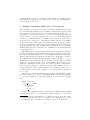
in Fig. 1. It represents the right half of the traditional rhomb representation for
check points in an FSM flowchart—where the right half represents the exit for
yes (when the checked condition evaluates to true) and the left half the exit
for no (when the checked condition evaluates to false). Is there a simple definition for the semantics of the await construct within the context of synchronous
parallel basic ASMs? Otherwise stated, can a definition of the semantics of the
await Cond do M machine, namely to wait until Cond becomes true and then
to proceed with executing M , be smoothly incorporated into the usual semantical definition of ASMs based on constructing update sets?
Such a definition would avoid the need for control states in the high-level
definition of await (without hindering its implementation by control states).
Above all it would preserve a main advantage of the update set construction in
defining what is an ASM step, namely to elegantly capture what is intended to
be considered as a basic machine step. This is important where one has to work
with different degrees of granularity of what constitutes a basic machine step,
usually called ‘atomic’ step to differentiate it from the typical sequence of actions
in a standard program with “;” (sequential execution). For example basic ASMs,
which consist only of rules if Cond then Updates, have been equipped in [7] with
a notation for operators to sequentialize or call submachines. It is defined within
the ASM semantics framework in such a way that the computation performed
by M seq N appears to the outside world as one atomic step, producing the
overall effect of first executing an atomic M -step and in the thus produced state
an atomic N -step; analogously for submachine execution. Machines with these
constructs are called turbo ASMs because they offer two levels of analysis, the
macro step level and the view of a macro step as a sequence of micro steps (which
may contain again some macro steps, etc.).
We provide in this paper a similar application of the ASM semantics framework to define the meaning of await for concurrent ASMs, in the context of the
synchronous parallelism of single-agent ASMs.
1.2
Atomicity in Control State ASMs and
+
CAL
When discussing this issue with Margus Veanes from Microsoft Research at the
ABZ2008 conference in London, our attention was drawn to the recently defined
language + CAL for describing concurrent algorithms. It is proposed in [21] as “an
algorithm language that is designed to replace pseudo-code” (op.cit., abstract),
the idea being that describing algorithms in the + CAL language provides two
advantages over traditional pseudo-code whose “obvious problems . . . are that it
is imprecise and . . . cannot be executed” (op.cit. p.2): a) “a user can understand
the precise meaning of an algorithm by reading its TLA+ translation”, and b)
“an algorithm written in + CAL . . . can be executed—either exhaustively by
model checking or with non-deterministic choices made randomly”(ibid.), using
the TLC model checker.
These two features advocated for + CAL are not new. ASMs have been used
successfully since the beginning of the 1990’ies as an accurate model for pseudocode, explicitly proposed in this function in [2,3]. A user can understand the
3