1
105U-G Wireless Gateway
User Manual
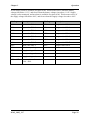
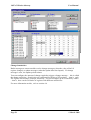
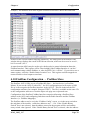
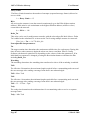
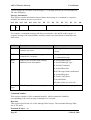
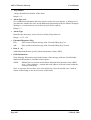
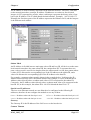
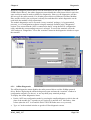
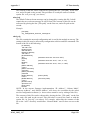
trigger will occur for register 34. Sensitivity values are in decimal and can vary between 1
and 65535 (16-bit).
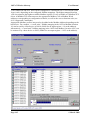
Up to 50 blocks of sensitivities can be configured. If a register is included in more than one
block, then the first sensitivity value configured will be accepted and later values ignored.
If Scaling is configured (refer next section), then the number of blocks is reduced to 25.
Registers which are not included in any block use the “default” sensitivity which is also userconfigurable. In the above example, the default sensitivity is 1 and is the sensitivity for all
I/O registers not included in the three blocks.
Important Note. Sensitivity values need to be selected carefully for analogue or counting
registers as small values can result in a large number of change messages, which can overload
the radio channel. A sensitivity value of 1 in 65535 is a change of 0.0015%. If the host
device writes an analogue value to a 105G every 100msec, it will change by at least 1 bit
each time. A small sensitivity value will cause a change message to be sent every 100msec.
If there are many analogue values in the same situation, then there would be many change
messages every 100msec. Sensitivity values for analogue I/O should be set to be greater than
the normal process noise of the signal. For example, if a flow signal has a normal process
oscillation of 2.5%, then the sensitivity should be set to 3% (or a value of 2000) to avoid
change transmissions from the process oscillations.
4.6.2 I/O Value Scaling
Firmware version 1.76 and later:
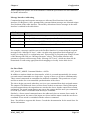
The values in I/O registers can be scaled as the values are transferred to the data bus, or from
the data bus.
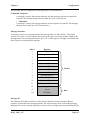
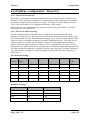
The I/O values in the 105G database registers are stored as 16-bit values (between 0 and
FFFF hexidecimal or 0 and 65,535 decimal). Analog inputs at a 105U I/O module are scaled
hex 4000 (dec 16,384) for 4mA and hex C000 (dec 49152) for 20mA. A 12 mA signal is
half-way in this range at hex 8000 (dec 32,768).
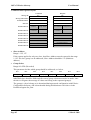
The reason for adding additional scaling between the 105G database (radio side) and the data
bus is to cater for external host devices which do not handle normal 16-bit values. Two
examples are:
"
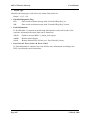
Honeywell Modbus gateways which only handle 12-bits values (0-4,095 decimal), and
"
Sensor / analyser devices with “signed 16-bit” values. A signed 16-bit value is a 15-bit
value with an additional bit to signify plus (0) or minus (1).
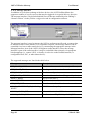
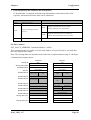
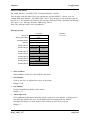
Scaling of I/O registers can be configured in blocks. Different blocks can have different
scaling.
Note that scaling only affects values transferred in or out of the data bus port. It has no effect
on the radio side.
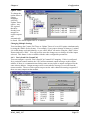
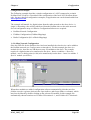
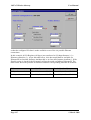
Scaling is configured in the “Sensitivities” section of the configuration software. If you select
a new sensitivity/scaling block, you can select/deselect sensitivity or scaling or both. There
is no relationship between sensitivity and scaling - we use the same configuration area as it
is convenient because both features use blocks of I/O registers.
Page 61
© March 2006