1
Dimmer Power Wiring and Fusing
WIRING AND INSTALLATION OF BATTERIES, DIMMERS, AND LOADS MUST BE IN
ACCORDANCE WITH APPLICABLE LOCAL AND NATIONAL ELECTRICAL CODES.
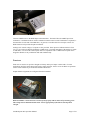
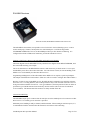
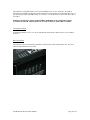
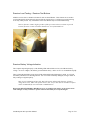
Beside the main power connector on RX4 receiver-dimmers is a pair of clips for a load fuse. Standard
AGC fuses fit easily into these clips. This fuse is in the positive side of the dimmer output circuit.
To effectively protect the load, wiring, and electronics, and to reduce potential hazards, one of the
following dimmer fusing techniques MUST be used:
1.
Choose a load fuse that accurately reflects the total load for all four channels. This technique is best
when loads are relatively small, i.e. one MR16 on a single channel.
2.
Use external fuses for each individual output, appropriately sized for each load. Put the fuse in the
positive side of the load circuit, returning directly to the positive side of the supply battery, rather than
the positive output terminals on the dimmer. RX4 dimming is done on the negative side. This option
is recommended for high currents. A small fuse should still be installed on the RX4 board to drive
the indicator LEDs. A positive lead must still come to the receiver to power the logic circuitry.
DO NOT OPERATE LOADS WITHOUT FUSES. YOU MUST FUSE EVERY CIRCUIT.
DO NOT simply install the largest fuse you can find and forget about it. This can result in an unsafe
situation, possibly a fire or burn hazard. It is not recommended to internally fuse any RX4 receiver above
25A.
DO NOT fuse any single RX4 dimmer above 25A. With all 4 dimmers individually fused at 25A, a total
of 100A can flow. At 12V this is 1200W, substantially beyond the maximum rating of the product.
Continuous current exceeding 500W requires the RX4-HO receiver. In any case, be sure to use appropriate
connectors and large wire gauges, and monitor the system closely – particularly the operating temperature –
at all times.
Here are some typical fuse values:
75 watt MR16 halogen lamp: draws 6.25A at 12VDC. Use an 8A fuse.
1/4HP 12VDC motor: typically draws 20A when operated smoothly, but could surge to 40A on a fast
start-up. Use a 25A fast-blow fuse and avoid rapid start-up (ramp up the power level slowly).
Do not use slow-blow fuses. They do not protect semiconductors in a fault condition.
It is difficult to apply typical safety standards to these devices, because of the unusual circumstances of
theatrical prop construction. The “rule of thumb” is that nothing should be allowed to operate at a
dangerous temperature. Appropriately sized wire gauges and connectors must be used, along with suitable
ventilation and external fuses rated for the load being operated.
WIRING AND INSTALLATION OF BATTERIES, DIMMERS, AND LOADS MUST BE IN
ACCORDANCE WITH APPLICABLE LOCAL AND NATIONAL ELECTRICAL CODES.
RC4 devices are operated at the user’s own risk and Soundsculpture accepts no liability, either direct or
consequential, arising from the use of RC4 equipment.
Soundsculpture RC4 Operation Manual
Page 22 of 41