1
Example: Assume that you are inletting the lock assembly. After you remove
the lock for the first time you will note the black transfer marks in the cavity.
Little black will be apparent around the edges of the lock. Black marks will be
located within the cavity showing where wood is to be removed to allow the
working parts of the lock to fit. You will continue to coat the part with transfer
agent, reinsert it into the cavity, continue inletting gradually dropping the lock
into place. As the lock is lowered into position the edge of the lock plate will
come into contact with the stock. At this time you must proceed very slowly.
Wood is actually shaved from the cavity where the edge of the lock plate
meets the stock. When the lock plate is properly inletted, light transfer marks
will be apparent around the edges of the cavity. If these light transfer marks
were to be removed you would create gaps between the edge of the lock plate
and the surface of the stock, a condition that is not desirable.
There are two simple ways to obtain a suitable transfer agent.
One is to coat the part with soot from a smoking candle. The smoke from the
candle flame is played on the part. This technique is very effective when fitting metal to metal. Add a few drops of oil at the wick base if your candle
does not smoke enough. The second way to obtain a transfer agent is to purchase a bottle of “inletting black” from a gunsmith supply house.
KIT ASSEMBLY INSTRUCTIONS:
GREAT PLAINS RIFLE AND PLAINS PISTOL
The first step in assembly is with the barrel group. The barrel is to be partially
finished first so that it can be readily inletted into the stock.
1. Draw Filing the Barrel–Draw filing is used primarily to shave away the
tool marks left on the barrel by the precision milling operation; secondarily
to dress the patent breech to the barrel.
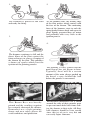
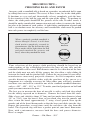
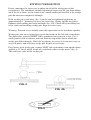
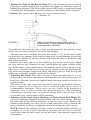
During draw filing, the file is held such that it makes a right angle with the axis
of the barrel (refer to Figure 1). Holding the file with both hands, it is lightly
drawn down the entire length of the barrel, shaving metal away as it travels.
Begin by securing the barrel in a padded vise and start draw filing the entire
barrel, one flat at a time. Start at the muzzle and draw the file towards you,
making sure that the file is held flat against the barrel. Do not allow the file to
rock side to side during the draw, as this will cause rounded edges.
Continue filing, one flat at a time, until each flat of the barrel is completely
free of milling tool marks, and the breech plug is flush with the barrel flats.
Take your time.
When the draw file has been completed, lightly oil the entire barrel to prevent
rust. The final polishing of the barrel will be done after all inletting has been
completed.