1
Volume III.i
THE MISOSYS QUARTERLY-
20
21
22
23
24
25
26
27
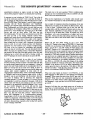
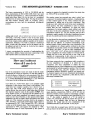
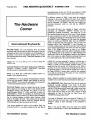
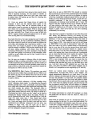
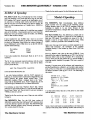
hexadecimal is
properly termed
sexadecimal
Other systems commonly in use are: binary, base 2; octal
(which some say should be termed octonary or octonal), base
8; duodecimal, base 12; hexadecimal (which experts say is
properly termed sexadecimal), base 16; and sexagesimal, base
60, commonly used for calculations in geodetics (degrees,
minutes, seconds,...).
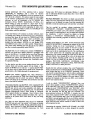
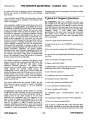
If we confme ourselves to a three-place decimal number, say
473 for no particular reason, and apply the general formula,
we have a result like this:
473 = 4 * 102 + 7 * iOJ- + 3 * iOO
= 4 * 100 + 7 * 10 + 3 * 1
= 473
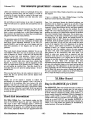
I have used a "*" symbol to denote multiplication. One of the
restrictions on a number system, is that no digit can be of a
value which exceeds the base. Thus, we have the class of
symbols, [0, 1, 2, 3, 4, 5, 6, 7, 8, 91 representing the ten digits
making up the decimal system. Similarly, if we were to
consider an octal system, its eight symbols would be the class
[0, 1, 2,3, 4, 5, 6, 7). Likewise, the binary system would use
a class of two symbols: [0, 1). Hexadecimal, being base 16,
has 16 symbols. We arbitrarily use symbols of the alphabet to
indicate digits of value greater than 9; thus, [0, 1, 2,3,4,5,6,
7, 8, 9, A, B, C, D, E, F) are the class of symbols for
hexadecimal.
Very early computers actually were decimal based. I do
recollect some early work towards a ternary-based computer
using tn-state devices; however, since digital electronics
oriented towards a scheme of gates which had two distinct
"positions", computers soon switched to the binary system.
That's why its important to understand the binary number
system and binary mathematics.
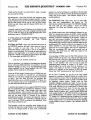
The binary system is simple since there are only two symbols
in its class, (0, 1). If we want to write the number "01011011"
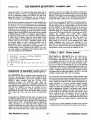
in our general formula construct, it would be:
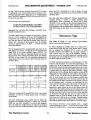
SUMMER 1988
1
2
4
8
16
32
64
128
28
29
210
211
212
2 13
2 14
215
Volume III.i
256
512
1024
2048
4096
8192
16384
32768
This shows our number has a value of:
1*64 + 1*16 + 1*8 + 1*2 + 1*1 = 91D
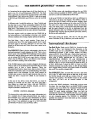
Here I have introduced additional notation. The suffix, "D",
designates the base of the number. Without that suffix, how
would you know I wasn't talking about a hexadecimal
number? You wouldn't. Therefore, whenever we are working
with different number systems, it is important for us to
designate the base of a number by means of a suffix symbol.
We commonly use "D" for decimal, "B" for binary, "H" for
hexadecimal, and "0" for octal. We generally also assume that
a number without a base suffix is expressed as decimal.
Sometimes when writing in certain computer languages, its
acceptable to use a "Q" as a designator for octal to avoid
confusing the letter "oh" and the number "zero" when reading
the numeric value. Other problems exist when the language
assumes hexadecimal as the default and you want to write a
hexadecimal value ending in "B". Is the number "lOB"
hexadecimal or binary? To avoid even that confusion, some
languages use a "V I' to indicate binary; but that really isn't too
common.
Up to this point, you should have recognized that the way in
which we convert a number from one base to decimal, is to
add up the positional values according to our generalized
formula expressing the number. But how about converting a
decimal number to another base? We can do that easily by
repeatedly dividing the decimal number by the desired base
saving the remainder as one of the new digits, then repeating
the process with the new quotient until the quotient becomes
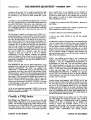
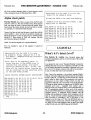
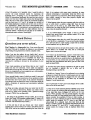
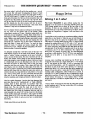
zero. Let's examine this in an example. Convert 247D to
binary. I'll use the notation,
0*27 + 1*26 + 0*25 + 1*24 + 1*23 + 0*22 + 1*2 1 +1*20
dividend + divisor =
quotient ' remainder
When dealing with the binary number system, a power of two
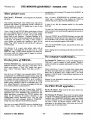
table is convenient to either have, or remember. It's quite easy
to produce by calculating (if you know how to multiply by 2
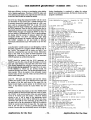
without a computer). Here's a short power of two table:
Roy's Technical Corner
- 28 -
Roy's Technical Corner