1
VOX.book Page 21 Friday, June 1, 2001 10:05 AM
Chapter 1 Overview
4 At some point the VRU may want to transfer the call. It would normally do this
using the VDUID to identify the call. However, in the current case, the callidentifier must be passed as part of the call, and there is not enough available
space in the call to pass the 32-bit VDUID. Therefore, using the VDUID, the
VRU requests [VOX.pseudo_ani] a pseudo-ANI from the VOX Server, which the
VOX Server supplies [VOX.pseudo_ani.response]. This pseudo-ANI is passed
with the call, as though it were an ANI, and serves to identify the call.
Informing eContact Telephony to End or Transfer a
Telephone Call
When the telephone call is transferred from the VRU, the VOX Server must be
notified.
Note: In a system using a network VRU, or in a system without a PBX, no
Telephony Server is involved with the incoming call at the VRU. Since the VOX
Server command VOX.transfer makes use of the Telephony Server, this command is
not available in such a system.
When the VRU no longer needs the eDU (e.g., after a hangup), the VOX.gone
command is issued and the VRU cannot refer to that call’s VDUID again.
Note: Flash-hook transfers by the VRU are not supported.
Other Interactions with eContact Telephony
All other interactions with the VOX Server are optional and determined by the
scripts you write for the VRU.
In a typical scenario, you might want to write a script to collect touch-tone input
from the caller, store it in the call’s eDU, fetch information about the call or the
caller from a database, and transfer the call to a human agent. To access eContact
Telephony services such as data retrieval and transfers, you would incorporate calls
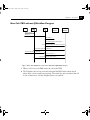
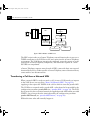
to the eContact Telephony external function library in your VRU script. Figure 4
illustrates a typical example of the VRU communicating with the VOX Server to
access eContact Telephony services.
21