1
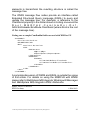
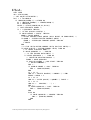
names of the start and end tags must match and denote the
name of the folder (in the example, ComIbmDni), similar to an
XML element type. In contrast, with an XML document the folder
cannot begin with an XML declaration; because there can also
be no document type declaration (and thus no document type)
a folder can never be a valid XML document, although it might be
well-formed.
The name of the folder used in the example (ComIbmDni) is
constructed from the top-level domain name ‘Com’, followed by
the company name ‘Ibm’ and the internal product identifier ‘Dni’.
Any characters following the end tag in the NameValueData
string must be blank. Therefore, each string cannot contain more
than one folder. Additional folders can be specified in separate
NameValueData fields, each preceded by its corresponding
NameValueLength field.
Each folder, between its start and end tags, can contain any
number of groups, properties, or both, in any order.
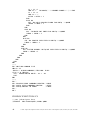
A group, like a folder, is delimited by XML start and end tags, for
example:
<Dnf> ... </Dnf>
Again, the name of a group is determined by the name of its start
and end tags (in the example, Dnf). Like folders, groups can
contain properties or additional nested groups. Therefore, a
group can be regarded and used as a ‘sub-folder’ for properties
that are related by type or function. (In the example, the folder
contains properties used to control the WBI for FN Extension for
SWIFTNet, which has the component code Dnf.) There is no limit
to the nesting level of groups and any number of groups can
share the same name within an MQRFH2.
A property, like a folder or group, is delimited by start and end
tags that define its name, but can contain an optional value
(instead of groups or other properties), for example, where
‘Failed’ is the value:
<Code>Failed</Code>
38
© 2003. Xephon UK telephone 01635 33848, fax 01635 38345. USA telephone (303) 410 9344, fax (303) 438 0290.