1
CHAPTER 5. USING TABLING IN XSB: A TUTORIAL INTRODUCTION
66
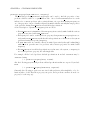
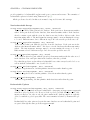
filterPO(?Pred,?Preference structure,+Partial order), then calls Pred1 and for each return of Pred1 fails if there is some answer already in the table for filterPO1/4 such that the first
n arguments of Pred in the tabled answer unify with the first n arguments of Pred in the return
and whose preference structure (last argument) is preferred to that of the return. A case study in
the use of filterPO/4 to construct preference logic grammars can be found in [11].
5.4.1
Local Evaluation
For the shortest path example, simply failing until a minimal answer was derived and then returning
that solution was an effective technique for computing the shortest path. However, this approach
will not always work. As we have seen in Exercise 5.2.8, programs can consist of sets of mutually
recursive predicates and in principle these sets can be arbitrarily large. If these computations are
to use tabled aggregation, the approach taken by filterReduce/4 will not suffice. To see this, we
make the notion of mutual recursion more precise. A tabled computation can be viewed as a directed
graph, in which there is a link from one non-completed tabled predicate P 1 to a non-completed
tabled predicate P 2 if P 2 (or tnot(P 2)) is called by P 1. Of course, this graph constantly changes
through an evaluation as resolution proceeds, subgoals are completed, and so on. Any directed
graph can be uniquely partitioned into a set of maximal strongly connected components or SCCs,
and these sets correspond to sets of mutually recursive predicates. The SCCs then, are reminiscent
of the LRD-stratifiedstratification discussed in Section 5.3.2, except that both positive and negative
links are counted as dependencies. From this view, to optimally compute tabled aggregation, nonoptimal answers from a given subgoal S must be returned within the SCC of S, but not outside
the SCC. This action is performed by Local Scheduling.
It is illustrative to compare local scheduling to Batched Scheduling the default scheduling of
XSB. Batched scheduling returns answers as they are derived, and resembles Prolog’s tuple at a
time scheduling. Local scheduling was shown to be quite efficient in terms of time and space in
[20], and is the fastest scheduling strategy that we know of for computing a sequence of answers.
The same paper also introduced Local Scheduling, which computes all answers for each SCC and
return only the best answer (or answers) out of the SCC, when the SCC is completely evaluated
— exactly the thing for tabled aggregation.
XSB can be configured to use local scheduling via the configuration option --enable-local-scheduling
and remaking XSB. This will not affect the default version of XSB, which will also remain available.