1
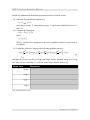
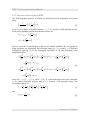
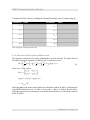
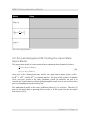
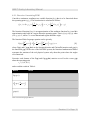
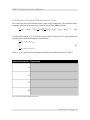
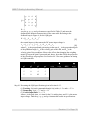
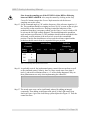
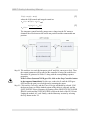
QNET Gantry Laboratory Manual 4.2.1. Exercise: Linearizing EOM Consider a continuous, nonlinear two-variable function f(x,y) that is to be linearized about the operating point (xo,yo). The linearization is calculated as follows ∂ ∂ fl( x, y ) = f( xo, yo ) + ⎛⎜ f( xo, yo ) ⎞⎟ ( x − xo ) + ⎛⎜ f( x , y ) ⎞⎟ ( y − yo ) ⎜ ∂xo ⎟ ⎜ ∂yo o o ⎟ ⎝ ⎠ ⎝ ⎠ . The linearized function fl(x,y) is an approximation of the nonlinear function f(x,y) and this approximation only holds in a region about the operating point. That is, fl(x,y) ≈ f(x,y) when (x-xo,y-yo)∈C, where C is a two-dimensional region about the origin. The linearized Euler-Lagrange equation can be given by d d ⎛ d2 ⎞ Dl( q ) ⎜⎜ 2 q( t ) ⎟⎟ + Cl⎛⎜⎜ q, q( t ) ⎞⎟⎟ ⎛⎜⎜ q( t ) ⎞⎟⎟ + gl( q ) = τ ⎜⎝ d t ⎟⎠ ⎝ dt ⎠ ⎝ dt ⎠ [11] where Dl(q) and Cl(q,q_dot) are the linearized inertia and Christoffel matrices and gl(q) is the linearized g(q). In the case of the ROTPEN system, the linearized mathematical model represents the motions of the real physical system only about the point where the angles were linearized. Linearize each element of the D(q) and C(q,q_dot) matrices as well as the vector g(q) about the operating point xo = [ 0, 0, 0, 0 ]T and record the results in Table 6. Matrix Value Dl( q( t ) ) d Cl⎛⎜⎜ q( t ), q( t ) ⎞⎟⎟ dt ⎝ ⎠ gl( q( t ) ) Table 6 Linearized Lagrangian Matrices Revision: 01 Page: 12