1
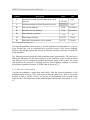
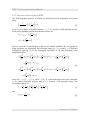
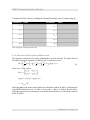
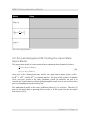
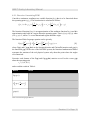
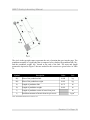
QNET Gantry Laboratory Manual 1. Laboratory Objectives In industry, the crane is often used to transport items from one place to another. The gantry experiment involves developing a control system for a crane travelling on a moving platform. In this case, the crane is represented by the suspended pendulum and the rotary arm behaves as the moving platform that transports the crane at different locations. The problem is to develop a controller that enables the platform, or in this case the arm of the rotary pendulum system, to track a commanded position while minimizing the motions of the crane, or pendulum, as it is being transported. In this laboratory, the equations representing the motions of the rotary pendulum will be derived using a technique known as Lagrange. The resulting nonlinear dynamics are then then linearized and converted to a state-space model. The linear state-space representation of a system is different than Laplace and is used more prominently in the control research field. The obtained model is then used to design a closed-loop controller using the LinearQuadratic Regulator technique. It is used to minimize or dampen the movements of the suspended pendulum while the rotary arm tracks the reference angle given. Practically speaking, the algorithm developed regulates the movements of the gantry and keeps the crane steady in the vertical down position such that items can be transported in a safely. Regarding Gray Boxes: Gray boxes present in the instructor manual are not intended for the students as they provide solutions to the pre-lab assignments and contain typical experimental results from the laboratory procedure. 2. References [1] NI-ELVIS User Manual. [2] QNET-ROTPEN User Manual. 3. ROTPEN Plant Presentation 3.1. Component Nomenclature As a quick nomenclature, Table 1, below, provides a list of the principal elements composing the Rotary Pendulum (ROTPEN) Trainer system. Every element is located and identified, through a unique identification (ID) number, on the ROTPEN plant represented Revision: 01 Page: 1