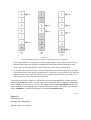
1
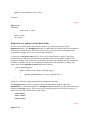
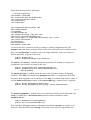
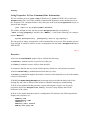
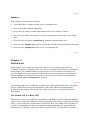
Page i
Abstract Data Types in Java
Page ii
McGRAW-HILL
JAVA MASTERS TITLES
Boone, Barry JAVA Certification Exam Guide for Programmers and Developers,
0-07-913657-5
Chung, David Component Java, 0-07-913690-7
Jenkins, Michael S. Abstract Data Types in Java, 0-07-913270-7
Ladd, Scott Robert Java Algorithms, 0-07-913696-6
Morgenthal, Jeffrey Building Distributed JAVA Applications, 0-07-913679-6
Reynolds, Mark C. Object-Oriented Programming in JAVA, 0-07-913250-2
Rice, Jeffrey and Salisbury, Irving Advanced JAVA 1.1 Programming, 0-07-913089-5
Savit, Jeffrey; Wilcox, Sean; Jayaraman, Bhuvana; Enterprise JAVA: Where, How, When
(and When Not) to Apply Java in Client/Server Business Environments; 0-07-057991-1
Siple, Matthew The Complete Guide to Java Database Programming, 0-07-913286-3
Venners, Bill, Inside the JAVA Virtual Machine, 0-07-913248-0
Page iii
Abstract Data Types in Java
Michael S. Jenkins
McGraw-Hill
New York • San Francisco • Washington, D.C. • Auckland
Bogotá • Caracas • Lisbon • London • Madrid • Mexico City
Milan • Montreal • New Delhi • San Juan • Singapore
Sydney • Tokyo • Toronto
Page iv
Library of Congress Cataloging-in-Publication Data
Jenkins, Michael S.
Abstract data types in Java / Michael S. Jenkins.
p. cm.
Includes index.
ISBN 0-07-913270-7
1. Java (Computer program language) 2. Abstract data types
(Computer science) I. Title.
QA76.73.J38J45 1998
97-30666
005.7' 3-dc21
CIP
Copyright © 1998 by The McGraw-Hill Companies, Inc. Printed in the United States of
America. Except as permitted under the United States Copyright Act of 1976, no part of this
publication may be reproduced or distributed in any form or by any means, or stored in a data
base or retrieval system, without the prior written permission of the publisher.
1 2 3 4 5 6 7 8 9 0 DOC/DOC 9 0 2 1 0 9 8 7
PN 032936-2
PART OF
ISBN 0-07-913270-7
The sponsoring editor for this book was Judy Brief and the production supervisor was Tina
Cameron. It was set in Vendome ICG by Douglas & Gayle, Limited
Printed and bound by R.R. Donnelley & Sons Company.
McGraw-Hill books are available at special quantity discounts to use as premiums and sales
promotions, or for use in corporate training programs. For more information, please write to
Director of Special Sales, McGraw-Hill, 11 West 19th Street, New York, NY 10011. Or
contact your local bookstore.
Information contained in this work has been obtained by The McGraw-Hill Companies, Inc.
("McGraw-Hill') from sources believed to be reliable. However, neither McGraw-Hill nor its authors
guarantees the accuracy or completeness of any information published herein and neither McGraw-Hill
nor its authors shall be responsible for any errors, omissions, or damages arising out of use of this
information. This work is published with the understanding that McGraw-Hill and its authors are
supplying information but are not attempting to render engineering or other professional services. If
such services are required, the assistance of an appropriate professional should be sought.
This book is printed on recycled, acid-free paper containing a minimum of 50%
recycled de-inked fiber.
Page v
Contents
Acknowledgments
ix
Introduction
xi
Chapter 1 Basic Concepts
1
Abstract Data Types
2
Classes and Abstract Data Types
3
Reference Objects and Value Types
3
Passing Reference and Value Types
5
Why Use Abstract Data Types?
Chapter 2 Error Handling and Exceptions
8
15
What Are Exceptions?
16
Return Values Versus Exceptions
17
Throwing and Catching Exceptions
18
The Throwable Class
22
Using the Built-in Exceptions
24
Defining Our Own Exceptions
25
Chapter 3 Arrays, Vectors, and Sorting
31
What Are Arrays?
32
What Are Vectors?
33
Vectors Versus Arrays
38
Extending the Vector
39
Creating a Sorted Vector
40
External Vector and Array Sorting
46
Chapter 4 Hash Tables
57
Chapter 4 Hash Tables
57
What Are Hash Tables?
58
A Simple Hash Table
60
The Java Hash Table
66
Uses of the Hash Table
69
Properties as a Subclass of the Hash Table
72
Using Properties To Pass Command-Line Information
74
Chapter 5 Linked Lists
77
The Linked List as a Base ADT
78
An Array-Based Linked List
79
Page vi
Putting the Linked List to Work
82
Nodes
85
A Reference-Based Linked List
88
Standard Linked List Operations Revisited
88
List Traversal
92
Using the Reference-Based Linked List
94
Chapter 6 Circular and Doubly-Linked Lists
105
Extensible Linked List Superclasses
106
A Doubly-Linked List
109
Circular Linked Lists
115
Performance Considerations
121
Chapter 7 Stacks
125
A Specialized Linked List—the Stack
126
The Java Core Class: java.until.Stack
127
127
Uses of the Stack
129
A Reference-Based Stack
129
Chapter 8 Queues
139
The FIFO Queue
140
Queue Versus Stack
140
A Vector-Based Queue
141
A Reference-Based Queue
143
Some Uses for the Queue
149
Chapter 9 Simple Trees
153
Trees
154
Tree Versus Linked List
155
Adding Nodes to the Tree
158
Traversal
159
In-Order Traversal
160
Pre-Order Traversal
162
Rotation
Chapter 10 Binary Trees
163
171
Binary Trees
172
Tree Nodes
172
An Interface to Compare Nodes
173
A Tree Traversal Interface
174
Page vii
The Tree Class
174
Adding Nodes to the Tree
177
177
Searching the Tree
180
Traversing the Tree
180
Using the Tree
181
Balancing the Tree
183
Chapter 11 Multi-Way Trees
193
Adding Complexity: Multi-Way Nodes
194
2-3-4 Trees
195
The Red-Black Tree: A Binary Version of the 2-3-4 Tree
197
Implementing a Red-Black Tree
199
Using a Red-Black Tree
210
Chapter 12 B-Trees
215
B-Trees
216
Indexing Large Data Sets
217
Node Width
217
B-Tree Operations
218
Searching a B-Tree
218
Traversing a B-Tree
219
Adding Keys to a B-Tree
219
Splitting the Nodes of a B-Tree
219
Balancing a B-Tree
221
Representing a B-Tree with Binary Nodes
221
Implementing a Binary B-Tree
223
Using a B-Tree
234
Appendix A Java Language Overview
Java
239
239
239
Security
240
Keywords
241
Java Built-In Data Types
242
Primitive Types
242
Reference Types
243
Access Modifiers
243
Packages
245
Classes
245
Interfaces
246
Methods
247
Applications and Applets
248
Page viii
The Java Core Class Library
248
The java.applet Package
248
The java.awt Package
249
The java.awt.datatransfer Package
251
The java.awt.event Package
251
The java.awt.image Package
252
The java.io Package
253
The java.lang Package
255
The java.lang.reflect Package
257
The java.net Package
257
The java.rmi Package
258
The java.rmi.dgc Package
259
259
The java.rmi.registry Package
260
The java.rmi. server Package
260
The java.security Package
261
The java.security.acl Package
262
The java.security.interfaces Package
262
The java.sql Package
263
The java.text Package
264
The java.util Package
264
The java.util.zip Package
265
Appendix B Keywords and Literals
267
What's On the CD-ROM?
273
Complete Source Code for Abstract Data Types in Java
273
Java Development Kit (JDK) Version 1.1.3
273
Installing the JDK on Windows 95/ Windows NT
274
Installing the JDK on Solaris
274
Installing the JDK Documentation
275
Running the JDK from the CD-ROM
275
About ObjectSpace
277
ObjectSpace JavaTM Products
277
What Is Voyager?
278
Traditional Distributed Computing
278
Agent-Based Computing
279
The Best of Both Worlds
279
Voyager on the CD-ROM
Index
282
283
Page ix
Acknowledgments
I would like to take a moment to express my appreciation to all of the people who helped me
through this project.
A big "Thank you!" goes to all the people at McGraw-Hill, especially Judy Brief for helping
me to figure out which end is up.
I would like to thank Jeff Rice for all the advice and direction he offered while reviewing the
manuscript.
I would also like to express my appreciation for all of the support I received from my fellow
Java devotees in the Project A team at the Chicago Board of Trade throughout the course of
working on this book.
And, of course, my eternal gratitude goes to my lovely wife, Juliana, and our two beautiful
children, Dana and David, for all the sacrifices they made in order to allow me the time to
complete this project.
Page xi
Introduction
Abstract Data Types in Java examines the design and development of the data structures
required for meaningful application development, specifically in the Java programming
language. With its numerous examples and exercises, this book is intended as both a resource
for the programmer and as a collegiate text. Abstract Data Types in Java provides extensive
analysis, explanation, and code examples in the Java programming language for the data
structures explored. An incremental learning approach is used to facilitate the comprehension
and retention of the material. Simpler, basic abstract types evolve into the more complex
structures chapter by chapter. Each chapter closes with a summary of the important topics
discussed as well as exercises designed to illustrate the points covered and to solidify the
reader's understanding.
This book is written for the intermediate-level programmer and the college-level computer
sciences student who are studying advanced programming concepts. As a programmer, a solid
understanding of abstract data types is integral to the software-development process. This
understanding includes the design, use, and implementation of these data structures. Any
large-scale software development project will use at least some of these abstract types in its
implementation. This book addresses these needs. Since the examples and exercises in the
book are implemented in the relatively new and very popular Java programming language, this
book should also appeal to programmers migrating from the more established industry
languages such as C and C++.
To make good use of this book, you should have a reasonable familiarity with the Java
programming language and its syntax. C and C++ programmers should have little problem
following the examples supplied. Non-programmers and beginning programmers may want to
have a Java language reference manual at hand. Appendix A supplies a brief overview of the
Java language and syntax.
Chapter Overview
Chapter 1, Basic Concepts
This chapter answers the question, ''What are abstract data types?" The idea of using
well-designed abstract data types (ADTs) to simplify the development
Page xii
life cycle and to create reusable code is well established. This chapter covers the basics of
designing and implementing ADTs in an object-oriented programming language. As a
foundation to exploring data abstraction, we will take a look inside Java and explore some of
the internal workings of the Java runtime system. Java reference objects will be explained.
The passing of reference and value types as arguments and how each type of argument passing
is used in the Java programming language will be discussed. Near the end of this chapter,
exercises are provided to stimulate understanding in the use of reference objects.
Chapter 2, Error Handling and Exceptions
This chapter explains the importance of critical and non-critical error handling. The use of
return values is contrasted with the use of exception handling. The Java Exception superclass is
explored in detail as an example. The syntax and mechanics of Throwing and Catching
Exceptions are briefly covered. Examples of how to extend the Exception class are given and
explained. Exercises demonstrate the use of standard exceptions as well as how the use of
customized exceptions can facilitate smooth software development.
Chapter 3, Arrays, Vectors, and Sorting
This chapter takes a brief look at the basics of array handling and explains the vector as a
generic extensible array type. The treatment of arrays as objects in Java is discussed and
examples are provided for the declaration and initialization of Java arrays. The reasons for
using vectors instead of arrays are outlined, and examples are given on how to extend vectors
to provide functionality not available in a standard array. One of the examples in the chapter
shows us how to use a container class to extend the functionality of the basic Java vector. The
Quick Sort algorithm is explained and a simple implementation is presented. The exercises
near the end of this chapter include the development of a Sortable interface to create the
SortedVector data type, which brings together these concepts.
Chapter 4, Hash Tables
This chapter examines the hash table. The hash table is a container that allows for quick and
easy storage and retrieval of data that has a unique
Page xiii
key associated with it. The concepts of hash codes and hash methods are discussed in detail. A
simple hash table class is defined from scratch to demonstrate the concepts. How and when to
use hash tables are explained, and examples are given that use the core Java class Hashtable
and its subclass, the Properties class. The chapter concludes with exercises that include the use
of the Properties object to parse command-line arguments.
Chapter 5, Linked Lists
In this chapter we examine the linked list. Linked lists are container types that store collections
of data in a sequential order. The concept of the generic data node is introduced and explained
in this chapter. The standard linked list operations are covered in detail, and examples are
given for simple add, insert, and delete methods. Array-based and non-array linked list
implementations are examined and contrasted. List traversal is explained and implemented
using the java.util.Enumeration interface.
Chapter 6, Circular and Doubly-Linked Lists
In this chapter a few of the extensions to the linked list class will be covered. Better super
classes will be defined, and the examples will help provide the explanation and
implementation of doubly-linked and circular-linked lists. The impact of performance and
flexibility are explored in these more complex implementations. Integration of the previously
developed quick sort is among the exercises presented at the end of the chapter.
Chapter 7, Stacks
This chapter takes a look at the stack as a specialized linked list. The built-in Java Stack object
is used as an example of a Vector based stack. An analysis of the internals for the stack is
provided and a non-Vector implementation is developed as a contrast. Exercises present an
opportunity to look at uses of the stack.
Chapter 8, Queues
This chapter explores another specialization of the linked list, the queue. Queues are used in
systems requiring message handling, event processing,
Page xiv
and the sharing of resources such as printers. Throughout the chapter we will be walking
through the concepts behind, and the implementation of, a standard first-in/first-out queue. We
will compare the queue storage container to the stacks covered in the last chapter and their
last-in/first-out schema. We will once again take a look at Vector and non-Vector
implementations of the queue in the examples and exercises we cover in the chapter.
Chapter 9, Simple Trees
In this chapter we explain the structure and use of simple rooted trees. Rooted trees are
specialized storage containers that possess a single entry point and arrange the elements
contained in a hierarchical fashion. We will draw a comparison between the tree structure and
traditional linked lists such as those we have covered in previous chapters. We will take a
look at the mechanism behind tree traversal and how it differs from that of the linked list. We
will also briefly discuss the use of an Interface to provide generic search and compare
functionality to the tree.
Chapter 10, Binary Trees
This chapter expands concepts provided in Chapter 9 and explains the Binary Tree. A Binary
Tree is implemented with a balanced tree structure to improve performance. The search
algorithm is explained, implemented, and contrasted to the sequential search available in
non-sorted linked lists.
Chapter 11, Multi-Way Trees
This chapter explains the structure of more complex tree types. We will expand on the binary
trees we've covered so far and take a close look at a specific multi-way tree, the 2-3-4 tree.
We will draw comparisons between the newly introduced multi-way trees and the binary tree
structures we've looked at previously. Examples are provided to illustrate how a multi-way
tree can be rendered as a binary implementation. Implementations of the tree types are walked
through in the examples. Exercises encourage the development of other variations of the
multi-way trees.
Page xv
Chapter 12, B-Trees
In this chapter we will take a detailed look at the B-Tree data structure as an extension of the
red/black and 2-3-4 trees. B-Trees are typically used to index large data sets and external data
stores such as database files. We will take a look at a simple B-Tree implementation to help
walk through the concepts presented in the chapter. Exercises include the development of a
simple indexed data file.
About the Examples
All of the source code in this book was written using Version 1.1.3 of the Java Development
Kit (JDK). All examples were tested and compiled using the JDK from Sun Microsystems on
the SolarisTM and Windows 95TM platforms. Source code appears in a monospaced font
(Courier).
All of the examples should be source compatible with any Version l.l.x of the JDK and should
compile using any development environment that conforms to the Version 1.1 specification.
With the exception of the inner classes used in the later sections of the book, all of the code
should compile and run without modification using any previous versions of the JDK as well.
All of the source examples in this book are written using the same basic style. The following
coding style guidelines are used to enhance source readability throughout the book:
•
Class names always begin with a capital letter.
•
Variable names begin with a lowercase letter with each subsequent word in the variable
name beginning with a capital letter.
•
Constants (public final static) are in all uppercase.
•
In cases where two or more classes are defined in the same source file, the public class
is defined first followed by classes of default or protected scope.
•
"extends" and "implements" clauses are indented on lines subsequent to the class
name definition.
Page xvi
•
The methods of a class are defined before static(class) variables and instance
variables.
•
All curly braces ( "{ " and "}" ) are vertically aligned.
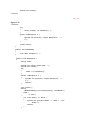
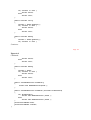
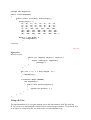
public class Foo
extends Bar
{
public Foo( int argumentOne )
{
System.out.println( "Hello World" );
}
public final static int LEFT = 1;
String myString;
}
Contacting the Author
Michael S. Jenkins is an independent software development consultant. For the past nine years
he has been assisting his clients in successfully developing their business applications and
enterprise systems. He has worked with companies such as the Chicago Board of Trade, the
Chicago Stock Exchange, Baxter Healthcare, A.C. Nielsen/Dun & Bradstreet, and other major
corporations.
If you have any questions or comments about anything in this book you can contact the author
via email at:
java@jcs-inc com
or on the world wide web at the following URL:
http://www.wwa.com/-mjenkins
Page 1
Chapter 1
Basic Concepts
This chapter answers the question, "What are abstract data types?" The idea of using
well-designed abstract data types (ADTs) to simplify the development life cycle and to create
reusable code is well established. This chapter covers the basics of designing and
implementing ADTs in an object-oriented programming language. As a foundation to exploring
data abstraction, we will take a look inside Java and explore some of the internal workings of
the Java runtime system. Java reference objects will be explained. The passing of reference
and value types as arguments and how each type of argument passing is used in the Java
programming language will be discussed. Near the end of this chapter, exercises are provided
to stimulate understanding in the use of reference objects.
Page 2
Abstract Data Types
This book is an introduction to abstract data types. So what are ADTs? To answer this
question, we'll take a look at something we already know about: an integer data type. Virtually
every modern programming language has some representation for an integer type.
In Java, we'll look at the primitive type int. An initialized Java int variable holds a 32-bit
signed integer value between -232 and 232 -1. So, we've established that an int holds data.
Operations can be performed on an int. We can assign a value to an int. We can apply the Java
unary prefix and postfix increment and decrement operators to an int. We can use an int in
binary operation expressions, such as addition, subtraction, multiplication, and division. We
can test the value of an int, and we can use an int in an equality expression.
In performing these operations on an int variable, the user does not need to be concerned with
the implementation of the operation. The internal mechanism by which these operations work is
irrelevant. Examine the following simple code fragment, for example:
int i = 0;
i++;
The user knows that after the second statement is executed, the value of the i variable is 1. It
isn't important to know how the value became 1—just that in performing the increment in this
example, i always will equal 1.
The user also does not need to know how the value is represented and stored internally Things
such as byte order again are irrelevant to the user in the preceding code example.
To summarize the built-in int data type, an int does the following:
•
An int holds an item of data.
•
Predefined operations can be performed on an int.
•
An int has an internal representation that is hidden from the user in performing these
operations.
If we consider the primitive data types in this light, it is easy to understand the definition we
will give to ADTs. An ADT is defined as the following:
Page 3
•
An ADT is an externally defined data type that holds some kind of data.1
•
An ADT has built-in operations that can be performed on it or by it.
•
Users of an ADT do not need to have any detailed information about the internal
representation of the data storage or implementation of the operations.
So, in effect, an ADT is a data construct that encapsulates the same kinds of functionality that a
built-in type would encapsulate. This does not necessarily imply that ADTs need to have
addition or increment operations in order to be valid or useful, and it does not mean that any of
the built-in operators will work with an ADT. It only means that the appropriate operations for
the type created will be transparently available and that the user does not need to be concerned
with the implementation details.
Classes and Abstract Data Types
In the Java language, all user-defined data types are classes. A class is a notation used by an
object-oriented programming language to describe the layout and functionality of the objects
that a program manipulates. All Java ADTs therefore are described by one or more classes.
Not all classes are ADTs, but certainly all ADTs are implemented as classes. The built-in
types in Java are not classes. This section takes a look at the differences among the various
Java types.
Reference Objects and Value Types
In Java, two basic types of variables exist: primitive types and reference types. Primitive types
are the standard built-in types we would expect to find in any modern programming language:
int, long, short, byte, char,
1
We will use the generic term data to refer to what, in most cases, will be a Java object.
Page 4
boolean, void,2 float, and double. Reference types are any variables that refer to an object.
This is an important distinction, because the two variable types are treated differently in
various situations. All reference type objects are of a specific class, for example.
All classes in Java are derived from the root class Object. So, given the rules of inheritance
and polymorphism, an Object class variable can refer to any reference object of any class. In
other words, a widening conversion can take place from any class to Object. Take a look at
the following code, for example:
String s = new String("Hello World");
Object o = s;
MyClass m = new MyClass();
Object o = m;
One of Java's strengths is the fact that it uses a polymorphic model3 wherein all classes are
derived from a common root. All objects share a common base Application Programming
Interface (API). This does not apply to the primitive types, however. The following code does
not work, for example:
double d = 3.8;
Object o = d;
The Java Development Kit (JDK) from Sun Microsystems comes complete with a set of
classes defined by Sun as the core API. All these classes are the Java equivalent of a standard
library. The Java core classes include wrapper classes for all the primitive types: Integer
for int, Double for double, Float for float, and so on. Of course, all these wrapper classes
are derived from the root class Object as well.
One unique case is that of the array. An array can be an array of primitives or an array of
reference types. For the most part, the array itself is treated as a reference type of the Object
class. The individual members, of course, are not treated in any special way. The rule of thumb
is that anything created by the operator new is assignable to Object. So, again, the following
code would work:
2
Void is a valid return type, even though it technically is not a data type. Variables cannot be declared
as type void. Void is used to denote that a method returns nothing.
3
Polymorphism is an Object Oriented Programming term used to describe the capability of an object
of one class to be treated as an object of another class due to the fact that the two classes maintain a
hierarchical relationship.
Page 5
long 1[10] = new long[10];
Object o = 1;
Object a[] = new Object[10];
Object o = a;
What does all this mean in terms of ADTs? Well, if we create a construct that works with
objects of class Object, we can use the construct with any reference type in place of
Object.
Passing Reference and Value Types
When calling a class member function, the developer will pass any required parameters to the
method as arguments to the method call. Suppose that class foo has a member method
declared as the following:
public int bar( String s, int i )
The caller of the method must supply a String (or an equivalent object that is automatically
convertible to String) and an int to the call, or the compiler will generate an error. The
questions here are, ''What are we passing?" and "What are the consequences of passing any
given parameter type?"
In very oversimplified terms, when a method is called, the system takes the arguments passed
to the method from the calling routine and pushes them on the program stack. The execution
point in the program then is jumped to the beginning of the method's code. The system then pops
the arguments off the stack and uses them as variables of the types declared in the method's
parameter list. This type of mechanism enables methods to be passed arguments that normally
may be outside the method's scope of visibility. When it is time for the method to return to the
calling routine, it pushes the return value onto the stack. The program then jumps back to the
calling routine and pops the return value back off the stack. For the purposes of this discussion,
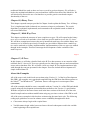
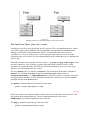
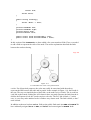
it is not important that we know the details of how a stack works. It is enough to know that a
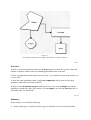
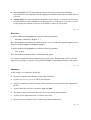
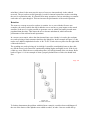
stack is a construct used to store data (see Figure 1-1). For more information on stacks, see
Chapter 7, "Stacks."
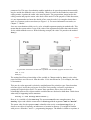
Java uses a mechanism called pass by value to handle argument passing in method calls. This
means that the system makes a copy of the value of the argument and pushes that onto the stack
for the called method to access. In the following example, the value 4 is passed to the method
foo():
Page 6
Figure 1-1
A typical data stack where one data item is "pushed" onto and then "popped" off of the stack.
int i = 4;
foo(i);
The method itself has no knowledge of the variable i. Changes made by foo() to the value
passed will have no effect on i from the caller. If 4 is incremented to 5, for example, the value
of i remains 4.
This pass by value approach is relatively straightforward for primitive types. But what about
reference types? Aren't they references to objects? Isn't passing a reference equivalent to
passing the original object itself? To answer these questions, take a closer look at the
relationship between Java objects and the variables that are declared to hold them. Think about
what really is happening in this statement:
String s = new String("Hello World");
Here, s is a variable of class String. The operator new allocates enough memory for a
String object and calls the constructor for string with the argument "Hello World".
The return value for the operator new is a handle to the newly created String object. A
handle to an object is basically an indicator to a location in memory. You might be familiar
with pointers from the C and C++ programming languages. The handle is similar to a pointer; it
does "point" to an object. Unlike the more traditional pointers, though, a handle to a Java object
cannot be modified except in the case of assignment to variables. A Java reference variable
can be reassigned to a different object.
Page 7
The implications of the differences between handles and pointers are subtle but important.
When a reference type is passed as an argument to a method, the handle to the object is copied
and passed—not the object itself So, in this code segment, the output would be "Hello":
String s = new String( "Hello" );
change( s );
System.out.println( s );
. . .
public void change( String t )
{
t = new String( "World" );
}
The handle to the object containing "Hello" is passed to change() as String t. t is
reassigned to the new object containing "World", but s remains unchanged. So, on the return
of the function, "World" is left unreferenced, and the memory it occupies eventually is
reclaimed by the garbage collector
So, any handle that we want to be reassigned during a method call must be the return value for
the method, or the handle must be a member of an enclosing or wrapper class.
In the following example, a new string containing "Hello" is created:
String s = new String("Hello");
s = s.concat(" World");
When the concat() method then is used, a new string is created in the concat() method
containing "Hello World" and is returned to the calling routine. This new string is
completely unrelated to the original string "Hello". The concat() method is defined to
return a String object.
In the next example, StringWrapper contains as a member field a String object:
class StringWrapper
{
public String s;
}
. . .
Page 8
changeString( StringWrapper t )
{
t.s += " World";
}
StringWrapper s = new StringWrapper();
s.s = "Hello";
changeString(s);
Here, the StringWrapper object is passed as an argument to changeString(), and
StringWrapper.s is reassigned to the new string "Hello World". After returning from
the call to changeString(), the calling routine has access to the new "Hello World"
string. A core class called StringBuffer provides a mutable String class. This class is
much more complete than this simple example here.
Why Use Abstract Data Types?
Now that we have some idea of what ADTs are, this section takes a look at why we use them.
The String class has been mentioned several times in this chapter. The String class
provides a mechanism by which string literals may be stored, accessed, and manipulated. It
provides methods with which we can compare, concatenate, copy, and convert strings. If a
String class did not exist, string operations would have to be implemented from scratch each
time they were needed.
A robust and reasonably generic String class gives us the capability to use these string
operations at any time without having to "reinvent the wheel" each time. So ADTs provide us
with code reusability. After we encapsulate the operations required to make a useful String
class, we can reuse those facilities at any time in the future, with little or no additional
development effort.
This also is the case with other ADTs, such as the ones we'll develop and examine in the
following chapters. By designing our ADTs to be as generic as possible, we can reuse them in
various situations and over several projects. Any time we develop an object or a group of
related objects that can be reused, we reduce the overall development time of a project.
There are certain guidelines that need to be followed to make ADT's reusable. In this book, we
are primarily concerned with container ADTs. A container object's primary purpose is to hold
other objects. The containPage 9
ers we will design and implement in the following chapters will hold various types of data.
To make oour containers reusable, we need to make them generic. Generic, in this sense,
means that the containers need to follow three rules:
1. Containers need to be able to store data of any kind.
2 Containers should provide a public interface that encompasses only behaviors that would be
useful in a general sense.
3. Containers should be kept insulated from application-specific considerations.
To satisfy rule 1, we can select the Object class as our data type. This means that we will
define our API for each of the ADTs to store and retrieve data of class Object. As discussed
earlier, the Object class is the root for all classes in Java. Therefore, any class defined in
Java is assignable directly to a variable of class Object. If we were to specify a data class
called MyDataClass, for example, we could pass a handle to that class to any method
defined to take a parameter of the Object class. This is a standard, automatic widening
conversion and requires no typecasting. The reverse narrowing conversion always requires
casting. So extracting our data back out of the constructs requires a cast to the appropriate type.
If a getData() method is defined to return a type Object, for example, we need to cast the
returned handle back to MyDataClass explicitly.
As a brief aside, take a quick look at typecasting. Typecasting enables the programmer to
temporarily change the type of an object or primitive. Two types of typecasting exist: automatic
(or implicit) casting and manual (or explicit) casting. Implicit casting can be used when the
compiler is able to determine that the type change is safe. Explicit casting is required if the
safety of the typecast cannot be determined until runtime. To understand when each of the two
types is appropriate, it is necessary to comprehend a little about the relationship of classes.
In the Java language, all classes are related in a hierarchical manner. The base of the hierarchy
is the Object class. As discussed earlier, all classes in Java are derived from the root class
Object. Each class that is subclassed directly from Object creates a new branch in the
hierarchy. When these subclasses are subclassed, they extend and split the branch farther and
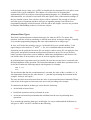
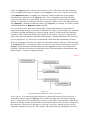
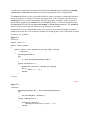
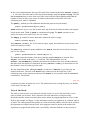
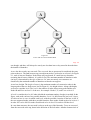
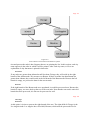
farther. Figure 1-2 shows a sample hierarchy.
Page 10
Figure 1-2
A partial inheritance diagram for the Java core classes.
As we can see, if we start tracing the hierarchy tree backward from any class on the tree, it
eventually leads us back to the Object class. Each class along the route from the starting
class is a superclass of the starting class as well as a superclass of its immediate child classes.
Because a subclass extends its superclass, any subclassed object can be treated as a member of
the superclass. This process is known as a widening conversion. An object's type is being
widened toward the more general. The compiler can assume that any widening conversion is
safe; therefore, the compiler can automatically supply the conversion.
This process works fine as long as the conversion is in the direction of the superclass or more
general case. Because Java is polymorphic, it is possible to determine at runtime the real type
of an object. This runtime type information is necessary to determine whether a narrowing
conversion is safe. Because a subclass is actually an extension of its parent class, there will
naturally be a possibility that there is some field information in the subclass that isn't in the
superclass.
Because this determination is done at runtime, this type of invalid cast cannot be detected at
compile time. If it is detected at runtime, the system throws a runtime exception, the
ClassCastException, to indicate the error. If the system throws this exception, the
offending thread is halted. For a more detailed discussion of exceptions, see Chapter 2, "Error
Handling and Exceptions."
Page 11
We can create an object of type MyClass, as in the following example, and pass it to a
method that takes an Object as an argument. The widening conversion is checked at compile
time and therefore is implicitly done. If we then return the same object as a type Object, the
narrowing conversion is checked at runtime and therefore needs to have an explicit cast.
MyClass m = new Myclass();
m = (MyClass)processData( m );
. . .
public Object processData(Object o)
{
. . .
return o;
}
When designing around rules 2 and 3, we need to keep in mind which behaviors are specific to
the application we will be implementing and which are a function of the ADT itself
Developers have a tendency to over-design container and utility classes to include every
conceivable functionality into the class itself Generally, this is a mistake and is probably one
of the biggest causes of code non-reusability. Keep in mind that we can subclass the ADT class
and add case-specific code to the subclass. This leaves the base ADT class uncluttered and
much more likely to be suitable for reuse.
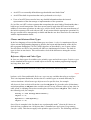
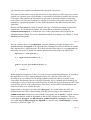
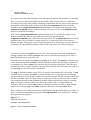
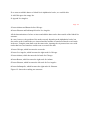
Suppose that we design a base class called Polygon. We would restrict the fields and
methods in the base class to those dealing with any generic polygon. We could have a
numberOfSides field and accessor methods, but probably not an area() method, because
the area calculations would be dependent on the specific polygon we instantiate. Then we
could subclass Polygon into Rectangle, Quadrilateral, Octagon, and so on. We
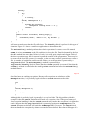
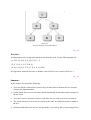
also could subclass Rectangle into Square as a specific case of Rectangle. A sample
hierarchy is shown in Figure 1-3.
Page 12
Figure 1-3
An example of inheritance providing specialization in a group of objects.
Page 13
Exercises
1. Write a small Java application that uses the String class to input one word at a time and
outputs a complete sentence when a terminating punctuation mark is entered.
2. Write an application similar to the one in exercise 1, but output the words in the sentence in
reverse order.
3. Write the same application using a single StringBuffer object passed to the input
method to collect the words in the sentence.
4. Write a class MutableInteger similar to the Java core class Integer but with the
capability to change the value of the integer. (The Integer class, like the String class, is
immutable after it is initialized.)
Page 14
Summary
In this chapter, we learned the following:
•
Abstract data types are similar to built-in types in that they have the same functionality.
•
All ADTs in Java are implemented as classes.
•
Primitive types and reference types have very different properties.
•
All arguments to methods are passed by value in Java. Primitive types pass the value of the
variable; reference types pass the value of the handle.
•
Widening conversions of reference types passed as arguments are automatic while
narrowing conversions require a type cast.
•
Following a few simple design rules can promote code reusability, especially in the design
of ADTs.
Page 15
Chapter 2
Error Handling and Exceptions
This chapter explains the importance of critical and non-critical error handling. The use of
return values is contrasted with the use of exception handling. The Java Exception
superclass is explored in detail as an example. We'll take a brief look at the syntax and
mechanics of throwing and catching exceptions. This chapter also provides examples of
extending the Exception class. Near the end of this chapter, exercises demonstrate using
standard and customized exceptions to facilitate smooth software development.
Page 16
What Are Exceptions?
The proper handling of exception conditions is integral to sound software development. The
first question that may come to mind is, ''What is an exception?" An exception, in terms of
software development, is an anomalous situation in which the state of the program is in
jeopardy of becoming or has become unstable or corrupt.
One example of this condition is when a program is trying to call a non-static method for which
the instance has not been defined or initialized. In Java, this state would generate a
NullPointerException. In this case, the exception condition must be handled
immediately to prevent the program from coming to an unexpected halt. We could use this code,
for example:
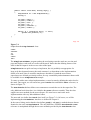
public class ExceptionTest
{
public static void main( String argv[] )
{
Vector v = null;
try
{
v.elementAt(0);
}
catch( NullPointerException e )
{
System.out.println("Exception Handled");
}
}
}
This code attempts to call the elementAt() method of Vector for instance v without first
creating the object to which v refers. When an instance method is called from within a
program, the Java runtime environment automatically passes the method the handle this.
this is a reference to the calling instance object. If the this argument refers to null, a
NullPointerException is thrown. After it is thrown, if the exception is not caught, the
program is halted by the Java runtime environment. (We will cover the mechanics of throwing
and catching exceptions shortly.) The point here is that once program execution reaches the
elementAt() call, there is no way to continue processing. If the call were allowed to
continue, the method would be accessing memory in an undefined location. This would not only
be a security breach, but it also could cause problems with the runtime or the system itself
Page 17
Return Values Versus Exceptions
Some programming languages do not support exception handling. As a matter of fact, exception
handling such as that supported by Java is relatively new to mainstream software development.
In the past, it was common to use the return value of a method or function to determine whether
the call was successful, as shown in this example:
public boolean toUpper( String s )
{
if( s == null )
// Error condition!
return false;
. . .
// process the String
return true;
}
In this case, the method would return true or false to indicate whether the method
succeeded. The problem with this type of approach is twofold. First, there is no way to
indicate what kind of error occurred or even where in the method the error occurred. What if
two or three primary operations were performed by the method? There is no way to tell which
operations succeeded and which failed.
The second problem with this approach is the fact that, in many instances, meaningful data is
passed back to the calling routine by the method. Suppose that we define a method called
doSomething()to return a reference to an object of type String. Upon reaching an error,
this method would return null instead of a String reference as an indication of an error. Take
a look at what would happen in the following call, for example:
myObject. doSomething ( . concat ("World" );
The problem with this code is that any error that occurs in doSomething() would cause the
program to crash or come to an abrupt halt. The return value from doSomething() is being
cascaded into the concat() call from the expected String object being returned. If the
method returns null, what will the concat() method work on? null is not a String
object. It has no methods to be called.
In some cases, however, it might be appropriate to use the return value of a method to indicate
an error condition. When using the method, the user must be clear as to the meaning of the
return value. We might want
Page 18
to use a return value for error reporting if we are using a method such as the indexOf()
method of the String class, for example. indexOf() is used to find the place in a string
where the first instance of a character exists. The return value is that position. If the character
is not found, the method returns -1. Why not throw an exception instead? An error condition is
not always an exception. Remember that an exception is a condition in which program or data
stability is suspect or actually corrupt. Not finding a character in a string doesn't pose any kind
of impending threat to the program or data state. Although the method fails in its objective, the
data still retains its integrity.
In cases like this, throwing an exception might cause more harm than good. Programming and
runtime overhead are involved in exception handling. The cost of implementing the exception
must be weighed against the benefits derived. With this in mind, continue to the next section,
which takes a closer look at the mechanics of throwing and catching exceptions.
Throwing and Catching Exceptions
Any method in Java may throw any exception. In order to throw the exception, though, the
method must be defined to throw it. 1 There is a throws clause that can be added to any
method declaration to indicate that the method can throw an exception. We can list as many
exceptions as appropriate for the method, as shown in this example:
Public void Foo()
throws BarException, Bar2Exception
{
. . .
}
To throw an exception (assuming that a throws clause exists that allows it), we need to
create a new object of the type of the required exception class and use the keyword throw to
deliver it, as this statement shows:
1
A group of exceptions called runtime exceptions is subclassed from the Java RuntimeException
class. These special exceptions do not need to be declared to be thrown. Any method may throw any
of these exceptions at any time. The RuntimeException class is used to indicate a runtime error
condition, such as trying to access a method on an unallocated class object or trying to access an
out-of-bounds index on an array.
Page 19
throw new IOException("Bad file name");
Catching an exception is a little more involved. We use a combination of statement blocks to
define the relevant test and response actions. To let the system know that we are testing for the
exception condition, we enclose the relevant code in try/catch blocks, as this code
shows:
try
{
. . . // code in danger of exception condition
}
catch( MyExceptionClass e )
{
. . . // handler code
}
Here, a block of code follows the try statement. This is the code for which the exception will
be tested. A second block of code also follows the try block; this is the catch block. The
catch keyword always is followed by a declaration much like a method declaration with a
single parameter. The parameter should be a derivative of the Exception class, and it must
be a class type that has Throwable in its class hierarchy. This catch block is the actual
exception handler.
If, in the process of executing the code in the try block, an exception is generated that is
assignable to the exception class declared in the catch statement, the exception is said to
have been caught At this point, the code in the catch block is executed in the thread in which
the exception occurred. This code is treated much like a method call, but its scope is that of the
method enclosing the try/catch blocks.
To perform exception handling, both blocks are necessary, complete with parentheses.
Although it generally isn't a good idea to do this, either block can legally be empty. If the try
block is empty, the entire code segment is a null operation. Obviously, if no code exists to test
for the exception, no exceptions are caught.
The only reason to have an empty catch block is to prevent an exception from being
propagated to the parent class. We must be certain that this is really what we intend before we
do something like this, because it can have serious consequences in the running Java process.
In the preceding code example, there can be as much code as necessary in the try block. We
are not limited to just the method call that may throw the exception. It is a good idea to keep the
code to a minimum, though. Just include enough code to properly encapsulate the significant
operations. If a repeated operation, such as a while loop, encloses a
Page 20
method call, it might be appropriate to include the entire while loop in the try block instead
of placing the try block within the while loop. This approach circumvents the repeated
overhead of the try clause. Be sure that the catch block takes this fact into consideration,
though, if the exception is not terminal.
A third statement block can be used optionally to enhance the functionality of the try/catch
blocks: the finally block. The finally block offers a way to provide for the execution of
a block of code after a try/catch block, whether or not an exception is caught. This clause
overrides any control-transfer statements invoked in the catch block, including any break,
continue, or return statements as well as the propagation of the exception itself
The finally block of code is executed whether or not the exception is caught and whether or
not an exception is even thrown. In terms of program flow, if the exception is not thrown, the
finally block is executed immediately after the try clause completes. If the exception is
thrown and is caught by the catch block, the finally block is executed immediately after
the catch block but before any return, break, or continue statements. The finally
block is used to ensure that our follow-up code always gets executed.
Suppose that we have a method that opens a file, performs some input and output operations,
and then closes the file. If an exception condition occurs during the course of the input or output
operations, we probably
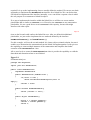
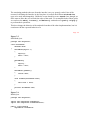
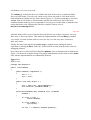
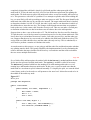
Figure 2-1
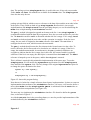
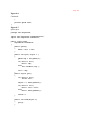
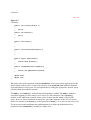
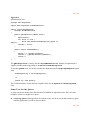
IOTest.java
import java.io.*;
public class IOTest
{
public static void writeFile( String name, String
contents )
{
FileOutputStream f;
try
{
f = new FileOutputStream( name );
}
catch( Exception e )
{
System.err.println( "Exception opening
file "
+ name +":" + e );
return;
}
Continues
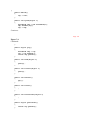
Page 21
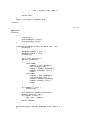
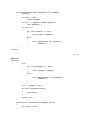
Figure 2-1
Continued
DataOutputStream out = new DataOutputStream(f);
try
{
out.writeBytes( contents );
}
catch( IOException e )
{
System.err.println(
"Exception writing to file:" + e );
return;
}
finally
{
try
{
f.close();
}
catch( IOException e )
{
System.err.println(
"Exception closing file:" + e );
return;
}
}
}
public static void main( String args[] )
{
writeFile("Test", "This is it, my friend" );
}
}
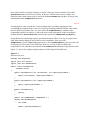
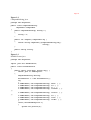
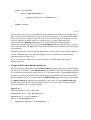
will want to make sure that the file still closes. The finally block is perfect for this type of
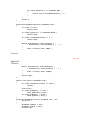
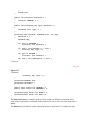
situation. Figure 2-1 shows a small test application to demonstrate this.
The writeFile() method performs three basic operations. It creates a new file named
name, it writes contents to the file, and then it closes the file. Don't be daunted by the fact
that this method has more than 30 lines of code; it is really quite simple and elegant. Each of
the three operations may fail for reasons beyond the control of the programmer. There may be
no room on the local file system, for example, or the user may not have permission to create a
file. A number of conditions could cause the failure, so each operation is protected by a
try/catch block. The writeBytes() method is protected by a
try/catch/finally block to ensure that the close operation is executed. Note that the
close() method is called after the catch's print statement but before the writeFile()
method returns.
Page 22
One final note on catching exceptions: Because all exceptions are subclasses of the
Exception class, it is perfectly legal to define a catch statement such as this:
try
{
. . .
}
catch( Exception e )
{
. . .
}
Although this is perfectly legal, it generally is a very bad idea. The big problem with this
example is that this catch statement will catch any exception. One of the great features of
Java exception handling is that the catch statement only catches the exceptions it is defined to
catch. Suppose that this try/catch block is protecting against an IOException. The
catch statement as defined will catch the IOException if it occurs. The catch block
then can handle the exception by whatever means has been defined. But what will happen if a
NullPointerException is generated? The catch statement defined here will catch this
exception as well. This statement is designed to handle input/output exceptions, and yet it will
be called for a NullPointerException.
If the catch block handles the exception simply by closing the stream and returning, the
NullPointerException remains unhandled. This could lead to unforeseen problems
with the rest of the application. It is almost always a bad idea to catch the Exception class
instead of one of its subclasses.
In certain situations catching a more general exception can be useful. We could define an
exception class that is the superclass to all the custom exceptions that can be thrown by classes
in our project. We then could catch our base exception and differentiate it, if necessary, by
using the instanceof operator in the catch block. But keep in mind that we must be very
careful that we handle every exception in the group properly.
The Throwable Class
The base class for all exceptions in Java is the Throwable class. For an object to be thrown
or caught, it must be derived from Throwable or one of the subclasses of Throwable.
Two types of general Throwable objects exist: the Exception class and the Error class.
Page 23
The Exception class is a special class, because the compiler enforces its throwing and
catching. Unless the exception is generated by the Java virtual machine, the method doing the
throwing must declare that it may throw the exception. Likewise, if a method declared to throw
an exception is used, the exception must be dealt with in some fashion. We can deal with an
exception in two ways: catch it or rethrow it. A class may define that it throws an exception.
By declaring this, it alleviates the class's methods from explicitly handling that particular
exception. In this case, the unhandled exception simply is propagated to the class that invoked
the offending method. The Exception class itself doesn't add any user functionality to
Throwable; it is just used as a superclass to other enforced exceptions.
The difference between the Exception class and the Error class is that Error is not
bound by the compiler to be declared as being thrown or caught. These exceptions represent
conditions that may occur during runtime that affect the virtual machine. Error generally is
not intended to be caught by the program. It indicates a condition that in theory should not occur
in a running program. An example of an Error subclass is the StackOverflowError.
This error is thrown when the program stack in the Java virtual machine overflows. Errors are
abnormal and generally unrecoverable; therefore, they are best left to the system to handle.
The exception model is defined this way to give all exceptions a common base that is not
equivalent to Throwable and to differentiate Exceptions fromErrors. Using this kind
of no-op subclassing2 ensures that, during type checking, all Exceptions are Throwable,
but all Throwables are not necessarily Exceptions. Because the difference between the
definitions of Throwable and Exception really is in name only, our exploration of the
Exception class is also an examination of the Throwable class.
Exception defines only two constructors to override the Throwable constructors. These
constructors are the only methods in the Exception class. Their sole functionality is to call
the corresponding Throwable constructor. The constructor takes no arguments at all or a
single String object that is used as a detail message to the Throwable object.
The rest of the methods examined in this chapter are part of the Throwable superclass.
The method getMessage() returns the String object containing the detailed message.
This may be null if no detailed message was supplied.
2
We are referring here to creating subclasses without adding any new member fields or methods.
Page 24
A standard toString() method exists, as in most methods (those methods that don't supply a
toString() inherit the default from the Object class).
The method fillInStackTrace() populates the internal handle backtrace with the
call stack information. The code that generates this information is native to the local platform.
The format of this stack information is unspecified and also is platform dependent.
There are a couple of printStackTrace() methods that will each call the private native
printStackTrace0() method, which will print the stack trace to either the
System.out stream or to a PrintStream supplied by the caller.
Using the Built-in Exceptions
Now take a look at some of the most commonly used exceptions. The first Exception subclass
we will explore is the ArrayIndexOutOfBoundsException. This exception is thrown
when an attempt is made to access a member of an array with an invalid index. If the index
supplied is greater than the length of the array less one or less than zero, it is invalid.
In this example, the index 3 is invalid:
int array [] = new int[3];
array[3] = 6;
This code would cause the ArrayIndexOutOfBoundsException to be thrown. The
only valid indexes for array are 0, 1, and 2. This is one of the RuntimeException
subclasses. Because this exception is generated by the Java virtual machine, it does not need to
be declared explicitly as being thrown, and it is not mandatory that it is caught. If the exception
is not caught, however, it leads to the invoking thread being shut down.
Another common exception in Java applications programming is the IOException. This
exception is thrown when there is a problem with an input or output operation. Take a look at
the following simple output operation, which creates a new file for output:
public FileOutputStream openOutFile( String name )
{
try
{
return new FileOutputStream( name );
}
Page 25
catch( java.lang.IOException e )
{
System.out.println("Unable to open file:" +
name);
return null;
}
}
Suppose that an invalid file name is supplied to this method. The constructor for
FileOutputStream declares that it throws IOException. Without the try/catch
block or a declaration that the class will rethrow the exception, a compilation error will occur.
This example assumes that the calling method will check the return value for null and handle
the error. It could prompt the user for a new file name in the exception handler, for example.
Defining Our Own Exceptions
When designing our own exception classes, it is a good idea to follow the convention of
keeping the exception class with the package from which it is intended to be thrown. The
IOException class, for example, is part of the java.io package. This convention is a
good idea for two reasons. First, it prevents the need to import a whole package of exceptions
or to explicitly import each exception class into the class that uses it. If the code needs to catch
an exception from an object's method, the package that defines the object (and therefore the
package that defines the exception) already will have been imported. Second, the base
Exception class is part of the java.lang package. It is not a good idea to make any
modifications to the core packages, because that could lead to confusion when delivering the
compiled classes or installing a new Java class library.
With that in mind, we will now create our own exception class. Because constructors have no
return types, assume that we need to check that a constructor is initialized properly. To do this,
we'll create a ConstructorException class. For this class, we want to include a way to
determine the cause of the constructor failure. The base class provides a string object in
which we can store detail information in the exception object. A lot of overhead exists in string
manipulations, though. It is easier programatically to check a numeric value instead of the
string. We will add an int field member to our class to store the numeric value. We also will
define some constants that can be used to represent the different failure conditions. The class
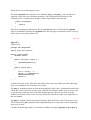
definition follows:
Page 26
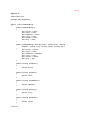
public class ConstructorException
extends Exception
{
public ConstructorException( String s, int cause )
{
super(s);
this.cause = cause;
}
public ConstructorException( int cause )
{
this(null, cause);
}
public ConstructorException( String s )
{
this(s, UNKNOWN);
}
public ConstructorException()
{
this(null);
}
public int getCause()
{
return cause;
}
int cause;
public static int UNKNOWN
= 0;
public static int REASON_FOO = 1;
public static int REASON_BAR = 2;
}
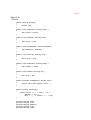
Notice that the ConstructorException class has two additional constructors in addition
to the Exception superclass. We have allowed for the exception object to be created in as
many ways as possible. The object requires two parameters: a string and an int. The user may
create the exception using either, both, or none. Any parameters that are not passed as
arguments are set to default values by the appropriate constructor. The string is set to null if it
is not provided, and the int is set to the constant value UNKNOWN if it is omitted.
The string can be used to store meaningful text information in the event that the exception is
rethrown all the way to the virtual machine level (through the propagation discussed earlier). If
the exception gets that far without being handled, the executing thread halts, and the detailed
message is printed along with a stack trace. The stack trace can be handy
Page 27
for debugging purposes because it shows the call stack of all of the methods leading to the
exception condition.
The int value can be used by a catch clause to determine the reason for failure and perhaps to
allow recovery. If the cause of the failure was FOO, for example, perhaps something can be
done to correct the situation, and then the constructor could be called again to instantiate the
object.
That's really all there is to it. Defining our own exceptions is simply a matter of adding any
exception-specific data to the base Exception class and supplying any constructors or
accessor methods needed.
Page 28
Exercises
1. Create individual classes that generate the following exceptions:
ArithmeticException
NullPointerException
ArrayIndexOutOfBoundsException
FileNotFoundException
ClassNotFoundException
2. Demonstrate the effects of catching and not catching (rethrowing) each type of exception
from Exercise 1.
3. Develop a class called PositiveOnly. This class should take a positive integer value
through its constructor. Use an instance method to decrement the value. Create a custom
exception to be thrown whenever a negative value is reached. Use the exception handler to
report this exception to System.out and set the value in the object to a non-negative value.
Page 29
Summary
In this chapter, we learned the following:
•
An exception is an unusual situation in which the state of the program is in jeopardy of
becoming or has become unstable or corrupt.
•
Return values can be used to indicate some error conditions upon the return from a method,
but exceptions can give more detailed information about the cause of the method failure and
can offer a better chance of error recovery in certain circumstances.
•
Five Java keywords are used when throwing and catching exceptions: throws, throw,
try, catch, and finally. We looked at using these keywords and deciding when it is
appropriate to use each keyword to handle exceptions.
•
The Throwable class is the base class for all Exception and Error classes. We
briefly explored the methods in the Throwable class.
•
How to use some of the built-in Exception classes.
•
How to define customized Exception classes to be used in special situations.
Page 31
Chapter 3
Arrays, Vectors, and Sorting
This chapter takes a brief look at the basics of array handling and explains the vector as a
generic extensible array type. The treatment of arrays as objects in Java is discussed and
examples are provided for the declaration and initialization of Java arrays. The reasons for
using vectors instead of arrays are outlined, and examples are given on how to extend vectors
to provide functionality not available in a standard array. One of the examples in the chapter
shows us how to use a container class to extend the functionality of the basic Java vector. The
Quick Sort algorithm is explained, and a simple implementation is presented. The exercises
near the end of this chapter include the development of a Sortable interface to create the
SortedVector data type, which brings together these concepts.
Page 32
What Are Arrays?
An array is a collection of data, all the same type, stored in contiguous memory. In Java, an
array may be an array of primitive types, such as ints, floats, or chars. An array also can
consist of reference types, including objects of the core classes and objects of a user-defined
type. Arrays have a static number of elements set when the array is instantiated. After the array
is created, the number of elements it can contain is static. Although all the elements of the array
may not be populated with valid objects at any given moment, the size of the storage set aside
for the array is fixed. Array variables (references) are reusable; to change the length of an
array, we can create a new array of the desired length and assign it to the original array
variable.
Arrays are a special data type in the Java language. Certain properties are special to arrays. In
Chapter 1, ''Basic Concepts," reference data types were discussed. Arrays are treated as
reference types by the system, regardless of the type contained in the array. But at the same
time, arrays are not classes as are other reference types. Also, arrays do not extend from the
root class Object, although Object is considered the superclass of all arrays,1 and an array
can be treated as if it were of type Object. An array can be assigned to any variable of type
Object. Any of the methods from Object can be called through an array. The memory for
an array must be allocated using the new operator just like a class object, no matter what type
is contained by the array.
int arrayOfInt[] = new int[7];
String arrayOfString[] = new String[4];
In the preceding declarations, arrayOfInt is an array of seven int values. Because int is a
primitive type, there is no need to allocate any additional space after the new call. The array
already is assigned enough contiguous memory to hold seven ints. The arrayOfString
allocation call is a little different. The new operator assigns enough contiguous memory for the
handles to four Strings; it does not allocate the memory for the String objects
themselves. The String memory must be created separately, as shown in this code:
1
See section 10.8 of the Java Language Specification (Gosling, Joy, Steele)
Page 33
int arrayOfInt[] = new int[7];
String arrayOfString[] = new String[4];
for( int i = 0; i < 7; i++ )
{
arrayOfInt[i] = i;
}
arrayOfString[0]
arrayOfString[1]
arrayOfString[2]
arrayOfString[3]
=
=
=
=
new String("Hello");
new String("World");
new String("It's");
"Me";
The final statement is an implicit call to the following:
arrayOfString[3] = new String("Me");
Access to the elements in an array is provided by the index operator ([ ]), as in the preceding
example. All Java arrays use a zero-based index. This means that for an array of N elements,
the valid index values are 0 to N-1. An array also has a special public instance member called
length. The length member contains the allocated length of the array. This value is
associated with the array object at allocation time and is not changeable during the life of the
object.
What Are Vectors?
A vector is a type-safe, dynamic collection class similar to an array with advanced
data-handling features. In a vector, the size of the collection is dynamic. Storage space can be
added or deleted on-the-fly. This allows for efficient memory management on a data set that
can vary in size. The vector also allows the addition, insertion, and deletion of data.
The vector class has three constructors, all of which are public. One of the protected member
fields is capacityIncrement. This member keeps track of how much to grow the
collection when memory needs to be allocated. The parameters to the constructors offer
different levels of control over the initial size and capacityIncrement. The constructors
for the vector class are as follows:
public Vector(int initialCapacity, int capacityIncrement)
public Vector(int initialCapacity)
public Vector()
Page 34
The first constructor enables the user to set both the initial size of the collection and the
capacityIncrement. The collection size is analogous to the length member in an
array. The second constructor sets the initial size but leaves the capacityIncrement set
as the default. The third constructor sets both the initial size and the capacityIncrement
to the defaults.
The vector class default size is 10. The default capacityIncrement is not a specific
number; instead, it is an algorithm. If no specific capacity increment exists, the vector doubles
the size of the collection every time it runs out of space. This process might seem inefficient,
but it isn't. In most cases, it is very effective as a trade-off between speed and space
management. Now take a closer look at how the vector manages memory.
The vector uses an internal array variable to store the data. As the array runs out of space, a
new array is allocated based on the capacityIncrement. The data from the old array is
copied to the new array, and the new array is assigned to the internal array variable. The
creation of the new array and the copying are relatively expensive in terms of time. To get the
best possible performance out of a construct such as the vector, you need to minimize the
number of expansions made to the collection. At the same time, to keep resource use to a
minimum, you need to keep the unused storage space in the collection as small as feasible.
If you have a good handle on the data requirements, you can manage the growth of the
collection programmatically. In many cases, though, you will not be able to accurately estimate
the appropriate capacity and increment of the collection. In these cases, the default
capacityIncrement can be very efficient; it is a good trade-off between memory and
speed.
Consider the following scenario. A vector is created with an initial size of 1, and then 100
strings are added to the vector, one by one. Compare the capacity changes in Table 3.1 for the
default increment versus an increment of 10.
Using the default capacityIncrement causes a resize only seven times, whereas using an
increment of 10 requires 10 resizes. Here, the trade-off is three less array creations and copies
against the unused space associated with the 28 extra elements that are allocated.
public final synchronized void copyInto(Object anArray[])
The copyInto() method takes an array as an argument and copies the entire contents of the
vector into it, as shown in the preceding code. The collection must be of sufficient size to hold
all the elements in the vector.
public final synchronized void trimToSize()
Page 35
Table 3.1 Vector Capacity Changes
Capacity
Default
Change
Increment
Iteration
0
1
Increment
of 10
1
1
2
11
2
4
21
3
8
31
4
16
41
5
32
51
6
64
61
7
128
71
8
81
9
91
10
101
The trimToSize() method reduces the capacity of the vector to equal the number of
elements contained, as shown in the preceding code. In this scenario, a call to
trimToSize() after string 100 is added reduces memory use from 128 strings to 100. This,
of course, involves another iteration of the capacity change. This time, the capacity is reduced
rather than increased.
public final synchronized
void ensureCapacity(int minCapacity)
The preceding method checks the length of the internal array against the minCapacity
argument. If the array is of greater or equal length, the method simply returns. If the array is
shorter than the requested capacity, the vector is resized to the minCapacity supplied or to
the next capacityIncrement step, whichever is greater
public final synchronized void setSize(int newSize)
The setSize() method enables the user to have explicit control over the size of the internal.
Here, the array is set to the specified size, and the data in the original array that was beyond the
new end of the array is truncated.
Page 36
public final int capacity()
This method returns the current capacity of the vector.
public final int size()
This method returns the current number of used elements in the vector.
public final boolean isEmpty()
This method returns true or false to indicate whether the vector has any elements. This
code is regardless of capacity; it refers strictly to the used elements.
public final synchronized Enumeration elements()
The elements() method returns an enumeration of the elements in the vector. Here,
Enumeration is an interface that allows a single-pass walk-through of a data set. The
Vector class provides its own specialized Enumeration class called
VectorEnumeration. The methods are the standards provided by the interface
declaration; no new methods are defined in VectorEnumeration.
public final boolean contains(Object elem)
The preceding method returns true or false to indicate whether the supplied object is
contained in the array. Here, the object is compared by using the object's equals() method.
public final int indexOf(Object elem)
Using the same criteria as earlier, indexOf() returns the index of the desired element.
public final synchronized
int indexOf(Object elem, int index)
The preceding method differs from the single-parameter version only in the fact that the search
for the object starts at the supplied index instead of zero.
public final int lastIndexOf(Object elem)
This method performs the indexOf() search backward from the last element in the
collection.
Page 37
public final synchronized int lastIndexOf(Object elem, int
index)
The preceding method is the same, except that the backward search begins at the specified
index.
public final synchronized Object elementAt(int index)
The elementAt() method is an accessor method that provides the same index reference
functionality as the index operators ([ ]) in an array. The element at the indicated index is
returned. Here, the index must be valid for the current collection, or an exception is thrown.
public final synchronized Object firstElement()
This method returns the element at the zero index.
public final synchronized Object lastElement()
This method returns the last element in the collection.
public final synchronized
void setElementAt(Object obj, int index)
This method enables the user to substitute a new object for the object contained in the element
indicated. Here, the index must be valid for the current collection, or an exception is thrown.
public final synchronized void removeElementAt(int index)
This method enables the user to delete an element from the collection at the specified index.
Here, the index must be valid for the current collection, or an exception is thrown.
public final synchronized
void insertElementAt(Object obj, int index)
This method enables the user to insert an element at the specified index. Here, the index can be
anywhere from zero to the number of elements. This enables the insertElementAt()
method to be used also as an append operation (the last element in the list is indexed at one
less than the number of elements-N-l). The list is checked for available space and expanded as
necessary according to the incrementCapacity setting.
public final synchronized void addElement(Object obj)
Page 38
The addElement() method appends the new object to the end of the collection. The list is
checked for available space and expanded as necessary.
public final synchronized boolean removeElement(Object obj)
The preceding method removes the element from the collection that matches the specified
object. Here, the indexOf() method is used to find the first occurrence of the object in the
collection, and that element is removed using the removeElementAt() method.
public final synchronized void removeAllElements()
This method empties the collection of elements. Each element, in turn, is set to null, and the
element count is reset to zero.
public synchronized Object clone()
The clone method creates a copy of the vector object, not the elements. Here, the internal
array is copied to a new Vector object, which then is returned. The vector is defined to
implement the clonable interface; therefore, this method must be supported.
public final synchronized String toString()
This method generates and returns a string representation of the Vector object.
Only three instance variables are defined in the Vector class:
protected Object elementData[];
protected int elementCount;
protected int capacityIncrement;
All three variables are declared to be protected so that they are available to subclasses but not
the general public. elementData is a generic Object array handle that holds the internal
array storage for the collection. The elementCount member field is self-explanatory, and
capacityIncrement was covered earlier in this chapter.
Vectors Versus Arrays
In many cases, a vector and an array may be used interchangeably. Generally, though, one is
preferred over the other for any given circumstance. As a good general rule of thumb, we
would use an array anytime the collection meets the following conditions:
Page 39
•
All elements of the collection are of the same type (especially the primitive types).
•
The collection is a known, fixed size or maximum size.
•
The collection is a non-sorted data set (data is not inserted into the collection).
If any of these conditions are not met, it might be better to use a vector object. Generally, the
choice is pretty clear. If it necessary to manipulate the storage of the data, regardless of
whether the data itself is manipulated, it probably is better to use a vector instead of an array.
The advantages of the vector are mainly the fact that the collection is of a dynamic size and that
methods are available to manipulate the storage.
If we want to perform an insert into an array, assuming that we have space for the additional
member, we would have to do something along these lines:
System.arrayCopy( myArray, insertPosition,
myArray, insertPosition + 1,
array.length - insertPosition );
myArray[insertPosition] = newElement;
This is basically what the vector's insertElementAt() method does.
The advantages of using an array are speed, easy access, and reduced overhead. As mentioned
earlier, the vector's capability to expand as necessary comes with the price of creating and
copying the collection to the new internal array. By allocating all the memory needed for the
array at one time, these time-consuming operations are eliminated. Each access to an element in
a vector also requires a method call, which is avoided by the simple index notation an array
uses for element access.
The advantages of a vector are flexibility and control. The methods available in the vector
enable the programmer to manipulate the collection at will. It is a simple matter to insert or
move an element in the collection.
Extending the Vector
In the Java Vector class, most of the methods are defined as final; this prohibits us from
modifying the behavior of the class by preventing us from overriding the methods. This
restriction also speeds up the performance of the Vector class. In Java, it is possible to have
more than one method in the same class with the same name. The methods must have different
argument lists, but they can all share the same name. This feaPage 40
ture is known as method overloading. Methods inherited from a superclass may be overloaded
as well. A subclass also may contain a method with a name and signature that are identical to a
method in the superclass. This feature is known as method overriding.
When a class has methods that are overridden, there is a question of from which class
(superclass or subclass) to actually invoke the method. The method called is the closest match
to the choices available based on the runtime type of the object calling the method. It
sometimes is impossible to determine at compile time which class an object really is. For this
reason, the determination of which method to call is deferred until runtime. At runtime, the
system can determine the exact real type of all the objects. Remember that an object carries not
only its real type but also all the types of all its superclasses all the way down to the Object
class itself
Any method that has the possibility of being overridden is called a virtual method All the
virtual methods are kept in a table by the system so that the runtime environment can perform
lookups to determine the correct virtual method to call. In Java, all methods are virtual by
default. Methods declared as final, however, cannot be overridden by a subclass. This
eliminates the need for a virtual function table and the overhead involved with looking up the
appropriate method each time a call is made. Access to any final or private methods is faster
than access to the virtual methods in the class.
The vector's instance variables are declared as protected, though. Protected access to the
variables enables us to extend the functionality of the vector by allowing the subclass access to
the internal data representation of the class. So, in effect, even though the core functionality of
the class cannot be changed because of the final methods, the class may be extended at will by
adding functionality to the class.
Any kind of functionality can be added to the class as long as we don't need to change the
behavior of any of the existing methods. In the next section, we'll take a look at extending the
vector by adding the capability to sort the elements in the collection.
Creating a Sorted Vector
One feature that would be handy to have in a vector class would be the capability to have
the vector automatically sort the data. Of course, in order to sort the data, we first must be able
to compare one element to another. To accommodate this requirement, we will define a Java
interface
Page 41
called Comparable. The base interface needs to declare only one method: compare().
We can define the Comparable interface by using the following code:
public inteface Comparable
{
public int compare( Comparable obj );
}
This simple code segment says a lot. Remember that, in Java, an interface does not implement
any methods; it just declares them. Any class that implements the interface will implement the
methods declared. By implementing the Comparable interface, an instance of the class
becomes an object of type Comparable as well as its other inherited types. This lets us use
the instanceof operator from within our sortable Vector class to confirm that an object
is comparable before we attempt to call the compare() method when sorting the object
within the vector.
The compare() method should perform an operation similar to the compareTo() method
in the String class. The method should compare itself to the object passed as an argument
and return an integer comparison value. The return value should be zero if the two objects are
considered equal, negative if this object is less than the argument object, and positive if this
object is greater than the argument object.
So, after we define the SortedVector class to use the compare() method to determine
sort order, any class that implements Comparable can be stored in sorted order. But what
happens if an object that is not comparable is passed to the sortable vector? We can handle this
situation in one of two ways. We can supply a default order for non-comparable objects, or we
can throw an exception indicating this as an unacceptable condition.
Another condition to consider is the case in which two objects implement the Comparable
interface and yet are of different types. Suppose that the user defines a ComparableFoo and
a ComparableBar class and tries to store both in the SortedVector. How is this
situation handled? It is irrelevant to the Sortedvector class what type of objects it stores,
as long as they implement the Comparable interface. The responsibility is on the user of the
class to be sure that any comparable objects inserted into the collection know how to compare
themselves to other comparable objects.
One of the benefits of using an interface to define a data type is that it enables classes like
SortedVector to be used very flexibly. If the user can find some way to compare two
different classes, both classes may be stored in the SortedVector together, as long as they
both implement the Comparable interface.
Page 42
Even though we can't override the vector's methods, there is nothing stopping us from
overloading the methods in the vector. Overloading is defining methods with the same names
that use different parameter lists. So, if we define the addElement() method to take a
comparable instead of an object, we allow the user to add comparables to the list using the
method defined in SortedVector instead of the superclass' addElement(Object).
Using this kind of subclassing requires good documentation. There is no way to stop the user
from inadvertently adding an object that is not a comparable. If the user calls
addElement() with a String argument, the vector's addElement() processes the call
and destroys the sort order of the collection. However, as long as the user adds only
comparables to the collection, the methods in Sortedvector add them in appropriate order.
Figure 3-1 shows the complete implementation of adt.Chapter03.SortedVector.
Figure 3-1
SortedVector.java.
package adt.Chapter03;
import java.util.Vector;
import java.util.Enumeration;
public class SortedVector
extends Vector
{
public SortedVector( int initialSize, int capacityIncrement )
{
super( initialSize, capacityIncrement );
}
public SortedVector( int capacityIncrement )
{
super( capacityIncrement );
}
public SortedVector()
{
super();
}
public void addElement( Comparable o )
throws SortableException
{
int index;
index = getInsertIndex(o);
Continues
Page 43
Figure 3-1
Continued
insertElementAt(o,index);
}
public void insert( Comparable o )
throws SortableException
{
addElement(o);
}
public boolean contains( Comparable o )
{
return super.contains(o);
}
public SortedEnumeration sortedElements()
{
return new SortedEnumeration(elementData);
}
private int getInsertIndex( Comparable o )
throws SortableException
{
int index;
for( index = 0; index < elementCount; index++ )
{
if( !(elementData[index] instanceof
Comparable) )
throw new SortableException( "Element
" + index + " not Comparable" );
if( o.compare( (Comparable)elementData
[index] ) < 0 )
break;
}
return index;
}
}
class SortedEnumeration
implements Enumeration
{
SortedEnumeration( Object array[] )
{
this.array = array;
}
public boolean hasMoreElements()
{
if( index < array.length )
return true;
return false;
}
Continues
Page 44
Figure 3-1
Continued
public Object nextElement()
{
if( !(array[index] instanceof Comparable) )
throw new SortableException(
"Element " + index
+ " not Comparable" );
return array[index++];
}
Object array[];
int index = 0;
}
A SortableException class also is defined to handle any objects inserted into the
collection that are not comparable. Although there is no way to stop this from happening
because the vector itself will store any object, we can test that each element encountered in the
addElement() and insertElement() is comparable as we insert each new object to
determine that it is a Comparable. Each element also is tested as it is passed through the
sortedElements() method. If it is not an instance of Comparable, the exception is
thrown. These two checks ensure that none of the methods in the Sortedvector class will
generate a runtime error because of data of the wrong type being included in the collection.
We now can create a small application to demonstrate the SortedVector; this application
is called SortableVector. To use the SortedVector, we need to define a data class to
implement the Comparable interface. The data class is called ComparableString, as
shown in Figure 3-2.
To keep the example simple, the ComparableString class is not well encapsulated. The
String member should be declared as private, and it should really have accessor
methods. The important part of the class is the compare method, because it is the
implementation of the Comparable interface. Because this is a comparable String class, it
uses the built-in compareTo() method in the String class and saves the work of
reimplementing the functionality.
The Sortablevector application simply declares and instantiates a SortedVector
object and fills it with ComparableString objects (see Figure 3-3). Notice that all the
addElement() calls are enclosed in a single try block. If we inadvertently try to add an
object that is not comparable, the SortableException is thrown. After all the
ComparableString's are added to the collection, the application demonstrates that they
are sorted by walking through the enum enumeration.
Page 45
Figure 3-2
ComparableString. java.
package adt.Chapter03;
public class ComparableString
implements Comparable
{
public ComparableString( String s )
{
string = s;
}
public int compare( Comparable obj )
{
return string.compareTo(((ComparableString)obj).
string);
}
public String string;
}
Figure 3-3
SortableVector.java.
package adt.Chapter03;
import java.util.Enumeration;
public class SortableVector
{
public static void main( String arg[] )
throws java.io.IOException
{
ComparableString cString;
SortedVector v = new SortedVector();
try
{
v.addElement( new ComparableString( "This" ) );
v.addElement( new ComparableString( "is" ) );
v.addElement( new ComparableString( "a" ) );
v.addElement( new ComparableString( "sorted" ) );
);
v.addElement( new ComparableString( "vector" ) );
);
v.addElement( new ComparableString( "in" ) );
v.addElement( new ComparableString( "sort" ) );
v.addElement( new ComparableString( "order" ) );
}
catch( SortableException e )
{
System.out.println(e);
Continues
Page 46
Figure 3-3
Continued
System.exit(0);
}
Enumeration enum = v.elements();
while( enum.hasMoreElements() )
{
System.out.println(
((ComparableString)enum.nextElement()).string );
}
System.in.read();
}
}
Figure 3-4
The output from the data set {''This", "is", "a", "sorted", "vector", "in", "sort", "order"}
This
a
in
is
order
sort
sorted
Figure 3-4 shows the output for the application.
The SortedVector class maintains the sort order by managing the add and insertion
operations. No special sort-in-place operation restores sort order if the order of elements in
the collection changes. This type of utility class relies on the programmer to use the class
properly. It is relatively easy to shoot yourself in the foot if you are not careful. This type of
design enables the programmer to be much more flexible in implementing a solution, but it
comes with a price. Other, somewhat safer, approaches to the sorted vector problem exist.
External Vector and Array Sorting
As an alternative to extending the Vector class, sorting can be done externally by a utility
class. In this case, the data items are added to the collection normally, using the methods in the
Vector class. At some point in the process, the collection is passed through a sort engine that
reorders it appropriately. The sort engine could support any one of a number of sort algorithms
that could be used interchangeably according to the user's preference. In this chapter, we will
take a look at one of these types of generic sort algorithms: the quicksort.
Page 47
The quicksort algorithm has a worst-case time of N2, where N is the number of elements in the
collection to be sorted. So, at most, N2 comparisons must be made between the elements in the
collection to completely sort the collection. This might not seem very efficient, but the average
is closer to NlogN This can be proven mathematically, but such proof is beyond the scope of
this book. Quicksort usually is considered to be a fairly efficient general-purpose sort
algorithm. The general theory behind this algorithm is divide and conquer. The collection to be
sorted is split into two subsets that are recursively put through the same process. The key to the
algorithm is the process by which the subsets are determined. A boundary value is defined so
that each element of subset A compares as less than the boundary value, and each element in
subset B compares as greater than the boundary value.
Given an array A[] of length N (where LO=0, HI=N, and X=A[LO]), partition the array so that
all elements less than X are to the left of X, and all values to the right of X are greater than X in
the array. X can be any element in the array except for A[N-1]. If the boundary value is the
last element in the array and it also is the lowest sort value in the collection, we will end up in
an infinite recursion. The partitioning is accomplished by walking through the array in both
directions and comparing the elements encountered to X. When an element in the ascending or
descending leg of the walk compares as out of place, that leg is halted until the other leg is
complete. After both legs are complete, the indexes of each leg are compared. If the ascending
leg index is less than the descending leg index, the elements are swapped, and the process
continues. If the ascending leg index is greater than the descending leg index, the array is
partitioned at the descending leg index, and the two subarrays go through the same process.
Figure 3-5 shows an array of seven ints [6,3,8,5,7,1,9] in various stages of being sorted. The
quicksort algorithm is used to sort the array.
•
(A) shows the initial array. The value of the first element of the array, 6, is used as a pivot.
[9] compares greater than 6, so the [9] is in the correct half and the arrow moves to the next
node in line: [1]. [1] is less than the pivot value 6, so the arrow stops at [1]. The first
element in the array, [6], compares (as expected) equal to the pivot value, so the arrow
stops here. 6 is less than 1, so the two elements are swapped.
•
(B) The comparisons continue after the swap with the top arrow at [7]. [7] is greater than
6, so the arrow moves to [5]. 5 is less than 6, so the arrow stops. The other arrow would
have been pointing at [1] after the swap. That arrow moves to [3], which is less than 6. The
Page 48
Figure 3-5
Three intermediate stages of a data set run through the quick sort algorithm.
arrow moves again to [8] which is, of course, greater than 6. Once again, the arrow stops.
Because both arrows are stopped, a comparison is made between the elements at each
arrow, and it is determined that a swap needs to take place between [8] and [5].
•
(C) Because the arrows have met, we know that all the values below the split are less than
6 and all those above the split are greater than 6. Therefore, you can split the array into two
subarrays at the arrows and start the process over again. Each subarray gets a new pivot
value based on the first element in each subarray.
For the purpose of this example, we will define two classes that handle the sorting instead of
subclassing the Vector class. The first class is the sort engine. It has a sort() method that
can be called to sort an array or a vector. The engine class is called SortEngine. We still
need a method of comparing the objects in the collection. For this, we'll define a new interface
with a compare() method. The interface is called SortInterface.
Page 49
Figure 3-6
SortEngine.java.
package adt.Chapter03;
import java.util.Vector;
public class SortEngine
{
public SortEngine( SortInterface s )
{
helper = s;
}
public void sort( Object array[] )
{
quicksort( array, 0, array.length );
}
public void sort( Vector v )
{
quicksort( v, 0, v.size() );
}
public void quicksort( Object array[], int lo, int
hi )
{
if( lo == hi )
return;
Object o = array[lo];
int i = lo - 1;
int j = hi;
while( true )
{
while( --j >= lo )
{
if( helper.compare( array[j], o )
<= 0 )
break;
}
while( ++i < hi )
{
if( helper.compare( array[i], o )
>= 0 )
break;
}
if( i < j )
{
Object tmp = array[i];
Continues
Page 50
Figure 3-6
Continued.
array[i] = array[j];
array[j] = tmp;
j++;
i--;
}
else
{
break;
}
}
quicksort( array, lo, j );
quicksort( array, j+1, hi );
}
public void quicksort( Vector v, int lo, int hi )
{
if( lo == hi )
return;
Object o = v.elementAt(lo);
int i = lo - 1;
int j = hi;
while( true )
{
while( --j >= lo )
{
if( helper.compare( v.elementAt(j),
o ) <= 0 )
break;
}
while( ++i < hi )
{
if( helper.compare( v.elementAt(i),
o ) >= 0 )
break;
}
if( i < j )
{
Object tmp = v.elementAt(i);
v.setElementAt( v.elementAt(j), i);
v.setElementAt(tmp,j);
j++;
i--;
}
else
{
break;
}
}
Continues
Page 51
Figure 3-6
Continued.
quicksort( v, lo, j );
quicksort( v, j+1, hi );
}
public SortInterface helper;
public final static int QUICK = 1;
}
<><><><><><><><><><><><>
package adt.sort;
public interface SortInterface
{
public int compare( Object a, Object b );
}
The difference between the Comparable interface and the SortInterface is that, in this
case, the compare() method compares two separate objects. In the Comparable interface,
a Comparable object compares another Comparable object to itself After we pass the
sort engine an object that implements SortInterface, we can use the compare() method
to compute the sort order.
To better understand the quicksort algorithm, we can examine the quicksort() method.
The array version is a little easier to follow. The quicksort() method is called with three
arguments: the array to be sorted and two integer values. The integer values represent the low
and high index range of the array to be sorted. These values are necessary to have the
capability to sort subarrays within a larger array. Initially, the method is called with the array,
zero, and the array length, respectively.
In this implementation, the low index always is used to determine the partitioning boundary.
The method initializes int's i and j to keep track of the current positions of each leg of the
array traversal. The j leg compares each element of the array by descending index to the
boundary value to determine whether the element belongs in the greater than subset. As soon as
a value is found that is less than or equal to the boundary value, the j-leg is stopped, and the
i-leg begins. The i-leg starts at the low end of the array and moves upward, comparing each
value to the boundary value to determine whether it belongs to the less than subset. When a
value is found that is greater than or equal to the boundary value, the i-leg is stopped.
If the i-leg stopped at a lower index than the j-leg, the elements are swapped, and the
comparisons continue through the while loop. If the i and j-legs stop on the same index or if
they cross, the array is partiPage 52
tioned around the boundary value. In this case, the array is split around the boundary, and the
two subsets are put recursively through the same process. After the size of any subset gets to 1,
the element indexed is in the right place. So, after the recursion is done, the array is sorted!
Figure 3-7 shows a small console application to test the sort engine.
This example creates a vector with the words "This is a sorted vector in sort order" as its
elements. It then creates a sort engine using this as the sort interface. The vector is sorted and
displayed in order. The application then creates an array of strings containing "This is a sorted
array in sort order," which it then sorts and displays. Notice that it does not really matter to
SortEngine from where the SortInterface came. It could have been implemented in a
separate class StringSortInterface. In this case, it was more convenient to implement
it in the main class.
Figure 3-7
SortTest.java
package adt.Chapter03;
import java.util.Enumeration;
import java.util.Vector;
public class SortTest
implements SortInterface
{
public static void main( String arg[] )
throws java.io.IOException
{
SortTest test = new SortTest();
SortEngine engine = new SortEngine(test);
Vector v = new Vector();
v.addElement(
v.addElement(
v.addElement(
v.addElement(
v.addElement(
v.addElement(
v.addElement(
v.addElement(
"This" );
"is" );
"a" );
"sorted" );
"vector" );
"in" );
"sort" );
"order" );
engine.sort(v);
Enumeration enum = v.elements();
while( enum.hasMoreElements() )
{
System.out.println( (String)enum.
nextElement() );
}
Continues
Page 53
Figure 3-7
Continued.
String array[] = { "This","is","a","sorted",
"array","in","sort","order" };
engine.sort(array);
for( int i = 0; i < array.length; i++ )
System.out.println( array[i] );
System.in.read();
}
public int compare( Object a, Object b )
{
return ((String)a).compareTo((String)b);
}
}
Page 54
Exercises
1. Create a small application to create, populate, and list an array of strings.
2. Create and use a vector to hold the same strings.
3. Modify the SortInterface to handle generic collections. This requires at least these
additional methods: swap, getPrevious, and getNext. Then modify SortEngine and
SortTest to use this new model to sort a vector and an array using the same call to
SortEngine.sort().
Page 55
Summary
In this chapter, we learned the following:
• Arrays are collections of data stored in contiguous memory.
•
A vector is a type-safe, dynamically sized implementation of an array.
•
Sometimes, it is more appropriate to use an array, and sometimes a vector can be the best
storage mechanism.
•
The Vector class can be extended in various ways to be more useful.
•
Sorting can be applied to the Vector class in several ways.
Page 57
Chapter 4
Hash Tables
This chapter examines the hash table. A hash table is a container that enables quick-and-easy
storage and retrieval of data that has a unique key associated with it. Hash codes and hash
methods are discussed in detail in this chapter. A simple hash table class is defined from
scratch to demonstrate these concepts. We'll learn how and when to use hash tables, and we'll
look at examples that use the core Java class Hashtable and its subclass, the Properties
class. Near the end of this chapter, we'll run through some exercises on using the
Properties object to parse command-line arguments.
Page 58
What Are Hash Tables?
Hash algorithms describe a mapping of objects to a range of integer hash values so that the
distribution of mapped objects is as even as possible. Hash tables are a collection of a fixed
number of containers, with one container for each integer in the range of possible hash values.
When an object is stored in a hash table, a hash value is computed, and the object is placed in
the hash table's container that corresponds to the hash value.
A hash table is a storage container that associates a unique key with each object it stores. The
key used to store the object is used later to retrieve the object from the table. Hash tables
enable us to easily access data without having to linearly search through the entire set of data in
the container. As the name implies, the data is stored in a table that is similar in many ways to a
standard array. In fact, a hash table is really a generalized implementation of an array. Take a
minute to examine what that means. In an array, data is stored in a tabular fashion. The data is
accessed through an index into the array. If the index is known in advance, the data can be
accessed with a single lookup operation such as this:
String myString = array[n];
In the case of the array, we can think of the index as a key. Arrays do require that the index be
unique. Two data items cannot exist at the same index in the array. Arrays also require a static
size. The array cannot be grown to larger than the initial capacity. So the array has a fixed set
of keys (indexes) and a fixed storage capacity.
Because the hash table stores the data items in a tabular format, the hash table also requires that
the keys are unique. One difference between an array and a hash table is that, in a hash table,
the universe of keys generally is considered the set of natural numbers. The main difference
between an array and a hash table is that, in the array, only one data item is stored in each
index. In the hash table, the storage scheme is a bit different. The hash table generally has an
internal array, but this array is an array of lists of key/value pairs. The indexes in the array
represent the key lists in which to search for the specified key. It is desirable—but not
necessary—to have a single object in each index.
A hash code is a numeric representation of an object. Suppose that we have a list of data items
for which the domain of keys consists of two character strings (such as ''aa", "ab", "ac", . . .,
"ba", "bb", "bc", and so on). To translate the keys into numeric indexes that can be used in the
array, a hash method must be defined.
Page 59
The hash algorithm implemented must satisfy two basic requirements. First, it must guarantee
that the same key always will produce the same hash code. The entire purpose of the hashing is
defeated if the hash codes aren't consistent. Second, the algorithm should have a reasonable
chance of evenly distributing the expected universe of keys among all the possible hash codes.
If the hash codes aren't evenly distributed, the efficiency of the hash table is degraded. Take a
look at a simplified example of a hash algorithm. Suppose that, like the earlier example, the
keys are all two-character strings, and all the characters are between 'a' and 'z'. The hash code
generated is the ASCII value of the first character of the key minus 'a'. This generates a hash
code between 0 and 25. The hash method could look like the one in Figure 4-1.
In Figure 4-1, the keys are hashed to the values of 0, 0, 0, 1, 1, and 1, respectively. Notice that
the keys "aa", "ab", and ''ac" are all hashed to the same value: 0. "ba", "bb", and "bc" are all
hashed to the same value: 1. These conditions are known as collisions When keys collide, the
key list at the appropriate index grows. The list of keys at any given index is commonly known
as the bucket. All keys with a hash code of zero are put in the zero bucket, as shown in Figure
4-2.
If a user retrieves the data associated with "ba", the hash table lookup is simplified in
comparison to a linear search construct, such as a vector. ba" hashes to 1, so bucket one is
traversed linearly until the key is found. This reduces the maximum number of lookups to the
number of keys in the bucket. In a vector, the entire set of keys would have to be traversed until
the desired one is found, giving an average number of lookups of N/2 (N
Figure 4-1
A simple hash method.
public int hash( String key )
{
byte array[] = new byte[1]
key.getBytes ( 0, 1, array, 0 );
return (int) (array [0]-(byte) 'a')
}
Figure 4-2
Multiple keys sharing the same "bucket" based on the hash algorithm provided.
Bucket
Key List
0
"aa", "ab", "ac", ... , "az"
1
"ba", "bb", "bc",...,"bz"
...
25
"za", "zb",...,"zz"
Page 60
is the number of keys in the data set). In this particular hash table example, the average number
of lookups is 26/(N*2), assuming that there is an even distribution of keys. If this is the case,
storing any list of more than five keys is more efficient (on average) in the hash table than in the
vector.
This is a very crude and simplified example; its purpose is to demonstrate the basic concepts
of hashing. The biggest problems with this example are that the table size is static and there is
no allowance for optimization. What would happen if all the entries in the hash table had a key
that started with 'a' or 'b'? The first two buckets would fill up, and the remaining 24 buckets
would stay empty. This, in turn, would lead to inefficient linear lookups within the two filled
buckets.
Also consider what could happen if the keys were three characters instead of two. With
two-character keys, the table can hold a maximum of 676 entries, or 26 per bucket. If the key
size is expanded to three, the table holds 17,576 entries. There are still only 26 buckets to hash
into, with a new maximum of 676 keys per bucket. As we can see, the number of buckets and
available keys can have a great effect on how efficient the hash table is. For the hash table to
be useful in real-world applications, we'll need a better hashing algorithm. In the next section,
we'll take a closer look at the hashing algorithm.
A Simple Hash Table
Up to this point in the chapter, we have examined the basic concepts of the hash table. Now
take a look at a simple but fairly complete hash table construct. For the purpose of this
demonstration, assume that all keys are unique String objects and that data may be any Java
object derived from the Object class.
First take a look at the hash code generator method. It takes a string "key" as an argument and
generates an int that represents the sum of all the characters in the string. Figure 4-3 defines the
hashCode() method.
Now take a look at the entire class in Figure 4-4. The first thing we will notice is the definition
of a non-public class called HashObject. The HashObject class is simply a data
structure; it has no methods. This class is used for holding the key/value pairs and forming the
basis of our list in each bucket.
In the HashTable class, the provided constructor takes no arguments. It simply initializes the
bucket table to the correct starting size by creating an array of HashObjects to serve as the
buckets in the table. The size
Page 61
Figure 4-3
A simple hashCode method.
public int hashCode ( String key )
{
int value = 0;
byte array[] = new byte[key.length()];
key.getBytes ( 0, key.length(), array, 0 );
for ( int i = 0; i < array.length; i++ )
{
value += (int)array[i];
}
return value;
}
Figure 4-4
HashTable.java.
package adt.Chapter04;
class HashObject
{
String key;
Object data;
HashObject next;
}
public class HashTable
{
public HashTable()
{
table = new HashObject[23];
size = table.length;
rehashSize = 4;
capacityIncrement = 2;
count = 0;
}
public void put( String key, Object data )
{
HashObject obj = new HashObject();
obj.key = key;
obj.data = data;
obj.next = null;
bucketAdd( table, getBucket(hashCode(key)), obj
);
count++;
if( count > size * rehashSize )
rehash();
}
Continues
Page 62
Figure 4-4
Continued.
public Object get( String key )
throws NoSuchKeyException
{
HashObject place = table[ getBucket
(hashCode(key)) ];
while( place.key.compareTo(key) != 0 && place
!= null )
place = place.next;
if( place == null )
throw new NoSuchKeyException( key );
return place.data;
}
private int hashCode( String key )
{
int value = 0;
byte array[] = new byte[key.length()];
key.getBytes( 0, key.length(), array, 0 );
for( int i = 0; i < array.length; i++ )
{
value += (int)array[i];
}
return value;
}
private int getBucket( int hash )
{
return hash % size;
}
private void bucketAdd( HashObject table[],int
bucket, HashObject obj )
{
obj.next = table[ bucket ];
table[ bucket ] = obj;
}
private void rehash()
{
int newSize = size * capacityIncrement;
HashObject newTable[];
HashObject tmp, obj;
if( newSize % 2 == 0 )
newSize++;
newTable = new HashObject[ newSize ];
for( int i = 0; i < size; i++ )
{
tmp = table[i];
Continues
Page 63
Figure 4-4
Continued.
while( tmp != null )
{
obj = new HashObject();
obj.key = tmp.key;
obj.data = tmp.data;
obj.next = null;
bucketAdd( newTable, hashCode
(tmp.key) % newSize, obj );
tmp = tmp.next;
}
}
size = newSize;
table = newTable;
}
private
private
private
private
private
HashObject table[];
int size;
int rehashSize;
int capacityIncrement;
int count;
}
variables also are set to their default values. These variables are used to track the size of the
table and to determine when to "rehash" the entire construct. It is important to use an odd
number, preferably a prime, as the initial size of the table. This helps to optimize the
distribution of keys in the table. We easily could add a constructor and accessor methods to
enable the user to fine-tune the hash table performance, but for this example, we'll leave these
out.
The only public methods defined beyond the constructor are put() and get(). The
put() method takes a string key and an object data as parameters. A new HashObject
instance is created to hold the key/data pair. The bucket into which this key belongs is
determined by using the hashCode() and getBucket() methods. This is also the point at
which the counter is bumped. If the total item count exceeds the maximum defined by size *
rehashSize, the table is rehashed. Assuming that there is an even distribution of keys to the
buckets, the hash table is rehashed when there are rehashSize entries in each bucket.
The get() method is used to retrieve the data by looking up the supplied key. The bucket
number is determined by using the same process as the put() method. After the appropriate
bucket is determined, the list at that bucket is traversed linearly until a matching key is found. If
the key is not found in the list, an exception (NoSuchKeyException) is thrown to indicate
the error condition. Figure 4-5 shows the definition for NoSuchKeyException It is nothing
more than a no-op subclass of exception.
Page 64
Figure 4-5
NoSuchKeyException.java.
package adt.Chapter04;
public class NoSuchKeyException
extends Exception
{
public NoSuchKeyException( String s )
{
super(s);
}
public NoSuchKeyException()
{
super();
}
}
This kind of subclassing sometimes is used to indicate specific exceptions instead of the
generalized Java core Exception class. This also makes it easier to add more specific
behaviors or information to the exception at a later time.
Note that the private hashCode() method defined in this class is not really necessary in
real-world Java applications. It is provided as an example of one specific method in which to
generate hash code values. The core Java Object class, which is the parent to all Java
classes, defines a generalized hashCode() method for use by all objects. This method
returns a large int value for any instance of any object in the system. This hash code is not
guaranteed to be unique, but it is guaranteed to always generate the same value for the same
instance of any object.
Any particular class may override the default method to provide specific hashing functionality.
The String class, for example, defines its own hashCode() method so that any two
equivalent strings hash to the same value. The default hashCode() method provided by
Object would generate different values for different instances of equivalent strings.
The remaining private methods are getBucket(), bucketAdd(), and rehash(). The
getBucket() method calculates the bucket number by returning the modulus of the hash
value provided as an argument and the total number of buckets as defined by size. This
guarantees a bucket value between zero and size for each hash code.
The bucketAdd() method prepends the new HashObject to the list in the appropriate
bucket. If there is no list in the bucket, the new HashObject is used to start the list.
Otherwise, the first key in the list is assigned to the new HashObject's next reference, and
the new object becomes the beginning of the list. The table to which we are adding is supplied
to the method to make this method useful to the rehash() method.
Page 65
The rehash() method gives the hash table the capability to expand without corrupting the
hash table scheme. Remember that the number of lookups required to find the key is directly
proportional to the number of keys in any given bucket. If 100 keys are spread evenly among 4
buckets, the average number of lookups is 12.5. The same 100 keys spread evenly between 10
buckets yields a lookup average of 5. When the table gets too full, the number of buckets
expands. To accomplish this, a new table must be created (because an array cannot change
size), and all the keys must be reassigned to the new table in the correct new buckets. After the
new table is fully populated, it replaces the old table, and the size variable is adjusted to
reflect the larger table.
To test the example HashTable implementation, we can create a small Java application that
uses this class. The application shown in Figure 4-6 loads 2000 key/value pairs into the hash
table and then accesses them in the reverse order in which they were inserted.
Figure 4-6
HashTest.java.
package adt.Chapter04;
public class HashTest
{
public static void main( String args[] )
{
HashTable table = new HashTable();
for( int i = 0; i < 2000; i++ )
{
table.put("STRING " + i, new Integer( i )
);
}
for( int i = 1999; i >= 0; i-- )
{
try
{
System.out.println( "KEY = STRING " +
i +
" VALUE = " + table.get("STRING " +
i ) );
}
catch( NoSuchKeyException e )
{
System.out.println( "KEY NOT FOUND: "
+ e.getMessage() );
}
}
}
}
Page 66
The only operation this sample hash table doesn't include is the capability to remove a
key/value pair from the table. Other than that, it is a reasonably usable construct as it stands.
The Java core classes, however, include a Hashtable class that is more robust than this
example and includes several other useful features for real-world applications.
The Java Hash Table
The Java core class java.util.Hashtable implements all the functionality of the hash
table presented in the previous section. The core class also takes the next step and adds
functionality that can be useful to the programmer. This section discusses this additional
functionality.
The Java Hashtable class generates the hash code value by using the hashCode() method
internal to each object supplied as a key. The sample hash table supplied a specific
hashCode() method that was a part of the HashTable class to be used for all keys. This
method enables the table to convert any object supplied as a key into an appropriate hash code.
It is not necessary to restrict the universe of keys to strings, as in the example. The default
hashCode() method supplied by the Object class does not guarantee that the hash code
values will be positive. If we are using the default hash codes to index into the array, we must
make the hash code non-negative for the calculation. The Java hash table does this by
performing a bitwise AND on the value that causes the leftmost bit in the int to be dropped if it
is set. Java uses this leftmost bit to determine the sign of an int. The int values from 0x0 to
Ox7FFFFFFF are the positive integers 0 to 2147483647. The int values from 0x80000000 to
0xFFFFFFFF are -2147483648 to -1.
The Java Hashtable class uses a data class similar to the HashObject in this example. It
is called the HashtableEntry class. In addition to storing the key, value, and next
fields, it also stores the hash code for the key and provides a clone() method.
Figure 4-7
The setting of the leftmost bit indicates a negative integer number
int value
hexadecimal value
binary value
2147483647
7FFFFFFF
011111111111111111111111111111111
-2147483648
80000000
10000000000000000000000000000000
-1
FFFFFFFF
11111111111111111111111111111111
Page 67
In the Java core Hashtable class, constructors enable the user to define the size of the initial
table and the percentage filled before rehashing takes place, as shown in the following code:
public Hashtable(int initialCapacity, float loadFactor)
public Hashtable(int initialCapacity)
public Hashtable()
If one or both of these values are not specified, the class defines defaults for them. A default
Hashtable object has 101 buckets and is rehashed when it is 75 percent full. The Java
Hashtable class, by default, keeps an average of less than one key per bucket. It is up to the
user of the class to decide the best values for these fields for the implementation. The user
cannot change the loadFactor and initialCapacity after the table is constructed.
The size() and isEmpty() methods are accessor methods used to determine the actual
number of key/value pairs stored in the hash table, as shown in this sample code:
public int size()
public boolean isEmpty()
If there are no elements, isEmpty() returns true; otherwise, it returns false. The
size() method simply returns the value of the count field.
The keys() and elements() methods supply an enumeration of the hash table data:
public synchronized Enumeration keys()
public synchronized Enumeration elements()
An enumeration, in this context, is a traversable list of objects. The keys() method supplies
a list of all keys in the table, and the elements() method supplies a list of all data objects
stored in the table.
The contains() and containsKey() methods search the hash table for the desired
object, as shown in this code:
public synchronized boolean contains(Object value)
public synchronized boolean containsKey(Object key)
The contains() method traverses the entire table looking for a match to the supplied
argument in the value (data) field. The containsKey() method uses the hash table lookup
to find the desired key object. Both these methods use the objects internal equals() method
to determine whether a match has occurred.
The get and put operations are supported much like the get() and put() methods in this
example:
Page 68
public synchronized Object get(Object key)
public synchronized Object put(Object key, Object value)
The Java Hashtable class adds more error checking to these operations. The put()
method checks that the data object is not null. The get() method returns null if the key is
not found.
The Java hash table includes remove() and clear() methods to enable the deletion of one
or all of the key/value pairs in the table. The remove() method takes a key for an argument.
The key is searched for in the table, and, if it is found, it is removed from the table returning the
value stored for that key. The method returns null if the specified key is not found. The
clear() method removes all the entries in the table but does not affect the capacity:
public synchronized Object remove(Object key)
public synchronized void clear()
The Hashtable class provides a shallow copy clone method to create a duplicate hash
table. The standard toString() method is implemented to create a string that includes a
complete list of all keys and data values stored in the table. The keys and values are
represented by their internal toString() methods, as shown in this code:
public synchronized Object clone()
public synchronized String toString()
Two very handy methods provided by the Hashtable class are readObject() and
writeObject(). These methods enable the user to save and restore the entire contents of a
hash table through a stream. The process of sending an object through a stream is called object
serialization. The methods do not save or restore the actual state of the hash table capacity and
load factor The hash table restored will not necessarily be equivalent to the table saved, except
that both have the complete set of all the key/value pairs. The number of buckets and the
specific buckets in which the entries reside may differ. Using readObject() and
writeObject() gives the programmer a way to make the data stored in the hash table
persistent from one run of the program to the next, as shown in this code:
private synchronized void writeObject (java.io.
ObjectOutputStream s)
private synchronized void readObject (java.io.
ObjectInputStream s)
The rehash() method, for the most part, works the same as that in the example, except that
the capacity is hard coded to be approximately doubled each time the table is rehashed:
Page 69
protected void rehash()
Uses of the Hash Table
As we've seen, hash tables can be used to store any type of objects, as long as some unique key
exists for each value stored. The key can be an object of any class, as can the data. One
possible use for a hash table is to store information associated with points in a Cartesian
coordinate system. Normally, a two-dimensional array might be used in this case, but what if
the data is only for a small number of points in the map?
In a 200x200-pixel map such as this, it would take a two-dimensional array of dimensions
[200][200], or 40,000 data objects, to store the information for all possible points. Even
though all 40,000 objects do not necessarily
Figure 4-8
The output from the PointTest program.
The entire area represents a 200X200 point grid.
Page 70
need to be allocated, the array itself must be allocated from the free memory space. The hash
table can be a viable alternative in this case. It only needs to allocate memory based on the
number of points saved. Figure 48 was generated using the code in Figure 4-9.
PointInfo is the data class for the PoinTest application. The source code for PointInfo
is shown in Figure 4-10.
Figure 4-9
PointTest.java.
package adt.Chapter04;
import
import
import
import
java.awt.*;
java.util.Hashtable;
java.util.Enumeration;
java.util.Random;
public class PointTest
extends Frame
{
public PointTest()
{
Point p;
PointInfo pi;
int x;
int y;
Color color[] = { Color.green, Color.blue,
Color.red, Color.black };
table = new Hashtable( 23, 2.0f );
rand = new Random();
for( int i = 0; i < 50; i++ )
{
x = Math.abs( rand.nextInt() %
y = Math.abs( rand.nextInt() %
p = new Point( x, y );
pi = new PointInfo( color[ i%4
(rand.nextInt() % 20) + 1
table.put( p, pi );
}
resize( 200, 200 );
}
public void paint( Graphics g )
{
Point p;
PointInfo pi;
Enumeration e = table.keys();
while( e.hasMoreElements() )
200 );
200 );
],
);
Continues
Page 71
Figure 4-9
Continued.
{
p = (Point)e.nextElement();
pi = (PointInfo)table.get( p );
g.setColor( pi.getColor() );
g.drawOval( p.x, p.y, pi.getSize(),
pi.getSize() );
}
}
public static void main( String args[] )
{
PointTest p = new PointTest();
p.show();
}
Hashtable table;
Random rand;
}
Figure 4-10
PointInfo.java.
package adt.Chapter04;
import java.awt.Color;
public class PointInfo
{
public PointInfo( Color color, int size )
{
this.color = color;
this.size = size;
}
public Color getColor()
{
return color;
}
public int getSize()
{
return size;
}
public void setColor( Color color )
{
this.color = color;
}
public void setSize( int size )
{
Continues
Page 72
Figure 4-10
Continued.
this.size = size;
}
Color color;
int size;
}
Properties as a Subclass of the Hash Table
The Java core classes define the Properties class as an extension (subclass) of the
Hashtable class. The Properties class is a hash table in which all the keys and data are
in the form of String objects. This table can be used to store and access configuration and
environment settings, as well as to perform other functions.
A system-level Properties object is in every Java application or applet. This object
contains the key/value pairs that describe the attributes of the system under which the Java
program is running. This object can be queried to determine any platform-specific information
available. A simple, one-line Java program can demonstrate the properties available. The
source code for the PropertyList application follows:
class PropertyList
{
public static void main( String arg[} )
{
System.getProperties().list( System.out );
}
}
Figure 4-11 shows the output generated from running this program.
The Properties class has a couple of important distinctions from its superclass,
Hashtable. As mentioned earlier, the Properties table holds key/value pairs consisting
entirely of String objects. These pairs can be loaded directly from a text file opened as a
stream. The text file contains entries of this form:
KEY1=VALUEl
KEY2 VALUE2
...
KEYn=VALUEn
Page 73
Figure 4-1 1
Ouput from the PropertyList application.
-- listing properties -java.home=C:\Java\JDK
awt.toolkit=sun.awt.win32.MToolkit
java.version=internal_build
file.separator=\
line.separator=
java.vendor=Sun Microsystems INC.
user.name=mjenkins
os.arch=x86
os.name=windows 95
java.vendor.url=http://www.sun.com/
user.dir=C:\Java\Developement\src
java.class.path=.;C:\Java\JDK\lib\Classes.xip;C:\Java...
java.class.version=45.3
os.version=4.0
path.separator=;
user.home=C:\Java\JDK
A text file like this is extremely useful for reading or writing configuration files. The
Properties class also can supply default values for keys that are not set explicitly in the
table. The Properties constructor creates an empty hash table. It also can reference a
defaults hash table, as shown in this code:
public Properties()
public Properties(Properties defaults)
The load() and save() methods provide the mechanism for reading or writing a text
configuration file (stream), as shown in this code:
public synchronized void load(InputStream in)
public synchronized void save(OutputStream out,
String header)
The getProperty() method returns the string value associated with the string key
parameter. If the key is not found in the Properties table, it is supplied by the default
Properties table (supplied to the constructor). If the key is not found in the defaults either, it
uses the defaultValue parameter to the getProperty() method if one is supplied:
public String getProperty(String key)
public String getProperty(String key, String defaultValue)
Page 74
The propertyNames() method returns an enumeration of all keys in the hash table. The
list() method takes a PrintStream argument to which it dumps the entire
Properties list:
public Enumeration propertyNames()
public void list(PrintStream out)
This is handy for debugging purposes, although the maximum String size it prints is 40
characters. After that, the value String is truncated, and an ellipsis is appended to the
String.
Using Properties To Pass Command-Line Information
The Java runtime process (java.exe on Windows 95, java on UNIX ) also is tied to the
Properties class. One of the available command-line arguments to the runtime process is
the -D option. The -D option defines a key/value pair in the system's Properties object, as
shown in this example:
java -Dthis.is.my.property=HELLO HashTest
The runtime will put an entry into the system's Properties object with the key
''this.is.my.property" and the value "HELLO". A call to the following, for example,
returns "HELLO":
System.getProperties() .getProperty("this.is.my.property")
We can specify as many -D properties on the command line as we want. If the number gets too
large, though, it usually is better to create a configuration file and load a Properties object
from the file.
Page 75
Exercises
1. Rewrite the HashTable sample class to include the following:
A remove() method to delete a specific key/value pair.
A clear() method to remove all keys from the table.
A constructor that lets the user set the initial capacity, rehash size, and capacity increment.
A built-in hashCode() method inherited from the key's class.
A stats() method that supplies the number of entries in the hash table as well as the number
of keys in each bucket.
2. Modify the NoSuchKeyException's message string to include the hash code for the
missing key and a list of all keys in the bucket to which the missing key should belong.
3. Write a Java application that generates a report showing the complete set of system
properties (do not use Properties.list(), because it only displays the first 40
characters of the value).
4. Write a Java application that reads in a configuration file similar to the following and also
displays the properties set:
NAME=my name
DEFAULTDIR=C:\TMP
VERSION= 1.0
EMAIL=my email address
WWW=my home page URL
Page 76
Summary
In this chapter, we learned the following:
•
That a hash table is similar in many ways to a standard array
•
How to create basic hashing algorithms
•
How to look up values in a hash table based on the key by which it is stored
•
The process by which a hash table is resized by moving all its entries into a new, larger
table
•
How to use the default Java hashCode() method to generate hash codes
•
How to use the Properties class to examine the available system information at runtime
•
How to use the Properties class to use a configuration file
Page 77
Chapter 5
Linked Lists
In this chapter, we'll examine the linked list. Linked lists are container types that store
collections of data in a sequential order. The concept of a generic data node also is introduced
and explained. The standard linked list operations are covered in detail, and examples are
given for simple add, insert, and delete methods. Both array-based and non-array linked list
implementations are examined and contrasted. List traversal is explained and implemented
using the java.util.Enumeration interface.
Page 78
To demonstrate the use of a linked list, we'll develop a simple phone book utility. This utility
will use a linked list to store name information. Each of the linked list implementations
developed in this chapter will be used in the phone book utility to examine the linked list
functionality.
The Linked List as a Base ADT
When abstract data types (ADTs) are mentioned to programmers, the first thing that probably
comes to their minds is the linked list. A simple linked list is the basis for many more advanced
ADTs—some of which are examined later in this book. Why is the linked list as important as
an ADT? It encapsulates one of the most common programming tasks: the organization and
maintenance of a dynamic collection of data in a specified order. The linked list, in its many
incarnations, is well suited to this task.
In Chapter 4, "Hash Tables," we looked at the operations of a hash table and learned that, at a
minimum, this table includes put and get. In this chapter, we'll define a minimal set of
operations on the linked list to be add, insert, get, and delete. Linked lists are empty
when created. While using a linked list, elements can be added to the list end of the list and
inserted at specific locations in the list, or later deleted from the list. And, of course, at some
point, the user will need to retrieve the objects stored in the list.
In some ways, a linked list is similar to a vector. Elements are stored in a specific order and
can be accessed in that same order. For the most part, though, all operations on a vector
container are based on the index of the item in the vector array. In a linked list, the operations
are based strictly on sequential access to the elements in the linked list instead of on an index.
Access to an element in the linked list is based on linear traversal of the list, similar to the way
in which the enumeration that the vector's elements() method provides its
hasMoreElements() and nextElement() methods. Also, Java vectors are based on
storage in a contiguous array. In a linked list, the data stored also can be stored in contiguous
memory, although this is not a requirement. This brings up one of the possible advantages of
using a linked list: Growing a vector requires the creation of a new, larger internal array and
then the copying of the old data into the new array. It is possible to implement a linked list in
which the memory for each element is created at the time the element is stored. This ensures
that no extra memory space is wasted.
Page 79
Figure 5-1
Four data nodes in a linked list.
A linked list can be represented as a collection of data objects tied together in a chain, with
each object keeping track of the next object in the list. In Figure 5-1, each data object in the
chain knows how to access the next data object. As long as we know how to access the first
object in the list, we can access any of the objects in the list simply by walking the chain! The
job of the linked list is to create and maintain this data chain and to give users a way to walk
the chain.
Now we'll take a minute to define our requirements so far for the linked list. We need the
capability to store a collection of generic data items in order. We must be able to traverse the
list and access each element in that same order. We need to be able to add data items to the list
by appending, prepending, or inserting them so that the order we choose can be maintained. We
also need to be able to delete a particular item from the list.
An Array-Based Linked List
To implement our linked list, we need to create an ordered collection of elements. One way to
achieve this is to use an array as the collection container. Indexing the array provides us with
our mechanism to find the next element in the chain. We simply add 1 to the index to find the
"next" element. In Java, we can create an array of primitive or reference types with the new ([
]) operators. As we saw earlier, though, the Java vector class is a safe, generic way to
create a dynamically sized array. Using the vector gives us the immediate advantage of freeing
us from the need to know the size of the list ahead of time. We also have many of the operations
we will need predefined, such as the capability to insert an object into the vector at a specific
index or to delete a specific item from the vector. As is often the case, reusing and extending
the Java core classes is a good way to reduce development time and increase productivity.
Now take a look at the simple implementation of a vector-based, singly-linked list class in
Figure 5-2. Here, we provide one public constructor that creates an empty list and initializes
our instance variables. The instance variables are references to the vector we use to store the
data (dataSet) and
Page 80
Figure 5-2
VSLinkedList.java.
package adt.Chapter05;
import java,util.Vector;
import java.util.Enumeration;
public class VSLinkedList
{
public VSLinkedList ()
{
current = 0;
dataSet = new Vector ();
}
public void add( Object o )
{
dataSet.addElement(o);
current = dataSet.size() - 1;
}
public void insert( Object o )
{
dataSet.insertElementAt( o, current );
}
public void delete()
{
dataSet,removeElementAt(current);
if( current >= dataSet.size () )
current--;
}
public void setCurrent( Object o )
{
dataSet.setElementAt(o,current);
}
public Object getCurrent()
{
return dataSet.elementAt(current);
}
public void reset()
{
current = 0;
}
public boolean next()
{
if( ++current < dataSet.size() )
{
return true;
Continues
Page 81
Figure 5-2
Continued.
}
else
return false;
}
public Enumeration elements()
{
return dataSet.elements();
}
protected Vector dataSet;
protected int current;
}
an int primitive, which we use to keep track of our current position in the linked list,
(current). In Figure 5-2, we declare our instance variables in this case to be protected to
allow the extension of our VSLinkedList class. Any subclasses we create that use
VSLinkedList as a superclass most likely will need access to these variables.
Most of the methods in the VSLinkedList class consist of one statement. This is because
we are taking advantage of the vector's functionality to do most of the work for us. Now take a
look at what each method does.
The add() method adds an element to the end of the list by using the Vector.
addElement() method. Additionally, the current field needs to be adjusted. The field
always should point to the last element that was affected. In this case, that corresponds to the
last element in the list.
The insert() method inserts the new element before the element indicated by the current
field. The vector insertElementAt() method is used. The value of the current field
doesn't need to change, because it now indicates the position of the new element.
The delete() method uses the Vector. removeElementAt() method to delete the
element at the current position in the list. Once again, the current field doesn't need
adjustment, because it now indicates the position of the element in the list that occupies the
position vacated by the deleted element. If no other references exist to the deleted element, its
memory is freed on the next pass of the garbage collector.
The setCurrent() method is used to update or replace the data in the current position
in the list. The element is replaced by using the Vector. setElementAt() method. The
reference to the displaced element is lost to the list and, like the deleted element, its memory is
freed on the next pass of the garbage collector if no outside references exist to the element.
Page 82
The getCurrent() method is used to retrieve the element stored at the current position in
the list. It uses the Vector.elementAt() method to return the object. It is the
responsibility of the caller of the method to cast the returned object to the appropriate type.
The reset() method and the next() method usually work together. They enable the user
to manipulate the current field of the linked list. The reset() method forces current to
the first position in the list. The next() method then is used to move the current position
forward in increments of 1. Users therefore can walk through the list and perform any of the
other operations they want. next() also returns a boolean value to indicate whether it has
reached the end of the list. If next() returns false, current is set to the position of the
last element in the list.
Putting the Linked List to Work
Now that we've developed a linked list class, it's time to put it to work. In this section, we are
going to write an elementary Java application we can use to put the linked list through its
paces. We will develop an address book application that keeps track of names and prints a
listing.
Because the address book will be nothing more than a specific implementation of our linked
list, we will derive the AddressBook class directly from VSLinkedList.
Remember that a subclass inherits all the public and protected methods of its superclass. So,
for the most part, all we need to do is write the main() method. This is an application rather
than an applet. We will not need to write any HTML code, and we won't need to use a browser
to run the application. For this example, we are not interested in presenting a nice GUI
interface, so we can just use the console for output.
To run the test, we can have our address book perform the following steps:
1. Create a linked list.
2. Add a list of names to the list.
3. Print the entire list.
4. Verify that the list is printed in the same order as entered.
5. Insert a new name at an arbitrary location in the list.
6. Reprint and verify the insertion.
Page 83
7. Delete a different name from the list.
8. Reprint and verify the deletion.
The AddressBook class main() method creates the new AddressBook object and runs
right through the steps as outlined. Five names are added to the phone book (without phone
numbers), and the list is printed. To print the list, though, we need to walk through the entire
chain and print each name as we go. Luckily, the linked list class has just the thing we need; the
reset() and next() methods are made for this type of work. We use these methods as the
basis for our print() method.
Figure 5-3
AddressBook.java.
package adt.Chapter05;
import java.util.Enumeration;
public class AddressBook
extends VSLinkedList
{
public static void main( String args[] )
throws java.io.IOException
{
AddressBook addrBook = new AddressBook();
addrBook.add( "Jim Jones" );
addrBook.add( "Mike Smith" );
addrBook.add( "Patty Thompson" );
addrBook.add( "Joan Barker" );
addrBook.add( "Joe Block" );
addrBook.print();
addrBook.reset();
while( !( ((String)addrBook.getCurrent()).equals
( "Joan Barker" ) ) )
{
addrBook.next();
}
addrBook.insert("John Smith");
addrBook.print();
addrBook.reset();
while( !(((String)addrBook.getCurrent()).equals(
"Mike Smith" )) )
{
addrBook.next();
}
addrBook.delete();
Continues
Page 84
Figure 5-3
Continued.
addrBook.print();
System.in.read();
}
public void print()
{
reset();
do
{
System.out.println( getCurrent() );
} while( next() );
}
}
Figure 5-4
The output for our address book application.
Jim Jones
Mike Smith
Patty Thompson
Joan Barker
Joe Block
Jim Jones
Mike Smith
Patty Thompson
John Smith
Joan Barker
Joe Block
Jim Jones
Patty Thompson
John Smith
Joan Barker
Joe Block
Then we walk through the list to find an entry that matches ''Joan Barker". After "Joan Barker"
is set to current, insert a new node for "John Smith". Reprint the list with the print()
method.
Finally, we reset the list again and walk through it to find "Mike Smith". When we find his
node, we delete it and again call print(). Here is the complete class definition for the
AddressBook application:
Figure 5-4 shows the output for this program.
This linked list was very easy to implement, because we took advantage of the vector's built-in
functionality, reducing our development time. In doing so, however, we also inherit the
overhead of the vector. The vector-based implementation of the linked list has several
disadvantages. First, consider the impact of the implementation on system resources. The two
resources impacted by our linked list are memory and CPU use. By using a Java vector
object as our underlying mechanism, we inherit not
Page 85
only its functionality but also its overhead. In Chapter 3, "Arrays, Vectors, and Sorting," we
examined the way in which the Vector class allocates memory for the storage of its elements.
If we do not actively want to manage the memory of the vector, we will have to live with the
default behavior This means that every time the vector runs out of preallocated memory, its size
doubles. Depending on our list, this could lead to a lot of allocated but unused memory.
We could have the list internally manage the size of the vector, but that would have the side
effect of causing the vector to perform a lot of arraycopy() operations (see "Vectors
versus Arrays" in Chapter 3). This process could be very time-intensive and could bring about
less than optimal performance in our linked list. The insert operation also will always cause an
arraycopy() to occur. Again, we could program around this behavior by always adding to
the vector sequentially and keeping an index for the next node in the node itself. If we do that,
however, we give up the capability to use much of the built-in functionality of the vector.
To summarize, it appears that using an array-based implementation of our generic linked list
might not be the most efficient approach. Another alternative is to use a reference-based
implementation to address these issues and develop a better, more efficient, and more easily
extensible linked list. In the next section, we'll take a look at such an approach.
Nodes
Before we jump ahead to the new linked list, take a quick look back to the HashObject from
Chapter 4. There, we used the HashObject to make a list in each bucket in the hash table.
This is really a linked list in its simplest form. All the HashObject did was chain together
data elements into a linked list construct. The HashObject is a construct called a node. We
can consider a node to be one part of a larger conglomerate whole. Individual computers in a
network sometimes are referred to as nodes.
The basic data storage container in the linked list is the node. A linked list node contains, at a
minimum, a placeholder for our stored data and some mechanism to reference the next node in
the chain. A node container also provides a layer of abstraction between the user and the
implementation. This gives us more flexibility in designing our implementation by
disassociating the data from the container. In other words, we can redesign the node in any way
we want in the future without affecting the code that uses the linked list.
Page 86
A node also is similar in concept to the Java core class vector element we examined in Chapter
3. Unlike a standard array, the user has no direct access to the individual nodes. The user
interacts with the data through accessor methods defined in our node API. Figure 5-5 shows a
simple node base class.
Figure 5-5
SLNode.java.
package adt.Chapter05;
class SLNode
implements Cloneable
{
protected SLNode()
{
data = null;
}
protected SLNode( Object data )
{
setData(data);
}
protected void setData( Object data )
{
this.data = data;
}
protected Object getData()
{
return data;
}
protected void setNext( SLNode next )
{
this.next = next;
}
protected Object getNext()
{
return next;
}
public boolean equals( Object o )
{
return data.equals(o);
}
private Object data;
private SLNode next;
}
Page 87
Figure 5-6
shallowCopy versus deepCopy.
class Foo
{
public static Foo shallowCopy( Foo a )
{
Foo b = new Foo();
b.s1 = a.s1;
reference
return b;
// Copy the
}
public static Foo deepCopy( Foo a )
{
Foo b = new Foo();
b.s1 = new String( a.s1 ); // Copy the object
(String)
return b;
}
String s1;
}
The first thing we might notice about the SLNode (Single Link Node) class is that we did not
declare it to be public. According to the Java visibility rules, this class is accessible only to
classes in the same package. We limit the visibility of our Node class, because the mechanism
we use for data storage and manipulation is implementation specific. These types of details
should be hidden from the end user of our linked list. This kind of encapsulation gives the
programmer the freedom to change the implementation later without affecting any existing code
that uses the linked list.
We have declared that the SLNode class implements the Cloneable interface. The
Cloneable interface in Java defines no methods; it simply allows the SLNode object to be
copied using the standard clone() method inherited from the Object class. Any class can
declare that it implements Cloneable to enable the use of the clone() method. The
default Object.clone() is a native (operating-system dependent) method that performs a
shallow copy of the instance object. A shallow copy means that each member is copied into the
corresponding member of the new class instance. In other words, the reference to a member is
copied, but a new copy of the member object is not created (see Figure 5-6). We can override
the clone() method to specialize the cloning behavior if it becomes necessary to have a
deep copy. A deep copy is a copy in which the members of the class are copied as well.
The class provides two constructors: a default constructor to create an empty node and a
constructor to create an SLNode and initialize the data
Page 88
field. Neither of the constructors needs to be declared as public, because the class cannot be
instantiated outside of the package.
SLNode uses the Object class as the internal data type. As the base class for all Java
classes, this provides the generic behavior we want in an ADT. Any Java reference or array
type can be stored in our SLNode. Primitive types can be stored in our SLNode by using the
standard Java wrapper classes. We declare the data field member as private to provide
data encapsulation to the class. All access to the data field must come through the accessor
methods getData() and setData().
Also, an instance variable next is used to store a reference to the next node in the chain. In
our vector-based implementation, we were using the vector's built-in indexing to keep track of
the position. SLNode also provides two accessor methods to allow outside access to this
field. So now we have a means to reference the next node in the chain without having to rely on
the vector's behavior.
A Reference-Based Linked List
Now that we have created the data storage mechanism for our linked list, we need to chain
together these nodes to create our linked list. This type of linked list is called a
reference-based linked list. The name stems from the fact that the node objects use a reference
to track the next object in the list. To complete the linked list, we need to provide the add,
insert, and delete functionality.
Now take a look at the SLinkedList class; it provides a single constructor to create an
empty SLinkedList and initialize the instance variables. The only instance variables
defined in this case are head and current, which are both SLNodes. head keeps track of
the first node in the chain, and current is used as an internal placeholder. Now it's time to
take a look at the meat of the linked list. Take a look at each of the operations and their
implementations for the linked list in Figure 5-7.
Standard Linked List Operations Revisited
The add() method is used to append a data element to the list. It first needs to create a new
node object to hold the data. Next, we need to determine whether the list is empty. If head is
null, we haven't yet added
Page 89
Figure 5-7
SLinkedList.java.
package adt.Chapter05;
import java.util.Enumeration;
public class SLinkedList
{
public SLinkedList()
{
head = null;
}
public void add( Object o )
{
SLNode newNode = new SLNode(o);
if( head == null )
{
current = head = newNode;
return;
}
current = head;
while( current.getNext() != null )
current = current.getNext();
current.setNext( newNode );
current = newNode;
}
public void insert( Object o )
{
SLNode newNode = new SLNode(o);
SLNode tmp = current.getNext();
current.setNext( newNode );
newNode.setNext( tmp );
}
public void delete()
{
SLNode tmp = head;
if( current == head )
{
current = head = head.getNext();
return;
}
while( tmp.getNext() != null )
{
if( tmp.getNext() == current )
{
tmp.setNext( current.getNext() );
Continues
Page 90
Figure 5-7
Continued.
current = tmp.getNext();
return;
}
}
}
public void setCurrent( Object o )
{
current.setData(o);
}
public Object getCurrent()
{
return current.getData();
}
public void reset()
{
current = head;
}
public boolean next()
{
current = current.getNext();
if( current == null )
return false;
else
return true;
}
public SLEnumeration elements()
{
return new SLEnumeration( head );
}
protected SLNode head;
protected SLNode current;
}
any nodes; all we need to do is set head and current to reference the new node we created.
We always want to set current to reference the last node we affect. This enables us to keep
track internally of where we are. We will find this especially useful in the insert() and
delete() methods. If the list is not empty, we need to find the end of the list and add the
node there. We accomplish this by setting current to the start of the list (head) and walking
the list until next is null. When we find the end of the list, we simply let next refer to the
new node.
Page 91
The insert() method is a little different. It is used to insert a data element into the list at the
current position. We still need to check to see whether the list is empty. If it is, the users really
aren't inserting—they are adding. This is not an important enough distinction to the users of the
linked list, so there is no need to throw an exception. We'll just handle the situation internally
by calling the add() method. We could just duplicate the add() code in the insert, but if we
change the implementation of add() in the future, we will have to propagate that change to
insert() as well. If the list is not empty, we need to break the existing chain at the current
node and rejoin it with our new node in place, as shown in Figure 5-8. We assume that the user
has positioned current in the proper location in the list and wants to insert immediately
before the node that current references.
The delete() method also is concerned with checking for an empty list. The only case
where current should ever equal null is when the list is empty. We just as easily could
check for head == null. Because the operation is based on the position of the current
node, though, we'll check current to be consistent. It also is possible that the user is deleting
the first node in the chain. This case requires special handling as well, because we have to
reset the head reference. After we move the head reference to head's next, the list loses all
references to the old head object, and the garbage collector should free its memory on the next
pass.
Removing the head node is a special case, though; now look at a normal deletion. Normal
deletion presents us with a special problem of its own. To delete a node, we need to break the
chain around the node we want to delete and restore the chain excluding the deleted node. To
do this, we need to know what the previous node was to restore the link! But our node only
keeps track of the next node in the series. To get around this problem, we need to walk the list
until we find the node where next refers to current. Then we set the previous node's
next to current's next, and current drops out of the chain. All that remains is to reset
current to refer to the old current's next, and we're done.
Figure 5-8
A new node is inserted into the list by rearranging
the references of the previous node.
Page 92
Because we have an internal placeholder (current), and we base our insert() and
delete() operations on the "current" node, we need to provide a mechanism for the user to
walk through the list to find the desired node. To provide this functionality, we've supplied
three public methods: reset(), next(), and getCurrent(). The user can use these
three methods in combination to identify any node in the list. This is exactly like our
vector-based implementation.
The procedure starts by resetting the list. Then, it repeatedly tests the current node and steps to
the next node if necessary. All three methods are extremely simple. The reset() method just
sets current to head so that we can begin at the start of the list. The getCurrent()
method returns a reference to the data stored in the current node, and next() moves
current by one node after first checking to see that we are not going to step off the end of the
list. This extra check in the next() method also ensures that current will never be null
unless the list is empty.
We've also supplied a setCurrent() method to enable the user to update the data at any
node using the same type of procedure, and we have an isEmpty() method to enable the user
to determine whether the list is, in fact, empty. We determine that the list is empty if head
refers to null.
List Traversal
One of the advantages of storing data in a linked list is that it is relatively easy to perform a
repetitive operation on the data stored in this fashion. This kind of processing is commonly
known as list traversal or enumeration. In Java terminology, it is called enumeration, and an
Enumeration interface is defined for implementation by any class for which enumeration is
appropriate.
Remember that a Java interface defines only the names and the signatures of the methods
required. It is up to the implementing class to actually define the method. We can use two basic
approaches to implement the Enumeration interface for a linked list. We can declare that
our linked list implemented the interface internally, or we can define a separate class in which
the sole purpose is to enumerate a linked list object.
If we opt to implement the interface within the linked list, we will have to create another
placeholder that is similar to current, or we'll need to use current as our enumeration
placeholder. It's not a good idea to reuse current in this capacity, because this might
interfere with other operaPage 93
tions on the list and could confuse the linked list user. After we define this additional
placeholder, we just need to implement the two methods defined by the interface:
hasMoreElements() and nextElement().
For this example, we'll use the second method. It's a better object-oriented solution, because it
enables us to disassociate the enumeration from the linked list implementation. It also gives us
the capability to create multiple instances of the enumeration and simplifies the further
extension of the Enumeration class.
All we need to do to create the SLEnumeration class is provide the capability to walk the
data chain and determine when we are finished.
Figure 5-9
SLEnumeration.java.
package adt.Chapter05;
import java.util.Enumeration;
public class SLEnumeration
implements Enumeration
{
public SLEnumeration( SLNode first )
{
if( first == null )
throw new NullPointerException("List is
empty");
current = first;
}
public boolean hasMoreElements()
{
return (current != null );
}
public Object nextElement()
{
Object o = current.getData();
current = current.getNext();
return o;
}
public void print()
{
while( hasMoreElements() )
{
System.out.println( nextElement() );
}
}
SLNode current;
}
Page 94
The question is how to access the linked list to provide this functionality in a separate object.
Well, we know that a linked list is really just a collection of nodes in which each node knows
how to access the next. Again, as long as we have access to the first node in the list, we have
access to all nodes in the list, but in one direction only—forward. This satisfies the
requirements of the Enumeration interface, which is defined to walk through the
enumeration once and only once. So, all our SLEnumeration class needs to have is access
to the first node in the list: head. The class constructor therefore is defined to take an SLNode
as an argument.
It might be reasonably expected that the enumeration is used to invoke some common function
on each node in the list in turn, such as printing. The user could do that by implementing
something similar to Figure 5-10.
In fact, because this is likely to be a requested feature, we defined the method in the
Enumeration class.
Using the Reference-Based Linked List
Now we can run an application such as AddressBook with our new reference-based linked
list. But first, we'll spruce up the AddressBook application a little. The first thing we should
do is add address entries to the data. After all, it is an address book. A simple string object
no longer is sufficient or practical to use when storing compound data. We also can make the
address book interactive. We need to define an AddressEntry class to use as a data object.
The AddressEntry class has two constructors. One creates an empty AddressEntry,
and the other fills in all the fields. The data fields are for the first name, last name, address,
city, state, and ZIP code. Accessor methods
Figure 5-10
Using Enumeration to print a linked list
SLinkedList list = new SLinkedList();
. . .
Enumeration e = list.elements();
while( e.hasMoreElements() )
{
System.out.println( e.nextElement() );
}
Page 95
Figure 5-11
AddressEntry.java.
package adt.Chapter05;
public class AddressEntry
{
public AddressEntry()
{
this.first = null;
this.last = null;
this.address = null;
this.city = null;
this.state = null;
this.zip = null;
}
public AddressEntry( String first, String last, String
address, String city, String state, String zip )
{
this.first = first;
this.last = last;
this.address = address;
this.city = city;
this.state = state;
this.zip = zip;
}
public String getFirst()
{
return first;
}
public String getLast()
{
return last;
}
public String getAddress()
{
return address;
}
public String getCity()
{
return city;
}
public String getState()
{
return state;
}
Continues
Page 96
Figure 5-11
Continued
public String getZip()
{
return zip;
}
public void setFirst( String first )
{
this.first = first;
}
public void setLast( String last )
{
this.last = last;
}
public void setAddress( String address )
{
this.address = address;
}
public void setCity( String city )
{
this.city = city;
}
public void setState( String state )
{
this.state = state;
}
public void setZip( String zip )
{
this.zip = zip;
}
public boolean lastEquals( String last )
{
return this.last.equals( last );
}
public String toString()
{
return first + " " + last + "\n" +
address + "\n" +
city + ", " + state + " " + zip;
}
private
private
private
private
private
String
String
String
String
String
first;
last;
address;
city;
state;
private String zip;
}
Page 97
encapsulate and give us safe access to the data fields. There is also a method to enable the user
to compare for a match on the last name field. A more complete implementation would have
comparison methods for all the fields.
Now we modify the AddressBook class to use the new data object and display an
interactive menu. One important thing to mention is that there is an additional field in the
AddressBook2 class. The DataInputStream. in is used to allow the class to process
the System.in stream as buffered line input. We used System.out previously to print
output to the console. System.in is the standard console input stream (a
java.io.InputStream object) supplied to each application. An InputStream allows
for only a fairly primitive input, though, so we've created a DataInputStream that will do
some of the work in processing the stream. The net effect is that the AddressBook2 class
can use the readLine() method to process input. Here is the complete class definition for
the AddressBook2 application:
Figure 5-12
AddressBook2 Java.
package adt.Chapter05;
import java.util.Enumeration;
import java.io.*;
public class AddressBook2
{
public AddressBook2()
{
list = new SLinkedList();
in = new DataInputStream( System.in );
}
public void menu()
{
boolean isDone = false;
String choice = "";
while( !isDone )
{
System.out.println("A Add Entry");
System.out.println("F Find Entry");
System.out.println("I Insert Entry");
System.out.println("D Delete Entry");
System.out.println("P Print List");
System.out.println("Q Quit");
System.out.print( "Choice: " );
System.out.flush();
try
{
choice = in.readLine();
Continues
Page 98
Figure 5-12
Continued.
}
catch( IOException e )
{
System.out.println( "Input Exception:
" + e );
}
switch(choice.charAt(0))
{
case 'a':
case 'A':
menuAdd();
break;
case 'f':
case 'F':
menuFind();
break;
case 'i':
case 'I':
menuInsert();
break;
case 'd':
case 'D':
menuDelete();
break;
case 'p':
case 'P':
menuPrint();
break;
case 'q':
case 'Q':
System.exit(0);
}
}
}
private AddressEntry getEntry()
{
AddressEntry entry = new AddressEntry();
System.out.print("First name: ");
System.out.flush();
try
{
entry.setFirst( in.readLine() );
}
catch( IOException e )
{
System.out.println( "Input Exception: " +
e );
}
Continues
Page 99
Figure 5-12
Continued.
System.out.print("Last name: ");
System.out.flush();
try
{
entry.setLast( in.readLine() );
}
catch( IOException e )
{
System.out.println( "Input Exception: " +
e );
}
System.out.print("Address: ");
System.out.flush();
try
{
entry.setAddress( in.readLine() );
}
catch( IOException e )
{
System.out.println( "Input Exception: " +
e );
}
System.out.print("City: ");
System.out.flush();
try
{
entry.setCity( in.readLine() );
}
catch( IOException e )
{
System.out.println( "Input Exception: " +
e );
}
System.out.print("State: ");
System.out.flush();
try
{
entry.setState( in.readLine() );
}
catch( IOException e )
{
System.out.println( "Input Exception: " +
e );
}
System.out.print("Zip: ");
System.out.flush();
Continues
Page 100
Figure 5-12
Continued.
try
{
entry.setZip( in.readLine() );
}
catch( IOException e )
{
System.out.println( "Input Exception: " +
e );
}
return entry;
}
public void menuAdd()
{
list.add( getEntry() );
}
public void menuFind( )
{
String name;
System.out.print("Last name: ");
System.out.flush();
try
{
name = in.readLine();
}
catch( IOException e )
{
System.out.println( "Input Exception: " +
e );
return;
}
list.reset();
while(
((AddressEntry)list.getCurrent()).lastEquals(
name )
!= true )
{
if( list.next() == false )
{
System.out.println("Name " + name + " not
found.");
return;
}
}
System.out.println( (AddressEntry)list.
getCurrent() );
Continues
Page 101
Figure 5-12
Continued
}
public void menuInsert()
{
list.insert( getEntry() );
}
public void menuDelete()
{
list.delete();
}
public void menuPrint()
{
list.elements().print();
}
public static void main( String args[] )
{
AddressBook2 book = new AddressBook2();
book.menu();
}
DataInputStream in;
SLinkedList list;
}
The added functionality in this version of the AddressBook makes it quite a bit larger than
the original. Because this version is interactive, we must generate input prompts for the user
and process that input accordingly. For AddressBook2, we've added a menu() method to
give the user the available choices. After the user inputs a choice, we process it appropriately.
There is a separate method for each of the menu choices except for ''Quit", which causes the
application to terminate. Also, a getEntry() method is used to prompt the user for the
details required in the AddressEntry when we need to create a new entry in the list.
One of the advantages of object-oriented programming and design is the capability to easily
replace the underlying implementation of an object. In the case of the AddressBook
applications, it would have been a trivial matter to substitute the vector-based linked list for
the reference-based linked list, or vice versa. This kind of flexibility is especially
characteristic of the Java language. Java's interfaces encourage the definition of standard APIs.
The implementations of these APIs easily can be substituted for one another, which leads to a
more flexible, extensible system.
Page 102
Exercises
1. Create a linked list implementation from scratch using Java arrays. Do not use the vector
class.
2. Create a simple linked list class that is extended from SLNode instead of containing a list of
SLNodes.
3. Extend the implementation of AddressBook2 to do the following:
Supply mechanisms to look up by first name, last name, address, city, state, or ZIP code.
Allow filtered printing (only list cities that match "Chicago", for example).
Automatically insert the entries in alphabetical order by last name.
Page 103
Summary
In this chapter, we learned the following:
•
The linked list is a very commonly used ADT.
•
Linked lists share some common attributes with vectors, arrays, and hash tables.
•
We can implement a linked list construct by using the Vector class as a base.
•
We learned what a node is and how to use it with the linked list.
•
We learned about the java.lang.Cloneable interface.
•
We learned the difference between a shallow and a deep copy.
•
We implemented a reference-based linked list construct using node objects.
•
We looked at using list traversal and enumeration in linked lists.
•
We examined extending the standard java.util.Enumeration class to make it more
useful.
Page 105
Chapter 6
Circular and Doubly-Linked Lists
This chapter covers a few of the extensions to the linked list class. Better superclasses are
defined, and examples explain the implementation of doubly-linked and circular-linked lists.
The impact of performance and flexibility is explored in more complex implementations. The
integration of the quicksort algorithm developed in Chapter 3, "Arrays, Vectors, and Sorting" is
one of the exercises presented near the end of this chapter.
Page 106
Extensible Linked List Superclasses
In the last chapter, we examined the singly-linked list and looked at classes for nodes,
enumerations, and the linked list itself. Unfortunately, the design of these classes isn't as
flexible as it could be. One reason for this is that some implementation-specific methods and
fields are included in the classes to simplify and clarify the explanations.
In the introduction to Chapter 5, we learned that we can use the linked list as the basis for
several other abstract data types. The ADTs covered in the next few chapters are all
derivatives of the linked list class. It therefore is appropriate to define some truly generic
linked list superclasses from which to extend.
We will start out with a new Node superclass (see Figure 6-1). One of the things that is going
to differ in the linked list derivatives is the numFigure 6-1
Node.java.A
package adt.Chapter06;
class Node
implements Cloneable
{
Node()
{
data = null;
}
Node( Object data )
{
setData(data);
}
void setData( Object data )
{
this.data = data;
}
Object getData()
{
return data;
}
public boolean equals( Object o )
{
return data.equals(o);
}
protected Object data;
}
Page 107
ber and functionality of the links. The SLNode contains a reference to the next node in the list,
appropriately called next. Some of the linked list types we will look at will not encompass
the concept of "next", per se. To allow for flexibility in defining the links, our Node superclass
will not specify any link at all. It will be left to the subclasses to define and implement the
appropriate link mechanism for the class.
The new Node class is very similar to the SLNode class. It has an Object as a data field
that, in this case, is protected instead of private as it was in the SLNode. The data Object
must be declared as protected to allow the subclasses access to the data field in the superclass.
All the public accessor methods for the data field are the same as in the SLNode. The default
equals() method is retained as well to allow for data field comparisons.
The next class that has been rewritten to provide a generic superclass is the
SLEnumeration class (see Figure 6-2). Its purpose is to provide the traversal functionality
in the list. The new superclass is called ListEnumeration. Like its predecessor, it
implements the Enumeration interface from the core Java utility package.
We should note some important changes in the ListEnumeration class. The object passed
to the constructor in the old SLEnumeration class was of type SLNode. In the new class, it
is now of type Node, our new node superclass. We want to use the generic Node as the
parameter so that all the derived enumeration classes will share a common root. Most of the
functionality of the enumeration is supplied by this superclass using the Node class. The only
thing the subclasses will need to do is implement the nextElement() method.
The nextElement() method has been declared as being an abstract method. The
abstract keyword in a Java method declaration indicates that the definition of the method is
not provided. This forces the user to create a subclass to define the method with the signature
provided. This is similar in function to a Java interface declaration. In an interface, all the
declared methods are abstract and require a class to "implement" the interface by defining the
method bodies. Trying to instantiate an abstract class directly within a Java application
generates a RunTimeException. In this case, we declare the method abstract because
the nextElement() method is supposed to follow the link to the "next" element in the list.
No link mechanism is defined in the Node class, though. We expect Node to be subclassed to
implement the link functionality, which will determine how the "next" element is reached.
The biggest change is the transformation of the SLinkedList class to the LinkedList
class. It is no longer a class at all. LinkedList defines an interface rather than a class. The
Java interface is roughly equivalent to a class in
Page 108
Figure 6-2
ListEnumeration.java.
package adt.Chapter06;
import java.util.Enumeration;
public abstract class ListEnumeration
implements Enumeration
{
public ListEnumeration( Node first )
{
if( first == null )
throw new NullPointerException("List is
empty");
current = first;
}
public boolean hasMoreElements()
{
return (current != null );
}
public abstract Object nextElement();
public void print()
{
while( hasMoreElements() )
{
System.out.println( nextElement() );
}
}
Node current;
}
which all methods are declared to be abstract. The big differences between an interface
and an abstract class revolve around inheritance. An abstract class, like all classes in
Java, is a subclass of Object. It inherits all the members of Object, as would any other
subclass. An interface, on the other hand, is not a class and so does not inherit any of the
properties of the Object class. The inheritance limit of one direct superclass for each class
does not apply, because an interface merely lists required methods that are present in the class.
A class is allowed to implement as many interfaces as desired.
In this case, the interface defines the minimum functionality that a linked list must provide. The
interface also defines the signature for each of the required methods. By using Java interfaces,
the developer ensures compliance with a particular standard API. The LinkedList interface
(see Figure 6-3) defines a minimally required seven specific methods that must be implemented
to conform with the linked list specification.
Page 109
Figure 6-3
LinkedList.java.
package adt.Chapter06;
public interface LinkedList
{
public void add( Object o );
public void insert( Object o );
public
public
public
public
public
void delete();
void reset();
void setCurrent( Object o );
Object getCurrent();
ListEnumeration elements();
}
The most important thing we should keep in mind here is that we don't expect the Node,
ListEnumeration, or LinkedList to be used alone. As a matter of fact, because they
are abstract, the LinkedList and ListEnumeration are not able to be used directly. An
abstract class must be subclassed to be used at all.
Node, ListEnumeration, and LinkedList comprise the basic building blocks we'll
use to create the linked list derivatives in this and the following chapters. Now that we have
this foundation, take a look at the first of the linked list derivatives: the doubly-linked list.
A Doubly-Linked List
In Chapter 5, we looked at the singly linked list. Although these lists are quite useful under
certain circumstances, singly-linked lists do have disadvantages. Every access must start from
the head of the list, and movement through the list is unidirectional. This makes some of the
operations, such as searching and appending on the list, less convenient than they could be
otherwise. The doubly-linked list is a variation of the linked list that doesn't have these
disadvantages. It provides bi-directional links in the list. These links make it possible to
traverse the list in either direction—forward or backward.
In Chapter 5, we learned that, when working with the SLinkedList class, that the
delete() method needs to identify the node in the list immediately preceding the node to be
deleted. The list has to be traversed from the beginning each time to find the node that precedes
the node to be deleted. The preceding node is required so that we can save the next reference
from the deleted node to restore the chain. Traversing the list from the beginning to get a
reference to the preceding node can be
Page 110
Figure 6-4
DLNode.java.
package adt.Chapter06;
class DLNode
extends Node
{
DLNode()
{
super();
next = prev = null;
}
DLNode( Object data )
{
super(data);
next = prev = null;
}
void setNext( DLNode next )
{
this.next = next;
}
DLNode getNext()
{
return next;
}
void setPrev( DLNode prev )
{
this.prev = prev;
}
DLNode getPrev()
{
return prev;
}
private DLNode next;
private DLNode prev;
}
avoided in a doubly-linked list, beause each node can directly identify the preceding node as
well as the following one.
We will create the Node class for a doubly-linked list, DLNode, by subclassing our new
Node class (see Figure 6-4). The data field and all the accessor methods of DLNode are
available from the Node superclass. In addition, DLNode implements the link functionality for
both forward and backward links. This is accomplished by defining two DLNode references
prev and next, as well as their accompanying accessor methods.
Page 111
The setNext() and getNext() accessor methods maintain the forward link to the node.
The setPrev() and getPrev() accessor methods maintain the new backward link. We
now have the mechanism by which we can walk forward or backward through the linked list.
Now take a look at the doubly-linked list class in Figure 6-5.
Figure 6-5
DLinkedList.java.
package adt.Chapter06;
import java.util.Enumeration;
public class DLinkedList
implements LinkedList
{
public DLinkedList()
{
head = null;
}
public void add( Object o )
{
DLNode newNode = new DLNode(o);
if( head == null )
{
current = head = tail = newNode;
return;
}
current = tail;
current.setNext( newNode );
newNode.setPrev( current );
tail = current = newNode;
}
public void insert( Object o )
{
DLNode newNode = new DLNode(o);
DLNode prev;
if( head == null )
{
current = head = tail = newNode;
return;
}
prev = current.getPrev();
Continues
Page 112
Figure 6-5
Continued.
newNode.setNext( current );
newNode.setPrev( prev );
if( prev != null )
prev.setNext( newNode );
current.setPrev( newNode );
if( current == head )
head = newNode;
current = newNode;
}
public void delete()
{
DLNode prev;
DLNode next;
if( current == null )
return;
if( current == head )
{
current = head = head.getNext();
head.setPrev( null );
return;
}
if( current == tail )
{
current = tail = tail.getPrev();
tail.setNext( null );
return;
}
prev = current.getPrev();
current = next = current.getNext();
prev.setNext(next);
next.setPrev(prev);
}
public void setCurrent( Object o )
{
current.setData(o);
}
public Object getCurrent()
{
return current.getData();
Continues
Page 113
Figure 6-5
Continued.
}
public void reset()
{
current = head;
}
public boolean next()
{
current = current.getNext();
if( current == null )
return false;
else
return true;
}
public boolean prev()
{
current = current.getPrev();
if( current == null )
return false;
else
return true;
}
public boolean tail()
{
current = tail;
if( current == null )
return false;
else
return true;
}
public boolean head()
{
current = head;
if( current == null )
return false;
else
return true;
}
public DLEnumeration elements()
{
return new DLEnumeration( head );
}
protected DLNode head;
protected DLNode tail;
protected DLNode current;
}
Page 114
As with the DLNode class, the DLinkedList class is very similar to its singly-linked
counterpart in the methods and data fields it provides; the LinkedList interface determines
the names and signatures of the main methods in the class. One notable difference between
DLinkedList and SLinkedList is that, in DLinkedList, an additional data field
member called tail exists. The DLNode tail is used in much the same way as the
DLNode and SLNode head; it provides a placeholder that points to the element at the end of
the list.
In the singly-linked list, head is used as the base point for many of the operations. We must
''reset" the list and traverse it from the beginning to locate a particular element of interest. We
can use the tail field in the DLinkedList in much the same fashion. Instead of starting at
the beginning of the list and walking forward through it, we can use the tail field to start at
the end of the list and walk backward through it.
Even though the methods are by and large the same as the SLInkedList, the implementation
of the methods in the DLinkedList is a little different with the addition of the tail field.
The add() method checks to see whether the node being added is the first node in the list. If it
is, the head, current, and tail are set to point to the new node. If not, the node is added
to the end of the list. In the SLinkedList, the entire list must be traversed to find the end. In
the DLinkedList, the tail is already there. After the new node is added, the tail field
must be reset to point to the new end of the list (newNode).
The insert() method performs the same check as add() for an empty list. Otherwise, the
new node is inserted before the current node by using the next and prev fields to reset the
links. Again, the need to traverse the list to find the previous node is eliminated. Because we
insert before the current node, there is no need to maintain the tail reference as long as the list
is not empty The head reference still must be maintained, though, as before. If the current node
is the head node, the new node will have to become the new head.
The delete() method needs to check for two special conditions: whether the node being
deleted is the head or tail node. In either case, the end node is reset to the subsequent or
preceding node, respectively. If the node falls under either of these special cases, the delete
operation is much simpler than in the singly-linked list. Again, we avoid traversing the list,
because we simply need to set the previous and next nodes to point to each other and drop the
current node out of the list.
There are no changes at all to the setCurrent(), getCurrent(), reset(), and
next() methods. A few additional methods also are added for convenience. The prev()
method enables the user to back-step
Page 115
through the list. The user also can use the tail() and head() methods to set the current
reference to either end of the list.
Finally, the elements() method is changed only to return a DLEnumeration object
derived from ListEnumerator instead of the SLEnumeration object.
Circular Linked lists
In the previous linked list derivatives, the end nodes are indicated by the next and/or prev
reference being set to null. (Remember that new nodes are initialized with all of the pointers
set to null.) The list can be set to one endpoint and traversed until the null reference
indicates that the other endpoint to the list is reached.
The next derivative of the linked list we'll look at has a slightly different arrangement. Instead
of having the first and last nodes in the list reference null, they reference each other. This
type of linking is known as circular, in contrast to the linear approach used so far (see Figure
6-6).
Figure 6-6
Unlike the linear linked list, any node may be the head of a
circular linked list without losing access to any of the nodes.
Page 116
Figure 6-6 illustrates the basic concept of the circular linked list. Looking at the illustration, it
is very clear which nodes are the head and tail of the linear linked list. It is not clear which
node is the head of the circular list. This raises an interesting question: Is the concept of a head
and tail node appropriate for a circular linked list? The answer depends on the intended use of
the list.
One reason to opt for a circular design is that it can simplify the implementation. Maintaining
the two-way links in a linear implementation generally involves separate references for the
head and tail of the list. In a circular list, the tail easily can be computed from the head node
(head.getPrev()). This removes the need for a separate reference and the code needed to
maintain that reference. This approach offers little in the way of additional functionality, but it
can improve the performance of the list.
A different reason for using the circular design is the capability to have a floating head to the
list. Because the list is circular, there is no underlying requirement that the head of the list is
any particular node. The current reference used in the examples so far in this chapter easily
could be considered the head of the list for any particular operation. Operations that traverse
the list just need to continue through one complete cycle at the maximum, and possibly less if
the operation is searching for a particular node in the list.
The problem with this approach is that it makes it very difficult to maintain a specific order to
the list. Imagine traversing a list to find the correct place in which to insert a new node.
Because the nodes are inserted into the list in order, the usual process is to traverse the list
until the current node compares larger than the node being inserted. But with a floating head
node, at some arbitrary point in the traversal, the value of the nodes you are comparing to
drops. This requires the comparison method not only to compare the current node with the
target node but also with the previous node to determine whether the node with the maximum
value has been reached.
For this example, we will implement a hybrid implementation. We'll keep track of the true head
of the list and process as normal for most operations. We'll also allow traversal from an
arbitrary point if desired. This "floating head" behavior will be restricted to the list
enumeration.
First look at the new ListEnumeration subclass in Figure 6-7. As in the previous
ListEnumeration classes, we need to pass the constructor a reference to the head of the
list. In this case, though, we need to retain this value to check whether we've cycled through the
whole list. In our previous implementations, we checked for a null reference to indicate the
end condition. In a circular list, this will not occur.
Page 117
Figure 6-7
CLEnumeration.java.
package adt.Chapter06;
import java.util.Enumeration;
public class CLEnumeration
extends ListEnumeration
{
public CLEnumeration( DLNode first )
{
super(first);
if( first == null )
throw new NullPointerException("List is
empty");
current = first;
this.first = first;
}
public boolean hasMoreElements()
{
if( super.hasMoreElements() == false ||
((DLNode)current).getNext() == first )
return false;
else
return true;
}
public Object nextElement()
{
Object o = current.getData();
current = ((DLNode)current).getNext();
The first field will hold a reference to the head of the list. As far as our enumeration class
is concerned, this could be the real head of the list, or it could be the "floating head" that has
been discussed. To the enumeration, there is no difference as to which node it uses as a starting
point. This enumeration is designed to loop through the entire list once from the starting point
indicated. Where that starting point is in comparison to the "real" head of the list makes no
difference and causes no change in processing or procedure.
For this subclass of ListEnumeration, all the methods have to be defined. We can't do
with the default hasMoreElements() method from the superclass, because it doesn't
process a circular list. In this version of hasMoreElements(), the superclass version of
the method is called first. This ensures that the error checking for an empty list is done before
our check for a "wrapped" entry is performed. You might be asking, "Why not just
Page 118
do the same check here as is done in the superclass and save the extra method call?" That's a
good question. As the classes currently stand, it would be easy to incorporate the
error-checking code into our new method and skip the call to super. But, once again, we need
to think about extensibility. What if the nature of the list changes so that other validation tests
are required for the enumeration? By incorporating a call to
super.hasMoreElements(), we ensure that changes of this sort are included
automatically in our subclass without us having to re-edit and recompile. Now, take a look at
the CLinkedList class shown in Figure 6-8.
The big difference between the DLinkedList and CLinkedList is that the tail reference
is gone and, in its place, the head reference points to the "end" of the list as its previous node.
Figure 6-8
CLinkedList.java.
package adt.Chapter06;
import java.util.Enumeration;
public class CLinkedList
implements LinkedList
{
public CLinkedList()
{
head = null;
}
public void add( Object o )
{
DLNode newNode = new DLNode(o);
DLNode prev;
if( head == null )
{
current = head = newNode;
head.setNext( current );
head.setPrev( current );
return;
}
prev = head.getPrev();
prev.setNext( newNode );
head.setPrev( newNode );
newNode.setNext( head );
newNode.setPrev( prev );
current = newNode;
Page 119
Figure 6-8
CLinkedList.java.
}
public void insert( Object o )
{
if( head == null )
{
add(o);
return;
}
DLNode newNode = new DLNode(o);
DLNode prev;
prev = current.getPrev();
newNode.setNext( current );
newNode.setPrev( prev );
prev.setNext( newNode );
current.setPrev( newNode );
if( current == head )
head = newNode;
current = newNode;
}
public void delete()
{
DLNode prev;
DLNode next;
DLNode tail;
if( current == null )
return;
tail = head.getPrev();
if( head == tail )
{
current = head = null;
return;
}
if( current == head )
{
current = head = head.getNext();
head.setPrev( tail );
tail.setNext( head );
return;
}
Continues
Page 120
Figure 6-8
Continued
if( current == tail )
{
current = tail = tail.getPrev();
tail.setNext( head );
head.setPrev( tail );
return;
}
prev = current.getPrev();
current = next = current.getNext();
prev.setNext(next);
next.setPrev(prev);
}
public void setCurrent( Object o )
{
current.setData(o);
}
public Object getCurrent()
{
return current.getData();
}
public void reset()
{
current = head;
}
public boolean next()
{
current = current.getNext();
if( current == null )
return false;
else
return true;
}
public boolean prev()
{
current = current.getPrev();
if( current == null )
return false;
else
return true;
}
public boolean tail()
{
current = head.getPrev();
if( current == null )
return false;
else
return true;
}
public boolean head()
{
current = head.getPrev();
if( current == null )
Continues
Page 121
Figure 6-8
Continued.
return false;
else
return true;
}
public boolean head()
{
current = head;
if( current == null )
return false;
else
return true;
}
public ListEnumeration elements()
{
return new DLEnemeration(head );
}
public ListEnumeration elements( boolean fromCurrent)
{
if( fromCurrent )
return new DLEnumeration( head );
else
return new CLEnumeration( head );
}
protected DLNode head;
protected DLNode current;
}
Performance Considerations
A big advantage of both these types of linked lists is the increase in speed brought about by the
elimination of the need to traverse the list on insert and delete operations in the middle of the
list. In a list that primarily appends or prepends to the list, there is no big advantage to a doubly
or circularly linked list. The same rule applies to a list in which deletes are performed
primarily to the first and last nodes in the list. As a matter of fact, the additional overhead of
maintaining the second set of references actually degrades the performance of the list in these
situations.
For these bi-directionally linked list types, we've abandoned the vector approach to the
implementation. This is not to say that a vector solution is not viable. In the context of
performance, though, the vector has the most overhead in the insert and delete operations—the
very same operations that make the bi-directionally linked lists attractive.
Page 122
Exercises
1. Implement the DLinkedList class by using the vector approach and compare its
performance to the reference implementation presented in this chapter.
2. Use the quicksort algorithm to create a linked list class that automatically orders a set of
comparable elements.
Page 123
Summary
In this chapter, we learned the following:
•
We defined new superclasses for the node and list enumeration to simplify further
extensions of the linked list.
•
We created a new interface to define the properties of a linked list type. This interface
supports easier extension of the linked list.
•
We examined the concept of a bi-directionally linked list and compared it to the
unidirectional list covered earlier.
•
We looked at circular linking and the advantages it offers.
•
We examined some guidelines to help us decide which type of linked list to use in different
circumstances.
Page 125
Chapter 7
Stacks
This chapter takes a look at the stack as a specialized linked list. The built-in Java Stack
object is used as an example of a vector-based stack. An analysis of the internals for the stack
is provided, and a non-vector implementation is developed as a contrast. Exercises near the
end of this chapter give us an opportunity to look at the uses of the stack.
Page 126
A Specialized Linked List—the Stack
In Chapter 1, ''Basic Concepts," we saw a data construct called a stack. It was used to describe
the mechanism the Java platform uses when passing arguments to a method when it is called. A
stack is another of the abstract data types based on the linked list. More specifically, a stack is
derived from the singly-linked list.
In Chapter 6, we learned that singly-linked lists are best used in situations in which most of the
additions to and deletions from the list will occur at one of the endpoints. The stack definitely
meets this criterion. A stack is a data storage mechanism of a type known as last in, first out
(LIFO). A LIFO type has only two basic operations it is responsible for: push and pop.
These operations are roughly analogous to the put and get operations used with the hash
table, as discussed in Chapter 4, "Hash Tables." Remember that the put operation adds a data
item to the hash table in a position determined by the hash table rather than the user. An internal
algorithm determines where in the table the element belongs. A get operation retrieves an
element based on the same algorithm.
Push and pop are very similar to put and get; they are used to store and retrieve data from
the stack. The difference is in the algorithm used to determine the storage position. In a LIFO,
the add operation is always performed at the front (also called the top or head of the stack).
Each add therefore pushes the node before it deeper into the list. By the same token, each get
operation (deletion) moves a data item off the top of the stack (or pops it off the stack). This
operation also moves the rest of the data in the stack closer to the top by one position. Figure
7-1 illustrates the push and pop operations.
To better visualize the mechanics of a stack, think about the spring-loaded plate servers at most
restaurant salad bars. Clean plates are loaded onto a spring-loaded platform for the customers
to use. Imagine an employee loading the plates onto the platform one at a time. As each plate is
added, it pushes the plates before it deeper into the stack. Customers have easy access only to
the top plate in the stack. As each customer comes by and pops a plate off the top, each of the
remaining plates are moved one plate closer to the top. In other words, the last plate added to
the stack is always the first plate removed from the stack—last in, first out.
Page 127
Figure 7-1
Pushing a node onto a stack and popping a node off of a stack.
The Java Core Class: java.util.Stack
Among the core classes provided by the Java Developer's Kit is an implementation of a stack
type called, appropriately, Stack. The Java Stack is extended from the vector class,
making it an array-based implementation. Earlier, we learned that the most expensive
operations in a vector, in terms of time, are the operations that require a part or all of the
underlying array to be copied. The Java implementation of the stack makes sure to minimize the
need to copy.
Remember that no insert operation exists on a stack—just push and pop (add and get from
previous examples). Also, no delete operation from the middle of the list exists. All the
operations are performed at the end of the list. With this stipulation, the vector can be quite
effective as the underlying basis for a stack.
The Java Stack class is a subclass of Vector. This means that all the public methods in
Vector are available in Stack. Using the standard Vector methods, such as
insertElementAt() or removeElement(), defeats the purpose of using a stack in the
first place and so should be avoided. With that in mind, this section covers only the methods
provided directly in the Stack class.
The push() method adds an item to the top of the stack:
public Object push(Object item)
Page 128
In the case of the vector implementation of the stack, the top of the list is considered to be the
last element in the underlying array. The Java implementation uses the vector's
addElement() method to append the item to the list.
The pop() method extracts the top item in the stack:
public synchronized Object pop()
In the vector implementation, the top of the stack is the element at the index Vector.size()
- 1. Of course, the actual index of the top element changes with each push and pop. The fact
that the Stack always works at the end of the vector instead of the beginning means that the
number of times an array copy occurs is limited to the number of times the size of the
underlying array must be expanded.
The peek() method provides additional functionality that can be quite handy:
public synchronized Object peek()
Peek enables the user to view the element at the top of the stack without actually removing the
item from the stack. Think of peek as a nondestructive pop. The peek operation is not
strictly necessary to the stack, but it is a nice feature.
The empty() method is used to determine whether the stack is empty:
Public boolean empty()
If the Vector.size() == 0, the stack is empty. Again, this method is not necessary to the
stack but certainly is useful.
The search() method is another addition to the Stack class that is not strictly necessary
but is a nice feature:
public synchronized int search(Object o)
The method returns the distance from the top that the supplied Object is located. If the
Object is not found in the stack, -1 is returned. This implementation uses the
Vector.lastIndexOf() method to determine the position in the array and then subtracts
that index from the number of elements in the array (vector.size()) to determine how far
the element is away from the top of the stack.
We also should know that, although Stack is a subclass of Vector, it provides only the
default constructor. The user of the Stack class cannot specify the initial size of the
underlying array or the capacity increment of the Stack (as was possible with the Vector's
constructors). The default
Page 129
constructor provides an initial size of 10. The default action for resizing the array is to double
it each time it becomes full.
Uses of the Stack
The stack is used in many cases when the desired action is to access the data in the reverse
order in which it was stored. This is similar to the undo function in word processing.
Keystrokes and the actions caused by them can be undone by unapplying them in reverse order.
Refer to the example in Chapter 1 of the mechanism used to pass arguments to a method when it
is called. The calling method first pushes its current instruction address onto the stack, and then
the arguments are pushed onto the stack. After program control is passed to the method, the
arguments are popped back off the stack. And, finally, when the method is ready to return, it
pops the return address off the stack and passes control back to the calling method.
The stack also is very useful when quick data storage and access are required and order is not
necessarily important. No traverse operation is necessary to a stack, because all access to data
is through a single point. No overhead is involved in looking up a data item, because the next
data item is the one at the top of the stack.
A Reference-Based Stack
Because we've already looked at the Java core class vector-based stack, it's time to take the
next step and define a reference-based stack class type of our own. It is possible to create a
stack type with just a few lines of Java code, as shown in Figure 7-2.
By looking at the SimpleStack class in Figure 7-2, it is obvious that a reference-based
stack implementation is extremely simple. We've included only push() and pop() methods,
with only a default constructor.
The mechanics of the reference-based stack are as basic as the class itself Like all our linked
list implementations, the SimpleStack uses a node class to store the data. In this case, we
define a package private SimpleStackNode to do the job. The SimpleStackNode class
defines no methods. It has only the two package private (default access) fields in which to store
a reference to the data object and the next node down in the stack.
Page 130
Figure 7-2
SimpleStack.java.
package adt.Chapter07;
public class SimpleStack
{
public void push( Object o )
{
SimpleStackNode tmp = new SimpleStackNode();
tmp.data = o;
tmp.next = top;
top = tmp;
}
public Object pop()
{
if( top == null )
return null;
SimpleStackNode tmp = top;
top = top.next;
return tmp.data;
}
SimpleStackNode top;
}
class SimpleStackNode
{
Object data;
SimpleStackNode next;
}
As a general rule of thumb, defining a class with exposed (public) data members is a bad idea.
There is very poor data encapsulation for the member fields, because they are visible and
accessible to any class in the package. Breaking encapsulation like this also severely limits the
extensibility of the whole stack construct by making the SimpleStack class explicitly
dependent on the SimpleStackNode implementation. Any change to the data types of the
SimpleStackNode member fields most likely will cause a need for the SimpleStack
class to be modified accordingly.
Why was the SimpleStackNode implemented this way? To provide an example of one
instance in which this kind of class can be used effectively. Notice that the
SimpleStackNode class is defined in the same source file as SimpleStack Java allows
multiple classes to be defined in a single source file, as long as only one of the classes is
defined as public. This practice also is frowned upon, but it is allowed for precisely this kind
of situation. We should define multiple classes in the same source file if the package priPage 131
vate class is used by the public class only If a class outside the source file containing the
package private class (with the public class) uses or extends the package private class, it
should be defined in its own source file.
Now take a look at exactly what push() and pop() are doing. The push() method creates
a new node and populates the data field. The actual push part of the operation is performed
by setting the new nodes next field to point to the previous top of the stack. This effectively
maintains the chain of nodes without the need to traverse the list. The final step to the push is to
reassign top to refer to the newly created node.
The pop() method is almost as easy. First, we need to check that the list is not empty. If top
is null, the list is empty, and null is returned. Otherwise, we can proceed with the pop
operation. Because we are going to remove the top node from the list, but we don't want to lose
the data associated with it, we need to keep a temporary reference to the node. This is done to
protect against the node being prematurely garbage collected and because, after we reassign
top, we lose the reference and have no way to get it back. This is a singly-linked list,
remember. The local variable tmp therefore is assigned with the reference to top. All that
remains is to reassign top to the next node in the list and to return the data object.
That is all there is to creating an extremely simplified but fully functional stack type. Figure 7-3
shows a minimal demonstration program for the SimpleStack class, and Figure 7-4 shows
the output from the program.
Figure 7-3
SimpleStackTest.java.
package adt.Chapter07;
public class SimpleStackTest
{
public static void main( String args[] )
{
SimpleStack ss = new SimpleStack();
String s;
ss.push(
ss.push(
ss.push(
ss.push(
ss.push(
ss.push(
"this" );
"comes" );
"out" );
"in" );
"reverse" );
"order" );
while( (s = (String)ss.pop()) != null )
System.out.println( s );
}
}
Page 132
Figure 7-4
Output from the SimpleStack class.
order
reverse
in
out
comes
this
The SimpleStackTest program pushes the word strings onto the stack one at a time and
pops and displays each word as it comes off the stack. Notice that the defining feature of the
stack is that the output is in the reverse order of the input.
SimpleStack was quick and easy to implement, but it is probably not appropriate for
large-scale development because the stack construct is so dependent on the implementation
details of its node class. It would be much more desirable to extend the more robust
superclasses we defined previously to allow for easy extensibility and maintenance than would
be available in our SimpleStack example.
To come up with a more robust implementation, we need to start by defining the node class for
the stack. Once again, we will extend our generic Node class and add the next reference, as
shown in Figure 7-5.
The StackNode subclass defines two constructors to match the two in the superclass. The
only additional work done here is to initialize the next reference to null. Then the class
supplies accessor methods for the next reference. We now have a much safer node
implementation with very little additional effort.
The next task is to define the Stack class itself (see Figure 7-6). Of course, we will be
implementing the LinkedList interface we defined in Chapter 6.
In the source listing, notice that the class defines push() and pop() methods that are almost
identical to the ones in SimpleStack. The only difference is that the StackNode's next
reference is manipulated through the accessor methods provided by the StackNode class.
The remaining methods (the ones from the interface) are very sparsely coded. One of the
reasons for defining the interface in the first place is to allow the different LinkedList
types to be used interchangeably. Unlike the vector-based Java core Stack class, though, we
don't want to allow the user to break the order of the stack. To accomplish both of these goals,
we can force the add(), insert(), and delete() methods to use push() and pop()
to perform their operations.
This does change the behavior of the methods from that of the other implementations, but it is
consistent with the expected behavior of a
Page 133
Figure 7-5
StackNode.java.
package adt.Chapter07;
class StackNode
extends Node
{
StackNode(Object o)
{
super(o);
next = null;
}
StackNode()
{
super();
next = null;
}
StackNode getNext()
{
return next;
}
void setNext(StackNode next)
{
this.next = next;
}
private StackNode next;
}
Figure 7-6
Rstack.java.
package adt.Chapter07;
import adt.Chapter06.LinkedList;
import adt.Chapter06.ListEnumeration;
public class RStack
implements LinkedList
{
public RStack()
{
top = null;
}
public void push(Object o)
{
StackNode tmp = new StackNode(o);
tmp.setNext(top);
top = tmp;
Continues
Page 134
Figure 7-6
Continued.
}
public Object pop()
{
StackNode tmp = top;
top = top.getNext();
return tmp.getData();
}
public void add(Object o)
{
push(o);
}
public void insert(Object o)
{
push(o);
}
public void delete()
{
pop();
}
public void reset()
{
;
}
public void setCurrent(Object o)
{
;
}
public Object getCurrent()
{
return top.getData();
}
public ListEnumeration elements()
{
return null;
}
StackNode top;
}
stack. For example, push is analogous to add in the stack vernacular. It is not unreasonable to
expect the add() and push() methods to perform exactly the same operations.
Page 135
The insert operation is not really appropriate to a stack at all. We defined that all additions to
the stack are performed at the top of the stack. Insert implies that the new element added will
be somewhere in the middle of the list. So one option for the insert() method is to have it
do nothing at all, because the stack doesn't allow traditional insertions. Some precedence
exists, however, for an insertion to be performed at the list endpoint. Remember that an insert
to an empty list performs an add operation. Although this might be a bit of a stretch as a
justification, it is better to have the insert() method do a push and follow the conventions
of the stack than to have it do nothing at all.
The delete() method always has been used so far to remove the current element in the list.
In the case of the stack, the current element is always the top element in the stack. So it makes
perfect sense to have the delete() method call the pop() method. The difference is that the
pop() method is defined to return the reference to the "popped" element. The delete()
method is not defined to return anything, so the reference is dropped.
To counter the fact that the delete() method pops an element off the list without returning a
reference, the getCurrent() method returns a reference to the top element in the stack
without performing a pop. This operation is similar to the peek() method provided by the
Java core class Stack.
The reset() and setCurrent() methods aren't appropriate at all for the stack. The
purpose of the reset() method originally was to force the node at the endpoint (usually,
head) to be the current node. With the stack, the current node is always the top node. The
reset operation therefore is meaningless to the stack and doesn't do anything. We do have to
define the method, though, or the LinkedList interface will not be completely implemented.
So we define it as an empty method.
The same basic argument applies to the setCurrent() method. The difference, of course, is
that setCurrent() was expected to find a particular element in the list and make the
corresponding node the current node in the list. The only way to make a particular element
current in the stack is to pop off all the elements until the desired one is found. That
functionality is very counterintuitive, so it is best to leave this method empty as well.
The final method defined in the interface is the enumerator, elements(). The enumeration of
our linked lists so far have been non-destructive. There is no overwhelming reason to change
that behavior with the stack, so the elements() method gives the user of the stack a way to
peruse the contents of the stack without affecting the state of the stack.
Page 136
Listing 7-7
StackEnumeration.java.
package adt.Chapter07;
import adt.Chapter06.ListEnumeration;
public class StackEnumeration
extends ListEnumeration
{
public StackEnumeration( StackNode first )
{
super(first);
if( first == null )
throw new NullPointerException("Stack is
empty");
current = first;
}
public Object nextElement()
{
Object o = current.getData();
current = ((StackNode)current).getNext();
return o;
}
}
This brings us to the last class needed to complete our stack implementation:
StackEnumeration (see Figure 7-7). The implementation is almost exactly like the
enumeration demonstrated in Chapter 6.
With the StackEnumeration class, the user has the capability to walk the contents of the
stack without having to pop each element off the stack.
Page 137
Exercises
1. Construct an application that uses the Java core class Stack to store a list of words.
Display the stack by using the pop() method. Substitute the Vector class for the Stack
class in the same application. Use the appropriate Vector methods to perform the push and
pop operations.
2. Construct an application using the Java core class Stack. Use the superclass Vector
insertElementAt() method to store a list of words alphabetically in the stack (even
though this makes no sense in the context of the stack). Then use the Stack pop() method to
display the contents of the stack.
3. Construct an application to use the Random class to generate a list of 10,000 four-character
strings. Compare the performance of the RStack and the Stack to push and pop these 10,000
strings.
Page 138
Summary
In this chapter, we learned the following:
•
Stacks are specific implementations of singly-linked lists.
•
Stacks are last in, first out (LIFO) constructs.
•
Stacks are somewhat similar to hash tables.
•
We can implement stack functionality in several ways.
Page 139
Chapter 8
Queues
This chapter explores another specialization of the linked list: the queue. Queues are used in
systems that require message handling, event processing, and the sharing of resources such as
printers. Throughout the chapter, we'll walk through the concepts behind, and the
implementation of, a standard first-in/first-out (FIFO) queue. We'll compare the queue storage
container to the stacks covered in the preceding chapter and their last in, first out (LIFO)
schema. Once again, we'll take a look at both vector and non-vector implementations of the
queue in the examples and exercises provided in this chapter.
Page 140
The FIFO Queue
When we discussed the stack type in the preceding chapter, we determined that it used a last
in, first out (LIFO) schema. The queue type we'll examine in this chapter is of the first in, first
out (FIFO) variety, which means that the elements of the list will be accessed in the exact
order in which they were added to the list.
The queue is analogous to a grocery checkout line or a waiting line at a bank. The customers
are lined up and handled in the order in which they arrived. If 10 people are ready to check out
their groceries or to see a teller, they line up behind each other as they come in at one end of
the line and are processed from the other end of the line. The first person in line is checked out
(processed) first, and the tenth person in line is checked out tenth.
Like the stack type with its push and pop operations, only two basic operations are required
on a queue: put and get (see Figure 8-1). The put operation is expected to add an element
to the end of the list, and the get operation is expected to extract the first item in the list.
Notice that no operations are defined for manipulating elements in the middle of the list.
As was discussed earlier, the queue is another of the linked list derivatives appropriate for
implementation as a singly-linked list. In Chapter 6, we determined that the singly-linked list is
best used when the majority of the operations on a list is performed at the endpoints of the list.
The queue meets this criterion handily.
Queue Versus Stack
The put and get operations for the queue occur at opposite ends of the list, unlike the stack,
in which all operations are performed on a single endpoint. In the queue, all the put
operations are performed at the tail end of the list, whereas all the get operations are
performed at the head of the list.
Figure 8-1
All of the operations on a queue are performed on the endpoints of the list.
Page 141
A Vector-Based Queue
The Java core classes do not include an implementation of the queue. Unlike the Stack class,
the queue is not as efficiently rendered as an extension to the vector It is not that it is more
difficult to implement the queue class as a vector extension, but that the performance limitations
of the vector are emphasized when using the queue schema.
As pointed out in Chapter 3, ''Arrays, Vectors, and Sorting," a big performance hit associated
with using a vector comes from the need to perform an array copy when the underlying array
needs to grow or when an element is inserted or deleted within the collection. Unfortunately,
implementing a vector-based queue tends to do a lot of array copying. If the implementation
"gets" elements from the end of the vector, it must "put" elements at the first index in the vector
(index zero). Every put after the first element causes the array to be copied (refer to the
vector's insert operation in Chapter 3). Alternatively, the put operation could add elements to
the end of the vector. Then the get operation would cause a deletion of the first node in the
vector after retrieving the data element. Deleting the first element in the vector would cause an
array copy every time (refer to the vector's delete operation in Chapter 3).
Now we will do a quick implementation of a vector-based queue. In this implementation, we
choose to take the performance hit in the put() method. The reason for choosing put instead
of get is that the put operation will cause the vector to allocate more memory for the
underlying array when it fills up. Because growing the underlying array will cause the array
copy anyway (refer to the add operation in Chapter 3), we will isolate the performance issues
in this one method.
The actual class implementation is very straightforward. Figure 8-2 shows the source code
listing for our vector-based queue class.
The entire VQueue class consists of two methods: put() and get(). No constructor is
supplied, so the class uses a default constructor. Any class that doesn't define its own
constructor uses a constructor by default, which is equivalent to the following:
public Classname()
{
super();
}
Thus, the no-argument constructor for the parent Vector class is called when a VQueue
object is instantiated. Because the VQueue class doesn't supply a constructor, there is no way
for the user to specify the initial or inPage 142
Figure 8-2
VQueue.java.
package adt.Chapter08;
import java.util.Vector;
public class VQueue
extends Vector
{
public void put( Object o )
{
insertElementAt(o,0);
}
public Object get()
{
int n = size() - 1;
Object o = elementAt(n);
removeElementAt(n);
return o;
}
}
crement size of the vector. Therefore, the default values are used, which cause the underlying
array to be doubled in size each time it is resized.
The put() method performs an insert at the beginning of the vector. As mentioned earlier, this
causes the vector to perform an array copy each time an element is added. Also, an array copy
is executed each time the vector resizes the underlying array. Because we chose to do the
additions at the front of the vector, we have effectively isolated all of the resize operations to
this one method.
The get() method retrieves the element from the other end of the vector. This preserves our
FIFO schema. The get operation in this implementation never causes the vector's underlying
array to be resized.
Consider the following scenario. An element is added to an empty VQueue using the put()
method, placing it at index zero of the underlying vector. Another element is added to the queue
in the same fashion. Our original element is pushed out to index 1, and the new element is
added at index 0. Now there are two elements in the vector.
To extract an element, the get() method is used. We expect to retrieve the original element,
because it was the first one added to the queue. To access the original element using the
vector's elementAt() method, the index to extract is determined by subtracting 1 from the
size of the vector In this case, the size is 2, so the index to retrieve is 1. After we have a
reference to the element, we can remove it from the queue and return the
Page 143
Figure 8-3
VQueueTest.java.
package adt.Chapter08;
public class VQueueTest
{
public static void main( String args[] )
{
VQueue sq = new VQueue();
String s;
sq.put(
sq.put(
sq.put(
sq.put(
sq.put(
sq.put(
sq.put(
sq.put(
"this" );
"comes" );
"out" );
"in" );
"the" );
"order" );
"as" );
"submitted" );
while( (s = (String)sq.get()) != null )
System.out.println( s );
}
}
extracted element to the method caller. The second element then can be removed in the same
manner, leaving us once again with an empty queue.
Just as with the Java core class vector-based Stack class, the user of the VQueue has access
to all the public methods of the Vector superclass. The same rule we applied to the Stack
holds true for the VQueue, though: It is inappropriate to use many of the vector methods on the
VQueue because their use could break the VQueue's storage scheme (FIFO).
Now that we have implemented the VQueue class, we need to create a small application to
test it. The VQueueTest class is used for this purpose, as shown in Figure 8-3. The test
simply adds a few strings to the queue and then extracts and prints all of them to demonstrate
that they retain their order.
A Reference-Based Queue
Because of the performance issues involved with the vector-based queue, it probably is a
better idea to implement the queue as a reference-based linked list. As a first implementation,
stick to just the basics and implement only the put and get operations, as shown in Figure
8-4.
Page 144
Figure 8-4
SimpleQueue.java.
package adt.Chapter08;
public class SimpleQueue
{
public SimpleQueue()
{
head = tail = null;
}
public void put( Object o )
{
SimpleQNode tmp = new SimpleQNode();
tmp.data = o;
if( head == null )
head = tmp;
else
tail.next = tmp;
tail = tmp;
}
public Object get()
{
if( head == null )
return null;
Object o = head.data;
if( head == tail )
head = tail = null;
else
head = head.next;
return o;
}
SimpleQNode head;
SimpleQNode tail;
}
class SimpleQNode
{
Object data;
SimpleQNode next;
}
Like all our linked list implementations, the SimpleQueue uses a Node class to store the
data. The package private SimpleQNode class is used in this case. It has only two member
fields: data and next. No methods are available for this Node class. The SimpleQueue
class also has only the two
Page 145
package private fields in which to store a reference to the data object and the next node in line
in the queue. These fields are both of type SimpleQNode. Because this is just a rough
implementation (like SimpleStack from the preceding chapter), we are not subclassing the
Node class or implementing the LinkedList interface.
The put() method is designed to append an element to the list. A new SimpleQNode is
created and initialized with the data object argument. Next, the new node needs to be put in the
list. The head is tested for null to determine whether the list is empty. If it is empty, head
and tail are both assigned the new node, and the operation is complete. If the list is not
empty, the new node is assigned to the next reference of the tail. The tail then is
reassigned to the new node, which becomes the new tail.
The get() method should extract the first element in the list and return it to the caller. To
retrieve the node, the list first needs to be checked to see whether it is empty. If the list is
empty, the method returns null. As an alternative, the get() method could throw an
exception to indicate that the list is empty, but, in this case, the return of null is probably
sufficient. If the list is not empty, the data object is extracted from the head node. The head
reference is bumped up one in the queue, and the data Object is returned.
This is all that is required in this minimalist implementation of the queue type. To test the
SimpleQueue, we will modify the VQueueTest application to use the SimpleQueue
class instead of the VQueue class. The only change to the original VQueueTest required is
to change the queue declaration line from
VQueue sq = new VQueue();
to
SimpleQueue sq = new SimpleQueue();
Figure 8-5 shows this program listing.
Now that we've looked at a simple reference-based queue implementation, it's time to create an
implementation that conforms to the LinkedList interface. Of course, we'll need to define a
more robust Node class than SimpleQNode. QNode is subclassed from the Node class to
provide better data encapsulation (see Figure 8-6).
The next step is to implement the LinkedList interface. We therefore define the Queue
class, as shown in Figure 8-7.
As with the RStack class in the preceding chapter, we need to provide implementations of the
methods defined by the LinkedList interface.
Page 146
Figure 8-5
SimpleQueueTest.java.
package adt.Chapter08;
public class SimpleQueueTest
{
public static void main( String args[] )
{
SimpleQueue sq = new SimpleQueue();
String s;
sq.put( "this" );
sq.put( "comes" );
sq.put( "out" );
sq.put( "in" );
sq.put( "the" );
sq.put( "order" );
sq.put( "as" );
sq.put( "submitted" );
while( (s = (String)sq.get()) != null )
System.out.println( s );
}
}
Figure 8-6
Onode.java.
package adt.Chapter08;
import adt.Chapter06.Node;
class QNode
extends Node
{
QNode(Object o)
{
super(o);
next = null;
}
QNode()
{
super();
next = null;
}
QNode getNext()
{
return next;
}
void setNext(QNode next)
{
this.next = next;
Continues
Page 147
Figure 8-6
Continued.
}
private QNode next;
}
Figure 8-7
Queue.java.
package adt.Chapter08;
import adt.Chapter06.ListEnumeration;
import adt.Chapter06.LinkedList;
public class Queue
implements LinkedList
{
public Queue()
{
head = tail = null;
}
public void put( Object o )
{
QNode tmp = new QNode(o);
if( head == null )
head = tmp;
else
tail.setNext( tmp );
tail = tmp;
}
public Object get()
{
if( head == null )
return null;
Object o = head.getData();
if( head == tail )
head = tail = null;
else
head = head.getNext();
return o;
}
public void add(Object o)
{
put(o);
}
Continues
Page 148
Figure 8-7
Continued.
public void insert(Object o)
{
put(o);
}
public void delete()
{
get();
}
public void reset()
{
;
}
public void setCurrent(Object o)
{
;
}
public Object getCurrent()
{
return head.getData();
}
public ListEnumeration elements()
{
return new QEnumeration(head);
}
QNode head;
QNode tail;
}
But again, some of the operations in the LinkedList are not necessarily appropriate for the
queue model. In these cases, we force the behavior of the LinkedList method to match the
expected behavior of the queue. We accomplish this by calling the appropriate "normal" queue
operation from the method in question.
The add() and insert() methods both call the put() method. The add() method is
equivalent to put() in this context, so it's easy to see the connection. The insert()
method, on the other hand, normally inserts a new element into the middle of the list. The
queue, however, allows operations to take place only at the endpoints of the list. It is not too
much of a stretch to let insert() be the equivalent of add(), so we have it call put as well.
The next step toward completing this implementation is to define the enumeration class
required for the elements() method (see Figure 8-8).
Page 149
Figure 8-8
QEnumeration.java.
package adt.Chapter08;
import adt.Chapter06.ListEnumeration;
public class QEnumeration
extends ListEnumeration
{
public QEnumeration( QNode first )
{
super(first);
if( first == null )
throw new NullPointerException("Queue is
empty");
current = first;
}
public Object nextElement()
{
Object o = current.getData();
current = ((QNode)current).getNext();
return o;
}
}
The QEnumeration is exactly like the StackEnumeration, with the exception that it
supplies a different message string to the NullPointerException.
To test the Queue class, we need to modify the declaration in the SimpleQueueTest again
from
SimpleQueue sq = new SimpleQueue();
to
Queue sq = new Queue();
The results should be exactly like the original results for the VQueue and SimpleQueue
tests.
Some Uses for the Queue
A queue can be useful any time data needs to be handled in sequential order. Here are some
examples of how we might use a queue:
• A message queue: Messages from an outside source can be received and stored in a queue
until the application is ready to process them.
Page 150
• An event queue: In GUI environments, input events such as keystrokes and mouse
movements need to be handed off to the appropriate handlers in the order in which they are
received.
• A print queue: In a networked and/or multitasked environment, it sometimes is necessary
to share printers between multiple users and print jobs. A print queue, or spooler, is used
to store print jobs until the resources are available to allow the job to print.
Page 151
Exercises
1. Add a method to the Queue class with the following signature:
boolean contains( Object o );
Have the method non-destructively check the queue to see whether the supplied argument is in
the queue. Return true or false accordingly.
2. Add a method to the Queue class with the following signature:
int size();
Have the method return the number of elements in the queue.
3. Construct an application that implements a message queue. Read messages from a file and
display each message in sequence, along with the number of remaining messages in the queue.
Page 152
Summary
In this chapter, we learned the following:
•
Queues are another specialization of the singly-linked list.
•
A queue is a first in, first out (FIFO) data structure.
•
A queue is similar to a stack, because all the operations are performed at the endpoints of
the list.
•
A queue has only two basic operations: put and get.
•
The queue is not as efficient as the stack as a vector-based implementation.
•
A queue is best implemented as a reference-based list.
•
Queues are very common in GUI- and message-based applications.
Page 153
Chapter 9
Simple Trees
In this chapter, we'll examine the structure and use of simple rooted trees. Rooted trees are
specialized storage containers that have a single entry point and arrange the elements contained
in a hierarchical fashion. We'll draw a comparison between the tree structure and traditional
linked lists, such as those covered in previous chapters. We'll take a look at the mechanism
behind tree traversal and how it differs from that of the linked list. We'll also briefly look at
using an interface to provide generic search-and-compare functionality to the tree.
Page 154
Trees
For the past several chapters, we've looked at different varieties of linked lists. The linked list
was described as a storage mechanism for linear, noncontiguous data collections. In this
chapter, we will begin looking at tree structures. The big difference between trees and linked
lists is that trees store data in a non-linear, non-contiguous fashion. Trees store data nodes
hierarchically.
Before we delve into this chapter, we need to know some common terms. A tree node has at
most one entry point. An entry point is a reference to a node by another node. In Figure 9-1,
node A has a reference to node B. This is the entry point to B. A is considered the parent of B
and the parent of D. B and D therefore are children of A. In general, a node can have as many
children as desired. Each child can have only one par-
Figure 9-1
A tree with one of its branches filled.
Page 155
ent, though, and there will always be exactly one less data item or key stored in the node than
the number of branches.
A tree also has exactly one root node. The root node has no parent and is considered the entry
point to the tree. The path between any two adjacent nodes is referred to as a branch. In Figure
9-1, node A has two branches. Node B has only one branch. If a node has zero branches
(meaning that it has no children), it is called a leaf The maximum number of branches a node
can have is determined by the type of the tree. Or, more accurately, tree structures are
classified by the maximum number of branches each node can support.
A tree has a height. The height of a tree is the maximum number of consecutive nodes in the
longest path on the tree from root to leaf. In Figure 9-1, the height is three. Along with height,
we need to consider level. The level is the number of nodes between any node and the root.
Nodes B and D are on level 1 of the tree, for example. Nodes C, E, and F are on level 2.
A level is considered to be full when it holds the maximum number of nodes it can hold. In the
figure, each node can have two possible branches. Level 1 is full (B and D), but level 2 is not.
A balanced tree is a tree in which each level, with the possible exception of the last, is full. If
the tree supported nodes with three possible branches, three nodes would need to be on level 1
in order for it to be full. Six nodes would need to be on level 2 in order to fill that level.
In a tree data structure, the root node is always at the top of the hierarchy. Trees are accessed
from the root node at the top, down in the direction of the leaf nodes. Another characteristic of
the tree is that it is a recursive structure. Each node of the tree can be considered the root of its
own subtree. Again referring to Figure 9-1, A is the root of the whole tree. D is the root for the
subtree containing D, E, and F
Tree Versus Linked List
In the previous chapters that covered the different kinds of linked lists, we saw that the lists
were very useful constructs in which to store ordered data. The order was determined by the
user manually inserting the data in place. The nature of the tree structure, on the other hand,
requires that the order be determined programmatically. The tree's nodes are not stored in a
linear fashion; they are inserted into the tree hierarchy based on a comparison to the existing
nodes in the tree.
Page 156
A tree therefore must be supplied with some algorithm by which the data stored in the tree can
be compared. The basis on which the comparison is made is arbitrary. The programmer could
decide that the data should be compared lexically, numerically, or by some other criteria.
There is also no requirement that the data stored in a tree be of a homogenous type. The
important factor is that, given any two data items (objects) stored in the tree structure, one can
be determined to be greater than, less than, or equal to the other. As long as a consistent basis
of comparison is determined, the tree structure's requirements are satisfied.
The basic storage schema in a tree structure uses the comparison relationship between two
nodes to determine the position of the nodes in the tree. Suppose that we have a tree node that
is defined to have three branches. The left branch of the node contains nodes with data items
that compare less than the current node's data. The center branch contains nodes that compare
equal to the current node. And the right branch contains nodes that compare greater to the
current node.
In a tree containing these types of three branch nodes, the structure of the tree is that nodes on
the left side of the tree are comparatively less than nodes on the right. This distinction is
arbitrary as well. The nodes just as easily could have been defined so that the right branch
holds the less-than nodes and the left branch holds the greater-than nodes. But a distinction
does need to be made, and it must be consistent for the entire tree structure. As a general rule,
programmers have a tendency to follow the left is less and right is greater model. This is
probably because people generally sort things from left to right and least to greatest.
Now take a look at the difference in populating a linked list versus a tree structure. Suppose
that we have the following data set of city names to be stored:
Chicago
Los Angeles
Atlanta
Boston
Houston
Indianapolis
If we want to add this data to a linked list in alphabetical order, we could do this:
1. Add Chicago to the empty list.
2. Append Los Angeles.
Page 157
3. Insert Atlanta and Boston before Chicago.
4. Insert Houston and Indianapolis before Los Angeles.
All the determinations of where to insert and add the data can be done outside of the linked list
structure.
In a tree, however, the position of the nodes not only depends on the alphabetical order, but
also on the order in which they are inserted and the number of branches allowed to each node
in the tree. Using the same data set in the same order, inserting the city names into a tree with
nodes that have two branches would create a scenario like this:
1. Insert Chicago, which becomes the root node.
2. Insert Los Angeles, which becomes the right node for Chicago.
3. Insert Atlanta, which becomes the left node for Chicago.
4. Insert Boston, which becomes the right node for Atlanta.
5. Insert Houston, which becomes the left node for Los Angeles.
6. Insert Indianapolis, which becomes the right node for Houston.
Figure 9-2 shows the resulting tree structure.
Figure 9-2
The order in which the nodes are added affects the structure of the tree.
Page 158
Figure 9-3
The same tree, heavily unbalanced to the left.
Now look at what happens if we insert the nodes into the tree in the reverse order. Figure 9-3
shows the tree generated by the following scenario:
1. Insert Indianapolis, which becomes the root node.
2. Insert Houston, which becomes the left node for Indianapolis.
3. Insert Boston, which becomes the left node for Houston.
4. Insert Atlanta, which becomes the left node for Boston.
5. Insert Los Angeles, which becomes the right node for Indianapolis.
6. Insert Chicago, which becomes the right node for Boston.
The tree in this case looks very different from the tree in Figure 9-2. In fact, though, both trees
contain the same data.
Adding Nodes to the Tree
Why do the two sample trees look so different? The answer is in the way in which nodes are
added to the tree. As mentioned earlier, a tree has one—and only one—root node. In the case
of the first tree, Chicago was the first node added and therefore the root node. In the second
tree, Indianapolis become the root node, because it was the first node inserted into the tree.
Page 159
In the tree in Figure 9-2, the second node added (Los Angeles) is compared to the root node.
Because Los Angeles compares alphabetically greater than Chicago, the new node is placed to
the right of the root node. Because there are no other nodes on the right branch of the tree, this
node becomes the right-hand child of the root node at level 1.
The next node is for Atlanta. Its case is exactly the same as Los Angeles, except that Atlanta is
alphabetically less than Chicago. So this node becomes the left-hand child of the root node at
level 1. At this point, level 1 is full.
The next node to be inserted in the tree is the one for Boston. Again, it compares less than
Chicago, so placement moves to the left branch of the tree. In this case, though, the left child of
Chicago already is occupied. The node now needs to be compared to the child, Atlanta. Boston
compares as greater than Atlanta, so it is moved to the right branch of the Atlanta subtree.
Because this branch is empty, Boston becomes the right child of Atlanta.
Houston is next, and it compares as greater than Chicago. Placement moves to the right branch
of the tree where Los Angeles is the child node. The comparison shows Houston to be less than
Los Angeles, so Houston is placed as the child on the left branch of the Los Angeles subtree.
The final city is Indianapolis. In the same fashion as Houston, its placement is moved to the
right branch of the root tree. Because Houston already occupies the left child position of Los
Angeles, the node is compared also to Houston and becomes the child on the right branch of the
Houston subtree.
Now we can see why the two sample trees looked so different. Each placement of a new node
requires that each node along its path be compared and a decision made as to which branch is
next. Also, we should note that the first sample tree is much more balanced than the second.
The first tree has a total of two nodes in the left branch and three nodes in the right branch. The
second tree, however, has four nodes in the left subtree and only one node in the right. We'll
look at the issue of balance in a moment. But first, we need to look at how we access the nodes
in our tree.
Traversal
Much like their linked-list cousins, the nodes of a tree are accessed by traversal. The starting
point for the traversal is the root of the tree. Each node in the tree then can be accessed by
''walking" the tree structure. In the
Page 160
linked list, this walking was linear through the list. After a node was visited, it was obvious
which node was next in line.
With a tree, there is only one way into each node: from the node's parent. In many cases,
though, multiple children exist for a given node and it might not be evident how to access them.
The key question here is, "In what order are the nodes accessed?"
The order of the nodes can be determined in several ways. Here, we'll look at the two most
common traversal schemes: in-order and pre-order traversal. In all cases, tree traversal begins
with the root node. In linked list traversal, after a node is accessed in the traversal, the data in
the node is processed immediately, and the traversal moves on to the next node. In tree
traversal, a node may need to be accessed several times before the data actually is processed.
There are two operations in a traversal: movement and action. The movement operation causes
the focus of the traversal to shift to another node. The action operation is the processing of the
data contained in a node. The movement operation can happen multiple times for a single node
in a single traversal. This is not as confusing as it sounds. First, take a look at how tree
traversal works.
In-Order Traversal
Using in-order traversal processes the nodes in exact sort order; this is true regardless of the
number of child nodes. The key concept to remember is that, from the perspective of the nodes,
left means less than and right means greater than.
To access the nodes in sort order, we need to start with the "least" or leftmost node and work
our way through to the "greatest" or rightmost node. This is the same general principle we
might find in a linear list that is accessed from left to right, from the least to greatest value
node, according to the comparison criteria. In a tree, however, we are working in more than
one dimension. Besides left to right, there is also top to bottom.
In the case of the tree, the top is the root node, and the leaves are at the bottom. To find the first
(least) node, we start at the root node. If there is a populated left branch to the root node, there
are nodes that evaluate less than the root. Take another look at the first sample tree, which is
shown again in Figure 9-4, to understand this process.
Start with the root node, Chicago. There is a left branch to the Chicago node, so we move
there. Now the current node is Atlanta. There is no left branch, so Atlanta must be the leastmost
node. At this point, we take ac-
Page 161
Figure 9-4
Each subtree is traversed in total before its parent.
tion and process the node's data. Suppose that we are printing the list. In this section, each city
name appears in the order in which it will be printed. After each city name, we'll see an
explanation of why that name is printed in that order.
Atlanta
If any nodes are greater than Atlanta but still less than Chicago, they will reside in the right
branch of the Atlanta node. We next move to Boston. If there are nodes less than Boston but
greater than Atlanta, they would reside in the left branch of the Boston node. Because the left
branch is empty, we process the data for the current node.
Boston
If the right branch of the Boston node were populated, it would be processed next. Because the
branch is empty, we move back up the tree to the root node. Now that the root node's entire left
branch has been processed, it's data can be processed as well.
Page 162
Chicago
Houston
At this point, it is time to process the right branch of the tree. The right child of Chicago is the
Los Angeles node. Los Angeles has a left child, Houston, which must be processed first. So
Houston is made the current node. Because Houston does not have a left child, Houston's data
is processed.
Indianapolis
The Houston node has a right branch. The Indianapolis node is processed next. It has no
children, so it finishes the processing of the left branch of the Los Angeles node.
Los Angeles
Because Los Angeles does not have a right branch, it is the last (greatest) node processed.
Pre-Order Traversal
Pre-order traversal works in much the same fashion as in-order traversal. The only real
difference between the two is that, in pre-order traversal, the data in the node is acted on
before either of the branches is examined.
In other words, the in-order scheme follows:
1. Process the left branch.
2. Process the current node.
3. Process the right branch.
The pre-order scheme follows:
1. Process the current node.
2. Process the left branch.
3. Process the right branch.
Although the movement between the nodes of the tree remains unchanged, the order in which
the data is processed varies. The output for a pre-order traversal is far different from the
previous in-order example, as shown in Table 9.1.
As we can see, the order in which the nodes are processed has a great impact on the behavior
of the traversal operation. The thing to keep in
Page 163
TABLE 9.1
In-Order Traversal
Pre-Order Traversal
Atlanta
Chicago
Boston
Atlanta
Chicago
Boston
Houston
Los Angeles
Indianapolis
Houston
Los Angeles
Indianapolis
mind here is that, for the most part, the users of a tree are interested only in the ordered
traversal. The pre-order traversal generally is used for internal operations, such as searching
the tree for a particular node. It is beneficial in many operations, such as searching, to examine
each node as we pass though it. This can increase the performance of the search operation.
Rotation
The next tree concept we need to explore is rotation. As we saw with the first two tree
examples, the order in which the data is added to a tree can have a great impact on the actual
structure of the tree. It is quite possible to generate a tree in which one branch is much more
populated than the other. This causes the tree to become unbalanced, which affects the
performance of the add and search operations.
In a worst-case scenario, where the data inserted into a tree already is in order, the resultant
tree ends up being a linear construct similar to the linked list. In the example in Figure 9-5, the
nodes were added in alphabetical order: A B C D E F. Each node was placed as the right child
of the node before it.
The resulting tree ends up being six levels high. It would be considerably better to have this
tree fill the lower levels instead of continuously adding higher and higher levels. If the levels
of this tree were filled, the tree would end up three levels high instead of the six shown. Refer
back to Figure 9-1 for an example of what a properly balanced tree of this size should look
like.
Page 164
Figure 9-5
A worst-case tree.
To further demonstrate the problem with this linear example, consider what would happen if
the rest of the letters of the alphabet were added as nodes, in order. Our tree would end up
being 26 levels high; the equivalent balanced tree with two branches per node would be only
five levels high.
To correct an unbalanced tree, we need to modify the structure of the tree without destroying
the order of the nodes. This is where rotation comes in. Because the structure of the tree is
based on well-defined properties, it is possible to shift the nodes and retain their original
order.
Here, we will take a specific subtree and rotate it so that the level it represents is more
balanced. Take a look at the examples shown in Figures 9-6 and 9-7.
Figure 9-6 shows how an unbalanced right branch in a two-branch node can be rotated to the
left to achieve balance. The C node, which originally was the root of the subtree, has been
moved to the left child of the D node. The D node now becomes the new root of the subtree.
The net effect of this rotation of position is that it reduces the number of levels in the subtree
and fills the reduced level. The process is largely the same for nodes with more than two
branches. The nodes can be shifted in position, but the greater than/less than relationship must
be maintained at all times.
Page 165
Figure 9-6
A left rotation.
Figure 9-7
A right rotation.
Figure 9-7 demonstrates a rotation to the right. The original subtree is unbalanced to the left.
The E node, which is the root of the subtree, becomes the right child of the D node. The D node
becomes the new root of the subtree. In both this case and in the left-rotation example, we can
say that we rotate around the D node, or that D is the axis of rotation.
There is one important restriction on this type of rotation. The node being used as the axis of
the rotation cannot already have a child in the direction of the rotation. In the left-rotation
example, if the D node already had a child on its left branch, the rotation could not be
performed in this manner. It still is possible to perform such a rotation, but it becomes more
complex to do so.
Page 166
Now look at the effects of rotation on an unbalanced tree. To balance the tree shown in Figure
9-5, for example, we will want to rotate the tree to the left, because all the nodes are on the
right branch of the tree. To balance the tree and reduce its six levels, we'll perform left
rotations on the root of the tree until the branches of the tree are as even as possible. Our axis
in these rotations always will be the right child of the tree's root node.
Our first rotation is a left rotation using the B node as the axis. The result of this rotation is that
the B node becomes the new root of the tree, and the A node is the left child of the B node. We
still have four nodes on the right branch of the tree and only one on the left (not counting the
root node, which is at the center).
Because we have a total of six nodes, and six nodes can fit on two levels, we can go ahead and
perform another left rotation to fill the second level. This time, we'll use the C node as the axis.
The C node resides in the same place that the B node did in the previous rotation—the right
child of the root node of the tree. Figure 9-8 shows the effect of this rotation.
Figure 9-8
The tree after the second left rotation.
Page 167
The C node is the new root of the tree. The B node has been moved to the left child of the C
node. Notice that the A node continues to be the left child of the B node. Nothing about the
rotation has changed the relationship between A and B. At this point, we have two levels on the
left branch of the tree and three levels on the right branch.
Performing another rotation from the right child of the root will only switch the imbalance from
the right to the left branch. We still have too many levels on the right branch, though. There is a
third level, even though the second level is not filled. To remedy this, we will move the
rotation on the next level of the branch. We will perform another right rotation using the E node
as the axis. This rotation affects the subtree rooted at the D node.
This rotation causes the D node to become the left child of the E node. The E node replaces the
D node as the root of the subtree, which yields the well-balanced tree shown in Figure 9-9.
The three rotations we performed transformed the heavily unbalanced tree we began with into
the completely balanced (but not full) tree in Figure 9-9. This kind of internal balancing is
transparent to the user and has no effect on in-order traversals. There would be a definite
change in the results of a pre-order traversal but, as mentioned earlier, pre-order traversals
generally are used only internally, anyway.
Now that we've examined the basic concepts of the tree structure, we will move on to the next
few chapters and look at different kinds of trees and their implementations.
Figure 9-9
The final structure of the balanced tree.
Page 168
Exercises
1. Diagram three trees using nodes that have two branches each. Use the following data sets:
{ A, B, L, W, Q, S, Z, P, I, R, E, X, C, J}
{ Z, Y, X, W, V, U, T, S, R, Q}
{ A, B, C, D, H, G, F, E, I, J, K, L, P, O, N, M}
2. Diagram the rotations necessary to balance each of the trees we created in Exercise 1.
Page 169
Summary
In this chapter, we learned the following:
•
Trees are similar to linked lists, because they use data nodes to abstract the tree structure
from the tree implementation.
•
Unlike linked lists, trees are not linear, and the mechanism for data placement is integral to
the tree itself.
•
Trees are recursive structures, because each node of a tree is the root of its own subtree.
•
The actual structure of a tree can vary based on the order in which data nodes are added to
the tree.
•
Similar to linked lists, the data in a tree generally is accessed by the user traversing the tree
and performing some action on each node in the tree.
•
The standard way for a user to traverse the tree is called in-order traversing, which
processes nodes in sorted order.
•
It sometimes is necessary to manipulate the tree structure to achieve balance.
Page 171
Chapter 10
Binary Trees
This chapter expands on the concepts presented in Chapter 9 and explains the binary tree. A
binary tree is implemented with a balanced tree structure to improve performance. This
chapter also explains implementing the search algorithm and contrasts it with using the
sequential search available in non-sorted linked lists.
Page 172
Binary Trees
Chapter 9 explained the base functionality of the basic tree structure. To keep the explanation
simple, the examples were based on tree nodes with a maximum of two branches. This type of
tree is called a binary tree and will be the focus of this chapter Although a tree structure may
support nodes with any number of branches, the binary tree is the simplest to implement and in
many ways the most efficient in performing its operations. The operations are simplified by
restricting each decision in the tree to a two-way choice: left/right or greater/less.
Tree Nodes
Chapter 9 explained the concepts involved with the tree. This chapter will concentrate on the
implementation of the binary tree. The first step in implementing the tree in Java is to create the
node class (see Figure 10-1). The binary tree node class is very similar to the doubly-linked
list node class used in the DLinkedList examples.
Figure 10-1
TreeNode.java.
package adt.Chapter10;
public class TreeNode
{
public TreeNode( Object o )
{
left = right = null;
data = o;
}
public Object getData()
{
return data;
}
public TreeNode getLeft()
{
return left;
}
public TreeNode getRight()
Continues
Page 173
Figure 10-1
TreeNode.java.
(continued)
{
return right;
}
public void setData( Object o )
{
data = o;
}
public void setLeft( TreeNode l )
{
left = l;
}
public void setRight( TreeNode r )
{
right = r;
}
public String toString()
{
return "TreeNode " + data;
}
TreeNode left;
TreeNode right;
Object data;
}
The TreeNode class follows the format of the linked list nodes. The main difference is in the
names of the link references: right and left. Of course, there is no functional difference in the
references. The name change just makes the code easier to read. As is usual, we use proper
data encapsulation by making the member fields private and supplying accessor methods to
manipulate the values.
An Interface to Compare Nodes
Now that we have a safe, generic node class, we need to address some of the other issues
involved in the tree implementation. For the tree to correctly place the TreeNodes in sort
order within the tree, we need to be able to compare two nodes quantitatively (see Figure
10-2).
Page 174
Figure 10-2
Comparable.java.
package adt.Chapter10;
public interface Comparable
{
public int compare( Object a, Object b );
}
Figure 10-3
Traversal java.
package adt.Chapter10;
public interface Traversal
{
public void process(Object o);
}
To compare the nodes, we'll create an interface that defines a method the tree class can call
when it needs to compare two objects. It will be the responsibility of this method to be able to
determine whether a node is greater than, less than, or equal to another node. In the examples,
all the data is in the form of alphanumeric strings. In such cases, the compare() method
could just make a call to String.compareTo() to perform the comparison.
A Tree Traversal Interface
We are going to need one more interface defined for the tree (see Figure 10-3). Remember that,
during traversal, there is a movement operation and an action operation. The action operation
needs to be defined externally just as the compare() method was.
The Traversal interface defines a method called process(). The instantiator of the tree
will need to pass a class that implements the Traversal interface to the tree object. The tree
will call this method when it is time to process the data in the node.
The Tree Class
Now we can get on to the Tree class itself. Figure 10-4 shows the entire source listing for the
Tree class. The tree has two private instance variables:
Page 175
Figure 10-4
Tree.java.
package adt.Chapter10;
public class Tree
{
public Tree( Comparable o )
{
c = o;
}
public void add( Object o )
{
add( root, new TreeNode( o ) );
}
protected void add( TreeNode root, TreeNode newNode )
{
if( root == null )
{
this.root - newNode;
return;
}
int val = c.compare( newNode.getData(),
root.getData() );
if( val == 0 )
{
root.setData( newNode.getData() );
return;
}
else if( val < 0 )
{
if( root.getLeft() == null )
root.setLeft( newNode );
else
add( root.getLeft(), newNode );
}
else if( val > 0 )
{
if( root.getRight() == null )
root.setRight( newNode );
else
add( root.getRight(), newNode );
}
}
public Object search( Object o )
{
return search( root, o );
}
Continues
Page 176
Figure 10-4
Continued
protected Object search( TreeNode root, Object o )
{
if( root == null )
{
return null;
}
int val = c.compare( o, root.getData() );
if( val == 0 )
{
return root.getData();
}
else if( val < 0 )
{
return search( root.getLeft(), o );
}
else if( val > 0 )
{
return search( root.getRight(), o );
}
return null;
}
public void traverse( Traversal t )
{
traverse( INORDER, t );
}
public void traverse( int type, Traversal t )
{
traverse( root, type, t );
}
protected void traverse( TreeNode root, int type,
Traversal t )
{
TreeNode tmp;
if( type == PREORDER )
t.process( root.getData() );
if( (tmp = root.getLeft()) != null )
traverse( tmp, type, t );
if( type == INORDER )
t.process( root.getData() );
if( (tmp = root.getRight()) != null )
traverse( tmp, type, t );
}
protected TreeNode root;
Continues
Page 177
Figure 10-4
Continued
protected Comparable c;
public final static int INORDER = 1;
public final static int PREORDER = 2;
protected final static int RIGHT = 1;
protected final static int LEFT = 2;
}
root and c. The root variable is used to hold a reference to the root of the tree. The c
variable holds a reference to the object that implements the Comparable interface that will
be used in all the placement and movement operations.
Only one constructor is supplied with the Tree class. The constructor takes a Comparable
object as an argument, which is used to initialize the c reference. By not supplying a default
constructor, public Tree(), the Tree class forces all new trees to be supplied with the
Comparable object.
Besides the constructor, the remaining methods are add(), search() and traverse().
The interesting thing in this class is not only that these three methods are overloaded, but also
that some of the overloaded methods are protected and therefore not available to other classes
(unless the class is a subclass or a part of the same package). Now take a look at why the class
was designed this way.
As a public user of the Tree class, an application most certainly will need to add data (nodes)
to the tree. Eventually, the client application will need to search for data in the tree, traverse
the tree, or both. In the case of the add operation, there is one public add() method. The only
required argument for the public add() method is the object that is to be stored. But
internally, the class uses recursion to properly place the node within the tree.
To use recursion in the add() method, the class requires a relative root node for the tree or
subtree. The external user of the tree doesn't need to know anything about nodes, roots, or
subtrees to use the tree. In fact, it is better encapsulation to insulate the user from these details.
Therefore, the protected add() method tracks the root of the tree and is called from the public
add() method.
Adding Nodes to the Tree
The protected add() method takes a TreeNode root and a TreeNode newNode as its
arguments. The newNode is the data object passed in from
Page 178
the public add() method embedded in a new TreeNode object. This node needs to be
passed along and placed in the proper position in the tree. The root argument, however, is the
key to the recursion. When the protected add() method is first called from the public add(),
this root is the actual root of the tree. If the tree is empty, this root will be null, and we
know to make this node to the root node. The new TreeNode is assigned to this.root.
The this must be used explicitly in this case, because the root argument conflicts with the
class's root instance variable. After this is done, the add operation is complete, and the
method returns.
If the tree already is populated, a little more work must be done. We need to figure out exactly
where in the tree structure this data node belongs. To do this, we need to compare the data in
the node provided by the caller to the data object in the root node. There are three
possibilities: The data could compare greater than, less than, or equal to the root's data object:
Depending on the outcome of the comparison, the new node is placed in the left or right branch
from the root node.
The comparison is performed via the compare() method in the Comparable object
supplied in the Tree constructor. The compare() method is defined to return an int value
that represents the relationship between the two objects. A negative value indicates that the
new object compares as less than the root's data object. Zero means that the objects are equal,
and a positive value means that the new object is greater than the root's object.
If the objects compare as equal, there is a problem. The tree is structured so that it cannot
handle duplicates. Theoretically we could treat a duplicate by default as less than or greater
than and just insert it into the tree at the appropriate location. The new node would be
inaccessible to the search operation, though, because the first instance of the object (the root's
data object, in this case) would be a match. To avoid this problem and all the associated issues
that would come up, we have two choices. We can throw an exception or treat this operation as
an update. In this case, the update option was chosen, and the data in the root node is
assigned the data from the new node. This might be slightly confusing to think about, but
remember that the tree has no control over the compare() method. The data object in the
node may be a complex object, and only the keys of the objects are compared, such as in an
address record in which only the names are compared.
If the new node's data object compares as less than the root's data object, the new node needs
to be placed somewhere on the left branch of the tree. If there is no left child of the root node,
the new TreeNode becomes the left child. If there is already a left child, we need to
determine
Page 179
where on the left branch the new node goes under the child. This is where the recursion comes
in.
In Chapter 9, we learned that trees are recursive structures, which means that each node in the
tree is a subtree and can be considered to be a complete tree in and of itself. The structural
recursion of trees is crucial to the workings of the tree methods; because a subtree is also a
tree, any operation that can be performed on a tree can be performed on a subtree. To illustrate,
look again at the protected add() method in Figure 10-4. The TreeNode root argument
just as easily could be the root of a subtree as the root of the entire tree. We take advantage of
this fact to recurse down the left branch to place the new data node.
The left child of the root node is used as the root argument in a new call to the protected
add() method. The entire process begins again with the call to the compare() method. The
recursive call will never have a null root, because it already has been established that a
node is being passed. This time, the comparison is between the new data node and the root of
the subtree. The root node of the subtree, in this case, is the left child of the entire tree's root.
This recursion continues until the proper place for the data node is determined and a new
TreeNode is added to the tree. Each recursion through the protected add() method is for a
subtree of the next level of the tree. We can follow the path through the tree by tracing through
the illustration in Figure 10-5.
Figure 10-5
Each node can be considered to be the root of its own subtree.
Page 180
Of course, the entire scenario is the same for a positive return value from compare(). The
comparison is greater than instead of less than, and the child is on the right branch instead of
the left. But the processing is the same on either branch, and at every recursion the placement
may move left or right.
Searching the Tree
The next overloaded method of the Tree class we'll look at is the search() method. In
comparison to the linear search used with linked lists, a binary tree search is extremely fast and
efficient. In the worst-case scenario, the number of lookups required to find a node is equal to
the number of levels in the longest branch in the tree. In the linked list, though, the worst case
requires as many lookups as there are nodes in the list.
As with the add() method, there is a public and a protected search() method. The public
search() method takes only an object as an argument. This is the object to compare to the
data objects in the nodes. When a match is found, the data object for that node is expected to be
returned. If no match is found in the tree, the method returns null.
The public search() method, like the public add() method, has only a single line of
code—a call to the protected search() method. In this respect, the search() methods
work the same way as the add() method. The user doesn't need to know about TreeNodes
to find the node for which the user is searching. For the search to be recursive, though, the
protected method needs to have a root node from which to search.
In most aspects, the protected search() method is just like the protected add() method.
The big difference is that, instead of adding the object to the end of the branch, the search
method walks the branch only as far as necessary to identify and return the data object in
question.
Traversing the Tree
The last of our overloaded methods is the traverse() method, for which there are two
public methods and one protected method. The first public traverse() method takes an
object that implements the Traversal interface as its only argument. The Traversal
object provides the process() method, which performs the user's desired action on the data
Page 181
object in each node in the tree, in order. This method assumes that the user wants to use
in-order traversal.
The second public traverse() method takes a Traversal argument again, as well as an
int argument: type. The type argument lets the user specify the type of traversal to use. This
gives the user access to the preorder traversal and makes it easier in the future to expand the set
of traversals offered. Both this and the first public traversal method make a single call to the
protected traverse() method.
The protected traverse() method takes three arguments: a TreeNode root, an int
type, and a Traversal t. As with the add() and search() methods, the protected
traverse() method requires the root argument in order to recurse. The type and t
arguments are passed through from the public methods. The traversal operation begins with the
determination of the type of the traversal. If the type is pre-order, the node is processed first. If
the type is in-order, we first move up the left branch. At this point, we recurse up the left
branch. The traverse() method is called again, with the left child as the root node.
Assuming that the traversal type is in-order, the recursion continues up the left branch until
there is no left child. We are at the leastmost node at this point. The node is processed by
calling the process() method from the Traversal object t. If there is a right child to the
current node, the recursion moves up that branch in the same manner.
Traversal is different from the add and search operations, because not only do we need to
travel up the branches, but we also need to go back down the tree to process every node. After
we've exhausted the upward recursive movement, we need to go back. The TreeNodes do not
have references to their parents, so how do we go back? If we look at how we got to the
current node, the answer becomes clear. With each movement, the traverse() method was
called from the traverse() method. When the method returns, it returns to the calling
method, which has a root one level higher. In this fashion, we can move up and down the
branches to visit each node.
Using the Tree
Now that we've examined the basic operations, it's time to put the tree to work. We'll use the
cities example we've been looking at so far. Here, we're going to create an application to
populate and traverse the tree. Figure 10-6 shows the TreeTest class source listing.
Page 182
Figure 10-6
TreeTest.java.
package adt.Chapter10;
public class TreeTest
{
public static void main( String args[] )
{
Tree t = new Tree(
new Comparable()
{
public int compare( Object a, Object b )
{
return ((String)a).compareTo(
(String)b );
}
}
);
t.add("Chicago");
t.add("Los Angeles");
t.add("Atlanta");
t.add("Boston");
t.add("Houston");
t.add("Indianapolis");
t.traverse(
new Traversal()
{
public void process(Object o)
{
System.out.println( o );
}
}
);
System.out.println( "SEARCH=" + t.search(
"Houston" ) );
System.out.println( "SEARCH=" + t.search( "Miami"
) );
}
}
The TreeTest class has only one method: the main() method. When the application starts,
it first creates a Tree object. The Tree constructor requires a Comparable object as an
argument. In this case, we supply an anonymous inner class that implements the Comparable
interface. Inner classes were introduced to the Java language in Version 1.1. An anonymous
inner class makes it easy to implement an interface that doesn't have a lot of methods defined
and doesn't need to be referenced elsewhere in the defining class.
Page 183
Because the data in the cities example consists entirely of String objects, the compare()
method defined just calls the String.compareTo() method to provide the comparison.
After the Tree object is created, the application moves on to add all the city data. As we can
see, the user of the class can remain blissfully unaware of the structure of the tree itself. There
is no external knowledge of the placement of the nodes.
After all the data is added, TreeTest performs a traversal of the tree. The Traversal
object supplied as an argument to the public traverse() method is another anonymous inner
class. Again in this case, the anonymous inner class is appropriate, because the Traversal
interface defines only one method, and the TreeTest class doesn't need to refer directly to
the Traversal object anywhere. The process() method simply outputs the name of the
city to the console.
Finally to test out the search() method, we look up two cities. Houston is one of our test
cities and so is found. Miami doesn't exist in the tree, so the search() method returns null.
Balancing the Tree
One of the problems with our binary tree implementation is that the physical structure of the
tree is dependent on the order in which the data is added to the tree. In the worst-case scenario,
the data could be added to the tree already in sorted order. This would cause the tree to
resemble a singly-linked list with all the additions extending the right branch only. In this case,
all the advantages of the binary tree over the linked list are lost.
For the tree to be efficient, it needs to be reasonably balanced. It is desirable to have as few
levels as possible for the data set being stored and to have those levels as full as possible. It is
highly unlikely that the data will be added to the binary tree in precisely the right order to
achieve perfect balance to the tree. It therefore is possible to monitor and adjust the tree's
balance at the time that data is added to the structure to achieve a better balance. We'll
investigate other tree structures later that can lead to trees that are more nearly perfectly
balanced. At this point, we are going to keep it simple, though, and just try for a tree that isn't
too lopsided.
As discussed in the preceding chapter, balance is achieved through the use of the rotation
operation. Any binary tree or subtree can be rotated to the right or the left around any node, as
long as the branch opposite the direction of rotation is not empty. Basically, this means that
because
Page 184
the left child becomes the new root of the subtree in a right rotation, we can't perform the
rotation if that child is empty. The same goes for a left rotation and right child.
Now take a look at the Tree class with some measure of automatic balancing built in. To
build the BalTree class, as shown in Figure 10-7, we will extend the Tree class we just
created. For the most part, we simply are going to reuse the methods defined in the original
Tree class.
Figure 10-7
BalTree.java.
package adt.Chapter10;
public class BalTree
extends Tree
{
public BalTree( Comparable o )
{
super( o );
}
public void add( Object o )
{
super.add( o );
if( root != null )
{
root = balance( root );
}
}
protected int branchCount( TreeNode root, int
direction )
{
count = 0;
TreeNode branch = null;
if( root == null )
return 0;
switch( direction )
{
case RIGHT:
branch = root.getRight();
break;
case LEFT:
branch = root.getLeft();
break;
}
if( branch == null )
return 0;
Continues
Page 185
Figure 10-7
Continued.
traverse( branch, INORDER,
new Traversal()
{
public void process( Object o )
{
count++;
}
}
);
return count;
}
protected TreeNode rotate( TreeNode root, int
direction )
{
TreeNode newRoot = null;
TreeNode orphan = null;
switch( direction )
{
case RIGHT:
newRoot = root.getLeft();
root.setLeft( null );
orphan = newRoot.getRight();
newRoot.setRight( root );
break;
case LEFT:
newRoot = root.getRight();
root.setRight( null );
orphan = newRoot.getLeft();
newRoot.setLeft( root );
break;
}
if( newRoot == null )
return root;
if( orphan != null )
add( root, orphan );
return newRoot;
}
protected TreeNode balance( TreeNode root )
{
if( root == null )
return null;
int left = branchCount( root, LEFT );
int right = branchCount( root, RIGHT );
Continues
Page 186
Figure 10-7
Continued.
if( left > right )
{
while( left > right + 1)
{
root = rotate( root, RIGHT );
left = branchCount( root, LEFT );
right = branchCount( root, RIGHT );
}
}
if( right > left )
{
while( right > left + 1 )
{
root = rotate( root, LEFT );
left = branchCount( root, LEFT );
right = branchCount( root, RIGHT );
}
}
root.setLeft( balance( root.getLeft() ) );
root.setRight( balance( root.getRight() ) );
return root;
}
protected int count = 0;
}
The constructor for the BalTree class takes a Comparable object as an argument, just like
the superclass Tree. All this constructor needs to do is call the superclass constructor and
initialize the new instance variable, count. The count field will be used to help judge
whether the tree is out of balance.
The public add() method of the superclass is overridden in the BalTree class. At this
point, we attempt to balance the tree. By balancing the tree after the add operation, we
accomplish two things. First, we ensure that the tree always will be reasonably in balance. The
only way that data is added to the tree is through this method, and adding data is what throws
the tree out of balance.
The second thing that balancing from the add method gives us is a centralized point of
operation. This way, we don't have to worry about calling the balance routine before each
access by the user. This is somewhat a matter of judgment, however. Shifting the balance
operation to the point of user access (the search and traverse operations) may have some
advantages as well. If the data stored in the tree were added in a relatively
Page 187
random order, it tends to be more efficient to balance the tree after the tree is fully populated.
A count method is used internally to discover how far out of balance the tree is. A balanced
binary tree will have roughly the same number of nodes in each of its two branches. This
method leverages the traverse() method to do its counting. Remember that each node can
be considered to be a complete subtree in and of itself By completely traversing one of these
subtrees and keeping a count as we go, we can determine exactly how many nodes are in the
branch in question. This doesn't include the parent node, of course.
The branchCount() method takes two arguments: a TreeNode root to be used as the
parent for the count and an int constant representing the direction of the branch to count (LEFT
or RIGHT). The appropriate child of the parent is used as the root for an in-order traversal.
The Traversal process method is used to increment a counter to keep track of the number of
nodes visited during the traversal; this yields the correct count for the branch. The count does
not include the node passed to the method as the parent.
The rotate() method is used to manipulate the structure of the tree to bring it more in
balance. It is important that the rotation operation does not impact the results of an in-order
traversal of the tree. The rotate() method takes two arguments: a TreeNode root and
an int constant to indicate the direction of the rotation. The root node is the node that is
actually going to be rotated into a new position. The rotations for left and right are mirrors of
each other. For convenience, this section covers only the left rotation, but keep in mind that the
steps for a right rotation are equivalent and opposite (refer to Figure 10-7).
We should be concerned with three nodes in a left rotation. The root passed to the method is
the node that is targeted to be moved. The TreeNode newRoot is the right child of root.
It will take root's place in the tree structure when the rotation is complete. The TreeNode
orphan is the node, if any, that will be displaced as newRoot's left child by root moving
into its place.
The actual Java code for the rotation is fairly straightforward. First, newRoot is assigned the
right child of root. The right reference in root then is cleared so that there isn't an
accidental circular reference in the tree. Next, orphan is assigned to the left child of
newRoot. The rotation is going to cause root to become the left child of newRoot, and we
don't want to lose the subtree rooted at orphan. We then go ahead and set root as the left
child of newRoot. If orphan is not null, a node and possibly an entire subtree needs to be
put back in the tree. Luckily, we have an add()
Page 188
method that can take care of this. We finally just need to ''add" orphan to root, and we're
done.
The balance() method uses a really simple algorithm to keep some semblance of balance in
the tree structure. All we do is check that one branch is not more than one node larger than the
other branch. If one branch is larger, we rotate in the opposite direction until the branches are
within one node of each other. We put in the "one more" qualification because, if the total
number of nodes in the branches is an odd number, it is impossible to get the branches even.
Like many of the other methods in the tree, balance() is recursive. After we've balanced the
subtree rooted at the root node, we recursively balance each branch in the same manner
As with the rotate() method, the Java code for balance() is relatively simple. First, we
get the count for each branch, and then we rotate the imbalance in the opposite direction and get
a new count. These steps are continued in a while loop until the branches are about even.
Finally, we call balance() for the left and right child of the local root node and continue
down the tree until the leaf nodes are reached and the tree is reasonably balanced.
Now we'll test out this new tree, as shown in Figure 10-8, and see how close we come to a
balanced tree. The TreeTest2 class is the same as the TreeTest class. In this case,
though, we are going to use a larger data set to demonstrate the balance functionality. For our
data strings, we will just use the letters of the alphabet, A-Z.
Figure 10-8
TreeTest2 java.
package adt.Chapter10;
public class TreeTest2
{
public static void main( String args[] )
{
BalTree t = new BalTree(
new Comparable()
{
public int compare( Object a, Object b )
{
return ((String)a).compareTo(
(String)b );
}
}
);
t.add("A");
t.add("B");
Page 189
Figure 10-8
Continued.
t.add("C");
t.add("D");
t.add("E");
t.add("F");
t.add("G");
t.add("H");
t.add("I");
t.add("J");
t.add("K");
t.add("L");
t.add("M");
t.add("N");
t.add("O");
t.add("P");
t.add("Q");
t.add("R");
t.add("S");
t.add("T");
t.add("U");
t.add("V");
t.add("W");
t.add("X");
t.add("Y");
t.add("Z");
t.traverse( Tree.PREORDER,
new Traversal()
{
public void process(Object o)
{
System.out.println( o );
}
}
);
}
}
In this test, we explicitly use the pre-order traversal to demonstrate the tree structure. By using
pre-order, the data in the node is printed as soon as the node is accessed, before the move to
the next node. This gives you an idea of how the tree is actually structured internally.
There are better algorithms that can be used to balance a binary tree.1 In this example, the goal
was to avoid the worst-case binary tree scenario of all the nodes being placed along one
straight branch of the tree (like a
1
Cormen, Leiserson, and Rivest, Introduction to Algorithms, McGraw Hill/MIT Press, New York,
1990.
Page 190
linked list). The balancing algorithm presented here was kept simple to illustrate tree rotation.
There is no reason why you could not implement a more complex (and efficient) algorithm for a
better binary tree balance. Such a tree class easily could be subclassed from the BalTree
class itself. Minimally, all the developer would need to do is to override the balance()
method with a better implementation. The balance() method could adjust for the number of
children on a branch, for example, as well as for how full each level of the tree is.
Page 191
Exercises
1. In addition to the in-order and pre-order traversals covered here, there are other traversal
algorithms. Modify the Tree class to support the following additional traversal types:
POSTORDER: The opposite of PREORDER It processes the left child, the right child, and the
root.
LEVELORDER: Processes each level in full before processing the next level. (Hint: The
recursive methods used so far emulate a stack. This ordered traversal might be better
implemented using a queue.)
2. Create a small Java application to print the tree structure to the console, as shown in this
example:
3. Create a small Java application to print the tree structure to the console from the leaves
down, as shown in this example:
4. Create a small Java application to print the tree structure to the console sideways, as shown
in this example:
5. Use the tree-printing methods used in the earlier exercises to demonstrate the changes in the
tree structure due to the rotations performed in balancing the tree.
Page 192
Summary
In this chapter, we learned the following:
•
How to implement a binary tree.
•
The binary tree node is very similar to the node used for a doubly-linked list.
•
How to use recursive methods to make repetitive tree operations easier.
•
How to quickly and easily search the binary tree structure.
•
How to perform simple rotations within the tree structure to better balance the binary tree.
Page 193
Chapter 11
Multi-Way Trees
This chapter explains the structure of more complex tree types. It expands on the binary trees
covered so far and takes a close look at a specific multi-way tree: the 2-3-4 tree. Here, we'll
draw comparisons between the newly introduced multi-way trees and the binary tree structures
we examined previously. Examples are provided to illustrate how a multi-way tree can be
rendered as a binary implementation. We'll walk through implementations of the tree types in
the examples. Exercises near the end of this chapter encourage us to develop other variations of
multi-way trees.
Page 194
Adding Complexity: Multi-Way Nodes
So far, the discussion of tree types has been restricted to binary trees. A binary tree is a
specific implementation of the general tree structure in which the nodes of the tree have exactly
two possible branches. There is no reason why a tree cannot be constructed with nodes that
have a larger number of branches, though. This general type of tree can be called a multi-way
tree.
A tree node can be constructed to contain two, three, four, or n number of branches. To support
these branches, the node needs to support an appropriate number of keys. In the binary tree
node, there is one key for two branches—left and right. The left branch is for nodes with keys
less than the current key. The right branch is for nodes with keys greater than the current key.
In a tree that uses nodes that support three branches, the node needs to have two keys. The first
key should be less than the second key. The left branch is for nodes with keys less than the first
key. The center branch is for nodes with keys greater than the first key but less than the second
key. The right branch is for nodes with keys greater than the second key.
A two-branch node requires one key. A three-branch node requires two keys. In the same
fashion, a four-branch node requires three keys. As a matter of fact, an n branch node requires
n-1 keys. There is always one less key than the number of branches the node supports; Figure
11-1 illustrates this point. The alphabetic characters in each node represent the keys the node
contains, and the numbers represent the branches the node supports.
Sample I represents the typical binary (or two-way) node we've used before with its single key
and two branches. Sample 2 represents a three-way node, which needs two keys to support its
three branches. Sample 3 represents a four-way node with three keys and four branches.
Figure 11-1
Multi-way nodes always have one more branch than the number of data items (or keys).
Page 195
It is typical for multi-way trees to have nodes of several types. A tree that supports three-way
nodes, for example, generally will have both two-way and three-way nodes populating the tree,
because it makes the tree easier to manage. A 2-3-4 tree will contain two-way nodes,
three-way nodes, and four-way nodes.
2-3-4 Trees
A big difference between a multi-way tree like this and the previous binary tree is that, in a
multi-way tree, data items always are added to the leaf nodes, and the tree grows up instead of
down. A 2-3-4 tree is a tree structure that contains two-way, three-way, and four-way
nodes—just as its name implies. The tree starts out with a two-way node and one data item. As
data is added to the tree, the node fills up. The tree first becomes a three-way node and then a
four-way node. When it reaches its maximum capacity of three data items, the tree splits into
three 2-way nodes; the middle node is pushed up one level, and the right and left nodes become
its right and left children. In this case, the tree creates a new level in the process. The new data
item is placed in the appropriate two-way node, thereby making it a three-way node. The
process continues this way as more data items are added to the tree. The new data always is
added to the appropriate leaf node, though. All the leaves for the tree always are at the same
level.
Now walk through the population of a small 2-3-4 tree to get a better idea of how it works.
We'll start with an empty tree and add the sequence of data C-H-M-U-A-F-D. See Figure 11.2
for a representation of the tree after each step.
1. Add C to the empty tree. This creates a two-way or binary node as the root of the tree.
Because there is only one data item, there are two possible branches to the node at this point.
2. Add H to the root node. The root node becomes a three-way node with the data items in
sorted order.
3. Add M to the root node. At this point, the node becomes a four-way node, with three data
items and four possible branches.
4. Add U to the root node. At this point, the node already is full. To add the new data item, the
node must be split. C and M each become two-way nodes. H is pushed up one level on the tree
to create a new root level. H is a two-way node that parents both the C
Page 196
Figure 11-2
A 2-3-4 tree structure grown by
adding the sequence of data C-H-M-U-A-F-D.
and M nodes. Finally, the U data item is added to the appropriate two-way node, and M
promotes the two-way M to the three-way M-U.
5. A is added to the tree using the same kind of placement algorithm as used in the binary tree.
It compares as less than H, so it is assigned to the left child of the root node. Because the left
child is a two-way node, it is promoted to a three-way node and now holds both the A and C
data items.
6. F is added to the tree next. It compares as less than the root data item H, so it is assigned to
the left child A-C. The child node already is a three-way node, so it is promoted to a four-way
node containing A, C, and E
7. Finally, D is added to the tree. Again, it compares as less than H and is assigned to the left
child. This time, though, the left child is already a four-way node. It needs to be split again. As
before, the two outer data items are populated into two-way nodes, and the middle item, C, is
pushed up one level in the tree. The two-way node containing H is already at the root level, so
the C data item is added, which creates a three-way node at the root. Finally, the correct
two-way node is identified and D is added, which creates the three-way node containing D-F.
One thing that should stand out while looking at the tree representations in Figure 11-2 is that
the 2-3-4 tree always is extremely well balanced.
Page 197
This is a consequence of the structure of the tree combined with the method by which the new
data objects are added to the tree. New nodes are split from old nodes as space is needed, but
the tree only grows new levels from the root end of the structure.
The Red-Black Tree: A Binary Version of the 2-3-4 Tree
As we can ascertain from the discussion so far, the 2-3-4 tree is a fairly efficient model for
data storage. These trees are self balancing and require no additional work by the user in
comparison to binary trees. The 2-3-4 tree also is a fairly complex structure to implement.
Instead of implementing that structure here, we'll take a look at 2-3-4 trees in a different
fashion—one that keeps the benefit of the balanced tree and basic 2-3-4 structure but is much
easier to implement.
It is possible to represent the three-way and four-way nodes as a combination of two-way
nodes. Take a look at the four-way nodes in Figure 11-3. The node on the left is a traditional
four-way node, like the one we've looked at so far. On the right is the two-way node equivalent
of the four-way node. This binary equivalent will be called a four-way cluster. We can see that
the binary representation retains all the important properties of the four-way node. There are
still three data objects maintaining four external branches. The binary representation does have
one major difference from the traditional four-way node: It requires an extra level to provide
the same characteristics.
In the same way, a three-way node can be represented by two 2-way nodes in a cluster There
are two data items and three external branches to the binary representations just like the
traditional equivalent. Once again, the price we pay for this convenience is measured in
additional levels to the tree.
Figure 11-3
A traditional 4-way node can be represented by a cluster of 2-way nodes.
Page 198
Figure 11-4
Binary representations of a 3-way node.
In both Figures 11-3 and 11-4, you will notice that some of the branches are thicker lines than
the others. These thicker lines represent the internal links of the multi-way node. In the case of
the four-way node, the link between A and B and the link between B and C symbolize the
relationship of the data objects within the four-way node. The same goes for the three-way
node; the link between A and B is internal to the three-way node cluster.
Traditionally, in red-black tree diagrams, the internal links are red and the external links are
black. This modified tree type gets its name from these diagrams: It is called a red-black tree.
When we move on to the implementation of the red-black tree, we will use a boolean value to
denote the color of the link: true for red and false for black. A node's color is considered
to be that of its link with its parent. The color differentiation is the key to the maintenance of the
tree's balance. We use this information with two rules to maintain balance:
•
There can never be two consecutive red links on a branch.
•
The number of black links in the path between each leaf and the root node should be equal
on all branches.
The rules are pretty easy to understand. Because the red links represent an internal relationship,
when would you ever want two reds in a row? Whenever an operation performed on the tree
violates one of these rules, a rotation is performed to correct the imbalance.
Page 199
Implementing a Red-Black Tree
Now take a look at the implementation for the red-black tree. The tree will require interfaces
for Comparable and Traversal, just like the binary tree. Figures 11-5 and 11-6 list these
two interfaces. They are identical to the interfaces in the binary tree.
The red-black tree also will need a node class to hold the data. This node will provide quite a
bit more functionality than the nodes defined previously. Figure 11-7 shows the complete
source listing for the TreeNode class for the red-black tree.
Figure 11-5
Comparable.java.
package adt.Chapter11;
public interface Comparable
{
public int compare( Object a, Object b );
}
Figure 11-6
Traversal.Java.
package adt.Chapter11;
public interface Traversal
{
public void process( Object o );
}
Figure 11-7
TreeNode.java.
package adt.Chapter11;
public class TreeNode
{
public TreeNode( Object o )
{
data = o;
color = RED;
left = right = null;
}
public Object getData()
{
return data;
}
Continues
Page 200
Figure 11-7
Continued.
public void setData( Object o )
{
data = o;
}
public TreeNode getLeft()
{
return left;
}
public void setLeft( TreeNode l )
{
left = l;
}
public TreeNode getRight()
{
return right;
}
public void setRight( TreeNode r )
{
right = r;
}
public boolean getColor()
{
return color;
}
public void setColor( boolean c )
{
color = c;
}
public void flip()
{
color = !color;
}
public boolean hasRedChild()
{
if( left != null && left.color == RED )
return true;
if( right != null && right.color == RED )
return true;
return false;
}
Continues
Page 201
Figure 11-7
Continued.
public boolean is2Way()
{
if( color == RED )
return false;
return !hasRedChild();
}
public boolean is3Way()
{
if( color == RED )
return false;
if( is2Way() || is4Way() )
return false;
return true;
}
public boolean is4Way()
{
if( color == RED )
return false;
if( left == null || right == null )
return false;
if( left.color == RED && right.color == RED )
return true;
return false;
}
public String toString()
{
return "Node " + data;
}
private
private
private
private
TreeNode left;
TreeNode right;
Object data;
boolean color;
public static final boolean RED = true;
public static final boolean BLACK = false;
}
In this version of the TreeNode, we have added a few extra member fields. First, we needed
to add a field to represent the color of the node. The earlier explanation described the links
between the nodes as having
Page 202
Figure 11-8
A node inherits the ''color" of its parent branch.
a color. For all practical purposes, the color may safely be associated with the node to
represent the link between the node and its parent. In the example in Figure 11-8, the B node is
the root. The tree root implicitly has a black link, so the node's color is black. The A node has
a red link to the B node, making the A-B cluster a three-way node. Because the link from the A
child to the B parent is red, the A node carries a red color. The B-C link is black. C, in this
case, is a two-way node attached to the A-B three-way cluster node. The link is black, so the C
node is black.
In addition to the new boolean color field are the public final static ints RED and BLACK We
have arbitrarily assigned True to RED, and false has been assigned to BLACK In the
TreeNode constructor, the color of the node is set to RED. With the exception of the tree's
root node, every node added to the red-black tree will be added as a RED link to an existing
node. Remember that, in the examples in the traditional 2-3-4 tree, adds always occur in an
existing two- or three-way node. If a four-way node is the intended insertion point, it is split
into two 2-way nodes prior to the add operation.
The TreeNode class contains the same accessor methods the binary tree did: getLeft(),
setLeft(), getRight(), setRight(), getData(), and setData(). In addition to
these accessors, a few new methods are available in the TreeNode for the red-black tree.
The getColor() and setColor() methods are standard accessors for the color field.
Also, a utility method called flip() sets the color field. As its name implies, flip() is
used to flip the color of the node from BLACK to RED or RED to BLACK. There is one more
method in the TreeNode
Page 203
class that is used specifically with color operations. The hasRedChild() method can be
used to determine whether either of the children of the node is RED linked. The capability to
determine whether a RED child exists, without specifically resolving which child it is, is very
handy in some of the operations performed internally to the node and externally on the
red-black tree itself We'll look at some of these operations next.
Because the red-black tree is a binary representation of a multi-way tree, it sometimes is
desirable to know exactly what kind of multi-way node is being modeled in the binary format.
The next three methods address this issue. Before we look at the individual methods, remember
that it is possible to determine the node configuration only from the root node of any particular
model. If a node has a red link to it, it is a child in a configuration and cannot determine the
type of its parent. So these three methods are valid only on black nodes.
A node can have six basic configurations if we disregard direction:
1. No children
2. Two black children
3. Two red children
4. One black and one red child
5. One red child only
6. One black child only
These configurations are without regard to direction, because we don't particularly care in this
determination which child is which color. It is only relevant that a child or the specified color
exists—left or right.
The is2Way() method determines whether a particular node is a two-way node cluster. It
first checks to see that it is not a red node, as explained earlier. Of the six configurations here,
numbers 1 and 2 represent two-way nodes. Programmatically, this can be determined simply by
checking that there are no red children. So the bottom line is that if a node is not red and has no
red children, it is a two-way node.
The is4Way() method checks to see whether this node is the root of a completely filled
four-way node cluster. The only way a node can be a four-way node is if the node itself is
black and both its children are red. Notice that in Figure 11-7, before attempting to access the
color field of each child, we first determine whether the child exists. One of the most
common mistakes made by novice programmers is trying to access the fields or methods of an
object that doesn't exist. Skipping the check for existence leads to a lot of
NullPointerExceptions.
Page 204
All black nodes will be roots of clusters that will fall into one of three categories: two-way,
three-way, or four-way clusters. This makes the implementation of the is3Way() method
very simple. If a node is black, and it is not a two-way or a four-way node, it must be a
three-way cluster.
Finally, the node class supplies the toString() method so that printing the node is
equivalent to printing the data field only. It also could be used to print the node's color for
debugging purposes.
Next comes the tree class itself We defined the RBTree class to implement the red-black tree;
Figure 11-9 shows the complete listing. The public method names are the same as in the Tree
class, but the implementations are substantially different.
Figure 11-9
RDTree.java.
package adt.Chapter11;
public class RBTree
{
public RBTree( Comparable c )
{
this.c = c;
root = null;
}
public void add( Object o )
{
root = add( root, new TreeNode(o) );
root.setColor( TreeNode.BLACK );
}
protected TreeNode add( TreeNode root, TreeNode
newNode )
{
if( root == null )
return newNode;
if( root.is4Way() )
split(root);
int val = c.compare( newNode.getData(),
root.getData() );
if( val < 0 )
{
if( root.getLeft() == null )
{
root.setLeft( newNode );
Continues
Page 205
Figure 11-9
Continued.
}
else
{
root.setLeft(add( root.getLeft(),
newNode ));
}
}
else
{
if( root.getRight() == null )
{
root.setRight( newNode );
}
else
{
root.setRight(add( root.getRight(),
newNode ));
}
}
root = balance( root );
return root;
}
protected TreeNode balance( TreeNode node )
{
if( node.hasRedChild() == false )
return node;
TreeNode child = node.getLeft();
if( child != null )
{
if( child.hasRedChild() == true )
node = rotate( node, RIGHT );
}
child = node.getRight();
if( child != null )
{
if( child.hasRedChild() == true )
node = rotate( node, LEFT );
}
return node;
}
public void split( TreeNode node )
Continues
Page 206
Figure 11-9
Continued.
{
node.flip();
node.getRight().flip();
node.getLeft().flip();
}
protected TreeNode rotate( TreeNode root, int
direction )
{
TreeNode newRoot = null;
TreeNode orphan = null;
boolean tmp;
tmp = root.getColor();
switch( direction )
{
case RIGHT:
newRoot = root.getLeft();
root.setLeft( null );
orphan = newRoot.getRight();
newRoot.setRight( root );
break;
case LEFT:
newRoot = root.getRight();
root.setRight( null );
orphan = newRoot.getLeft();
newRoot.setLeft( root );
break;
}
if( newRoot == null )
return root;
root.setColor( newRoot.getColor() );
newRoot.setColor( tmp );
if( orphan != null )
add( root, orphan );
return newRoot;
}
protected Object search( TreeNode root, Object o )
{
if( root == null )
{
return null;
}
int val = c.compare( o, root.getData() );
if( val == 0 )
{
Continues
Page 207
Figure 11-9
Continued.
return root.getData();
}
else if( val < 0 )
{
return search( root.getLeft(), o );
}
else if( val > 0 )
{
return search( root.getRight(), o );
}
return null;
}
public void traverse( Traversal t )
{
traverse( INORDER, t );
}
public void traverse( int type, Traversal t )
{
traverse( root, type, t );
}
protected void traverse( TreeNode root, int type,
Traversal t )
{
TreeNode tmp;
if( type == PREORDER )
t.process( root.getData() );
if( (tmp = root.getLeft()) != null )
traverse( tmp, type, t );
if( type == INORDER )
t.process( root.getData() );
if( (tmp = root.getRight()) != null )
traverse( tmp, type, t );
}
protected TreeNode root;
protected TreeNode lastBlack;
protected Comparable c;
public final static int INORDER = 1;
public final static int PREORDER = 2;
protected final static int RIGHT = 1;
protected final static int LEFT = 2;
}
Page 208
The constructor for the RBTree class is the same as the constructor for the Tree class. It
takes an object of type Comparable as an argument. This is used to perform comparisons
between the data stored in the nodes.
The public add() method in RBTree takes an object as an argument just as its Tree
counterpart. It also calls the protected version of the add ( method in turn. Additionally, in this
version of the method, we need to call setColor() on the root node to make sure that it
stays black. It is important to keep the root node black to correctly balance the tree. Remember
that, when splitting a four-way cluster, the colors of the nodes flip. If the root node splits, it
leaves the root as a red node. Red denotes that the node is a child in a three-way or four-way
node. The root of the tree by definition cannot be a child of anything, so we artificially force
the root to stay black at all times.
The protected add() method in the RBTree class is where a lot of the action in the tree takes
place. As with the Tree class, the protected add() method takes two arguments-both of the
TreeNode's. The first is the root of the subtree to which this node is being added. The
second is the newNode that is being added to the tree. As before, if the root passed to the
method is null, the tree is empty and the node becomes the new root of the tree. If this is the
first node added to the tree, it is added as a red two-way node. After returning to the caller (the
public add() method), the node is converted to a black two-way node. This is the only case
in which a node is added as a two-way node.
If the tree already is partially populated, we need to add the node in the appropriate place and
then make sure that the tree still is balanced. In the description of the traditional 2-3-4 tree, we
discussed that the target for the new node is identified and then, if necessary, the target is split.
If the target is a four-way node, it needs to be split into two 2-way nodes before the new node
can be added. Splitting the four-way node pushes a two-way node up one level in the tree. This
push could cause another four-way node to split, and so on. The normal processing on a 2-3-4
tree is a two-pass operation. The new node travels down the tree to its destination, and then the
changes to the tree structure are propagated up the tree level by level until the root is reached.
In the red-black tree, we take a slightly different approach. Because the add() method uses
recursion, we still have what amounts to a two-pass operation: one pass while recursing
deeper into the tree structure and another as we come out of each layer of the recursion. In our
method, though, we'll do all the splitting on the first pass on the way down the tree to find the
new node's target. This is perfectly legal and acceptable,
Page 209
because we will pass through only node clusters that are along the path to the new target
position in the tree. It is quite likely that we'll end up having to split any four-way node clusters
we pass through anyway. So, after checking whether we are adding the root node to the empty
tree, we immediately test to see whether the current node is the root of a four-way cluster. If it
is, we split the node at this point.
The next step is to determine the branch to which this node belongs. We perform the
comparison and check for a value less than zero. If it is less than zero, we know that the new
node will go somewhere down the left branch of the current subtree. If there is no node on the
left branch, we have found the target position for the new node and can assign it as the left
child of the current root. If the branch is not empty, we need to recurse down the tree to the left
one more level and start the process all over again. The process is the same for the right
branch.
Note that the recursive call to the add() method is embedded in a call to the setLeft()
method. This is done because it is quite possible that the child we pass as the root to the new
subtree in the recursive call may be rotated out of place on the return. As you can see, after the
new node is added to the tree and right before we return from the recursive call, the method
calls the balance() method to make sure that the tree structure still is intact.
The balance() method's sole purpose is to maintain the tree's red-black structure. This is
accomplished by performing rotations on the subtrees as necessary. Under what conditions will
we need to perform rotations? Earlier in this chapter, we learned that there can never be two
consecutive red links on a branch. But the process of adding the new node gave no regard to the
color of the nodes being processed. This inevitably leads to circumstances in which the add
operation will break this rule. The balance() method solves the problem by rotating the
double RED link into a legal red-black configuration.
Because the condition we need to correct in the balance() method is brought about by two
consecutive red nodes on the same branch, we immediately can cease the operation if the
current node has no red children. So balance() makes an immediate call to the node's
hasRedChildren() method. If this call returns false, we're done. If the node does have
at least one red child, we determine which child by testing each one. When we find a red child
node, we check it to see whether it has a red child. This time, we use the child node's
hasRedChild() method. If this call returns true, we've encountered an illegal
configuration. To remedy the situation, we simply rotate the offending node in the opposite
direction of the inappropriate red
Page 210
child. If the node passed as an argument to the balance() method has a left red child that, in
turn, has a red child, for example, we rotate right. If the argument node's right child is red, and
that node has a red child, we rotate left.
These rotations have two effects. The first is that the subtree to which the new node originally
was added now has a new root. This new root is returned from the balance() method to the
add() method, which then returns the new root of the subtree affected to its caller (the
recursive add()). This repeats along the path from the target subtree to the real root of the
whole tree structure, thereby supplying us with the second pass of our two-pass add operation.
The rotations also automatically force the tree into a very balanced structure.
The split() method takes a TreeNode node as an argument. This node should be the root
of a four-way cluster. If it is not a four-way cluster, the method returns immediately. As
discussed earlier, the only thing that needs to be done to split a four-way cluster is to flip the
colors of all the links or, in this case, the nodes. We don't need to worry about any of the
children being null, because we've already established that this is a four-way cluster and
therefore has two red children.
The rotate() method is the same for the RBTree as it was for the Tree class. The only
difference is that there are a few statements in the method that maintain the colors of the root
and newRoot nodes. The idea here is that, even though the nodes have been rotated into new
positions, the colors of the links between the nodes should not change. If a pair of nodes, A and
B, have a red link with A as the parent, rotation around B causes B to become A's parent
instead of its child. To maintain the relationship of the two nodes (A-B being red), we need to
swap the colors of the nodes. This also has the effect of the former relationship between A and
its parent being maintained by B as the new root of the subtree.
The RBTree versions of the search() and traverse() methods are identical to those
found in the Tree class. And that covers the entire RBTree class. Next, we'll take our tree for
a test drive.
Using a Red-Black Tree
The RBTreeTest class is a rehash of the TreeTest worst-case scenario for a binary tree.
All the data is added to the tree already in sort order. With a data set like this, we expect that
the tree would become lopsided to the
Page 211
right. Fortunately, the red-black tree takes care of this problem, and we end up with a
reasonably balanced tree in any case. Figure 11-10 shows the source code for the
RBTreeTest class.
Figure 11-10
RDTreeTest.java.
package adt.Chapter11;
public class RBTreeTest
{
public static void main( String args[] )
{
RBTree t = new RBTree(
new Comparable()
{
public int compare( Object a, Object b )
{
return ((String)a).compareTo(
(String)b );
}
}
);
t.add("A");
t.add("B");
t.add("C");
t.add("D");
t.add("E");
t.add("F");
t.add("G");
t.add("H");
t.add("I");
t.add("J");
t.add("K");
t.add("L");
t.add("M");
t.add("N");
t.add("O");
t.add("P");
t.add("Q");
t.add("R");
t.add("S");
t.add("T");
t.add("U");
t.add("V");
t.add("W");
t.add("X");
t.add("Y");
t.add("Z");
t.traverse( RBTree.PREORDER,
Continues
Page 212
Figure 11-10
Continued.
new Traversal()
{
public void process(Object o)
{
System.out.println( o );
}
}
);
}
}
If you did the exercise in the last chapter to print the tree structure, you can plug that into the
RBTree to see the final structure of the tree. Otherwise, you can use the PREORDER traversal
output to visualize the tree structure as it would appear. The first node listed is the root of the
tree. The nodes then follow, from the left branch down to the leaves. Then the right branches of
the nodes are listed as far back to the root node. Finally, the process is mirrored for the right
branch of the root.
Page 213
Exercises
1. Create a small Java application to print the red-black tree structure to the console. You will
need to be a little more creative than with the binary trees. Make sure to indicate the color of
each branch/node in the output.
2. Use the tree-printing method in Exercise 1 to demonstrate the changes in the tree structure as
data is added to the tree. Pay special attention to what happens to the structure when nodes are
filled and split.
Page 214
Summary
In this chapter, we learned the following:
•
How multi-way trees are structured.
•
How a 2-3-4 tree is different from a standard binary tree.
•
How the structure inherent in the 2-3-4 tree forces the tree to be as balanced as possible at
all times.
•
How to use the binary tree structure to represent higher order trees, such as the red-black
implementation of the 2-3-4 tree.
•
How to split full nodes to make room for tree structure expansion.
Page 215
Chapter 12
B-Trees
In this chapter, we'll take a detailed look at the B-Tree data structure as an extension of the
red-black and 2-3-4 trees. B-Trees typically are used to index large data sets and external data
stores, such as database files. In this chapter, we'll take a look at a simple B-Tree
implementation to help us walk through the concepts presented here. Exercises near the end of
this chapter include developing a simple indexed data file.
Page 216
B-Trees
The red-black trees discussed in Chapter 11 are examples of multi-way trees of a fixed order.
The term order, in this context, describes the maximum number of branches a node can support.
The 2-3-4 and red-black trees in Chapter 11 have an order of 4. In other words, there is a
maximum of three data elements or keys and four branches per multi-way node. In this chapter,
we'll discuss a multi-way tree structure with an arbitrary number of data items per node: a
B-Tree.
As in all the previous tree examples, a B-Tree of order N will have nodes with a maximum of
N branches and N-1 keys or data elements. Figure 12-1 illustrates a partially filled multi-way
tree of order 5. The full root node has four key values and five branches with children. The
first three children—A-B, D-E-F, and H-I—are partially filled. The last two
children—K-L-M-N and Q-R-S-T—are filled completely. The numbers at the bottom of the
illustration show the possible branches based on the current number of keys in each node.
Because the tree has an order of 5, all nodes have the potential to parent five children on five
separate branches. Because a node can support only one more branch than the number of keys
contained, though, the partially filled nodes only show potential for the number of branches
indicated by the number of keys the nodes currently have.
A B-Tree of order 5 with two completely full levels has 24 keys and potentially 25 branches. If
a third level is filled, the tree holds 149 keys with 150 potential branches. One of the
advantages of the B-Tree data type is that a large number of keys can be stored in a tree only a
few levels deep. When the nodes are being stored and read from disk files, these larger nodes
represent much more efficient access to the data. This is true especially when the node sizes
are calibrated to match the block read size of the disk. Fewer nodes and levels in the tree also
reduce the number of accesses required from the disk.
Figure 12-1
A partially filled 5-way tree.
Page 217
One additional note about the number of keys and branches in a node: it is desirable to keep the
nodes as full as possible in a B-Tree to promote efficiency. We therefore define a rule that
requires that, at a minimum, half the node must be occupied at all times. In a B-Tree of order 6,
for example, each node is required to have a minimum of three branches (order/2) and two
keys (number of branches - 1).
Indexing Large Data Sets
One of the most common uses of the B-Tree data type is to represent an index for an indexed
sequential access method (ISAM) database file. The data and index usually are kept in
separate files. The index file allows for quick lookups in the data file by storing a unique key
along with a numeric offset in the data file to the beginning of the indexed record. The
advantage of the index file is that, instead of having to sequentially search through the data file
to find the desired record, an access program can look up the key in the much smaller index file
to find the exact offset of the desired record within the data file. Not only is the index file
inherently much smaller than the data file (because the key is usually a small part of the
record), but it also is organized as a tree structure designed to optimize these kinds of lookups.
Generally, an application that uses a B-Tree type structure for an index optimizes the number of
keys so that the size of each node is equal to the size of a page read in the native filesystem. By
doing so, the application gets peak performance from the B-Tree, because the disk is read in its
largest single-read blocks, which then correspond to the size of a node.
Node Width
Determining the correct node width is somewhat of a problem in Java. Because the optimum
size of a B-Tree node is the number of keys that fit in a single disk page, a Java implementation
of a B-Tree is at some disadvantage. Java is meant to be platform independent; that is one of
the features that makes it so attractive as a development language. It also means that the
developer is fairly well insulated from the native platform on which the code is run.
Page 218
There is no way in Java to determine the page size of the local filesystem. There also is no
easy way in Java to determine the size of an object. Therefore, any 100-percent
Java-implemented B-Tree is not going to be able to optimize the number of keys per node to the
disk page size. The best we can do is to use what seems to be a reasonable number of keys per
node and count on the advantages of the tree storage structure to help give better performance.
In any case, the performance of the B-Tree will be better than using a linear storage
mechanism.
B-Tree Operations
Most of the operations performed on a B-Tree are very similar to those performed on any tree
type. In operations such as tree traversal and searching, the only difference is in navigation.
When performing a search, the process is basically the same as it is in the binary tree.
Searching a B-Tree
The search starts with the first key in the root node of the B-Tree. If the key matches the target,
the search is complete. If the search target compares as less than the key, the search continues
down the first branch. If the target compares greater than the key, the second key is tested. The
comparison continues with the second key exactly as the first. The move to the second key is
the equivalent of the move down the right branch in a binary tree. Each key is checked until one
of three things happens:
•
A match is found, which terminates the search.
•
The target compares as less than the comparison key, which causes the search to proceed
down the corresponding branch.
•
If the target is greater than the last key in the node, the search continues down the right
branch of the node.
The search continues in exactly the same manner for each node along the search path until the
key matches the target or the search leads to a null branch, which indicates that the target
does not match any key in the tree.
Page 219
Traversing a B-Tree
The traversal operation predictably follows the same basic schema as the search operation.
Assuming an in-order traversal, the tree is traversed branch - key - branch - key - branch, in
much the same way as a binary tree. In a B-Tree, however, many of the branches are internal to
the node. This section walks us through the basics of the B-Tree in-order traversal.
The traversal starts, as always, with the root node. An in-order traversal starts with the first
branch. If the branch is not null, the traversal moves to the child node on the branch. If the
branch is null, the first key is processed with the process method. Then the traversal moves
to the second branch of the node. The traversal continues in this fashion until the last key in the
node is processed, and the traversal moves to the child node on its right branch, if any.
As the traversal moves to the children on each branch, the process is repeated as though the
child were the root of the tree. Because the traversal operation is recursive, after the right
branch is completely processed, the method returns to allow the next level up to continue. The
processing continues in the same way until every node on the tree is completely visited and
processed.
Adding Keys to a B-Tree
The add operation for a B-Tree is similar to the add operation for a 2-3-4 tree. The location
for the add is determined in exactly the same way as in a 2-3-4 tree. The tree structure is
traversed looking for the node where the new key belongs. After the correct node is found, the
key is inserted into the node in the proper location. There is one big difference in a B-Tree add
operation compared to a 2-3-4 tree add. Unlike a 2-3-4 tree operation, a B-Tree add does not
split full nodes automatically as it passes through searching for the insert location. In a B-Tree,
we want to have the nodes as full as possible, which leads to the fewest number of overall
nodes and levels.
Splitting the Nodes of a B-Tree
The process of splitting a B-Tree node is again very similar to splitting the nodes of a 2-3-4
tree. When a node is full and a new key needs to be inserted, the node first is split into two
nodes. The process of splitting a
Page 220
B-Tree node involves first determining the center key in the series. This middle key is pushed
up to the next higher level in the tree, and it becomes a member of its former parent node. The
remaining keys and all the branches from the original node are used to populate the new nodes.
The first branch in the node, the left branch, becomes the left branch of the new left node. The
first key in the original node becomes the first key in the new left node. The same process
follows for the second branch and key, the third branch and key, and so on until the middle of
the node is reached.
Suppose that we are splitting a node with an order of 6, such as the one shown on the left in
Figure 12-2. The first and second branch and key are transferred to the new left node. The third
branch (of six total) becomes the new left node's right branch. The third key is promoted to the
next higher level node, which, in turn, may cause that node to need splitting. The fourth branch
of the original node becomes the left branch of the new right node. The fourth key in the
original becomes the first key in the new right node. The fifth branch and key from the original
become the second branch and key of the new right node, respectively. The sixth and final
branch of the original node becomes the right branch of the new right node. We end up with the
configuration shown on the right in Figure 12-2.
The key that was promoted to the parent of the original node now becomes the parent of the
new left node. In other words, if the promoted key becomes the third key in the parent, the new
left node is the child on the third branch of the parent. The branch that the original, unsplit node
resided on ends up pointing to the new right node.
It is important to note that, although a 2-3-4 tree splits any full nodes encountered during an add
operation, a B-Tree generally waits until an overflowing key is being added to the full node
itself. With a B-Tree, we
Figure 12-2
Splitting a 6-way node.
Page 221
are looking to get as many full nodes as possible to keep the tree height to a minimum. If a
B-Tree implementation is going to be used as a file-based index, for example, each node can
be read from the index file as a single operation. Therefore, full nodes reduce the total number
of read operations to load the tree.
Balancing a B-Tree
A B-Tree is pretty much a self-balancing construct. Because of the nature of the add and split
operations, there generally is no need for any additional balancing after these operations.
Deleting a key from a node can throw the tree out of balance, however. Earlier, we defined a
rule stating that a node must be, at a minimum, half full. Deleting a key from a node can put it
under the minimum. In a case like this, we would rebalance the tree by rotation.
Representing a B-Tree with Binary Nodes
The B-Tree structure can be implemented in many ways. In this section, we'll implement our
version of the B-Tree by using a binary representation of the multi-way nodes similar to the
red-black representation of a 2-3-4 tree.
As with a red-black tree, it can be easier to work with a B-Tree structure by using a binary
representation of the multi-way nodes. The biggest problem with the implementation is keeping
track of which of the branches of the binary tree represent internal links between keys and
which are external links to other multi-way nodes.
Compare the binary B-Tree representation in Figure 12-3 with its traditional representation in
Figure 12-1. These two illustrations show the structure for the exact same tree. In the binary
version, the thicker arrows marked with Rs (red) denote internal links between keys in the
same node. The thinner arrows marked with Bs (black) signify external branches for the
multi-way node. The black branches in Figure 12-3 correspond to the branches shown in
Figure 12-1. The binary nodes C, G, J, and P are connected by red branches. These binary
nodes, in reality, are siblings in the represented multi-way node of the B-Tree.
Page 222
Figure 12-3
A binary represenation of a B-Tree.
Page 223
One rule that is not going to carry over from the red-black 2-3-4 tree is that the structure of a
red-black tree forbids the occurrence of two consecutive red links. In the binary B-Tree,
consecutive red links are common. The limit to consecutive red branches in the B-Tree is
actually two less than the order of the tree. The maximum is based on the fact that there is one
less branch joining the multi-node siblings than there are siblings. It also has been established
that there is, at a maximum, one less sibling than there are external branches (the number of
which define the order).
Implementing a Binary B-Tree
In our binary implementation of a B-Tree, we need the same Comparable and Traversal
interfaces we used in the rest of the tree implementations. Figures 12-4 and 12-5 show the
source code for these interfaces.
The node class we will use for the B-Tree also is very similar to the node from the red-black
tree in Chapter 11. The TreeNode class here contains the same data, color, left, and
right fields as its predecessor. The accessor methods getData(), setData(),
getLeft(), setLeft(), getRight(), setRight(), getColor(), and
setColor() also are reused in this incarnation as is the utility method flip().
In the B-Tree's TreeNode class, we maintain the concept of node color as the color of the
branch from the parent (see Figure 12-6). Therefore, we retain the static final RED and BLACK
boolean constants. Just like in the red-black tree, we will depend heavily on the color of the
node to determine behavior during the processing of the operations on the B-Tree.
Figure 12-4
Comparable.java.
package adt.Chapter12;
public interface Comparable
{
public int compare( Object a, Object b );
}
Figure 12-5
Traversal.Java.
package adt.Chapter12;
public interface Traversal
{
public void process( Object o );
}
Page 224
Figure 12-6
TreeNode.java.
package adt.Chapter12;
public class TreeNode
{
public TreeNode( Object o )
{
data = o;
color = RED;
left = right = null;
}
public Object getData()
{
return data;
}
public void setData( Object o )
{
data = o;
}
public TreeNode getLeft()
{
return left;
}
public void setLeft( TreeNode l )
{
left = l;
}
public TreeNode getRight()
{
return right;
}
public void setRight( TreeNode r )
{
right = r;
}
public boolean getColor()
{
return color;
}
public void setColor( boolean c )
{
color = c;
}
public void flip()
{
Page 225
Figure 12-6
Continued.
color = !color;
}
public int countRedChildren()
{
int count = 0;
if( left != null && left.color == RED )
{
count += left.countRedChildren();
count++;
}
if( right != null && right.color == RED )
{
count += right.countRedChildren();
count++;
}
return count;
}
public boolean isOverFull(int order)
{
if( color == RED )
return false;
if( countRedChildren() >= order - 1 )
return true;
return false;
}
public String toString()
{
return "Node " + data;
}
private
private
private
private
TreeNode left;
TreeNode right;
Object data;
boolean color;
public static final boolean RED = true;
public static final boolean BLACK = false;
}
Two new methods are present in the B-Tree's node class: countRedChildren() and
isOverFull(). The countRedChildren() method is used to determine how many
siblings are in the multi-node. For this implementation, the black node in any multi-node
grouping is
Page 226
considered to be the conceptual owner of the node. The reason for this is that, for a multi-node
to exist, at least one key or data item must reside in one node. The black owner TreeNode
object theoretically could have no red siblings (children on the binary tree), but it is
impossible to have a sibling without its black owner TreeNode object. Also, because black
represents an external connection, the parent of a black node is always from a different
multi-node.
The countRedChildren() method is a recursive method that counts the number of red
children the node has on each of its two branches. The recursion continues down each branch
until a black child or no child is found. Remember that a black child means a separate
multi-node, so it cannot be counted as a sibling. After both branches are counted in this manner,
the total is returned to the calling method. As the recursion unwinds, the final return value
contains a total of all red siblings for the multi-node.
The other new addition to the TreeNode class is the isOverFull() method. This method
is used to determine whether the multi-node needs to be split. Only the owner node for the
multi-node can make the determination of whether the group needs to be split. For this reason,
the first thing the method does is check the color of the node. If the color is red, the method
returns immediately. Otherwise, if it is a black node, the method checks the number of red
children it has. If the number of red children is greater than or equal to one less than the order,
the node is too full.
A B-Tree takes a different approach than a red-black tree when determining when a node needs
to be split. This binary implementation takes the standard B-Tree approach one step further. In
normal B-Tree processing, the system determines that a new key must be added to a full node.
The node then is split according to the procedure outlined earlier, and the new key is added to
the appropriate node.
In the binary implementation, we do the splitting after the key (new binary node) is added. This
is covered in more detail shortly when we take a look at the B-Tree add operation. For now, it
is important only to understand that we will be looking for the condition of an overfilled node.
The method returns true or false based on this determination.
Now take a look at the BTree class itself in figure 12-7. Once again, this is a binary
representation of a multi-way tree just like the red-black tree. The implementation shares many
similarities with the red-black tree. The BTree also will have significant differences from the
red-black tree implementation.
One difference is in the constructor. The BTree class constructor takes two arguments—the
tree's order and a Comparable object—so that we can compare nodes.
Page 227
A B-Tree has the same basic public API as a red-black tree. There is a public add() and a
protected add() method. The public add() method is the same for a B-Tree as it is for a
red-black tree. The protected add() method is a little different, however. As with all the
binary trees, we first check to see whether the tree is empty. If it is, we assign the newNode to
the root node by using newNode as the return value for the method. After we determine that
this is not an empty tree, we need to determine whether the new node is greater than or less
than the local root node.
If the new node is less, it goes somewhere on the left branch. If there is no left child of this
subtree, the new node becomes the left child of the root node. If there is a left child, we
recursively call add() with the left child as the root of the new add operation. If the new node
is greater than the root node, the same process follows for the right branch.
So far, this process is similar to the red-black add operation. The one difference is that we
completely skipped the red-black's check for a full node and the subsequent split of the
multi-node if, in fact, the node was full. A B-Tree has different requirements for splitting the
multi-nodes. We don't want to split a full multi-node unless we need to actually add a new key
to it. This presents us with a bit of a problem. If we attempt to split the node before adding the
key, we most likely will end up needing to make two passes to add. The first pass identifies the
multi-node into which the new key needs to be inserted. The target multi-node then is checked
to determine whether it is full. If it is full, the node is split, and we can determine in which of
the child nodes to insert the new key. The changes in the branch structure then are populated
back up the tree via the return value from the recursive call. Then we can make a second pass
to determine whether the tree has been thrown out of balance due to the add operation.
Suppose that we have a tree with an order of 5. The full node has four keys and five branches.
To split the node, one of the keys must be promoted up one level to the parent multi-node. This
leaves three keys to distribute between two nodes. One node gets two keys, and the other gets
one. Suppose that the new key now needs to be added to the multi-node with the two keys. We
end up with one child with three keys and the other with only one key. This is unbalanced, so
we'll need to perform a rotation to rebalance the nodes.
As an alternative to this process, we are going to add the node first and then determine whether
any splitting must be done. This greatly simplifies the implementation for us by eliminating the
need to determine the target location for the new key a second time and the need to rebalance
the tree across multiple multi-nodes.
Page 228
So, to finish off the add operation, the method calls the balance() method and then checks
for the need to split an overfilled multi-node. The split() method is called if necessary.
The balance() method called here has nothing to do with rotating multi-nodes or even
rotating keys and branches between multi-nodes. In this case, we need to make sure that the
multi-node we are about to split is balanced internally. To simplify the split, we want the black
owner binary node to be the node we will promote to the next level. It therefore needs to be in
the middle of the multi-way node.
Figure 12-7
BTree java.
package adt.Chapter12;
public class BTree
{
public BTree( int order, Comparable c )
{
this.order = order;
this.c = c;
root = null;
}
public void add( Object o )
{
root = add( root, new TreeNode(o) );
root.setColor( TreeNode.BLACK );
}
protected TreeNode add( TreeNode root, TreeNode
newNode )
{
if( root == null )
return newNode;
int val = c.compare( newNode.getData(),
root.getData() );
if( val < 0 )
{
if( root.getLeft() == null )
{
root.setLeft( newNode );
}
else
{
root.setLeft(add( root.getLeft(),
newNode ));
}
}
Continues
Page 229
Figure 12-7
Continued.
else
{
if( root.getRight() == null )
{
root.setRight( newNode );
}
else
{
root.setRight(add( root.getRight(),
newNode ));
}
}
root =
balance( root );
if( root.isOverFull(order) )
{
split(root);
}
return root;
}
protected int branchCount( TreeNode child )
{
if( child != null )
{
if( child.getColor() == TreeNode.RED )
{
return child.countRedChildren() + 1;
}
}
return 0;
}
protected TreeNode balance( TreeNode node )
{
if( node == null )
return node;
if( node.getColor() != TreeNode.BLACK )
return node;
if( node.countRedChildren() < 2 )
return node;
while( branchCount( node.getLeft() )
< branchCount( node.getRight() ) - 1 )
{
node = rotate( node, LEFT );
}
Continues
Page 230
Figure 12-7
Continued.
while( branchCount( node.getRight() )
< branchCount( node.getLeft() ) - 1 )
{
node = rotate( node, RIGHT );
}
return node;
}
public void split( TreeNode node )
{
if( node.isOverFull(order) == false )
return;
node.flip();
if( node.getRight() != null )
node.getRight().flip();
if( node.getLeft() != null )
node.getLeft().flip();
}
protected TreeNode rotate( TreeNode root, int
direction )
{
TreeNode newRoot = null;
TreeNode orphan = null;
boolean tmp;
tmp = root.getColor();
switch( direction )
{
case RIGHT:
newRoot = root.getLeft();
if( newRoot == null )
return root;
orphan = newRoot.getRight();
root.setLeft( orphan );
newRoot.setRight( root );
break;
case LEFT:
newRoot = root.getRight();
if( newRoot == null )
return root;
orphan = newRoot.getLeft();
root.setRight( orphan );
newRoot.setLeft( root );
break;
}
root.setColor( newRoot.getColor() );
newRoot.setColor( tmp );
return newRoot;
Continues
Page 231
Figure 12-7
Continued.
}
protected Object search( TreeNode root, Object o )
{
if( root == null )
{
return null;
}
int val = c.compare( o, root.getData() );
if( val == 0 )
{
return root.getData();
}
else if( val < 0 )
{
return search( root.getLeft(), o );
}
else if( val > 0 )
{
return search( root.getRight(), o );
}
return null;
}
public void traverse( Traversal t )
{
traverse( INORDER, t );
}
public void traverse( int type, Traversal t )
{
traverse( root, type, t );
}
protected void traverse( TreeNode root, int type,
Traversal t )
{
TreeNode tmp;
if( type == PREORDER )
t.process( root.getData() );
if( (tmp = root.getLeft()) != null )
traverse( tmp, type, t );
if( type == INORDER )
t.process( root.getData() );
if( (tmp = root.getRight()) != null )
Continues
Page 232
Figure 12-7
Continued.
traverse( tmp, type, t );
}
protected TreeNode root;
protected Comparable c;
protected int order;
public final static int INORDER = 1;
public final static int PREORDER = 2;
protected final static int RIGHT = 1;
protected final static int LEFT = 2;
}
The branchCount() method is used to test the number of children on a branch of the
multi-node. It includes the child node in the count and is safe to call even if the child node is
null.
The balance() method is used to internally balance a multi-node. To simplify the split
operation, it is desirable to have the black owner binary node in the middle of the multi-node.
Middle, in this case, means that the same number of red child nodes should exist on each of the
black node's two branches (or as close as is possible). The first thing the method does is check
to see whether this is a valid attempt to balance the multi-node. The call is valid if the node
passed to the method meets three criteria:
•
It is not null.
•
It is colored black.
•
It has at least two red children (it makes no sense to attempt to balance zero or one child!).
The actual processing of the balance operation is relatively simple. If there are less nodes in
the left branch than one less the number in the right branch, the tree is rotated to the left:
( branchCount( node.getLeft()
node.getRight() ) - 1 )
) < branchCount(
Otherwise, if there are less nodes in the right branch than one less the number of nodes on the
left branch, the tree is rotated to the right:
( branchCount( node.getRight() ) < branchCount(
node.getLeft() ) - 1 )
Page 233
The new balanced root of the multi-node is used as the return value of the method.
The split() method for a B-Tree is basically the same as the split() method for a
red-black tree, with one exception. The B-Tree version of the method first does a check to
make sure that the split is valid by calling the node's isOverFull() method. The split is
performed by flipping the color of the nodes. The original black node becomes red, thereby
becoming a sibling in the original parent multi-node, and each of the red children becomes a
black owner of its own multi-nodes.
The rotate() method is used to move the members of a multi-node around until the
multi-node is balanced. Of course, the balance() method controls the number of times
rotate() is called and the direction of the rotation.
To rotate a B-Tree, we get the binary child opposite the direction of rotation and assign it as
the newRoot node. We then store a reference to the child of the newRoot, if any, that is in
the same direction as the rotation. This orphan subtree is assigned as the new child of the
original root on the branch recently vacated by newNode(). Next, the old root is set as the
new child of the newRoot in the branch formerly occupied by orphan.
The last two methods for a B-Tree, search() and traverse(), are exactly the same as
with any of the other binary trees. We saw these same implementations in all the binary-based
trees we examined.
Figure 12-8 shows a quick program to populate the tree.
Figure 12-8
BTreeTest.java.
package adt.Chapter12;
public class BTreeTest
{
public static void main( String args[] )
{
String keys[] = {
"A", "B", "C", "D", "E", "F", "G", "H",
"I", "J", "K", "L", "M", "N", "O", "P",
"Q", "R", "S", "T", "U", "V", "W", "X",
"Y", "Z", "ZA", "YA", "UA", "XA", "WA",
"VA", "TA", "SA", "RA", "QA", "PA", "OA",
"NA", "MA", "LA", "KA", "JA", "IA", "HA",
"GA", "FA", "EA", "DA", "CA", "BA", "AA" };
BTree t = new BTree( 6,
new Comparable()
{
Continues
Page 234
Figure 12-8
BTreeTest.java.
public int compare( Object a, Object b )
{
return ((String)a).compareTo(
(String)b );
}
}
);
for( int i = 0; i < keys.length; i++ )
{
t.add(keys[i]);
}
t.traverse( BTree.INORDER,
new Traversal()
{
public void process(Object o)
{
System.out.println( o );
}
}
);
}
}
Using a B-Tree
The implementation we've just gone through covers the data structure itself. By itself, the
B-Tree class we've implemented could be used as a data storage container. To use the B-Tree
as an index for a large data file, we need to take several additional steps.
In the beginning of the chapter, we learned that the B-Tree structure can be stored directly in a
file. To do that, we first need to extend the BTree to handle the creation, reading, and writing
of the index file.
Some methods we might use for these purposes are createIndexFile(),
deleteIndexFile(), readMultiNode(), and writeMultiNode(). The
createIndexFile() method most likely will take a string name as an argument. We then
can use the name to create a file stream, which we can use as the disk-based index file. The
deleteIndexFile() method, of course, will delete the entire index from the disk.
We can use the readMultiNode() and writeMultiNode() methods to read and write
entire multi-way nodes to and from the tree structure. With these methods, we need to treat the
binary representation of the multi-way node as though it were a more traditional
implementation.
Page 235
Keep in mind that one of the big advantages of the B-Tree as an index to a data file is in
reducing the number of reads and writes to disk. We accomplish this in traditional B-Trees by
reading and writing nodes that are optimized in size to the disk device. If the binary
representation is used and binary nodes are read and written to individually, we lose this
advantage. Using the red-black notation enables us to easily reconstruct the nodes in a way that
more closely resembles the traditional nodes.
Page 236
Exercises
1. Complete the implementation of the file-based B-Tree class by extending the B-Tree class
and implementing the methods required to save and load the tree data.
2. Add a method to print the structure of the B-Tree both in its red-black form and as a
traditional B-Tree structure with its multi-way nodes.
3. Create an ordered data set and compare the tree structures of simple binary trees, 2-3-4
trees, and B-Trees.
Page 237
Summary
In this chapter, we learned the following:
•
A B-Tree is a variant of the tree structure that can have nodes containing an arbitrary
number of keys and/or data structures.
•
We looked at the functionality of the traditional B-Tree.
•
We created a binary representation of the B-Tree similar to the red-black binary
implementation of the 2-3-4 tree.
•
The B-Tree structure is commonly used to create and maintain index files for large data
sets.
Page 239
Appendix A
Java Language Overview
This appendix will present a brief overview of the Java programming language. This appendix
is not intended as a Java primer but as a convenient and brief reference. The general syntax,
keywords, primitive types, and class structure are briefly explained. An abbreviated overview
of the Java core packages and class hierarchy is presented as well.
Java
In 1995, Sun Microsystems, Inc. released the first official version of the Java platform and
programming language. Java is intended to be an operating system and hardware platform
independent environment in which to develop and run computer programs. A special emphasis
is placed on network-centric applications. Java achieves its platform independence by
compiling the Java source code files into byte-code files that can be decoded by a Java runtime
virtual machine. The virtual machine (VM) is a platform-specific byte code interpreter that
translates the byte code into native instructions on the local host computer In this fashion, any
platform that supports a Java Virtual Machine can run any Java application without the need to
recompile or rewrite any of the source code.
Two basic execution units exist in the Java environment—Java applets and Java applications.
Applets are executable units designed to run in a World Wide Web browser environment such
as Netscape Navigator or Microsoft Internet Explorer. They are embedded in HTML encoded
''Web Pages" and run in a protected environment in the context of the browser itself. The
browser identifies an applet by recognizing a special HTML tag <APPLET> that supplies the
browser with all of the information it needs in order to download and run the applet. Fields
within the <APPLET> tag define where the byte code for the applet can be found as well as
any parameters to be supplied to the applet at start-up. The browser then starts a Java VM and
runs the byte code by making calls to specific methods defined by the
java.applet.Applet class.
Java applications are designed to be run as stand-alone programs that do not need a Web
browser or Web Pages. They still require a Java Virtual Machine to interpret the byte code
Java class files, but they run in a
Page 240
stand-alone Java runtime interpreter, which makes them roughly equivalent in execution context
to native applications. The interpreter runs a Java application by calling the public static
method main() in the class named on the interpreter's command line.
Security
Security issues must be taken into consideration when letting an unknown applet from an
internet site run on a local machine. Allowing an unknown applet unrestricted access to the
local host machine could lead to hostile attacks or viruses on the local computer running the
applet. For this reason, security restrictions exist regarding what resources an applet can
access.
Many World Wide Web browsers use a sandbox approach to applet security This approach
defines a very limited environment in which all applets must run. The environment generally
excludes any access to the following:
•
The local files system (if any)
•
Execution of any local commands
•
Any socket connection except to the server from which the applet was loaded (its
originating URL)
•
Any GUI resources not managed by the browser itself (additionally, any windows opened
by the browser on behalf of the applet get tagged with a warning such as Untrusted
Applet Window to warn users that the window belongs to the applet)
Java applications generally have less restrictions than Java applets. A Java application does
not run in the context of a web browser and so cannot generally be invoked directly over the
internet. A Java application needs to be executed in an explicitly created Java Virtual Machine
on the host computer unlike the applet, which is executed automatically by its browser host.
This being the case, Java applications are considered to be as trusted as any other non-Java
application and have the same access to system resources as any other application.
In either case, a Java SecurityManager class is used to determine the access
characteristics of the Java executable unit being invoked. Although most web browsers come
with a preconfigured SecurityManager, the SecurityManager object may be modified to allow
different access rights
Page 241
based upon criteria such as the originating URL or a digital certificate or signature attached to
the apple.
Keywords
The following words are reserved in the Java language:
•
abstract
•
boolean
•
break
•
byte
•
case
•
catch
•
class
•
const2
•
continue
•
do
•
default
•
double
•
else
•
extends
•
false1
•
final
•
finally
•
float
•
for
•
goto2
•
if
•
int
•
interface
•
long
•
native
•
new
•
null1
•
package
•
private
•
protected
•
public
•
return
•
short
•
static
•
super
•
switch
•
synchronized
•
this
•
throw
•
transient
•
true1
•
try
1
True, false, and null are defined in the language as literal values. Unlike the rest of the list, they are
not keywords. They are reserved though, in that they cannot be used as identifiers.
2
These words are reserved but currently unused in the language.
Page 242
•
implements
•
import
•
instanceof
•
void
•
volatile
•
while
None of the words listed may be used as identifiers in any Java language construct. All of these
words have specific meanings in the Java language and will generate compiler errors if not
used appropriately.
Java Built-In Data Types
Two basic sets of data types exist in the Java language. The first set is known as the primitive
types. The second set is the reference types.
Primitive Types
The Java primitive types are the same basic data types found in almost any programming
language. Primitive types hold a single data item. They do not have any methods associated
with them and are not considered as objects in Java. Some of the reserved words in Java
represent these primitive types.
The defined integer types are byte, short, int, and long. All integer types in Java are signed and
so one bit of the total number of bits in each type is used for the sign. The floating point types
are float and double. Java floating point types are IEEE 754-1985 compliant. The Java char
type
TABLE A.1
Primitive Types
Keyword
byte
short
int
long
float
double
char
boolean
Represents Values
8-bit signed integer
16-bit signed integer
32-bit signed integer
64-bit signed integer
32-bit floating point number
64-bit floating point number
16-bit unicode character
true or false
Page 243
holds a 16-bit Unicode 1.1 character value, and the boolean type holds either the true or false
literal.
In other programming languages such as C and C++, the size of the primitive types is dependent
upon the platform on which the program is compiled/run. For example, in C++ an integer (int)
may be defined to be 16 bits on a PC platform and 32 bits on a UNIX platform. One of the
advantages that Java has over these other languages is the fact that the language itself defines
the size of the primitive types. This property of the language removes many of the
cross-platform porting issues associated with these other languages.
Reference Types
The second set of data types in Java are the reference types. Like most object-oriented
languages, the Java language uses classes as the constructs that define objects. Any field or
variable associated with a class or an interface is a reference type. Arrays are also considered
to be reference types regardless of the contents of the array. So an array primitive types is still
a reference object.
A variable associated with a reference type is called a reference. A reference to an object is
basically a handle or pointer to that object. Under the Java platform, there is never direct
access to the memory that holds an object. All access to objects is through one of these handles
(or references).
Access Modifiers
The Java language has four levels of access: private, default (or package), protected, and
public. Three Java keywords cover these four levels. The default access in Java is defined to
be the package access. Package access is assumed unless one of the specific keyword
modifiers are used to define the access level. The access levels are hierarchical in relation to
one another
The private modifier is the most restrictive as it limits access to the enclosing scope of the
declaration. The private modifier may be used to restrict the access of any member of a class
(field or method) when it is defined. Any field declared as private in a class is considered to
be tightly encapsulated because it is inaccessible to any class except its own. Any method in
the defining class can freely access such a field.
Generally, if a private field is used to describe an attribute of the class that needs to be set or
read publicly, access or methods are provided. In
Page 244
Figure A-1
Access levels defined in a simple class.
Class MyClass
{
public void setState( boolean b )
{
state = b;
}
public boolean getState()
{
return state;
}
private boolean state;
}
Figure A-1, MyClass has one private member field, the boolean state. Since state is private,
it can be accessed only by a member method in the class MyClass, such as setState() and
getState(). An external user of the class gains access through these two methods thereby
insulating the actual data field from outside access.
The default access (also known as package access) expands the access level to include the
entire package. If no modifier is applied to a field or method member of a class, it is
considered to be of package access. Package level access restricts any class outside of the
declared package from accessing the member field or method. Inversely, this means that any
class belonging to the same package has unrestricted access to the member.
As with the private modifier, a field with package access may describe an attribute that may
need to be publicly read or set. If this is the case, the class API will include accessor methods
for the field. C++ developers will find that package access is similar in concept to the friend
keyword in C++.
The protected modifier, in turn, expands this access to include subclasses, even those defined
in other packages. Protected access still includes all the access granted by the package level.
With the protected modifier, subclasses can access member fields and methods from within the
superclass. Protected access is often given for methods that would otherwise be restricted to
private access. The difference is that the superclass designer assumes that the method may want
to be changed for a subclass. This allows subclasses to modify or extend the behavior of a
class without the need to declare either method or field members as publicly accessible.
The public modifier removes all restrictions on access, which gives the Java equivalent of
global access. Any method from any class can access members declared as public. The public
modifier is generally reserved for member methods because public access to a member field is
generally considered to be a bad idea since it breaks encapsulation.
Page 245
Packages
The Java language allows the grouping of related classes using a concept called packages.
Classes and their members that belong to the same package have special privileges in regard to
one another as explained earlier in this appendix.
The package for a class is declared as the first non-commented statement in a source file. The
package name becomes part of the fully qualified name of the class. For example,
java.util.Vector is the fully qualified name of the Vector class that belongs to the
java.util package. In turn the java.util package is nested within the java package. Package
names are separated from nested or sub-packages by using the "." notation, as is the name of the
package from the name of the class.
To provide an easier way to refer to classes and thereby make code a bit more readable, Java
allows a source file to declare that specific classes or packages are to be used in the source.
The import statement provides this functionality:
import java.util.*;
import java.io.File;
These two declarations denote that all of the java.util package and the File class of the
java.io package may be referenced in the enclosing source file without the need for a fully
qualified class name. The "*" notation indicates that the entire package is being imported as
opposed to naming each individual class. In this example, Vector may be used in place of
java.util.Vector anywhere in the source file. File will also refer to
java.io.File throughout the source file.
Classes
The class keyword is used to denote a class definition:
class MyClass {...}
A class name declaration is always followed by a definition block, which is delimited by a
matching set of curly braces "{ }". The definition block encloses all of the member fields and
methods contained in the class.
A class may be declared as allowing public or package access to itself. A public class is
accessible from anywhere while a package (or default) class
Page 246
is accessible only from within the package of which it is declared to be a member.
A class may also be declared as abstract or final. An abstract class may not be directly
instantiated. It must be subclassed, and the subclass may be instantiated. The abstract class may
be used as the type of a reference variable and thereby hold any object that is instantiated as a
subclass of the abstract class. A final class may be instantiated directly but may not be
extended (subclassed).
Classes may be extended to provide additional specialization or functionality. A class that
extends another class is called a subclass The class being extended is called a superclass The
Java language limits the number of superclasses a subclass can extend to one. In other words,
multiple inheritance is not a supported feature in the Java language.
class MyClass
extends SomeOtherClass
{
. . .
}
Subclasses automatically inherit all of the public and protected members of the declared
superclass. This includes the methods and the fields defined by the superclass. Private
members are not accessible to the subclass and package members are available only if the
subclass belongs to the same package as the superclass.
Interfaces
The Java language allows for a construct called an interface. An interface is a definition of a
named API with no associated implementation. The API definition may contain zero or more
method declarations and zero or more static field declarations.
public interface MyInterface
{
public void iMethod( Sting s );
}
A class may be defined to conform to an interface by declaring that the class implements the
interface and by providing implementations for the
Page 247
declared methods. The fields defined by the interface are automatically inherited by any class
that implements the interface.
public class MyClass
implements MyInterface
{
public void iMethod( String s )
{
. . .
}
. . .
{
A class may implement as many interfaces as is desired. This faculty to implement multiple
interfaces offers developers the ability to design type-safe APIs that can be used to bridge
between classes.
Methods
Methods are the routines that perform the work of classes (objects). Each class can define its
own methods to perform any task for which the class is responsible.
Every method has a signature. A method signature defines the name of the method and the
number and types of the arguments. All arguments are passed to the method by value and are
strictly type checked. Each method also has a return type that may be void, one of the primitive
types, or a class. A value of the return type (except for void, which returns nothing) is passed
back to the calling method upon completion of the method.
Public or protected methods inherited from a superclass may be overridden by a subclass. An
overriding method in a subclass has the same signature as the method that is being overridden
in the superclass. The overriding method must also have the same return type as the overridden
method.
A subclass may access an overridden method in its superclass by using the super keyword:
super.methodName( args );
Otherwise a call to the overridden method from the subclass will result in a call to the
overriding method in the subclass.
Page 248
Applications and Applets
The two basic execution units in Java are applications and applets. Applets run inside World
Wide Web browsers. All Java applets are subclasses of the java.applet.Applet class.
Special HTML <APPLET> tags are embedded in web pages that give the browser the
information needed to load and start the applet. When an applet is loaded into the browser's
Java Virtual Machine, specific methods in the applet superclass are invoked to initialize and
start the applet.
Applications run as stand-alone programs. A Java Virtual Machine is started as a process on
the native operating system which in turn loads the desired class and invokes the class's static
main method.
The Java Core Class Library
The Java Development Kit (JDK) from JavaSoft3 comes with a set of core classes defined by
JavaSoft to provide the minimum level of functionality available to the Java platform. The core
library is divided into related packages based on the types of functionality the included classes
provide. The following sections will give a summary explanation of each package in the core
library including a brief overview of the specific classes in the package.
The java.applet Package
The java.applet package is the basis for all applets. Any Java process to be run from a
browser platform must extend the Applet class. The Applet class itself extends
java.awt.Panel and so provides a GUI container class for all of the applet's interface
components.
3
JavaSoft is a business unit of Sun Microsystems, Inc. JavaSoft maintains and develops the Java
platform and related Java technologies.
Page 249
Interfaces
AppletContext
AppletStub
AudioClip
Classes
Applet
The java.Applet.Applet class is derived from the java.awt.Panel class. This
derivation gives each Applet a base GUI container in which to run.
The java.awt Package
java.awt is the abstract windowing toolkit package. This package is the basis for the
graphical user interfaces (GUI's) developed in Java. java.awt supplies standard GUI
components such as buttons, lists, labels, panels, and canvases that can be used directly or
subclassed into custom components:
Interfaces
Adjustable
ItemSelectable
LayoutManager
LayoutManager2
MenuContainer
PrintGraphics
Shape
Classes
AWTEvent
AWTEventMulticaster
BorderLayout
Button
Canvas
Page 250
CardLayout
Checkbox
CheckboxGroup
CheckboxMenuItem
Choice
Color
Component
Container
Cursor
Dialog
Dimension
Event
EventQueue
FileDialog
FlowLayout
Font
FontMetrics
Frame
Graphics
GridBagConstraints
GridBagLayout
GridLayout
Image
Insets
Label
List
MediaTracker
Menu
MenuBar
MenuComponent
MenuItem
MenuShortcut
Panel
Point
Polygon
PopupMenu
PrintJob
Rectangle
ScrollPane
Scrollbar
SystemColor
TextArea
TextComponent
TextField
Toolkit
Window
Exceptions
AWTException
IllegalComponentStateException
Page 251
Errors
AWTError
The java.awt.datatransfer Package
The java.awt.datatransfer package provides an interface to the native concept of a
clip board, allowing Java classes to perform cut-and-paste operations to the native clip board.
This allows a Java application to exchange data with another application running in the same
native environment.
Interfaces
ClipboardOwner
Transferable
Classes
Clipboard
DataFlavor
StringSelection
Exceptions
UnsupportedFlavorxception
The java.awt.event Package
The java.awt.event package contains classes related to the delegation event model
introduced in JDK Version 1.1. Besides the event classes themselves, this package contains the
interfaces necessary to implement listener functionality as well as default adapter classes
which implement no-op listeners that may easily be extended.
Page 252
Interfaces
ActionListener
AdjustmentListener
ComponentListener
ContainerListener
FocusListener
ItemListener
KeyListener
MouseListener
MouseMotionListener
TextListener
WindowListener
Classes
ActionEvent
AdjustmentEvent
ComponentAdapter
ComponentEvent
ContainerAdapter
ContainerEvent
FocusAdapter
FocusEvent
InputEvent
ItemEvent
KeyAdapter
KeyEvent
MouseAdapter
MouseEvent
MouseMotionAdapter
PaintEvent
TextEvent
WindowAdapter
WindowEvent
The java.awt.image Package
The java.awt.image package contains several classes that are useful to manipulate
images:
ImageConsumer
ImageObserver
ImageProducer
AreaAveragingScaleFilter
ColorModel
Page 253
CropImageFilter
DirectColorModel
FilteredImageSource
ImageFilter
IndexColorModel
MemoryImageSource
PixelGrabber
RGBImageFilter
ReplicateScaleFilter
The java.io Package
The java.io package provides classes that handle all of the basic input and output for a Java
process. This package includes classes that handle raw and streamed input and output:
Interfaces
DataInput
DataOutput
Externalizable
FilenameFilter
ObjectInput
ObjectInputValidation
ObjectOutput
Serializable
Classes
BufferedInputStream
BufferedOutputStream
BufferedReader
BufferedWriter
ByteArrayInputStream
ByteArrayOutputStream
ByteToCharConverter
CharArrayReader
CharArrayWriter
CharToByteConverter
DataInputStream
DataOutputStream
File
FileDescriptor
FileInputStream
Page 254
FileOutputStream
FileReader
FileWriter
FilterInputStream
FilterOutputStream
FilterReader
FilterWriter
InputStream
InputStreamReader
LineNumberInputStream
LineNumberReader
ObjectInputStream
ObjectOutputStream
ObjectStreamClass
OutputStream
OutputStreamWriter
PipedInputStream
PipedOutputStream
PipedReader
PipedWriter
PrintStream
PrintWriter
PushbackInputStream
PushbackReader
RandomAccessFile
Reader
SequenceInputStream
StreamTokenizer
StringBufferInputStream
StringReader StringWriter
Writer
Exceptions
CharConversionException
ConversionBufferFullException
EOFException
FileNotFoundException
IOException
InterruptedIOException
InvalidClassException
InvalidObjectException
MalformedInputException
NotActiveException
NotSerializableException
ObjectStreamException
OptionalDataException
StreamCorruptedException
SyncFailedException
UTFDataFormatException
Page 255
UnknownCharacterException
UnsupportedEncodingException
WriteAbortedException
The java.lang Package
The java.lang package is the base package for the Java Development Kit. It is a globally
available set of classes that require neither an import statement nor full package qualification
in order to be used. The classes in this package include all of the classes used to instantiate a
process and the threads that run in that process, the wrapper classes for the primitive types, the
basic numeric and text handling classes, and the Object class which is the ultimate superclass
of all Java classes.
Interfaces
Cloneable
Runnable
Classes
Bignum
Boolean
Byte
Character
Class
ClassLoader
Compiler
Double
Float
Integer
Long
Math
Number
Object
Process
Runtime
SecurityManager
Short
String
StringBuffer
System
Thread
Page 256
ThreadGroup
Throwable
Void
Exception Classes
ArithmeticException
ArrayIndexOutOfBoundsException
ArrayStoreException
ClassCastException
ClassNotFoundException
CloneNotSupportedException
Exception
IllegalAccessException
IllegalArgumentException
IllegalMonitorStateException
IllegalStateException
IllegalThreadStateException
IndexOutOfBoundsException
InstantiationException
InterruptedException
NegativeArraySizeException
NoSuchFieldException
NoSuchMethodException
NullPointerException
NumberFormatException
RuntimeExcept ion
SecurityException
StringIndexOutOfBoundsException
Errors
AbstractMethodError
ClassCircularityError
ClassFormatError
Error
ExceptionInInitializerError
IllegalAccessError
IncompatibleClassChangeError
InstantiationError
InternalError
LinkageError
NoClassDefFoundError
NoSuchFieldError
NoSuchMethodError
OutOfMemoryError
StackOverflowError
ThreadDeath
UnknownError
Page 257
UnsatisfiedLinkError
VerifyError
VirtualMachineError
The java.lang.reflect Package
The java.lang.reflect package provides the means to interrogate classes at run time as
to the public data and methods provided by the class. The facility is used extensively in Java
Beans.
Interfaces
Member
Classes
Array
Constructor
Field
Method
Modifier
Exception Classes
InvocationTargetException
The java.net Package
The java.net package provides access to network resources. This includes Internet and
local area network resources. TCP/IP sockets and URL connections are among the facilities
offered by this package.
Interfaces
ContentHandlerFactory
FileNameMap
Page 258
SocketImplFactory
URLStreamHandlerFactory
Classes
ContentHandler
DatagramPacket
DatagramSocket
DatagramSocketImpl
HttpURLConnection
InetAddress
MulticastSocket
ServerSocket
Socket
SocketImpl
URL
URLConnection
URLEncoder
URLStreamHandler
Exception Classes
indException
ConnectException
MalformedURLException
NoRouteToHostException
ProtocolException
SocketException
UnknownHostException
UnknownServiceException
The java.rmi Package
The java.rmi package provides remote method invocation. This allows a Java process
running on one virtual machine to invoke methods on an object running on another virtual
machine.
Interfaces
Remote
Page 259
Classes
Naming
RMISecurityManager
Exception Classes
AccessException
AlreadyBoundException
ConnectException
ConnectIOException
MarshalException
NoSuchObjectException
NotBoundException
RMISecurityException
RemoteException
ServerError
ServerException
ServerRuntimeException
StubNotFoundException
UnexpectedException
UnknownHostException
UnmarshalException
The java.rmi.dgc Package
The java.rmi.dgc package provides distributed garbage collection for remote objects.
Interfaces
DGC
Classes
Lease
VMID
Page 260
The java.rmi.registry Package
The java.rmi.registry package provides the classes used in the RMI registry. Any
virtual machine allowing rmi connections will have a registry. A registry on a given node
provides a database that maps local names to remote objects.
Interfaces
Registry
RegistryHandler
Classes
LocateRegistry
The java.rmi.server Package
The java.rmi.server package provides the server-side functionality for RMI services.
The server is the node on which RMI connections and requests are received and processed.
Interfaces
LoaderHandler
RMIFailureHandler
RemoteCall
RemoteRef
ServerRef
Skeleton
Unreferenced
Classes
LogStream
ObjID
Operation
RMIClassLoader
Page 261
RMISocketFactory
RemoteObject
RemoteServer
RemoteStub
UID
UnicastRemoteObject
Exception Classes
ExportException
ServerCloneException
ServerNotActiveException
SkeletonMismatchException
SkeletonNotFoundException
SocketSecurityException
The java.security Package
The java.security package provides the means to examine a class at load-time to
determine the classes' level of access to the local system.
Interfaces
Certificate
Key
Principal
PrivateKey
PublicKey
Classes
DigestInputStream
DigestOutputStream
Identity
IdentityScope
KeyPair
KeyPairGenerator
MessageDigest
Provider
SecureRandom
Security
Signature
Signer
Page 262
Exception Classes
DigestException
InvalidKeyException
InvalidParameterException
KeyException
KeyManagementException
NoSuchAlgorithmException
NoSuchProviderException
ProviderException
SignatureException
The java.security.acl Package
The java.security.acl package provides an access control list functionality to the
java.security package.
Interfaces
Acl
AclEntry
Group
Owner
Permission
Exception Classes
AclNotFoundException
LastOwnerException
NotOwnerException
The java.security.interfaces Package
The java.security.interfaces package defines the interfaces necessary to
implement encryption schemes in Java.
Page 263
Interfaces
DSAKey
DSAKeyPairGenerator
DSAParams
DSAPrivateKey
DSAPublicKey
The java.sql Package
The java.sql package provides an interface to the industry standard Structured Query
Language used in accessing relational databases. The classes in this package use and manage
JDBC drivers that allow Java to interface with native RDBMS's.
Interfaces
CallableStatement
Connection
DatabaseMetaData
Driver
PreparedStatement
ResultSet
ResultSetMetaData
Statement
Classes
Date
DriverManager
DriverPropertyInfo
Time
Timestamp
Types
Exception Classes
DataTruncation
SQLException
SQLWarning
Page 264
The java.text Package
The classes in the java.text package provide a language-independent way to handle the
processing and formatting of text.
Interfaces
CharacterIterator
Classes
BreakIterator
ChoiceFormat
CollationElementIterator
CollationKey
Collator
DateFormat
DateFormatSymbols
DecimalFormat
DecimalFormatSymbols
FieldPosition
Format
MessageFormat
NumberFormat
ParsePosition
RuleBasedCollator
SimpleDateFormat
StringCharacterIterator
Exception Classes
ParseException
The java.util Package
The java.util package contains various utility classes. The package includes classes that
handle time and date functionality. There are container classes like the Vector, Hashtable,
Dictionary, and Stack. The package also includes the Random class used to generate random
numbers. The java.util package is also the home of the Enumeration and Observer
interfaces.
Page 265
Interfaces
Enumeration
EventListener
Observer
Classes
BitSet
Calendar
Date
Dictionary
EventObject
GregorianCalendar
Hashtable
ListResourceBundle
Locale
Observable
Properties
PropertyResourceBundle
Random
ResourceBundle
SimpleTimeZone
Stack
StringTokenizer
TimeZone
Vector
Exceptions
EmptyStackException
MissingResourceException
NoSuchElementException
TooManyListenersException
The java.util.zip Package
The java.util.zip package provides the classes needed for data compression and
decompression using various algorithms.
Interfaces
Checksum
Page 266
Classes
Adler32
CRC32
CheckedInputStream
CheckedOutputStream
Deflater
DeflaterOutputStream
GZIPInputStream
GZIPOutputStream
Inflater
InflaterInputStream
ZipEntry
ZipFile
ZipInputStream
ZipOutputStream
Exception Classes
DataFormatException
ZipException
Page 267
Appendix B
Keywords and Literals
The following keywords and literals are defined for the Java language:
abstract
A keyword used to identify a class or method purposely left without a complete implementation
with the expectation that a subclass will provide the implementation.
boolean
A primitive type which always holds a value of either true or false.
break
A keyword used to leave an execution loop or switch statement.
while( true )
{
if( state == true )
break;
{
byte
A primitive integer type holding an 8-bit value.
case
A control flow statement used in a switch construct. Defines an action block to be executed if
the switch constant and the case constant are equal. See switch.
catch
A keyword used in exception handling to indicate the type of exception being trapped.
try
{
. . .
}
catch( IOException e )
{
. . .
}
Page 268
class
A keyword used to indicate the beginning of a class definition.
const
A word reserved for future use in the Java language.
continue
A keyword used to switch program flow to the next iteration of a loop.
while( i < 100 )
{
if( i % 10)
continue;
else
. . .
}
do
A keyword used to indicate the starting point of a loop that has its exit contition after the body
of the loop. Always used with the while keyword.
do
{
. . .
} while( b == true );
default
A keyword indicating the default action in a switch statement if none of the case statements
apply. See switch.
double
A primitive floating point numeric type that holds a 64-bit value.
else
A keyword indicating the alternative branch in an if-else conditional statement.
if( b == true
. . .
else
. . .
extends
A keyword used in a subclass definition statement defining the name of the superclass from
which this class derives.
Page 269
false
A boolean literal.
final
A keyword used to identify a method that is not overridable or a field that is not modifiable.
finally
A keyword used in the definition of a try/catch/finally block used for exception handling. The
finally block is always executed regardless of whether or not the exception condition occured.
float
A primitive floating point numeric type that holds a 32-bit value.
for
A keyword used in the definition of an iteractive loop.
For( int i = 0; i < 10; i++
{
. . .
}
)
if
A keyword used in the definition of a conditional statement. If the condition resolves to true,
the supplied statement/block is executed.
if( b == true )
. . .
implements
A keyword used with a class declaration to identify the interfaces implemented by the class.
import
A keyword used to identify the classes/packages from which the source file will use shortened
class and interface names.
import java.awt.*; allows "Graphics" instead of the fully qualified class name
"java.awt.Graphics"
Page 270
instanceof
A keyword used to test a reference variable to determine whether the variable is castable to the
supplied type.
if( b instanceof MyClass )
. . .
int
A primitive integer type holding a 32-bit value.
interface
A keyword used to declare a Java interface.
long
A primitive integer type holding a 64-bit value.
native
A keyword used to denote that a method is defined in native (non-portable) code.
new
A keyword used to allocate dynamic memory for a class or array instance.
null
A literal used to indicate that a reference does not point to any object.
package
A keyword used to define the package to which a source file belongs. The package statement
must be the first statement in the source file.
private
A keyword access modifier used to denote access limited to the defining scope.
protected
A keyword access modifier used to denote access limited to the defining package and any
subclasses of the defining class.
public
A keyword access modifier used to denote free access by any class or method regardless of
package or class hierarchy.
Page 271
return
A keyword used in a method definition to indicate the exit point of the method. It may also be
used to supply the defined return value.
short
A primitive integer type holding a 16-bit value.
static
A keyword used to denote that a member exists only once per class rather than once per
instance of the class.
super
A keyword used to refer to the superclass of this instance.
switch
A keyword used in the definition of a multi-conditional statement. A supplied value is tested
against multiple ''cases" or constants for equivalence. Execution is transferred to the
appropriate case.
synchronized
A keyword used to place a lock and monitior on an object in order to ensure data integrety in
objects accessed by multiple threads.
this
A keyword referring to the current instance of a class. The current object.
throw
A keyword used to generate and deliver an exception.
throws
A keyword used in the declaration of a method to indicate the possible exception conditions
that may be thrown by the method.
transient
A keyword used to denote that a field in a class object will not be persistent through
serialization.
true
A boolean literal.
try
A keyword used to define a block for which specific exceptions should be caught. See catch.
Page 272
void
A keyword used to indicate that a method has no return value.
volatile
A keyword used on a data field to indicate that optimizing compilers should not make
assumptions about the field.
while
A keyword used to define a conditional loop.
While( b == true )
{
. . .
}
Page 273
What's on the CD-ROM?
Complete Source Code for Abstract Data Types in Java
All of the source code listed in the book is provided, ready to compile. The source listings are
broken down chapter-by-chapter Each chapter's Java source comes with an example
makefile that can be used to easily build all of the classes described in the book.
The main directory for all of the source code is \adt on the CD-ROM. Each chapter has its own
subdirectory containing all of the source for that chapter.
Figure 1
The main directory for the source
code on the CD-ROM.
Java Development Kit (JDK ) Version 1.1.3
The complete 1.1.3 release of the Java Development Kit Version 1.1.3 is included on the
CD-ROM. The compressed, installable versions for Windows 95, Windows NT, Solaris 2.x
(Sparc), and Solaris 2.x (x86) are located in the JDK directory. The file names follow.
jdkl.l.3-beta-solaris2-x86.bin
Solaris 2.x PC (x86)
version (beta version)
Page 274
jdk1.1.3-solaris2-spare.bin
Solaris 2.x Sparc
version
jdk113.exe
Windows 95 / Windows NT
version
jdk113doc.tar.gz
Complete documentation for the JDK
in a gzipped tar file format.
Installing the JDK on Windows 95 / Windows NT
To install the JDK on Windows 95 or Windows NT, insert the CD-ROM, select the
appropriate drive letter in Windows explorer or File Manager, and double-click on the
jdk113.exe file. The installation program will walk you through all of the steps necessary
to complete installation.
Please read the \jdk\README file in order to set up the appropriate environment variables
before attempting to run the JDK utilities.
Installing the JDK on Solaris
To install the JDK on either Solaris platform, Sparc, or x86, copy the appropriate file from the
CD-ROM to the desired base directory on your workstation. If you unpack the software or
documentation in a directory that contains a directory named jdk1.1.3, the new software
will overwrite files of the same name in that jdk1.1.3 directory. Please be careful to
rename the old directory if it contains files you want to keep.
In a shell window, execute the following commands. Note that executing these commands
temporarily creates a README file in the current directory (which will overwrite any
README file you may have).
To install the JDK on the SPARC platform (must be unpacked on a SPARC machine running
Solaris 2.4 or greater):
% chmod a+x jdk1.1.3-solaris2-sparc.bin
% ./jdkl.1.3-solaris2-sparc.bin
To install the JDK on the x86 platform (must be unpacked on a x86 machine running Solaris 2.5
or greater):
% chmod a+x jdk1.1.3-beta-solaris2-x86.bin
% ./jdk1.1.3-beta-solaris2-x86.bin
Page 275
This will bring up a license for you to read. If you agree, type yes, press Return, and the
program creates a directory called jdk1.1.3 containing the JDK software.
Included in the unpacked files is a file lib/classes.zip. Do not unZIP the
classes.zip file. This file contains all of the core class binaries and must remain in its
zipped form for the JDK to use it.
The Java source files originally appear as a src.zip file under the jdk1.1.3 directory in
the Solaris installation, which you may unzip manually to obtain access to the source code for
the JDK class libraries. However, you must use an unzip program that maintains long
filenames. Such unzip utilities may be found at the UUNet FTP Site
(ftp://ftp.uu.net/pub/archiving/zip)
Please read the \jdk\README file to set up the appropriate environment variables before
attempting to run the JDK utilities.
Installing the JDK Documentation
To install the javadoc (HTML) documentation for all of the Java classes, copy the
jdk113doc.tar.gz file into the same directory into which you installed the JDK.
Uncompress the file. On Windows platforms, you need to have the WinZip utility
(http://www.winzip.com). On the Solaris platforms, you need the gzip utility (available
from countless places on the Internet). The compressed file expands into the
jdkl.1.3/docs directory that will contain all of the javadoc files for the core libraries.
Running the JDK from the CD-ROM
If you are running Windows 95 or Windows NT, you can run the JDK directly from the
CD-ROM without having to install it on your hard drive. The \jdkl.1.3 directory on the
CD-ROM contains a completely expanded and ready-to-use version of the JDK, including the
Java source files. You need to read the \jdk\README file to set up the appropriate
environment variables.
Page 277
About ObjectSpace
ObjectSpace is an advanced software technology company that specializes in distributed
computing. Using a partnership approach, ObjectSpace provides the people, process,
technology, and skills transfer services needed to render innovative business solutions for our
clients. ObjectSpace strives for the highest levels of quality and functionality while
transforming the client's development organization.
Extensive experience and continued research make the people at ObjectSpace experts at the
application of distributed technology. We facilitate skills transfer through an educational
services curriculum that blends partnered project development, training classes, and mentoring
services. ObjectSpace leverages its rapid application development process by relying on
proven, iterative methodology. Finally, the company's portfolio of application frameworks,
advanced technology components, and project management tools ensure visible, timely, and
measurable results.
Headquartered in Dallas, Texas, ObjectSpace maintains offices in major cities across the US.
and has a worldwide distributor network. Among our clients are Fortune 500 companies
specializing in manufacturing, communications, and financial services.
The ObjectSpace Development Technology Division leads the market for standards-driven
C++ and JavaTM components. ObjectSpace products are proven performers that deliver
advanced technology in a form easily applied to today's development problems.
ObjectSpace Java Products
The Java Products from ObjectSpace provide Java developers with core technology for Java
development. Both are free for commercial use at www.objectspace.com.
•
JGL—Generic Collection Library for Java. The most comprehensive set of containers
and algorithms available for Java today.
Page 278
•
Voyager—Agent-Enhanced Distributed Computing for Java. The only Java platform today
that seamlessly supports traditional and agent-enhanced distributed computing techniques
What is Voyager?
Voyager is the world's first 100-percent Java agent-enhanced Object Request Broker (ORB).
Voyager enables Java programmers to create sophisticated network applications quickly and
easily using bot traditional and agent-enhanced distributed programming techniques.
Voyager was designed carefully to be extremly easy to use. Use regular Java message syntax to
construct remote objects, send them messages, and move them between applications. In
minutes, you can create autonomous agents that can roam a network and continue to execute as
they move.
Traditional Distributed Computing
Many people today are becoming familiar with client/server programming. Well-known
technologies, such as remote process communication (RPC), were designed specifically for the
client/server paradigm. In client/server computing, the client establishes a connection with one
or more stationary servers and sends them messages to complete a task.
Client/Server techniques do the following:
•
Consume network bandwidth for each message.
Page 279
•
Require the network connection be maintained with a specific service during the entire
conversation.
Agent-Based Computing
With agent-based computing, an application is constructed from a mix of stationary objects and
mobile objects, or agents. When necessary, agents can move to stationary objects or to other
agents to perform high-speed, local communications.
•
Consumes network bandwidth only once, when the agent moves.
•
Agents continue to execute after they move, even if they lose connectivity with their
creators.
•
Agents use high-speed native messaging to complete the conversation, consuming no
network bandwidth.
The Best of Both Worlds
Voyager is the only Java platform today that seamlessly supports traditional and
agent-enhanced distributed programming techniques. Depending on the application context, one
of these two approaches may better satisfy the system requirements. In most large distributed
systems, both techniques used together produce the optimal result. Don't restrict yourself by
choosing only one-choose Voyager and get both. Voyager is the obvious choice for distributed
system development because it is
•
100% Java
•
Extremely easy to use, requiring no modifications to your classes.
•
A single unified platform providing remote messaging, mobility, and autonomy.
•
Very compact and fast.
•
Absolutely free for commercial use.
"Agent technology will be as important for the Internet as the Internet
has been for personal computing. Voyager is the most powerful and
easy-to-use solution for agent-enabled distributed computing I have
seen."
—John Nordstrom, Sabre Decision Technologies
Page 280
Transparently locate agents and send them messages as they work, even if the agents are
moving. Do all this and much more—absolutely free—with Voyager. With Voyager you get the
following:
VOYAGER INCLUDES SEAMLESS SUPPORT FOR AGENT TECHNOLOGY.
Voyager enables you to create—in minutes—agents that can roam a network and continue to
execute as they move. Because an agent is just a special kind of object, moving agents and
other objects can exchange remote messages using regular Java message syntax.
VOYAGER DOES NOT REQUIRE YOU TO ALTER JAVA CLASSES IN ANY WAY.
Voyager can remotely construct and communicate with any Java class, even third-party
libraries without source. Other
Page 281
technologies typically require the use of .idl files, interface definitions, and modifications to
the original class, which consume development time and tightly couple your domain classes to
a particular ORB technology.
VOYAGER HAS THE BEST INTEGRATION WITH THE JAVA LANGUAGE. Objects
can be constructed remotely using the regular Java construction syntax; static methods can be
executed remotely; remote exceptions are automatically rethrown to the caller; and serializable
objects can be passed and returned by value. All of these features result in simpler and quicker
development for a Java programmer
VOYAGER INCLUDES SEAMLESS SUPPORT FOR OBJECT MOBILITY. You may
move any serializable object after it has been created to a new location, even while the object
is receiving messages. Messages sent to the old location are automatically forwarded to the
new location.
VOYAGER IS FAST. Remote messages are as fast as the CORBA ORBS. In addition,
messages delivered by mobile agents are often up to 100,000 times faster than other Java
ORBs.
VOYAGER IS SMALL. The total class file size for Voyager is less than 150K. It is a fully
functional agent-enhanced object request broker and does not require any additional software
beyond the JDK 1.1.
VOYAGER IS COMPREHENSIVE. Version 1.0 includes support for one-way, future, and
sync messages using TCP communications. Future versions will include a powerful distributed
event system, group communications, a distributed directory service, store-and-forward,
reliable UDP communications, mobile tracking facilities, and enhanced agent capabilities.
Page 282
VOYAGER HAS THE BEST CONNECTIVITY. Some ORBs prevent objects in browsers
from communicating with objects that are not located in the browser's server. Voyager does not
impose this restriction and includes an integrated software router than enables objects to
communicate with each other anywhere in the world (firewalls permitting).
VOYAGER IS 100% PURE JAVA. Voyager applications can be written once and run
anywhere.
Voyager on the CD-ROM
The current beta 3.0 version of Voyager in included on the CD-ROM. All of the files needed to
install Voyager are included. Please read the license agreement included with the software. By
installing or using this software, you indicate acceptance of the terms and conditions of the
enclosed license. You do not need to download additional materials to install beta 3.0.
Updates are available for free directly from the ObjectSpace web site at the following address:
http://www.objectspace.com
The files on the CDROM are as follows:
\Voyager\README.txt
Installation instructions—PLEASE READ FIRST
\Voyager\license.txt
Voyager License—READ BEFORE INSTALLATION
\Voyager\Voyager.PDF
Voyager User's Manual in Adobe Acrobat format
\Voyager\voyager_l.0_beta_3.0.zip
Windows ZIP format
\Voyager\voyager_l.0_beta_3.0.tar.Z
UNIX TAR file
\Voyager\voyager_l.0_beta_3.0.tar.gz
UNIX GZipped TAR file
\Voyager\voyager_l.0_beta_3.0.exe
Self-extracting executable
Java is a trademark of Sun Microsystems. All other trademarks are the property of their
respective companies.
Page 283
Index
A
abstract classes, 246
abstract data types (ADTs)
and classes, 3
container, 8-9
definition, 3
linked lists, 78
reasons for using, 8
abstract keyword, 267
abstract windowing toolkit (java.awt package), 249-251
access modifiers, 243-244
action operation (traversal), 160
addElement() method
SortedVector class, 42, 44
Vector class, 37-38, 81
add() method
BalTree class, 186-188
BTree class, 227
DLinkedList class, 114
Queue class, 148
RBTree class, 208-210
RStack class, 134
SLinkedList class, 88, 90
Tree class, 175, 177-180
VSLinkedList class, 81
AddressBook class, 82-85, 97, 101
AddressBook2 class, 97-101
AddressEntry class, 94-97
API (Application Programming Interface), 4
applets, 239
java.applet package, 248-249
security issues with, 240-241
<APPLET> tag, 239, 248
argument passing, 5-6
ArrayIndexOutOfBoundsException class, 24
arrays, 4
changing length of, 32
as data type, 32
definition, 32
examples of, 32-33
hash tables vs., 58
indexes to, 58
number of elements in, 32
and object class, 32
sorting, with quicksort algorithm, 47-48
vectors vs., 38-39
axis of rotation, 165-167
B
backtrace, 24
balanced trees, 155
binary trees, 183-190
B-trees, 221
red-black trees, 198
balance() method
BalTree class, 188
BTree class, 228, 232
RBTree class, 209, 210
BalTree class, 184-188, 190
add() method of, 186-188
balance() method of, 188
branchCount() method of, 187
count() method of, 187
rotate() method of, 187, 188
binary trees, 172-190
adding nodes to, 177-180
balancing, 183-190
comparing nodes for, 173-174
definition, 172
node class for, 172-173
searching, 180
traversing, 174, 180-181
and Tree class, 174-177
using, 181-183
boolean keyword, 267
branchCount() method
BalTree class, 187
BTree class, 232
branches, 155
break keyword, 267
break statement (catch block), 20
BTree class, 226-233
B-trees, 216-235
adding keys to, 219
balancing, 221
branches in, 216-217
Page 284
BTree class, 226-233
BTreeTest class, 233-234
implementing binary, 221-234
with indexes, 217
keys in, 216-217
node width in, 217-218
searching, 218
splitting nodes of, 219-221
traversing, 219
TreeNode class, 223-226
using, 234-235
BTreeTest class, 233-234
bucketAdd() method (HashObject class), 64
buckets, 59, 60, 85
built-in exceptions, 24-25
byte-code files, 239
byte keyword, 267
C
capacity changes (vectors), 34, 35
capacityIncrement instance variable (Vector class), 33-34, 38
capacity() method (Vector class), 36
case keyword, 267
catch block, 19-22
catching exceptions, 16, 19-22
catch keyword, 267
children, 154-155
circular linked lists, 115-121
ClassCastException, 10
classes
calling member functions of, 5
core, 4
declaring, 245-246
definition, 3
subclasses, 10, 246-247
superclasses, 10, 246
wrapper, 4
class keyword, 268
clear() method (Hashtable class), 68
CLEnumeration class, 116-118
CLinkedList class, 118-121
clone() method
Hashtable class, 68
Object class, 87
Vector class, 38
collisions, 59
Comparable interface, 41-46, 51, 174, 177, 182, 199
ComparableString class, 44, 45
compare() method
Comparable interface, 41
SortInterface interface, 51
Tree class, 178
compareTo() method (String class), 41, 44
concat() method (string class), 7
const keyword, 268
ConstructorException class, 25-27
containers, 8-9
over-designing, 11
containsKey() method (Hashtable class), 67
contains() method
Hashtable class, 67
Vector class, 36
continue keyword, 268
continue statement (catch block), 20
conversions, widening vs. narrowing, 10
copyInto() method (Vector class), 34
core API, 4
core classes, 4
count() method (BalTree class), 187
countRedChildren() method (TreeNode class), 225-226
createIndexFile() method (BTree class), 234
current instance variable (SLinkedList class), 88, 90-92
D
data compression/decompression (java.util zip package), 265-266
deep copies, 87
default access, 244
default keyword, 268
deleteIndexFile() method (BTree class), 234
delete() method
DLinkedList class, 114
RStack class, 135
SLinkedList class, 90, 91, 109
VSLinkedList class, 81
DLinkedList class, 111-115, 118
DLNode class, 110-111, 114
do keyword, 268
-D option (Java runtime process), 74
Page 285
double keyword, 268
doubly-linked lists, 109-115
E
elementAt() method (Vector class), 37, 82, 142
elementCount instance variable (Vector class), 38
elementData instance variable (Vector class), 38
elements() method
DLinkedList class, 115
Hashtable class, 67
RStack class, 135
Vector class, 36, 78
else keyword, 268
empty() method (Stack class), 128
ensureCapacity() method (Vector class), 35
entry points, 154
Enumeration interface, 92-94
enumeration (list traversal), 92-94
Error class, 23
error conditions
exceptions vs., 18
and return values, 17-18
event queues, 150
Exception class, 22, 23, 64
exception handling, 17
exceptions, 10
built-in, 24-25
catching, 16, 19-22
costs of implementing, 18
creating custom, 25-27
definition, 16
error conditions vs., 18
example, 16
return values vs., 17-18
runtime, 18n1
and Throwable class, 22-24
throwing, 16, 18-19
explicit typecasting, 9
extends keyword, 268
F
false keyword, 269
FIFO (first in, first out), 140
FileOutputStream, 24-25
fillInStackTrace() method (Throwable class), 24
final classes, 246
final keyword, 269
finally keyword, 269
firstElement() method (Vector class), 37
first in, first out (FIFO), 140
flip() method (TreeNode class), 202
float keyword, 269
for keyword, 269
G
getBucket() method (HashObject class), 63, 64
getColor() method (TreeNode class), 202
getCurrent() method
DLinkedList class, 114
SLinkedList class, 92
VSLinkedList class, 82
getData() method
SLNode class, 88
TreeNode class, 202
getEntry() method (AddressBook2 class), 101
getLeft() method (TreeNode class), 202
getMessage() method (Throwable class), 23-24
get() method
HashObject class, 63
Hashtable class, 67-68
Queue class, 148
SimpleQueue class, 145
VQueue class, 141, 142
getPrev() method (DLNode class), 111
getProperty() method (Properties class), 73
getRight() method (TreeNode class), 202
graphical user interfaces (GUIs), 249
H
handles, 6
pointers vs., 7
hash algorithms, 58-60
hashCode() method
HashObject class, 60, 61, 64
Hashtable class, 66
String class, 64
Page 286
HashObject class, 60-65
Hashtable class (Java), 66-69
hash tables, 58-74
arrays vs., 58
and buckets, 59, 60
definition, 58
example, 60-66
Java Hashtable class, 66-69
keys to, 58-60
Properties class, 72-74
size of, 60
uses of, 69-72
hasMorelements() method
CLEnumeration class, 117-118
Enumeration interface, 93
hasMostElements() method (CLEnumeration class), 118
hasRedChild() method
RBTree class, 209-210
TreeNode class, 203
head instance variable
DLinkedList class, 114
SLinkedList class, 88, 90, 91
head() method (DLinkedList class), 115
HTML, 239
I
ifinally block, 20, 21
if keyword, 269
implements keyword, 269
implicit typecasting, 9
import keyword, 269
indexed sequential access method (ISAM) database files, 217
indexes, 58
indexOf() method (Vector class), 36
inheritance, 12
in-order traversal, 159-162
insertElementAt() method (Vector class), 37, 39, 81
insert() method
DLinkedList class, 114
Queue class, 148
RStack class, 135
SLinkedList class, 90, 91
VSLinkedList class, 81
instanceof keyword, 270
instance variables, 79, 81
integer data type, 2
interface keyword, 270
interfaces, 246-247
int keyword, 270
IOException, 22, 24-25
ISAM (indexed sequential access method) database files, 217
isempty() method
Hashtable class, 67
SLinkedList class, 92
Vector class, 36
isOverFull() method (TreeNode class), 226
is2Way() method (TreeNode class), 203
is3Way() method (TreeNode class), 204
is4Way() method (TreeNode class), 203
J
Java, 239-248
access modifiers in, 243-244
applets in, 248
applications in, 248
classes in, 245-246
execution units in, 239
interfaces in, 246-247
methods in, 247
packages in, 245
primitive types in, 242-243
reference types in, 243
reserved keywords in, 241-242
and security, 240-241
stand-alone programs written in, 239-240
java.applet package, 248-249
java.awt.datatransfer package, 251
java.awt.event package, 251-252
java.awt. image package, 252-253
java.awt package, 249-251
Java core class library, 248
Java Development Kit (JDK), 4, 248
Java.io package, 25, 253-255
java.lang package, 25, 255-257
java.lang.reflect package, 257
java.net package, 257-258
java.rmi.dgc package, 259
java.rmi package, 258-259
java.rmi.registry package, 260
java.rmi.server package, 260-261
Page 287
java.security.acl package, 262
java.security.interfaces package, 262-263
java.security package, 261-262
java.sql package, 263
java.text package, 264
java.util package, 264-265
java.util.zip package, 265-266
Java Virtual Machine, 239, 240
JDK. See Java Development Kit
jumping, 5
K
keys, 58-60
with B-trees, 216-217, 219
with multi-way trees, 194
keys() method (Hashtable class), 67
keywords, Java, 241-242, 267-272
L
lastElement() method (Vector class), 37
last in, first out (LIFO), 126
lastIndexOf() method (Vector class), 36-37
leaves, 155
left is less and right is greater model, 156, 160
LIFO (last in, first out), 126
LinkedList class, 107-109, 145, 148
linked lists, 78-101
and abstract data types, 78
adding data elements to, 88, 90-91
array-based, 79-82
address-based application, 82-85
circular linked lists, 115-121
definition, 77
doubly-linked lists, 109-115
empty, 91
enumeration with, 92-94
extensible superclasses with, 106-109
nodes in, 85-88, 90-92, 94
performance and types of, 121
reference-based, 88-90
address book application, 94-101
representing, 79
trees vs., 155-158
vectors vs., 78
ListEnumeration class, 107-109, 116
list() method (Properties class), 74
list traversal (enumeration), 92-94
load() method (Properties class), 73
long keyword, 270
M
main() method
AddressBook class, 83
TreeTest class, 182
memory management
with arrays, 32
with vectors, 33, 78
menu() method (AddressBook2 class), 101
message queues, 149
method overloading, 39-40
method overriding, 39-40
methods
calling, 5
definition, 247
signatures of, 247
virtual, 40
Microsoft Internet Explorer, 239
movement operation (traversal), 160
multi-way trees, 194-195. See also B-trees
definition, 194
of fixed order, 216
2-3-4 trees, 195-197
N
narrowing conversions, 10
native keyword, 270
Netscape Navigator, 239
network resources (java.net package), 257-258
new keyword, 270
nextElement() method
Enumeration interface, 93
Node class, 107
next() method
AddressBook class, 83
DLinkedList class, 114
SLinkedList class, 92
VSLinkedList class, 82
Node class, 106-107, 109
Page 288
nodes, 85-88, 90-92, 94, 154
adding, to trees, 158-159
binary trees, 177-180
base class, 86-88
color of, in red-black trees, 198
definition, 85
and left is less and right is greater model, 156, 160
in multi-way trees, 194-195
root, 155
splitting B-tree, 219-220
in 2-3-4 trees, 195-197
width of, in B-trees, 217-218
no-op subclassing, 23
NoSuchKeyException class, 63-64
null keyword, 270
NullPointerException, 16, 22
O
Object class, 4-5, 9-11, 87-88
and arrays, 32
objects, handles to, 6
order, 216
overloading, method, 39-40
overriding, method, 39-40, 247
P
package access, 244
package keyword, 270
packages, 245
parents, 154-155
pass by value, 5-6
peek() method (stack class), 128
pointers, 6-7
PointInfo class, 70-72
polymorphism, 4, 10
pop() method
RStack class, 132
SimpleStack class, 129, 130
SimpleStackNode class, 131
Stack class, 128
pre-order traversal, 162-163
prev() method (DLinkedList class), 114-115
primitive types, 3-4, 32, 242-243
print() method (AddressBook class), 83, 84
print queues, 150
printStackTrace() method (Throwable class), 24
private keyword, 270
private modifier, 243-244
process() method (Traversal interface), 174
Properties class, 72-74
PropertyList application, 72
propertyNames() method (Properties class), 74
protected keyword, 270
protected modifier, 244
public keyword, 270
public modifier, 244
push() method
RStack class, 132, 134
SimpleStack class, 129, 130
SimpleStackNode class, 131
Stack class, 127-128
put() method
HashObject class, 63
Hashtable class, 67-68
Queue class, 148
SimpleQueue class, 145
VQueue class, 141, 142
Q
QEnumeration class, 149
QNode class, 145-147
Queue class, 145, 147-149
queues, 140-150
and FIFO, 140
reference-based, 143-149
stacks vs., 140
uses for, 149-150
vector-based, 141-143
quicksort algorithm, 46-52
quicksort() method (SortEngine class), 51
R
RBTree class, 204-210
RBTreeTest class, 211-212
readMultiNode() method (BTree class), 234
readObject() method (Hashtable class), 68
Page 289
red-black trees, 197-212
balancing of nodes in, 198
interfaces for, 199
node configurations in, 203
RBTree class, 204-210
RBTreeTest class, 211-212
TreeNode class, 199-204
using, 210-212
reference-based linked lists, 88-90
address book application, 94-101
reference-based queues, 143-149
reference-based stacks, 129-136
reference types, 4, 32, 243
rehash() method
HashObject class, 65
Hashtable class, 68
remote method invocation (java.rmi package), 258-259
removeAllElements() method (Vector class), 38
removeElementAt() method (Vector class), 37, 81
removeElement() method (Vector class), 38
remove() method (Hashtable class), 68
reset() method
AddressBook class, 83
DLinkedList class, 114
RStack class, 135
SLinkedList class, 92
VSLinkedList class, 82
return keyword, 271
return statement (catch block), 20
return values, exceptions vs., 17-18
root node, 155
rotate() method
BalTree class, 187, 188
BTree class, 233
RBTree class, 210
rotation, 163-167
binary trees, 183-184
RStack class, 132-135
RStackEnumeration class, 136
RuntimeException class, 18n1, 24
runtime exceptions, 18n1
S
sandbox approach, 240
save() method (Properties class), 73
searching
binary trees, 180
B-trees, 218
search() method
BTree class, 233
Stack class, 128
Tree class, 175-176, 180
security issues, with applets, 261-262
SecurityManager class, 240-241
setColor() method
RBTree class, 208
TreeNode class, 202
setCurrent() method
DLinkedList class, 114
RStack class, 135
VSLinkedList class, 81
setData() method (SLNode class), 88
setElementAt() method (Vector class), 37, 81
setLeft() method
RBTree class, 209
TreeNode class, 202
setNext() method (DLNode class), 111
setRight() method (TreeNode class), 202
setSize() method (Vector class), 35
short keyword, 271
signatures, method, 247
SimpleQNode class, 144
SimpleQueue class, 144-145
SimpleStack class, 129-131
SimpleStackNode class, 129-131
SimpleStackTest program, 132
size() method
Hashtable class, 67
Vector class, 36
SLEnumeration class, 93-94, 107
SLinkedList class, 88-92, 107, 109-110
SLNode class, 86-88, 107
SortableException class, 44
SortableVector application, 44-46
sortedElements() method (SortableException class), 44
SortedVector class, 40-46
sorted vectors, 40-53
with Comparable interface, 41-46
with quicksort algorithm, 46-52
SortEngine class, 48-51
SortInterface interface, 48, 51, 52
SortTest class, 52-53
split() method
Page 290
BTree class, 228, 233
RBTree class, 210
spoolers, 150
Stack class, 127-129, 132
StackNode class, 132
StackOverflowError class, 23
stacks, 5, 6, 126-136
functioning of, 126-127
Java core class, 127-129
push and pop operations with, 126-127
queues vs., 140
reference-based, 129-136
uses of, 129
static keyword, 271
String class, 4, 6-7, 17, 41, 44, 64
StringWrapper class, 7-8
Structured Query Language (java.sql package), 263
subclasses, 10, 246-247
subclassing, no-op, 23
Sun Microsystems, Inc., 239
superclasses, 10, 246
super keyword, 271
switch keyword, 271
synchronized keyword, 271
T
tail() method (DLinkedList class), 115
text processing (java.text package), 264
this keyword, 271
Throwable class, 22-24
throwing exceptions, 16, 18-19
throw keyword, 271
throws keyword, 271
toString() method
Throwable class, 24
TreeNode class, 204
Vector class, 38
transient keyword, 271
traversal, 159-163
binary trees, 174, 180-181
B-trees, 219
in-order, 159-162
pre-order, 162-163
Traversal interface, 174, 180-181, 183, 199
traverse() method
BTree class, 233
Tree class, 176, 180-181
Tree class, 174-181
add() method of, 175, 177-180
compare() method of, 178
search() method of, 175-176, 180
traverse() method of, 176, 180-181
TreeNode class
binary trees, 172-173, 177-181
B-trees, 223-226
red-black trees, 199-204
trees, 10, 154-167
adding nodes to, 158-159
B-. See B-trees
balanced, 155
binary. See binary trees
branches of, 155
children in, 154-155
entry points to, 154
full levels of, 155
height of, 155
leaves of, 155
linked lists vs., 155-158
multi-way, 194-195
nodes of, 154, 155
parents in, 154-155
red-black. See red-black trees
root node of, 155
rotation of, 163-167
and traversal, 159-163
2-3-4 trees, 195-197
unbalanced, 163-166
TreeTest class, 181-183
TreeTest2 class, 188-190
trimToSize() method (Vector class), 34-35
true keyword, 271
try/catch blocks, 19-22, 25
try keyword, 271
2-3-4 trees, 195-197, 219-220. See also red-black trees
typecasting, 9
U
unbalanced trees, 163-166
utility classes
java.util package, 264-265
over-designing, 11
Page 291
V
vector-based queues, 141-143
vectors (Vector class), 33-38, 79
arrays vs., 38-39
capacity changes of, 34, 35
constructors for, 33-34
default size of, 34
definition, 33
internal array variables in, 34
linked lists vs., 78
method overloading/overriding with, 39-40
methods of, 34-38
sorted, 40-53
with Comparable interface, 41-46
with quicksort algorithm, 46-52
and Stack class, 127, 128
virtual machine (VM), 239, 240
virtual methods, 40
VM (virtual machine), 239, 240
void keyword, 272
void return type, 4n2
volatile keyword, 272
VQueue class, 141-143
VSLinkedList class, 80-82
W
while keyword, 272
while loops, 19-20
widening conversions, 10
World Wide Web browsers, 239
wrapper classes, 4
writeFile() method, 21
writeMultiNode() method (BTree class), 234
writeObject() method (Hashtable class), 68
Page 293
About the Author
Michael S. Jenkins is an experienced object-oriented software development consultant who
has been working with Java since its pre-Alpha release. He helped create the Chicago Board
of Trade's ''100% Java" electronic trading system. Mike has also developed successful system
solutions for the Chicago Stock Exchange, Baxter Healthcare, and A.C. Nielsen/Dun &
Bradstreet.