1
vWire User’s Manual
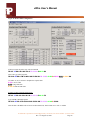
The Active Chnl bytes are MSB = 2, LSB = 0 indicating that AD0 is the only active channel. Therefore the Dig Chnl State bytes
will not be present and the AD1 channel byte will not be present. Only the AD0 byte data MSB = 0, LSB = F follow the Active
Chnl bytes. Of course the check sum byte, Ck Sum, is always there.
Notice that the RSSI data 3Dh (61 decimal) is always available. The receiver sensitivity for the Xbee Pro wireless module is
published to be –100dbm therefore margin can be calculated as (received signal strength) - (receiver sensitivity) = –61 – (–100) =
39db which is excellent.
The Src Adr or source address is 1389 hex or 5001 decimal. That, of course, is just what was programmed into the second
(remote) vWire board.
Network API mode
This mode allows a general-purpose network of up to 65,533 boards to be established using a unique 16-bit My Adr address, for
each board in the network. This network is a peer-to-peer type network where any one board can communicate directly with any
other board in the network using a packet protocol. Multiple independent networks in the same area can also be established by
using different channels (channel 12 through channel 23) for each different network.
To enable the API Network mode using the vWireCfg.exe program, set the transmission mode to API-1, UART I/O to OFF,
Sample Rate to 0 and Bound Adr to 0 on all boards. Additionally set all boards in a network to the same channel. Set each board
in the network to a unique 16-bit My Adr address. My Adr address range is from 1 to 65534. The Dest Adr address does not
matter, as this will be embedded into the transmitted command packet.
This peer-peer network is often used in a single-boss, many-workers arrangement where one and only one of the boards, the
boss, always initiates any communication with the workers in the network. A host controller is connected to the boss vWire
board and it sends command packets or receives response packets through this board’s RS232 port. The boss will address the
local vWire board or a remote worker vWire board individually using the appropriate local or remote command packet type
using the destination address set to the worker vWire board My Adr address.
If operating in a multi-boss peer-to-peer arrangement then each board can act as a boss or worker and therefore each board will
require its own host processor. Each host is then responsible for setting the desired destination address in a command packet that
it sends.
The command packet allows looking at the input and output I/O data to or from a vWire board. It also allows other parameter
values to be set or read remotely. This is useful, for example, to look at the RSSI signal strength data or to set power levels on a
particular worker board.
Command/Response Packet Protocols
Local or remote command packets, are used to send two-character ASCII commands to a given vWire wireless module. There
are many different AT commands available to set or query module parameters. See Table 10 below for some of these
commands.
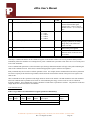
Table 10 List of Commands
Cmd
IS
Description
Force a read of all enabled inputs
Parameter(s)
-
Default
Value
-
Notes
First returns a status response
packet and then returns a data
response packet which includes
input/output state and input values.
Returns error if no DI or AD
iP Solutions Corporation • 41784 Higgins Way • Fremont, CA 94539 • Phone: (510) 651-6403
Rev 1.7a August 18, 2009
Page 20