1
UHP Software 3.0 User Manual
4
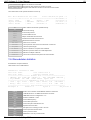
1. Glossary
16APSK
8PSK
AGC
BCH
BUC
C/N
CCM
COTM
CRTP
DAMA
DSCP
DVB
Eb/N0
EIRP
ETSI
FEC
Hard priority
HTTP
Frame
Frame plan
HUB
Hubless
HW
ICMP
IESS
IFL
IGMP
16 Amplitude and Phase-shift keying or Asymmetric Phase-shift keying, (APSK), is a digital
modulation scheme that conveys data by changing, or modulating, both the amplitude and the
phase of a reference signal (the carrier wave).
Phase-shift keying (PSK) is a digital modulation scheme that conveys data by changing, or
modulating, the phase of a reference signal (the carrier wave).
Automatic Gain Control
BCH code is a multilevel cyclic variable-length digital error-correcting code used for correcting
multiple random error patterns. BCH codes may also be used with multilevel phase-shift keying
whenever the number of levels is a prime number or a power of a prime number.
Block Up-Converter is used in the transmission (uplink) of satellite signals. It converts a band (or
"block") of frequencies from a lower frequency to a higher frequency.
Carrier-to-noise ratio, often written as CNR or C/N, is the signal-to-noise ratio (SNR) of a
modulated signal.
Constant coding and modulation. DVB-S2 mode when MODCOD is not changed during channel
operation.
Communication on the move.
Compressed Real-time Transport Protocol, header compression of IP/UDP/RTP datagrams
reduces header overhead.
Demand Assigned Multiple Access. Channel establishment on demand.
Differentiated Services Code Point (DSCP) is a 6-bit field in the header of IP packets for packet
classification purposes. DSCP replaces the outdated IP precedence, a 3-bit field in the Type of
Service byte of the IP header originally used to classify and prioritize types of traffic
Digital Video Broadcasting (DVB) is a suite of internationally accepted open standards for digital
television.
Ratio of Energy per bit (Eb) to Noise density (N0).
Effective Isotropically Radiated Power.
The European Telecommunications Standards Institute is an independent, non-profit,
standardization organization in the telecommunications industry (equipment makers and network
operators) in Europe, with worldwide projection.
In telecommunication and information theory, forward error correction (FEC) is a system of error
control for data transmission, whereby the sender adds redundant data to its messages, also
known as an error-correction code.
Method of transmission queues handling when packets from lower priority queue are not
transmitted until all packets from higher priority queue are transmitted.
Hypertext Transfer Protocol (HTTP) is an application-level protocol for distributed, collaborative,
hypermedia information systems.
Sequence of time slot s. Number of slots is frame length . Repeated every ~100 ms while
assignment of stations to slots can vary every frame.
TDMA service packet describing which station should transmit in which time slot . Generated ~10
times per second.
Central Station of satellite network that is managing all the stations and resources
Special mode of operation when all stations are transmitting to one TDMA carrier and all
receiving this carrier.
Hardware
The Internet Control Message Protocol (ICMP) is used by networked devices to send error
messages indicating, for instance, that a requested service is not available or that a host or router
could not be reached.
Intelsat Earth Station Standards
Connection from the indoor equipment (modem/router) to the outdoor equipment at the antenna
normally involves two inter-facility (IFL) cables.
The Internet Group Management Protocol (IGMP) is a communications protocol used by hosts
and adjacent routers on IP networks to establish multicast group memberships.
Document version 1.0, May 2013
4