1
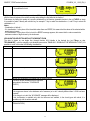
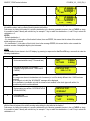
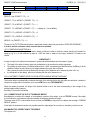
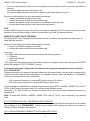
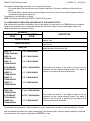
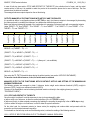
3590EXT, CPWE series indicators E-CHECK_03 _12.05_EN_U If the alibi memory is empty the message ―EMPTY‖ appears on the display for a few instants; if the ID code entered is not valid, the ―no id‖ message appears for a few instants, and then one exits the step. By entering a valid ID code, the display shows the following data, selectable through the arrow keys : Ch.X in which X is the selected channel number (always 1) Gross weight value with unit of measure; Tare weight value with unit of measure; Net weight value with unit of measure. Press C to exit the reading state of the weighs. NOTE: It is possible to read the weigh carried out also through the PC serial line (see the ―WEIGH READING‖ serial command in the following section). 16.2 SERIAL COMMANDS FOR MANAGING THE ALIBI MEMORY: !! IMPORTANT !! If the serial commands are transmitted in the format: <ESC> command <STX> in which: <ESC> is the ASCII decimal 27 character <STX> is the ASCII decimal 02 character Also the relative answer will be: <ESC> string <STX> 16.2.1 REQUEST WEIGHT VALUE WITH WEIGH ID The command which allows saving the weight in the alibi memory and the transmission is: <II>PID<CRLF> < II > = machine code, only if functioning in 485 PID = saving command of the weight data in the alibi memory CR = ASCII 13 decimal code LF = ASCII 10 decimal code If the gross weight is equal or greater than zero and stable, the instrument will save the weight on the belt in the alibi memory. And the PID string (weight/id) will be transmitted on the PC port; this is described in the following section. It is also possible to use the command <II>PIDM<CRLF> < II > = machine code, only if the 485 is used PIDM = saving command of the weight data in the alibi memory CR = ASCII 13 decimal code LF = ASCII 10 decimal code Differently than the previous command, this allows to save the last totalised weigh of the instrument in the alibi memory; therefore by transmitting the PIDM command various times after the instrument has totalised a weigh, one will obtain various times the saving of the same weigh until it has been substituted with a new one. The instrument shows the PIDM (weight/id) string described in the following paragraph. To avoid the saving of the same weigh various times, it is possible to use the <II>CIP<CRLF> command (see the description of the serial commands (TECH.MAN.REF.)), and the number of the last stored weigh and the last totalised weigh will be displayed. By executing a check on the weigh progressive, it is possible to know when a new weigh has been totalised and, by transmitting the PIDM command, and one obtains the saving of the new weight into the alibi memory. In this way it is possible to store n weighs, avoiding to store the same weigh various times. 55