1
Bluetooth Security
1 Introduction
In this document the security of Bluetooth as it relates to ECKey will be assessed.
After a general introduction to Bluetooth and a description of the approach in this
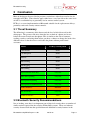
section, the threats are listed in section 2 and conclusions provided in section 3.
1.1 Background
Bluetooth wireless technology is the low-power, short-range radio technology that
allows electronic devices such as mobile phones, headsets, PDA's and notebook PC's
to speak to each other without wires. Bluetooth is the established short range wireless
technology.
1.1.1 Interference
Bluetooth wireless technology's Adaptive Frequency Hopping (AFH) capability was
explicitly designed to reduce interference between wireless technologies sharing the
2.4 GHz spectrum. AFH works within the spectrum to take advantage of the available
frequency. This is done by detecting other devices in the spectrum and avoiding the
frequencies they are using. This 'adaptive hopping' allows for more efficient
transmission within the spectrum, thereby providing the user with greater
performance, even if using other technologies along with the Bluetooth wireless
technology.
1.1.2 Range
•
•
Class 3 radios - most commonly found in mobile devices - have a range of 10
meters or 30 feet.
Class 1 radios - used primarily in industrial use cases - have a range of 100
meters or 300 feet
1.1.3 Power
The most commonly used radio (class 3) uses 1mW of power; Bluetooth wireless
technology is designed to have very low power consumption; the specification
reinforces this by allowing radios to be powered down when they are not active.
1.1.4 Name
"Bluetooth" refers to Harald Blatland, the 10th-century Danish king who unified the
Danes and Norwegians.
1.1.5 Stability
Membership - There are over 3400 members in the Special Interest Group.
Companies like IBM, Microsoft, Motorola, Nokia, DaimlerChrysler, Palm, ECKey,
are all backers of the technology.
BluetoothSecurityWhitePaperv1.1.doc
20-Jul-07
Page 1