1
definition line should start with a character different of S, C or R. Each line for object
definition should include eight parameters in the order as following explained:
-
Type: C (Cylinder), S (Sphere), R (Prism) . Cylindrical objects will be oriented
along Z axis.
-
Material: line number position in mat_names.inp file for filename defining the
desired material
-
XC, YC, ZC: central object coordinates in centimetres
-
RI, RE: Inner and outer radio for Cylinder or Sphere. X Length and Y Length for
Prism. centimetres units.
-
H: Height for cylinder and Z Length for prism. Not used in sphere.
-
PH_INC: Azimuth angle for source inclination in degrees.
-
TH_INC: Polar angle for source inclination in degrees.
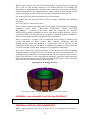
The file scanner.geo with the PENELOPE definition of geometry including
scanner and objects will be generated. To visualize the geometry it can be used the
programs gview2d.exe and gview3d.exe that PENELOPE includes and can be used in a
Windows PC. If you want to define inclusive bodies this need to be done starting from
inside to outside.
“source.inp” (Working directory): radioactive emission source definition
------ SOURCE DEFINITION -------------------------------------------------------------C 1E6 F 1 0 0 0 0 1 1 0 0 0 0 0 180 !T A U I X Y Z RI RE H PH_IN TH_IN PH TH TH1 TH2
!ONE LINE FOR EACH SOURCE
.
.
---------------------------------------------------------------------------------------
This file must contain a free first line, subsequent lines with definition of one
source in each line and at least one line indicating the end of the definition. This end of
definition line should start with a character different of S, C, P or R. Each line for object
definition should include eight parameters in the order as following explained:
-
Type: C (Cylinder), S (Sphere) , P (point source) or R (Prism). Important use capital
letter for hot regions. If cold regions (without activity) are needed use lower case c,
s and r. When defining cold regions activity, units and isotope need a value but
won’t be used and emission angles not need to be written. Cylindrical objects will
be oriented along Z axis.
-
A: Activity of the source in Becquerel or Becquerel/cc. Activity will change when
realistic time elapse. If Activity goes close to 0 simulation will stop. If long very
low activity is desired select 0 activity and time between decays will be just a little
bigger than singles dead time.
-
U: Activity units (T or F). T means Bq/cc and F means Bq. Be careful is you define
a cold region because if you use concentration activity will be always referencing to
the total hot region defined.
-
I: Number indicating the Isotope that compounds the source. Number should be
taken from isotope.inp file.
-
XC, YC, ZC: central source coordinates in centimeters
- 12 -