1
EURO-DAC 1994, c 1994 ACM 0-89791-685{9/94/0011 $ 1.50
When subranges of the instruction word occur in expressions, the according bits in the control code are
symbolically set to "C" to indicate that the instruction
provides an immediate constant at these bits, and thus
a restriction exists for setting these bits in microoperations to be executed concurrently.
7 Storage disabling
When several microoperations are packed into one microinstruction, unused storage modules must remain
unchanged. Therefore, PRISMA also extracts disabling
operations for each register or memory port. This task
is very similar to extraction of microoperations. All
(expression, precondition) pairs are computed that guarantee NOLOAD operations for each storage. Additionally,
in case of registers, versions are extracted that force a
register to store its previous value, i.e. PRISMA looks
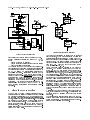
for cyclic paths within the structure. For instance, the
accu can preserve its state by setting instruction bit 15
to 1 ("NOLOAD", see g. 4 and 6), or by setting instruction bit 15 to 0 ("LOAD") and bits (9:8) to 10 ("PASS
d0" via alu). Generating these additional disabling operations can provide more alternatives for a compiler to
select from during code compaction.
8 Experimental results
PRISMA has been implemented with about 10,000 lines
of C++ code on a Sun SPARCstation 10. It has been
applied to several target structures, among them the
datapaths mentioned in [3] (di) and [5] (mssv), and
partial datapaths of the TMS320 DSP family [7] and of
the ADSP2101 signal processor [8]. Since no information about the internal controller structure is provided
for TMS and ADSP, an arbitrary VLIW controller has
been added to these structures in order to permit extraction.
structure
example
di
E1000
ADSP
mssv
mssq
TMS
# modules
15
23
18
43
8
13
29
# -OPs
20
79
48
746
53
127
545
CPU sec
0.57
0.95
0.66
305
0.90
13.76
378
Table 1: Experimental results
The results shown in table 1 indicate that instruction
set extraction is feasible even for larger realistic structures. Runtime grows rapidly with the number of extracted microoperations due to the compaction phase.
Time for compaction could be reduced by pre-sorting
the extracted operations into several groups according
to their expressions and compaction only within each
group, but this is only an implementation issue. The
number of extracted microoperations itself is mainly inuenced by features of the structural model: the number of RT level modules, the number of dierent behaviors per module, and the chaining degree within the
structure. The number of resulting microoperations is
only reduced by instruction word restrictions, such as
bit sharing (see e.g. alumux and alu in g. 4).
6
9 Conclusions
With ASIPs emerging as a new important means of
DSP system implementation, CAD tool support becomes necessary for software development for these systems. Retargetable compilers that map behavioral descriptions onto specic structures by exploiting complex instruction sets with high degree of potential parallelism have been proposed to solve this problem. Pattern matching has been identied as one key technique
in this context [5, 6]. Matching is performed between
data/control ow patterns in the behavioral description and RT patterns in the hardware structure. The
latter can be extracted from the hardware descriptions
automatically, resulting in full compiler retargetability. A prototype tool for instruction set extraction was
presented in this paper, which provides a convenient
interface between compiler and target structure, since
the possible patterns of a given structure can be computed in advance and be stored in a database. Restrictions arising from the controller structure are already
detected in this phase. During the steps of binary code
generation (allocation and code compaction), the compiler can rely on this pattern database rather than on
the RTL structure, permitting a higher level of abstraction. Experiments with realistic structures proved feasibility of instruction set extraction. Future work will
include extending the structure domain towards modules with multi-cycle operations.
References
[1] P.G.Paulin: DSP Design Tool Requirements for the
Nineties: An Industrial Perspective, 6th International
High Level Synthesis Workshop, 1992
[2] M.Mahmood, F.Mavaddat, M.I.Elmasry: Experiments
with an Ecient Heuristic Algorithm for Local Microcode Generation, Proc. International Conference on
Computer Design (ICCD), 1990, pp. 319-323
[3] M.Langevin, E.Cerny: An Automata-Theoretic Approach to Local Microcode Generation, Proc. European Design and Test Conference(EDAC), 1993, pp.
94-98
[4] L. Nowak, P. Marwedel: Verication of Hardware
Descriptions by Retargetable Code Generation, Proc.
26th Design Automation Conference, 1989, pp.441-447
[5] P.Marwedel: Tree-Based Mapping of Algorithms to
Predened Structures, Proc. International Conference
on Computer-Aided Design (ICCAD), 1993, pp. 586593
[6] C.Liem, T.C.May, P.G.Paulin: Instruction Set Matching and Selection for DSP and ASIP Code Generation,
to appear in: Proc. European Design and Test Conference (EDAC), 1994
[7] TMS320C2x User's Guide, Rev. B, Texas Instruments,
1990
[8] ADSP2101/2102 User's Manual (Architecture), Analog
Devices, 2nd Edition, 1991