1
1232
JOURNAL OF ATMOSPHERIC AND OCEANIC TECHNOLOGY
VOLUME 30
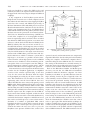
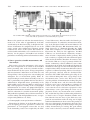
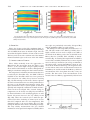
FIG. 6. NXIC CTD sedimentary fouling salinity measurement decay: (a) FSI salinity measurement decay between
service visits and (b) expanded view of the FSI salinity decay profile.
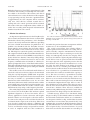
However, the general near-real-time data transfer latency
tends to be on the order of approximately 20–30 min,
as indicated by the fitted curve (Fig. 5). Despite the limitations of Orbcomm, the comparatively low cost of the
service against other satellite-based telemetry options
resulted in the choice of this system. The latencies introduced, while undesirable, were considered to be satisfactory for the purpose of FerryBox near-real-time
performance monitoring and measurement data transfer.
4. Sensor operation, scientific measurements, and
data analysis
This section reviews the performance of the sensors
that were incorporated in or trialed in the FerryBox
before presenting some of the key scientific measurements undertaken by the system. A long-term problem
with measurements undertaken in the Irish Sea and
Liverpool Bay is that of progressive sensor fouling and
subsequent loss of measurement quality. While biological fouling of sensors almost inevitably occurs over
time, a particularly acute problem has been the effect of
sedimentation. Suspended matter, particularly in the
highly turbid waters of the river Mersey and Liverpool
Bay, caused progressive fouling of the oceanographic
instrumentation as seawater was pumped through the
FerryBox instrumentation chamber. This frequently resulted in reductions in scientific measurement quality.
This problem has primarily affected the measurement of
seawater salinity and chlorophyll fluorescence, as reported previously (Balfour et al. 2007).
a. Oceanographic sensor performance evaluation
Throughout the lifetime of the FerryBox, there has
been an ongoing process in operation to evaluate the
performance of oceanographic sensors that are used
in the demanding coastal areas required by the NOC
Coastal Observatory. Previous studies had found a potential robustness of conductivity measurement advantage of the Teledyne Citadel nonexternal inductive cell
(NXIC) CTD (Teledyne RD Instruments 2010), formerly referred to as a Falmouth Scientific, Inc., (FSI)
CTD, when compared to a Sea-Bird CTD (Sea-Bird
Electronics Inc. 2007) for this application. Sea-Bird
CTDs use an electrode-based conductivity measurement cell with a comparatively smaller geometry. This
had a tendency to rapidly foul with sediment deposits
when used in the Irish Sea FerryBox. In contrast to this,
the Citadel CTD uses a larger geometry-shielded inductive conductivity cell that exhibited a more robust
measurement in the Irish Sea FerryBox. Following the
installation of this type of sensor in the FerryBox, it has
transpired that salinity measurement drift still occurs in
response to sedimentary fouling, albeit to a lesser degree
than previously observed with the Sea-Bird instrumentation. The NXIC CTD salinity plots (Fig. 6) for
data collected during 2007 show a step change in the
measurement after a service visit. This serves to illustrate the problem of instrumentation fouling. The plots
(Figs. 6a and 6b) show a roll off of measured salinity
between service visits to the FerryBox to exchange the
sensors in the engine room. The measured value recovers after the service visit before a progressive value
underestimate occurs again during the sensor set deployment. Clearly, any measurement error is undesirable, and the first step taken to address this problem was
to install a valve to stop the FerryBox chamber water
flow when the ferry was close to port. This was to suspend the measurements while the ship was in highly
turbid and disturbed near-shore waters. The penalty for
this was to interrupt the measurements when the valve
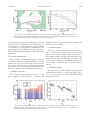
was closed. The plot (Fig. 7a) shows changes in the peak
salinity measurement per crossing. The peak salinity
value occurs as the ferry crosses the Irish Sea between