1
AES 128-Bit Implementation with Zilog Microcontrollers
Application Note
Discussion
The Advanced Encryption Standard (AES) was released by the National Institute of Standards and Technology (NIST) in November 2001. It is the successor to the Data Encryption Standard (DES), which no longer satisfies today’s security requirements due to its
short key length of 56 bits. NIST had hosted a competition for different algorithm proposals that would replace DES; the best would become the new AES standard. In the final
round of the competition, the Rijndael algorithm, named after its Belgian inventors Joan
Daemen and Vincent Rijmen, won because of its security, ease of implementation and
small-footprint memory requirements.
There are currently three different versions of AES; all of them have a block length of 128
bits, whereas key length is allowed to be 128, 192 or 256 bits. For the purposes of this
application note, only a key length of 128 bits is discussed.
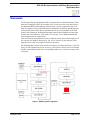
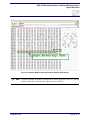
The AES algorithm consists of ten rounds of encryption, as indicated in Figure 1. The 128bit key is first expanded into eleven round keys, each of them 128 bits in size. Each round
includes a transformation that uses a corresponding cipher key to ensure the security of the
encryption.
Figure 1. AES Encryption Algorithm
AN033801-0812
Page 2 of 34