1
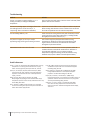
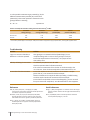
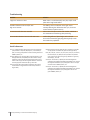
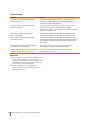
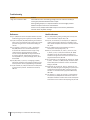
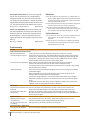
Troubleshooting
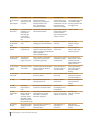
Problem
Solution
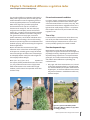
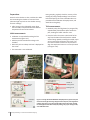
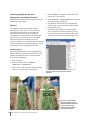
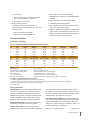
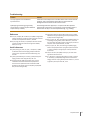
How should the main tiller be identified after tillering?
The main tiller can be identified as the longest and most
advanced (i.e., with most number of developed leaves). To
do this, arrange all tillers from a single plant with their basal
nodes together and select the culm which is the longest
from the base of the stem to the tip of the newest fully
expanded leaf.
In-field identification of the terminal spikelet
(for GS30 determination) is difficult and/or
time consuming.
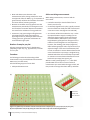
For in-field identification of multiple plots, it is more
useful to identify the first detectable node at
1 cm above tillering node (GS31).
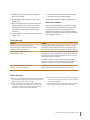
In drought stressed trials the spike has not emerged
from the boot before anthesis.
In order to identify the date of the anthesis for such
trials, it may be necessary to open the flag leaf sheath
to reveal the spike or to determine the date of anthesis
retrospectively from the length of the developing grain.
Comparison of developmental data across genotypes
and sites does not show a clear relationship
with time in days.
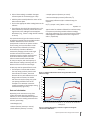
It is more meaningful to use thermal time, as
temperature drives the rate of development.
References
Useful references
Tottman, DR. and Broad, H. (1987) The decimal code for the growth
stages of cereals, with illustrations. Annals of Applied Biology
110, 441–454.
University of Bristol. (2011) Wheat: The big picture. Bristol Wheat
Genomics. Available at: http://www.wheatbp.net/ (accessed 11
January 2012).
Zadoks, JC., Chang, TT. and Konzak, CF. (1974) A decimal code for
growth stages of cereals. Weed Research 14, 415–421.
Stapper, M. (2007) Crop Monitoring and Zadoks Growth
Stages for Wheat. CSIRO Plant Industry, Canberra, ACT.
Available at: http://www.biologicagfood.com.au/wheatmanagement/crop-monitoring-and-zadoks-growth-stages/
(accessed 10 January 2012).
Sylvester-Bradley, R., Berry, P., Blake, J., Kindred, D., Spink, J.,
Bingham, I., McVittie, J. and Foulkes, J. (2008) The Wheat
Growth Guide. Pp. 30, Home-Grown Cereals Authority, 2nd
Edition. HGCA, London. Available at: http://www.hgca.com/
(accessed 6 January 2011).
Direct growth analysis
77