1
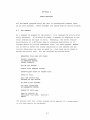
where outfilei is an output file and
infile~
are input
1
More than two input files can be specified in the function call,
files.
and inf ile
but DORA accepts only the first two requested.
These files must be in
floating point format; if they are not, they must be reformatted using
the AIPOS TRANSFER function (refer to section 3.4.2).
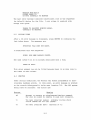
After the input files are specified to Job Control, DORA creates three
working areas, each of which initially contains a copy of one of the
original files, and which will, during processing, contain the current
version of the data files.
areas
~'
1 and T.
These areas are referred to as working
Initially, working areas 1 and T each contain a
~ contains a copy of
1
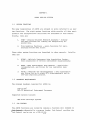
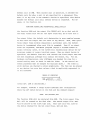
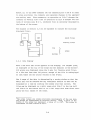
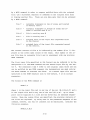
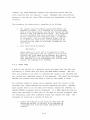
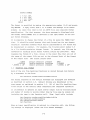
initial allocation can be considered graphically:
copy of infile
and working area
infile~.
This
input files
working areas
~
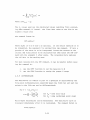
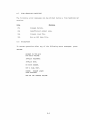
The constants
in working areas
and 1 are used in DORA commands to refer to the files
~
and 1.
Using the DORA commands, files
~
and 1 can
be modified, but the original data files are always left untouched.
Thus, working areas
nent files.
~
and 1 are temporary storage areas for the perma-
The devices that contain the working areas are derived
from the output files specification to Job Control.
If two output files
(and hence two devices) are specified, those devices will hold DORA's
working areas.
If no output file is specified, the device that will
contain the working area is as defined for default devices, section
1.6.
For system optimization, two output files should be specified,
particularly for disk configurations that are started from LINCtape,
so that Job Control is cognizant of all available devices.
Devices
that are not defined in the DORA call to Job Control or do not have a
sufficiently large working area are not used by DORA.
Working area
allocation requires that sufficient space is available on the specified (or default) devices.
If a disk is available, DORA tries to put
both working areas there rather than one on disk and one on LINCtape
for I/O optimization.
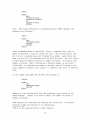
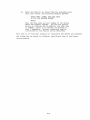
For example, the call
LT~:DORA DK~:OFl,LTl:OF2=DK~:IFl,IF2
2-2