1
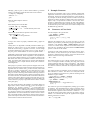
Although g may be given f , whose contract matches g’s domain
contract, g should also accept functions with stricter contracts:
h : int[> 9] → int[50,99]
val rec h = λ x. · · ·
g(h ),
functions without explicit contracts:
g(λ x. 50),
functions that process external data:
read num : int[> 9] → int[0,99]
val rec read num = λ n. · · · read the nth entry from a file · · ·
g(read num),
2
Example Contracts
We begin our presentation with a series of Scheme examples that
explain how contracts are written, why they are useful, and how to
check them. The first few examples illustrate the syntax and the basic principles of contract checking. Sections 2.2 and 2.3 discuss the
problems of contract checking in a higher-order world. Section 2.4
explains why it is important for contracts to be first-class values.
Section 2.5 demonstrates how contracts can help with callbacks,
the most common use of higher-order functions in a stateful world.
To illustrate these points, each section also includes examples from
the DrScheme [5] code base.
2.1
Contracts: A First Look
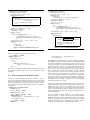
and functions whose behavior depends on the context:
val rec dual purpose = λ x.
if · · · predicate on some global state · · ·
then 50
else 5000.
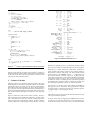
The first example is the sqrt function:
;; sqrt : number → number
(define/contract sqrt
((λ (x) (≥ x 0)) 7−→ (λ (x) (≥ x 0)))
(λ (x) · · ·))
as long as the context is properly established when g applies its
argument.
Following the tradition of How to Design Programs [3], the sqrt
function is proceeded by an ML-like [23] type specification (in a
comment). Like Scheme’s define, a define/contract expression
consists of a variable and an expression for its initial value, a function in this case. In addition, the second subterm of define/contract
specifies a contract for the variable.
Clearly, there is no algorithm to statically determine whether proc
matches its contract, and it is not even possible to dynamically
check the contract when g is applied. Even worse, it is not enough
to monitor applications of proc that occur in g’s body, because g
may pass proc to another function or store it in a global variable.
Additionally, higher-order functions complicate blame assignment.
With first-order functions, blame assignment is directly linked to
pre- and post-condition violations. A pre-condition violation is the
fault of the caller and a post-condition violation is the fault of the
callee. In a higher-order world, however, promises and obligations
are tangled in a more complex manner, mostly due to functionvalued arguments.
In this paper, we present a contract system for a higher-order world.
The key observation is that a contract checker cannot ensure that g’s
argument meets its contract when g is called. Instead, it must wait
until proc is applied. At that point, it can ensure that proc’s argument is greater than 9. Similarly, when proc returns, it can ensure
that proc’s result is in the range from 0 to 99. Enforcing contracts in
this manner ensures that the contract violation is signaled as soon as
the contract checker can establish that the contract has indeed been
violated. The contract checker provides a first-order value as a witness to the contract violation. Additionally, the witness enables the
contract checker to properly assign blame for the contract violation
to the guilty party.
The next section introduces the subtleties of assigning blame for
higher-order contract violations through a series of examples in
Scheme [8, 16]. Section 3 presents λC ON , a typed, higher-order
functional programming language with contracts. Section 4 specifies the meaning of λC ON , and section 5 provides an implementation
of it. Section 6 contains a type soundness result and proves that the
implementation in section 5 matches the calculus. Section 7 shows
how to extend the calculus with function contracts whose range depends on the input to the function, and section 8 discusses the interactions between contracts and tail recursion.
Contracts are either simple predicates or function contracts. Function contracts, in turn, consist of a pair of contracts (each either a
predicate or another function contract), one for the domain of the
function and one for the range of the function:
CD 7−→ CR.
The domain portion of sqrt’s contract requires that it always receives a non-negative number. Similarly, the range portion of the
contract guarantees that the result is non-negative. The example
also illustrates that, in general, contracts check only certain aspects
of a function’s behavior, rather than the complete semantics of the
function.
The contract position of a definition can be an arbitrary expression
that evaluates to a contract. This allows us to clarify the contract
on sqrt by defining a bigger-than-zero? predicate and using it in the
definition of sqrt’s contract:
;; bigger-than-zero? : number → boolean
(define bigger-than-zero? (λ (x) (≥ x 0)))
;; sqrt : number → number
(define/contract sqrt
(bigger-than-zero? 7−→ bigger-than-zero? )
(λ (x) · · ·))
The contract on sqrt can be strengthened by relating sqrt’s result to
its argument. The dependent function contract constructor allows
the programmer to specify range contracts that depend on the value
of the function’s argument. This constructor is similar to 7−→, except that the range position of the contract is not simply a contract.
Instead, it is a function that accepts the argument to the original
function and returns a contract:
d
CD 7−→ (λ (arg) CR )