1
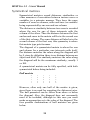
Chapter 2 - Analyses to be maintained, so that the resulting dendrogram reflects the similarity between adjacent cases. This is obviously very useful for stratigraphical studies in which the original order is of importance. Constrained clustering can be performed as a variation of any of the above agglomerative procedures. Instead of scanning the whole distance matrix for the most similar objects, constrained clustering scans just the distances of adjacent cases. Otherwise it can be calculated as described above. Diversity Indices This procedure computes three diversity indices commonly used in ecology, Simpson’s, Shannon’s, and Brillouin’s. See Pielou (1969) and Krebs (1989) for a discussion of the use and derivation of these indices. Two variations of Simpson’s are available. The most commonly presented form, which is labeled simply “Simpson’s” in the drop-down list on the dialog box, is based on the following formula: s D = 1 − ∑ pi 2 i =1 where: D = Simpson’s diversity index pi = Proportion of species i in the community s = Number of species This version is appropriate for samples taken from an infinite population and may be applied to measures of biomass and cover as well as individual counts. However, it is a biased estimator of the true diversity index for the whole population. An unbiased version (labeled “Simpson’s unbiased” in the MVSP diversity dialog) is proposed by Pielou (1969): s n ( n − 1) D =1− ∑ i i i =1 N ( N − 1) 61