1
 Elgin/Lake Huron SCADA Upgrades
SCADA Standards
Section 500 Software Programming Guidelines
Version 8
8. Additional program standards are as follows:
a. Use the status of any field input only once at the beginning of the ladder to drive the status of a, logic
relay/bit or register/word (point). Rungs that perform this "translation" of all field inputs form the top
section of the ladder. Logic points are then used in all later rungs, rather than the field inputs.
b. Use only logic points in the second section of the ladder. This section contains the rungs that form the
actual control logic.
c. Use logic points to drive the field outputs in the third section of the ladder. Place any field output coil as
an output in only 1 rung.
d. Place all checks for device response together with a timer for each. Certain controllers have a built in
function to do feedback checks, so this section may not be necessary.
e. Group all registers/words and relays/bits that are of interest to monitoring personnel in sequential blocks.
This includes setpoints, timer limits, tuning constants, and status flags. This simplifies the transfer of this
data to supervisory systems. Maintain the "translated" field inputs (as per B above) in separate block(s)
from other data.
f. Use constants in the code only where it is unlikely they will ever be changed.
g. Layout I/O points having functions for successive devices in identical, consecutive blocks. For example,
group the start/stop outputs for all low lift pumps in similar order and in adjacent terminals.
h. Avoid latches.
i. Avoid jumps.
j. Avoid drum sequencers.
k. Label every register/word, relay/bit, and rung with a name or comment.
l. Don't sacrifice program clarity and simplicity to achieve higher execution speed and smaller code size.
9. All PLC programs shall conform to IEC-1131 and IEC-848. In addition, the programs written for critical or
hazardous applications shall conform to CAN/CSA-Q396 Quality Assurance Program for the Development of
Software Used in Critical Applications.
10. Each control program shall be identified by its version number (Vx.x) and its name. The location of each copy
of the program shall be recorded.
4.
Documentation
4.1 Program Listings
1. All applications programs shall be listed in the control language used by the hardware running the program.
The listings should show the compiled control language if a compiler is required to convert the program into a
runtime version.
2. The entire program shall be annotated. Each I/O, derived value, register and coil, subroutine and object shall
be identified by a descriptor. Values of tuning parameters and constants shall be included.
4.2 Parameter Listings
1. All parameters used in application programs shall be listed. These lists include I/O lists for controllers,
historical data bases and operator stations. Software addresses for I/O and derived values shall be included
for controllers that allow addresses to be used in applications programs. The list shall show the software
address and descriptor for each point. For real I/O, the list must also show the hardware address.
5.
Programming
5.1 Memory Organization
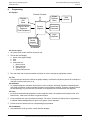
1. PLC memory shall be organized into three major sections:
a. I/O Registers
b. Control
c. Communication
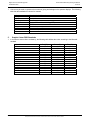
2. Each section should contain memory for expansion up to the overall limit defined in the technical specifications
for the PLC. Within each section, the memory should be further organized into logical blocks as shown in the
Memory Partition Table.
3. I/O Registers:
EA LH SCADA Standards 500 v8.doc
The only actual version of this document is the web site, not a printed version.
If this printout is more than 24 hours old, check web site for a more current version. Printed 1/18/2011
7 of 23