1
Appendix C: TCP/IP Reference Information
Appendix C: TCP/IP Reference Information
This appendix provides background information on TCP/IP addressing, Windows ® 95 TCP/IP
configuration for LAN use, and information on configuring an EDAS unit using a serial
communications program.
C.1 IP Addresses, Gateway Addresses and Subnet Masks
EDAS-1000 Series Ethernet Data Acquisition Systems connect to and communicate over
Ethernet (IEEE 802.3 10Base-T) Local Area Networks (LANs) and use Transmission Control
Protocol/Internet Protocol (TCP/IP, a standard networking protocol that provides
communication across interconnected networks, including the public Internet).
TCP/IP uses three basic pieces of information to successfully transmit and receive data between
devices (or hosts) on networks: The IP address, Gateway address and Subnet Mask.
Every host on a TCP/IP network is identified by a unique 32-bit IP address. IP addresses are
typically represented using “dotted decimal notation”. Using this format, each byte (8-bit
segment) of the 32-bit address is represented by a decimal number (0-255) and separated by a
period.
A gateway address is the IP address of a router or gateway device on the network. A gateway
links one network to another and always has at least two network interfaces. If a host on one
network wants to communicate with a remote host on another network, the gateway will
recognize that the IP address of the remote host is not on the local network and will route the
data to the next network. Depending on the number of interconnected networks, the data may be
routed through several (or many) gateways until the destination host is reached.
An IP address is actually divided into two sections. One section defines a Network ID and
another section defines a Host ID. The purpose of a subnet mask is to define or separate the
Network and Host ID portions of an IP address. As you might guess, the Network ID
distinguishes a group of computers and other devices on the same network. The Host ID
identifies a computer or other device within that network. Before showing an example subnet
mask, it will help to understand the various network classes that have been defined for public
Internet use.
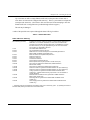
There are three IP network classes for accommodating internetworks of different sizes. The
network class (A, B or C) is identified by the first byte of its IP address. The table below shows
the Network ID and Host ID fields defined for each network class. The letters W.X.Y.Z are used
to represent the 4 bytes of the IP address.
43