1
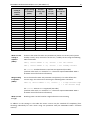
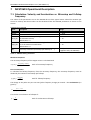
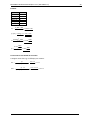
MCST3601 Hardware Manual (Rev. 0.91 / 2014‐MAY‐27) 7 21 MCST3601 Operational Description 7.1 Calculation: Velocity and Acceleration vs. Microstep and Fullstep Frequency The values of the parameters sent to the TMC429 do not have typical motor values like rotations per second as velocity. But these values can be calculated from the TMC429 parameters as shown in this section. PARAMETERS OF TMC429 Signal Description Range fCLK Clock‐frequency 16 MHz velocity ‐ 0… 2047 a_max Maximum acceleration 0… 2047 Divider for the velocity. The higher the value is, the less is pulse_div the maximum velocity 0… 13 default value = 0 Divider for the acceleration. The higher the value is, the ramp_div less is the maximum acceleration 0… 13 default value = 0 0… 8 (a value of 7 or 8 is internally Usrs Microstep‐resolution (microsteps per fullstep = 2usrs) mapped to 6 by the TMC429) Table 7.1 TMC429 velocity parameters MICROSTEP FREQUENCY The microstep frequency of the stepper motor is calculated with usf [ Hz ] f CLK [ Hz ] velocity 2 pulse _ div 2048 32 with usf: microstep‐frequency FULLSTEP FREQUENCY To calculate the fullstep frequency from the microstep frequency, the microstep frequency must be divided by the number of microsteps per fullstep. fsf [ Hz ] usf [ Hz ] 2 usrs with fsf: fullstep‐frequency The change in the pulse rate per time unit (pulse frequency change per second – the acceleration a) is given by a 2 f CLK 2 a max pulse _ div ramp _ div 29 This results in acceleration in fullsteps of: a af 2 usrs with af: acceleration in fullsteps