1
3 – Inflation control
Regardless of the type of packer or the inflation
method, it is critically important to have an inflation
system that provides sufficient control and monitoring
functions. The assembly shown in figure 4 (or equivalent
set-up) is considered to be the minimum for safe,
efficient operations. The system basically requires: a
pressure source, an isolating valve, a vent valve, a
pressure gauge, suitable hose to connect to the packer
and between the other items.
suitable inflation fluid , inflation control and monitoring
system , it’s time to connect it all up and trial inflate the
packer. If gas inflating, trial inflations should only be
performed in a pipe of adequate thickness and with
appropriate safety precautions. If inflating with a fluid, trial
inflations may be performed free in air but are probably
more usefully done in a pipe .
Trial inflation allows the operator to check for system
performance and leaks. Specifically, the operator should
be checking inflation pressure to firm contact with the test
pipe wall and packer integrity at the maximum pressure.
It is best to perform trial inflations with the full length of
inflation tube that will be run in the hole to reach the
maximum setting depth of the packer. This allows the
operateor to time inflation and deflation, get a indication
of pumping pressures during different stages of inflation
and, for a liquid inflated packer, primes both the packer
and the inflation tube.
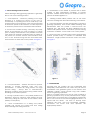
figure 4
Remarks
? The pressure gauge cannot be accidentally isoled
from the packer and so always indicates the packer
pressure.
? The pressure source is independently isolated from the
packer. This is of great importance with gas regulator
since they can easely be set at very high pressures or
not be properly shut down. In fact, the temptation is to
leave the regulated gas connected to the packer at
pressure which may lead to packer over-expansion and
sub-sequent failure.
? The vent valve ensures that the packer can be safely
deflated.
? Being small, self contained and portable (if provided
with suitable hose lengths), the gauge set can be
moved to the most convenient location to control and
monitor the packer during inflation and grouting
operations.
Clearly, all components used in the inflation control
system must be adequate pressure rating. In the case of
gas inflation, if operating deep in a water filled hole the
surface gas pressure may easely be over 70 bar and
adequate precautions are required. The pressure gauge
should be chosen such that the maximum inflation
pressure lies in the middle third of the gauge’s scale.
Pressure gauges are delicate instruments that require
careful treatment and regular calibration to ensure their
reliable operation.
The general characteristics of packers whether inflated
with liquid or gas is that the bulk of the inflation volume is
placed into the packer at relatively low pressure and it is
only the last little bit of volume that is placed at
increasingly higher pressure. Charting inflation pressure
against time leads a curve showing low, steady pressure
increase over an extended period followed by a rapid
pressure increase (after wall contact is achieved) in a
relatively very short time. This characteristic takes some
time to getting used to and operators should be
encouraged to use the trial inflations to accustom
themselves to the pressure, volumes and times involved.
5 – Deploying the packer
The usual deployment methods are via a rigid pipe or a
hose. The later is quicker but provides limited depth
control, no packer hold-down capacity and limited
support for inflation tubes. It’s also depth limited by the
self-supporting capacity of the hose and it’s connection to
the packer for which reason a safety wire is sometimes
used along with the hose. Depth limitations may also be
due to the handling capacity of the hose raising and
lowering system which is frequently manual.
Using a rigid pipe for running the packers offers good
depth control, good support for inflation tubes and some
hold-down capacity. However it generally requires a
mechanized system (drill rig or crane) to handle the rods
due to their length and weigth and thus is much slower
and more cumbersome.
4 – Inflating the packer
Once the packer size has been chosen along with a
Bimbar inflatable packers - Instructions for use
Page 5