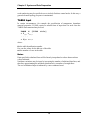
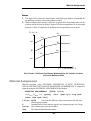
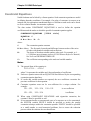
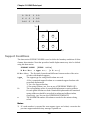
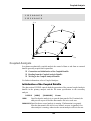
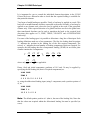
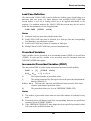
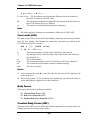
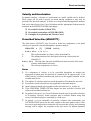
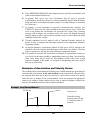
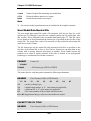
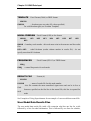
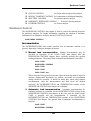
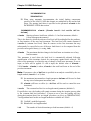
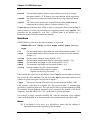
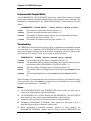
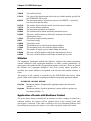
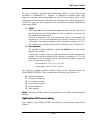
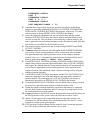
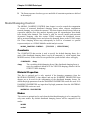
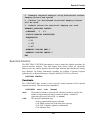
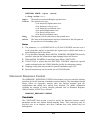
1
Solver Reference Manual LUSAS Version 14.5 : Issue 1 LUSAS Forge House, 66 High Street, Kingston upon Thames, Surrey, KT1 1HN, United Kingdom Tel: +44 (0)20 8541 1999 Fax +44 (0)20 8549 9399 Email: [email protected] http://www.lusas.com Distributors Worldwide Copyright ©1982-2010 LUSAS All Rights Reserved. Table of Contents Table of Contents Notation................................................................................................... iii Chapter 1 Introduction ................................................................................ 1 Introduction ............................................................................................. 1 LUSAS Data Chapters ............................................................................. 1 Chapter 2 Syntax and Data Preparation .................................................... 7 Reading and Writing LUSAS Data Syntax .............................................. 7 Chapter 3 LUSAS Data Input..................................................................... 13 System Parameters ............................................................................... 13 Problem Definition ................................................................................. 15 Data Groups ........................................................................................... 17 Element Topology.................................................................................. 17 Solution Order ....................................................................................... 20 Solver Type ............................................................................................ 22 Nodal Coordinates ................................................................................. 25 Geometric Properties ............................................................................ 43 Composite Geometry............................................................................. 46 Geometric Assignments ........................................................................ 47 Material Properties ................................................................................ 47 Linear Material Properties ..................................................................... 48 Matrix Properties ................................................................................... 57 Joint Material Properties ....................................................................... 58 Material Properties Mass ....................................................................... 72 Nonlinear Material Properties ............................................................... 73 Field Material Properties ..................................................................... 133 Material Assignments .......................................................................... 139 Composite Material .............................................................................. 140 Composite Assignments ..................................................................... 142 Element Ages ....................................................................................... 142 Activate/Deactivate Elements ............................................................. 143 Damping Properties............................................................................. 152 Slidelines.............................................................................................. 153 Thermal Surfaces................................................................................. 169 Nodal Freedoms................................................................................... 188 Freedom Template ............................................................................... 189 Cartesian Sets...................................................................................... 190 Transformed Freedoms ....................................................................... 193 Constraint Equations........................................................................... 194 Support Conditions ............................................................................. 196 Coupled Analysis................................................................................. 199 Structural Loading ............................................................................... 201 General Point/Patch Loads.................................................................. 223 Field Loading ....................................................................................... 228 i Table of Contents Curve Definition ................................................................................... 233 Retained Freedoms ............................................................................. 239 Output Control ..................................................................................... 240 Load Combinations ............................................................................. 246 Enveloping Results ............................................................................. 247 Superelements..................................................................................... 247 Analysis Control .................................................................................. 268 Nonlinear Control ................................................................................ 269 Dynamic Control .................................................................................. 284 Transient Control................................................................................. 290 Viscous Control ................................................................................... 293 Eigenvalue Control .............................................................................. 301 Guyan Control ..................................................................................... 306 Modal Damping Control ...................................................................... 308 Spectral Control................................................................................... 311 Harmonic Response Control ............................................................... 313 Fourier Control .................................................................................... 316 Creating a Plot File .............................................................................. 318 Restart Facilities .................................................................................. 318 Re-Solution .......................................................................................... 321 End ....................................................................................................... 322 Appendix A LUSAS User Options .......................................................... 323 LUSAS User Options ........................................................................... 323 LUSAS User Options by Category ...................................................... 329 Appendix B Nonlinear Hardening Material Convention ........................ 335 Nonlinear Hardening Material Convention ......................................... 335 Appendix C Material Model Interface ..................................................... 339 Solver User Interface Routines ........................................................... 339 Programming Rules............................................................................. 341 Declaration........................................................................................... 342 User Defined Constitutive Models ...................................................... 343 User Defined Resultant Models .......................................................... 354 User Defined Joint Models .................................................................. 363 User Defined Creep Models ................................................................ 371 User Defined Damage Models............................................................. 375 User Defined Friction Models.............................................................. 378 User-Defined Rate of Internal Heat Generation .................................. 381 Utility Routines .................................................................................... 386 ii Notation Notation A Ap As, Asy, Asz A1 ... An ar s x, y, z, xy, xz, yz x, y, z br r C Ci C0 C1, C2 c co Dij du, dq E Ep Ex, Ey, Ez ep ey, ez x, y, z s e c p Fx, Fy, Fz Fyld F fc’ f t’ x, y, z xy, xz, yz G Gf Gxy, Gxz, Gyz x, y, z Cross sectional area Plastic area Effective shear area Nodal cross sectional areas Mass Rayleigh damping constant Coefficient of thermal expansion Softening parameter Orthotropic thermal expansion coefficients Angular accelerations (radians/sec2) Stiffness Rayleigh damping parameter Shear retention factor/parameter Principal stresses direction (radians) Specific heat capacity (i)th hardening stiffness Neo-Hookean rubber model constant Mooney-Rivlin rubber model constants Cohesion Initial cohesion Rigidity coefficients Relative displacement, rotation Modulus of elasticity (Young‟s modulus) Elasto-plastic modulus Orthotropic modulus of elasticity Strain at peak compressive strength Eccentricity Direct strains (local or global) Maximum shear strain Von Mises equivalent strain Creep strains Equivalent plastic strain Forces (local or global) Yield force Deformation gradient Compressive strength of concrete Tensile strength of concrete Flexural strain resultants Torsional strain resultants Shear modulus Fracture energy Orthotropic shear modulus values Membrane strain resultants iii Notation x, y, z H HI1 HK1 hc hr x, y, z 1 , 2 a , b Iy, Iz Iyy, Izz Iyz J K Kc Kl Ko Kt k kx, ky, kz kr Li 1, 2, 3 M mx, my, mz Mx, My, Mz Mx, My, Mz, Mq Mxy, Mxz, Myz M1, M2 ri, ri Nx, Ny, Nz, Nq Nx, Ny, Nxy Nmax, Nmin Ns Ne xy, xz, yz Px, Py, Pz Q qa qv Field gradients (local or global) Enthalpy Isotropic hardening parameter Kinematic hardening parameter Convective heat transfer coefficient Radiative heat transfer coefficient Rotations (local or global) Loof node rotations (local) Nodal rotations for thick shells Angle defining principal directions of l1, l2 1st moments of inertia 2nd moments of inertia Product moment of inertia Volume ratio (determinant of F) Spring stiffness Contact stiffness Lift-off stiffness Original gap conductance Torsional constant Thermal conductivity Orthotropic thermal conductivity values Bulk modulus Hardening stiffness Limit of (i)th hardening stiffness Principal stretches Mass Mass in element local directions Concentrated moments (local or global) Flexural moments (local or global) Torsional moments (local or global) Concentrated loof moments (local or global) Coulomb friction coefficient Ogden rubber model constants Membrane resultants (local or global) Stress resultants Principal stress resultants Maximum shear stress resultant Von Mises equivalent stress resultant Poisson‟s ratio Orthotropic Poisson‟s ratio Concentrated loads (global) Mass density Field loading for nodes Field face loading intensity Field volume loading intensity iv Notation qx, qy, qz qs Sp y yo x, y, z max, min xy, xz, yz s e T T, To t1 ... tn U, V, W e o Vx, Vy, Vz V11, V12 ... V33 Wx, Wy, Wz X, Y, Z Xcbf, Ycbf, Zcbf Xo, Yo, Zo y1, z1 ... y4, z4 Zyp, Zzp Zyyp, Zzzp x, y, z Field fluxes (local or global) Stress potential parameters Plastic shear area Yield stress Initial uniaxial yield stress Direct stresses (local or global) Principal stresses Shear stresses (local or global) Maximum shear stress Von Mises equivalent stress Temperature Final, initial temperatures Nodal thicknesses Displacements (global) Field variable External environmental temperature Frictional angle Initial frictional angle Body force potential Nodal initial velocities (global) Left stretch tensor components Uniformly distributed load intensities Nodal coordinates (global) Constant body forces (global) Offsets of finite element model coordinate system from point about which global angular acceleration and velocities are applied Cross sectional coordinates (local) Torsional plastic modulus values Flexural plastic modulus values Frequency of vibration Angular velocities (global) (radians/sec) v Notation vi Introduction Chapter 1 Introduction Introduction This manual contains details of the data sections available for input in a LUSAS datafile. The data sections required at any one time will depend upon the type of analysis to be carried out. Some of the sections are of specialised application, others are general to all problems. For example, the ELEMENT TOPOLOGY and NODE COORDINATES sections are required to define the problem in all analyses, however, the thermal conductivity of a material is only applicable to a heat transfer analysis. The specialised sections are referenced in the Modeller User Manual where a brief description is available of the problem type to which the command applies. LUSAS Data Chapters A full list of LUSAS data chapters, in the order in which they must be specified, is shown below. Data section Description SYSTEM PROBLEM UNITS OPTION GROUP ELEMENT TOPOLOGY SOLUTION ORDER SOLVER FRONTAL SOLVER CONJUGATE GRADIENT System parameters Problem definition Unit definition User options Grouped data Element topology Equation solution order Solve using Frontal method Solve using iterative Conjugate Gradient method Node coordinates Local Cartesian coordinates Local cylindrical coordinates NODE COORDINATES LOCAL CARTESIAN COORDINATES LOCAL CYLINDRICAL COORDINATES LOCAL SPHERICAL COORDINATES 1 Local spherical coordinates Chapter 1 Introduction Data section Description GLOBAL CARTESIAN COORDINATES SPACING SPACING ARC RATIOS QUADRILATERAL SPACING COPY NODES RENUMBER NODES DELETE NODES GEOMETRIC PROPERTIES COMPOSITE GEOMETRY Global Cartesian coordinates Spacing of nodes on a line Spacing of nodes on an arc Spacing of nodes in a quadrilateral Copying nodes Renumbering nodes Deleting nodes Geometric properties Laminated/composite shell/solid thicknesses Geometric property assignments Isotropic model Orthotropic plane stress model GEOMETRIC ASSIGNMENTS MATERIAL PROPERTIES MATERIAL PROPERTIES ORTHOTROPIC MATERIAL PROPERTIES ORTHOTROPIC PLANE STRAIN MATERIAL PROPERTIES ORTHOTROPIC THICK MATERIAL PROPERTIES ORTHOTROPIC AXISYMMETRIC MATERIAL PROPERTIES ORTHOTROPIC SOLID MATERIAL PROPERTIES ANISOTROPIC MATERIAL PROPERTIES ANISOTROPIC SOLID RIGIDITIES MATRIX PROPERTIES STIFFNESS MATRIX PROPERTIES MASS MATRIX PROPERTIES DAMPING JOINT PROPERTIES JOINT PROPERTIES GENERAL JOINT PROPERTIES NONLINEAR 31 JOINT PROPERTIES NONLINEAR 32 JOINT PROPERTIES NONLINEAR 33 JOINT PROPERTIES NONLINEAR 34 JOINT PROPERTIES NONLINEAR 35 MATERIAL PROPERTIES MASS PLASTIC DEFINITION MATERIAL PROPERTIES NONLINEAR 75 MATERIAL PROPERTIES NONLINEAR 64 Orthotropic plane strain model Orthotropic thick model Orthotropic axisymmetric model Orthotropic solid model Anisotropic model Anisotropic model for solid elements Linear rigidity model Stiffness matrix property definition Mass matrix property definition Damping matrix property definition Standard linear joint model General linear joint model Standard elasto-plastic joint model General elasto-plastic joint model Nonlinear smooth contact model Nonlinear frictional contact model Nonlinear viscous damper model Mass for non-structural mass elements Nonlinear plasticity material data Optimised implicit Von Mises model Drucker-Prager yield surface model 2 LUSAS Data Chapters Data section Description MATERIAL PROPERTIES NONLINEAR 61 MATERIAL PROPERTIES NONLINEAR 65 MATERIAL PROPERTIES NONLINEAR 94 MATERIAL PROPERTIES NONLINEAR 29 MATERIAL PROPERTIES NONLINEAR USER MATERIAL PROPERTIES NONLINEAR RESULTANT USER VISCOUS DEFINITION CREEP PROPERTIES CREEP PROPERTIES USER VISCOELASTIC PROPERTIES VISCOELASTIC PROPERTIES USER DAMAGE PROPERTIES DAMAGE PROPERTIES USER DAMAGE PROPERTIES HASHIN TWO PHASE MATERIAL MATERIAL PROPERTIES RUBBER MATERIAL PROPERTIES NONLINEAR 81 MATERIAL PROPERTIES NONLINEAR 86 MATERIAL PROPERTIES NONLINEAR 89 MATERIAL PROPERTIES NONLINEAR 27 MATERIAL PROPERTIES NONLINEAR 26 MATERIAL PROPERTIES NONLINEAR 25 SHRINKAGE PROPERTIES CEB_FIP_90 SHRINKAGE PROPERTIES GENERAL SHRINKAGE PROPERTIES USER MATERIAL PROPERTIES FIELD ISOTROPIC MATERIAL PROPERTIES FIELD ORTHOTROPIC Tresca yield surface model Non-Associated Mohr-Coulomb yield surface model Nonlinear multi-crack concrete model Stress resultant elasto-plastic model User defined nonlinear material model User defined nonlinear resultant material model Viscous material data Creep material properties User defined creep material properties Viscoelastic properties User defined viscoelastic properties Damage properties User defined damage model Hashin damage model for composites Two phase material parameters Rubber material properties Volumetric crushing model CEB-FIP creep model Generic polymer material model 2D elasto-plastic interface model 3D elasto-plastic interface model Delamination interface properties Concrete shrinkage properties General shrinkage properties User defined shrinkage model Isotropic field model Orthotropic field model 3 Chapter 1 Introduction Data section Description MATERIAL PROPERTIES FIELD ORTHOTROPIC SOLID MATERIAL PROPERTIES FIELD LINK 18 MATERIAL PROPERTIES FIELD LINK 19 COMPOSITE MATERIAL PROPERTIES MATERIAL ASSIGNMENTS COMPOSITE ASSIGNMENTS ELEMENT AGES Orthotropic solid field model Linear convection/radiation model Nonlinear convection/radiation model DEACTIVATE ELEMENTS ACTIVATE ELEMENTS DAMPING PROPERTIES SLIDELINE PROPERTIES SLIDELINE PROPERTIES USER SLIDELINE_SURFACE DEFINITION SLIDELINE ASSIGNMENTS THERMAL GAP PROPERTIES LINEAR THERMAL GAP PROPERTIES GENERAL THERMAL CONTACT PROPERTIES THERMAL RADIATION PROPERTIES THERMAL ENVIRONMENT PROPERTIES THERMAL RADIATION SYMMETRY THERMAL_SURFACE SYMMETRY ASSIGNMENT THERMAL_SURFACE DEFINITION THERMAL_SURFACE PROPERTY ASSIGNMENT THERMAL ASSIGNMENT VIEW_FACTOR OUTPUT ENVIRONMENTAL NODE DEFINITION ENVIRONMENTAL NODE ASSIGNMENTS Laminated/composite shell/solid materials Material property assignments Composite property assignments Age of elements when using CEB-FIP concrete model Deactivate elements Activate elements Frequency dependent Rayleigh parameters for viscous and/or structural damping Slideline property definition User defined slideline properties Slideline surface definition Slideline property assignments Linear thermal gap properties General thermal gap properties Thermal contact properties Thermal radiation properties Thermal environment properties Thermal radiation symmetry planes Thermal radiation symmetry surface Thermal surface definition Thermal surface property assignment Thermal gap and radiation surface assignment View factor output control Environmental node definition Environmental node assignment 4 LUSAS Data Chapters Data section Description NODAL FREEDOMS Number of freedoms at a node for thick shells Optional definition of list of freedoms Local Cartesian sets Transformed freedoms Constraint equations Support conditions Coupled analyses initialisation Coupled analysis data read Coupled analysis data write Load case definition Prescribed variables Concentrated loads Element loads Distributed loads Distributed element loads Element point loads Uniformly distributed loads Face loads Constant body forces Body force potentials Element body force potentials Velocities Acceleration Initial stresses and strains at nodes Initial stresses and strains for elements Initial stresses and strains at Gauss points Residual stresses at nodes Residual stresses for elements Residual stresses at Gauss points Temperature loads at nodes Temperature loads for elements Environmental temperatures Temperature load case Temperature dependent environmental temperatures Rate of internal heat generation Temperature load assignments FREEDOM TEMPLATE CARTESIAN SETS TRANSFORMED FREEDOMS CONSTRAINT EQUATIONS SUPPORT NODES COUPLE COUPLE READ COUPLE WRITE LOAD CASE PDSP CL ELDS DLDL, DLDG DLEL, DLEG PLDL, PLDG UDL FLD CBF BFP BFPE VELOCITY ACCELERATION SSI SSIE SSIG SSR SSRE SSRG TEMP TMPE ENVT TEMPERATURE LOAD CASE TDET RIHG TEMPERATURE LOAD ASSIGNMENTS TDET RIHG CURVE DEFINITION CURVE ASSIGNMENT TDET assignments RIHG assignments General curve definitions General curve assignment 5 Chapter 1 Introduction Data section Description RETAINED FREEDOMS ELEMENT OUTPUT NODE OUTPUT LOAD COMBINATION ENVELOPE START ENVELOPE FINISH SUPERELEMENT ASSIGN SUPERELEMENT DEFAULT Retained freedoms Element output control Nodal output control Load combinations Enveloping results start Enveloping results finish Open a new superelement database Change the default superelement database Defines a superelement Uses the superelement in the residual structure Recovers superelement results Distributes mass and stiffness from the residual structure to the superelement Utilises user modal data in the residual structure Nonlinear analysis control Dynamic analysis control Transient field analysis control Creep analysis control Eigenvalue analysis control Guyan reduced eigenvalue analysis Spectral response analysis control Harmonic Response analysis control Fourier analysis control Control for distributed viscous and/or structural damping Plot file generation Write to a restart file Read from a restart file Problem termination. SUPERELEMENT DEFINE SUPERELEMENT USE SUPERELEMENT RECOVER SUPERELEMENT DISTRIBUTE SUPERELEMENT MODAL_DATA NONLINEAR CONTROL DYNAMIC CONTROL TRANSIENT CONTROL VISCOUS CONTROL EIGENVALUE CONTROL GUYAN CONTROL SPECTRAL CONTROL HARMONIC_RESPONSE CONTROL FOURIER CONTROL MODAL_DAMPING CONTROL PLOT FILE RESTART WRITE RESTART READ END 6 Reading and Writing LUSAS Data Syntax Chapter 2 Syntax and Data Preparation Reading and Writing LUSAS Data Syntax Although the commands and numerical values required for each stage of the data input may vary for different analyses, there is a common form, or syntax, for every data line. This chapter defines the syntax rules to which every line of data input must conform. LUSAS data syntax consists of command words and parameters. Command words instruct LUSAS of the data chapter or section being specified. Parameters provide details of the command section and are in the form of alphanumeric values. All data input for LUSAS is in a free format field, so reducing the time spent specifying data and reducing the possibility of errors. Certain command words or parameters are optional, and some data should be entered several times for different values. Occasionally, alternative command words or parameters can achieve the same objective. How To Read Syntax Lines In This Manual In this manual LUSAS data syntax lines are identified by a keyboard icon in the margin, and each separate line begins with a bullet as shown below. Enter the text as you read it on the page whilst following these rules: Curved brackets { } show alternative data input separated by a vertical line. You must choose one of the alternatives (mutually exclusive and compulsory). The brackets are not part of the syntax. Do not include them in your data input. {COMMAND 1 | COMMAND 2} Square brackets [ ] show optional data input. You may use one of the data input options, or none at all. The brackets are not part of the syntax. Do not include them in your data input. [option] 7 Chapter 2 Syntax and Data Preparation or [option 1 | option 2] Triangular brackets < >i=1,n show data input that you should repeat along the same line according to the subscript. The chevrons and subscript are not part of the syntax. Do not include them in your data input. An arrow is used to indicate that lines should be repeated for tabulated data entry. For example, the following syntax line means enter n values across and m down. < Vi(1) >i=1,n . . . . < Vi(m) >i=1,n Throughout this manual, the form of LUSAS input data is indicated by syntax lines as described above, and the parameters and command words used are defined beneath each group of syntax lines. The data input is divided into data chapters and data sections. Commonly a data chapter will contain several data sections. For example, the data chapter: NONLINEAR CONTROL can contain the data sections: INCREMENTATION STEP REDUCTION ITERATION BRACKETING BRANCHING CONVERGENCE OUTPUT INCREMENTAL COUPLE READ INCREMENTAL COUPLE WRITE TERMINATION Data chapters must generally be specified in order. Within each data chapter, data sections may generally be specified freely. In either case, those chapters or sections which are not mandatory may be omitted. A full list of LUSAS data sections, and their usual order, is given in the Introduction. Data Delimitation The position of data items on a line is not important providing each word or parameter is sufficiently delimited. The delimiters used in LUSAS are blank spaces and commas. 8 Reading and Writing LUSAS Data Syntax Command Words Command words instruct LUSAS of the data section currently being specified. Commonly a data section (or command line) will require the specification of more than one command word. The LUSAS command interpreter only decodes the first 4 letters of each word, hence long commands may be abbreviated. Titles For most data chapters in LUSAS it is possible to add a title which will be printed out as a heading in the output file. Whenever a syntax line indicates that a title may be written, it may consist of any characters required. For example: NODE COORDINATES title [TITLE title] descriptive text Numerical Values When a syntax line indicates that a numerical value is required, for convenience, it can be written in a number of ways as indicated in the syntax line below. There should be no spaces within a numerical value. Where an integer parameter is specifically indicated, integer input should be used. However, in general, integer and real numbers may be mixed freely. Small or large numerical values may be written in exponential (E) format. [+ | -]< DIGIT >[.< DIGIT >][E[+ | -]< DIGIT >] Simple Arithmetic Expressions When a syntax line indicates that a numerical value is required it can be written as a simple arithmetic expression as indicated by the following: VALUE < [*VALUE] [/VALUE] [**VALUE] > The arithmetic expressions allowed in LUSAS are as follows, (note + and - are not allowed) Multiplication Division Exponentiation * / ** Some examples of the use of arithmetic expressions are shown below: Expression Means Expression Means 8*2 16 8**2 64 8/2/2 2 25E-1/2 1.25 8/2 4 8*2/4 4 9 Chapter 2 Syntax and Data Preparation 25E-1*2 5 8/4**2 0.5 One of the uses of arithmetic expression input is that you can record in the data lines the component values which make up a numerical value. For example, the moment of inertia of a rectangular section is I=b*d*d*d/12 and you may wish to record the breadth b=4.3 and depth d=8.51, say, in the data as: 4.3*8.51**3/12 The arithmetic expression facility may also be employed for the conversion of units. Comments Comment lines may be placed anywhere in the data. A comment line must start with the letter C and must be followed by a space or comma. For example: C This is a comment Alternatively, individual lines of data may be annotated using a colon (:). All information specified to the right-hand side of the colon will be treated as a comment. For example: 1 13 1 71E9 0.34 : This is a comment Line Continuation When the data input is too long for a line, it may be continued onto the next line by the use of the continuation indicator, which is a space followed by three full stops (...). Data lines may be continued in this way onto as many lines as is required. However, a title may continue onto one extra line only. Implied Sequence Generation The implied sequence facility may be used as a simple method for the automatic generation of data, and is incorporated into many of the LUSAS data sections. The general form of the implied sequence generator is: N Nlast Ndiff where: Nis the first number in the sequence Nlastis the last number in the sequence Ndiffis the difference between consecutive sequence numbers Each specified number must be an integer. LUSAS will check that a valid sequence is formed and will write an error message if this is not the case. Sequences comprising of one number only, for example 5, may be specified as (5 5 0) or (5 0 0). 10 Reading and Writing LUSAS Data Syntax The implied sequence generator is commonly used for the specification of sequences of nodes or elements, and its use can substantially reduce the amount of data specified. For example, the instruction to assign material number 3 to elements 10, 20 and 30 may be written simply as: MATERIAL ASSIGNMENTS 10 30 10 3 Incremental Line Generation Throughout all stages of LUSAS input there are commands which can be used to generate data lines. FIRST INC < Vi >i=1,n [R] < 1i >i=1,n [R1] . . . . . . . INC < 1i >i=1,n [Rm] where: Vithe numerical values on the data line to be generated. In certain circumstances these may consist of words which are simply duplicated. Nthe number of numerical values on the data line Rthe total number of repetitions of the first data line (inclusive) with unit increments added to each successive line. If this item is excluded a value of R=1 is assumed. 1ithe increments added to all data generated in the lower (m-1) levels. These increments may take any numerical values. Rmthe total number of repetitions of all data lines generated in the lower (m-1) levels. The following simple examples illustrate the use of the general data generation. The data lines: 1 10 1 5.1 11 20 1 5.2 21 30 1 5.3 31 40 1 5.4 may be automatically generated using the data commands: FIRST INC 1 10 1 5.1 10 10 0 0.1 4 When constructing element meshes by hand (as opposed to automatic mesh generation) it is often useful to number the nodes and elements such that the incremental line generator may be used. For example, when using 8 noded quadrilateral elements, the 11 Chapter 2 Syntax and Data Preparation node numbering may be specified so as to include fictitious central nodes. In this way a general element topology sequence is maintained. TABLE Input In certain circumstances, for example the specification of temperature dependent material properties, LUSAS requires a tabular form of input data. In such cases the TABLE data command may be used. TABLE N [TITLE title] < V(1)i >i=1,n . . . . < V(m)i >i=1,n where: Nis the table identification number. V(k)iare the values for the kth row of the table. mis the number of rows in the table. Notes Data specified in tabulated form will be linearly interpolated at values between those values indicated. Nonlinear variations may be input by increasing the number of tabulated data lines, and therefore approximating the nonlinear distribution by a number of straight lines. The end of tabulated input is indicated by a new command word. 12 System Parameters Chapter 3 LUSAS Data Input System Parameters The data section SYSTEM may be used to modify certain values which define particular machine and program parameters. SYSTEM vbname END vbname n = n permitted system variable name (see below) the new value to be assigned to vbname Notes 1. The SYSTEM header must be the first command in the input data. 2. SYSTEM input must always be terminated by the END command. The following system variables may be modified (the default settings are shown in brackets): BULKLF BULKQF CRKTOL CTOL DECAY DECAYL EIGSCL HGVISC LSMAX LPGNUM IECHO IPGFAC Linear viscosity coefficient for explicit dynamics elements (0.06) Quadratic viscosity coefficient for explicit dynamics elements (1.5) Tolerance on ratio for cracking (0.01) Creep strain convergence tolerance (1.0E-8) Maximum diagonal decay allowed before problem termination (1.0E20) Limit of diagonal decay before warning messages are output (1.0E4) Scaling factor used to compute the stresses from eigenvectors (1.0E-20) Hourglass viscosity coefficient for explicit dynamics elements (0.1) Maximum number of iterations for arc-length to compute load level (150) The number of records of the paging file allowed in the cache (2500) Echoes system status to screen (1) Page factor used to set maximum size of files which can be created. IPFAC may be set to 1,2,4,8 (default),16,32 or 64. With IPGFAC=1 the 13 Chapter 3 LUSAS Data Input MAXERR MAXNB MAXRSA MAXSEG MEIGSH MREFCE MXEEST MXELIM MXELGP MXFEST MXIT MXMNDZ MXSLAE MXSLAN MXWAIT NCPU NCITER NDPGSZ NIDX NLPZ NONNAT NPGMAX NPGS PENTLY QMHDLM QTOL SHLANG SLFNCS SLSTCC SLSTFM SLSTPC max file size is 8Gb. IPGFAC =2 max file szie is 16Gb, IPGFAC=4 max file size is 32Gb etc. Maximum number of times a single error will be output (50) A large number which should not be exceeded by any element or node number (5000000) Maximum number of attempts allowed to set the symmetry tolerance TOLSYM (0) Maximum number of segments defining a radiation surface (100) Maximum number of eigen-solutions computed at a shift point (6) Maximum number of elements sharing a common face (3) Override estimate for total number of edges in structure (0) Maximum number of equations to be eliminated simultaneously in the parallel frontal algorithm (6) Maximum number of elements stored in an element group (Set automatically unless specified) Override estimate for total number of faces in a structure (0) Maximum number of iterations in slideline slave search (500) Maximum allowable frontwidth (5000) Maximum number of adjacent elements for contact nodes in slidelines or maximum number of adjacent thick shell elements at any node (64) Maximum number of adjacent nodes for contact nodes in slidelines (64) Maximum wait in seconds for DTF file before terminating analysis (900) Number of processors used in the parallel frontal algorithm (1) Iteration number at which to switch to iterative updates for multi crack concrete with crushing model (6) Record length for any new direct access files in bytes (16384) Size of master index table (50000) Number of real locations in the database (see on page) Switch to ensure binary compatibility between PC and UNIX platforms (0, i.e., no binary compatibility) Maximum record length for direct access files in integer words (4096) Maximum number of records allowed in the cache (960) Penalty stiffness coefficient used in constraint equations (0.0) Lower limit multiplier on hardening moduli for Mohr Coulomb model (0.01) Yield function convergence tolerance (1.0E-6) Maximum angle (in degrees) between nodal normals after which 6 degrees of freedom are assigned to a node (maximum value=90). Applicable to thick shell elements. (20) Slideline normal force scale factor for contact cushioning (1.0) Slideline stiffness factor for close contact (1.0E-3) Slideline surface stiffness ratio (100.0) Slideline stiffness factor for pre-contact (1.0) 14 Problem Definition SSCALE STEFAN STFINP STFSCL TOLFIJ TOLNOD TOLSYM IZPPRB IZPSHP IZPFRN IZPPLT IZPRST IZPDTF IZPADP IZPSUP IZPDBM BBOXF Scaling parameter for creep algorithms (1.0) Stefan-Boltzmann constant, temperature units of the value input must be Kelvin (5.6697E-8 W/m2 K4 ) In-plane stiffness parameter for flat shell elements (0.02) Stiffness matrix scaling factor for element deactivation (1.0E-6) Environment view factor tolerance, a radiation link may be formed if the environment view factor for a surface segment exceeds this value (-1.0) Tolerance distance for node on node contact in a slideline analysis (1.0E3) Symmetry plane tolerance, a node is considered to lie in a symmetry plane if its perpendicular distance from the plane is less than this value (-1.0) Compression level on PROBLEM database (default 0) Compression level on SHAPES database (default 0) Compression level on FRONTAL database (default 0) Compression level on PLOT database (default 1) Compression level on RESTART database (default 1) Compression level on DTF database (default 0) Compression level on ADAPT database (default 0) Compression level on SUPER database (default 0) Compression level on all other database (default 0) Scaling factor applied to increase bounding box which proscribes a slideline contact segment (default 1.2) Problem Definition The problem may be defined using the data sections for: Problem description (mandatory) Units definition (optional) Options (optional) The PROBLEM data section is mandatory (specification of UNITS and OPTIONS is optional). Problem The PROBLEM data section defines the start of the problem data and is mandatory for all analysis types. PROBLEM title [TITLE title] Descriptive text Notes 1. Data input for each problem must commence with the PROBLEM data section. 2. Title text can only be continued onto one additional line. 15 Chapter 3 LUSAS Data Input Units definition LUSAS is unit independent, hence all data quantities must be specified in a consistent set of units (irrespective of whether the UNITS data section is specified). The UNITS data section may be used to name the units used, in order that the output quantities may be annotated. UNITS frc lth mas tim tem frc lth mas tim tem A word for the units of force A word for the units of length A word for the units of mass A word for the units of time A word for the units of temperature Notes 3. All input data must be consistent with the units chosen for each problem. For dynamic analyses, if units are chosen for mass(m), length(l) and time(t), consistent units of force are given by, F = m a = ml/t/t 4. The UNITS command enables you to choose a symbol for force, length, mass, time and temperature, that will be printed out at the top of the column headings of the results output. 5. If a symbol for force, length or mass is specified which contains more than three characters, then only the first three characters will be output. Options The OPTIONS data section may be used to specify user definable analysis options. OPTIONS Ni < Ni >i=1,n The OPTION number(s) Notes 1. For a problem requiring more than one option, repeat the line or add option numbers (negative option numbers may be used to disable previously enabled options), as in the following example: OPTION 40 45 55 OPTION 87 OPTION 77 -55 2. There is no limit to the number of OPTION lines in the data input. 16 Data Groups 3. Options may be specified and respecified at any point in the LUSAS datafile. Some options may be subsequently disabled by specifying a negative number; for example, the output of strains can be switched on and off at different points using Option 55, whilst it is not permissible to reset Option 87 which defines the problem type to be Total Lagrangian. 4. A full list of user options is included in the Appendices Data Groups Data groups may be used to collectively assign quantities to defined sequences of elements. GROUP is a general purpose utility which can be used to replace a series of first, last, difference element sequences within certain LUSAS data chapters (see Notes). GROUP igroup [TITLE title] L Llast Ldiff igroup title L Llast Ldiff Group reference number Descriptive text The first, last and difference between element numbers in a serie Notes 1. The GROUP command must be specified before the ELEMENT TOPOLOGY data section. 2. The numbers defined in a group are checked to determine if a duplicate number has been specified. 3. The first and last number must be positive. 4. Groups may be utilised in GEOMETRIC ASSIGNMENTS, MATERIAL ASSIGNMENTS and COMPOSITE ASSIGNMENTS. Element Topology The data section ELEMENT TOPOLOGY is used to input the node numbers of the elements. The ELEMENT TOPOLOGY data section therefore describes the connectivity of the finite element discretisation. type L type L Ni Ei ELEMENT TOPOLOGY < Ni >i=1,n [TITLE title] < Ei >i=1,m The element type identifier as given in the description of each element; refer to the LUSAS Element Reference Manual. The element number allocated to the particular element being defined. The node numbers for each node of the particular element being defined. The moment end conditions which apply only to BEAM, BRP2, BMS3, BTS3 and GRIL elements. Put Ei as R for a restrained rotation (default) and F for a free rotation. The BTS3 element also allows translational 17 Chapter 3 LUSAS Data Input degrees of freedom to be released (see the element descriptions in the LUSAS Element Reference Manual for further details). The total number of nodes for the particular element type. The number of end releases. n m Notes 1. For problems idealised with more than one element type, the header line ELEMENT TOPOLOGY is repeated for each element type and followed by the element number and node numbers for each element. 2. Each element must be given a unique identifying number. If an element number is repeated, the new element node numbers overwrite the previous element node numbers and an advisory message is printed out. 3. The elements should preferably be numbered in ascending order across the narrow direction of the structure (see Solution Order). 4. The element numbers may have omissions in the sequence and need not start at one. The order in which the element numbers are specified is arbitrary. 5. The element node numbers must be specified in the order shown in the element diagrams in the LUSAS Element Reference Manual. Example 1. Element Topology TPM3 ELEMENT TOPOLOGY 1 1 5 4 2 1 2 5 3 2 6 5 4 2 3 6 5 4 3 1 2 1 18 6 4 2 3 Element Topology Example 2. Element Topology QPM8 ELEMENT TOPOLOGY FIRST 1 1 13 8 3 2 6 INC 1 2 2 2 2 2 2 11 12 10 5 15 20 4 2 14 25 2 2 2 4 3 8 2 INC 2 10 10 10 10 10 10 10 10 3 1 13 24 30 18 12 23 6 3 1 35 22 6 28 11 16 34 5 21 33 26 32 31 Example 3. Element Topology 7 QPM4 ELEMENT TOPOLOGY 8 3 9 6 FIRST 3 1 4 5 2 INC 2 1 1 1 1 2 INC 1 3 3 3 3 2 5 6 5 2 8 BAR2 ELEMENT TOPOLOGY FIRST 3 1 1 4 4 4 INC INC 1 3 3 6 2 2 2 1 7 1 2 19 2 Chapter 3 LUSAS Data Input Example 4. Element Topology 12 BEAM ELEMENT TOPOLOGY 16 1 8 R F FIRST 1 5 6 R R INC 1 1 1 (3) INC 3 4 4 (3) FIRST INC FIRST INC 10 6 10 1 1 1 13 10 14 1 1 1 4 8 3 3 7 16 F R 2 (3) 11 11 10 10 1 5 20 9 14 15 13 14 5 17 19 8 18 1 R R 16 6 2 6 15 12 4 9 7 13 17 (3) 18 17 19 R R 17 15 19 F R Solution Order The SOLUTION ORDER data section controls the efficient solution of the finite element discretisation. This command is not essential and may be omitted. However, in certain instances, a significant improvement in computation, both in time and cost may be achieved by the judicious selection of the element solution order. SOLUTION ORDER [nopt nitopt]] {L Llast Ldiff | G [ASCENDING | PRESENTED | AUTOMATIC [TITLE title] igroup} nopt Automatic optimiser selection (default=4) =1 standard LUSAS optimiser =2 Akhras-Dhatt optimiser =3 Cuthill-McKee optimiser =4 Sloan optimiser nitopt (when nopt=2) Number of optimising iterations (default=30) (when nopt=3) Optimisation target (default=4) 1 RMS wavefront 2 Bandwidth 3 Profile 4 Max wavefront L Llast Ldiff The first, last and difference between element numbers in a series G Command word which must be typed to use element groups. igroup Element group reference number. Notes 20 Solution Order 1. If the header line is left out the default action is SOLUTION ORDER ASCENDING and the structure is solved according to ascending element number. 2. For SOLUTION ORDER PRESENTED the structure is solved according to the order in which the elements were presented in ELEMENT TOPOLOGY. 3. Element number data is not required for the SOLUTION ORDER PRESENTED. 4. With SOLUTION ORDER AUTOMATIC, Option 100 may be used to output the optimum element order for the frontal solution. 5. Each element number must only be specified once. 6. Fewer elements may be specified for SOLUTION ORDER than those specified in ELEMENT TOPOLOGY. If an element is not required in the solution it should be omitted from the data input. 7. Specification of element numbers not specified in ELEMENT TOPOLOGY is illegal. 8. The standard LUSAS optimiser should not be used for unconnected structures. If this occurs, an error message is output stating that the finite element mesh has an unconnected element. Option 100 will indicate all the elements within the structure as negative, those with a positive number are outside the structure. 9. Option 282 will switch the default optimiser to the standard LUSAS optimiser for compatibility with pre LUSAS version 12 data files. Example 1. Solution Order 24 8 4 12 16 QPM4 ELEMENT TOPOLOGY FIRST 15 13 21 1 2 22 INC 1 1 1 1 1 FIRST 1 1 5 6 2 INC 1 1 1 1 1 3 INC 3 4 4 4 4 3 3 23 3 2 13 SOLUTION ORDER PRESENTED 21 21 7 2 14 22 6 3 11 6 10 4 5 15 8 5 1 1 9 14 7 9 13 Chapter 3 LUSAS Data Input Example 2. Solution Order SOLUTION ORDER 1 2 4 12 11 36 22 28 15 21 27 3 7 30 31 2 6 10 34 14 20 26 1 5 9 33 13 19 25 35 6 16 1 30 3 8 1 32 31 7 10 1 32 11 12 1 33 36 1 FIRST 13 16 1 INC 6 6 0 3 Solver Type The SOLVER data section allows the specification of the solver to be used for the solution of the set of linear equations. This command is not essential and may be omitted, which will cause LUSAS to choose either the standard or the fast frontal solver, depending on the type of problem to be solved. However, in certain instances, a significant reduction in both computation time and memory may be achieved by choosing the iterative solver. It is also possible to assemble and write the global stiffness matrix and load vector(s) (or mass matrix, for eigenvalue problems) to binary files, without solving for the displacements. SOLVER {FRONTAL | FAST | ASSEMBLE} or SOLVER CONJUGATE_GRADIENT {INCOMPLETE_CHOLESKY | DECOUPLED | HIERARCHICAL} [droptol] [itmax] droptol Drop tolerance parameter determining the size of the preconditioning matrix used during the conjugate gradient solution. The size of this matrix affects the nature of the iterative process, with larger preconditioning matrices giving rise to fewer, but more computationally expensive, iterations. The default value is 1.0, which produces relatively small matrices (i.e. fewer non-zero entries), which is suitable for well conditioned problems that do not require many iterations to achieve convergence. For more ill-conditioned problems, values in the range [1e-3, 1e-6] are recommended. 22 Solver Type itmax Maximum number of conjugate gradient iterations to be processed (default = 5000). Notes 1. The fast frontal solver will solve all problems except superelement analyses, Guyan reduction and non-linear problems using branching and bracketing. 2. For the fast frontal solver, the maximal and minimal pivots returned are based on magnitude, whereas the standard frontal solver returns pivots based on algebraic position. For example, if a problem gave rise to the three pivots 10.0, 0.1 and -1.0, the fast solver would return 10.0 and 0.1 as the maximum and minimum, respectively, whereas the standard solver would return 10.0 as the maximum and 1.0 as the minimum. 3. For the standard frontal solver, the concept of negative pivots is synonymous with that of negative eigenvalues, which signify when a bifurcation point has been reached during a non-linear analysis, and also whether a structure is loading or unloading. Thus warnings are given for negative pivots that are encountered during the solution phase. For the fast frontal solver, the concept of negative pivots is different from that of negative eigenvalues, and warnings of their existence are not given. For symmetric matrices, the number of negative eigenvalues is returned separately, and for non-symmetric matrices, the determinant of the stiffness matrix is returned, from which the parity of the eigenvalues (whether there are an even or odd number of negative eigenvalues) can be deduced. LUSAS uses this information during a non-linear analysis when using the fast solver, so the same results will be observed regardless of the solver used. 4. The conjugate gradient solver may only be used for linear, static analyses that give rise to symmetric, positive-definite stiffness matrices. 5. The INCOMPLETE_CHOLESKY option chooses Incomplete Cholesky preconditioning, which is applicable to all analyses for which the conjugate gradient solver may be used. With a judicious choice of drop tolerance, convergence is guaranteed for most problems. 6. The DECOUPLED option chooses Decoupled Incomplete Cholesky preconditioning, and may be used for all analyses except those involving tied slidelines, thermal surfaces and Fourier elements. It generally leads to faster overall solution times than Incomplete Cholesky preconditioning, although more iterations are required for convergence. For less well conditioned problems, the conjugate gradient algorithm may not converge using this technique, so care should be taken. 7. The HIERARCHICAL option chooses Hierarchical Decoupled Incomplete Cholesky preconditioning, which is only available for models consisting entirely of two- and three-dimensional, solid continuum, quadratic elements, and offers excellent convergence properties. It is by far the most effective technique for models of this type, and when used in conjunction with fine integration (OPTION 18) allows solutions to be obtained for relatively ill-conditioned problems. For very ill-conditioned problems of this type (e.g. where the average element aspect 23 Chapter 3 LUSAS Data Input 8. 9. 10. 11. 12. 13. 14. 15. 16. 17. 18. ratio is high), an extra preconditioning option exists (OPTION 323) which will often yield a solution faster than using a direct solver. When using the conjugate gradient solver with hierarchical basis preconditioning, if any midside degrees of freedom are supported or prescribed, their corresponding vertex neighbours must also be supported or prescribed. For example, if a midside node is fixed in the x-direction, all nodes on the same edge of that element must also be fixed (or prescribed) in the x-direction. Problems involving constraint equations cannot currently be solved with the iterative solver, since the resulting stiffness matrix is non-positive-definite. For problems with multiple load cases, iterative solvers are less efficient since a separate iterative process is required for each load case, and the total time taken will increase in proportion to the number of load cases. By contrast, direct solvers incur very little extra cost when solving for multiple load cases. Guyan reduction and superelement analyses cannot be solved iteratively, since matrix reduction does not take place. The iterative solver will perform very poorly if there is not enough main memory for the solution to proceed in-core. To guard against this, a data check (OPTION 51) may be performed (as with the direct solvers), which will estimate the amount of memory the iterative solver would use with the specified drop tolerance and choice of preconditioning technique. If a convergence history of the iterative process is desired, OPTION 247 can be activated to write the residual norm of the solution vector to the output file after each iteration. The preconditioning matrix can be stored using single precision storage (OPTION 248), which can significantly reduce the total amount of memory required for solution. For ill-conditioned problems, however, the rate of convergence may be affected, and the incomplete Cholesky factorisation may fail, hence this option must be used with care. The iterative solver has limited error diagnostics to warn against ill-defined or incompletely specified models. If this is suspected, the analysis should be run through the standard frontal solver for more comprehensive error diagnostics. For the iterative solver, the convergence criterion is a tolerance value of 1e-6 for the residual of the solution vector. If the solution returned by the iterative solver is deemed unsatisfactory, this tolerance can be lowered by altering the system parameter SOLTOL. It should not be raised under normal circumstances, unless an approximate solution only is required. For the fast frontal and iterative solvers, the global matrix assembly involves the use of scratch files, since the size of the matrix data can be very large. For small problems which require many load increments or time steps, the global assembly process can be forced to remain in-core (OPTION 17) by placing it under the control of the data manager, assuming sufficient memory is available. For the ASSEMBLE option, the data can be written to ASCII files by setting the system parameter MCHOUT to 0. The matrices are written in standard compressed 24 Nodal Coordinates row (or Harwell-Boeing) format. For binary files, the order of the data written is as follows: N (integer - number of rows and columns) NJA (integer - number of non-zero entries in the matrix) IA (integer array, length N+1 - stores row pointers for the columns array JA) JA (integer array, length NJA - stores column indices for the nonzero entries) A (double precision array, length NJA - stores values for the nonzero entries) Note that for symmetric matrices, only the upper triangular part of the matrix will be written to the file. For vectors, the order of the data written to binary files is as follows: N (integer - total number of rows) NVEC (integer - number of load cases) VECTOR (double precision array, dimensioned (N, NVEC) - vector of values) 19. When using the fast frontal solver jobs sometimes fail because the presence of a large number of constraint equations causes an excessive amount of pivotting during the solution. To reduce the amount of pivotting a smaller value for the system parameter PVTTOL (default=0.01) can be specified in the data file. Nodal Coordinates The data chapter NODE COORDINATES is used to specify the nodal coordinates, defined in the global Cartesian system. All coordinates can be input using the NODE COORDINATE command. Alternatively the following facilities may be used within the NODE COORDINATES data chapter in order to aid or automate nodal coordinate generation: Local Coordinate Systems Spacing Nodal Coordinates on a Line Spacing Nodal Coordinates on an Arc Spacing Nodal Coordinates in a Quadrilateral Copying Nodes Renumbering Nodes Deleting Nodes Node Coordinates The NODE COORDINATES data section inputs the nodal coordinates in the global Cartesian coordinates of the problem. NODE COORDINATES N [TITLE title] X,Y [Z] 25 Chapter 3 LUSAS Data Input N X,Y,Z The node number allocated to the particular node being defined. The global coordinates of the node. For 2D structures only X and Y need be specified. Notes 1. If a node is repeated the new coordinate values overwrite the previous values and an advisory message is printed out. 2. LUSAS checks for nodes with same coordinates and if encountered, prints out an advisory message (Option 2 suppresses this check). 3. If several nodes are overwritten or specified in an arbitrary order, you can request output of the final node coordinates in ascending order with Option 30. 4. Extra dummy nodes, not associated with particular elements, may be specified. These dummy nodes can, for example, be used to simplify data generation. Y z Node Node z Y y y 0 0 X x x x 2D and 3D Coordinate Definition Local Coordinate Systems Local Cartesian coordinates may be used to generate coordinate points in each of the local systems indicated that follow. LOCAL {CARTESIAN | CYLINDRICAL | SPHERICAL} COORDINATES N0 Nx [Nxy] N { X,Y | X,Y,Z | X,r,x | r,x,c } A return to global coordinates may be obtained following the command GLOBAL CARTESIAN COORDINATES. 26 Nodal Coordinates GLOBAL CARTESIAN COORDINATES No Nx Nxy The node defining position of local axis origin. The node together with No defining the positive direction of local x-axis. The node defining the position of xy plane i.e. any point in the positive quadrant of the local xy plane. (Not required for 2D coordinates). N The node number allocated to the particular node being defined. X, Y, Z Local Cartesian coordinates (see Local Cartesian Coordinates). X, r, x Local cylindrical coordinates (see Local Cylindrical Coordinates). r, x, c Local spherical coordinates (see Local Spherical Coordinates). Notes 1. After insertion of a LOCAL COORDINATE header line, LUSAS assumes that all subsequent node coordinate data refers to that local coordinate system. 2. The coordinates of the nodes, with respect to the global coordinate axes, defining the position and orientation of the local axes must be defined prior to the insertion of LOCAL COORDINATE header line. 3. Other coordinate generation procedures such as FIRST, SPACING, QUADRILATERAL and COPY may be used in local coordinates (see subsequent commands in this section). 4. A set of LOCAL COORDINATE data must always be terminated by the GLOBAL CARTESIAN COORDINATE command. This command transforms the local node coordinates into the global coordinates in which LUSAS operates, and outputs the global coordinate values. 5. There is no limit to the number of sets of LOCAL COORDINATE data, but each set should be terminated by the GLOBAL CARTESIAN COORDINATE command before the subsequent set of LOCAL COORDINATE data is specified. 6. x and c are specified in degrees. 27 Chapter 3 LUSAS Data Input Local Cartesian Coordinates For LOCAL COORDINATES definitions apply: x y z CARTESIAN the following z Node distance from the local origin in the local xdirection. distance from the local origin in the local ydirection. distance from the local origin in the local zdirection. z Y y 0 x x Local Cylindrical Coordinates For LOCAL CYLINDRICAL COORDINATES the following definitions apply: x r qx x Node r distance from the local origin in the local x-direction. radius from the local x-axis in the local yz-plane. angle in degrees from the side of the local xy-plane about the local x-axis (right-hand screw rule). x x y 28 z Nodal Coordinates Local Spherical Coordinates For LOCAL SPHERICAL COORDINATES the following definitions apply: r qx x Node radius from the local origin angle in degrees from the positive quadrant of the local xy-plane about the local xaxis. The rotation is clockwise when looking along the x-axis in the positive direction (right hand screw rule). angle in degrees from the local x-axis to the radius line. qc r c x y Example 1. Local Cartesian Coordinates Y Cartesian Coordinates y 5.0 5.0 6 5 4 1 3 2 x 101 (9.0, 4.0) 100 (3.0, 1.0) 5.0 10.0 X NODE COORDINATES 100 3.0 1.0 101 9.0 4.0 LOCAL CARTESIAN COORDINATES 100 101 29 z Chapter 3 LUSAS Data Input FIRST 1 2 1 INC 1 1 0 3 INC 3 0 1 2 GLOBAL CARTESIAN COORDINATES Example 2. Local Cylindrical Coordinates x Cylindrical Coordinates 51 (4,4,6) Z 10 9 y z 52 (4,8,0) 2 Y y 1 8 3 7 z 50 (4,4,0) 4 5 0 6 X NODE COORDINATES 50 4 4 0 51 4 4 6 30 Nodal Coordinates 52 4 8 0 LOCAL CYLINDRICAL COORDINATES 50 51 52 1 0 2 0 2 0 2 45 3 0 2 90 4 0 2 135 5 0 2 180 6 0 2 225 7 0 2 270 8 0 2 315 9 3 2 0 10 3 2 45 GLOBAL CARTESIAN COORDINATES Spacing Nodal Coordinates on a Line The SPACING command computes the coordinates of a line of nodes from the coordinates of the end nodes and the defined spacing ratios. SPACING [ {X | Y | Z} RATIOS] N Nlast Ndiff < Si >i=1,n N Nlast Ndiff The first node, last node and difference between nodes of the series of nodes to be spaced. Si The ratios of the spaces between consecutive nodes. For M spaces with the same value S use an asterisk to automatically repeat value as M*S. Note that i 120 even when M*S format is used. n The number of spaces between consecutive nodes. Notes 1. The coordinates of the first and last nodes of a line must be specified before the spacing data line. 2. Projections of the line connecting the N and Nlast nodes on the X, Y and Z axes may be evaluated by using the SPACING X RATIOS, SPACING Y RATIOS and SPACING Z RATIOS commands respectively. 3. It is permissible to specify up to 120 spacing ratios. If the data will not fit on to one line use the LUSAS line continuation symbol (three dots …) to continue onto a second line. 4. Additional spacing data may be specified without repeating the header line. 31 Chapter 3 LUSAS Data Input Example 1. Node Coordinates Spacing on a Line This data file segment: Has the same effect as this one: NODE COORDINATES NODE COORDINATES 5 1 1 5 1 1 25 9 7 25 9 7 SPACING SPACING 5 25 5 1.667 5.0 1.667 1.667 5 25 5 3*1.667 5.0 Y 5.0 25 (9.0, 7.0) 1.667 5.0 20 1.667 15 1.667 10 5 (1.0, 1.0) 5.0 32 10.0 X Nodal Coordinates Example 2. Node Coordinates Spacing on a Line This data file segment: Has the same effect as this one: NODE COORDINATES NODE COORDINATES 11 1.0 2.0 11 1.0 2.0 16 11.0 2.0 16 11.0 2.0 29 1.0 7.5 29 1.0 7.5 34 11.0 7.5 34 11.0 7.5 SPACING SPACING 11 29 6 2*2.0 1.5 FIRST 11 29 6 2*2.0 1.5 16 34 6 2*2.0 1.5 INC 5 5 (2) 11 3.75 16 1 2.5 3*1.25 FIRST 11 16 1 3*1.25 3.75 2.5 17 3.75 22 1 2.5 3*1.25 INC 6 6 (4) 23 3.75 28 1 2.5 3*1.25 29 3.75 34 1 2.5 3*1.25 Y 29 30 31 32 33 34 23 24 25 26 27 28 1.5 17 18 19 20 21 22 2.0 11 12 13 14 15 16 1.25 1.25 1.25 2.0 3.75 5.0 X 33 Chapter 3 LUSAS Data Input Spacing Nodal Coordinates on an Arc The SPACING ARC RATIOS data section computes the coordinates of a circular line of nodes from the coordinates of the end nodes and the defined arc ratios. SPACING [X | Y] ARC RATIOS Xc Yc [Zc] [Nd] N Nlast Ndiff < Si >i=1,n Xc, Yc, Zc The coordinates of the centre of the circle. Nd The node defining the direction in which nodes are to be spaced around circle. N Nlast Ndiff The first node, last node and difference between nodes of the series of nodes to be spaced. Si The ratio of the arc spaces between consecutive nodes. For M spaces with the same value S use an asterisk to automatically repeat value as M*S. Note that i 120 even when M*S format is used. n The number of arc spaces between consecutive nodes. Notes 1. The coordinates of the first, last and centre nodes of a circular line must be specified before the spacing data line. The radius between the centre node and the N and Nlast nodes must be equal. 2. It is permissible to specify up to 120 arc spacing ratios. If the data will not fit onto one line, use the LUSAS line continuation symbol (three dots …) to continue onto a second line. 3. Additional spacing data may be specified without repeating the header line. 4. The program will assume that the nodes will be spaced around the shortest arc length between the first and last nodes. For sweep angles greater than 180, a node, lying in the plane and direction of the circular line to be generated, must be specified on the header line. The coordinates of this direction node must be specified prior to the header line. 5. Incremental generation may be used to generate several circular lines with the same centre. For M arc spaces with the same increment value S, use the asterisk repeat facility as M*S. Zero arc spacing ratio increments need not be specified if the total number of lines are put in brackets. 6. The projection of the X or Y coordinate of the arc onto the X or Y axis is calculated using the SPACING X ARC RATIOS and SPACING Y ARC RATIOS respectively. The projected nodes lie in the same Z-plane as the centre of the circle. 7. When using SPACING X (or Y) ARC RATIOS the first and last Y (or X) coordinates must not change sign over the segment of arc being generated. 34 Nodal Coordinates Example 1. Node Coordinates Spacing on an Arc This data file segment: Has the same effect as this: NODE COORDINATES NODE COORDINATES 1 11.0 1.0 1 11.0 1.0 13 0.437 9.863 13 0.437 9.863 SPACING ARC RATIOS 2.0 1.0 SPACING ARC RATIOS 2.0 1.0 1 13 3 16.67 16.67 16.67 50.0 1 13 50.0 Y 3 3*16.67 13 (0.437, 9.863) 10 7 5.0 50° 4 16.67° 16.67° 16.67° 1 (11.0, 1.0) 5.0 X Example 2. Node Coordinates Spacing on an Arc This data file segment: Has the same effect as this: NODE COORDINATES NODE COORDINATES 11 5.33 0.5 11 5.33 0.5 26 9.66 3.0 26 9.66 3.0 35 Chapter 3 LUSAS Data Input 15 1.0 3.0 15 1.0 3.0 30 1.0 8.0 30 1.0 8.0 SPACING SPACING 15 2.0 30 5 1.0 2.0 15 2.0 30 5 1.0 2.0 11 2.0 26 5 1.0 2.0 11 2.0 26 5 1.0 2.0 SPACING ARC RATIOS 1.0 2.0 SPACING ARC RATIOS 1.0 2.0 11 2*10 15 1 25 15 FIRST 2*10 16 2*10 20 1 25 15 INC 21 2*10 25 1 25 15 Y 10.0° 30 11 15 1 5 5 25 0 (4) 10.0° 29 15.0° 28 27 25 24 25.0° 23 22 20 15 19 14 18 13 26 17 12 21 16 11 X (1.0, -2.0) 36 15 Nodal Coordinates Spacing Nodal Coordinates in a Quadrilateral The data section QUADRILATERAL SPACING generates node coordinates for plane or parabolic quadrilateral zones. QUADRILATERAL SPACING N { X,Y | X,Y,Z } SIDE POINTS N Nlast Ndiff [ Xs,Ys | Xs,Ys,Zs ] N A corner node number of the quadrilateral zone to be generated. X, Y, Z The global coordinates of a corner node. For 2D structures, only X, Y are specified. Four corner node data lines are required in any order. N Nlast Ndiff The first node, last node and difference between nodes of the series of nodes along a side of the quadrilateral zone. Xs, Ys, Zs The global coordinates of a point along a side of the quadrilateral zone which defines the parabolic shape and grading of the line of nodes. This point must lie inside the central half of the side and need not be coincident with any node. Four side point data lines are required in any order. Notes 1. If the coordinates of the side points are omitted a straight sided regularly spaced quadrilateral will be generated. 2. The angle subtended at any corner of a quadrilateral zone must be less than 180° otherwise non-uniqueness of mapping may result. 37 Chapter 3 LUSAS Data Input Example 1. Node Coordinates Quadrilateral Spacing Y 16 (7.0, 7.0) 14 15 13 (4.0, 5.0) 10 9 6 5 12 11 8 7 3 2 1 (1.0, 1.0) 4 (10.0, 1.0) X NODE COORDINATES QUADRILATERAL SPACING 8 2 1 11 7 1 29 8 5 26 2.5 5 SIDE POINTS 8 11 1 4.5 1.6 11 29 6 7 3 26 29 1 5.25 5.6 8 26 6 1.8 3 38 Nodal Coordinates Example 2. Node Coordinates Quadrilateral Spacing Y 46 48 50 52 * (3 .0, 6.0 ) 54 56 34 36 38 42 44 40 * (0 .0, 3.0 ) * (9 .0, 3.0 ) 22 24 26 28 30 32 10 12 14 16 * (3 .0, 0.0 ) 18 20 X NODE COORDINATES QUADRILATERAL SPACING 10 0 0 20 9 0 46 0 6 56 9 6 SIDE POINTS 10 20 2 3 0 20 56 12 9 3 46 56 2 3 6 10 46 12 0 3 The number of nodes on either side of the mid-node are equal, but the spacing of the nodes will only be equal if the mid-node happens to bisect the side. 39 Chapter 3 LUSAS Data Input Example 3. Node Coordinates Quadrilateral Spacing Y 16 (7.0, 7.0) 14 15 13 (4.0, 5.0) 10 9 6 5 12 11 8 7 3 2 1 (1.0, 1.0) 4 (10.0, 1.0) X NODE COORDINATES QUADRILATERAL SPACING 1 1 1 4 10 1 13 4 5 16 7 7 SIDE POINTS 1 4 1 1 13 4 13 16 1 4 16 4 40 Nodal Coordinates Copying Nodes The data section COPY NODES copies the coordinates of a series of nodes to another series of nodes. COPY NODES N1 N1last N1diff TO N2 N2last N2diff N1 N1last N1diff The first node, last node and difference between nodes of the series of node coordinates to be copied. N2 N2last N2diff The first node, last node and difference between nodes of the recipient series of nodes. Notes The coordinates of the first series of nodes must be specified prior to the use of this command. 1. Any node coordinates in the second series of nodes which were previously specified will be overwritten. 2. The number of nodes in both series must be equal. 3. This command could, for example, be used in LOCAL COORDINATES to copy a repetitive pattern of nodes to a new position and orientation. Example. Node Coordinates Copying Nodes Y 7 x 8 y 6 11 5 4 3 10 1 2 X NODE COORDINATES 1 1 1 2 2 1 41 Chapter 3 LUSAS Data Input 3 2 2 4 1 2 10 4 2 11 6 3 LOCAL CARTESIAN COORDINATES 10 11 COPY NODES 1 4 1 TO 5 8 1 GLOBAL CARTESIAN COORDINATES Renumbering Nodes The data section RENUMBER NODES renumbers a series of node numbers with a new series of node numbers. RENUMBER NODES N1 N1last N1diff TO N2 N2last N2diff N1 N1last N1diff The first node, last node and difference between nodes of the series of node coordinates to be renumbered. N2 N2last N2diff The first node, last node and difference between nodes of the recipient series of nodes. Notes 1. The node coordinates of the series of nodes to be renumbered must be specified prior to the use of this command. 2. Any node coordinates of the series of new nodes which were previously specified will be overwritten. 3. The number of nodes in both series must be equal. Deleting Nodes The data section DELETE NODES deletes a series of node coordinates from the LUSAS database. DELETE NODES N Nlast Ndiff N Nlast Ndiff The first node, last node and difference between nodes of the series of node coordinates to be deleted. Note 1. If a node for deletion has not been previously specified, a warning message will be output. Example. Node Coordinates Deleting Nodes DELETE NODES 7 9 2 42 Geometric Properties DELETE NODES 17 19 2 21 22 23 24 25 16 17 18 19 20 11 12 13 14 15 6 7 8 9 10 1 2 3 4 5 Geometric Properties The data section GEOMETRIC PROPERTIES is used to define the geometric property values for the specified element type. Not all elements will require the input of geometric properties; for example, the geometric properties for a membrane element will be the element thickness at each node, whilst there is no equivalent property for the solid elements. The LUSAS Element Reference Manual should be consulted for geometric property details of each element type. GEOMETRIC PROPERTIES are assigned to a series of elements using the GEOMETRIC ASSIGNMENTS data section. type GEOMETRIC PROPERTIES title] igmp [CONSTANT] [nxs] [TITLE < Gi >i=1,n type The element type identifier as given in the description of each element. Refer to the LUSAS Element Reference Manual. CONSTANT Specifies that the GEOMETRIC PROPERTIES are the same for all nodes on the element (see Notes). nxs The number of quadrilateral cross-sections defining the total cross-section (used for beam elements, see Notes). igmp The geometric property reference number (see Geometric Assignments). 43 Chapter 3 LUSAS Data Input Gi The geometric property values for the element type specified, see element descriptions in the LUSAS Element Reference Manual for definition of values. Number of geometric properties to be input. n Notes 1. Some element types in LUSAS do not require geometric property input, in which case this section should be omitted. 2. If an element is repeated, the new geometric properties overwrite the previous values for that element and an informative message is printed in the output file. 3. When the CONSTANT parameter is used, the geometric properties for only 1 node need be defined and the others are assumed to be the same. 4. The parameter nxs can only be utilised with beam elements that require quadrilateral cross-sections to be defined via the local coordinates: BMX3 element in 2D; BXS4 and BXL4 elements in 3D. The maximum number allowed for parameter nxs is 2000 (approximately 200 cross section geometries). 5. For compatibility with previous versions of LUSAS, prior to LUSAS 12, geometric properties may still be associated with elements directly using the element first, last, inc facility. To use this approach Option -117 must now be set. The CONSTANT and nxs parameters cannot be utilised with this approach. Examples of Geometric Properties Input for 3D problem comprising thin beam elements with and without quadrilateral cross-sections (see LUSAS Element Reference Manual for definition of values): Example 1. Geometric Properties Without Quadrilateral Cross-Sections y 1 x 10 Properties defined for each node: BS3 GEOMETRIC PROPERTIES 44 10 z Geometric Properties 11 100.0 833.33 1666.66 0.0 0.0 0.0 ... 100.0 833.33 1666.66 0.0 0.0 0.0 ... 100.0 833.33 1666.66 0.0 0.0 0.0 Properties defined constant for all nodes: BS3 GEOMETRIC PROPERTIES CONSTANT 12 100.0 0.0 833.33 1666.66 0.0 0.0 Example 2. Geometric Properties With Quadrilateral Cross-Sections Cross section defined at each node. Input four y,z pairs at each node followed by the number of integration points in the local y and z directions respectively. BXL4 GEOMETRIC PROPERTIES 21 0.25 -0.125 0.5 -0.125 0.5 0.125 0.25 0.125 0.25 -0.125 0.5 -0.125 0.5 0.125 0.25 0.125 0.25 -0.125 0.5 -0.125 0.5 0.125 0.25 0.125 3 8 Cross section defined constant for all nodes. Input four y,z pairs followed by the number of integration points in the local y and z directions respectively. BXL4 GEOMETRIC PROPERTIES 21 0.25 -0.125 CONSTANT 0.5 -0.125 0.5 0.125 0.25 0.125 3 8 Cross section defined as two rectangles constant for all nodes. Input four y,z pairs followed by the number of integration points in the local y and z directions respectively for each quadrilateral in the section. BXL4 GEOMETRIC PROPERTIES 21 CONSTANT 2 0.25 -0.125 0.5 -0.125 0.5 0.0 0.25 0.5 0.5 0.125 0.25 0.125 3 4 0.0 0.0 45 0.25 0.0 3 4 Chapter 3 LUSAS Data Input y 0.125 4 x 3 2 1 4 0.125 2 3 1 1 z 0.125 2 0.125 Composite Geometry The data section COMPOSITE GEOMETRY defines the thicknesses of layers used to laminate a composite material. The number of layers defined in this data section must be the same as the number of layers used in the accompanying COMPOSITE MATERIAL section. The data is input in tabular form where rows relate to layers and columns to element nodes. The lay-up sequence is always defined sequentially from the lower to upper surface of the element. COMPOSITE GEOMETRY and COMPOSITE MATERIALS are assigned to elements through the COMPOSITE ASSIGNMENT data section. COMPOSITE GEOMETRY TABLE t11 .. icgp [< t1i >i=2,nnode] tnlayr1 icgp tji nlayr nnode [TITLE title] [< tnlayri >i=2,nnode] Composite geometry set number. Thickness of layer j at node i (see Notes). Total number of layers. Number of element nodes. Notes 1. Node order is defined by element topology. If the layer thickness is the same at each node then only the thickness at node 1 need be defined. 46 Geometric Assignments 2. The layer thickness may be specified as a ratio of the total thickness defined under GEOMETRIC PROPERTIES for semiloof shells or of the depth defined by the element topology for composite solids. Geometric Assignments The data section GEOMETRIC ASSIGNMENTS is used to assign defined geometric property sets to single, groups or sequences of elements. GEOMETRIC ASSIGNMENTS {L Llast Ldiff | G [TITLE title] igroup} igmp [igmpv] L Llast Ldiff The first, last and difference between elements with the same geometric assignment. igmp The geometric property reference number (see Geometric Properties) igmpv The varying geometric property reference number if it is defined in the LUSAS Modeller pre-processing model. This number is saved in the LUSAS Modeller results file for use in post-processing. G A command word which must be typed to use element groups. igroup The element group reference number (see Defining Data Groups). Example. Geometric Assignments Nodal thicknesses for a single curved shell element (QSL8) with 8 nodes: QSL8 GEOMETRIC PROPERTIES 2 2.5 2.5 2.5 3.0 3.5 3.5 3.5 3.0 GEOMETRIC ASSIGNMENTS 1 0 0 2 Material Properties Every element declared in the model discretisation must be assigned a material property. Material property definitions may be classified into one of the following groups: Linear Material Properties Matrix Properties Joint Material Properties Mass Properties Nonlinear Material Properties Field Material Properties Composite Material Properties 47 Chapter 3 LUSAS Data Input Each set of data specified under MATERIAL PROPERTIES must have a unique material identification number associated with it. This allows a group of elements to be assigned a set of material properties under MATERIAL ASSIGNMENTS. Material properties specified under MATERIAL PROPERTIES can be combined with the PLASTIC DEFINITION, VISCOUS DEFINITION and/or DAMAGE PROPERTIES definitions via the MATERIAL ASSIGNMENTS data chapter. Temperature dependent material properties may be input for both field and structural elements. In this case the TABLE command must directly follow the particular material properties command. Lines of data listing the material properties at particular reference temperatures are then input. The following restrictions apply to the use of the temperature dependent material properties: Limited to continuum models (von Mises, Tresca, Mohr-Coulomb, DruckerPrager), i.e., not available for stress resultant model Limited to formulations based on total strains (geometric linearity and Total Lagrangian or Co-rotational geometric nonlinearity) Hardening modulus values are not temperature dependent. Notes 1. Superfluous properties or rigidities for elements not present in a structure may be specified. 2. For a more detailed description of each constitutive model refer to the LUSAS Theory Manual. 3. The LUSAS Element Reference Manual defines the material properties that are applicable for each of the element types. 4. For compatibility with previous versions of LUSAS, material properties may still be associated with elements directly using the element first/last/inc facility. To use this approach Option -118 and/or -146 must be set. Linear Material Properties The following linear elastic material models are available: Isotropic Orthotropic Plane Stress Orthotropic Plane Strain Orthotropic Thick Orthotropic Axisymmetric Orthotropic Solid 48 Linear Material Properties Anisotropic Rigidity specification Linear Isotropic Model The data section MATERIAL PROPERTIES is used to define the material properties for linear elastic isotropic materials. MATERIAL PROPERTIES imat imat E ar br T [TITLE title] E [ ar br T] The material property identification number Young‟s modulus Poisson‟s ratio Mass density Coefficient of thermal expansion Mass Rayleigh damping constant Stiffness Rayleigh damping constant Reference temperature Linear Orthotropic Plane Stress Model The data section MATERIAL PROPERTIES ORTHOTROPIC is used to define the material properties for linear orthotropic plane stress materials. MATERIAL PROPERTIES ORTHOTROPIC imat imat Ex,Ey Gxy xy x, y, ar br T Ex Ey Gxy xy [ x y xy ar br T] The material property identification number Young‟s modulus values Shear modulus Poisson‟s ratio Angle of orthotropy in degrees relative to the reference axis (see Notes). Mass density xy Coefficients of thermal expansion Mass Rayleigh damping constant Stiffness Rayleigh damping constant Reference temperature Notes 1. Subscripts refer to the element reference axes, where reference axes may be local or global (see Local Axes in the LUSAS Element Reference Manual for the proposed element type). If q (about z) is set to zero, the reference axes are used for defining material properties. 49 Chapter 3 LUSAS Data Input 2. When using MATERIAL PROPERTIES ORTHOTROPIC care must be taken to ensure that all properties are input to sufficient numerical accuracy. Failure to do this may result in erroneous answers. Linear Orthotropic Plane Strain Model The data section MATERIAL PROPERTIES ORTHOTROPIC PLANE STRAIN is used to define the material properties for linear orthotropic plane strain materials. MATERIAL PROPERTIES ORTHOTROPIC PLANE STRAIN imat Ex Ey Ez Gxy xy yz xz [ x y xy z ar br T] imat The material property identification number Ex,Ey,Ez Young‟s modulus values Gxy Shear modulus xy,yz,xz Poisson‟s ratios Angle of orthotropy in degrees relative to the reference axis (see Notes). Mass density x,y,xy,z Coefficients of thermal expansion ar Mass Rayleigh damping constant br Stiffness Rayleigh damping constant T Reference temperature Notes 1. Subscripts refer to the element reference axes, where reference axes may be local or global (see Local Axes in the LUSAS Element Reference Manual for the proposed element type). If q (about z) is set to zero, the reference axes are used for defining material properties. 2. When using MATERIAL PROPERTIES ORTHOTROPIC care must be taken to ensure that all properties are input to sufficient numerical accuracy. Failure to do this may result in erroneous answers. Linear Orthotropic Thick Model The data section MATERIAL PROPERTIES ORTHOTROPIC THICK is used to define the material properties for linear orthotropic thick materials. MATERIAL PROPERTIES ORTHOTROPIC THICK imat Ex Ey Gxy xy Gxz Gyz [ x y xy xz yz ar br T] imat The material property identification number Ex,Ey Young‟s modulus values Gxy,Gxz,Gyz Shear modulus values xy Poisson‟s ratio 50 Linear Material Properties Angle of orthotropy in degrees relative to the reference axis (see Notes). Mass density x,y, xy,xz,yz Coefficients of thermal expansion ar Mass Rayleigh damping constant br Stiffness Rayleigh damping constant T Reference temperature Notes 1. Subscripts refer to the element reference axes, where reference axes may be local or global (see Local Axes in the LUSAS Element Reference Manual for the proposed element type). If q (about z) is set to zero, the reference axes are used for defining material properties. 2. When using MATERIAL PROPERTIES ORTHOTROPIC care must be taken to ensure that all properties are input to sufficient numerical accuracy. Failure to do this may result in erroneous answers. Linear Orthotropic Axisymmetric Model The data section MATERIAL PROPERTIES ORTHOTROPIC AXISYMMETRIC is used to define the material properties for linear orthotropic axisymmetric materials. MATERIAL PROPERTIES ORTHOTROPIC AXISYMMETRIC imat Ex Ey Ez Gxy xy yz xz [ x y xy z ar br T] imat The material property identification number Ex,Ey,Ez Young‟s modulus values Gxy Shear modulus xy,yz,xz Poisson‟s ratios Angle of orthotropy in degrees relative to the reference axis (see Notes). Mass density x,y,xy,z Coefficients of thermal expansion ar Mass Rayleigh damping constant br Stiffness Rayleigh damping constant T Reference temperature Notes 1. Subscripts refer to the element reference axes, where reference axes may be local or global (see Local Axes in the LUSAS Element Reference Manual for the proposed element type). If q (about z) is set to zero, the reference axes are used for defining material properties. 51 Chapter 3 LUSAS Data Input 2. When using MATERIAL PROPERTIES ORTHOTROPIC care must be taken to ensure that all properties are input to sufficient numerical accuracy. Failure to do this may result in erroneous answers. Linear Orthotropic Solid Model The data section MATERIAL PROPERTIES ORTHOTROPIC SOLID is used to define the material properties for linear orthotropic solid materials. MATERIAL PROPERTIES ORTHOTROPIC SOLID imat nset Ex Ey Ez Gxy Gyz Gxz xy yz xz [ x y z xy yz xz ar br] T imat The material property identification number nset The CARTESIAN SET number used to define the local axis directions. Ex,Ey,Ez Young‟s modulus values Gxy,Gyz,Gxz Shear modulus values xy,yz,xz Poisson‟s ratios Mass density x,y,z, xy,yz,xz Coefficients of thermal expansion ar Mass Rayleigh damping constant br Stiffness Rayleigh damping constant T Reference temperature Notes 1. Subscripts refer to the element reference axes, where reference axes may be local or global (see Local Axes in the LUSAS Element Reference Manual for the proposed element type). For the solid model, the orthotropy is defined by the CARTESIAN SET command. If nset is set to zero, the orthotropy coincides with the reference axes. 2. When using MATERIAL PROPERTIES ORTHOTROPIC care must be taken to ensure that all properties are input to sufficient numerical accuracy. Failure to do this may result in erroneous answers. Linear Anisotropic Model The data section MATERIAL PROPERTIES ANISOTROPIC is used to define arbitrary constitutive equations relating stress to strain. The material modulus matrix is input on a component by component basis. Note that symmetry is assumed so that only the upper triangle of the matrix is required. The matrix is defined column by column. MATERIAL PROPERTIES ANISOTROPIC 52 {n | SOLID} Linear Material Properties imat { ar br T nset ar br T} < Di >i=1,n(n+1)/2 imat ar br T nset i Di n < i >i=1,n The material property identification number Mass density Mass Rayleigh damping constant Stiffness Rayleigh damping constant Reference temperature Angle of anisotropy (degrees) relative to the element reference axes (see Notes) The CARTESIAN SET number used to define the axes of anisotropy (required for ANISOTROPIC SOLID only). Coefficients of thermal expansion Values in upper triangular half of modulus matrix. The number of stress/strain components for element (=6 for SOLID) Notes 1. The element reference axes may be local or global (see Local Axes in the LUSAS Element Reference Manual for the proposed element type). If nset or q is set to zero, the anisotropy coincides with the reference axes. 2. The upper triangle components of the modulus matrix only are entered (the components are entered column by column), and: Di The m components of the upper triangle of the modulus matrix. m The number of components of the modulus matrix, where m may be computed from m=n(n+1)/2 Linear Rigidity Model The data section RIGIDITIES is used to define the in-plane and bending rigidities from prior explicit integration through the element thickness. RIGIDITIES imat imat n ar br T i Di n ar br T < i >i=1,n < Di >i=1,n(n+1)/2 The material property identification number The number of stress/strain resultants for the element Mass density Mass Rayleigh damping constant Stiffness Rayleigh damping constant Reference temperature Angle of orthotropy relative to the reference axis (degrees) Coefficients of thermal expansion The values in the upper triangular half of the rigidity matrix 53 Chapter 3 LUSAS Data Input Note 1. The element reference axes may be local or global (see Local Axes in the LUSAS Element Reference Manual for the proposed element type). If q is set to zero, the anisotropy coincides with the reference axes. Example 1. Membrane Behaviour RIGIDITIES 3 imat, , a , b , T, q, , D D R|N x U| LD1 S|N y V| MMD 2 TN xy W MND 4 D2 D3 D5 D4 D5 D6 OPR|R| x U| R| xo U|U| R|N xo U| PPS|S| y V| S| yo V|V| S|N yo V| QTT xy W T xyo WW TN xyo W where: N D e are the membrane stress resultants (force per unit width). membrane rigidities. membrane strains. and for isotropic behaviour, where t is the thickness: D1 D 3 t 1 2 D4 D5 0 D2 t 1 2 D6 t 2 1 b g The initial strains due to a temperature rise T are: R| xo U| R1 U | | ot S yo V TS 2 V |T xyo |W |T 3 |W Example 2. Thin Plate Flexural Behaviour RIGIDITIES 3 imat, , a , b , T, q, , D D R|M x U| LD1 S|M y V| MMD 2 TM xy W MND 4 D2 D3 D5 D4 D5 D6 OPR|R|x U| R|xo U|U| R|M xo U| PPS|S|y V| S|yo V|V| S|M yo V| QTTxy W Txyo WW TM xyo W 54 Linear Material Properties where: M D Y are the flexural stress resultants (moments per unit width). flexural rigidities. flexural strains given by: 2 R|- w U| R|x U| | 2xw2 || S|y V| = |S|- y 2 V| Txy W | 2 2 w | ||T- xy ||W and for an isotropic plate for example, where t is the thickness: D1 D 3 Et 3 12(1 2 ) D2 Et 3 12(1 2 ) D6 Et 3 D4 24(1 ) = D5 = 0 The initial strains due to a temperature rise T are: R|xo U| T R1 U |S 2 |V ot Syo V |Txyo |W z |T 3 |W Example 3. Thick Plate Flexural Behaviour RIGIDITIES 5 imat, , a , b , T, q, , D D R|M x U| LD1 ||MM y || MMD 2 S| xy V| MMD 4 ||SS xz || MMDD 7 T yz W N 11 D2 D4 D7 D3 D5 D8 D5 D6 D9 D8 D9 D10 D12 D13 D14 OPR|R|x U| R|xo U|U| R|M xo U| D12 ||y | |yo || |M yo | P || | | || | | D13 P SSxy V Sxyo VV SM xyo V P D14 P ||xz | |xzo || |S xzo | || | | || | | D15 PQ |T|Tyz |W |Tyzo |W|W |TS yzo |W D11 where: M are the flexural stress resultants (moments per unit width). 55 Chapter 3 LUSAS Data Input S D Y G shear stress resultants (shear force per unit width). flexural and shear rigidities. flexural strains given by: 2 R| w U| R|x U| | 2xw2 || S|y V| |S| y 2 V| Txy W | 2 2 w | ||T xy ||W shear strains given by: R w u U RSxzUV |S x z |V TyzW || wy vz || T W and for an isotropic plate for example: D10 D15 Et 2(1 ) k D7 D8 D9 D11 D12 D13 D14 0 where t is the plate thickness and k is a factor taken as 1.2 which provides the correct shear strain energy when the shear strain is assumed constant through the plate thickness. D1 to D6 are the same as defined for the thin plate flexural behaviour (see Example 2. Thin Plate Flexural Behaviour). The initial strains due to a temperature rise T are: R|xo U| R1 U R0 U || 2 || ||0 || yo | | RSot UV |Sxyo |V T S 3 V TS0 V T ot W |xzo | z |0 | | 4 | || || ||0 || || || T yzo W T W T 5 W Example 4. Shell Behaviour RIGIDITIES 6 56 Matrix Properties imat, , a , b , T, q, , D D R|N x U| LD1 ||NN y || MMD2 S|Mxyx V| MMMDD47 ||M y || MMD11 |TM xy |W ND16 D2 D3 D5 D8 D12 D17 D4 D5 D6 D9 D13 D18 D7 D8 D9 D10 D14 D19 D11 D12 D13 D14 D15 D 20 D16 D17 D18 D19 D 20 D 21 OPR|R| x U| R| xo U|U| R|N xo U| PP|||| y || || yo |||| ||NN yo || xyo S V V V PPS|S|xyx V| S|xyo M xo || | xo | PP||||y || ||yo |||| ||M yo || Q|T|Txy |W |Txyo |W|W |TM xyo |W where: N M D e G are the membrane stress resultants (forces per unit width). are the flexural stress resultants (moments per unit width). flexural and shear rigidities. membrane strains. flexural strains. The initial strains due to a temperature rise T are: xo 0 1 yo 0 2 ot xyo 3 dt 0 T ot xo 0 dz 4 yo 0 5 xyo 0 6 Matrix Properties The data section MATRIX PROPERTIES is used to explicitly define the linear properties of the stiffness, mass and damping matrices for joint elements in the local coordinate system. MATRIX PROPERTIES imat imat Ki Mi Ci {STIFFNESS | MASS | DAMPING} [N] {< Ki >i=1,m | < Mi >i=1,m | < Ci >i=1,m} The material property identification number The values in upper triangular half of local element stiffness matrix. The values in upper triangular half of local element mass matrix. The values in upper triangular half of local element damping matrix. 57 Chapter 3 LUSAS Data Input N Size of matrix (total number of freedoms for element in question). The default value is given by twice the maximum number of freedoms at a node for the structure in question. Number of components of the matrix where m is calculated from m=N(N+1)/2 m Notes 1. Either the stiffness, mass or damping matrix can be specified for an element. If more than one matrix is specified the last matrix overwrites all previous matrices. To specify more than one matrix property overlay the number of elements required. 2. The force/displacement relationship is defined as: P = TT K T a where: P T K a The global nodal forces A transformation matrix relating local freedoms to global The local element stiffness matrix stored in upper triangular form. The global element freedoms (displacements). Joint Material Properties Joint material models are used to define the material properties for linear and nonlinear joint models. Ten types of joint model are available: Standard Linear Joint Model General Linear Joint Model Standard Nonlinear Elasto-Plastic Joint Model General Nonlinear Elasto-Plastic Joint Model Nonlinear Joint Model For Smooth Contact Nonlinear Joint Model For Frictional Contact Visco-elastic Dampers Kelvin Four parameter solid Hysteretic Damper For Lead-Rubber Bearing Hysteretic Damper For Friction Pendulum System User-Supplied Nonlinear Joint Properties 58 Joint Material Properties Standard Linear Joint Model Joint type: Spring stiffness only The JOINT PROPERTIES data section defines linear spring stiffnesses for joints. JOINT PROPERTIES imat imat K N [N] < Ki >i=1,N The material property identification number Elastic spring stiffness corresponding to each local freedom. These local directions are defined for each joint element in the LUSAS Element Reference Manual. Number of springs for joint element. Example. Joint Properties JPH3 ELEMENT TOPOLOGY 2 2 3 4 JOINT PROPERTIES 1 51.2 48.9 23.1 MATERIAL ASSIGNMENT 2 0 0 1 General Linear Joint Model Joint type: General properties The JOINT PROPERTIES GENERAL data section defines the full joint properties of spring stiffness, mass, coefficient of linear expansion and damping factor. JOINT PROPERTIES GENERAL imat imat K M C a b mcode [N] < Ki Mi Ci i ari bri >i=1,N [mcode] Material property identification number Elastic spring stiffness corresponding to (i)th local freedom. Mass corresponding to (i)th local freedom. Viscocity coefficient - damping corresponding to the (i)th local freedom Coefficient of thermal expansion corresponding to (i)th local freedom. Mass Rayleigh damping constant corresponding to (i)th local freedom Stiffness Rayleigh damping constant corresponding to (i)th local freedom An integer number which determines the position of a mass or masses. = 0 for mass between nodes (default) = 1 for mass at 1st node. = 2 for mass at 2nd node. 59 Chapter 3 LUSAS Data Input N The number of springs for joint element. Notes 1. In order to input the damping values Ci OPTION 324 must be specified. 2. Modeller will automatically set OPTION 324 . 3. If all the Ci input values are specified as zero the Rayleigh damping parameters will be used to form the element damping matrix. Standard Nonlinear Elasto-Plastic Joint Model Joint type: Elasto-plastic (tension and compression equal) The JOINT PROPERTIES NONLINEAR 31 data section defines the material properties for the standard elasto-plastic joint model. The model incorporates elastoplasticity with isotropic hardening. Equal tension and compression yield conditions are assumed. JOINT PROPERTIES NONLINEAR 31 imat imat K M a b Fyld mcode N [N] < Ki Mi i ari bri Fyldi i >i=1,N [mcode] Material property identification number Elastic spring stiffness corresponding to (i)th local freedom. Mass corresponding to (i)th local freedom. Coefficient of thermal expansion corresponding to (i)th local freedom. Mass Rayleigh damping constant corresponding to (i)th local freedom Stiffness Rayleigh damping constant corresponding to (i)th local freedom Yield force Hardening stiffness An integer number which determines the position of a mass or masses. = 0 for mass between nodes (default) = 1 for mass at 1st node. = 2 for mass at 2nd node. The number of springs for joint element. 60 Joint Material Properties + : tension - : compression F + strain hardening stiffness +Yield force K - elastic spring stiffness = 2 - 1 -Yield force - strain hardening stiffness Standard Nonlinear Elasto-Plastic Joint Model (Model 31) General Nonlinear Elasto-Plastic Joint Model Joint type: Elasto-plastic (tension and compression unequal) The JOINT PROPERTIES NONLINEAR 32 data section defines the material properties for the general elasto-plastic joint model. The model incorporates elastoplasticity with isotropic hardening. Unequal tension and compression yield conditions are assumed. JOINT PROPERTIES NONLINEAR 32 imat imat K M a b +Fyld + -Fyld - [N] < Ki Mi i ari bri +Fyldi +i -Fyldi -i >i=1,N [mcode] Material property identification number Elastic spring stiffness corresponding to the (i)th local freedom. Mass corresponding to (i)th local freedom. Coefficient of thermal expansion corresponding to the (i)th local freedom. Mass Rayleigh damping constant corresponding to (i)th local freedom Stiffness Rayleigh damping constant corresponding to (i)th local freedom Tensile yield force Tensile strain hardening stiffness Compressive yield force (value is always positive) Compressive strain hardening stiffness (value is always positive) 61 Chapter 3 LUSAS Data Input mcode N An integer number which determines the position of a mass or masses. = 0 for mass between nodes (default) = 1 for mass at 1st node. = 2 for mass at 2nd node The number of springs for joint element. + : tension - : compression F + strain hardening stiffness Tensile Yield Force K - elastic spring stiffness = 2 - 1 Compressive Yield force - strain hardening stiffness General Nonlinear Elasto-Plastic Joint Model (Model 32) Nonlinear Joint Model For Smooth Contact The JOINT PROPERTIES NONLINEAR 33 data section defines the material properties for the nonlinear joint model for smooth contact with an initial gap. JOINT PROPERTIES NONLINEAR 33 imat imat Kci Mi i ari bri Fyldi [N] < Kci Mi i ari bri Fyldi i gapi >i=1,N [mcode] The material property identification number The contact spring stiffness corresponding to (i)th local freedom. The mass corresponding to (i)th local freedom. The coefficient of linear expansion corresponding to (i)th local freedom. Mass Rayleigh damping constant corresponding to (i)th local freedom Stiffness Rayleigh damping constant corresponding to (i)th local freedom Lift-off force 62 Joint Material Properties i gapi mcode N Lift-off stiffness The initial gap (see Notes) An integer number which determines the position of a mass or masses. = 0 for mass between nodes (default) = 1 for mass at 1st node. = 2 for mass at 2nd node The number of springs for joint element. F - lift-off stiffness Lift-off force = 2 - 1 = 2 - 1 Gap K - contact spring stiffness Nonlinear Joint Model for Smooth Contact (Model 33) Note 1. If an initial gap is used in a spring, then the positive local axis for this spring must go from node 1 to 2. If nodes 1 and 2 are coincident the relative displacement of the nodes in a local direction (d2- d1) must be negative to close an initial gap in that direction. Nonlinear Joint Model For Frictional Contact Joint type: Friction contact The JOINT PROPERTIES NONLINEAR 34 data section defines the material properties for the nonlinear joint model for frictional contact with an initial gap. JOINT PROPERTIES NONLINEAR 34 imat imat K M < Kci Mi i ari bri >i=1,N [N] gap [mcode] Material property identification number Contact spring stiffness corresponding to (i)th local freedom. Mass corresponding to (i)th local freedom. 63 Chapter 3 LUSAS Data Input a b gap mcode N Coefficient of thermal expansion corresponding to (i)th local freedom. Mass Rayleigh damping constant corresponding to (i)th local freedom Stiffness Rayleigh damping constant corresponding to (i)th local freedom Coefficient of friction. Initial gap in x The initial gap in the local x-direction. An integer number which determines the position of a mass or masses. = 0 for mass between nodes (default) = 1 for mass at 1st node. = 2 for mass at 2nd node The number of springs for joint element. Notes 1. If an initial gap is used in a spring, then the positive local x axis for this spring must go from node 1 to 2. If nodes 1 and 2 are coincident the relative displacement of the nodes in the local x direction (dx2- dx1) must be negative to close an initial gap. Fy or Fz Fx Fo Gap Kcy or Kcz - contact spring stiffness xy = y2 - y1 or xz = z2 - z1 xx = x2 - x1 K - contact spring stiffness -Fo Fo - coeff. of friction Fx Nonlinear Joint Model for Frictional Contact (Model 34) 64 Joint Material Properties Visco-Elastic Dampers Joint type: Viscous damper – Kelvin Joint type: Viscous damper - Four parameter solid The JOINT PROPERTIES NONLINEAR 35 data section defines the material properties for a general preloaded visco-elastic damper joint model. The model consists of three springs and a dashpot in the so-called four-parameter solid model arrangement. Selectively setting the appropriate stiffnesses to zero allows the model to degenerate to a Kelvin (K2=0, K3=0) or Maxwell (K1=0, K2 or K3=0) unit. JOINT PROPERTIES NONLINEAR 35 imat imat K1 M C Fp K2 K3 mcode N [N] < K1i Mi Ci i vi Fpi K2i K3i >i=1,N [mcode] Material property identification number Spring stiffness corresponding to (i)th local freedom (see below). Mass corresponding to (i)th local freedom. Viscosity coefficient Damping corresponding to the (i)th local freedom Coefficient of thermal expansion corresponding to (i)th local freedom. Velocity exponent corresponding to (i)th local freedom Preload force corresponding to (i)th local freedom Spring stiffness corresponding to (i)th local freedom in parallel with damper (see below). Spring stiffness corresponding to (i)th local freedom in series with damper (see below). An integer number which determines the position of a mass or masses. = 0 for mass between nodes (default) = 1 for mass at 1st node. = 2 for mass at 2nd node. The number of springs for joint element. C K3 F K1 K2 F Four parameter solid model for visco-elasticity (Model 35) 65 Chapter 3 LUSAS Data Input Notes 1. Stiffnesses, mass and preload force can be set to zero in order to create a viscous damper only. 2. The preload force represents the force that must be exceeded to cause movement of the damper piston (typically the initial pressure in hydraulic fluid). 3. If a Kelvin unit is defined the damping force is computed from F Cv v . 4. The viscosity coefficient is typically evaluated from C Fn / Vn v where Fn and Vn are the maximum force and velocity that are expected to occur in the damper. Lead-Rubber Bearing with Hysteretic damping Joint type: Lead rubber bearing Lead-rubber bearings (LRBs) are generally constructed of low-damping natural rubber with a preformed central hole, into which a lead core is press-fitted. The central lead core provides an additional means of energy dissipation and the energy absorbed by the core reduces the lateral displacement of the isolator. This system provides the combined features of vertical load support, horizontal flexibility, restoring force and damping in a single unit. Under lateral deformation, the lead core deforms in almost pure shear, yields at low level of stress (approximately 8 to 10 MPa in shear at normal temperature), and produces hysteretic behavior that is stable over many cycles. Unlike mild steel, lead recrystallizes at normal temperature (about 20°C), so that repeated yielding does not cause fatigue failure. LRBs generally exhibit characteristic strength that ensures rigidity under service loads. JOINT PROPERTIES NONLINEAR 36 [N] imat Ki Mi C i ari bri Fyldi i A s i=1,N imat Ki Mi C i ari bri Fyldi i [mcode] Material property identification number Elastic spring stiffness corresponding to the ith local freedom Mass corresponding to the ith local freedom Viscosity coefficient Damping corresponding to the (i)th local freedom Coefficient of thermal expansion corresponding to the ith local freedom Mass Rayleigh damping constant corresponding to the ith local freedom Stiffness Rayleigh damping constant corresponding to the ith local freedom Yield force (only applicable to the 1st local freedom in 2D and the 1st and 2nd local freedoms in 3D) Post-yield stiffness (only applicable to the 1st local freedom in 2D and the 1st and 2nd local freedoms in 3D) 66 Joint Material Properties Hysteretic parameter A (only applicable to the 1st local freedom in 2D and the 1st and 2nd local freedoms in 3D) Hysteretic parameter s (see Notes) Biaxial coupling coefficient used in evolution of hysteretic variables (only applicable for the 3D case – see Notes) Hysteretic parameter beta Hysteretic parameter gamma An integer number which determines the position of a mass or masses. =0 for mass between nodes (default) =1 for mass at 1st node =2 for mass at 2nd node Number of springs for joint element A s cp mcode N Force - post-yield stiffness Fyld Lead Core Rubber Steel Plate Displacement K - elastic spring stiffness Lead Rubber Bearing Schematic LRB and hysteretic behaviour (Model 36) Notes 1. The input parameters are utilised in the following manner; for the 3D case, the forces in the damper are computed from: Fx x u 1 x /K x Fyldx z x Fy y v 1- y /K y Fyld y z y where the evolution of the hysteretic terms is given by: u y z A x zsxx sgn uz x x v y z z z sgn uz x y cp x y cp z x z y sgn vz y u sy A y z y sgn vz y v where, uy and vy are displacements when yield occurs. For the 3D uncoupled case ( =0), the values for sx and sy are taken as the specified input parameters. For the coupled case ( >0) the values are fixed, sx=sy=2. z x and z y are dimensionless hysteretic variables bounded by values 1 . When working in 2D, the input parameter sx should take a value > 1, where it is used to define the following hysteretic term: 67 Chapter 3 LUSAS Data Input z x sx 1 Note that the value for the hysteretic coupling parameter, , must lie within the limits of 0 and 1; a value of 0 leads to fully uncoupled hysteretic equations and a value of 1 fully coupled equations. For more information please consult the LUSAS Theory Manual. 2. The input parameters Fyld, , A, s and the other hysteretic control parameters are only applicable to the joint local x translation in 2D and the local x and y translation in 3D. 3. Lift-off does not occur in this model and the vertical stiffness is taken as the local y direction in 2D and the local z direction in 3D. 4. If all the Ci input values are specified as zero the Rayleigh damping parameters will be used to form the element damping matrix. Sliding/Frictional Pendulum System with Hysteretic Damping Joint type: Friction pendulum system A friction pendulum system (FPS) bearing consists of a spherical sliding surface and an articulated slider which is faced with a high pressure capacity bearing material. The bearing may be installed as shown below or upside down with the spherical surface facing downwards. Irrespective of the installation method, the behaviour is identical. JOINT PROPERTIES NONLINEAR 37 [N] imat Ki Mi C i ari bri μ max0i μ maxpi μ mini imat Ki Mi C i ari i A s i=1,N A R [mcode] μ max0i Material property identification number Elastic spring stiffness corresponding to the ith local freedom Mass corresponding to the ith local freedom Viscosity coefficient Damping corresponding to the (i)th local freedom Coefficient of thermal expansion corresponding to the ith local freedom Mass Rayleigh damping constant corresponding to the ith local freedom Stiffness Rayleigh damping constant corresponding to the ith local freedom Friction coefficient at zero pressure (only applicable to the 1st local μ maxpi freedom in 2D and the 1st and 2nd local freedoms in 3D). Friction coefficient at high pressure (only applicable to the 1st local bri freedom in 2D and the 1st and 2nd local freedoms in 3D). 68 Joint Material Properties μ mini A s Ac R cp mcode N Friction coefficient at (near) zero velocity (only applicable to the 1st local freedom in 2D and the 1st and 2nd local freedoms in 3D). Coefficient of velocity Parameter controlling the variation of the coefficient of friction with velocity (only applicable to the 1 st local freedom in 2D and the 1st and 2nd local freedoms in 3D). Pressure coefficient Parameter used to determine the variation of the friction coefficient with pressure (only applicable to the 1 st local freedom in 2D and the 1st and 2nd local freedoms in 3D) Hysteretic parameter A (only applicable to the 1st local freedom in 2D and the 1st and 2nd local freedoms in 3D) Hysteretic parameter s (see Notes) Contact area of FPS Radius of sliding surface (spherical) Specify R=0 for a flat surface. Biaxial coupling coefficient Parameter used in evolution of hysteretic variables (only applicable for the 3D case – see Notes) Hysteretic parameter beta Hysteretic parameter gamma An integer number which determines the position of a mass or masses. =0 for mass between nodes (default) =1 for mass at 1st node =2 for mass at 2nd node Number of springs for joint element Force Bearing Material N Spherical Sliding Surface Displacement Friction Pendulum Bearing FPS layout and schematic representation (Model 37) Notes 1. The input parameters are utilised in the following manner; for the 3D case, the forces in the FPS element, including the restorative forces, are given by: 69 Chapter 3 LUSAS Data Input N u μ s Nz x R N Fy v μ s Nz y R Fx where the normal force N is evaluated as follows N=K z w where Kz and w are stiffness and compressive deformation in the contact direction. The friction coefficient s is given by: μs μmax μmax μmin exp u where max is computed from: μ max μ max0 μ max0 μ maxp tanh P and the bearing pressure is given by: P=N/Ac For the 3D case the evolution of the hysteretic terms is given by: u y z A x zsxx sgn uz x x v y z z z sgn uz x y cp x y cp z x z y sgn vz y u sy A y z y sgn vz y v where, uy and vy are displacements when yield occurs. For the 3D uncoupled case ( =0), the values for sx and sy are taken as the specified input parameters. For the coupled case ( >0) the values are fixed, sx=sy=2. z x and z y are dimensionless hysteretic variables bounded by values 1 . When working in 2D, the input parameter sx should take a value > 1, where it is used to define the following hysteretic term: z x sx 1 Note that the value for the hysteretic coupling parameter, , must lie within the limits of 0 and 1; a value of 0 leads to fully uncoupled hysteretic equations and a value of 1 fully coupled equations. For more information please consult the LUSAS Theory Manual. 2. The input parameters max0, maxp, min, , A, s and the other hysteretic control parameters are only applicable to the joint local x translation in 2D and the local x and y translation in 3D. 3. Lift-off occurs when the local vertical strain (y in 2D, z in 3D) is greater than zero. If lift-off occurs the vertical stiffness is set to zero and the hysteretic terms are also initialised in readiness for re-contact. In a compressive state the vertical stiffness is taken as the input value Ky in 2D and Kz in 3D. 4. If all the Ci input values are specified as zero the Rayleigh damping parameters will be used to form the element damping matrix. 70 Joint Material Properties User-Supplied Nonlinear Joint Properties Joint type: Nonlinear user The USER joint model facility allows user-supplied joint property subroutines to be used from within LUSAS. This facility provides controlled access to the pre- and postsolution constitutive processing and nonlinear state variable output via these usersupplied subroutines. By default these routines are supplied as empty routines with defined interfaces that are unchangeable. The externally developed code should be placed into these routines which is then linked into the LUSAS system. Source code access is available to these interface routines and object library access is available to the remainder of the LUSAS code to enable this facility to be utilised. See Appendix C: Solver User Interface Routines. Since user specification of a constitutive model involves the external development of source FORTRAN code, as well as access to LUSAS code, this facility is aimed at the advanced LUSAS user. The required joint properties input for the user-supplied joint model is completely general. However, the properties Mi,Ci,i,ari,bri along with mcode are reserved for LUSAS internal use: you only need to utilise them if other features of the program are required (e.g. dynamic and thermal analyses). The data section JOINT PROPERTIES NONLINEAR USER is used to define all the joint property parameters for user-supplied joint models. JOINT PROPERTIES NONLINEAR USER LPTUSR N NPRZS NPRZJ NSTAT imat Ki Mi Ci i ari bri {uj}j=1,nprzs-6i=1,N {pk}k=1,nprzj [mcode] LPTUSR N NPRZS NPRZJ NSTAT imat Ki Mi Ci i ari bri User model number Number of springs for joint element Total number of joint properties per spring Number of properties per joint (common to all springs) Number of state variables Material property identification number Elastic spring stiffness corresponding to the ith local freedom Mass corresponding to the ith local freedom Viscocity coefficient Damping coefficient corresponding to the ith local freedom Coefficient of thermal expansion corresponding to the ith local freedom Mass Rayleigh damping constant corresponding to the ith local freedom Stiffness Rayleigh damping constant corresponding to the ith local freedom 71 Chapter 3 LUSAS Data Input uj Pk mcode User defined material properties for individual component directions User defined joint properties common to all directions An integer number which determines the position of a mass or masses. =0 for mass between nodes (default) =1 for mass at 1st node =2 for mass at 2nd node Notes 1. The total number of joint properties, NPRZ, will be computed from N*NPRZS + NPRZJ + 1. 2. The number of material properties input must be equal to that specified in the data. 3. When no state variables are required (i.e. when nstat is specified as zero) a warning message will be invoked. 4. The properties Mi,Ci,i,ari,bri along with mcode are required by LUSAS in order to perform other types of analyses: for example thermal problems require the coefficients of thermal expansion iand a dynamic analysis requires the mass Mi and possibly damping via Ci or ari and bri along with mcode. 5. If all the Ci input values are specified as zero the Rayleigh damping parameters will be used to form the element damping matrix. 6. Option 179 can be set for argument verification within the user routines. Material Properties Mass The data section MATERIAL PROPERTIES MASS is used to specify the element nodal masses in the local coordinate system for non-structural mass elements. MATERIAL PROPERTIES MASS imat imat naxes nnode mxi myi mzi mxi myi {mzi} ... naxes nnode mxnnod mynnod {mznnode} The material property identification number Number of axes in structure (2D or 3D) Number of nodes to element Mass at node i in local x direction Mass at node i in local y direction Mass at node i in local z direction (only if naxes=3) Notes 1. MATERIAL PROPERTIES MASS must only be assigned to non-structural mass elements. Only translational masses in the x, y and z directions are available. Rotational masses are not available. 2. For point elements the nodal (point) mass is input. For line elements the mass per unit length is input. For surface elements the mass per unit area is input. 3. By default nodal masses are defined with respect to local element axes. However, it is also possible to define the mass orientation with respect to any CARTESIAN SET. This is specified under MATERIAL ASSIGNMENTS. 72 Nonlinear Material Properties Nonlinear Material Properties The nonlinear models may be used to model yielding of materials such as metals, concrete, rubber, soils and rocks etc.. The following types of nonlinear material models are available (described in detail in the LUSAS Theory Manual): Plasticity Models Plastic Definition (von Mises, Hill, Hoffman) Optimised Von Mises Model Drucker-Prager Model Tresca Model Non-Associative Mohr-Coulomb Model Multi Crack Concrete Model Elasto-Plastic Stress Resultant Model User-Supplied Nonlinear Material Properties Viscous Definition (Creep, Viscoelasticity) Damage Model Composite Matrix Failure Model Two Phase Material Model Rubber Model Volumetric Crushing Model Concrete Creep Models CEB-FIP Model Code 1990 Chinese Creep Code for Dams Generic Polymer Model 2D Interface Model / 3D Interface Model Delamination Model Resin Cure Model Shrinkage A full section (stress resultant) yield criterion is available for some of the shell and beam elements. Other elasto-plastic models for Gauss point stress evaluations are applicable to shell, membrane and solid elements. Various yield criteria with isotropic and kinematic hardening are available. Implicit integration of the elasto-plastic constitutive equations is also implemented for some of the models. The pressure dependent material models allow for different properties in tension and compression. In addition to the standard element data output, the following details of the nonlinear material model behaviour are also output (at the Gauss points): YFUNC The value of the yield function. zero: stress on the yield surface. 73 Chapter 3 LUSAS Data Input CURYS EPSTN IYLD NSTEPS negative: stress within the yield surface. The value of the equivalent yield stress. The value of the equivalent plastic strain. The value of the yield flag. 0 - elastic 1 - plastic The number of sub increments used to integrate the elasto-plastic strain increment (explicit integration), or the number of Newton-Raphson iterations used to satisfy the elasto-plastic constitutive relations (implicit integration). Plastic Definition The PLASTIC DEFINITION data chapter allows more flexibility in the way that plastic properties for a nonlinear material can be defined. In particular, the following options may be used to define a hardening curve by specifying the following pairs of values: the gradient of the curve together with the plastic strain limit for which the gradient applies the yield stress together with a plastic strain value the yield stress together with a total strain value A PLASTIC DEFINITION should be used in conjunction with a linear material property; the linear and nonlinear sets of properties are then assigned to elements using the MATERIAL ASSIGNMENTS or COMPOSITE MATERIAL data chapters. The following linear material property types can be assigned to the same elements as a PLASTIC DEFINITION data set: MATERIAL PROPERTIES MATERIAL PROPERTIES ORTHOTROPIC MATERIAL PROPERTIES ORTHOTROPIC PLANE STRAIN MATERIAL PROPERTIES ORTHOTROPIC THICK MATERIAL PROPERTIES ORTHOTROPIC AXISYMMETRIC MATERIAL PROPERTIES ORTHOTROPIC SOLID Note. If an orthotropic linear material is used to define the linear elastic properties, then any accompanying plastic data set must include an orthotropic stress potential. STRESS POTENTIAL {VON_MISES | HILL | HOFFMAN} ipls [xx yy zz xy yz zx T | xxt xxc yyt yyc zzt zzc xy yz xz T] YIELD STRESS ipls yot [n ] [yoc] [T] 74 Nonlinear Material Properties HARDENING CURVE [HARDENING_GRADIENT | PLASTIC_STRAIN | TOTAL_STRAIN] Nt [Nc] ipls < Hit Sit >i=1,Nt [< Hic Sic >i=1,Nc] [T] HEAT FRACTION ipls hf [T] ipls The plastic definition set identification number, see Notes. ij Stresses defining the yield surface for Hill model. ijt(c) Stresses defining the yield surface in tension (compression) for Hoffman model. T Reference temperature. N Number of yield stresses to be specified, see Notes. (Default=1). y0t(c) Initial reference tensile (compressive) yield stress. Nt(c) Number of points/sections defining the tensile (compressive) hardening curve. Hit(c) First value defining the hardening curve for tension (compression), see Notes. Sit(c) Second value defining the hardening curve for tension (compression), see Notes. hf Heat fraction. Notes 1. Data sections specified under the PLASTIC DEFINITION data chapter, which are used to build up the definition of a particular material, must be allocated the same plastic definition identification number, ipls. 2. The STRESS POTENTIAL data section must always be used. A stress potential must be specified for every set of plastic material properties defined. 3. The data sections under the PLASTIC DEFINITION chapter may be specified in any order. 4. When using the HARDENING CURVE, YIELD STRESS or HEAT FRACTION data sections a linear material model must be specified to define the linear material properties. 5. The PLASTIC DEFINITION data must be combined with other material data to define the required nonlinear material using the MATERIAL ASSIGNMENTS or COMPOSITE MATERIAL data chapters. 6. The PLASTIC DEFINITION data chapter is intended to be used in conjunction with linear material models (e.g. MATERIAL PROPERTIES ORTHOTROPIC). 7. If tables of properties in the separate data sections defining a particular material are inconsistent, an amalgamated table is assembled for interpolation. Tables are inconsistent if they are made up of a different number of lines of data or use different reference temperatures. If this is the case, a value may need to be interpolated which is outside the temperature bounds of the table defined in a particular data section. If this occurs the appropriate extreme value in the table is 75 Chapter 3 LUSAS Data Input used. If Option 227 is invoked by the user, this occurrence will cause a data error and the analysis will be terminated. 8. For additional information see: Stress Potential Yield Stress Hardening Curve Heat Fraction Stress Potential The use of nonlinear material properties applicable to a general multi-axial stress state requires the specification of yield stresses in each direction of the stress space when defining the yield surface (see the LUSAS Theory Manual). These stresses are specified under the STRESS POTENTIAL command and are assigned to appropriate elements through the MATERIAL ASSIGNMENTS or COMPOSITE MATERIAL data chapters. Hill, von Mises and Hoffman nonlinear material models are available. Notes 1. The STRESS POTENTIAL data section must always be used. A stress potential must be specified for every set of plastic material properties defined. 2. If a stress potential type is not specified then von Mises is set as default. 3. The yield surface must be defined in full, irrespective of the type of analysis undertaken. This means that none of the stresses defining the yield surface can be set to zero. For example, in a plane stress analysis, the out of plane direct stress zz, must be given a value which physically represents the model to be analysed. 4. The von Mises stress potential does not require the input of any parameters. 5. The stresses defining the yield surface in both tension, ijt, and compression, ijc, for the Hoffman potential must be positive. 6. An orthotropic material property must be assigned with the Hill or Hoffman stress potentials. 7. The LUSAS Theory Manual should be consulted if further information on these stress potential parameters is required. 8. The STRESS POTENTIAL data section can be specified under the PLASTIC DEFINITION or VISCOUS DEFINITION data chapters. If specified under the VISCOUS DEFINITION data chapter, the material properties must be linear and the STRESS POTENTIAL parameters are applied to the creep properties only. If creep is defined together with a nonlinear material property, the STRESS POTENTIAL parameters will be applied to both the creep and plasticity; in this instance, the parameters must only be specified under the PLASTIC DEFINITION data chapter. 76 Nonlinear Material Properties Yield Stress The stress or stresses specified under the YIELD STRESS data section define an initial uniaxial yield stress. For orthotropic material models, this value is only required for the definition of isotropic hardening; the current stress state for such models is computed using the yield surface defined under the STRESS POTENTIAL data section. Notes 1. The number of yield stresses to be specified depends on the material model defined. If different yield stresses are required in tension and compression, then n must be set to 2. (Default n=1). 2. There are some occasions when there is no need to use the YIELD STRESS data section: 3. When using the PLASTIC_STRAIN or TOTAL_STRAIN options to define the hardening curve. (The first stress in the curve data is taken as the uniaxial yield stress). 4. When using an orthotropic material property without specifying a hardening curve. In this instance LUSAS sets an arbitrary value of 1 and writes it to the output file. 5. When using the YIELD STRESS data section a linear material model must be used to specify the linear material properties. 6. The YIELD STRESS data section must always be used if the HARDENING_GRADIENT option is used to define the hardening curve. Hardening Curve The isotropic hardening behaviour for a nonlinear material can be defined under the HARDENING CURVE data section. There are three options available for defining the curve by using the HARDENING_GRADIENT, PLASTIC_STRAIN or TOTAL_STRAIN data sections. The data input required for each option is described below. Notes 1. The values used to define the hardening curve depend upon the option chosen for input. HARDENING_GRADIENT: Hit(c) the slope of the (i)th section of the reference tensile (compressive) yield stress against effective plastic strain curve. Sit(c) the limit on the effective plastic strain up to which the (i)th section of the hardening curve for tension (compression) is valid. PLASTIC_STRAIN: 77 Chapter 3 LUSAS Data Input Hit(c) the (i)th tensile (compressive) uniaxial yield stress defining the hardening curve. Sit(c) the effective plastic strain corresponding with the (i)th tensile (compressive) uniaxial yield stress. TOTAL_STRAIN: Hit(c) the (i)th tensile (compressive) uniaxial yield stress defining the hardening curve. Sit(c) the total strain corresponding with the (i)th tensile (compressive) uniaxial yield stress. 2. When using the PLASTIC_STRAIN or TOTAL_STRAIN options the first pair of values defining the curve must relate to the initial yield point. In this instance the YIELD STRESS data section can be omitted. 3. All values defined under PLASTIC_STRAIN or TOTAL_STRAIN data sections must be positive, even when defining values for compression. 4. When using the HARDENING CURVE data section a linear material model must be used to specify the linear material properties. 5. The YIELD STRESS data section must always be used if the HARDENING_GRADIENT option is used to define the hardening curve. Heat Fraction The heat fraction is only applicable in thermo-mechanical coupled analyses where the heat produced due to the rate of generation of plastic work is of interest. The HEAT FRACTION data section is used to define the fraction of plastic work that is converted to heat. Notes 1. When using the HEAT FRACTION data section a linear material model must be used to specify the linear material properties. 2. The heat fraction should take a value between 0.0 and 1.0. Example of Plastic Definition Example. Plastic Definition MATERIAL PROPERTIES 1 2E9 0.25 7E3 2E-5 5.0 PLASTIC DEFINITION STRESS POTENTIAL VON_MISES 23 78 1E-3 Nonlinear Material Properties HARDENING CURVE HARD 4 4 23... 200.0 0.005 190.0 0.01 150.0 0.015 100.0 0.02... 250.0 0.005 230.0 0.01 200.0 0.015 160.0 0.02 YIELD STRESS 2 23... 2E8 1.9E8 HEAT FRACTION 23... 0.9 MATERIAL ASSIGNMENTS 1 10 1 1 0 23 Optimised Von Mises Model The elasto-plastic von Mises yield surface models may be used to represent ductile behaviour of materials which exhibit little volumetric strain (for example, metals). In the optimised implicit (backward Euler) model the direction of plastic flow is evaluated from the stress return path. The implicit method allows the proper definition of a tangent stiffness matrix which maintains the quadratic convergence of the NewtonRaphson iteration scheme otherwise lost with the explicit method. This allows larger load steps to be taken with faster convergence. For most applications, the implicit method should be preferred to the explicit method. The data section MATERIAL PROPERTIES NONLINEAR 75 is used to define the material properties for the optimised implicit backward Euler von Mises material model. The model incorporates linear isotropic and kinematic hardening. MATERIAL PROPERTIES NONLINEAR 75 imat imat E ar br hf T N E ar br hf T yo HI1 HK1 L1 The material property identification number Young‟s modulus Poisson‟s ratio Mass density Coefficient of thermal expansion Mass Rayleigh damping constant Stiffness Rayleigh damping constant Heat fraction coefficient (see Notes) Reference temperature 79 Chapter 3 LUSAS Data Input yo HI1 HK1 L1 N Initial uniaxial yield stress Isotropic hardening parameter (see Notes) Kinematic hardening parameter (see Notes) The limit on the equivalent plastic strain up to which the hardening parameters are valid The number of straight line approximations to the hardening curve (N must equal 1 for this model) Notes 1. See Nonlinear Material Hardening Convention for an example of how to convert from the elasto-plastic modulus, Ep, to the slope of the uniaxial yield stress against equivalent plastic strain curve when specifying a hardening curve. 2. The heat fraction coefficient represents the fraction of plastic work which is converted to heat and takes a value between 0 and 1. For compatibility with pre LUSAS 12 data files specify Option -235. Uniaxial Yield Stress = tan -1C 1 yo L1 Equivalent Plastic Strain, p Nonlinear Hardening Curve for the Backward Euler von Mises and Hill Models (Model 75) Drucker-Prager Model The Drucker-Prager elasto-plastic model (see figures below) may be used to represent the ductile behaviour of materials which exhibit volumetric plastic strain (for example, granular materials such as concrete, rock and soils). The model incorporates isotropic hardening. The data section MATERIAL PROPERTIES NONLINEAR 64 is used to define the material properties. MATERIAL PROPERTIES NONLINEAR 64 80 N Nonlinear Material Properties imat imat E ar br hf T c0 f0 C11 C21 L1 N E ar br hf T c0 0 C11 C21 L1 The material property identification number Young‟s modulus Poisson‟s ratio Mass density Coefficient of thermal expansion Mass Rayleigh damping constant Stiffness Rayleigh damping constant Heat fraction coefficient (see Notes) Reference temperature Initial cohesion (see Notes) Initial friction angle (degrees) The slope of the cohesion against the equivalent plastic strain The slope of the friction angle against the equivalent plastic strain The limit to which the hardening curve is valid The number of straight line approximations to the hardening curve (N must equal 1) Notes 1. The heat fraction coefficient represents the fraction of plastic work which is converted to heat and takes a value between 0 and 1. For compatibility with pre LUSAS 12 data files specify Option -235. 2. Setting the initial cohesion (c0) to zero is not recommended as this could cause numerical instability under certain loading conditions. Cohes ion 1 C0 1=tan-1C11 L1 Equivalent Plas tic Strain p Cohesion Definition for the Drucker-Prager Yield Model (Model 64) 81 Chapter 3 LUSAS Data Input Friction Angle 0 2 2=tan-1C21 L1 Equivalent Plas tic Strain p Friction Angle Definition for the Drucker-Prager Yield Model (Model 64) Tresca Model The elasto-plastic Tresca yield surface model may be used to represent ductile behaviour of materials which exhibit little volumetric strain (for example, metals). The model incorporates elasto-plastic behaviour with isotropic hardening. The data section MATERIAL PROPERTIES NONLINEAR 61 is used to define the material properties for the Tresca yield surface model. MATERIAL PROPERTIES NONLINEAR 61 imat imat E ar br hf T yo C1 E ar br hf T yo N C1 L1 The material property identification number Young‟s modulus Poisson‟s ratio Mass density Coefficient of thermal expansion Mass Rayleigh damping constant Stiffness Rayleigh damping constant Heat fraction coefficient (see Notes) Reference temperature Initial uniaxial yield stress The slope of the uniaxial yield stress against equivalent plastic strain (see Notes) 82 Nonlinear Material Properties L1 The limit on the equivalent plastic strain up to which the hardening curve is valid The number of straight line approximations to the hardening curve (N must equal 1 for this model) N Notes 1. See Nonlinear Material Hardening Convention for an example of how to convert from the elasto-plastic modulus, Ep, to the slope of the uniaxial yield stress against equivalent plastic strain curve when specifying a hardening curve. 2. The heat fraction coefficient represents the fraction of plastic work which is converted to heat and takes a value between 0 and 1. For compatibility with pre LUSAS 12 data files specify Option -235. Uniaxial Yield Stress yo =tan-1C1 L1 Equivalent Plastic Strain, p Hardening Curve Definition for the Tresca and von Mises Yield Models (Models 61 & 62) Non-Associated Mohr-Coulomb Model The non-associated Mohr-Coulomb elasto-plastic model (see figures below) may be used to represent dilatant frictional materials which increasing shear strength with increasing confining stress (for example, materials such as granular soils and rock). The model incorporates isotropic hardening. The data section MATERIAL PROPERTIES NONLINEAR 65 is used to define the material properties. 83 Chapter 3 LUSAS Data Input MATERIAL PROPERTIES NONLINEAR 65 imat imat E ar br T ci i f hc f E ar br T ci i f hc f The material property identification number Young‟s modulus Poisson‟s ratio Mass density Coefficient of thermal expansion Mass Rayleigh damping constant Stiffness Rayleigh damping constant Reference temperature Initial cohesion Initial friction angle (degrees) Final friction angle (degrees) Dilation angle (degrees) Cohesion hardening parameter Limiting equivalent plastic strain Notes 1. The non-associated Mohr-Coulomb model may be used with 2D and 3D continuum elements, 2D and 3D explicit dynamics elements, solid composite elements and semiloof or thick shells. 2. The non-symmetric solver (Option 64) is automatically switched on when using the non-associated Mohr-Coulomb model. 3. A system parameter may also be modified when using the non-associated MohrCoulomb model. QMHDLM (default=0.01) To prevent solution instabilities a lower positive limit is applied on the hardening moduli used to form the D matrix. The default value is set at E/100 by may be altered using the system parameter QMHDLM. The value QMHDLM*E will then be used. 84 Nonlinear Material Properties Cohes ion 1 Ci 1=tan-1hc f Equivalent Plas tic Strain p Cohesion Definition for the Non-Associated Mohr-Coulomb Model (Model 65) Friction Angle f i f Equivalent Plas tic Strain p Friction Angle Definition for the Non-Associated Mohr-Coulomb Model (Model 65) 85 Chapter 3 LUSAS Data Input Elasto-Plastic Stress Resultant Model The elasto-plastic stress resultant model may be used for beams, plates and shells (see the LUSAS Element Reference Manual). It is based on a von Mises yield criterion. The data section MATERIAL PROPERTIES NONLINEAR 29 is used to define the material properties for the elasto-plastic stress resultant model. MATERIAL PROPERTIES NONLINEAR 29 imat imat E ar br T y ifcode E ar br T y ifcode The material property identification number Young‟s modulus Poisson‟s ratio Mass density Coefficient of thermal expansion Mass Rayleigh damping constant Stiffness Rayleigh damping constant Reference temperature Uniaxial yield stress Yield function code (refer to individual elements in the LUSAS Element Reference Manual) Notes 1. Temperature dependent material properties are not applicable for this model. 2. The yield criteria, when used with beam elements, includes the effects of nonlinear torsion. Note that the effect of torsion is to uniformly shrink the yield surface. 3. The stress-strain curve is elastic/perfectly plastic. 4. The fully plastic torsional moment is constant. 5. Transverse shear distortions are neglected. 6. Plastification is an abrupt process with the whole cross-section transformed from an elastic to fully plastic stress state. 7. Updated Lagrangian (Option 54) and Eulerian (Option 167) geometric nonlinearities are not applicable with this model. The model, however, does support the total strain approach given by Total Lagrangian and Co-rotational geometric nonlinearities, Option 87 and Option 229, respectively. User-Supplied Nonlinear Material Properties The USER constitutive model facility allows the user-supplied constitutive routines to be used from within LUSAS. This facility provides completely general access to the LUSAS property data input via the MATERIAL PROPERTIES NONLINEAR USER and MATERIAL PROPERTIES NONLINEAR RESULTANT USER data sections and provides controlled access to the pre- and post-solution constitutive processing and nonlinear state variable output via these user-supplied subroutines. 86 Nonlinear Material Properties By default these routines are supplied as empty routines with defined interfaces that are unchangeable. The externally developed code should be placed into these routines which is then linked into the LUSAS system. Source code access is available to these interface routines and object library access is available to the remainder of the LUSAS code to enable this facility to be utilised. See Solver User Interface Routines. Since user specification of a constitutive model involves the external development of source FORTRAN code, as well as access to LUSAS code, this facility is aimed at the advanced LUSAS user. Material Properties Nonlinear User The required material properties input for the user-supplied constitutive model is completely general. The first 15 properties are reserved for LUSAS internal use: you only need to utilise them if other features of the program are required (e.g. dynamic and thermal analyses). The data section MATERIAL PROPERTIES NONLINEAR USER is used to define all the material parameters for the user-supplied constitutive models. MATERIAL PROPERTIES NONLINEAR USER lptusr nprz nstat imat E x y z xy yz xz ar br hf T { < Ui >i=1,(nprz-15) lptusr A user defined material model number nprz The total number of material input parameters provided nstat The number of nonlinear state dependent constitutive variables imat The material assignment reference number E Young‟s modulus Poisson‟s ratio Mass density x y z xy yz xz Coefficients of thermal expansion (see Notes) ar Mass Rayleigh damping constant br Stiffness Rayleigh damping constant hf Heat fraction coefficient (see Notes) T Reference temperature Angle of anisotropy relative to the reference axes (degrees) Option 207 must be set (see Notes) nset The CARTESIAN SET number used to define the local reference axes spare Unused parameter at present (set = 0.0) Ui The user-defined material parameters Notes 1. LUSAS will check and diagnose erroneous or improbable data. 2. The number of material properties input must be equal to that specified on the data section header line (i.e. nprz). Failure to match the requested and supplied number of properties will invoke a LUSAS error message. 87 Chapter 3 LUSAS Data Input 3. When no state variables are required (i.e. when nstat is specified as zero) a warning message will be invoked. 4. User-supplied constitutive models may be used as part of a composite element material assembly. 5. The first 15 material properties are required by LUSAS in order to perform other types of analyses: for example thermal problems require the coefficients of thermal expansion (4th to 9th properties) and/or the temperature T (13th property), and a dynamic analysis requires the density (3rd property) and the Rayleigh damping parameters ar, br (10th, 11th properties). 6. The user is required to input appropriate values for the element type to be used and zeroes for the remainder. For example: Plane stress elements: x y xy Plane strain and axisymmetric elements: Thick shell elements: Solid elements: x y z xy x y xy yz zx x y z xy yz zx If an isotropic model is required then the input must be specified accordingly, e.g. for plane strain elements this would require x = y = z and xy = 0. 7. If temperature dependent properties are input via the TABLE format T, the 13th property, must be specified so that the values can be interpolated for the actual temperatures at the Gauss points. 8. The 15 reserved properties can all be set to zero if you do not require other LUSAS facilities 9. Option 207 allows you to control how the local reference axes are to be determined; if the angle of anisotropy is determined by the angle q, Option 207 must be set, otherwise the reference axes must be determined by a CARTESIAN SET. 10. Option 179 can be set for argument verification within the user routines. 11. The heat fraction coefficient represents the fraction of plastic work which is converted to heat in a coupled analysis and takes a value between 0 and 1. 12. A user defined nonlinear material model which results in a nonsymmetric modulus matrix can only be used with the following element types: 3D continuum (excluding explicit dynamics elements), 2D continuum (excluding Fourier and explicit dynamics elements), bar elements and axisymmetric membrane elements. Material Properties Nonlinear Resultant User The general form of the input for this chapter has been tailored to allow the specification of nonlinear moment-curvature curves. However, the parameters required for any other type of user defined nonlinear resultant model may be specified via this data chapter. The first 10 properties are reserved for LUSAS internal use: you only 88 Nonlinear Material Properties need to utilise some of them if other features of the program are required (e.g. dynamic and thermal analyses). The user subroutines supplied contain code that defines the moment-curvature relationship to be a function of the axial force in the member. The code in these routines can be overwritten with user defined code or alternatives added by utilising different lptusr parameters. MATERIAL PROPERTIES NONLINEAR RESULTANT USER nprz ndcrve nstat imat E ar br spare T spare spare … F1 < M1,j,C1,j >j=1,(nprz-1) . . . Fndcrve < Mndcrve,j,Cndcrve,j lptusr nprz ndcrve nstat imat E ar br spare T spare spare Fn Mn,j,Cn,j lptusr … … … … >j=1,(nprz-1) A user defined material model number The number of material input parameters for each curve The number of material data curves defined The number of nonlinear state dependent constitutive variables The material assignment reference number Young‟s modulus Poisson‟s ratio Mass density Coefficient of thermal expansion Mass Rayleigh damping constant Stiffness Rayleigh damping constant Unused parameter at present (set = 0.0) Reference temperature Unused parameter at present (set = 0.0) Unused parameter at present (set = 0.0) Axial force for nth curve (could be +ve, -ve or zero) Moment and curvature for point j on the n th curve Notes 1. LUSAS will check and diagnose erroneous or improbable data. 2. The number of material data curves defined must equal the number specified, ndcrve. 3. All data curves must be defined by the same number of parameters which must equal the number specified, nprz-1. 4. Some of the first 10 material properties are required by LUSAS in order to perform other types of analyses: for example thermal problems require the coefficients of 89 Chapter 3 LUSAS Data Input thermal expansion (4th property) and/or the temperature T (8th property), and a dynamic analysis requires the density (3rd property) and the Rayleigh damping parameters ar, br (5th and 6th properties). 5. When no state variables are required (i.e. when nstat is specified as zero) a warning message will be invoked. 6. Option 179 can be set for argument verification within the user routines. 7. If temperature dependent properties are input via the TABLE format T, the 8th property, must be specified so that the values can be interpolated for the actual temperatures at the Gauss points. Further Notes These notes apply if the MATERIAL PROPERTIES NONLINEAR RESULTANT USER subroutines are used with the nonlinear moment-curvature facility as supplied: 1. It is recommended that the curvature values used to define the points on each individual curve be defined reasonably consistently for all curves, i.e. the curvature range used to define point j in all n curves should be reasonably small. This will lead to better interpolation between curves. 2. For 3D beam elements, all curves relating to Iyy must be specified first followed by the curves for Izz. The same number of curves must be specified for both Iyy and Izz. 3. All moment and curvature values specified for a curve must be positive. The slope of the curve segments must always be greater than zero. 4. If the computed axial force is outside the bounds of the forces defined for the data curves, the curve relating to the maximum (or minimum) axial force will be used and a warning message printed to the output file. 5. If the computed curvature exceeds the maximum value specified in the data curves, the last section of the curve will be used to compute the bending moment and a warning message will be printed to the output file. Viscous Definition Nonlinear viscous behaviour occurs when the relationship between stress and strain is time dependent. The viscous response is usually a function of the material together with the stress, strain and temperature history. Unlike time independent plasticity where a limited set of yield criteria may be applied to many materials, the creep response differs greatly for many materials. To provide for the analysis of particular materials, user defined creep laws and viscoelastic models may be specified by replacing the CREEP PROPERTIES and VISCO ELASTIC PROPERTIES data sections with CREEP PROPERTIES USER and VISCO ELASTIC PROPERTIES USER respectively. 90 Nonlinear Material Properties Viscous Definition This data chapter contains the input for creep and viscoelastic material models. VISCOUS DEFINITION STRESS POTENTIAL ipls [xx yy {VON_MISES | HILL} zz CREEP PROPERTIES xy yz icrp fii=1,ncprp T CREEP PROPERTIES USER lctp icrp T spare spare nprzc Gv T] nstat < fi >i=1,nprzc-3 VISCO ELASTIC PROPERTIES ivse xz lctp [1] T For further information see: Stress Potential Creep Properties Creep Properties User Visco Elastic Properties Visco Elastic Properties User Stress Potential The definition of creep properties requires that the shape of the yield surface is defined (see the LUSAS Theory Manual). The stresses defining the yield surface are specified under the STRESS POTENTIAL command and are assigned to appropriate elements through the MATERIAL ASSIGNMENTS or COMPOSITE MATERIAL data chapters. The STRESS POTENTIAL should only be defined under VISCOUS DEFINITION if linear material properties are to be used, otherwise, it should be defined under the PLASTIC DEFINITION data chapter. Note that the Hoffman potential is not applicable if the STRESS POTENTIAL is specified under VISCOUS DEFINITION. STRESS POTENTIAL ipls ipls ij T [xx yy {VON_MISES | HILL} zz xy yz xz The stress potential set identification number Stresses defining the yield surface (Hill) Reference temperature 91 T] Chapter 3 LUSAS Data Input Notes 1. If a stress potential type is not specified then von Mises is set as default. 2. The stress potential must be defined in full irrespective of the analysis type, except for the von Mises stress potential which, being isotropic, does not require the input of any parameter. 3. None of the stresses defining the stress potential may be set to zero. For example, in a plane stress analysis, the out of plane direct stress must be given a value which physically represents the model to be analysed. 4. STRESS POTENTIAL HOFFMAN is not applicable within the VISCOUS DEFINITION data chapter. 5. The LUSAS Theory Manual should be consulted if further information on these stress potential parameters is required. 6. The STRESS POTENTIAL data section can be specified under the PLASTIC DEFINITION or VISCOUS DEFINITION data chapters. If specified under the VISCOUS DEFINITION data chapter, the material properties must be linear and the STRESS POTENTIAL parameters are applied to the creep properties only. If creep is defined together with a nonlinear material property, the STRESS POTENTIAL parameters will be applied to both the creep and nonlinear material property; in this instance, the parameters must only be specified under the PLASTIC DEFINITION data chapter. 7. The STRESS POTENTIAL data is combined with other material data to define an elasto-plastic and/or a creep material model within the MATERIAL ASSIGNMENTS or COMPOSITE MATERIAL data chapters. Creep Properties There are three uniaxial creep laws available in LUSAS and a time hardening form is available for all laws. The power creep law is also available in a strain hardening form. Fully 3D creep strains are computed using the differential of the von Mises or Hill stress potential. The CREEP PROPERTIES data section is used to describe the creep data for these models. CREEP PROPERTIES icrp lctp icrp fi fii=1,ncprp lctp T The creep model type: 1 - Power law (time dependent form) 2 - Power law (strain hardening form) 3 - Exponential law 4 - Eight parameter law The creep property identification number Creep properties 92 Nonlinear Material Properties ncprp Number of parameters defining the creep law: 3 - Power law 6 - Exponential law 8 - Eight parameter law Temperature T Example. Creep Properties MATERIAL PROPERTIES 1 2E5 0.3 VISCOUS DEFINITION STRESS POTENTIAL VON_MISES 23 CREEP PROPERTIES 100 1E-7 5 1 0.5 MATERIAL ASSIGNMENTS 80 1 1 0 23 100 Notes 1. The required creep properties for each law are: Power law c f1q f 2 t f 3 Exponential law LM N c f1e f 2 q 1 e f 3 tq f4 OP f5t e f q Q 6 Eight parameter law c f1q f 2 t f 3 f 4 t f 5 f 6 t f 7 e f8 / T where: c q t T = uniaxial creep strain = von Mises or Hill equivalent deviatoric stress = current time = temperature (Kelvin) Further information on these creep laws may be found in the LUSAS Theory Manual. 2. Creep properties must be defined under the VISCOUS DEFINITION data chapter 93 Chapter 3 LUSAS Data Input 3. The definition of creep properties requires that the shape of the yield surface is defined (see the LUSAS Theory Manual). The stresses defining the yield surface are specified under the STRESS POTENTIAL command and are assigned to appropriate elements through the MATERIAL ASSIGNMENTS or COMPOSITE MATERIAL data chapters. 4. If combined plasticity and creep is utilised then the creep and plasticity must adopt the same form of stress potential i.e. either isotropic or anisotropic. 5. Creep properties may be combined with other material properties and damage properties under the MATERIAL ASSIGNMENT or COMPOSITE MATERIAL data chapters. 6. Creep data is sometimes provided for the creep law in rate form. The time component of the law must be integrated so that the law takes a total form before data input. For example the rate form of the Power law c Aq n t m integrates to c A bm 1gq n t m 1 The properties specified as input data then become f1 A m1 f2 n f3 m 1 where A, n and m are temperature dependent constants. 7. NONLINEAR CONTROL must be specified with creep materials unless explicit integration and linear materials are specified (see Viscous Control). 8. DYNAMIC CONTROL may be utilised with creep properties if required. User Supplied Creep Properties The USER creep property facility allows user supplied creep law routines to be used from within LUSAS. This facility provides completely general access to the LUSAS property data input via the CREEP PROPERTIES USER data section and provides controlled access to the pre- and post-solution constitutive processing and nonlinear state variable output via these user-supplied subroutines. CREEP PROPERTIES USER must replace CREEP PROPERTIES within the VISCOUS DEFINITION data chapter. The appropriate STRESS POTENTIAL must also be specified under VISCOUS DEFINITION, if a linear material is to be used, or 94 Nonlinear Material Properties the PLASTIC DEFINITION data chapter if an allowable nonlinear material property is defined. Source code access is available to interface routines and object library access is available to the remainder of the LUSAS code to enable this facility to be utilised. Contact FEA for full details of this facility. Since user specification of a creep law involves the external development of source FORTRAN code, as well as access to LUSAS code, this facility is aimed at the advanced LUSAS user. CREEP PROPERTIES USER icrp lctp nprzc nstat icrp T spare fi T spare spare lctp nprzc nstat < fi >i=1,nprzc-3 A user defined creep model type The number of properties for the creep model The number of creep state variables (see Notes) The creep property identification number Reference temperature Unused parameter at present (set=0.0) Creep properties Notes 1. nstat must be an integer value greater than zero. 2. The number of creep properties input must be equal to that specified on the data section header line (i.e. nprzc). Failure to match the requested and supplied number of properties will invoke a LUSAS error message. 3. If temperature dependent properties are input using the TABLE format, T, the 1st property must be specified so that the values can be interpolated for the actual temperatures at the Gauss points. If the creep properties are not temperature dependent, the 1st property may be set to zero. 4. The user-supplied subroutine permits creep laws defined as: c f q, t,T where = rate of uniaxial. equivalent creep strain q = equivalent deviatoric stress t = time T = temperature 5. The user-supplied routine must return the increment in creep strain. Further, if implicit integration is to be used then the variation of the creep strain increment with respect to the equivalent stress and also with respect to the creep strain increment, must also be defined. 6. If the function involves time dependent state variables they must be integrated in the user-supplied routine. 95 Chapter 3 LUSAS Data Input 7. If both plasticity and creep are defined for a material, the creep strains will be processed during the plastic strain update. Stresses in the user routine may therefore exceed the yield stress. 8. User-supplied creep laws may be used as part of a composite element material assembly. 9. Option 179 can be set for argument verification within the user routines 10. Viscoelastic properties must be defined under the VISCOUS DEFINITION data chapter. 11. The definition of creep properties requires that the shape of the yield surface is defined (see the LUSAS Theory Manual). The stresses defining the yield surface are specified under the STRESS POTENTIAL command and are assigned to appropriate elements through the MATERIAL ASSIGNMENTS or COMPOSITE MATERIAL data chapters. 12. If combined plasticity and creep is utilised then the creep and plasticity must adopt the same form of stress potential i.e. either isotropic or anisotropic. 13. Creep properties may be combined with other material properties and damage properties under the MATERIAL ASSIGNMENT or COMPOSITE MATERIAL data chapters. Visco Elastic Properties The viscoelastic facility can be coupled with the linear elastic and non-linear plasticity, creep and damage models currently available in LUSAS. The model restricts the viscoelastic effects to the deviatoric component of the material response. This enables the viscoelastic material behaviour to be represented by a viscoelastic shear modulus Gv and a decay constant . Viscoelasticity imposed in this way acts like a springdamper in parallel with the elastic-plastic, damage and creep response. Coupling of the viscoelastic and the existing nonlinear material behaviour enables hysteresis effects to be modelled. There is currently one viscoelastic model implemented in LUSAS. The VISCO ELASTIC PROPERTIES data section is used to describe the viscoelastic data for this model. VISCO ELASTIC PROPERTIES ivse ivse Gv T Gv [1] T The viscoelastic property identification number Viscoelastic shear modulus (see Notes) Viscoelastic decay constant (see Notes) Reference temperature 96 Nonlinear Material Properties Notes 1. It is assumed that the viscoelastic effects are restricted to the deviatoric component of the material response. The deviatoric viscoelastic components of stress are obtained using a stress relaxation function G(t), which is assumed to be dependent on the viscoelastic shear modulus and the decay constant. t d ' 'v t 2G t s ds G t G v e t 0 ds 2. The viscoelastic shear modulus G v can be related to the instantaneous shear modulus, G0, and long term shear modulus, G 0 , using . G v G 0 G bg z b g bg 3. When viscoelastic properties are combined with isotropic elastic properties, the elastic modulus and Poisson‟s ratio relate to the long term behaviour of the material, that is, E and .At each iteration, the current deviatoric viscoelastic stresses are added to the current elastic stresses. The deviatoric viscoelastic stresses are updated using; 1 e t ' 'v t t 'v t e t 2G v b g e bg j t where v Gv t = deviatoric viscoelastic stresses = viscoelastic shear modulus = viscoelastic decay constant = current time step increment = incremental deviatoric strains 4. When viscoelastic properties are coupled with a nonlinear material model it is assumed that the resulting viscoelastic stresses play no part in causing the material to yield and no part in any damage or creep calculations. Consequently the viscoelastic stresses are stored separately and deducted from the total stress vector at each iteration prior to any plasticity, creep or damage computations. Note that this applies to both implicit and explicit integration of the creep equations. 5. Viscoelastic properties must be defined under the VISCOUS DEFINITION data chapter. 6. Viscoelastic properties may be combined with other material properties, creep and damage properties under the MATERIAL ASSIGNMENT and COMPOSITE MATERIAL data chapters. 7. NONLINEAR CONTROL must always be specified when viscoelastic properties are assigned. In addition either DYNAMIC CONTROL or VISCOUS CONTROL must also be specified to provide a time step increment for use in the viscoelastic 97 Chapter 3 LUSAS Data Input constitutive equations. If no time control is used the viscoelastic properties will be ignored. User Supplied Viscoelastic Properties The VISCO ELASTIC PROPERTIES USER facility enables a user supplied viscoelastic model to be invoked from within LUSAS. This facility provides completely general access to the LUSAS property data input via this data section and provides controlled access to the pre- and post-solution constitutive processing and nonlinear state variable output via these user supplied routines. VISCO ELASTIC PROPERTIES USER must replace VISCO ELASTIC PROPERTIES in the VISCOUS DEFINITION data chapter. Source code access is available to interface routines and object library access is available to the remainder of the LUSAS code to enable this facility to be utilised. Contact LUSAS for full details of this facility. Since user specification of a viscoelastic model involves the external development of a FORTRAN source code, as well as access to the LUSAS code, this facility is aimed at the advanced LUSAS user. VISCO ELASTIC PROPERTIES USER nstat ivse lvse nprzv nstat fi T fii=1,nprzv lvse nprzv T A user defined viscoelastic model type The number of properties for the viscoelastic model The number of user defined viscoelastic state variables Viscoelastic properties Reference temperature Notes 1. nstat must be an integer greater than or equal to zero. 2. The number of viscoelastic properties input must be equal to that specified on the data section header line (i.e. nprzv). Failure to match the requested and supplied number of properties will invoke a LUSAS error message. 3. If temperature dependent properties are input using the TABLE format, T, the last property must be specified so that the values can be interpolated for the actual temperatures at the Gauss points. 4. A viscoelastic model can be combined with any of the elastic material models and the following nonlinear models: Tresca (model 61) Mohr Coulomb (model 65) Drucker-Prager (model 64) 98 Nonlinear Material Properties 5. 6. 7. 8. Von-Mises (model 75) Hill Hoffman User Defined Nonlinear Material Model VISCO ELASTIC PROPERTIES USER must be defined under the VISCOUS DEFINITION data chapter and assigned using MATERIAL ASSIGNMENTS or COMPOSITE MATERIAL. Option 179 can be set for argument verification within the user routines. Viscoelastic properties may be combined with other material properties, creep and damage properties under the MATERIAL ASSIGNMENT or COMPOSITE MATERIAL data chapters. The current viscoelastic stresses must be evaluated at each iteration and added to the current Gauss point stresses. These viscoelastic stresses are subsequently subtracted at the next iteration, internally within LUSAS, before any plasticity, creep or damage calculations are performed. Damage Material Damage is assumed to occur in a material by the initiation and growth of cavities and micro-cracks. The DAMAGE PROPERTIES data chapter allows parameters to be defined which control the initiation of damage and post damage behaviour. In LUSAS a scalar damage variable is used in the degradation of the elastic modulus matrix. This means that the effect of damage is considered to be non-directional or isotropic. Two LUSAS damage models are available (Simo and Oliver) together with a facility for a user-supplied model. For further details of these damage models the LUSAS Theory Manual should be consulted. Damage Properties DAMAGE PROPERTIES idam idam r0 A B n T Notes [SIMO | OLIVER] {r0 A B | r0 A n} T Damage properties set identification number Initial damage threshold (see Notes) Characteristic material parameter (see Notes) Characteristic material parameter (see Notes) Ratio of the stresses that cause initial damage in tension and compression = cd/td (see Notes) Reference temperature 1. The initial damage threshold, r0, can be considered to carry out a similar function to the initial yield stress in an analysis involving an elasto-plastic material. 99 Chapter 3 LUSAS Data Input However, in a damage analysis, the value of the damage threshold influences the degradation of the elastic modulus matrix. A value for r0 may be obtained from: td ro bE 0 g1/ 2 where is the uniaxial tensile stress at which damage commences and E is the undamaged Young‟s modulus. The damage criterion is enforced by computing the elastic complementary energy function as damage progresses: 1/ 2 T De rt 0 e j where is the vector of stress components, D the elastic modulus matrix and r the current damage norm. The factor is taken as 1 for the Simo damage model, while for the Oliver model takes the value: FG H 1 n IJ K where 1 2 3 | 1|| 2|| 3| n dc td Only positive values are considered for <i>, any negative components are set to zero. The values and td represent the stresses that cause initial damage in compression and tension respectively (note that if = td , =1). The damage accumulation functions for each model are given by: b g b g A exp Bbr r0 1 A Simo: G rt 1 Oliver: r r G rt 1 0 exp A 1 0 rt rt bg rt 0 LM F N GH rt g IJ OP KQ For no damage, G(rt)=0. The characteristic t material parameters, A and B, would generally be obtained from experimental data. However, a means of computing A has been postulated for the Oliver model: 1 LM OP G f E0 AM MM l ch e dt j2 1 PPP 2Q N where Gf is the fracture energy per unit area, lch is a characteristic length of the finite element which can be approximated by the square root of the element area. 100 Nonlinear Material Properties 2. 3. 4. 5. These damage models are explained in greater detail in the LUSAS Theory Manual. The damage criterion for the Oliver model introduces a factor which is invoked if different stress levels cause initial damage in tension and compression. A damage analysis can be carried out using any of the elastic material models and the following nonlinear models: von Mises Hill Hoffman CREEP PROPERTIES and/or VISCO ELASTIC PROPERTIES may be included in a damage analysis. See Viscous Definition DAMAGE PROPERTIES must be assigned using MATERIAL ASSIGNMENTS or COMPOSITE MATERIAL. User Supplied Damage Properties The DAMAGE PROPERTIES USER facility allows routines for implementing a user supplied damage model to be invoked from within LUSAS. This facility provides completely general access to the LUSAS property data input via this data section and provides controlled access to the pre- and post-solution constitutive processing and nonlinear state variable output via these user-supplied subroutines. Source code access is available to interface routines and object library access is available to the remainder of the LUSAS code to enable this facility to be utilised. Contact LUSAS for full details of this facility. Since user specification of a damage model involves the external development of source FORTRAN code, as well as access to LUSAS code, this facility is aimed at the advanced LUSAS user. DAMAGE PROPERTIES USER idam ldtp nprzd nstat idam Pi T < Pi >i=1,nprzd ldtp nprzd nstat T User defined damage model identification number Number of parameters used in defining the damage model Number of damage state variables (see Notes) Damage properties set identification number User supplied parameters for damage model Reference temperature Notes 1. nstat must be an integer value greater than zero. 2. The number of damage properties input must be equal to that specified on the data section header line (i.e. nprzd). Failure to match the requested and supplied number of properties will invoke a LUSAS error message. 101 Chapter 3 LUSAS Data Input 3. If temperature dependent properties are input using the TABLE format, T, the last property must be specified so that the values can be interpolated for the actual temperatures at the Gauss points. 4. A damage analysis can be carried out using any of the elastic material models and the following nonlinear models: von Mises Hill Hoffman 5. CREEP PROPERTIES and/or VISCOELASTIC PROPERTIES may be included in a damage analysis. See Viscous Definition 6. DAMAGE PROPERTIES USER must be assigned using MATERIAL ASSIGNMENTS or COMPOSITE MATERIAL. 7. Option 179 can be set for argument verification within the user routines 8. Damage properties may be combined with other material properties and creep properties under the MATERIAL ASSIGNMENT or COMPOSITE MATERIAL data chapters. Multi-Crack Concrete Model This concrete model is a plastic-damage-contact model in which damage planes form according to a principal stress criterion and then develop as embedded rough contact planes. The basic softening curve used in the model may be controlled via a fixed softening curve or a fracture-energy controlled softening curve that depends on the element size. The former, distributed fracture model, is applicable to reinforced concrete applications, while the latter localised fracture model is applicable to unreinforced cases. MATERIAL PROPERTIES NONLINEAR 94 imat E, , , t, ar, br, T, fc, ft, c, 0, Gf,r , 0, , mg, mhi, mful, r, , d imat E t ar br T fc ft c The material property identification Young‟s modulus. Only Poisson‟s ratio. Mass density Coefficient of thermal expansion Mass Rayleigh damping coefficient Stiffness Rayleigh damping coefficient Reference temperature Uniaxial compressive strength (e.g. 40N/mm2) Uniaxial tensile strength (e.g. 3.0 N/mm2) Strain at peak uniaxial compression (e.g. 0.0022) 102 Nonlinear Material Properties o Gf r o mg mhi mful r d Strain at effective end of softening curve for distributed fracture (e.g. 0.0035, or 0.0 if Gf 0) Fracture energy per unit area (e.g. 0.1 N/mm or 0.0 if 00) Biaxial to uniaxial peak principal stress ratio (e.g. 1.15 Range = 1.0 to 1.25) Initial relative position of yield surface (e.g. 0.6. Range = 0.1 to 1.0 ) Dilatancy factor giving plastic potential slope relative to that of yield surface (e.g. -0.1 Range -0.25 to 1.0 ) Constant in interlock state function (e.g. 0.425 Range 0.3 to 0.6) Contact multiplier on 0 for 1st opening stage (e.g. 0.5 Range 0.25 to 2.0) Final contact multiplier on 0 (e.g. 5.0 Range 1.0 to 20) Shear intercept to tensile strength ratio for local damage surface (e.g. 1.25 Range 0.5 to 2.5) Slope of friction asymptote for local damage surface (e.g. 1.0 Range 0.5 to 1.5 Note < r) Angular limit between crack planes (e.g. 1.0 (radians)) Notes 1. The model can be used with 2D and 3D continuum elements, 2D and 3D explicit dynamics elements, solid composite elements and semiloof or thick shell elements. 1. All stresses and strains should be entered as positive values. 2. If no data for the strain at peak compressive stress, c, is available it can be ( f cu 15) . f c . Any value where f cu 125 45 for c should lie in the range 0.002 c 0.003 . As a guide, a reasonable value estimated from c 0.002 0.001 for most concretes is 0.0022. 3. It is important that the initial Young‟s modulus, E, is consistent with the strain at peak compressive stress, c. A reasonable check is to ensure that E 12 . ( fc / c ) . 4. For concrete that contains reinforcement, distributed fracture will be the dominant fracture state. In this case a value for the strain at the end of the tensile softening curve, 0, should be entered and Gf set to zero. If no data is available then a value of 0 0.0035 is reasonable to use for most concretes. 5. For unreinforced concrete the strains will tend to localise in crack zones, leading to localised fracture. The value for 0 must be set to 0.0 and the fracture energy per unit area, Gf, given a positive value. Gf varies with aggregate size but not so much with concrete strength. Typical values for various maximum coarse aggregate sizes are: 16 mm aggregate: Gf = 0.1N/mm 20 mm aggregate: Gf = 0.13N/mm 103 Chapter 3 LUSAS Data Input 32 mm aggregate: Gf = 0.16N/mm Damage evolution function If the effective end of the softening curve parameter, calculated from 0 5G f / Wc f t element; if a finite value is given for 0 , is set to zero, it will be where Wc is a characteristic length for the 0 , G f will be ignored. 6. The initial position of the yield surface is governed by the value of 0. For most situations in which the degree of triaxial confinement is relatively low, a value of between 0.5 and 0.6 is considered appropriate for 0 however, for higher confinements a lower value of 0.25 is better. 7. The parameter is used to control the degree of dilatancy. Associated plastic flow is achieved if =1, but it was found that values in the range -0.1 to –0.3 were required to match experimental results. Generally is set to –0.1, but for high degrees of triaxial confinement –0.3 provides a better match to experimental data. 8. The constant mg can be obtained from experimental data from tests in which shear is applied to an open crack. The default value for m g is taken as 0.425 but it is considered that a reasonable range for mg for normal strength concrete is between 0.3 and 0.6. However, it was found that a low value of 0.3 could lead to second cracks forming at shallow angles to the first, due to the development of relatively large shear forces. 9. It is assumed that there is a crack opening strain beyond which no further contact can take place in shear, eful., where eful is a multiple of 0, i.e. eful=mful 0. Trials suggest that when concrete contains relatively large coarse aggregate i.e. 20 to 30mm, a value of mful in the range 10-20 is appropriate, whereas for concrete with relatively small coarse aggregate, i.e. 5 to 8mm, a lower value is appropriate, in the range 3 to 5. This variation is necessary because the relative displacement at the end of a tension-softening curve (related via the characteristic dimension to 0) is not in direct proportion to the coarse aggregate size, whereas the clearance 104 Nonlinear Material Properties displacement is roughly in proportion to the coarse aggregate size. Thus eful is not in a fixed ratio to 0. 10. A POD is formed when the principal stress reaches the fracture stress (ft); the POD is formed normal to the major principal axis. Thereafter, it is assumed that damage on the plane can occur with both shear and normal strains. y r s t x z POD Local and Global co-ordinate systems Local damage surface The constants r and are the strain equivalents of the material input parameters r and . The relative shear stress intercept to tensile strength ratio r c / ft where c is the shear stress intercept. 11. Fine integration and the non-symmetric solver are always set by default with this material model. 12. It is recommended that the following LUSAS options are used with this model: 252 Suppress pivot warnings 62 Allow negative pivots 105 Chapter 3 LUSAS Data Input Composite Matrix Failure Model The Hashin composite damage model has been implemented within LUSAS to model matrix/fibre failure in composite materials. The model can be used with HX16C & PN12C elements and linear material models MATERIAL PROPERTIES or MATERIAL PROPERTIES ORTHOTROPIC SOLID. A set of failure criteria have been used to represent fibre and matrix failure. These failure criteria result in a degradation of the Young‟s modulus, shear modulus and Poisson‟s ratio where the damage has occurred. DAMAGE PROPERTIES HASHIN imat Sxt Sxc Sxy Syt Syc T where imat Sxt Sxc Sxy Syt Syc T Assignment reference number Ply tensile strength in fibre direction Ply compressive strength in fibre direction Ply shear strength measured from a cross ply laminate Ply transverse (normal to fibre direction) tensile strength Ply transverse compressive strength Reference Temperature Notes 1. This damage model can only be used with the solid composite elements HX16C and PN12C 2. This model may only be used with linear material types MATERIAL PROPERTIES and MATERIAL PROPERTIES ORTHOTROPIC SOLID. 3. Nonlinear material properties and creep cannot be used with this damage model. 4. All strength values specified are positive. Two-Phase Material The data chapter TWO PHASE MATERIAL allows the input of two-phase material properties. TWO PHASE MATERIAL iptm Ks Kf n kx ky kz T iptm Ks Kf n The two-phase material identification number Bulk modulus of solid phase (particle) Bulk modulus of fluid phase Porosity of medium Unit weight of fluid phase 106 Nonlinear Material Properties kx ky kz T Permeability in global x direction Permeability in global y direction Permeability in global z direction (not used at present) Reference temperature Notes 1. Usually, the value of Ks is quite large compared to Kf and not readily available to the user. If Ks is input as 0, LUSAS assumes an incompressible solid phase. Kf is more obtainable, eg. for water Kf = 2200 Mpa [N1] 2. Two-phase material properties can only be assigned to geotechnical elements, that is, TPN6P and QPN8P. 3. When performing a linear consolidation analysis TRANSIENT CONTROL must be specified. DYNAMIC, VISCOUS or NONLINEAR CONTROL cannot be used. 4. In an un-drained analysis two-phase material properties may be combined with any other material properties, and creep, damage and viscoelastic properties under the MATERIAL ASSIGNMENT data chapter. In a drained analysis only linear material properties may be used. 5. The two-phase material properties are assigned to the two-phase continuum elements using MATERIAL ASSIGNMENTS. Rubber Material Properties Rubber materials maintain a linear relationship between stress and strain up to very large strains (typically 0.1 - 0.2). The behaviour after the proportional limit is exceeded depends on the type of rubber (see diagram below). Some kinds of soft rubber continue to stretch enormously without failure. The material eventually offers increasing resistance to the load, however, and the stress-strain curve turns markedly upward prior to failure. Rubber is, therefore, an exceptional material in that it remains elastic far beyond the proportional limit. Rubber materials are also practically incompressible, that is, they retain their original volume under deformation. This is equivalent to specifying a Poisson's ratio approaching 0.5. 107 Chapter 3 LUSAS Data Input Hard Rubber Soft Rubber Rubber Material Models The strain measure used in LUSAS to model rubber deformation is termed a stretch and is measured in general terms as: l = dnew/dold where: dnew is the current length of a fibre dold is the original length of a fibre Several representations of the mechanical behaviour for hyper-elastic or rubber-like materials can be used for practical applications. Within LUSAS, the usual way of defining hyper-elasticity, i.e. to associate the hyper-elastic material to the existence of a strain energy function that represents this material, is employed. There are currently four rubber material models available: Ogden Mooney-Rivlin Neo-Hookean Hencky MATERIAL PROPERTIES RUBBER OGDEN imat < ri ri >i=1,N kr N [ ar br T] MATERIAL PROPERTIES RUBBER MOONEY_RIVLIN imat C1 C2 kr [ ar br T] MATERIAL PROPERTIES RUBBER NEO_HOOKEAN 108 Nonlinear Material Properties imat C0 [ ar br T] kr MATERIAL PROPERTIES RUBBER HENCKY imat G kr [ ar br T] imat The material property identification number ri, ri Ogden rubber model constants N The number of pairs of constants for the Ogden rubber model C1, C2 Mooney-Rivlin rubber model constants C0 Neo-Hookean rubber model constant G Shear modulus kr Bulk modulus (see Notes) Mass density Coefficient of thermal expansion ar Mass Rayleigh damping constant br Stiffness Rayleigh damping constant T Reference temperature The constants r, r, C1, C2 and C0 are obtained from experimental testing or may be estimated from a stress-strain curve for the material together with a subsequent curve fitting exercise. The Neo-Hookean and Mooney-Rivlin material models can be regarded as special cases of the more general Ogden material model. In LUSAS these models can be reformulated in terms of the Ogden model. The strain energy functions used in these models includes both the deviatoric and volumetric parts and are, therefore, suitable to analyse rubber materials where some degree of compressibility is allowed. To enforce strict incompressibility (where the volumetric ratio equals unity), the bulk modulus tends to infinity and the resulting strain energy function only represents the deviatoric portion. This is particular useful when the material is applied in plane stress problems where full incompressibility is assumed. However, such an assumption cannot be used in plane strain or 3D analyses because numerical difficulties can occur if a very high bulk modulus is used. In these cases, a small compressibility is mandatory but this should not cause concern since only near-incompressibility needs to be ensured for most of the rubber-like materials. Rubber is applicable for use with the following element types at present: 2D Continuum 3D Continuum 2D Membrane QPM4M, QPN4M HX8M BXM2, BXM3 109 Chapter 3 LUSAS Data Input Notes 1. For membrane and plane stress analyses, the bulk modulus kr is ignored because the formulation assumes full incompressibility. The bulk modulus has to be specified if any other 2D or 3D continuum element is used. 2. Ogden, Mooney-Rivlin and Neo-Hookean material models must be run with geometric nonlinearity using either the total Lagrangian formulation (for membrane elements) or the co-rotational formulation (for continuum elements). The Hencky material model is only available for continuum elements and must be run using the co-rotational formulation. The large strain formulation is required in order to include the incompressibility constraints into the material definition. 3. Option 39 can be specified for smoothing of stresses. This is particularly useful when the rubber model is used to analyse highly compressed plane strain or 3D continuum problems where oscillatory stresses may result in a "patchwork quilt" stress pattern. This option averages the Gauss point stresses to obtain a mean value for the element. 4. When rubber materials are utilised, the value of det F or J (the volume ratio) is output at each Gauss point. The closeness of this value to 1.0 indicates the degree of incompressibility of the rubber model used. For totally incompressible materials J=1.0. However, this is difficult to obtain due to numerical problems when a very high bulk modulus is introduced for plane strain and 3D analyses. 5. Subsequent selection of variables for displaying will include the variable PL1 which corresponds to the volume ratio. 6. Rubber material models are not applicable for use with the axisymmetric solid element QAX4M since this element does not support the co-rotational geometric nonlinear formulation. The use of total Lagrangian would not be advised as an alternative. 7. There are no associated triangular, tetrahedral or pentahedral elements for use with the rubber material models at present. 8. The rubber material models are inherently nonlinear and, hence, must be used in conjunction with the NONLINEAR CONTROL command. 9. The rubber material models may be used in conjunction with any of the other LUSAS material models. Volumetric Crushing Model Material behaviour can generally be described in terms of deviatoric and volumetric behaviour which combine to give the overall material response. The crushable foam material model accounts for both of these responses. The model allows you to define the volumetric behaviour of the material by means of a piece-wise linear curve of pressure versus the logarithm of relative volume. An example of such a curve is shown in the diagram below, where pressure is denoted by p and relative volume by V/V0. From this figure, it can also be seen that the material model permits two different unloading characteristics volumetrically. 110 Nonlinear Material Properties Unloading may be in a nonlinear elastic manner in which loading and unloading take place along the same nonlinear curve Volumetric crushing may be included in which unloading takes place along a straight line defined by the unloading/tensile bulk modulus K which is, in general, different from the initial compressive bulk modulus defined by the initial slope of the curve. Volumetric crushing is indicated by the ivcrush parameter. In both cases, however, there is a maximum (or cut-off) tensile stress pcut that is employed to limit the amount of stress the material may sustain in tension. The deviatoric behaviour of the material is assumed to be elastic-perfectly plastic. The plasticity is governed by a yield criterion that is dependent upon the volumetric pressure (compared with the classical von Mises yield stress dependency on equivalent plastic strain) and is defined as: 2 a 0 a1p a 2 p2 where p is the volumetric pressure, t is the deviatoric stress and a 0 a1 a2 are user defined 2 constants. Note that, if a1 = a2 = 0 and a0 = yld / 3 , then classical von Mises yield criterion is obtained. MATERIAL PROPERTIES NONLINEAR 81 N imat K G ar br hf T pcut a0 a1 a2 ivcrush ln(V/V0)i pi >i=1,N imat K G ar br hf T pcut a0..etc ivcrush < The material property identification number Bulk modulus used in tension and unloading (see figure below) Shear modulus Mass density Coefficient of thermal expansion Mass Rayleigh damping constant Stiffness Rayleigh damping constant Heat fraction coefficient (see Notes) Reference temperature Cut-off pressure (see Notes and figure below) Parameters defining pressure dependent yield stress (see Notes) Volumetric crushing indicator (see Notes): 0 - no volumetric crushing 1 - volumetric crushing. 111 Chapter 3 LUSAS Data Input N The number of points defining the pressure-logarithm of relative volume curve in compression ln(V/Vo)i Natural logarithm (loge, not log10) of relative volume coordinate for ith point on the pressure-logarithm of relative volume curve (see Notes and figure below) pi Pressure coordinate for ith point on the pressure-logarithm of relative volume curve (see Notes and figure below) Notes 1. The heat fraction coefficient represents the fraction of plastic work which is converted to heat and takes a value between 0 and 1. 2. The pressure-logarithm of relative volume curve is defined in the compression regime hence logarithms of relative volume must all be zero or negative and the pressure coordinates must all be zero or positive. 3. The cut-off pressure should be negative (i.e. a tensile value). 4. Parameters a0 and a1 should be positive. 5. The volumetric crushing indicator effectively defines the unloading behaviour of the material. If there is no volumetric crushing, the same pressure-logarithm of relative volume curve is used in loading and unloading and if volumetric crushing takes place the alternative unloading/reloading curve is used (see figure below). Compression pressure K - Bulk m odulus -ln (V/V0) K - Bulk m odulus Tension cut-off pressure Pressure - Logarithm of Relative Volume Curve 6. The yield surface defined is quadratic with respect to the pressure variable. Therefore it can take on different conical forms (see figure below), either elliptic (a2<0), parabolic (a2=0) or hyperbolic (a2>0). The parabolic form is comparable to the modified von Mises material model while the elliptic form can be considered to be a simplification of the critical state soil and clay material behaviour. For all 112 Nonlinear Material Properties values of a2 the yield criterion is taken as 2 a 0 when p is -ve (tension). For an elliptic surface (a2<0) the square of the yield stress is maintained at a constant maximum value (a0-a12/4a2) when the compressive pressure exceeds -a1/2a2. hyperbolic a 2>0 parabolic a 2=0 elliptic a 2< 0 Pcut a0 a 0 a12 / 4a 2 -ve = tension Pmax=-a1/2a2 Yield Surface Representation For Different a2 Values 7. The relationship between the elastic modulus values in shear, G, and tension, E, assuming small strain conditions, is given by: G E 2 1 8. The relationship between the elastic bulk (or volumetric) modulus, K, and tensile modulus, E, is given by: K E 31 2 Concrete Creep Models LUSAS accommodates two concrete creep codes, CEB-FIP Model Code 1990 and the Chinese Creep Code for Dams. The CEB-FIP model is valid for ordinary structural concrete (12-80 Mpa) that has been loaded in compression to less than 40% of its compressive strength at the time of loading. Relative humidities in the range 40-100% and temperatures in the range 5-30 degrees C are assumed. Although CEB-FIP Model Code 1990 is only applicable to beams, it has been extended in LUSAS to cover multi-axial stress states. The assumptions made in the derivation of this extension can be found in the LUSAS Theory Manual. 113 Chapter 3 LUSAS Data Input MATERIAL PROPERTIES NONLINEAR 86 [CEB-FIP | CHINESE] , , , ar, br, Hf, T, [fr, Ct, RH, hr | a, b, f1, g1, p1, r1, f2, g2, p2, r2, f3, r3] imat E ar br Hf T The material property identification number Modulus of elasticity: CEB-FIP = Eci = modulus at 28 days (see Notes) Chinese = E = long term modulus Poisson‟s ratio Mass density Coefficient of thermal expansion Mass Rayleigh damping coefficient (not used) Stiffness Rayleigh damping coefficient (not used) Heat fraction (not used) Reference temperature CEB-FIP: fr fcm/fcmo where fcm is the mean concrete compressive strength at 28 days and fcmo is a reference strength which is the equivalent of 10 Mpa in the chosen units. Ct Cement type (default=2, see Notes) RH Relative humidity (%) of the ambient environment (default = 70%) hr h/ho where h is the nominal member size (see Notes) and ho is a reference length which is the equivalent of 100mm in the chosen units. Chinese: a,b Parameters for controlling evolution of elastic modulus with time (see Notes) f ,g Parameters for controlling variation of creep coefficient with time (see Notes) p ,r Parameters for controlling variation of creep coefficient with time (see Notes) Notes 1. The CEB-FIP Code states that the modulus of elasticity at 28 days may be estimated from 1/ 3 f Eci 2.15 x10⁴ x cm 10 2. In the CEB-FIP code, the cement type Ct is defined as: 114 Nonlinear Material Properties 1 for slowly hardening cements SL 2 for normal or rapid hardening cements N and R 3 for rapid hardening high strength cements RS 3. In the CEB-FIP code, the nominal size of member, h, is computed from 2Ac/u where Ac is the area of cross section and u the length of the perimeter of the cross section that is in contact with the atmosphere. It should be noted that the CEB-FIP code has only been written to cover a uni-axial stress state (beams). The equations in CEB-FIP have been extended in LUSAS to cover multi-axial stress states, however, an appropriate value for hr must still be defined. 4. In the Chinese code, the evolution of elastic modulus with time is defined by: b E E 1 e a where E , a and b are parameters fitted from experimental data 5. In the Chinese code, the variation of creep coefficient with time is defined by: r t r t r t t , C f g p1 1 e 1 f g p2 1 e 2 f er3 1 e 3 1 1 2 2 3 where fi, gi, and pi, riare parameters fitted from experimental data. 6. In the Chinese code, parameters a, b and pi are assumed to be dimensionless while parameters ri are inverted retardation times and are therefore specified in days-1. Parameters fi and gi take the units of (E)-1. 7. The creep models must be run with NONLINEAR CONTROL and VISCOUS CONTROL. The time steps and total response time must be specified in days. An option exists under the INCREMENTATION chapter of VISCOUS CONTROL to use an exponent to increase the time step as the analysis progresses. 8. These material models can be combined with SHRINKAGE PROPERTIES CEBFIP_90 to combine the effects of creep and shrinkage. Generic Polymer Model The polymer material model is defined using an linear spring an Eyring damper and a number of parallel Maxwell elements. Model 88 is used when behaviour differs in tension and compression. MATERIAL PROPERTIES NONLINEAR 87 n imat <Gi i >i=1,n At t T Gspr K MATERIAL PROPERTIES NONLINEAR 88 n imat <<Gi i>i=1,n At t, Gspr>ten <<Gi i>i=1,n At t Gspr>>comp K ar br T 115 Chapter 3 LUSAS Data Input n imat Gi i At t T Gspr ten comp K ar br Number of Maxwell elements Material property identification number Shear modulus of spring in i‟th Maxwell element Maxwell element Newtonian dashpot viscous parameter Constant related to the activation energy of the Eyring dashpot Activation volume of the Eyring dashpot Reference temperature Shear modulus of external spring Properties in tension Properties in compression Bulk Modulus Density Coefficient of thermal expansion Mass Rayleigh damping constant Stiffness Rayleigh damping constant If some of the units are not required for a particular analysis, the material parameters for these should be defined as zero. Notes 1. NONLINEAR CONTROL with VISCOUS or DYNAMIC CONTROL should always be specified with this material model. 2. The number of Maxwell elements, n, has no restriction although the model requires at least one Maxwell element to be specified. 3. The bulk modulus, K, can be evaluated from values of Young‟s Modulus and Poisson ratio. 4. The Eyring parameters, At , t, can be set to zero for a reduction to a linear viscoelastic material. 5. The reference temperature is for future use and has no bearing on the model. 6. The density should be specified if DYNAMIC CONTROL is used. 7. The external spring can be removed by setting Gspr to zero. Generic Polymer Model with Damage The polymer material model with damage consists of a linear spring, a spring that includes damage, an Eyring dashpot and a number of parallel Maxwell elements. Different sets of material properties can be defined to model tensile and compressive behaviour, except for the Visco-Scram damage model whose properties apply in both tension and compression. 116 Nonlinear Material Properties Model 90 (see below) includes two additional features. The first feature is a set of failure criteria that are used to remove individual Maxwell elements when the criteria are met. The second is a switch between tensile and compressive material properties based on the stress state in an individual Maxwell element. MATERIAL PROPERTIES NONLINEAR 89 n imat <<Gi i>i=1,n At t Gspr>ten <<Gi i>i=1,n At t Gspr>comp idam {a c Ko m Vmax cmax s| itdam ntpfc icdam ncpfc <eit qit>i=1,ntpfc <eic qic>i=1,ncpfc} icrit suten euten su comp eu comp c1 c2 c3 c4 c5 c6 c7 c8 K ar br T MATERIAL PROPERTIES NONLINEAR 90 n imat <<Gi i>i=1,n At t Gspr>ten <<Gi i>i=1,n At t Gspr>comp idam {a c Ko m Vmax cmax s | itdam ntpfc icdam ncpfc <eit qit>i=1,ntpfc <eic qic>i=1,ncpfc | a c Ko m ymin ermin ymax ermax cmax s} icrit suten euten su comp eu comp c1 c2 c3 c4 c5 c6 c7 c8 K ar br T iswtch n imat Gi i i At t Gspr ten comp idam Number of Maxwell elements Material property identification number Shear modulus of spring in i‟th Maxwell element Viscous constant of Newtonian dashpot in i‟th Maxwell element Retardation time of Newtonian dashpot for i‟th Maxwell element Constant related to the activation energy of the Eyring dashpot Activation volume of the Eyring dashpot Shear modulus of external spring Properties in tension Properties in compression Damage model =1 ViscoScram model with constant Vmax =2 Strain-based damage model =3 ViscoScram model with strain rate dependant Vmax Visco Scram damage model with constant Vmax (idam=1) a Initial flaw size c Average crack growth Ko Threshold value of stress intensity 117 Chapter 3 LUSAS Data Input m Vmax cmax s Cracking parameter Maximum value of rate of growth of average crack radius Maximum crack length Static coefficient of friction Strain-based damage model (idam=2) itdam Tension function identifier =1 User defined =2 No damage ntpfc Number of points on damage curve for tensile damage function icdam Compression function identifier =1 User defined =2 No damage ncpfc Number of points on damage curve for compressive damage function ei x-coordinate of damage function qi y-coordinate of damage function (“Q”) Visco Scram damage model with strain rate dependant Vmax (idam=3) a Initial flaw size c Average crack growth Ko Threshold value of stress intensity m Cracking parameter ymin The value ln Vmax min (see notes) ermin The value min (see notes) ymax The value ln Vmax max (see notes) ermax cmax s The value max (see notes) Maximum crack length Static coefficient of friction Failure properties icrit Failure criteria = 1 Maximum shear stress criterion = 2 Von Mises criterion = 3 Maximum normal stress criterion = 4 Mohr‟s theory = 5 Maximum strain theory = 6 Critical strain theory suten Ultimate stress in tension euten Ultimate strain in tension sucomp Ultimate stress in compression eucomp Ultimate strain in compression c1 Gradient of ultimate stress vs. loge(effective strain rate) graph (tension) 118 Nonlinear Material Properties c2 c3 c4 c5 c6 c7 c8 Intercept of ultimate stress vs. loge(effective strain rate) graph with ultimate stress axis (tension) Gradient of ultimate strain vs. loge(effective strain rate) graph (tension) Intercept of ultimate strain vs. loge(effective strain rate) graph with ultimate strain axis (tension) Gradient of ultimate stress vs. loge(effective strain rate) graph (compression) Intercept of ultimate stress vs. loge(effective strain rate) graph with ultimate stress axis (compression) Gradient of ultimate strain vs. loge(effective strain rate) graph (compression) Intercept of ultimate strain vs. loge(effective strain rate) graph with ultimate strain axis (compression) Generic properties K Bulk Modulus Density Coefficient of thermal expansion ar Mass Rayleigh damping constant br Stiffness Rayleigh damping constant T Reference temperature Iswtch Tensile/compressive material property switch =0 switch on mean stress =1 switch on individual Maxwell element Notes 1. NONLINEAR CONTROL with either VISCOUS or DYNAMIC CONTROL should always be specified when using this material model. 2. At least one Maxwell element must be specified. However, there is no upper limit to n, the number of Maxwell elements. 3. The Newtonian damper in any Maxwell element can be turned off. For Model 89 this is achieved by setting the Maxwell element‟s viscous constant, i, to zero, while for Model 90 the retardation time, i, must be set to zero. The Maxwell element will then behave as a spring in parallel with the other Maxwell elements. 4. The strain rate across the Eyring dashpot is related to the Eyring parameters via the equation eyr At sinh t e where e is the effective deviatoric stress. 5. The Eyring parameters, At and t, can be set to zero to remove the effect of the Eyring dashpot. 119 Chapter 3 LUSAS Data Input 6. Properties for the Maxwell elements and the Eyring dashpot must be specified for both tension and compression. 7. There are two ViscoScram damage models, idam=1,3. With idam=1 a constant value for Vmax is used, whilst with idam=3 a log-log relationship between Vmax and the strain rate is used (see below). 8. For the Viscoscram damage model that uses a strain rate dependent Vmax (idam=3), the following relationship between Vmax and the effective strain rate, , applies. ln Vmax max ln Vmax min ln Vmax ln Vmax min ln max ln min ln ln min where Vmax min Vmax max Maximum rate of growth of the average crack radius, Vmax, at the minimum valid strain rate, min Maximum rate of growth of the average crack radius, Vmax, at the maximum valid strain rate max Minimum effective strain rate at which the log-log min relationship with Vmax is valid Maximum effective strain rate at which the log-log max relationship with Vmax is valid The relationship between Vmax and applies in the range min max . The value of ln Vmax is bounded as follows. ln Vmax ln Vmax max for ln Vmax ln Vmax min for min max The relationship between Vmax and is shown as a graph in the figure below. 120 Nonlinear Material Properties ln Vmax ln Vmax max ln Vmax min ln min ln max ) ) ln 9. The damage deviatoric strain in both ViscoScram damage models (idam=1,3) is defined as eijdam c3sij and the damage deviatoric strain rate is defined as 2 eijdam 3 3 c c 1 c sij sij 2G a a Ga where G is the sum of the Maxwell shear modulii. 10. If no damage is required with the ViscoScram damage models (idam=1,3), the value for a, the initial flaw size, should be set to zero. 11. For the ViscoScram damage models (idam=1,3) only one set of damage properties is specified to cover both tensile and compressive cases. 12. With failure, if any of the terms c1-c8 are non-zero then the ultimate stresses and strains, su and eu, in tension and compression are computed from the following equations. suten c1 ln c2 euten c3 ln c4 scomp c5 ln c6 u ecomp c7 ln c8 u is the effective strain rate, ten indicate tensions and comp indicates compression. The values computed above override any specification for su and eu in the data input. The sign convention for the data input is that the ultimate stresses/strains in tension are positive and in compression are negative. The terms c1- c8 are determined from graphs of ultimate stress/strain vs. the natural logarithm of the strain rate in tension and compression. The figure below 121 Chapter 3 LUSAS Data Input shows an example for the ultimate stress in tension. The graph shows the quantities c1 and c2 that define the relationship between s uten and ln . s uten gradient = c2 c1 ln 13. The bulk modulus, K, can be computed from standard isotropic relations using the Young‟s Modulus, E, and the Poisson ratio, , of the material. K E 31 2 14. The density, , must be specified if DYNAMIC CONTROL is used. 15. The parameter iswtch determines when a switch between tensile and compressive material properties occurs. With iswtch=0, the criteria is based on the mean stress. With iswtch=1, each Maxwell element has its tensile/compressive material properties selected based on the stress state within that Maxwell element. 16. The units of some GPM variables can be expressed in base dimensions M (mass), L (length), T (time) and (temperature). GPM unit Parameter Units Parameter Units Maxwell Eyring ViscoScram Gi At a c K0 m K Stress M.L-1.T-2 T-1 L L M.L-1/2.T-2 Dimensionless M-1.L.T2 M.L-3 1/ M.L-1.T-2 i t Vmax cmax s T M-1.L.T2 L.T-1 L Dimensionless ar br T Strain rate Dimensionless Dimensionless T-1 Generic Miscellaneous 122 Nonlinear Material Properties GPM unit Parameter Units Strain Dimensionless Parameter Units 2D Elasto-Plastic Interface Model The elasto-plastic interface models may be used to represent the friction-contact relationship within planes of weakness between two discrete 2D bodies. The model is available in plane stress and plane strain elements (see the LUSAS Element Reference Manual), a line of which must lie between the two bodies in the finite element discretisation. The elastic material properties are defined in the local basis, permitting differing values to be specified normal and tangential to the plane of the interface. The nonlinear behaviour is governed by an elasto-plastic constitutive law, which is formulated with a limited tension criterion normal to the interface plane, and a Mohr-Coulomb criterion tangential to the interface plane. The data section MATERIAL PROPERTIES NONLINEAR 27 is used to define the material properties for the 2D elasto-plastic interface model. MATERIAL PROPERTIES NONLINEAR 27 imat imat Ein Eout G ar br hf T c y Ein Eout G ar br hf T c y The material property identification number Young‟s modulus in-plane Young‟s modulus out-of-plane Shear modulus Poisson‟s ratio Mass density Coefficient of thermal expansion Mass Rayleigh damping constant Stiffness Rayleigh damping constant Heat fraction coefficient (see Notes) Reference temperature Cohesion Friction angle Uniaxial yield stress Notes 1. The model cannot be used within a geometrically nonlinear analysis. 2. The tangential (in-plane) direction is in the element x direction and the normal (out of plane) is in the element h direction. The x direction is defined from the vector between nodes 1 and 3 in the following diagram: 123 Chapter 3 LUSAS Data Input 7 5 6 8 4 1 2 3 3. The heat fraction coefficient represents the fraction of plastic work which is converted to heat and takes a value between 0 and 1. For compatibility with pre LUSAS 12 data files specify Option -235. 3D Elasto-Plastic Interface Model The elasto-plastic interface models may be used to represent the friction-contact relationship within planes of weakness between two discrete 3D bodies. The model is available in solid continuum elements (see the LUSAS Element Reference Manual), a line of which must lie between the two bodies in the finite element discretisation. The elastic material properties are defined in the local basis, permitting differing values to be specified normal and tangential to the plane of the interface. The nonlinear behaviour is governed by an elasto-plastic constitutive law, which is formulated with a limited tension criterion normal to the interface plane, and a Mohr-Coulomb criterion tangential to the interface plane. The data section MATERIAL PROPERTIES NONLINEAR 26 is used to define the material properties for the 3D elasto-plastic interface model. MATERIAL PROPERTIES NONLINEAR 26 imat imat Ein Eout Gin Gout in out Ein Eout Gin Gout in out ar br hf T c y The material property identification number Young‟s modulus in-plane Young‟s modulus out-of-plane In-plane shear modulus Out-of-plane shear modulus In-plane Poisson‟s ratio Out-of-plane Poisson‟s ratio 124 Nonlinear Material Properties ar br hf T c y Mass density Coefficient of thermal expansion Mass Rayleigh damping constant Stiffness Rayleigh damping constant Heat fraction coefficient (see Notes) Reference temperature Cohesion Friction angle Uniaxial yield stress Notes 1. The model cannot be used within a geometrically nonlinear analysis 2. The tangential (in-plane) direction lies in the element x-h plane and the normal (out of plane) in the element z direction. 7 8 5 6 3 4 2 1 3. The heat fraction coefficient represents the fraction of plastic work which is converted to heat and takes a value between 0 and 1. For compatibility with pre LUSAS 12 data files specify Option -235. Delamination Interface Properties The nonlinear material model 25 is used to define the delamination interface properties MATERIAL PROPERTIES NONLINEAR 25 idim imat (Gi t i mode)i=1,idim where idim imat number of dimensions of model (IPN6 =2, IS16 = 3) material number 125 Chapter 3 LUSAS Data Input Gi t i mode critical fracture energy tension threshold/interface strength maximum relative displacement unloading model 1 - reversible unloading 2 - unloading on secant towards origin 3 - coupling model Notes 1. It is recommended that the arc length procedure is adopted with the option to select the root with the lowest residual norm OPTION 261 2. It is recommended that fine integration is selected for the parent elements using OPTION 18 3. The nonlinear convergence criteria should be selected to converge on the residual norm. 4. OPTION 62 should be selected to continue if more than one negative pivot is encountered and OPTION 252 should be used to suppress pivot warning messages from the solution process. 5. The non-symmetric solver is selected automatically when mixed mode delamination is specified. 6. The critical fracture energies should be the measured GIc, and GIIc 7. The tension threshold /interface strength is the stress at which delamination is initiated. This should be a good estimate of the actual delamination tensile strength but, for many problems the precise value has little effect on the computed response. If convergence difficulties arise it may be necessary to reduce the threshold values to obtain a solution. 8. The maximum relative displacement is used to define the stiffness of the interface before failure. Provided it is sufficiently small to simulate an initially very stiff interface it will have little effect. Typically its value should be defined as 10 -7. 9. Although the solution is largely independent of the mesh discretisation, to avoid convergence difficulties it is recommended that a least two elements are placed in the process zone. Resin Cure Model This model is used for predicting the deformations of thermoset composites that occur during a hot cure manufacturing process. The effects of chemical shrinkage (via SHRINKAGE PROPERTIES) and thermal expansion are accounted for along with the evolution of material properties during the cure cycle. This facility is intended for use within the framework of a semi-coupled thermo-mechanical analysis. However, a simplified solution without thermo-mechanical coupling can be computed for the situation in which the cure proceeds uniformly within a part by prescribing the resin 126 Nonlinear Material Properties state plus accompanying shrinkage, at discrete points within the cure process. To fully utilise this model the High Precision Moulding product is required. Either layer or basic fibre/resin properties can be entered. Properties are required in both the glassy and rubbery states. Additionally, properties in the liquid state are required for layer properties. The basic fibre/resin properties are fed into a micromechanics analysis to produce the corresponding layer values. Full laminate values may also be entered. MATERIAL PROPERTIES NONLINEAR CURE LAYER [DIBENEDETTO | GENERAL | USER ] [npnts] [nstate] Imat E11G E22G E33G G12G G23G G13G 12G 23G 13G 11G 22G 33G 11G 22G 33G E11R R R R R R R R R R R R E22 E33 G12 G23 G13 12 23 13 11 22 33 11R R R L 22 33 E11 E22L E33L G12L G23L G13L 12L 23L 13L 11L 22L 33L 11L 22L 33L cGel ar br < fi > i=1,npnts MATERIAL PROPERTIES NONLINEAR CURE FIBRE_RESIN [DIBENEDETTO | GENERAL | USER ] [npnts] [nstate] imat Efib1 Efib2 Gfib12 Gfib23 fib fib1 fib2 fib EmatG matG G mat EmatR matR matR cGel mat ar br ftype WarpU FillU FibH FibW Wc Fc Acl nGP Atype < fi > i=1,npnts DIBENEDETTO DiBenedetto glass transition model, see Notes GENERAL Piecewise linear description of glass transition temperature, see Notes USER User defined glass transition function, see Notes G glassy property * * * R rubbery property L liquid property number of data parameters which define glass transition equation (not required if a glass transition function is not declared) number of user state variables (minimum of 1 if user model specified) The material property identification number Young‟s modulus of the laminar in the longitudinal, transverse and thickness directions. Young‟s modulus of the fibre in the longitudinal direction Young‟s modulus of the fibre in the transverse direction npnts nstate imat Eii Efib1 Efib2 127 Chapter 3 LUSAS Data Input Emat Gij Gfib12 Gfib23 Gmat ij fib mat ii fib1 fib2 mat ii cGel mat ar br ftype WarpU FillU FibH FibW Wc Fc Acl nGP Atype < fi > Young‟s modulus of the matrix Shear moduli for the laminar Shear modulus along fibre Shear modulus across fibre Shear modulus of the matrix Poisson‟s ratios of the laminar Poisson‟s ratio of the fibre Poisson‟s ratio of the matrix Coefficients of thermal expansion in the longitudinal, transverse and thickness directions of the laminar Coefficients of thermal expansion along the fibre Coefficients of thermal expansion across the fibre Coefficient of thermal expansion of the matrix Coefficients of shrinkage, with respect to degree of cure, in the degree of cure at which matrix gels Mass density of the laminar Mass density of the resin Rayleigh mass damping constant Rayleigh stiffness damping constant Fabric type, see Notes Warp undulation fraction (recommended 1.0) Fill undulation fraction (recommended 1.0) Fibre height fraction of layer height (recommended 1.0) Fibre width fraction (recommended 1.0) Warp count, fibre bundles per unit length in the warp direction Fill count, fibre bundles per unit length in the weft direction Aerial density of the fabric Number of Gauss points (1-11) (recommended 8) Woven fabric analysis type (1 = isostrain (recommended), 2 = isostress) Functional values which depend on the form of the Glass transition equation selected, see Notes Notes 1. The resin cure models are intended for use with the High Precision Moulding product. 2. These models are utilised in a thermo-mechanical coupled analysis where the degree of cure is computed in the thermal analysis. 3. The shrinkage of the resin is introduced via the SHRINKAGE PROPERTIES GENERAL or USER chapters. 128 Nonlinear Material Properties 4. No glass transition function need be entered if the material states are defined using the STATE command in VISCOUS CONTROL. 5. The following options are available for ftype, the fabric type. ftype Description ftype Description 1 Plain 8 Satin 5H 2 Leno 9 Satin 8H 3 Mock Leno 10 Satin 12H 4 Twill 2x1 11 Basket 2x2 5 Twill 3x1 12 Basket 4x4 6 Twill 2x2 13 Basket 8x8 7 Twill 4x4 14 0/90 UD (non-crimp) ab UD Tape where „a‟ is the mechanical model and „b‟ the thermal model. For example to use the CCA model to define the mechanical properties and Chamis the thermal „ab‟ = „215‟ a Mech.Model b Therm.Model 1 Rule of mixtures 11 Rule of mixtures 2 CCA 12 CCA 3 Puck 13 Schneider 4 Chamis 14 Shapery 5 Halpin Tsai (circ) 15 Chamis 6 Halpin Tsai (rect) 16 Chamberlain (hexag) 17 Chamberlain (square) 6. The functional values which depend on the form of the Glass transition equation selected are defined as follows DiBenedetto equation, npnts=3 f1 = TgI glass transition temperature of fully cured polymer f2 = Tg0 glass transition temperature before cure lambda = material parameter General piece-wise linear, npnts = number of points defining linear sections < DOCi Tgi >i=1,npnts DOC degree of cure, Tg glass transition temperature User equation defined via user interface, npnts=number of user input parameters < fi > i=1,npnts where 129 Chapter 3 LUSAS Data Input f1 = LTGUSR – identifier passed into user routine fi (i=2,npnts) = parameters passed to user routine 7. The User defined glass transition function is introduced via externally developed FORTRAN source code. Source code access is available to interface routines and object library access is available to the remainder of the LUSAS code to enable this facility to be utilised. Contact LUSAS for full details of this facility. 8. A minimum data solution is available which is applicable to thin composites in which the state of cure is constant or nearly constant at every point. This approach requires use of the STATE command in VISCOUS CONTROL and does not involve a coupled analysis. 9. The coupled analysis solution requires the use of NONLINEAR CONTROL in both the thermal and structural analysis. The thermal analysis also requires the TRANSIENT CONTROL chapter and the structural analysis VISCOUS CONTROL. A semi-coupled analysis with data transfer at every time step should be used. Shrinkage The cure of concrete and thermoset resins is accompanied by an isotropic shrinkage which in concrete‟s case depends on time, temperature and other environmental factors whilst for thermoset resins the shrinkage is normally described with respect to its degree of cure. LUSAS provides for the shrinkage of concrete using equations defined in the design code CEB FIP 90 and also a more general routine in which shrinkage is defined using a piecewise linear curve. Using the latter, shrinkage can be a function of either time or degree of cure. Additionally a user facility is available which provides a means of interfacing LUSAS with externally developed code. Shrinkage Properties CEB-FIP 90 SHRINKAGE PROPERTIES CEB_FIP_90 ishr ishr Ct RH hr fr Ct RH hr fr Shrinkage property identification number Cement type (see notes) Relative humidity (%) of the ambient environment h/ho where h is the nominal member size (see notes) and h o is the equivalent of 100mm in the chosen units. fcm/fcmo where fcm is the mean concrete compressive strength at 28 days and fcmo is a reference strength which is the equivalent of 10 MPa in the chosen units. Notes 1. The cement type, Ct, is defined as: 130 Nonlinear Material Properties 1 for slowly hardening cements SL 2 for normal or rapid hardening cements N and R 3 for rapid hardening high strength cements RS 2. The nominal size of member, h, is computed from 2Ac/u where Ac is the area of cross section and u the length of the perimeter of the cross section that is in contact with the atmosphere. The CEB-FIP Model Code 1990 is only strictly applicable to a uni-axial stress state but the law has been extended in LUSAS to accommodate multi-axial stress states. Care should be taken when estimating a value to use for h when applying CEB-FIP shrinkage to concrete members that are not beam-like in nature. In general, the larger the value for h, the longer the time taken for shrinkage strains to reach a final value; for large values of h, it must be decided whether this behaviour is reasonable. An illustration of the effect on shrinkage of varying the input parameter hr is shown below. As CEB-FIP creep and shrinkage input parameters can be defined separately, it is possible, if necessary, to use different hr values for creep and shrinkage on the same assignment. 3. The CEB-FIP shrinkage model can be used with the CEB-FIP creep model. 4. Shrinkage is calculated from the time of activation of the element. Shrinkage Properties General SHRINKAGE PROPERTIES GENERAL [TIME | DEGREE_OF_CURE] npnts ishr < fi Vsi > i=1.npnts 131 Chapter 3 LUSAS Data Input Interpolate linear shrinkage using time measured from the element‟s activation Degree_of_cure Interpolate linear shrinkage from degree of cure npnts Number of points defining piecewise-linear linear shrinkage curve fi time or degree of cure at point i Vsi Linear shrinkage at time/degree of cure at point i. TIME Notes 1. The linear shrinkage value Vsi is the shrinkage in the coordinate direction. It is applied equally in the x, y and z coordinate directions according to the particular element stress type. 2. The degree of cure is calculated from a coupled thermal analysis which takes account of the variation of temperature throughout the model. 3. Shrinkage is calculated from the time of activation of the element. That is the interpolation time is taken to be zero on activation. Shrinkage Properties User The SHRINKAGE PROPERTIES USER facility provides routines for implementing a user supplied shrinkage model to be invoked from within LUSAS. This facility provides completely general access to the LUSAS property data input via this data section and controlled access to the pre-solution processing and nonlinear state variable output. Source code access is available to interface routines and object library access is available to the remainder of the LUSAS code to enable this facility to be utilised. Contact LUSAS for full details of this facility. Since user specification of a shrinkage model involves the external development of source FORTRAN code, as well as access to LUSAS code, this facility is aimed at the advanced LUSAS user. SHRINKAGE PROPERTIES USER lstp nprzs nstat ishr lstp nprzs nstat fi < fi > i=1,nprzs User defined shrinkage model identification number Number of parameters used in definition of shrinkage model Number of shrinkage state variables (see Notes) User supplied parameters for shrinkage model Notes 1. nstat must be an integer greater than zero 2. The number of damage properties input must be equal to that specified on the data section header line (i.e. nprzs). 3. Option 179 can be set for argument verification within the user routines 132 Field Material Properties Field Material Properties The following section contains field element material properties, one of which must be defined for each field element; these material properties are not applicable to any other element type. The following types of field material properties are available: Isotropic Field Model Orthotropic Plane Field Model Orthotropic Solid Field Model If temperature dependent material properties are specified, the linear problem becomes nonlinear and NONLINEAR CONTROL will need to be specified to obtain a correct solution. TEMP and TMPE loading may be used to provide an initial thermal field for the evaluation of temperature dependent properties. Further iterations will use the evaluated thermal field. Note that for temperature dependent thermal boundary conditions, such as radiation, it is computationally more efficient to use thermal links to model the boundary heat transfer than to apply it directly to the elements as a load type. Isotropic Field Model The isotropic field model may be used to represent field properties which are identical in each direction. The data section MATERIAL PROPERTIES FIELD ISOTROPIC is used to specify the material properties for the isotropic field model. MATERIAL PROPERTIES FIELD ISOTROPIC imat imat n k T C H n k T [C H] The material property identification number Phase change type: =0 Phase change not required (default) =1 Del Giudice =2 Lemmon Thermal conductivity Reference temperature Specific heat coefficient Enthalpy Notes 1. The specific heat coefficient(s) must be multiplied by the density prior to input. 2. Isotropic field properties are applicable to all field elements except thermal links (see the LUSAS Element Reference Manual). 3. It is recommended that Option 105 (lumped specific heat) is used with phase change analyses. 4. Specific heat coefficient is only required for transient analyses. 133 Chapter 3 LUSAS Data Input 5. Enthalpy is only required for phase change analyses. Plane Orthotropic Field Model The data section MATERIAL PROPERTIES FIELD ORTHOTROPIC is used to define the material properties for the plane orthotropic field model. The model is valid for 2D plane field problems. MATERIAL PROPERTIES FIELD ORTHOTROPIC imat imat n kx, ky T C H n kx ky T [C H] The material property identification number Phase change type: =0 Phase change not required (default) =1 Del Giudice =2 Lemmon Thermal conductivity in x and y directions angle of orthotropy (degrees) relative to global X-axis (positive in an anticlockwise direction) Reference temperature. Specific heat coefficient (only required for transient analysis). Enthalpy (only required for phase change analysis). Notes 1. The specific heat coefficient(s) must be multiplied by the density prior to input. 2. It is recommended that Option 105 (lumped specific heat) is used with phase change analyses. Orthotropic Solid Field Model The data section MATERIAL PROPERTIES FIELD ORTHOTROPIC SOLID is used to define the material properties for orthotropic solid field problems. The model is valid for 3D solid field problems. MATERIAL PROPERTIES FIELD ORTHOTROPIC SOLID imat n nset kx ky kz T [C H] imat n The material property identification number Phase change type: =0 Phase change not required (default) =1 Del Giudice =2 Lemmon nset CARTESIAN SET number used to define local axes direction. If nset=0, the local axes coincide with global axes. kx, ky, kz Thermal conductivity in x, y and z directions 134 Field Material Properties T C H Reference temperature. Specific heat coefficient (only required for transient analysis). Enthalpy (only required for phase change analysis). Notes 1. The specific heat coefficient(s) must be multiplied by the density prior to input. 2. It is recommended that Option 105 (lumped specific heat) is used with phase change analyses. Isotropic Concrete Heat of Hydration Model The data section MATERIAL PROPERTIES FIELD ISOTROPIC CONCRETE is used to define the heat of hydration for different concrete types. This depends on the chemical composition of the cement. Cement types I, II, III and V are catered for. Note that cement type IV is no longer widely used as admixtures tend to be used instead, therefore no data is available for this type. Provision has been made for a user defined chemical composition which is defined as cement type VI. MATERIAL PROPERTIES FIELD ISOTROPIC CONCRETE imat icem k T wcem [C3S C2S C H wcra C3A wslg C4AF wpfa FreeCaO imat n pfacao SO3 Tr MgO n conv itime Blaine] The material property identification number Phase change type: =0 Phase change not required (default) =1 Del Giudice =2 Lemmon nset CARTESIAN SET number used to define local axes direction. If nset=0, the local axes coincide with global axes. kx, ky, kz Thermal conductivity in x, y and z directions T Reference temperature. C Specific heat coefficient (only required for transient analysis). H Enthalpy (only required for phase change analysis). icem Cement type (1= Type I, 2= Type2 II, 3= Type III, 5=Type V, 6=user defined) wcem Weight of cement per unit volume (must be defined in kg/m3) wcra Water/cementitious ratio (weight of water per unit volume/(wcem+wslg+wpfa)) wslg Weight of GGBF slag per unit volume (must be defined in kg/m3) wpfa Weight of fly ash per unit volume (must be defined in kg/m3) 135 Chapter 3 LUSAS Data Input pfacao CaO content of fly ash (defined as %) Values usually lie in the range 230%, class C fly ash = 24% and class F = 11% Tr Temperature at which concrete is assumed to cure (degrees C) conv Factor to convert heat (computed in J/m3) to model unit system itime Time unit identifier (1=hrs,2=days) C3S User defined C3S content (defined as %) C2S User defined C2S content (defined as %) C3A User defined C3A content (defined as %) C4AF User defined C4AF content (defined as %) FreeCaO User defined Free CaO content (defined as %) SO3 User defined SO3 content (defined as %) MgO User defined MgO content (defined as %) Blaine User defined Blaine index (must be defined in m2/kg) Notes 1. The time step and any termination response times must be specified in hours or days. If the timescale is in days; the thermal conductivity and heat transfer coefficients should be defined wrt days, i.e. J/day/m.C and J/day/m2.C. 2. The parameters C3S, C2S, C3A, C4AF, FreeCaO, SO3, MgO and Blaine are only required for the user defined cement type, that is, icem=6. 3. The heat of hydration properties in the data file must be specified in kg/m/oC units. The model itself can be in any units and Modeller will tabulate the appropriate conversion factor to convert J/m3 to the User‟s model units. In other words, the User defines their data in consistent units for their model, Modeller transforms these to kg/m/ oC on tabulation and also tabulates the conversion factor. 4. The CaO content for fly ash must be specified if fly ash is to be included. Some typical values are Class C fly ash (24%) and Class F fly ash (11%). 5. Other typical thermal properties for concrete: Specific heat capacity = 1020 J/kg.C (mature concrete). Conductivity = 2880-4680 J/hr/m.C Convective heat transfer coefficient = 3600-72000 J/hr/m2.C. Orthotropic Concrete Heat of Hydration Model The data section MATERIAL PROPERTIES FIELD ORTHOTROPIC CONCRETE is used to define the material properties for the plane orthotropic concrete/resin field model. The model is valid for 2D plane field problems. MATERIAL PROPERTIES FIELD ORTHOTROPIC CONCRETE imat icem kx ky T C H wcem wcra wslg wpfa 136 pfacao Tr conv n itime Field Material Properties [C3S C2S C3A C4AF FreeCaO SO3 MgO Blaine] All terms are as defined for the Isotropic Concrete Heat of Hydration Model. Orthotropic Solid Concrete Heat of Hydration Model The data section MATERIAL PROPERTIES FIELD ORTHOTROPIC SOLID CONCRETE is used to define the material properties for orthotropic solid concrete field problems. The model is valid for 3D solid field problems. MATERIAL PROPERTIES FIELD ORTHOTROPIC SOLID n imat nset kx icem wcem wcra [C3S C2S C3A ky kz T wslg C4AF C CONCRETE H wpfa pfacao FreeCaO SO3 Tr MgO conv itime Blaine] All terms are as defined for the Isotropic Concrete Heat of Hydration Model. Linear Variation Convection/Radiation Model Field link elements permit the variation of conductive, convective and radiative heat transfer to be related to an initial value at full closure, and a linear change in value with increasing gap opening. The data section MATERIAL PROPERTIES FIELD LINK 18 is used to define the material properties for the linear variation convection/radiation model. MATERIAL PROPERTIES FIELD LINK 18 imat imat Ko hco hro dk/dL dhc/dL dhr/dL T ko [hco hro dk/dl dhc/dl dhr/dl T] The material property identification number Gap conductance at origin Convective heat transfer coefficient at origin Radiative heat transfer coefficient at origin Variation of gap conductance with opening distance Variation of gap convective heat transfer coefficient with opening distance Variation of radiative heat transfer coefficient with opening distance Reference temperature. Notes 1. If a negative value of a material property is calculated, then the material property is set to zero. 2. The figure below shows heat transfer coefficients/gap distance relationship for the linear variation convection/radiation model. 137 Chapter 3 LUSAS Data Input 3. When a radiative heat transfer coefficient is specified the temperature units for the problem will be Kelvin by default. Option 242 allows temperatures to be input and output in Celsius (Centigrade) for problems involving radiative heat transfer. K, hc, hr dhc/dL hco dK/dL Ko dhr/dL hr o Gap distance L Heat Transfer Coefficients/Gap Distance Relationship for the Linear Variation Convection/Radiation Model Nonlinear Variation Convection/Radiation Model The nonlinear convection/radiation field model permits the variation of conductive, convective and radiative heat transfer to be related to the gap opening distance in an arbitrary manner, by defining the variation of property with distance as a sequential series of straight line segments. The data section MATERIAL PROPERTIES FIELD LINK 19 is used to define the material properties for the nonlinear variation convection/radiation model. MATERIAL PROPERTIES LINK 19 imat imat N ki hci hri Li T < Ki hci hri Li >i=1,N N T The material property identification number The number of points used to define the material properties Gap conductance for point i Convective heat transfer coefficient for point i Radiative heat transfer coefficient for point i Total distance for point i from origin Reference temperature. 138 Material Assignments Notes 1. The figure below shows the heat transfer coefficients/gap distance relationship for the nonlinear variation convection/radiation model. 2. When a radiative heat transfer coefficient is specified the temperature units for the problem will be Kelvin by default. Option 242 allows temperatures to be input and output in Celsius (Centigrade) for problems involving radiative heat transfer. K, hc, hr hco hco hco Ko Ko Ko hr o hr o hr o L1 L 2 Gap distance L Heat Transfer Coefficients/Gap Distance Relationship for the Nonlinear Variation Convection/Radiation Model Material Assignments Material specified using MATERIAL PROPERTIES, PLASTIC DEFINITION, VISCOUS DEFINITION, DAMAGE PROPERTIES and SHRIHKAGE is assigned to elements using the MATERIAL ASSIGNMENTS data chapter. MATERIAL ASSIGNMENTS [TITLE {L Llast Ldiff | G igroup} imatv ivse iptm ishr] title] imat [nset ipls icrp idam L Llast Ldiff First, last and difference between elements with the same element group number G Command word which must be typed to use element groups (see Group). igroup The element group reference number. imat The material identification number. 139 Chapter 3 LUSAS Data Input nset ipls icrp idam imatv ivse iptm ishr The Cartesian set number defining orthotropy of material properties (see Cartesian Sets and Notes). The stress potential set identification number. See Plastic Definition The creep property identification number. See Viscous Definition The damage property identification number. The varying material identification number if it is defined in the preprocessing LUSAS Modeller model. This number is saved in the LUSAS Modeller results file for post-processing. The viscoelastic property identification number. See Viscous Definition The two-phase material identification number. The shrinkage property identification number. Notes 1. nset is only applicable to material models using nset in their material input parameters. When nset is included in the MATERIAL ASSIGNMENT command the value input using MATERIAL PROPERTIES is overridden. 2. If an element is repeated the new properties/rigidities overwrite the previous values for that element. 3. Material properties may only be modified for a transient, dynamic or nonlinear problems subject to the following conditions: Only the material assignment respecified will be modified Further assignments may only use material properties datasets defined at the beginning of the problem. Composite Material Composite material input may be used to laminate a variety of materials together within a single element. In this lamination procedure, the composite lay-up sequence is always defined sequentially from the lower to upper surfaces of the element. Any appropriate LUSAS material model (see Notes) may be assigned to any defined layer within the element; hence combinations of material assignments may be used within a single element to achieve a numerical model of the laminated or composite material. The composite material data is input in three stages. 1. The constitutive materials are defined using MATERIAL PROPERTIES, PLASTIC DEFINITION, VISCOUS DEFINITION and/or DAMAGE PROPERTIES. 2. The composite lay-up is defined using the COMPOSITE MATERIAL command. 3. The defined composite material property sets are assigned to elements using COMPOSITE ASSIGNMENTS. The data section COMPOSITE MATERIAL is used to define the lay-up sequence for each composite property set. Data is specified in tabular form with each row relating to a particular layer in the sequence. The columns contain property set numbers relating to 140 Composite Material previously defined MATERIAL PROPERTIES, STRESS POTENTIAL, CREEP PROPERTIES, DAMAGE PROPERTIES, VISCO ELASTIC PROPERTIES and SHRINKAGE. The STRESS POTENTIAL property set must have been previously defined under either the PLASTIC DEFINITION or VISCOUS DEFINITION data chapters. COMPOSITE MATERIAL TABLE imati ivsei icmp nlayr imati anglei iplsi icrpi idami inamei ivsei ishr [TITLE title] iplsi icrpi icmp [anglei ishri] idami lnamei Composite material set number Number of layers in the composite property set ( i=1 to nlayr ) Material property set number for layer i Material direction angle for layer i (see Notes) Stress potential set number for layer i Creep property set number for layer i Damage property set number for layer i Layer name for layer Viscoelastic property set number for layer i Shrinkage property set number for layer i Notes 1. angle is applicable to orthotropic material models. The value for angle defined using the COMPOSITE MATERIAL command overrides the value input with MATERIAL PROPERTIES. 2. The number of layers defined in a COMPOSITE MATERIAL table must equal the number of layers defined in the corresponding COMPOSITE GEOMETRY table when assigning values to elements. 3. A composite property set may consist of up to 99 layers. 4. Layer stresses are output by requesting output at Gauss points. All layers will then be output. 5. Composite material data and geometry is allocated to elements using the COMPOSITE ASSIGNMENTS command. 6. The composite lay-up defined within this data chapter is orientated with respect to either the local element axes or with respect to a CARTESIAN SET defined within the COMPOSITE ASSIGNMENTS data chapter. Note that an angle of 0 aligns with the appropriate x axis and an angle of 90 with the y axis. 7. For shell elements an appropriate plane stress material model must be used while for solid elements a 3D continuum model should be used (see the LUSAS Element Reference Manual). 141 Chapter 3 LUSAS Data Input Composite Assignments Composite material and geometry sets are assigned to elements using the COMPOSITE ASSIGNMENTS data chapter. COMPOSITE ASSIGNMENTS {L Llast Ldiff | G [TITLE igroup} icpm title] icpg [ns1 nsj, j=2,nnode] L Llast Ldiff First, last and difference between elements with the same element group number. G Command word which must be typed to use element groups (see Group). igroup The element group reference number. icpm The composite material identification number (see Composite Material). icpg The composite geometry identification number (see Composite Geometry). nsj The orientation of the composite lay-up at node j (see Notes). = 0 for composite orientation with respect to local element axes (see LUSAS Element Reference Manual for element axes definitions) = h for composite orientation with respect to a defined CARTESIAN SET (see Cartesian Sets). nnode Number of nodes Notes 1. The number of layers defined by the COMPOSITE MATERIAL set and the COMPOSITE GEOMETRY set must be identical when used in the same assignment. 2. The composite lay-up orientation can be defined at each node where the node ordering is defined by the element topology. If the composite orientation is the same for all nodes then only the composite orientation for node 1 need be specified. 3. If the orientations of the composite lay-up are omitted then orientation with respect to the element local axes is assumed (nsj = 0 for j=1,nnode). 4. Orientations with respect to local element axes cannot be mixed with orientations with respect to CARTESIAN SETS for a particular element: either all nodes must have orientations with respect to the local element axes or with respect to CARTESIAN SETS (although the CARTESIAN SET numbers may be different for each of the nodes). Element Ages The element ages data chapter is used to define the time in days between casting and activation when using the CEB-FIP material model. ELEMENT AGES 142 Activate/Deactivate Elements L Llast Ldiff L Llast Ldiff age age First, last and difference between elements numbers Element age in days (default=0 days, see Notes) Note The element age should be defined as the time in days between casting and the time at which an element is activated. For example, an element could be 40 days old but activated in the analysis on day 28. Activate/Deactivate Elements The activation and deactivation facility accounts for the addition or removal of parts of a model as required by the simulation process. Also known as birth and death, rather than add or remove elements, the facility activates and deactivates elements to model their presence and absence. Staged construction processes, such as tunnelling, are an example of its use with structural analyses. All elements to be used in the model are specified at the start of the analysis. To model the absence of a part of the model, elements defining it are deactivated. In structural analyses, these elements have their stiffness matrix reduced in magnitude, while for field analysis the conductivity matrix (or other analogous quantity) is reduced. This ensures the deactivated elements have a negligible effect on the behaviour of the remaining model. The element stresses and strains, fluxes and gradients and other analogous quantities are all set to zero. To model the addition of a part to the model, the elements defining it are activated. In structural analyses, an unmodified stiffness matrix is computed for these elements and the activated elements are introduced in a stress/strain free state, except for any initial stresses or strains that have been defined. Strains are incremented from the point of activation and the current geometry is used to define the activated element‟s initial geometry. In field analyses activation works in the same manner, except that the quantities affected are the conductivity matrix (or other analogous quantity), the fluxes and the gradients. By default, all loads applied to deactivated elements are initialised to zero and concentrated loads at nodes common to both active and inactive elements are shuffled to the active element. By setting option 385, however, loads applied to deactivated elements are preserved to enable reapplication if and when the elements are reactivated. DEACTIVATE ELEMENTS L Llast Ldiff [ninc rdfact] L Llast Ldiff The first element, last element and difference between elements of the series of elements to be deactivated. 143 Chapter 3 LUSAS Data Input ninc rdfact The number of increments over which the fraction of residual force is to be redistributed, see Notes (default=1). The fraction of residual force to be redistributed, see Notes (default=0.0). ACTIVATE ELEMENTS L Llast Ldiff [ninc] L Llast Ldiff The first element, last element and difference between elements of the series of elements to be activated. ninc The number of increments over which any remaining residual force is to be redistributed, see Notes (default=1). Notes 1. Restrictions on use. Elements cannot be activated or deactivated in the following circumstances: In explicit dynamics analyses. In Fourier analyses. When using updated Lagrangian or Eulerian geometric nonlinearity. Elements adjacent to slideline surfaces cannot be activated or deactivated. 2. Option 272 and NONLINEAR CONTROL must be specified when elements are to be activated or deactivated. 3. For rdfact=0.0, all internal forces associated with deactivated elements will remain in the system (i.e. the stresses, displacements, etc., for the remaining elements in a static structural analysis will remain unchanged if the external load remains constant. The same applies to temperature, fluxes, etc., in a static field analysis)‟ For rdfact=1.0, all internal forces associated with deactivated elements are removed from the system (i.e. the stresses, displacements, etc., for the remaining elements in a structural analysis will change. The same applies to temperature, fluxes, etc., in a field analysis) For 1.0>rdfact>0.0, a fraction of the internal forces in deactivated elements is removed with the remainder retained in the system for subsequent redistribution (e.g. in a structural analysis with rdfact=0.1, 10% of internal force is removed so that some stress redistribution takes place on the deactivation stage, 90% is retained for redistribution when the element is subsequently re-activated). 4. When deactivated elements are re-activated, any remaining internal forces associated with the re-activated elements (forces retained from deactivation stage) will be removed from the system so that a stress/flux redistribution takes place. 5. Deactivation and activation can take place over several increments if convergence difficulties are encountered by specifying the parameter ninc. For example, if ninc=3 and rdfact=0.3, then 10% of the internal force will be removed on the first increment, 20% on the second and 30% on the third. The TERMINATION section in NONLINEAR CONTROL (or alternative CONTROL chapter if 144 Activate/Deactivate Elements 6. 7. 8. 9. 10. 11. applicable) would then have to be defined to cover at least 3 increments (time steps). See the example on Data Input Examples for Tunnel Excavation. Deactivated elements remain in the solution but with a scaled down stiffness/conductivity/etc., so that they have little effect on the residual structure. The scaling is performed using SYSTEM parameter STFSCL (default=1E-6) which can be changed by the user. In dynamic analyses, the mass and damping matrices are initialised to zero. When an element is deactivated, by default all loads associated with that element are removed from the system and will not be reapplied if an element is subsequently activated. This includes concentrated loads, unless the load is applied to a boundary between active and inactive elements when the load is shuffled to the active element. The only exceptions are prescribed loads (displacement, temperature or other analogous quantity) which can be applied to inactive elements. Accelerations may also be applied in a dynamic analysis but this is not recommended. Setting option 385 overrides the default load initialisation, preserving loads applied to deactivated elements to enable their reapplication if and when the elements are re-activated. When an element is activated in a subsequent stage of a structural analysis, it is introduced in an unstressed/unstrained state and the initial element geometry is taken as the current geometry. Strains are incremented from the time at which the element is activated. Initial stresses/strains and residual stresses may be defined for an element at the re-activation stage. The same applies to field analyses with analogous quantities of flux and gradient, although a geometry update does not take place. The activation of an element that is currently active results in the initialisation of stresses, strains, fluxes and gradients along with an update of the initial geometry to the current geometry. The element is considered to have just become active. The internal equilibrating forces that currently exist in the element will be immediately redistributed throughout the mesh. This provides a simplified approach to redistribute all the element forces of this newly activated element in one increment, for cases in which no relaxation of the remaining structure was required. See example on Data Input Examples for Tunnel Excavation. The direction of local element axes can change during an analysis when elements are deactivated and reactivated. In particular, 3-noded beam elements that use the central node to define the local axes should be avoided as this can lead to confusion. For such elements the sign convention for bending moments for a particular element may change after re-activation (e.g. it is recommended that BSL4 should be preferred to BSL3 so that the 4th node is used to define the local axes and not the initial element curvature). Care should be taken when deactivating elements in a geometrically nonlinear analysis, especially if large displacements are present. It may be necessary to apply prescribed displacements to deactivated elements in order to attain a required configuration for reactivation. 145 Chapter 3 LUSAS Data Input 12. It should be noted that the internal forces in the elements will not balance the applied loading until all residual forces in activated/deactivated elements have been redistributed. Data Input Examples for Tunnel Excavation T unnel lining Elements 38-55 T unnel lining Elements 238-255 T hese elem ents are used in the 3rd exam ple only. T hey have com mon nodes at the exterior boundary with elements 38-55 but the interior boundary nodes form a free surface using unique node num bers which define the tunnel void. T hese elem ents are used in all three examples T unnel void Elements 23-37 Element Numbers Defining the Tunnel Lining and Void Example 1. Residual Force Redistribution in Increments During Deactivation . . MATERIAL PROPERTIES C concrete properties 1 14E9 0.3 2400 C soil properties 2 15E7 0.3 2000 MATERIAL ASSIGNMENTS C assign all elements with soil material properties 1 200 1 2 SUPP NODE 1 59 1 R R C Apply load to set up initial stress state in soil and maintain constant (however load C does not have to remain constant) 146 Activate/Deactivate Elements LOAD CASE C surface surcharge CL 60 95 1 0 -5000 C soil self weight CBF 1 200 1 0 -2000 NONLINEAR CONTROL ITERATION 10 CONVERGENCE 0.1 0 0.1 0 0 0 OUTPUT 0 1 1 C Deactivate the elements representing the excavated material. DEACTIVATE ELEMENTS C f l i number of increments redistribution factor C (default=1) (default=0.0) 23 55 1 3 0.5 C This will have the effect of deactivating elements 23 to 55 and redistributing 0.5 of C the equilibrating forces to the remaining mesh prior to the activation of elements. This C can be interpreted as a relaxation of the stresses around the tunnel excavation, i.e C displacements and stresses will change so that the boundary of the excavation changes C shape. If factor=0.0 then all the residual force will be stored for subsequent C redistribution. This redistribution stage will take place over the next 3 increments. C i.e. Residual force = (1 - 0.5*1/3)Fr inc 2 C (1 - 0.5*2/3)Fr C (1 - 0.5)Fr 3 4 C More than one increment will only be required if convergence difficulties occur. For C linear elastic materials the same final result will be obtained irrespective of the 147 Chapter 3 LUSAS Data Input C number of increments used to redistribute the residual. For nonlinear materials it may C not be possible to redistribute the force in one increment. Allowing a staged C redistribution gives the opportunity to change the applied loading during this process. C Redistribution increments (initial loading is preserved except for load on deactivated C elements): NONLINEAR CONTROL TERMINATION 0 3 MATERIAL ASSIGNMENTS C Redefine material properties for tunnel lining 38 55 1 1 C Reactivate elements modelling the tunnel lining ACTIVATE ELEMENTS C f l i 38 55 1 number of increments (default=1) 4 C This command will re-activate elements 38 to 55 in an unstressed/unstrained state and C any remaining residual equilibrating force associated with these elements will be C redistributed throughout the mesh over the next 4 increments. C i.e. Residual force = 0.75*Fr’ C C 0.5*Fr’ 0.25*Fr’ 6 7 C 0.0*Fr’ 8 inc 5 C where Fr’= (1-0.5)Fr (from above) C Redistribute the remaining residual forces NONLINEAR CONTROL TERMINATION 0 4 END 148 Activate/Deactivate Elements Example 2. Simplified Version with No Redistribution at the Deactivation Stage . . MATERIAL PROPERTIES C concrete properties 1 14E9 0.3 2400 C soil properties 2 15E7 0.3 2000 MATERIAL ASSIGNMENTS C assign all elements with soil material properties 1 200 1 2 SUPP NODE 1 59 1 R R C Apply load to set up initial stress state in soil LOAD CASE C surface surcharge CL 60 95 1 0 -5000 C soil self weight CBF 1 200 1 0 -2000 NONLINEAR CONTROL ITERATION 10 CONVERGENCE 0.1 0 0.1 0 0 0 OUTPUT 0 1 1 MATERIAL ASSIGNMENTS C Redefine material properties for tunnel lining 38 55 1 1 C Activate elements modelling the tunnel lining ACTIVATE ELEMENTS C f 38 l 55 i 1 number of increments (default=1) 1 C This command will activate elements 38 to 55 and restore them to an unstressed/ 149 Chapter 3 LUSAS Data Input C unstrained state while the internal equilibrating force associated with these elements C will be redistributed throughout the mesh. If it is not required to allow some C relaxation of the boundary of the excavation prior to installing the tunnel lining, then C the activation of the tunnel lining can be done in one step. The activation of an C element which is currently active results in a resetting of the stresses/strains to zero C and the element is considered to have just become active. C Deactivate the elements that represent the tunnel void (i.e. the area inside the lining) DEACTIVATE ELEMENTS C f l i number of increments redistribution factor C (default=1) 23 37 1 (default=0.0) 1 1.0 C This will have the effect of deactivating elements 23 to 37 which form the tunnel void C and redistributing all residual force associated with these elements END Example 3. Alternative Method of Defining the Tunnel Lining . . MATERIAL PROPERTIES C concrete properties 1 14E9 0.3 2400 C soil properties 2 15E7 0.3 2000 C At the outset, deactivate the elements that will represent the tunnel lining on reC activation. DEACTIVATE ELEMENTS 150 Activate/Deactivate Elements C f l i number of increments redistribution factor C (default=1) (default=0.0) 238 255 1 1 1.0 C For simplicity, these elements may be thought of as being superimposed on elements 38 to C 55 which formed the tunnel lining in the previous analyses. However, only the external C boundary nodes of the tunnel lining must be common with nodes in theunderlying mesh. C In other words, these elements are connected to the elements which represent the soil at C the external boundary but the internal element boundaries are discretised with different C node numbers to form a free surface i.e. the tunnel void. MATERIAL ASSIGNMENTS C assign soil material properties 1 200 1 2 C assign lining elements with concrete material properties 238 255 1 1 SUPP NODE 1 59 1 R R C fix the additional nodes defining the internal boundary of the tunnel lining (i.e. C located on the elements that are deactivated from the outset). This permits the internal C dimensions of the tunnel opening to be preserved if critical. Note that prescribed C displacements could also be applied to these nodes to dictate the shape of the internal C surface prior to activating the tunnel lining. 201 289 1 R R C Apply load to set up initial stress state in soil. LOAD CASE C surface surcharge 151 Chapter 3 LUSAS Data Input CL 60 95 1 0 -5000 C soil self weight CBF 1 200 1 0 -2000 NONLINEAR CONTROL ITERATION 10 CONVERGENCE 0.1 0 0.1 0 0 0 OUTPUT 0 1 1 C Activate elements modelling the tunnel lining ACTIVATE ELEMENTS C f l i number of increments (default=1) 238 255 1 1 C Deactivate the elements that represent the overall tunnel excavation DEACTIVATE ELEMENTS C f l i number of increments redistribution factor C (default=1) 23 55 1 (default=0.0) 1 1.0 SUPP NODE C Release the nodes modelling the interior walls of the lining 201 289 1 F F END Damping Properties The data section DAMPING PROPERTIES is used to define the frequency dependent Rayleigh damping parameters for elements which contribute to the damping of the whole structure. This section is valid for viscous (modal) and structural (hysteretic) damping and may be utilised when distributed viscous and/or structural damping factors are required using MODAL_DAMPING CONTROL (see Modal Damping Control). DAMPING PROPERTIES L Llast Ldiff [VISCOUS | STRUCTURAL] < (ar br )i >i=1,n 152 Slidelines L Llast Ldiff First, last and difference between elements with identical damping properties. ar Mass Rayleigh damping parameter. br Stiffness Rayleigh damping parameter. Circular frequency at which the damping parameters apply. n Number of frequencies for which Rayleigh parameters are specified. If more than one set of parameters are specified linearly interpolated parameters will be computed at the required frequency. Notes 1. If only a and b are input it is assumed the Rayleigh parameters are the same for all frequencies. 2. The Rayleigh parameters are interpolated at the required frequency. 3. If this data chapter is omitted and distributed damping factors are required, then Rayleigh parameters from material properties are used. Slidelines Slidelines may be used to model contact and impact problems, or to tie dissimilar meshes together. Several slideline options are available: Tied sliding General sliding without friction General sliding with friction Sliding only (without friction or lift off) Null The tied slideline option allows meshes of differing degrees of refinement to be connected without the need of a transition zone between the meshes. It can be very useful in creating a highly localised mesh in the region of high stress gradients. The friction/no-friction slideline types model the finite relative deformation of contacting bodies in two or three dimensions where the contact is stationary or sliding, constant or intermittent. The sliding only option is similar but does not permit intermittent contact, i.e. the surfaces are kept in contact, allowing frictionless sliding contact without lift-off to be modelled. A null slideline is ignored during the analysis, useful when performing a preliminary check on a model. Each slideline comprises two surfaces - the master surface and the slave surface. These surfaces are specified using nodes in the region where contact is expected to occur. The nodes are ordered to form contact segments where each segment is a boundary face of an underlying element. 153 Chapter 3 LUSAS Data Input Note that, except for tied slidelines, the slideline contact facility is inherently nonlinear and must be used in a nonlinear analysis. This requires the use of the NONLINEAR CONTROL data chapter. The slideline facility requires the following data input: Slideline property definition Slideline surface definition Slideline assignments The SLIDELINE PROPERTIES command specifies the properties of each slideline, such as the stiffness scale factor and the coefficient of friction. The topology of each slideline surface is specified using the SLIDELINE_SURFACE DEFINITION data section. The segment ordering defined in this section should be checked before a full analysis is undertaken. Alternatively, or in conjunction with SLIDELINE_SURFACE DEFINITION, the AUTOMATIC SURFACE command can be used to define all valid external surfaces as possible contact surfaces. The slideline surfaces are associated with the required slideline properties using the SLIDELINE ASSIGNMENT data section. With automatically generated contact surfaces, The SLIDELINE ASSIGNMENT MATERIAL data section must be used. The slideline type, (e.g. tied, general sliding with friction), can be redefined during an analysis. This involves re-specifying the SLIDELINE ASSIGNMENT data chapter. SLIDELINE PROPERTIES can also be redefined and assigned. Temperature dependent SLIDELINE PROPERTIES can also be specified. In this case the TABLE command must follow the SLIDELINE PROPERTIES command. Lines of data listing the slideline properties at particular reference temperatures are then input. The stiffness scale factors and the coefficient of friction are linearly interpolated across the reference temperatures. All other properties remain unchanged. A nonlinear friction law can be introduced by using the SLIDELINE PROPERTIES USER command. This command allows a set of friction parameters to be defined that can vary with the temperature, velocity and acceleration of the contacting surfaces. These properties may also be specified as temperature dependent. The following features are available with slidelines Contact constraint enforcement By default the penalty method is used. The augmented Lagrangian method is also available. Geometric definition Slideline surfaces can be modelled using linear/bilinear segments, or as curved contact surfaces using quadratic patches. With quadratic patches the curved contact geometry is constructed from a patch of slideline segments, while the contact forces are distributed to the closest segment. The quadratic patches and the curved geometry are set-up automatically within LUSAS Solver. The standard patch consists of two linear segments in 2D and four bi-linear segments (quadrilateral or triangular) in 3D. 154 Slidelines Where a patch definition is not possible the standard linear/bi-linear definition is used instead. Rigid surfaces Rigid slideline surfaces are available for modelling contact with rigid bodies. Rigid surfaces can be assigned to valid structural elements as well as to special rigid surface elements R2D2, R3D3 and R3D4. The latter are recommended for modelling rigid bodies since they remove the need for defining structural elements, hence speeding up the solution. All nodes on a rigid surface should be completely restrained. Rigid surfaces cannot contact each other so only one slideline surface can be defined as rigid – master or slave. Close contact This defines a region above a slideline surface within which a soft spring is applied, but with no force. The stiffness of this spring is applied to all nodes that lie within the close-contact region, thus softening the transition between in-contact and out-of-contact states. This can help the nonlinear convergence when in-contact/out-of-contact chatter is experienced. Contact cushioning This facility applies a contact force and stiffness above a surface that increases exponentially as a node moves closer to the surface. This cushions the impact of a node with the surface and softens the transition between in-contact and out-of-contact states. This can help stabilise incontact/out-of-contact chatter and any consequent nonlinear convergence difficulties. Slideline extensions The boundary of a slideline segment can be expanded by specifying a slideline extension. Points outside the segment but within the extended boundary are considered valid for contact. This is particularly useful near the edges of a slideline surface, where a node could be on a segment in one nonlinear iteration and off the segment in the next iteration – a form of chatter that can cause nonlinear convergence difficulties. Pre-contact This facility brings two bodies into initial contact using interface forces that act between the slideline surfaces. One of the surfaces must be free to move as a rigid body and the direction of movement is dictated by the interface forces (which act normal to the surface), applied loading and support conditions. Pre-contact can be used to overcome problems encountered when applying an initial load (other than prescribed displacement) to a discrete body that, without the slideline, would undergo unrestrained rigid body motion. This is particularly the case when an initial gap exists between the contacting surfaces and a load is applied to bring them into contact. Pre-contact is only applicable to static analyses. Warning. Incorrect use of this procedure could lead to initial straining in the bodies or to an undesired starting configuration. The following table gives a list of elements valid for use with slidelines. 155 Chapter 3 LUSAS Data Input Element type LUSAS elements Engineering beams BMS3, BTS3 Thick shells TTS3, QTS4 Plane stress continuum TPM3, TPM3E, TPK6, QPM4M, QPK8, QPM8 TPM6, QPM4, QPM4E, Plane strain continuum TNK6, TPN3, TPN3E, TPN6, QPN4E, QPN4L, QPN4M, QPN8 QNK8, QPN4, Axisymmetric solid continuum TAX3, TAX3E, TAX6, QAX4L, QAX4M, QAX8, QAX4, QAX4E, Solid continuum TH4, PN6L, HX8, HX20, Continuum two-phase TH10P, TPN6P, PN12P, PN15P, HX16P, HX20P, QPN8P 2D interface IAX4, IAX6, IPN4, IPN6 3D interface IS6, IS8, IS16, IS12 2D rigid surface R2D2 3D rigid surface R3D3, TH4E, PN12, HX8E, HX20K, TXK6, QXK8, TH10, TH10K, PN6, PN6E, PN12L, PN15, PN15K, PN15L, HX8L, HX8M, HX16, HX16L, HX20L R3D4 Slideline Properties The data section SLIDELINE PROPERTIES is used to define the overall features of each slideline, such as the interface stiffness scale factor and friction coefficient. If a table of temperature dependent properties is specified under this data chapter, linear interpolation will be applied to all material data. It is possible to redefine and assign the SLIDELINE PROPERTIES as an analysis progresses. SLIDELINE PROPERTIES isprop Mscale Pupfac TZ isprop Mscale Sscale Sscale [TITLE r title] extn T Ccont Pentol Slideline property assignment number Interface stiffness scale factor for master surface (see Notes) For automatic surfaces factor is applied to IMAT1, where IMAT1 is a material property identifier Explicit solution schemes (default = 0.1) Implicit/static solution schemes (default = 1.0) Tied slidelines (default=100.0) Interface stiffness scale factor for slave surface For automatic surfaces factor is applied to IMAT2, where IMAT2 is a material property identifier 156 Slidelines r extn T Ccont Pentol Pupfac TZ Explicit solution schemes (default = 0.1) Implicit/static solution schemes (default = 1.0) Tied slidelines (default=100.0) Coulomb friction coefficient (default = 0.0) (see Notes) Zonal contact detection parameter (default=0.01) (see Notes) Slideline extension distance (default = 0.0) The extension eliminates interpenetration for slideline surfaces which are significantly irregular. More details may be found in the LUSAS Theory Manual. Reference temperature (default = 0.0) Close contact detection parameter, see Notes (default=0.001) Penetration tolerance with augmented Lagrangian method (see Notes) Penalty update factor with augmented Lagrangian method (default=10.0) (see Notes) Tied slideline detection zone (default a large number) (see Notes) Notes 1. The stiffness scale factors control the amount of interpenetration between the two slideline surfaces. Increasing these factors will decrease the relative penetration. 2. The zonal contact detection parameter in conjunction with the system parameter BBOXF controls the extent of the contact detection test. In the first phase a bounding box is defined around each body or contact surface in turn permitting an efficient check for their overlap. BBOXF is a scaling factor applied to this box, the default value of 1.2 is sufficient for most analyses. For the first iteration of precontact analyses BBOXF is replaced by the system parameter BBOXFP whose default value is 10.0. Then overlap is checked between bounding boxes containing individual surface segments and a nodal volume around the contacting node. The zonal detection distance sets the size of the nodal volume for a node and is calculated by multiplying the zonal detection parameter and the largest dimension of the model in the coordinate directions. A value of 1 will force a search of every single possible contact segment. The default value of 0.01 searches a zone which is 1% of the model size centred on the contacting node. 3. The close contact detection parameter, Ccont, is used to check if a node is threatening to contact a slideline surface. The surface tolerance used is the product of the detection parameter and the length of the surface segment where the node is threatening to penetrate. If the distance between the surfaces is less than the surface tolerance a spring is included at that point just prior to contact. By default, the stiffness of the spring is taken as 1/1000 of the surface stiffness. The factor of 1/1000 can be changed by redefining the SYSTEM parameter SLSTCC. The inclusion of springs in this manner helps to stabilise the solution algorithm when surface nodes come in and out of contact during the iteration process. The close contact detection facility is not available for explicit dynamics. 4. Slideline properties can be redefined at selected stages in an analysis by respecifying SLIDELINE PROPERTIES. 157 Chapter 3 LUSAS Data Input 5. The explicit tied slideline option is more robust when the mesh with the greatest node density is designated the slave surface. 6. Scaling of the slideline surface stiffnesses is automatically invoked at the beginning of each analysis if the ratio of the average stiffness values for each constituent slideline surface differ by a factor greater than 100 (a default value, modifiable using the SLSTFM SYSTEM parameter). In this manner account is made for bodies having significantly different material properties. Option 185 will suppress this facility. 7. The Coulomb friction can only be specified for slideline type 2. 8. The augmented Lagrangian scheme aims to reduce penetrations to below the penetration tolerance Pentol. If 0.0 is specified for the penetration tolerance, a machine dependant near-zero value is used. On 32-bit Windows PCs, the default is 1x10⁻⁹. 9. If the penetrations are not reducing quickly enough in the augmented Lagrangian scheme, the penalty update procedure can be used to increase the penalty parameters (contact stiffnesses) in order to accelerate the reduction. The procedure identifies nodes where the reduction in penetration is slow and updates the penalty parameter in the following manner. kN1 kN if kN1 kN if Fg GH g Fg GH g k N k-1 N k N k-1 N I JK I JK where N is the penalty parameter (contact stiffness), gN is the penetration, k is the augmented Lagrangian update number, is Pupfac and =0.25. 10. The penetration tolerance Pentol and penalty update factor Pupfac are only valid with the augmented Lagrangian method 11. The tied slideline detection zone TZ is a dimensional value that sets the maximum distance from a node to the adjacent surface beyond which no contact element will be formed. For instance if a body is 1m long a value of 1mm will probably be acceptable. Contact elements will only be formed for nodes which are within 1mm of the surface. User-Defined Slideline Properties The data section SLIDELINE PROPERTIES USER allows user supplied subroutines defining a nonlinear friction law to be called from within LUSAS. This allows you to introduce a friction law which may depend on the velocity, acceleration or temperature of the contacting surfaces. The user subroutines can only be used to compute the friction parameters and the allowable tangential frictional force on a surface. The remaining input data is treated in the same way as data specified under SLIDELINE PROPERTIES. As temperatures are passed into the user routines, together with a table 158 Slidelines of friction parameters, you can override interpolation of the friction parameters if necessary. It is possible to redefine SLIDELINE PROPERTIES USER as an analysis progresses. Source code access is available to these interface routines and object library access is available to the remainder of the LUSAS code to enable this facility to be utilised. Contact FEA for full details of this facility. Since user specification of a nonlinear friction law involves the external development of source FORTRAN code, as well as access to LUSAS code, this facility is aimed at the advanced LUSAS user. SLIDELINE PROPERTIES USER isprop Pentol nfric isprop Mscale Sscale i r extn T Ccont Pentol Pupfac TZ Mscale Sscale Pupfac Tz nfric < i >i=1,nfric [TITLE r extn title] T Ccont Number of friction parameters Slideline property assignment number Interface stiffness scale factor for master surface For automatic surfaces factor is applied to material IMAT1, where IMAT1 is a material property identifier Explicit solution schemes (default = 0.1) Implicit/static solution schemes (default = 1.0) Tied slidelines (default=100.0) Interface stiffness scale factor for slave surface For automatic surfaces factor is applied to material IMAT2, where IMAT2 is a material property identifier Explicit solution schemes (default = 0.1) Implicit/static solution schemes (default = 1.0) Tied slidelines (default=100.0) Friction parameters for user defined friction law Zonal contact detection parameter (default = 0.01) Slideline extension distance (default = 0.0) The extension eliminates interpenetration for slideline surfaces which are significantly irregular. See Notes (more details may be found in the LUSAS Theory Manual). Reference temperature (default = 0.0) Close contact detection parameter, see Notes (default=0.001) Penetration tolerance with augmented Lagrangian method (see Notes) Penalty update factor with augmented Lagrangian method (default=10.0) (see Notes) Tied slideline detection zone (default a large number) (see Notes) Notes 1. The stiffness scale factors control the amount of interpenetration between the two slideline surfaces. Increasing these factors will decrease the relative penetration. 159 Chapter 3 LUSAS Data Input 2. The zonal contact detection parameter in conjunction with the system parameter BBOXF control the extent of the contact detection test. In the first phase a bounding box is defined around each body or contact surface in turn permitting an efficient check for their overlap. BBOXF is a scaling factor applied to this box, the default value of 1.2 is sufficient for most analyses. For the first iteration of precontact analyses BBOXF is replaced by the system parameter BBOXFP whose default value is 10.0. Then overlap is checked between bounding boxes containing individual surface segments and a nodal volume around the contacting node. The zonal detection distance sets the size of the nodal volume for a node and is calculated by multiplying the zonal detection parameter and the largest dimension of the model in the coordinate directions. A value of 1 will force a search of every single possible contact segment. The default value of 0.01 searches a zone which is 1% of the model size centred on the contacting node. 3. The number of friction parameters defined must agree with the number expected nfric. All data values must be specified when using this data chapter, default values for data items other than the friction parameters will be set if D is specified in the required locations. 4. Slideline properties can be redefined at selected stages in an analysis by respecifying SLIDELINE PROPERTIES USER. 5. The close contact detection parameter, Ccont, is used to check if a node is threatening to contact a slideline surface. The surface tolerance used is the product of the detection parameter and the length of the surface segment where the node is threatening to penetrate. If the distance between the surfaces is less than the surface tolerance a spring is included at that point just prior to contact. By default, the stiffness of the spring is taken as 1/1000 of the surface stiffness. The factor of 1/1000 can be changed by redefining the SYSTEM parameter SLSTCC. The inclusion of springs in this manner helps to stabilise the solution algorithm when surface nodes come in and out of contact during the iteration process. The close contact detection facility is not available for explicit dynamics. 6. The augmented Lagrangian scheme aims to reduce penetrations to below the penetration tolerance Pentol. If 0.0 is specified for the penetration tolerance, a machine dependant near-zero value is used. On 32-bit Windows PCs, the default is 1x10⁻⁹. 7. If the penetrations are not reducing quickly enough in the augmented Lagrangian scheme, the penalty update procedure can be used to increase the penalty parameters (contact stiffnesses) in order to accelerate the reduction. The procedure identifies nodes where the reduction in penetration is slow and updates the penalty parameter in the following manner. kN1 kN if kN1 kN if Fg GH g Fg GH g k N k-1 N k N k-1 N I JK I JK 160 Slidelines where N is the penalty parameter (contact stiffness), gN is the penetration, k is the augmented Lagrangian update number, is Pupfac and =0.25. 8. The tied slideline detection zone TZ is a dimensional value that sets the maximum distance from a node to the adjacent surface beyond which no contact element will be formed. For instance if a body is 1m long a value of 1mm will probably be acceptable. Contact elements will only be formed for nodes which are within 1mm of the surface. 9. The penetration tolerance Pentol and penalty update factor Pupfac are only valid with the augmented Lagrangian method Slideline Surface Definition The data sections SLIDELINE_SURFACE DEFINITION is used to define the topology of each slideline surface. SLIDELINE_SURFACE DEFINITION < Ni >i=1,nseg nsurf Ni nseg nsurf [TITLE title] The surface number to be defined The node numbers defining each segment The number of nodes defining each segment SLIDELINE_SURFACE DEFINITION RIGID nsurf title] [TITLE < Ni >i=1,nseg nsurf Ni nseg The surface number to be defined The node numbers defining each segment The number of nodes defining each segment Notes 1. A segment is defined as an element face which forms part of the possible contact surface. Two nodes are required to define the slideline for 2D analyses. Three or four nodes, are required to define a segment for a 3D problem, depending on the particular element face. The segments must be located along the object boundary with segment node ordering defined in a consistent direction, however, segments may be specified in an arbitrary order. 2. For 2D surfaces, the master surface segment node ordering must be defined such that outward normals are defined. The slave surface node ordering must then be in the same direction. If Option 61 is used, both the master and slave surface segment node ordering must be defined such that outward normals are defined. The examples below show these cases. 3. For 2D slidelines the positive local x axis for the master surface coincides with the direction of segment node ordering. A right hand screw rule is then applied with a 161 Chapter 3 LUSAS Data Input 4. 5. 6. 10. 7. 8. 9. 10. positive local z axis pointing out of the page. The positive local y axis defines the direction of the surface normal, see Example 1. 2D Slideline Surface Definition. For 3D surfaces, the node definition for each surface segment must be labelled in an anti-clockwise direction (when looking towards the structure along the outward normal to the slideline surface). The numbering convention obeys the right hand screw rule. See the examples below. Sharp corners (of approximately 90) are generally best described by the use of two surfaces. Coarse mesh discretisation in the region of contact should be avoided. A slideline extension of the order of the anticipated allowable penetration is recommended for 3D slide surfaces. The coordinates of all contact nodes which are determined to have penetrated prior to the commencement of the analysis are reset normally to the contacted surface. Option 186 will suppress this facility as required. This resetting of coordinates is not available for tied slidelines. SLIDELINE_SURFACE DEFINITION RIGID is used to define a rigid surface. Such a surface is non-deformable and all nodes on it must be fully restrained. These restraints should be defined in the SUPPORT NODES data section. Standard node-on-segment contact assumes an equal weighting of force and stiffness at each contact node. Specifying isldst=1 uses a weighting based on contacted areas, which should improve the accuracy of the results. Standard node-on-segment contact assumes an equal weighting of force and stiffness at each contact node. Specifying isldst=1 uses a weighting based on contacted areas, which should improve the accuracy of the results. Slideline Surface Automatic The slideline contact surfaces can be defined automatically by including the command SLIDELINE_SURFACE AUTOMATIC Notes 1. All the external faces corresponding to valid underlying element types are extracted and united to form the contact surfaces. A valid element type is one that has edges or faces that can be used in a SLIDELINE SURFACE DEFINITION, however, elements with quadratic edges or faces are not currently supported. 2. The material identifiers, IMAT1 and IMAT2, belonging to the elements which have come into contact are used to identify the correct contact conditions set by the SLIDELINE ASSIGNMENTS MATERIAL command. 3. Care must be taken to avoid unintended contact when shells are present. A node is above the surface when it lies in the direction of the positive normal of the shell. 4. Manual slideline surfaces (defined by SLIDELINE_SURFACE DEFINITION) can be used in conjunction with the automatic surfaces. Nodes lying on a manually 162 Slidelines defined surface can only come in contact with the corresponding master or slave surface. However, a node on an automatically generated surface can come in contact with a manually defined surface. 5. The external surface data is saved in a .ASL file. In the event of resolving the problem the nodal topology data is checked against the data stored in this file and if there are no changes the surface data is reused. 6. If the angle between two adjacent segments is less than or equal to the system parameter ANGLEC then it is deemed to be an edge. Slideline extensions can be applied at this point if they have been defined. ANGLEC has a default value of 120. 7. The contact surfaces must be defined using linear geometry, i.e. curved quadratic patches (islgem = 2) are not currently supported. Slideline Assignments The data section SLIDELINE ASSIGNMENTS assembles manually defined slideline surfaces into the required slidelines. SLIDELINE ASSIGNMENTS [TITLE title] numsl Mnsurf Snsurf isprop isltyp [Pcont islcsh islpss islgem isldst islaug islpup alstat alsymf] numsl Mnsurf Snsurf isprop isltyp Pcont islcsh islpss islgem The slideline number The master slideline surface number The slave slideline surface number Slideline property number specified in SLIDELINE PROPERTIES data chapter Type of slideline treatment required for this surface (see Notes) :=0 for a null slideline =1 for general sliding without friction (default) =2 for general sliding with friction =3 for tied slidelines =4 for sliding only (without friction or lift off) Pre-contact detection flag :no pre-contact process = 0 (default) pre-contact required = 1 (see Notes) Contact cushioning parameter No contact cushioning = 0 (default) Contact cushioning required = 1 (see Notes) Number of contact check passes (see Notes) :Two pass = 2 (default) One pass =1 Contact surface geometric definition :Linear (2D), bi-linear (3D) = 1 (default) Curved quadratic patches = 2 (see Notes) 163 Chapter 3 LUSAS Data Input isldst islaug islpup alstat alsymf Use of distributed force/stiffness using contact areas (see Notes) 0 (off, default), 1 (on) Use of the augmented Lagrangian method (see Notes) 0 (off, default), 1 (on) Use of the penalty update procedure with the augmented Lagrangian method (see Notes) 0 (off, default), 1 (on) Contact status with the augmented Lagrangian method (see Notes) Uzawa‟s method = 1 (default) Powell‟s method =2 Symmetrised Coulomb friction with the augmented Lagrangian method (see Notes) 0 (off, default), 1 (on) Notes 1. The slideline surface numbers specified must be previously defined in the SLIDELINE_SURFACE DEFINITION command. 2. A slideline surface may only be used once. 3. Specifying a friction coefficient with isltyp=1 or 3 is invalid. 4. For 3D slideline surfaces the assignment of the master and slave surfaces is immaterial. 5. A null slideline may be specified if a slideline is defined in the data file but not required for a particular analysis. 6. Assignments can be changed at selected stages in an analysis by re-specifying SLIDELINE ASSIGNMENTS. However, assignments must remain unchanged for master and slave surface numbers, pre-contact detection, geometric definition and symmetrised Coulomb friction with the augmented method. When changing between frictional and other types of slideline the SLIDELINE PROPERTIES command will also be required to modify the friction coefficient. P 1 2 P 7. The pre-contact detection flag, Pcont, is used to overcome problems encountered when applying an initial load to a discrete body which would be subjected to 164 Slidelines 8. 9. 10. 11. unrestrained rigid body motion. This procedure is only applicable to static analyses and it is required when an initial gap exists between the slideline surfaces and a loading type other than PDSP or TPDSP is to be applied. When this facility is invoked the surfaces of the slidelines are brought together using interface forces (which act at right angles to the surfaces) and the applied loading. One of the surfaces must be defined on a discrete part of the structure which is free to move as a rigid body and the direction of movement is dictated by the interface forces, applied loading and support conditions. Incorrect use of this procedure could lead to initial straining in the bodies or to an undesired starting configuration. By selecting specific slidelines for the pre-contact process (i.e. slidelines where initial contact is expected) minimum initial straining will occur and more control over the direction of rigid body movement can be exercised. In the example above precontact is defined for slideline 1 but not for slideline 2. The force used to bring the bodies together (in addition to the applied loading) is computed from the product of the slideline stiffness and gap distance between the surfaces. This force can be factored using the SYSTEM parameter SLSTPC, (default=1.0). It is possible to define all slidelines for pre-contact and to specify a small value for SLSTPC (typically 1E-6), however, the initial applied loading must be small so that unrestrained rigid body motion does not occur and in general this approach tends to be less stable and is not recommended. It should be noted that if this procedure is used correctly any initial straining caused by the pre-contact process will disappear after the iterations for the first increment have lead to convergence. Contact cushioning is designed to remove discontinuities in force and stiffness between in and out of contact states via an exponential function, thus aiming to reduce associated problems such as chatter. It can only be specified for general sliding with and without friction slideline types. Compared to the basic penalty method, however, contact cushioning regards every node on every slideline as being active and may therefore increase processing time depending upon the number of slidelines and slideline nodes. If it is possible to make an assessment of potential areas where chatter may occur in a problem, contact cushioning should be used selectively on slidelines in those areas, although there is no harm in specifying it for all valid slidelines. Contact cushioning uses an estimate of the normal contact force scalar in the exponential function. Where it is felt that the estimate of the normal contact force scalar is going to be consistently computed as either being too high or too low, the SYSTEM parameter SLFNCS (default = 1.0) can be used to factor those estimates. Number of contact check passes is controlled by islpss. Currently this value only functions for rigid surfaces. For non-rigid surfaces, the default value of 2 will be used. If islpss is set to one for a rigid surface, only the penetration of deformable surface into the rigid surface is prevented (and not visa versa). Because rigid surfaces can not contact each other, only one of the slideline surfaces in a slideline assignment can be a rigid surface. 165 Chapter 3 LUSAS Data Input 12. Curved slidelines (islgem=2) are defined using quadratic patches. These use information from a patch of slideline segments to define the curved geometry, while the contact forces are distributed to the closest segment. The quadratic patches and the curved geometry are set-up automatically within LUSAS Solver with no additional user specification. The standard patch configuration consists of two linear segments in 2D and four bi-linear segments (quadrilateral or triangular) in 3D. Where a patch definition is not possible the standard linear/bi-linear definition is used instead. 13. The quadratic patch formulation has a non-symmetric tangent stiffness matrix. The non-symmetric solver is therefore set automatically by LUSAS Solver. 14. Large mesh „bias‟ with quadratic patches should be avoided to ensure a reasonable curve fit of the curved contact surface. 15. The standard slideline formulation applies an equal weighting to the force and stiffness at all contact nodes. With isldst=1, the weighting is based on the contacted area, accounting for effects at the edge of the contact area and for a nonuniform mesh. 16. The augmented Lagrangian method uses both penalty parameters and Lagrangian multipliers to reduce contact penetrations to below the tolerance specified under SLIDELINE PROPERTIES. The Lagrangian multipliers are introduced without increasing the number of variables in the solution. If at convergence the penetrations are not acceptable, the Lagrangian multipliers are updated using the penalty parameters, and the solution is rerun. This process is repeated until either the penetrations are acceptable or the maximum updates is reached (See Nonlinear Control). An augmented Lagrangian solution may therefore take longer than the standard penalty solution, but will be less sensitive to the penalty parameter and does not generate additional variables from the Lagrangian multipliers. 17. If the augmented Lagrangian solution is not reducing penetrations quickly enough, the penalty update procedure can be used to increase the penalty parameters (contact stiffnesses) in order to accelerate the reduction. Details of the procedure can be found under SLIDELINE PROPERTIES. The procedure only works with the augmented Lagrangian method. 18. The augmented Lagrangian criterion for determining whether a node is in contact is based on the sign of the Lagrangian multiplier rather than whether a node has penetrated. A positive value means a node is under tension and must therefore be out of contact, while a negative values means the node is under compression and therefore in contact. There are two techniques for employing this criterion. With Powell‟s method, the status of a node is only updated at the end of a Lagrangian loop, while with Uzawa‟s method the status is updated during each iteration. 19. The standard penalty and augmented Lagrangian formulations for Coulomb friction involve a non-symmetric stiffness matrix. Specifying alsymf=1 invokes a formulation that generates a symmetric stiffness matrix. This uses the Lagrangian multiplier from the previous update, rather than the current normal force, when 166 Slidelines computing the frictional force. Although the solution is quicker, it can lag behind the non-symmetric version by one Lagrangian update. Example 1. 2D Slideline Surface Definition Without Option 61: With Option 61: SLIDELINE PROPERTIES 1 SLIDELINE PROPERTIES 1 D D D D 0 1 D D D D 0 SLIDELINE DEFINITION FIRST 1 2 INC 1 1 1 INC SLIDELINE DEFINITION 5 SLIDELINE DEFINITION FIRST 1 11 12 1 1 2 FIRST 1 2 INC 1 1 5 SLIDELINE DEFINITION FIRST 4 INC SLIDELINE ASSIGNMENT 12 11 1 1 1 2 4 SLIDELINE ASSIGNMENT 1 1 2 1 D 1 1 2 1 D 2 15 11 12 13 y 14 y x 1 1 2 3 4 167 5 6 Chapter 3 LUSAS Data Input Example 2. 3D Slideline Surface Definition 1 13 12 10 11 Normal 7 4 Normal 8 1 9 5 2 6 3 2 SLIDELINE PROPERTIES 1 1 D D D D 0 SLIDELINE DEFINITION 2 FIRST 1 2 5 4 INC 1 1 1 1 2 INC 3 3 3 3 2 SLIDELINE DEFINITION 1 10 13 12 11 SLIDELINE ASSIGNMENT 1 2 1 1 D Slideline Assignments Materials The data section SLIDELINE ASSIGNMENTS MATERIALS complements the SLIDELINE ASSIGNMENT command but is used specifically with automatically generated surfaces for which a slideline surface number is not available. SLIDELINE ASSIGNMENTS MATERIALS [TITLE numsl IMAT1 IMAT2 islgem] numsl IMAT1 isprop isltyp title] [Pcont islcsh islpss The slideline number The master slideline surface material identifier IMAT 168 Thermal Surfaces IMAT2 isprop isltyp Pcont islcsh islpss Islgem The slave slideline surface material identifier IMAT Slideline property number specified in SLIDELINE PROPERTIES data chapter Type of slideline treatment required for this surface :=0 for a null slideline =1 for general sliding without friction (default) =2 for general sliding with friction =3 for tied slidelines =4 for sliding only (without friction or lift off) Pre-contact detection flag :no pre-contact process = 0 (default) pre-contact required =1 Contact cushioning parameter No contact cushioning = 0 (default) Contact cushioning required =1 Number of contact check passes (see Notes) :Two pass = 2 (default) One pass =1 Contact surface geometric definition : =1 Notes 1. Automatically generated contact surfaces are not formally identified prior to solving the problem. In the absence of a specific surface identifier contact conditions are specified using the material identifiers IMAT corresponding to the elements on the contacted and contacting surface. 2. A node may come in contact with more than one surface but a contact element is only formed with the surface for which the contact node has penetrated least. 3. The contact surface geometry must be linear (islgem = 1), i.e. curved quadratic patches (islgem = 2) are not currently supported. 4. All parameters are as defined in SLIDELINE ASSIGNMENTS. Further details should are given in this data chapter. Thermal Surfaces Heat flow across the gap between two surfaces is modelled in LUSAS by the specification of links which define both the path of the heat flow as well as the gap‟s conductivity. The thermal surface data chapter describes a framework in which these links can be automatically generated and updated. In addition to direct heat flow between two points, defined by a link, indirect heat flows are possible by the formation of a link to an environmental node. Heat may also be lost directly to the general environment. 169 Chapter 3 LUSAS Data Input Heat Transfer by Conduction and Convection The surfaces are discretised as a series of segments defined by the external nodes of the structure. In generating the links, heat flowing through an area of each segment is "lumped" to each of the segment nodes. The contributing portion of the segment surface assigned to a node is defined, for the following discussion, as a nodal area. It is then assumed that this heat flows in a direction normal to the nodal area. The origin of the normal flow vector is taken to be at a point one quarter the distance from the node to the segment centroid as this more fairly represents the source of the flow as being from an area rather than a node. To determine the heat flow from a nodal area to an opposing segment, the intercept of its nodal normal with that segment is sought. The size of the gap is defined as the magnitude of the intercept vector. Environmental nodes may be used to represent the medium which separates the thermal surfaces between which heat is flowing. As the length of a link directly connecting two surfaces increases, the validity of the assumed flow becomes more tenuous. Alternatively, instead of forming a link, heat could flow directly to the surroundings, but in this case, the heat is lost from the solution. This, in some cases, is a poor approximation to reality, particularly when the thermal surfaces form an enclosure. In this instance an environmental node can be used to model the intervening medium, with all nodal areas which are not directly linked to other areas linked to the environmental node. The environmental node then re-distributes heat from the hotter surfaces of the enclosure to the cooler ones without defining the exact process of the transfer. More than one environmental node may be defined and they may be connected together using links so that a better approximation to the behaviour of medium may be obtained. The precise form of the link depends on the specified data, with the possibility of links forming between two surfaces, or a segment forming a link to either an environmental node or to the general environment, or finally, the surface may be considered to be insulated without any associated links. However, the order of priority of formulation of link type is well defined, and is set out below (the commands, which are written in capitals, are detailed in subsequent sections): For nodal area normals which have intercepted another surface segment: a. If a nodal area has penetrated another surface and THERMAL CONTACT PROPERTIES have been specified a link is formed using these properties. b. If a nodal area has penetrated another surface and no THERMAL CONTACT PROPERTIES have been specified and if THERMAL GAP PROPERTIES LINEAR or THERMAL GAP PROPERTIES GENERAL have been specified then these properties are used. c. If no penetration has occurred and if THERMAL GAP PROPERTIES LINEAR or THERMAL GAP PROPERTIES GENERAL have been specified then these properties are used. 170 Thermal Surfaces d. If the length of the normal vector is less than or equal to the maximum permissible gap size defined by the properties in b. or c. then a link is formed otherwise it is considered that the surfaces are out of the range of influence and no link is formed. For nodal areas not linked to a surface segment by not having met conditions a. to d. above or not having intercepted another segment, and with THERMAL ENVIRONMENTAL PROPERTIES assigned: e. If the nodal area is associated to an environmental node then a link is formed to the node. f. If the nodal area is not associated to an environmental node, a link is formed to the general environment. If none of the conditions a. to f. apply then no link is formed. Updated geometry is calculated in a structural analysis and is transferred to the thermal analysis using the thermo-mechanical coupling commands. If contact pressures are required, a slideline analysis must be run. For conduction and convection the thermal surface input requires the following data: a. Specification of gap properties using the commands THERMAL GAP PROPERTIES LINEAR THERMAL GAP PROPERTIES GENERAL THERMAL CONTACT PROPERTIES b. Specification of thermal surface segments using the command THERMAL_SURFACE DEFINITION c. Assignment of both surfaces and gap properties to a gap using the commands THERMAL ASSIGNMENT GAP SURFACE DEFINITION Additionally, the following data may also be prescribed: d. Environmental surface properties (these define the conductivity between a surface and the environment) using the commands THERMAL ENVIRONMENT PROPERTIES THERMAL_SURFACE PROPERTY ASSIGNMENT e. Environmental nodes may be defined and assigned to thermal surfaces using the commands: ENVIRONMENTAL NODE DEFINITION ENVIRONMENTAL NODE ASSIGNMENT and are effective if THERMAL ENVIRONMENT PROPERTIES and THERMAL_ SURFACE PROPERTY ASSIGNMENTS have been specified. 171 Chapter 3 LUSAS Data Input Heat Transfer by Diffuse Radiation Heat transfer by diffuse radiation is modelled by defining the thermal surfaces that are engaged in radiative exchange. The thermal surfaces are then assigned to a radiation surface. The radiation surface defines those thermal surfaces that will exchange heat by radiation, since radiative heat transfer will only take place between thermal surfaces that define the same radiation surface. The geometry of the thermal surfaces is used to calculate the view factors between the segments that define the thermal surfaces. A view factor between two segments expresses the fraction of radiative energy leaving one segment that is directly incident on the other segment. If two segments do not have a direct view of each other, for example they may face in opposite directions or there may be other segments blocking the direct view, then the view factor is zero. However two segments with a zero view factor may still exchange heat by reflection off other segments in the thermal surfaces defining the complete radiation surface. If the thermal surfaces defining a radiation surface form an enclosure then the sum of the view factors for any surface segment must be 1.0. The view factors for each radiation surface are calculated in a data check run as well as a full solution run. All the thermal surfaces are assumed to be opaque so that the reflectivity is given by (1.0- emissivity) and the emissivity may be input by the user and assigned to each thermal surface. The emissivity is a fraction between 0.0 and 1.0 and describes the emissive power of a surface as a fraction of the blackbody emissive power. The blackbody emissive power is given by T4, where = Stefan Boltzmann constant = 5.6697e-8 W/m2/K4 = temperature of the body in Kelvin If you are working in units other than Watts and metres then the Stefan-Boltzmann constant will need to be set using the SYSTEM parameter STEFAN. By default all temperature data input and output by LUSAS will be in Kelvin, however you can choose to work in Celsius (Centigrade) by using Option 242. The temperature units of the Stefan Boltzmann constant must always be input in Kelvin. Using the view factors and emissivity data LUSAS can assemble a matrix that describes all the possible paths for heat to be radiated around the radiation surface. If the radiation surface does not form an enclosure then the segments may optionally radiate to the environment as well as each to other. If you have a symmetric problem in which the plane(s) of symmetry cut through a radiation surface then it is necessary to define the plane(s) of symmetry. This enables LUSAS to impose the zero flux condition necessary along a plane of symmetry in a thermal model. For diffuse radiation the thermal surface input requires the following data: 1. Specification of surface radiation properties using the command: 172 Thermal Surfaces THERMAL RADIATION PROPERTIES 2. Specification of thermal surface segments using the command: THERMAL_SURFACE DEFINITION 3. Assignment of radiation properties to thermal surfaces using the command: THERMAL_SURFACE PROPERTY ASSIGNMENT 4. Assignment of thermal surfaces to form a radiation surface using the commands: THERMAL ASSIGNMENT RADIATION SURFACE Additionally the following data may be specified if the model contains planes of symmetry that cut through thermal surfaces defining a radiation surface: 1. Specification of planes of symmetry using the command: THERMAL RADIATION SYMMETRY 2. Assignment of symmetry planes to a symmetry surface using the command: THERMAL_SURFACE SYMMETRY ASSIGNMENT 3. Assignment of a symmetry surface to a radiation surface using the commands: THERMAL ASSIGNMENT RADIATION SURFACE Thermal Gap Properties Linear The data section THERMAL GAP PROPERTIES LINEAR is used to define thermal properties which may take a linear variation across a gap opening. It is possible to redefine the properties as an analysis progresses, however, the properties must also be reassigned using the THERMAL ASSIGNMENT data chapter. THERMAL GAP PROPERTIES LINEAR gmat gmat ko hco dk/dL dh/dL Lmax T ko [TITLE title] [hco dk/dl dh/dl Lmax T] Gap properties identifier Gap conductance for a closed gap Convective heat transfer coefficient for a closed gap Variation of gap conductance with gap opening Variation of convective heat transfer coefficient with gap opening Maximum link length beyond which a link will not be created Reference temperature Notes 1. If the gap opening is such that a negative gap conductance or convective coefficient is calculated, then that gap property is set to zero. 2. The maximum length, Lmax, limits the range of validity of the link element to which these gap properties will be applied. If the length of the link is calculated to be greater than Lmax, then heat will flow either to an environmental node, to the 173 Chapter 3 LUSAS Data Input general environment or the surface will be considered to be insulated, depending on the ENVIRONMENTAL SURFACE PROPERTIES input. 3. Gap openings are calculated by evaluating the intersection of the surface normal, originating from a point 1/4 the distance from a segment node to the segment centroid, with an opposing surface. 4. Gap properties are assigned to a gap using the THERMAL ASSIGNMENT data chapter. Thermal Gap Properties General The data section THERMAL GAP PROPERTIES GENERAL is used to define thermal properties which can vary according to the size of the gap opening. It is possible to redefine the properties as an analysis progresses, however, the properties must also be reassigned using the THERMAL ASSIGNMENT data chapter. THERMAL GAP PROPERTIES GENERAL gmat n gmat ki hci Li T Notes < ki hci Li >i=1,n [TITLE title] T Number of gap openings for which properties will be defined Gap properties identifier Gap conductance for gap opening Li Convective heat transfer coefficient for gap opening Li Size of the ith gap opening Reference temperature 1. Lmax and Lmin are defined as the maximum and minimum of Li (i=1,n). 2. If the actual gap opening is less than the minimum value of gap opening, Lmin, the gap properties are assumed to be those corresponding to Lmin. If the gap opening is such that a negative gap conductance or convective coefficient is calculated, then that gap property is set to zero. 3. If the actual gap opening is greater than the maximum value of gap opening, Lmax, then heat will flow either to an environmental node, or to the general environment or the surface will be considered to be insulated, depending on the ENVIRONMENTAL SURFACE PROPERTIES input. 4. If only 1 point is input, n=1, Lmax is taken to be L1 and the gap properties are constant over a gap opening of 0 to L1. 5. Gap openings are calculated by evaluating the intersection of the surface normal, originating from a point 1/4 the distance from a segment node to the segment centroid, with an opposing surface. 6. Gap properties are assigned to a gap using the THERMAL ASSIGNMENT data chapter. 174 Thermal Surfaces Thermal Contact Properties The data section THERMAL CONTACT PROPERTIES is used to define thermal properties which can vary according to the surface pressure between two contacting surfaces. The surface pressures must be evaluated using the slideline facility and introduced to the thermal analysis via thermo-mechanical coupling. It is possible to redefine the properties as an analysis progresses, however, the properties must also be reassigned using the THERMAL ASSIGNMENT data chapter. THERMAL CONTACT PROPERTIES cmat n cmat ki hci Pi T Notes < ki hci Pi >i=1,n n [TITLE title] T Number of contact pressures for which properties will be defined Contact properties identifier Gap conductance for contact pressure Pi Convective heat transfer coefficient for contact pressure Pi The ith contact pressure defined Reference temperature 1. Pmax and Pmin are defined as the maximum and minimum of Pi (i=1,n). 2. If the surface pressure lies outside the range bounded by Pmax and Pmin, then the value taken is Pmin if the surface pressure is less than Pmin and correspondingly the value of Pmax is taken if the surface pressure exceeds Pmax. If the gap opening is such that a negative gap conductance or convective coefficient is calculated, then that gap property is set to zero. 3. Contact pressures can only be calculated using contact forces evaluated from a slideline analysis. The thermo-mechanical coupling option must be used to transfer this data to the thermal analysis. 4. Contact forces in a slideline analysis are computed if a node penetrates the opposing surface, whilst in a thermal analysis a contact area is calculated if a point 1/4 the distance from the node to the segment centroid has penetrated the opposing surface. This can occasionally lead to different contact predictions between the analyses, particularly at the ends of surfaces or if a sharp surface impacts on a smooth surface. 5. Contact pressure is calculated by dividing the nodal force by the area of all adjacent surfaces which are in contact with opposing surfaces. 6. If a surface is not in contact, a thermal link will be established either to an opposing surface, an environmental node, the general environment or the surface may be considered to be insulated, depending on the ENVIRONMENTAL SURFACE PROPERTIES input. 7. Contact properties are assigned to a gap using the THERMAL ASSIGNMENT data chapter. 175 Chapter 3 LUSAS Data Input Thermal Radiation Properties The data section THERMAL RADIATION PROPERTIES is used to define the emissivity of thermal surfaces engaged in heat transfer by radiation. THERMAL RADIATION PROPERTIES rmat rmat T [TITLE title] T Radiation property identifier Emissivity Reference temperature Notes 1. All surfaces are diffuse and opaque so the reflectivity is given by (1-emissivity). 2. The radiation properties are assigned to a thermal surface using the THERMAL_SURFACE PROPERTY ASSIGNMENT data chapter. 3. By default all temperatures input and output in heat transfer problems involving radiation will be in Kelvin. Option 242 may be set to allow temperatures to be input and output in Celsius (Centigrade). 4. Option 131 cannot be used with radiation properties. This is because Option 131 relies on a symmetric matrix and radiation is non-symmetric. Thermal Environment Properties The data section THERMAL ENVIRONMENT PROPERTIES is used to define the heat transfer coefficients for the interface of a surface and a bounding medium. The thermal environmental properties are properties of a surface, not a gap, and are assigned directly to a surface using the THERMAL_SURFACE PROPERTY ASSIGNMENT data chapter. Properties may be redefined as an analysis progresses, however, to invoke the redefinition the properties must also be reassigned. THERMAL ENVIRONMENT PROPERTIES emat emat k hc env envtmp T Notes k [TITLE title] [hc [env] envtmp T] Environment properties identifier Surface conductance to environment Surface convective heat transfer coefficient Environment emissivity (see Notes) Environmental temperature Reference temperature 1. A surface segment will try to establish a link with another surface segment. If it fails to do so, heat can flow to an environmental node or to the general environment. The conduction properties for this flow are defined using 176 Thermal Surfaces THERMAL ENVIRONMENT PROPERTIES. If these properties are not assigned to a surface and a link is not formed, and the surface does not define a RADIATION SURFACE, then surface is treated as though it is insulated. 2. If the surface has an associated environmental node, a link is established to this node with a conductivity defined using the THERMAL ENVIRONMENT PROPERTIES; the environmental temperature, envtmp, is ignored. If there is not an associated environmental node, heat is lost directly to the environment using a conductivity defined using the THERMAL ENVIRONMENT PROPERTIES; the environment takes a temperature of envtmp. 3. To specify the environment emissivity Option 253 must be set. The environment emissivity is only used if a segment within a RADIATION SURFACE has a view factor to the environment that exceeds a defined tolerance. The view factor to the environment for a surface segment is defined by 1.0 - (sum of the view factors from the segment to all the other segments defining the RADIATION SURFACE). The tolerance may be set by the system variable TOLFIJ. 4. Thermal environment properties are assigned to a surface using the THERMAL_SURFACE PROPERTY ASSIGNMENT data chapter. Thermal Radiation Symmetry The data section THERMAL RADIATION SYMMETRY is used to define lines or planes of symmetry that cut through radiation surfaces. THERMAL RADIATION SYMMETRY LINE PLANE nsym N1, N2, LX, LY, CX, CY, nsym nsym {NODES {NODES [TITLE title] N1 N2 | EQUATION LX LY L} N1 N1 N3 | EQUATION CX CY CZ C} Symmetry line or plane identifier N3 Node numbers defining a line or plane of symmetry L Coefficients in the line equation LX.x + LY.y = L CZ, C Coefficients in the plane equation CX.x + CY.y + CZ.z = C Notes 1. A line of symmetry must always lie in the global XY plane of the model. 2. A line of symmetry may be used in either a 2D, axisymmetric or 3D analysis. In an axisymmetric analysis a line of symmetry must be perpendicular to the axis about which the model is spun. In a 3D analysis a line of symmetry is converted to a plane of symmetry passing through the defined line and parallel to the global Z axis of the model. 3. A plane of symmetry may be used in either a 2D, axisymmetric or 3D analysis. In a 2D analysis the plane of symmetry must be parallel to the global Z axis of the model. In an axisymmetric analysis a plane of symmetry must be perpendicular to the axis about which the model is spun and parallel to the global Z axis of the model. 177 Chapter 3 LUSAS Data Input 4. Radiation symmetry lines and planes only need to be defined when the plane(s) of symmetry in a model cuts through a radiation surface. Symmetry planes are not required if no radiation surfaces are defined. 5. The symmetry planes are assigned to a symmetry surface using the THERMAL_SURFACE SYMMETRY ASSIGNMENT data chapter. Thermal Surface Symmetry Assignment The data section THERMAL_SURFACE SYMMETRY ASSIGNMENT is used to assign THERMAL RADIATION SYMMETRY lines and planes to a symmetry surface. THERMAL_SURFACE SYMMETRY ASSIGNMENT title] isym [TITLE < nsymi >i=1,npln isym npln nsym Symmetry surface identifier Number of lines and/or planes of symmetry defining symmetry surface npln symmetry line and/or plane identifiers defining symmetry surface Notes 1. The number of symmetry planes assigned to a symmetry surface must be sufficient to enable LUSAS to generate the full radiation surface by mirroring the defining thermal surfaces successively in each symmetry plane in the order in which the symmetry identifiers are specified in the assignment command. 2. The symmetry surface is assigned to a radiation surface using the RADIATION SURFACE data chapter. Thermal Surface Definition The data section THERMAL_SURFACE DEFINITION is used to define the topology of each thermal surface. It is possible to redefine the surfaces as an analysis progresses, however, the surfaces must also be reassigned using the THERMAL GAP ASSIGNMENT or the THERMAL_SURFACE PROPERTY ASSIGNMENT data chapters. THERMAL_SURFACE DEFINITION ntsurf < Ni >i=1,nseg ntsurf nseg Ni Thermal surface identifier Number of nodes defining each segment nseg node numbers defining segment Notes 178 [TITLE title] Thermal Surfaces 1. A segment is defined as an element face which forms part of the thermal surface. Two nodes are required to define the surface for 2D analyses. Three or four nodes are required to define a segment for a 3D problem, depending on the particular element face. The segments must be located along the object boundary with segment node ordering defined in a consistent direction, however, segments may be specified in an arbitrary order. 2. The heat flow from a surface is along a vector which is normal to the surface of the segment. For segments in two dimensions, the normal is defined using a right-hand screw rule with the local x-axis running from the first node to the second, the yaxis defines the surface normal with the z-axis coming out of the problem plane. For 3D surfaces, the node definition for surface segments must be labelled in an anti-clockwise direction (when looking towards the structure along the outward normal to the thermal surface). 3. If two 2D elements of different thickness are connected to a segment node, the thickness of the thermal segment is taken as the average of the two element thicknesses. 4. Thermal surface definitions are assigned using the THERMAL ASSIGNMENT data chapter. Thermal Surface Property Assignments The data section THERMAL_SURFACE PROPERTY ASSIGNMENTS assigns the THERMAL ENVIRONMENT PROPERTIES and THERMAL RADIATION PROPERTITES to a thermal surface previously defined using the THERMAL_SURFACE DEFINITION command. THERMAL_SURFACE PROPERTY ASSIGNMENT ntsurf ntsurf emat rmat npnts emat rmat [TITLE title] [npnts] Thermal surface identifier Thermal environment properties identifier Thermal radiation properties identifier Number of sub-segments to use in the calculation of radiation view factors. A default value of 2 will be used if not input by the user and if the thermal surface defines a radiation surface, otherwise default=0 Notes 1. THERMAL ENVIRONMENT PROPERTIES are not mandatory. If specified then they are used by surface segments that do not form a conduction or convection link to another surface segment, or they may be used by a thermal surface that defines a radiation surface to establish a radiation link to the environment depending on the surface segment environment view factor. 2. THERMAL RADIATION PROPERTIES are mandatory for any thermal surface that defines a radiation surface. 179 Chapter 3 LUSAS Data Input 3. If Option 131 is specified when radiation surfaces are defined, the option is switched off and a warning message is issued. (Option 131 is switched on by default). 4. The number of sub-segments will default to a value of 2 if not specified for any thermal surfaces that define radiation surfaces. The number of sub-segments is used in the view factor calculations to sub-divide each surface segment into a series of smaller segments. The accuracy of the view factors will increase as more sub-segments are used but the calculation time will also increase. Try to run with the minimum number of sub-segments that give the required accuracy. The maximum number of sub-segments allowed in 2D and axisymmetric models is 50 and in 3D models the maximum allowed is 30. 5. THERMAL ENVIRONMENT PROPERTIES and the THERMAL_SURFACE DEFINITION may be redefined and reassigned at any point in the solution. Thermal Assignment The data section THERMAL ASSIGNMENT is used to define the thermal gaps, their surfaces, properties and processing, and thermal radiation surfaces. THERMAL ASSIGNMENT [TITLE title] GAP DEFINITION [UPDATE | NO_UPDATE] [NO_SHADING | SHADING] [ACTIVE | INACTIVE] GAP PROPERTIES igap GAP SURFACE DEFINITION RADIATION SURFACES gmat igap irad [cmat] ntsurf1 isym [TITLE [ntsurf2] title] < itsurfi >i=1,nsurf igap Thermal gap identifier UPDATE Update geometry from coupled structural analysis (default) NO_UPDATE Prevent processing of updated geometry from coupled structural analysis (default UPDATE geometry) NO_SHADING No checks for shading of elements defining a thermal gap (default SHADING) SHADING Check for shading of surface segments defining a thermal gap (default) ACTIVE Process gap (default) INACTIVE Suppress further processing of thermal surface (default ACTIVE) gmat Gap property identifier (default=0, see Notes) cmat Contact property identifier (default=0, see Notes) ntsurf1 Thermal surface identifier (see Notes) ntsurf2 Thermal surface identifier (see Notes) irad Radiation surface identifier isym Symmetry surface identifier nsurf Number of thermal surfaces defining radiation surface 180 Thermal Surfaces itsurf nsurf Thermal surfaces defining the radiation surface (see Notes) Notes 1. Gaps may be defined and redefined at any point in the solution. 2. GAP PROPERTIES and GAP SURFACE DEFINITIONS may be re-assigned at any point in the solution. 3. The NO_UPDATE flag can be set to prevent the update and subsequent recalculation of thermal links when geometry is read from a coupled structural analysis. The default is to UPDATE geometry. 4. The SHADING parameter forces a complete search of all possible segments. The nearest segment with which it is possible to form a link is then taken as the linkage segment. By default the parameter is enabled. 5. The INACTIVE command suspends further processing of the thermal gap, which has the effect of insulating flow across it. A gap may be re-activated at a later stage in the solution by re-issuing the GAP DEFINITION command with the ACTIVE parameter. 6. The use of the GAP DEFINITION command resets the UPDATE, SHADING and ACTIVE parameters to their default or defined values. 7. Either a gap property identifier, gmat, or a contact property identifier, cmat, must be specified if a gap, igap, is defined. Specification of a 0 or D for an identifier will indicate that no property identifier is to be used. 8. ntsurf1, ntsurf2 and itsurf are the identifiers defined with the THERMAL_SURFACES DEFINITION data chapter. 9. At least one surface, ntsurf1, must be specified if a gap, igap, is defined. Links will then be set up between segments of this surface alone. 10. Only one thermal surface need be defined in a thermal gap. The specification of a second surface, ntsurf2, is for numerical efficiency. The search for linkage between the two defined segments commences with segments on the second surface; if no possible link is found, the first surface is then checked. 11. 0 or D should be input for the symmetry surface, isym, if the radiation surface, irad, has no symmetry assignment. 12. Any number of thermal surfaces may be used to define a radiation surface and the thermal surfaces do not have to form a continuous line/surface or enclosure. 13. Radiative heat transfer will only take place between thermal surfaces used in the definition of the same radiation surface. 14. The radiation view factors are only dependent on the geometry of the segments defining the radiation surface. So the view factors are only calculated on the very first iteration of a thermal analysis and are recalculated each time the nodal coordinates are updated in a thermal coupled analysis. Option 256 may be used to suppress the recalculation of the view factors in a coupled analysis. 181 Chapter 3 LUSAS Data Input 15. By default all temperatures input and output in heat transfer problems involving radiation will be in Kelvin. Option 242 may be set to allow temperatures to be input and output in Celsius(Centigrade). 16. If radiation surfaces have been defined and the problem units are not Watts and metres then the Stefan Boltzmann constant must be set in the appropriate problem units using the system variable STEFAN. Radiation Shading The RADIATION SHADING data chapter allows the user to specify which of the thermal surfaces defining a radiation surface are shading surfaces, partially or fully blocking the view between other thermal surfaces in the radiation surface RADIATION SHADING irad [TITLE title] < itshad >i=1,nshad irad nshad itshad Radiation surface identifier Number of shading thermal surfaces Thermal surfaces that obstruct the view between the thermal surfaces that define the radiation surface. itshad = -1: all thermal surfaces defining the radiation surface are assumed to obstruct the view between segments in the radiation surface. itshad = 0: no thermal surfaces obstruct any view between any of the thermal surfaces defining the radiation surface, for example the inside of a cube. Note. If the radiation shading chapter is omitted then all thermal surfaces defining the radiation surface are assumed to obstruct the view between segments in the radiation surface. If you are in any doubt about shading within a radiation surface then the fully obstructed option, itshad = -1, should be used. This is because the correct view factors are obtained even if a thermal surface is declared as a shading surface when it is not, but a shading surface not declared will lead to incorrect view factors. However you should always try to correctly identify the shading surfaces as this does speed up the view factor calculation. Radiation View Factor Read The RADIATION VIEW FACTOR READ chapter allows you to specify which radiation surface view factors are to be read from a file. RADIATION VIEW FACTOR READ [TITLE title] irad irad Radiation surface identifier The filenames for the radiation surfaces must follow the convention: 182 Thermal Surfaces jnnmm.rvf where: j= nn = job name radiation surface counter, =01 for the first radiation surface defined, 02 for the second etc. mm = file counter only required if the radiation surface view factors do not all fit in the default file size of 1Mbyte, =blank for the first file, 01 for the second file, etc. For example, imagine job radt contains two radiation surfaces with identifiers 3 and 4, then the view factors would be read from files: radt01.rvf, radt0101.rvf, radt0102.rvf ... for radiation surface 3, and radt02.rvf, radt0201.rvf, radt0202.rvf ... for radiation surface 4 Radiation view factor file format Number of integer words Single Precision Double Precision Convex Geometry type 1 = axisymmetric 2 = 2D planar 3 = 3D 1 2 1 Number of segments 1 2 1 Calculation type = 1 1 2 1 (100*number of records/file) + number of bytes/integer 1 2 1 Number of bytes/real 1 2 1 Segment areas N 2N N N*N 4*N*N N*N Description Direct interchange area matrix (Ai * Fij) Note. Option 255 creates the view factor transfer files for each radiation surface if they do not already exist. These files are very useful if the job is re-run, because the addition of the RADIATION VIEW FACTOR READ chapter makes LUSAS read in the view factors from these files instead of repeating the view factor calculations. 183 Chapter 3 LUSAS Data Input View Factor Output The data section VIEW_FACTOR OUTPUT is used to control the detail of view factor output in the LUSAS output file. VIEW_FACTOR OUTPUT irad iradlast [TITLE iraddiff title] [iout] irad iradlast iraddiff The first, last and difference defining a series of radiation surfaces with identical output control iout Radiation surface view factor output number =0 no view factor output =1 print the sum of the view factors for each surface segment in the radiation surface and, print the largest deviation in any segment sum from 1.0 =2 print all the individual view factors from each surface segment to all the other segments defining the radiation surface and, print the sum of the view factors for each surface segment in the radiation surface and, print the largest deviation in any segment sum from 1.0 =3 print just the largest deviation in any surface segment view factor sum from 1.0 Notes 1. The default control value for all radiation surfaces is 1. Environmental Node Definition The data section ENVIRONMENTAL NODE DEFINITION defines environmental nodes to be used with the thermal surfaces. They are used to distribute heat transferred to the medium separating the thermal surfaces. Heat will flow, via the medium, from hotter surfaces to cooler surfaces without the direct formation of thermal links between these surfaces. The medium is assumed to be of constant temperature as defined by the temperature of the environmental node. ENVIRONMENTAL NODE DEFINITION encode enode k C ar envtmp [TITLE title] [k C ar envtmp] Environmental node number (see Notes). Conductance from the environmental node to an external environment of constant temperature. Specific heat capacity multiplied by the mass of the medium associated to the environmental node (used in transient thermal analysis). Association radius. Segment nodes lying outside this radius are not associated to the environmental node (default = infinity, see Notes). External environmental temperature. 184 Thermal Surfaces Notes 1. Environmental nodes are assigned to gaps using ENVIRONMENTAL NODE ASSIGNMENTS command. 2. All environmental nodes must be defined in the initial data section prior to the first solution. Their node number and position are defined in NODE COORDINATES. Unassigned and disassociated environmental nodes will take the temperature of the external environment envtmp. 3. Environmental nodes may be connected together using other elements such as thermal links and bars. Care must be taken in ensuring that environmental nodes connected to links have the proper boundary conditions. 4. Environmental nodes may be assigned to more than one gap. More than one environmental node may be assigned to one gap. 5. Environmental nodes may be supported and temperatures prescribed using either the SUPPORT or PDSP commands. 6. Concentrated loads (i.e. thermal fluxes) may not be applied directly to environmental nodes. However, thermal bars may be connected to the environmental node and concentrated loads applied to the end of the thermal bar. 7. The associated radius will be ignored if this value is set to D. This effectively means that all nodes may be associated with this environmental node. 8. An example on the definition and usage of environmental nodes is given below. Environmental Node Assignments The data section ENVIRONMENTAL NODE ASSIGNMENTS assigns environmental nodes to thermal gaps. ENVIRONMENTAL NODE ASSIGNMENTS N Nlast Ndiff [TITLE title] igap N Nlast Ndiff The first node, last node and difference between nodes of the series of environmental nodes. igap Identifier defining the gap to which the environmental nodes are to be assigned (see Notes). Notes 1. All previous assignments are overwritten if the command ENVIRONMENTAL NODE ASSIGNMENTS is re-issued in the solution. 2. igap is defined in the THERMAL GAP DEFINITION data chapter. 3. An example of the assignment and usage of environmental nodes is given below. 185 Chapter 3 LUSAS Data Input Example. Use of Environmental Nodes Shown below is an enclosure with a possible distribution of heat flow: heat flows across the gap A C B heat flows to the environmental node heat flows to the environmental node Heat flows directly across the enclosure at its narrowest point B and via an environmental node at its widest point A. At C heat flow is to the environmental node, as the length of its link is beyond the maximum permitted. Meshing the enclosure surround as shown below: 186 Thermal Surfaces 46 47 48 49 50 51 52 53 54 37 38 39 40 41 42 43 44 45 28 29 30 31 32 35 36 19 20 21 22 23 24 26 27 10 11 12 13 14 15 16 17 18 1 2 3 4 5 6 7 8 9 where node 24 is the environmental node. The thermal surface data would take the form: : THERMAL GAP PROPERTIES LINEAR: define gap properties 44 100 0 0 0 2 0 THERMAL ENVIRONMENT PROPERTIES: define surface/gas interface properties 66 50 THERMAL_SURFACE DEFINITION 88: define surface as inside of enclosure FIRST 11 12 INC 1 1 6 FIRST 17 26 INC 9 9 3 FIRST 44 43 INC -1 -1 3 FIRST 41 32 INC -9 -9 2 FIRST 23 22 INC -1 -1 3 20 11 187 Chapter 3 LUSAS Data Input THERMAL_SURFACE PROPERTY ASSIGNMENTS: assign surface properties to surface 88 66 THERMAL GAP ASSIGNMENT: assign properties and surfaces to gap 1 GAP DEFINITION 1 GAP PROPERTY 1 44 GAP SURFACES DEFINITION 1 88 ENVIRONMENTAL NODE DEFINITION: define node 24 as environmental node 24 ENVIRONMENTAL NODE ASSIGNMENTS: assign environmental node 24 to gap 1 24 0 0 1 : Nodal Freedoms The NODAL FREEDOMS data chapter optionally defines the freedoms at a node when using thick shell elements (TTS3, QTS4, TTS6, QTS8). This command allows five or six degrees of freedom to be specified for a node where either two „local‟ or three global rotations will apply. This facility may be used in conjunction with TRANSFORMED FREEDOMS to specify loading or boundary conditions in more convenient directions. NODAL FREEDOMS N Nlast Ndiff nfree N Nlast Ndiff The first node, last node and difference between nodes of the series of nodes with identical nodal freedoms. nfree The number of freedoms (must be 5 or 6) Notes 1. Five degrees of freedom will automatically be assigned to a node unless: Another type of element with six global degrees of freedom is connected to the same node. The maximum angle between adjacent shell element normals at the node is greater than the SYSTEM parameter SHLANG (default = 20). 2. If six degrees of freedom are specified for a node, care should be taken that the rotation about the element normal is restrained IF NECESSARY to prevent 188 Freedom Template singularities. Circumstances in which singularities may occur if this rotation is not restrained are: When only one element is connected to the node. When the surface modelled by the elements is quite flat. 3. It is recommended that five degrees of freedom are used whenever possible. 4. A description of the two „local‟ rotations is given in the LUSAS Element Reference Manual. Freedom Template The FREEDOM TEMPLATE command optionally defines the list of freedoms for which values are defined in SUPPORT CONDITIONS, CONSTRAINT EQUATIONS, RETAINED FREEDOMS, MODAL SUPPORTS and LOADCASE data chapters. FREEDOM TEMPLATE < fretyp(i) >i=1,nfrtmp fretyp(i) Freedom type for each freedom in template. nfrtmp Number of freedoms in template. Valid freedom types are: U V W THX THY THZ THL1 THL2 DU DTHX PHI THA THB - displacement in global X-direction. - displacement in global Y-direction. - displacement in global Z-direction. - rotation about the global X-axis. - rotation about the global Y-axis. - rotation about the global Z-axis. - local rotation about the first loof point. - local rotation about the second loof point. - hierarchical displacement - hierarchical local rotation - field variable - rotation about first local axis for thick shells - rotation about second local axis for thick shells Notes 1. If FREEDOM TEMPLATE is not specified then the values input on the SUPPORT CONDITIONS, CONSTRAINT EQUATIONS, RETAINED FREEDOMS and LOADCASE will be applied to the freedoms at the node in the order that they occur. 2. The FREEDOM TEMPLATE command must be input when MODAL SUPPORTS are specified. 3. The following LOADCASE options utilise the FREEDOM TEMPLATE information: TPDSP, PDSP, CL, VELOCITY, ACCELERATION 189 Chapter 3 LUSAS Data Input 4. If superelements are used without any standard elements the FREEDOM TEMPLATE command must be specified. 5. If superelements are used that have more freedoms than the standard elements, and values are to be prescribed for these freedoms, then the FREEDOM TEMPLATE must be specified. Example. Freedom Templates If an analysis uses 3D beam elements with freedoms U, V, W, THX, THY, THZ and the template freedoms are defined as: FREEDOM TEMPLATE U V THZ Then the support data would be of the form: SUPPORT CONDITIONS 1 1 0 R F R which defines U and THZ as fixed and V as free; the other freedoms (i.e. W, THX, THY) will be considered as free. Cartesian Sets Cartesian coordinate sets may be used to define a set of local xyz-axes relative to the global axes. The data section CARTESIAN SETS is used to define the required local Cartesian coordinate axes. CARTESIAN SETS nset [TITLE title] N0 [N1 N2] CARTESIAN SETS nset [CYLINDRICAL] MATRIX [TITLE title] < Ri >i=1,nmatrix nset N0 N1 N2 Ri The Cartesian set identification number. The node defining the Cartesian set origin. Additional node required to uniquely define set. Additional node required to uniquely define set. The matrix terms (row by row) defining the Cartesian set transformation (see Notes). nmatrix The number of terms in the Cartesian set transformation matrix (4 for 2D problems and 9 for 3D problems). Notes 1. The nodes required to define a Cartesian set are as follows (see figures below): 190 Cartesian Sets 2D problem: The N1 node defines the local x-axis. The local y-axis is determined using the right-hand screw rule, with the zaxis coming out of the plane of the mesh 3D problem: The N1 node defines the local x-axis. The N2 node is any point lying in the positive quadrant of the local xyplane. The local z-axis is defined using the right-hand screw rule. 2. Cylindrical Cartesian sets define the radial, tangent and normal axes transformations. The tangent vector is positive in the direction of a clockwise rotation when looking along the local normal axis from the origin N0. The local axes are evaluated at an arbitrary point within the domain. The nodes used to define a Cylindrical Cartesian set are as follows (see figures below): 2D problem: No additional data is required. The local normal axis is directed out of the plane of the mesh. If a node is coincident with N0 the radial axis will coincide with the xaxis and the tangential axis will coincide with the y-axis. 3D problem: The N1 node defines the axis from which the cylindrical vectors are evaluated. The local normal axis is defined as being positive in the direction from N0 to N1. If a node lies on the local normal axis, by 1 default the radial axis will lie in the xy-plane and the tangential axis will complete the corresponding right-hand coordinate system. Order of axes r´, t´, n´. 3. The Cylindrical Cartesian set is evaluated at the centre point of an element when determining material properties. The centre point is defined as the average of the nodal x, y and z coordinates. 4. The Cartesian set transformation matrix defines the 2D or 3D transformation from local to global coordinate systems as: where {u´} is a vector in the local coordinate system and {U} is the vector in the global coordinate system. [R] is the transformation matrix. The dimensions of [R] are 2x2 for 2D problems and 3x3 for 3D problems. [R] may be constructed by defining the orthogonal vector directions which define the local coordinate directions. For example: 191 Chapter 3 LUSAS Data Input where {x´}, {y´} and {z´} are vectors defining the local coordinate directions (see figure below for a 2D example). 5. The Cartesian set transformation matrix will be checked for orthogonality and each vector will be automatically normalised. 6. Any number of CARTESIAN SET data chapters may be defined, but if duplicate nset values are specified the last definition will be used. (a) 2D Cartesian Set (b) Cylindrical Cartesian Set y y t' y' r' N0 N1 x' N0 0 x 0 x (c) 3D Cartesian Set (d) 3D Cylindrical Set y y n' t' z' r' N1 y' N2 N0 x' 0 0 x N0 N1 z x z Definition of Cartesian Sets 192 Transformed Freedoms Y y' x' (-3.0, 5.0) (10.0, 6.0) (0.0, 0.0) 10.0 6.0 R 3.0 5.0 or X cos sin R sin cos Cartesian Set Matrix Definition for 2D Example Transformed Freedoms Transformed freedoms may be used to rotate the global degrees of freedom at a node to a new orientation defined by the CARTESIAN SET command. The procedure is useful for applying loading values or boundary conditions in local coordinates directions. The data section TRANSFORMED FREEDOMS is used to define the nodes to which a predefined local Cartesian coordinate set applies. TRANSFORMED FREEDOMS N Nlast Ndiff [TITLE title] nset N Nlast Ndiff The first node, last node and difference between nodes of the series of nodes with identical transformed freedoms. nset The number of the Cartesian Set defining the directions or transformation of the transformed freedoms (see Cartesian Sets). Notes 1. All concentrated loads, prescribed displacements, support conditions and constraint equations applied to a nodal freedom which has been transformed, act in the transformed directions. 2. Default output is in the global direction. Option 115 outputs values in the transformed directions. 3. The order of the transformed directions for cylindrical sets is defined as r´, t´, n´. 193 Chapter 3 LUSAS Data Input Constraint Equations Nodal freedoms can be linked by a linear equation. Such constraint equations are useful in defining boundary conditions. For example, if an edge of a structure is to move as an integral unit, the appropriate translational degree of freedom at each node can be forced to act in a relative manner via constraint equations. The data section CONSTRAINT EQUATIONS is used to define the equation coefficients and the nodes to which the specified constraint equation applies. CONSTRAINT EQUATIONS EQUATION [TITLE title] C N Nlast Ndiff Nv Cf where: C The constraint equation constant N Nlast Ndiff The first node, last node and difference between nodes of the series of nodes with identical variables and coefficients. Nv The degree of freedom variable number at the node. For example, u=1, v=2 for plane stress elements (refer to LUSAS Element Reference Manual). See Notes on FREEDOM TEMPLATE. Cf The coefficient corresponding to the node and variable number. Notes 1. The general form of the equation is: C1V1+C2V2+ … +CiVi=C where Vi represents the variables and i the total number of coefficients 2. Each new equation starts with an EQUATION line followed by the corresponding constraint equation data lines. 3. If a node and variable number are repeated, the new coefficient overwrites the previous coefficient for that equation. 4. Constraint equations must not be over-sufficient for a unique solution. For example: U21 = U25, U25 = U30, U30 = U21 is over sufficient U21 = U25, U25 = U30 is sufficient 5. When using CONSTRAINT EQUATIONS with eigenvalue extraction, the constant C must be specified as zero. 6. If non-structural nodes or unconnected parts of a structure are to be constrained, the SYSTEM variable PENTLY should be specified to invoke the penalty constraint technique within the constraint equation. PENTLY should be specified as a small number to avoid numerical problems, but to ensure the reduction process within the solution does not break down. 194 Constraint Equations 7. Constrained variables which have been transformed will be constrained in their transformed directions. 8. If the FREEDOM TEMPLATE data chapter has been specified the values specified for Nv relate to the modified freedom list. 9. Freedoms featuring in constraint equations will not be candidates for use as automatic masters. 10. Care should be taken when specifying constraint equations so that ill conditioning of the equations does not result. For example, for some analyses it may be better to define: U21 = U25, U21 = U26, U21 = U27, U21 = U28 rather than: U21 = U25, U25 = U26, U26 = U27, U27 = U28 11. If constraint equations are defined in a Guyan analysis or eigenvalue analysis, a Sturm sequence check cannot be carried out. 12. If constraint equations have been defined the Eigenvalue/Frequency Range facility cannot be used in an Eigenvalue analysis. 13. Constraint equations are not permissible for use with explicit dynamics elements. Example. Constraint Equations Plane stress problem with U displacements at nodes 9,11 and 15 constrained to be equal. U9 = U11 U9 = U15 CONSTRAINT EQUATIONS EQUATION 0.0 9 0 0 11 0 0 1 1.0 1 -1.0 EQUATION 0.0 9 0 0 15 0 0 1 1.0 1 -1.0 Plane stress problem with a general constraint relationship. U9 + U11 + 0.5U6 - 3.0V14 = 12.5 CONSTRAINT EQUATIONS EQUATION 12.5 195 Chapter 3 LUSAS Data Input 9 11 2 1 1.0 6 0 0 1 0.5 14 0 0 2 -3.0 Y,v 13 14 15 7 8 9 11 8 5 4 5 6 7 X,u Support Conditions The data section SUPPORT NODES is used to define the boundary conditions of finite element discretisation. Note that prescribed nodal displacements may also be defined using this data section. SUPPORT NODES N Nlast Ndiff [TITLE title] < typei >i=1,n [< Vi >i=1,n] N Nlast Ndiff The first node, last node and difference between nodes of the series of nodes with identical supports. typei The support type for each global freedom at a node. =R for a restrained support freedom or a restrained support freedom with prescribed displacement. =F for a free support freedom. =S for spring freedom. (see Note on use of FREEDOM TEMPLATE) Vi The corresponding values of prescribed displacement or spring stiffness for each global freedom at a node. Rotational displacements and rotational spring stiffnesses should be prescribed in radians and stiffness/radian, respectively. (see Note on use of FREEDOM TEMPLATE) n The MAXIMUM number of freedoms at a node for the structure being solved. Notes 1. If a node number is repeated the new support (types and values) overwrites the previous support and an advisory message is printed out. 196 Support Conditions 2. The freedom associated with a prescribed displacement must be restrained using this data section. 3. If support values Vi are specified, the total number of values must be equal to the MAXIMUM number of freedoms at any node of the structure. Support values corresponding to free freedoms must be given values, say Vi=0. 4. Ensure that the structure is restrained against translation and rotation in all global directions for all static analyses. 5. For a skew support use TRANSFORMED FREEDOMS, or a joint element with the appropriate orientation, spring stiffness (K=0 for free freedom) and initial strain (prescribed displacement). 6. Support nodes may only be modified between increments of a transient/dynamic nonlinear problem subject to the following conditions: Only the support conditions for the nodes respecified will be modified. A support condition may be respecified only for a node specified as a support in the first set of SUPPORT NODES. A dummy support may be specified i.e. all variables free, for nodes that are subsequently restrained. 7. Ensure that nodes are not free to rotate when attached to beam elements with free ends. For example, node 1 in the diagram below must be restrained against rotation as well as displacement otherwise the element will be free to rotate as a rigid body. F R 2 1 8. Support nodes may be omitted for eigenvalue analyses provided a shift is used in the EIGENVALUE CONTROL data chapter. If the FREEDOM TEMPLATE data chapter has been used care should be taken that the required support conditions relate to the modified freedom list. For nonlinear problems it is recommended that prescribed displacements are specified using the PDSP or TPDSP loading data chapters. The PDSP values supersede the values specified on the SUPPORT NODES data line. If a spring support is defined at a variable then any subsequent PDSP applied to that variable is read as the spring stiffness. 9. In a axisymmetric analysis the nodes on the axis of symmetry must be restrained to prevent translation across the syemmtry axis. i.e. For symmetry about Y displacement in x must be restrained. 10. For axisymmetric Fourier problems the restrictions shown below are applied to the freedoms of nodes lying on the axis of symmetry. These conditions are automatically imposed on the centre-line nodes. axisymmetric about X axis harmonic restraint axisymmetric about Y axis harmonic 197 restraint Chapter 3 LUSAS Data Input n=0 v, w=0 n=0 u, w=0 n=1 u=0 n=1 v=0 n>1 u, v, w=0 n>1 u, v, w=0 Example 1. Support Conditions SUPPORT NODES 1 10 3 R R 2 0 0 F S 0.0 3 12 3 R F -0.35 23.1 0.0 Y,v 10 11 12 7 8 9 4 5 6 1 2 3 Spring constant K=23.1 N/ mm Prescribed displacement d=-0.35mm Example 2. Support Conditions SUPPORT NODES 198 X,u Coupled Analysis 1 13 3 R R R F F 3 15 3 F R R F F Z,w Y,v 14 15 13 10 12 8 9 7 4 6 2 3 1 X,u Coupled Analysis In a thermo-mechanically coupled analysis the control of data to and from an external datafile generally requires three operations Generation and initialisation of the Coupled Datafile Reading from the Coupled Analysis Datafile Writing to the Coupled Analysis Datafile For further information, refer to Coupled Analyses. Initialisation of the Coupled Datafile The data section COUPLE controls both the generation of the external coupled analysis datafile in the primary analysis and the file name specification in the secondary analysis COUPLE [OPEN] [PARALLEL] OPEN fname Specifies that the analysis is to open the data transfer file. If omitted, the analysis will expect to find the data transfer file in its work area. PARALLEL Specifies that a second analysis is running. If information is requested from the data transfer file and it is not located, an error is signalled if no other analysis is running, otherwise the current analysis will wait for new 199 Chapter 3 LUSAS Data Input fname data to become available. Note that the specification of PARALLEL without the second analysis running may cause the system to wait indefinitely for information that will not be available. The SYSTEM parameter MXWAIT determines the waiting time in seconds before an error is printed and the analysis terminated. The name of data transfer file. The name must be less than 65 characters with a 3 letter extension, or 61 without an extension (an extension .DTF will automatically be added). Reading from the Coupled Analysis Datafile The data section COUPLE READ controls the reading from the coupled analysis datafile. The command is used to initialise the read condition at the start of an analysis (mandatory) and may, if required, be specified at later stages of the analysis. COUPLE READ nstepr timerd ndatr nitemr [nstepr timerd ndatr nitemr] The step number in the current analysis at which the first data read will occur. This parameter is to be used for static analyses (default = previous step [0], set to -1 to disable ). The time in the current analysis at which data should be read. This parameter is to be used for dynamic/transient analyses (default = time end of previous step, set to -1 to disable). The index number for the next dataset to be read (see Notes) (default = 1). The type of data to be transferred =1 for nodal coordinates =2 for nodal temperatures =3 to initialise nodal reference temperatures to those of the previous step (automatically switches to type 2 on subsequent steps). =4 for heat flux due to plastic work and nodal coordinates (default value: Structural analysis = 2, Thermal analysis = 1). Notes 1. If the reference temperature of the structure is to be initialised with zero temperature nitemr type 3 should be used at the commencement of the analysis (the first specification of the COUPLE READ command). 2. Option 70 switches on the data echo. All data read into the analysis is echoed to the output file. 3. Each dataset that is written to the coupled datafile is given an integer index number which is automatically incremented by 1 on each write to the coupled analysis datafile. This number corresponds to ndatr specified in the COUPLE READ data line. 4. Further reading from the coupled datafile is controlled by the INCREMENTAL COUPLE READ data line within the respective analysis control data chapters. 200 Structural Loading Writing to the Coupled Analysis Datafile The data section COUPLE WRITE controls writing to the coupled analysis datafile. The command is used to initialise the write conditions at the start of an analysis (mandatory) and may, if required, be specified at later stages of the analysis. COUPLE WRITE nstepw timewt ndatw nitemw [nstepw timewt ndatw nitemw] The step number in the current analysis at which the first data write will occur. This parameter is to be used for static analyses (default = current step [1], set to -1 to disable). The time in the current analysis at which data should be written. This parameter is to be used for dynamic/transient analyses (default = time at end of current step, set to -1 to disable). The index number for the next dataset to be written (default = 1). The type of data to be transferred = 1 for nodal coordinates = 2 for nodal temperatures = 4 for heat flux due to plastic work and nodal coordinates (default value: Structural analysis = 1, Thermal analysis = 2). Notes 1. Each dataset that is written to the coupled datafile is given an integer index number which is automatically incremented by 1 on each write to the coupled analysis datafile. This number corresponds to ndatw specified in the COUPLE WRITE data line. 2. Further writing to the coupled datafile is controlled by the INCREMENTAL COUPLE WRITE data line within the respective analysis control data chapters. Structural Loading LUSAS incorporates a variety of loading types. The loading types available are classified into the following groups (the abbreviations for each loading type are shown in brackets): Prescribed variables (PDSP, TPDSP) Concentrated loads (CL) Element loads (ELDS, DLDL, DLDG, DLEL, DLEG, PLDL, PLDG) Distributed loads (UDL, FLD) Body forces (CBF, BFP, BFPE) Velocities and accelerations (VELOCITY, ACCELERATION) Initial stresses and strains (SSI, SSIE, SSIG) Residual stresses (SSR, SSRE, SSRG) Temperature loads (TEMP, TMPE) Field loads (ENVT, TDET, RIHG) 201 Chapter 3 LUSAS Data Input It is important for you to consult the individual element description in the LUSAS Element Reference Manualin order to check that the required loading is available for that particular element. Two forms of nodal loading are possible. Firstly, a load may be applied at a node. This load will act on all elements which are connected to the node. Secondly, a load may be applied on an element node, where the load is applied at the node of the prescribed element only. If the required direction of a global load does not lie in the global axes then transformed freedoms can be used to transform the loads to the required local directions (this applies to CL, PDSP, TPDSP, VELOCITY and ACCELERATION loads only). For some of the loading types it is possible to abbreviate a long line of data input. Such loading definitions make use of two parameters. The first, the loading data list pointer „l‟, indicates the position in the loading list of the first required component. The second, „n‟, indicates the total number of loading components which are required. For example, the full loading data list of temperature loading (TEMP) for an isoflex plate element contains the 8 components: T x T where only T y T z T0 T0 x T0 y T0 z T0 T and are applicable. z z Hence, final and initial temperature gradients of 10.5 and 5.6 may be applied by specifying the full loading list (that is 8 required components) as: LOAD CASE TEMP 8 0 0 0 10.5 0 0 0 5.6 or, using the abbreviated loading input (using 5 components, and a position pointer of 4), as: LOAD CASE TEMP 5 4 10.5 0 0 0 5.6 Note. The default pointer position is 1 (that is, the start of the loading list). Note also that the values not required within the abbreviated loading list must be specified (as zeros). 202 Structural Loading Load Case Definition The data section LOAD CASE is used to define the loading types which belong to a particular load case group. For linear analyses each specified LOAD CASE data section defines a new set of loading which are to be applied individually to the structure. For nonlinear analyses the LOAD CASE data section may also be used to define the incrementation of a set of applied loads. LOAD CASE [TITLE title] Notes 1. Each new load case must start with this header line. 2. Each LOAD CASE line must be followed by a load type line and corresponding load data lines; see subsequent sections. 3. Each LOAD CASE may consist of a number of load types. 4. Multiple linear LOAD CASES are processed simultaneously. Prescribed Variables Nodal variables can be prescribed in an incremental manner (PDSP) or in total form (TPDSP). In each case the variable to be prescribed must be restrained under the SUPPORT NODES data chapter. Incremental Prescribed Variables (PDSP) The data section PDSP is used to define incremental prescribed nodal variables. PDSP n [l] [TITLE title] N Nlast Ndiff < Vi > =1,n n l N Nlast Vi The required number of prescribed values. The starting location of the first input value in the prescribed displacement data list (default l=1) Ndiff The first node, last node and difference between nodes of the series of nodes with identical prescribed values. The prescribed values (see Note on FREEDOM TEMPLATE). Notes 1. The number of prescribed values must not exceed the number of freedoms for any node. 2. Prescribed values will function only if the corresponding freedoms are specified as restrained (R) in SUPPORT NODES. 3. If the FREEDOM TEMPLATE data chapter has been specified prescribed values will relate to the modified freedom list. 203 Chapter 3 LUSAS Data Input 4. Prescribed nodal variables may also be defined via the SUPPORT NODES data chapter (this is not recommended for nonlinear analyses). In this case the prescribed velocities will apply to all loadcases. 5. Incremental and total prescribed displacements (see Total prescribed variables (TPDSP) below) should not be applied in the same analysis if load curves have been defined. It is recommended that total prescribed displacements are used with load curves. 6. Incremental and total prescribed displacements must not be combined to prescribe values for variables at the same node. 7. Rotational displacements should be specified in radians. 8. In a linear analysis, multiple PDSP load cases may be defined but there must be no change in the degrees of freedom that are loaded. Total Prescribed Variables (TPDSP) The data section TPDSP is used to define total prescribed nodal variables. TPDSP n [l] N Nlast Ndiff n l N Nlast Vi [TITLE title] < Vi > =1,n The required number of prescribed values. The starting location of the first input value in the prescribed displacement data list (default l=1). Ndiff The first node, last node and difference between nodes of the series of nodes with identical prescribed values. The prescribed values (see Note on FREEDOM TEMPLATE). Notes 1. The number of prescribed values must not exceed the number of freedoms for any node. 2. Prescribed values will function only if the corresponding freedoms are specified as restrained (R) in SUPPORT NODES. 3. If the FREEDOM TEMPLATE data chapter has been specified prescribed values will relate to the modified freedom list. 4. Total and incremental prescribed displacements (see Incremental prescribed variables (PDSP) above) should not be applied in the same analysis if load curves have been defined. It is recommended that total prescribed displacements are used with load curves. 5. Total and incremental prescribed displacements must not be combined to prescribe values for variables at the same node. 6. Rotational displacements should be specified in radians. 7. In a linear analysis, multiple PDSP load cases may be defined but there must be no change in the degrees of freedom that are loaded. 204 Structural Loading Concentrated Loads (CL) The data section CL is used to define concentrated forces and/or moments which are applied directly to structural nodes. CL [TITLE title] N Nlast Ndiff < Pi >i=1,n N Nlast Ndiff The first node, last node and difference between nodes of the series of nodes with identical values. Pi The nodal forces/moments in global X, Y or Z directions (see Notes). n The number of nodal forces/moments Notes 1. If the FREEDOM TEMPLATE data chapter has been specified concentrated loading must relate to the modified freedom list. Element Loads Four types of internal element loads may be applied: Element loads (ELDS) Distributed loads (DLDL,DLDG) Distributed element loads (DLEL,DLEG) Element point loads (PLDL,PLDG) Consult the relevant element section in the LUSAS Element Reference Manual for details of the required loading components. Element Loads (ELDS) The data section ELDS is used to define the element load type and components. ELDS m [l] L Llast Ldiff [TITLE ltype title] < Vi >i=1,n m Maximum number of element loads applied to any one element per load case. l The starting location of the first input value in the element load data list (default l=1). L Llast Ldiff The first element, last element and difference between elements of the series of elements with identical element loading values. ltype The element load type number. The element loading types available are: 11 Point loads and moments in local directions 12 Point loads and moments in global directions 21 Uniformly distributed loads in local directions 22 Uniformly distributed loads in global directions 205 Chapter 3 LUSAS Data Input 23 Uniformly ditributed projected loads in global directions 31 Distributed element loads in local directions 32 Distributed element loads in global directions 33 Distributed element projected loads in global directions 41 Trapezoidal loads in local directions 42 Trapezoidal loads in global directions 43 Trapozoidal projected loads in global directions The element internal distances and load values. The number of element internal distances and load values for the loaded element type (see Loading section in the LUSAS Element Reference Manual). Vi n Distributed Loads Local/Global (DLDL,DLDG) The data sections DLDL and DLDG are used to define the distributed load components in local and global directions respectively. {DLDL | DLDG} L n l N NL n [l] [TITLE title] < qi >i=1,n The required number of values in the distributed load data list. The starting location of the first input value in the distributed load data list (default l=1). The element number. The element node number as defined in ELEMENT TOPOLOGY. The distributed load sequential number (see Notes). The distributed load values. L N NL qi Notes 1. Use the header line DLDL for local, or DLDG for global, distributed loads. 2. A unique sequential number must be assigned to each distributed load that is applied to an element for a given load case. 3. If an element has a sequential number that is repeated for a given load case, the new loads overwrite the previous values. Distributed Element Loads Local/Global (DLEL,DLEG) The data sections DLEL and DLEG are used to define the element distributed load components in local and global directions respectively. {DLEL | DLEG} L Llast Ldiff n NL n [l] [TITLE title] < qi >i=1,n The required number of values in the distributed internal element load data list. 206 Structural Loading l L Llast NL qi The starting location of the first input value in the distributed internal element load array (default l=1). Ldiff The first element, last element and difference between elements of the series of elements with identical distributed internal element load. The distributed internal load number (see Notes). The distributed internal load values. Notes 1. Use the header line DLEL for local, or DLEG for global, distributed internal element loads. 2. A unique internal load number must be assigned to each distributed load that is applied to an element for a given load case. 3. If an element has an internal load number that is repeated for a given load case, the new loads overwrite the previous values. Element Point Loads Local/Global (PLDL,PLDG) The data sections PLDL and PLDG are used to define the loading components for element point loads in local and global directions respectively. {PLDL | PLDG} L Llast Ldiff n l L Llast NL Pi n NL [l] [TITLE title] < pi >i=1,n The required number of values in the internal element point load data list. The starting location of the first input value in the internal element point load list (default l=1). Ldiff The first element, last element and difference between elements of the series of elements with identical internal element point loads. The element internal point load sequential number. The element internal point load values. Note 1. Use the header line PLDL for local, or PLDG for global, point loads. Distributed Loads Two types of distributed loads are available: Uniformly Distributed Loads (UDL) Face Loads (FLD) Uniformly Distributed Loads (UDL) The data section UDL is used to define the loading intensity components for uniformly distributed loads. UDL [TITLE title] 207 Chapter 3 LUSAS Data Input L Llast Ldiff < Wi >i=1,n L Llast Ldiff The first element, last element and difference between elements of the series of elements with UDL loads. Wi The uniformly distributed load (applied in the element local directions, see the LUSAS Element Reference Manual). n The number of uniformly distributed load components. Note 1. All values applied to elements are accumulative within each LOAD CASE. Face Loads (FLD) The data section FLD is used to define the loading components and associated element faces for face loading. The element face numbering conventions are shown in the LUSAS Element Reference Manual. FLD L n l n LF [l] N [TITLE title] < FLi >i=1,n The required number of values in the element face load data list. The starting location of the first input value in the element face load data list (default l=1). The element number. The element face number (see the LUSAS Element Reference Manual). The element face node number as input in element topology. The face load values. L LF N FLi Notes 1. If zero element face node N, is specified, then the face load will be applied to all nodes on the face. 2. When using Option 123 for clockwise node numbering, care should be taken to ensure that loading is applied in the correct direction. Body Forces Three types of body force loading are available: Constant Body Forces (CBF) Body Force Potentials (BFP) Element Body Force Potentials (BFPE) Constant Body Forces (CBF) The data section CBF is used to define the loading components for constant body force loading (specified as forces per unit volume). 208 Structural Loading CBF [n] [l] L Llast Ldiff n l L Llast qi [TITLE title] < qi >i=1,n The number of constant body forces/angular velocities/angular accelerations. The starting location of the first input value in the element load data list (default l=1). Ldiff The first element, last element and difference between elements of the series of elements with identical constant body forces. The constant body forces/angular velocities (see Notes)/angular accelerations in/about the global X, Y and Z directions/axes (see the LUSAS Element Reference Manual). Notes 1. Option 48 switches the constant body force input to linear acceleration input. The angular velocities and accelerations remain unchanged. 2. All values applied to elements are accumulative within each LOAD CASE. 3. Option 102 switches off the load correction stiffness matrix due to centripetal acceleration. 4. Centripetal stiffening effects are limited to 2D-continuum, axisymmetric solid, 3Dcontinuum, semiloof shells, thick shells and 3D numerically integrated beam elements. They are only included in nonlinear analyses via the Total Lagrangian geometrically nonlinear facility. 5. Element loading will be a function of the square of any angular velocity specified. If auto incrementation is used in a nonlinear analysis the load factor, TLAMDA, will be applied to the equivalent element loading and not the angular velocity. If LUSAS Solver detects this combination an error message will be written to the output file and the analysis terminated. To override this error check OPTION 340 can be specified in the data file and the analysis will continue giving a warning message only. To directly control the magnitude of the angular velocity applied to the structure in a nonlinear analysis manual incrementation or load curves should be utilised. Body Force Potentials (BFP) The data section BFP is used to define the loading components for body force potential loading (specified as forces at nodes). BFP [TITLE N Nlast Ndiff title] < qi >i=1,n N Nlast Ndiff The first node, last node and difference between nodes of the series of nodes with force potentials. qi The body force potentials/pore water pressure/constant body forces at nodes in global and/or local directions (see Notes). 209 Chapter 3 LUSAS Data Input n The number of body force potentials/pore water pressure/constant body forces. Notes 1. BFP values at a node apply to all elements connected to that node. 2. The LUSAS Element Reference Manual must be consulted to find out which values can be specified under BFP loading for a particular element. Unless otherwise stated, the values are defined as force/unit area or volume and consist of qi where: i=1 to 3 body force potentials, applied in local element directions i=4 pore water pressure, applied in global directions i=5 to 7 constant body forces, applied in global directions 3. All values applied to elements are accumulative within each LOAD CASE. Element Body Force Potentials (BFPE) The data section BFPE is used to define the loading components for elemental body force potential loading (specified as forces at element nodes). BFPE n L < i >i=1,n n l L N i N [l] [TITLE title] The required number of values in the body force potential data list. The starting location of the first input value in the body force potential data list (default l=1). The element number. The element node number as defined in ELEMENT TOPOLOGY. The body force potential values at the element node in global and/or local directions (see Notes). Notes 1. The LUSAS Element Reference Manual must be consulted to find out which values can be specified under BFPE loading for a particular element. Unless otherwise stated, the values are defined as force/unit area or volume and consist of: i: i=1 to 3 body force potentials, applied in local element directions i=4 pore water pressure, applied in global directions i=5 to 7 constant body forces, applied in global directions 2. All values applied to elements are accumulative within each LOAD CASE. 210 Structural Loading Velocity and Acceleration In dynamic analyses, velocities or accelerations at a nodal variable can be defined. These values can be used to specify an initial starting condition or they may be prescribed for the whole analysis. If values are to be prescribed throughout the analysis load curves must be used (see Curve Definition) and the appropriate freedom must be restrained in the SUPPORT NODES data chapter. Prescribed Velocities (VELOCITY) Prescribed Accelerations (ACCELERATION) Examples of Acceleration and Velocity Curves Prescribed Velocities (VELOCITY) The data section VELOCITY may be used to define the components of an initial velocity or to prescribe velocities throughout a dynamic analysis. VELOCITY n N Nlast Ndiff n l N Nlast Vi [l] [TITLE title] < Vi >i=1,n The required number of velocity values in the data list. The starting location of the first input value in the velocity data list (default l=1). Ndiff The first node, last node and difference between nodes of the series of nodes with identical velocities. The velocity components (see Notes). Notes 1. If a component of velocity is to be prescribed throughout an analysis the appropriate freedom must be specified as restrained (R) in support nodes. If an initial velocity is defined without using load curves the support condition for the variable must be free. 2. The number of velocities must not exceed the number of freedoms for any node. 3. Prescribed or initial velocities are only applicable to dynamic analyses. 4. Initial velocities should only be applied to the first load case (i.e. at time=0). 5. If the FREEDOM TEMPLATE data chapter has been specified velocities will relate to the modified freedom list. 6. In general, load curves (see Curve Definition) must be used to prescribe velocities in an analysis. However, initial velocities may be defined without using load curves if no other load type is controlled by a load curve. 7. In general, it is not reasonable to prescribe velocities and accelerations (see ACCELERATION below) for the same variable at the same point in time; if this does occur in an analysis the acceleration will overwrite the velocity and a warning message will be output. An exception to this rule occurs for implicit dynamics 211 Chapter 3 LUSAS Data Input 8. 9. 10. 11. analyses where an initial velocity and acceleration may be used to define an initial condition for the same variable. If initial conditions are to be applied, refer to Transient Dynamic Analysis for details on how to compute the data input required for the appropriate dynamics integration scheme. In explicit dynamics, if an initial velocity is to be followed by subsequent prescribed values (velocities, accelerations or displacements) at the same variable, the appropriate freedom must be restrained from the outset. Velocities defined in load curves for explicit dynamics will be written to the output file one time step later than the time at which they were defined. This time lag is a consequence of the central difference integration scheme. It is possible to switch from a prescribed velocity to a prescribed acceleration (or vice-versa) for the same variable by manipulating load curve data. Care should be taken when doing this to avoid any discontinuity which could excite a high frequency response in the model. An example of manipulating load curve data in this way is given on Examples of Acceleration and Velocity Curves. Prescribed Accelerations (ACCELERATION) The data section ACCELERATION may be used to define the components of an initial acceleration or to prescribe accelerations throughout a dynamic analysis. It should be noted however that an initial acceleration cannot be used to define the starting conditions for an explicit dynamic analysis. ACCELERATION N Nlast Ndiff n l N Nlast Vi n [l] [TITLE title] < Vi >i=1,n The required number of acceleration values in the data list. The starting location of the first input value in the acceleration data list (default l=1). Ndiff The first node, last node and difference between nodes of the series of nodes with identical accelerations. The acceleration components (see Notes). Notes 1. If a component of acceleration is to be prescribed throughout an analysis the appropriate freedom must be specified as restrained (R) in support nodes. If an initial acceleration is defined in an implicit dynamic analysis without using load curves the support condition for the variable can be free or restrained. 2. The number of accelerations must not exceed the number of freedoms for any node. 3. Prescribed or initial accelerations are only applicable to dynamic analyses. 4. Initial accelerations should only be applied to the first load case (i.e. at time=0) and are only valid for implicit dynamic analyses. 212 Structural Loading 5. If the FREEDOM TEMPLATE data chapter has been specified accelerations will relate to the modified freedom list. 6. In general, load curves (see Curve Definition) must be used to prescribe accelerations in an analysis. However, initial accelerations may be defined without using load curves in an implicit dynamic analysis if no other load type is controlled by a load curve. 7. In general, it is not reasonable to prescribe accelerations and velocities (see VELOCITY above) for the same variable at the same point in time; if this does occur in an analysis the acceleration will overwrite the velocity and a warning message will be output. An exception to this rule occurs for implicit dynamics analyses where an initial velocity and acceleration may be used to define an initial condition for the same variable. 8. If initial conditions are to be applied, refer to Transient Dynamic Analysis for details on how to compute the data input required for the appropriate dynamics integration scheme. 9. In explicit dynamics, accelerations defined in load curves will be written to the output file one time step later than the time at which they were defined. This time lag is a consequence of using the central difference integration scheme. 10. It is possible to switch from a prescribed acceleration to a prescribed velocity (or vice-versa) for the same variable by manipulating load curve data. Care should be taken when doing this to avoid any discontinuity which could excite a high frequency response in the model. An example of manipulating load curve data in this way is given below. Examples of Acceleration and Velocity Curves This example shows two methods for defining curves which alternate the prescribing of velocities and accelerations at the same freedom. In the first method, all load curves are assigned from time step 0 and zero sections in a curve allow control to be passed from one curve to another. In the second method, curves are reassigned at appropriate points in the analysis. Either method can be used in implicit dynamics analyses but only the first method should be used for explicit dynamics. Example. Load Curves Method 1 Velocity Load Curve 1 Prescribe velocity between times 0.0 and 1.0 and from time 2.0 onwards 0.0 1.0 2.0 Time 213 Chapter 3 LUSAS Data Input Acceleration Load Curve 2 Prescribe acceleration between times 1.0 and 2.0 0.0 1.0 2.0 Time Loading section from data file: LOAD CASE VELOCITY 2 1 2 1 0.0 200.0 LOAD CASE ACCELERATION 1 2 1 0.0 2 300.0 CURVE DEFINITION 1 USER 0.0 1.0 1.0 1.5 1.00001 0.0 1.99999 0.0 2.0 3.0 10.0 5.0 CURVE DEFINITION 2 USER 0.0 0.0 0.99999 0.0 1.0 1.0 2.0 1.0 2.00001 0.0 10.0 0.0 CURVE ASSIGNMENT 1 1.0 1 2 1.0 2 214 Structural Loading DYNAMIC CONTROL INCREMENTATION 0.01 CONSTANTS D OUTPUT 1 TERMINATION 30 END Combining curves with zero sections in this manner is only required if it is necessary to alternate the specification of velocities and accelerations at the same freedom. In explicit dynamics (with a varying time step size) the results near discontinuity points in the load curves should be checked to ensure that the tolerance used for defining zero sections is adequate enough to prevent erroneous values being prescribed. For implicit analyses the time step size is fixed and this potential problem will not arise if the load curves are defined correctly. Example. Load Curves Method 2 Acceleration Load Curve 1 Prescribe velocity profile completely 0.0 1.0 2.0 Time Acceleration Load Curve 2 Prescribe acceleration profile completely 0.0 1.0 2.0 Time Note. Method 2 should only be used for implicit dynamic analyses. Loading section from data file: LOAD CASE 215 Chapter 3 LUSAS Data Input VELOCITY 2 1 2 1 0.0 100.0 LOAD CASE ACCELERATION 2 1 100.0 2 1 0.0 CURVE DEFINITION 1 USER 0.0 2.0 1.0 3.0 2.0 6.0 10.0 10.0 CURVE DEFINITION 2 USER 0.0 1.0 0.99999 1.0 1.0 3.0 2.0 3.0 2.00001 0.5 10.0 0.5 CURVE ASSIGNMENT 1 1.0 1 DYNAMIC CONTROL INCREMENTATION 0.01 CONSTANTS OUTPUT D 1 TERMINATION 10 CURVE ASSIGNMENT 2 1.0 2 DYNAMIC CONTROL TERMINATION 10 CURVE ASSIGNMENT 1 1.0 1 DYNAMIC CONTROL TERMINATION 10 216 Structural Loading END Initial Stresses and Strains Three types of initial stress and strain loading are available: Initial stresses and strains at nodes (SSI) Initial stresses/strains for elements (SSIE) Initial stresses and strains at gauss points (SSIG) Initial stresses and strains are applied as the first load case and subsequently included into the incremental solution scheme for nonlinear problems. Initial stresses and strains are only applicable to numerically integrated elements. Refer to the individual element descriptions in the LUSAS Element Reference Manual for details of the initial stress and strain components. Initial Stresses and Strains at Nodes (SSI) The data section SSI is used to define the initial stress and strain components at nodes. SSI n [l] N Nlast Ndiff n l N Nlast Vi [TITLE title] < Vi >i=1,n The required number of initial stresses or strains at a node. The starting location of the first input value in the element stress/strain data list (default, l=1 for stress input). The value l=ndse + 1 gives the starting location for strain input, where ndse is the number of stress components for the loaded element type. Ndiff The first node, last node and difference between nodes of the series of nodes with identical initial stresses/strains. The initial stress, stress resultant or initial strain values at a node, relative to the reference axis. Note 1. The initial stress/strain values at a node, apply to all elements connected to that node. Example. Initial Stress To apply an initial stress resultant (Mxy) of magnitude 2 to node number 10 of a QSI4 element would require the following command: SSI 6 10 0 0 0 0 0 0 0 217 2 Chapter 3 LUSAS Data Input and for a strain (yxy) at the same node of magnitude 0.001 SSI 6 10 0 0 SSI 6 7 10 0 0 0 0 0 0 0 0 0 0 0 0 0 0 0.0001 or 0 0 0 0 0.0001 Initial Stresses/Strains for Elements (SSIE) The data section SSIE is used to define the initial element stress and strain components. SSIE n L < Vi >i=1,n N n l [l] [TITLE title] The required number of initial stresses or strains at an element node. The starting location of the first input value in the element stress/strain data list (default, l=1 for stress input). The value l=ndse + 1 gives the starting location for strain input, where ndse is the number of stress components for the loaded element type. The element number. The element node number as defined in ELEMENT TOPOLOGY. The initial stress, stress resultant or strain values at the element node. L N Vi Example. Initial Stress To apply an initial stress (sy) of magnitude 2 to node number 7 of QPM8 element number 3 would require the following command: SSIE 3 3 7 0 2 0 and for a strain (ey) at the same node of magnitude 0.001 SSIE 3 3 7 0 0 0 0 0.0001 0 0.0001 or SSIE 3 7 3 4 0 218 0 Structural Loading Initial Stresses and Strains at Gauss Points (SSIG) The data section SSIG is used to define the initial stress and strain components at Gauss points. SSIG n [l] L Llast Ldiff n l L Llast NGP Vi [TITLE NGP title] < Vi >i=1,n The required number of initial stresses or strains at an element Gauss point. The starting location of the first input value in the element stress/strain data list (default, l=1 for stress input). The value l=ndse + 1 gives the starting location for strain input, where ndse is the number of stress components for the loaded element type. Ldiff The first element, last element and difference between elements of a series of elements with identical initial stress/strains. The Gauss point number. The initial stress, stress resultant or strain value at the element Gauss point relative to the reference axis. Example. Initial Stress To apply an initial stress (sxy) of magnitude 2 to Gauss point number 2 of QAX4 element number 10 would require the following command: SSIG 10 4 0 0 2 0 0 2 0 and for a strain (exy) at the same node of magnitude 0.001 SSIG 10 4 0 0 2 0 0 0 0 0 0.0001 0 or SSIG 10 4 0 5 0 2 0 0 Residual Stresses Three types of residual stress loading are available: Residual stresses at nodes (SSR) Residual stresses for elements (SSRE) Residual stresses at gauss points (SSRG) 219 0 0.0001 0 Chapter 3 LUSAS Data Input Residual stresses (unlike initial stresses) are assumed to be in equilibrium with the undeformed geometry and are not treated as a load case as such. They are considered as a starting position for stress for a nonlinear analysis. Failure to ensure that the residual stresses are in equilibrium will result in an incorrect solution. Refer to the individual element descriptions in the LUSAS Element Reference Manual for details of the residual stress components. Residual Stresses at Nodes (SSR) The data section SSR is used to define the components of residual stress at nodes. SSR n [l] N Nlast Ndiff n l N Nlast ri [TITLE title] < ri >i=1,n The required number of residual stresses at a node. The starting location of the first input value in the element residual stress data list (default l=1). Ndiff The first node, last node and difference between nodes of the series of nodes with identical residual stresses. The residual stress or stress resultant values at a node, relative to the reference axis. Note 1. The residual stress value at a node applies to all elements connected to that node. Example. Residual Stress To apply a residual stress resultant (Mxy) of magnitude 2 to node number 10 of a QSI4 element would require the following command: SSR 6 10 0 0 0 0 0 0 0 2 Residual Stresses for Elements (SSRE) The data section SSRE is used to define the element residual stress components. n l L N SSRE n L < ri >i=1,n N [l] [TITLE title] The required number of residual stresses at an element node. The starting location of the first value in the element residual stress data list (default l=1). The element number. The element node number as defined in ELEMENT TOPOLOGY. 220 Structural Loading ri The residual stress or stress resultant values at the element node, relative to the element reference axis. Example. Residual Stress To apply a residual stress (sy) of magnitude 2 to node number 7 of QPM8 element number 3 would require the following command: SSRE 3 3 7 0 2 0 Residual Stresses at Gauss Points (SSRG) The data section SSRG is used to define the components of residual stress at Gauss points. SSRG n [l] L Llast Ldiff n l L Llast NGP ri [TITLE NGP title] < ri >i=1,n The required number of residual stresses at an element Gauss point. The starting location of the first input value in the element residual stress data list (default l=1). Ldiff The first element, last element and difference between elements of the series of elements with identical residual stresses. The Gauss point number. The residual stress or stress resultant values for the element, relative to the element reference axis. Example. Residual Stress To apply a residual stress (sxy) of magnitude 2 to Gauss point number 2 of QAX4 element number 10 would require the following command: SSIG 10 4 0 0 2 0 0 2 0 Temperature Loads Two types of temperature loading are available: Temperature loads at nodes (TEMP) Temperature loads for elements (TMPE) Consult the individual element descriptions in the LUSAS Element Reference Manual for details of the temperature components. 221 Chapter 3 LUSAS Data Input Temperature Loads at Nodes (TEMP) The data section TEMP is used to define the loading components for nodal temperature loads. TEMP n [l] N Nlast Ndiff n l N Nlast Ti [TITLE title] < Ti >i=1,n The required number of values in the temperature data list. The starting location of the first input value in the temperature data list (default l=1). Ndiff The first node, last node and difference between nodes of the series of nodes with identical temperature values. The temperature values at a node. Notes 1. The temperature values at a node apply to all elements connected to that node, except joints, in which temperature loading is invoked using Option 119. 2. For step by step problems, the initial temperature values need only be specified on the first load step. 3. The TEMP data section may be used to provide a temperature field for computing initial material properties in a nonlinear analysis. To initialise the temperature field in a nonlinear field analysis, the temperature loading must be applied using a manual loading increment. 4. In a stress analysis, temperature loading will only induce stresses if the coefficient of thermal expansion is specified in the material properties. 5. To initialise the temperature field in a nonlinear field analysis, the temperature loading must be applied using a manual load increment. Temperature Loads for Elements (TMPE) The data section TMPE is used to define the loading components for element temperature loads. TMPE n L < Ti >i=1,n n l L N Ti N [l] [TITLE title] The required number of values in the temperature data list. The starting location of the first input value in the temperature data list (default l=1). The element number. The element node number as defined in ELEMENT TOPOLOGY. The temperature values at the element node. Notes 222 General Point/Patch Loads 1. Temperature is only applied to the node of the element specified. 2. For step by step problems, the temperature values need only be specified on the first load step. 3. The TMPE data section may be used to provide a temperature field for computing initial material properties in a nonlinear analysis. To initialise the temperature field in a nonlinear field analysis, the temperature loading must be applied using a manual loading increment. 4. In a stress analysis, temperature loading will only induce stresses if the coefficient of thermal expansion is specified in the material properties. 5. To initialise the temperature field in a nonlinear field analysis, the temperature loading must be applied using a manual load increment. General Point/Patch Loads Since loading may not always conveniently be applied directly to the finite element mesh, the general point and patch load facilities provide a means of calculating the equivalent loads which are applied at the nodes to model loading which may lie within a single element or straddle several elements. By rotation of the vertical loading vector, in-plane loading may also be modelled. General loading can be applied across the finite element mesh by the definition of a search area. The search area overlies the finite element mesh and is composed of equivalent 3 and 4 noded, or 6 and 8 noded triangular and quadrilateral elements, connected into an area which conveniently covers all or part of the structure to be loaded. The loading is applied to this overlying mesh and converted into equivalent nodal loads using the shape functions of the search elements. These nodal loads are then applied directly to the underlying structural mesh. Note that the nodal loads correctly represent the vertical and in-plane components but do not account for any equivalent bending moments. To ensure a correct transfer of loading, the search area node numbers must coincide with the structural mesh. It is important to note that the loads are only applied to the nodes which are common to both the mesh and the search area. The definition of general point and patch loads therefore generally involves four data sections: Search area definition General point load definition General patch load definition Assigning point or patch loads to the structure An example showing the usage of these data sections is given on General Point and Patch Loading Assignment. 223 Chapter 3 LUSAS Data Input Search Area Definition The data section SEARCH AREA is used to define the general point and patch loading search area. SEARCH AREA nelt isarea nelt nodei n isarea < nodei >i=1,n The search area reference number. The element number allocated to the particular search element being defined. Node numbers for each node of the particular search element being defined. The number of nodes required to define the search element. Notes 1. Each search element must be given a unique identifying number. The element numbers may, but not necessarily, be the same as those used in the ELEMENT TOPOLOGY. 2. Node numbers must be the same as those used for the structural mesh (defined in NODE COORDINATES). 3. The search element numbers may have omissions in the sequence and need not start at one. The order in which the elements are specified is arbitrary. 4. Nodes must be numbered in an anti-clockwise manner. 5. Linear three and four noded elements may be combined or similarly six and eight noded elements may be combined to mesh the search area. 6. A search area must form a continuous surface irrespective of the element types used to mesh the structure. 7. A search area may be defined on any face of an element. General Point Load Definition The data section POINT DEFINITION is used to define a series of point loads of arbitrary magnitude in a local z-coordinate system. The loading is applied to the structure by using the ASSIGN command. A CARTESIAN SET is used to define the local xy coordinate system in which the position of the load is defined; the local axes for the load are also assigned using the ASSIGN command. POINT DEFINITION x y P ldefn x y P ldefn The load reference number. The local x-coordinate of point load. The local y-coordinate of point load. The magnitude of the point load acting in the local z-direction. 224 General Point/Patch Loads Notes 1. The x and y coordinates are defined in local coordinates with a user defined origin and orientation (see ASSIGN data chapter) 2. A load may include any number of point loads which are allowed to be defined in an arbitrary order. 3. A positive P is applied in the positive local z direction. General Patch Load Definition The data section PATCH DEFINITION is used to define general patch loads. These are converted to a series of point loads which are then treated in the same fashion as the point loading. The loading is applied to the structure by the specification of the node of the origin of the local xy coordinate system and its orientation with respect to the global axes using the ASSIGN command. Each different load can be applied at a different point and orientation, where the orientation of the local axes is defined using the CARTESIAN SET command. PATCH DEFINITION x y ldefn ndivx ndivy x y P ldefn ndivx ndivy P The patch reference number The number of patch divisions in local x-direction The number of patch divisions in local y-direction The local x-coordinate of point The local y-coordinate of point The magnitude of the patch load acting in the local z-direction (see Notes). Notes 1. The type of patch is defined by the number of points: points = Straight line knife edge load points = quadrilateral straight boundary patch 8 points = curved boundary patch 2. For knife edge patch loads, the direction of P corresponds with the local z direction (i.e. a positive P is applied in the positive local z direction). For 4 and 8 point patch loads the direction of point ordering for the patch is important. If the patch points are defined in an anticlockwise direction (when looking from positive to negative local z) the direction of loading corresponds with the positive local z direction. If the patch points are defined in a clockwise direction, a positive P will be applied in the negative local z direction. 3. The angle subtended at any corner of a quadrilateral zone must be less than 180° otherwise non-uniqueness of mapping may result. 225 Chapter 3 LUSAS Data Input 4. For the eight noded patch the mid-nodes must lie inside the central half of the sides. 5. The PATCH load is transformed to an equivalent summation of ndivx*ndivy point loads; the more divisions used the more realistic the patch load. 6. For line loads the ndivx parameter defines the number of load divisions used. General Point and Patch Loading Assignment Defined general point and patch loading is applied to the structure via the ASSIGN data section. This incorporates a transformation which allows the loads, defined in local coordinates, to be orientated at any angle to the global axes. Firstly, the local point or patch loading is orientated with respect to the main structure. The vertical loading can then be rotated to give an in-plane loading component (for example, to represent a vehicle braking or cornering load). ASSIGN norg norg ldfen nset isarea lset factor ldfen nset isarea lset factor The node number of the origin of the point or patch loading local coordinate system. The load definition number (see Point Definition and Patch Definition above). The Cartesian set defining the orientation of the local point or patch loading coordinates to the global system (see Cartesian Sets). By default the load will be applied in global directions. The search area definition number (see Search Area Definition). The Cartesian set defining the orientation of the applied vertical loading with respect to the global axes (see Cartesian Sets). The factor to be applied to the vertical load (default = 1.0). Notes 1. Any number of point or patch loads may be applied in an arbitrary order. 2. The origin of the local axes for point or patch loads may be placed on any node defined in the NODE COORDINATE data chapter. This node may be defined outside the boundary of the structure. 3. The orientation of point or patch loads may be varied using different Cartesian sets - (nset varies the patch orientation, lset varies the vertical load orientation). If zero is specified for the Cartesian set number, the orientation of point or patch loads is assumed to be with respect to the global axes. 4. Loading applied outside of the search area are ignored. 5. The translation degrees of freedom of the structural elements must agree with the resolved loading applied to the nodes; if the structure has, for instance, only a lateral freedom w, it is not possible to apply in-plane loading in the u and v 226 General Point/Patch Loads direction which arise if the lateral load applied to the loading mesh is reoriented about either the x or y axes. Example. Lorry Loading on Bridge Deck The bridge deck is discretised using a regular mesh of square planar elements: 602 700 501 600 401 500 301 400 201 300 101 200 102 103 1 2 3 4 5 - wheel loading positions 99 100 1. Definition of orientation of local coordinate. CARTESIAN SET 1 2 103 102 2. Definition of a search area 2 using 4 noded elements. SEARCH AREA 2 FIRST 1 1 2 102 101 INC 1 1 1 1 1 (5) INC 4 100 100 100 100 (5) 3. Definition of point loads to represent a 6 wheeled lorry load (local origin at node 102) with lorry at 45 to the global axes. POINT DEFINITION 4 0 0 3 1 0 3 3 0 2 227 Chapter 3 LUSAS Data Input 0 2 3 1 2 3 3 2 2 4. Assign point loads to structure. LOAD CASE ASSIGN 102 4 1 2 0 1 Field Loading Three types of loading are available for field analyses: Environmental temperature loading (ENVT) Temperature dependent environmental temperature loading (TDET) Temperature dependent rate of internal heat generation (RIHG) The prescription of temperature dependent or radiation loading turns a linear field problem into a nonlinear field problem. Note that other loading types such as face loads, constant body force, body force potentials, etc. are also applicable to field problems. Related commands are: Temperature load case Temperature Load Assignments Environmental temperature loading (ENVT) The data section ENVT is used to define the environmental temperature and convective and radiative heat transfer coefficients for environmental temperature loading. ENVT L n l L LF N V1 V2 LF n N [l] [TITLE title] < Vi >i=1,n The required number of values in the element environmental temperature data list (2 or 3). The starting location of the first input value in the element environmental temperature data list (default l=1). The element number. The element face number. The element face node number as defined in ELEMENT TOPOLOGY. The environmental temperature. The convective heat transfer coefficient. 228 Field Loading V3 The radiation heat transfer coefficient. Notes 1. If heat transfer coefficients vary on a specified face the values will be interpolated using the shape functions to the Gauss points. 2. If a zero element face node number is specified, then the environmental load will be applied to all nodes on the face. 3. If a nonzero radiation heat transfer coefficient is specified, the problem is nonlinear and NONLINEAR CONTROL must be used. 4. When a radiation heat transfer coefficient is specified the temperature units for the problem will be Kelvin by default. Option 242 allows temperatures to be input and output in Celsius (Centigrade) for problems involving radiative heat transfer. 5. Load curves can be used to maintain or increment the environmental temperature as a nonlinear analysis progresses. 6. Automatic load incrementation within the NONLINEAR CONTROL data chapter can be used to increment ENVT loading. 7. When using load curves or auto incrementation with ENVT loading, the envionmental temperature may be incremented but the heat coefficients remain constant. This means that the heat coefficients will be applied even if the load curve defines a zero environmental temperature. If the heat coefficients and ENVT load are to be introduced or removed during an analysis, then the first (or last) point defining the load curve must coincide with the time at which the ENVT is to be introduced (or removed). Note that if the ENVT is inactive, the heat coefficients are not applied. 8. If the boundary heat transfer conditions can be adequately represented by nontemperature dependent convection and radiation heat transfer coefficients, the ENVT command may be used to input the data. ENVT loading modifies the stiffness matrix and, consequently, for linear field problems, only one load case may be solved in any one analysis when this loading is applied. Temperature load case The TEMPERATURE LOAD CASE data section is used to define a new temperature dependent (that is, nonlinear) temperature load case. TEMPERATURE LOAD CASE [TITLE title] Notes 1. The TEMPERATURE LOAD CASE data section must be issued if TDET or RIHG loading are required. 2. Each TEMPERATURE LOAD CASE definition must be directly followed by either TDET, RIHG and/or TEMPERATURE LOAD ASSIGNMENTS data sections. 3. Each load case may consist of any number of load types. 229 Chapter 3 LUSAS Data Input 4. NONLINEAR CONTROL must be specified if temperature dependent loading is used. 5. The order of data input is first to list the temperature dependent data in the form of a table using the TEMPERATURE LOAD CASE followed by subcommands TDET and/or RIHG. These tables are then assigned to the elements using the TEMPERATURE LOAD ASSIGNMENTS followed by the subcommands TDET and/or RIHG. 6. If TDET or RIHG loading is to be combined with other load types such as CL or PDSP, the TEMPERATURE LOAD CASE must precede the LOAD CASE data chapter. Temperature dependent environmental temperature loading (TDET) The data section TDET is used to define the environmental temperature, convective and radiative heat transfer coefficients, and reference temperature for temperature dependent environmental temperature loading. TDET n [l] TABLE ilod [TITLE title] < Vi >i=1,n T n l ilod Vi T The required number of values in the environmental temperature data list (must currently =3). The starting location of the first input value in the environmental data list (default l=1). The table reference number. The list of values: V1 - Environmental temperature V2 - Convective heat transfer coefficient V3 - Radiative heat transfer coefficient Reference temperature. Notes 1. When a radiation heat transfer coefficient is specified the temperature units for the problem will be Kelvin by default. Option 242 allows temperatures to be input and output in Celsius (Centigrade) for problems involving radiative heat transfer. 2. Load curves can be used to maintain or increment the environmental temperature as a nonlinear analysis progresses. 3. When using load curves incrementation with TDET loading, the environmental temperature may be incremented but the heat coefficients remain constant. This means that the heat coefficients will be applied even if the load curve defines a zero environmental temperature. If the heat coefficients and TDET load are to be introduced during an analysis, then the first (or last) point defining the load curve 230 Field Loading must coincide with the time at which the ENVT is to be introduced (or removed). Note that if the ENVT is inactive, the heat coefficients are not applied. 4. Automatic load incrementation under the NONLINEAR CONTROL data chapter cannot be used with TDET loading. Temperature dependent rate of internal heat generation (RIHG) The data section RIHG is used to define the rate of internal heat generation and reference temperature for temperature dependent internal heat generation loading. RIHG TABLE V n l ilod V T n [l] [TITLE title] ilod T The number of values of data in the table (must currently =1) The starting location of the first input value in the table (default l=1). The table reference number. Rate of internal heat generation. Reference temperature. Notes 1. Load curves can be used to maintain or increment the RIHG as a nonlinear analysis progresses. 2. Automatic load incrementation under the NONLINEAR CONTROL data chapter cannot be used with RIHG loading. User defined rate of internal heat generation (RIHG USER) The USER defined rate of internal heat generation facility allows a user-supplied subroutine to be used from within LUSAS. This facility provides access to the LUSAS property data input via the RIHG USER data section and provides controlled access to the pre- and post-solution element processing via the user-supplied subroutine. By default the routine is supplied as an empty routine with a defined interface that is unchangeable. The externally developed code should be placed into this routine which is then linked into the LUSAS system. Source code access is available to the interface routine and object library access is available to the remainder of the LUSAS code to enable this facility to be utilised. See Solver User Interface Routines. Since user specification of rate of internal heat generation involves the external development of source FORTRAN code, as well as access to LUSAS code, this facility is aimed at the advanced LUSAS user. 231 Chapter 3 LUSAS Data Input The data section RIHG USER provides the interface to User supplied subroutines for computing the rate of internal heat generation. RIHG USER n [TITLE TABLE ilod title] < Ui >i=1,(n-1) T n ilod U T The number of values of data in the table The table reference number. The user-defined input parameters Reference temperature. Notes 1. NONLINEAR and TRANSIENT CONTROL chapters must be defined when using RIHG USER loading. 2. Load curves can be used to maintain or increment the RIHG USER as a nonlinear transient analysis progresses. 3. The number of input parameters must be equal to that specified on the data section header line (i.e. n). Failure to match the requested and supplied number of parameters will invoke a LUSAS error message. 4. Option 179 can be set for argument verification within the user routines. Temperature Load Assignments The TEMPERATURE LOAD ASSIGNMENTS data section is used to assign temperature dependent field loading (that is TDET and RIHG) to the associated elements. TEMPERATURE LOAD ASSIGNMENTS [TITLE title] Notes 1. Each load assignment list must start with this header. 2. The TEMPERATURE LOAD ASSIGNMENTS data section must be immediately followed by a TDET or RIHG assignment data section. 3. Load assignments must be used if temperature dependent field loads are specified. TDET Load Assignments The TDET assignment data section is used to assign the defined temperature dependent environmental temperature field loading to the associated elements. TDET L L LF N ilod The element number. 232 Curve Definition LF N ilod The element face number. The element (face) node number as defined in ELEMENT TOPOLOGY. The load table reference number (see Temperature dependent environmental temperature loading (TDET). RIHG Load Assignments The RIHG assignments data section is used to assign the defined temperature dependent and User defined rate of internal heat generation to the associated elements. RIHG [USER] L N ilod L N ilod The element number. The element node number as defined in ELEMENT TOPOLOGY. The load table reference number (see Temperature dependent rate of internal heat generation (RIHG)). Curve Definition General curves may be defined in order to describe loads that vary with time in a dynamic analysis or to describe loads that vary with the angle around the circumference for a Fourier analysis. Curves may also be used to define the variation of load with increment number in a static analysis. A selection of pre-defined LUSAS system curves is available, or more generally, curves may be described completely by the user. The description of the curve (or curves) is done by using the CURVE DEFINITION command. The CURVE ASSIGNMENT command then associates load cases to a particular curve. Curve Definition The definition of a curve is controlled by the CURVE DEFINITION command. CURVE DEFINITION SQUARE] [lcurve] [USER | SINE | COSINE | for USER curve definition: < ti F(ti) >i=1,n for SINE, COSINE, SQUARE curve definition: amplitude frequency [phase_angle t0] lcurve Load curve number (default is the order of CURVE DEFINITION input). ti Interpolation variable (e.g. time, angle, increment number). F(ti) The value of the function at ti (positive or negative as required). amplitude The peak value of the wave (positive or negative as required). frequency The frequency of the wave (i.e. the inverse of the time period). 233 Chapter 3 LUSAS Data Input phase_angle The offset in degrees applied to t. t0 The value of the interpolation parameter at which the curve is activated. Notes 1. The USER curve is assumed to be linear between defined points F(ti). It should be noted that each data point is input on a separate line. The USER curve is the default input. 2. Data should be input in order of increasing value of the interpolation parameter. The curve should, in general, only assume 1 value at each interpolation point. However, for Fourier static analysis a vertical segment may be used to define a step-function in the load distribution (see figure below). 3. If a point lies outside the USER defined curve no load is applied. 4. The LUSAS system curves are defined by: A curve amplitude F curve frequency phase offset (degrees) t 0 starting value. SINE curve t0 F t 0 t0 F t Asin f t t 0 For Fourier analysis: F t Asin ft COSINE curve t0 F t 0 t0 F t Acos f t t 0 For Fourier analysis: F t A cosft Note. If f=0 then F t Acos for all t SQUARE curve t0 F t 0 t0 F t A if F t A if F t 0 if sin f t t 0 0 sin f t t 0 0 sin f t t 0 0 Note. If f=0 then F t A for all t. 234 Curve Definition 5. Any number of curves may be specified. In the special case of an ENVT load in a thermal analysis, the temperature and heat coefficients are not applied. 6. For nonlinear static analysis the step increment number will be used to interpret the data. The INCREMENTATION data section must not be specified. 7. For Fourier analysis the load must only be applied over the angular range of 0° to 360°. Sine and cosine harmonics (without phase angle and constant specification) can be used to apply sinusoidal loading. 8. If load curves are used with NONLINEAR CONTROL the TERMINATION line must be specified to define the number of load steps to be applied. (See example below.) F(t) F(t) 0 0 t (a) Fourier Single Load t (b) Fourier Multiple Loads F(t) F(t) 0 t 0 (c) Non-Fourier Single Load t (d) Non-Fourier Multiple Loads Definition of Step Functions for a Fourier Static Analysis (Black circles indicate points that must be defined) 235 Chapter 3 LUSAS Data Input Curve Assignment The CURVE ASSIGNMENT command assigns loads defined by the LOAD CASE commands to a particular curve which has been described using the CURVE DEFINITION command. CURVE ASSIGNMENT L fac L fac lcurve lcurve Load case number (see Notes) The load factor to be applied to the load case The load curve number Notes 1. If the CURVE ASSIGNMENT command is not utilised the load cases are applied as for a standard analysis. 2. If the CURVE ASSIGNMENT command is used, unassigned load cases will not be applied. 3. Curve data, both user and system, once input, cannot be overwritten, extended or amended. However, new load curves may be added. Once the CURVE ASSIGNMENT command has been used, load curves are activated and loading is applied via factored load cases. If the CURVE ASSIGNMENT command is respecified, all existing assignments are overwritten. 4. Each curve assignment must start on a new line. 5. The load case number is defined by the order in which the LOAD CASES are input. The first load case is defined as 1, the second 2 and so on. If, during the analysis, further load cases are defined then the internal load case counter is reset to 1. In this instance, existing load cases will be overwritten. 6. The standard function of prescribed displacements and spring stiffnesses input using the SUPPORT facility is preserved. If PDSP loading is used, this data overwrites previously input data. Note that PDSP input determines the incremental displacements and not the total displacements even if LOAD CURVES are utilised. To define total displacements using load curves TPDSP should be used. 7. General curves can be used in the following applications: Analysis Type Interpolation Variable dynamic linear/nonlinear/explicit/implicit current response time transient linear/nonlinear/explicit/implicit current response time nonlinear static (not arc length) increment number Fourier static circumferential angle (degrees) 236 Curve Definition Example 1. Load Curves The commands used to double the intensity of a face load over a period of 10 units are LOAD CASE FLD 1 1 0 8. CURVE DEFINITION 3 USER 0 1 :assign a value of 1 at time/increment zero 10 2 :assign a value of 2 at time/increment ten CURVE ASSIGNMENT 1 2 3 :assign load curve 3 with a factor of 2 to load case 1. Example 2. Load Curves The following example shows how to superimpose three load curves to give a combined loading of one „dead‟ load and two „live‟ loads in a static nonlinear analysis. Unfactored loading: 4.0 1.0 1.0 8 7 9 4 6 1 2 237 3 Chapter 3 LUSAS Data Input Load curves to be superimposed: Factor Load Curve 1 Dead load 1.0 25 Increment Factor Load Curve 2 1.5 Live load 1 9 25 Increment Factor Load Curve 3 1.4 Live load 2 9 13 21 25 Increment Loading section from data file: LOAD CASE CL 7 9 2 0.0 1.0 8 8 0 0.0 4.0 CURVE DEFINITION 1 USER 1 1.0 238 Retained Freedoms 25 1.0 CURVE DEFINITION 2 USER 1 0.0 9 1.5 25 1.5 CURVE DEFINITION 3 USER 9 0.0 13 0.4 21 1.4 25 1.4 CURVE ASSIGNMENT 1 1.0 1 1 1.0 2 1 1.0 3 NONLINEAR CONTROL ITERATIONS 12 CONVERGENCE OUTPUT 0 1 TERMINATION 0.0 0.0 0.8 0.8 4 0 25 END The use of Load Curves with Fourier Elements Fourier loading should be input using the load curve commands to define its circumferential variation. The curve data must use q values lying between 0° and 360°. Both system and USER curve data may be utilised. For dynamic and harmonic response analyses the Fourier load component must be input explicitly. Retained Freedoms The RETAINED FREEDOMS data section is used to manually define master and slave freedoms. The definition of master and slave freedoms is required for Guyan reduced eigenvalue extraction. RETAINED FREEDOMS are also required to define the master freedoms for a superelement during the generation phase of an analysis involving superelements. Within the Guyan reduction phase the number of master freedoms may automatically be generated to compute the correct number of iteration vectors required, nivc. This 239 Chapter 3 LUSAS Data Input depends upon the number of master freedoms already specified in the RETAINED FREEDOMS data section, nmastr. The number of automatically generated master freedoms would therefore be namast = nivc - nmastr. RETAINED FREEDOMS N Nlast Ndiff [TITLE title] < typei >i=1,n N Nlast Ndiff The first, last and difference between nodes of the series of nodes with identical retained freedoms. typei The freedom type for each global freedom at a node. =M for a master degree of freedom (default) =S for a slave degree of freedom. n The number of freedoms at a node for the structure being solved. Notes 1. If a node number is repeated the new set of freedom types overwrites the previous set and an advisory message is printed out. 2. The master and slave codes must be separated by a space (for example M S M not MSM). 3. Master freedoms may also be selected automatically for Guyan reduction using the GUYAN CONTROL data chapter. 4. If the FREEDOM TEMPLATE data chapter has been utilised the freedom types specified in this section will relate to the modified freedom list. 5. If Option 131 is specified in your data file when retained freedoms are present, (Guyan reduction and superelement generation phases), the option is switched off and a warning message is issued. (Option 131 is switched on by default). Output Control The location of LUSAS output may be controlled in two ways: Element output Node output Stresses and strains at Gauss points and nodes are output using the ELEMENT OUTPUT command. Nodal displacements and reactions are output using the NODE OUTPUT command. The frequency of output is controlled using the OUTPUT data sections in the NONLINEAR, DYNAMIC, TRANSIENT and VISCOUS CONTROL data chapters. Further control is provided using the OPTION facility. The relevant output control options are: No. Output options 26 Reduce number of lines output in coordinates 240 Output Control No. Output options 32 Suppress stress output but not stress resultant output 33 Output direction cosines of local Cartesian systems for interface 34 Output element stress resultants 39 Stress smoothing for rubber material models 40 Output nodal displacement increments for nonlinear analyses 42 Output nodal residual forces for nonlinear 44 Suppress expanded input data printout except load cases 46 Suppress page skip between output stages 55 Output strains as well as stresses 59 Output local direction cosines for shells 77 Output principal stresses for solids 115 Output displacements and reactions in transformed axes 116 Suppress the output of internal constraint forces 143 Output shear forces in plate bending elements. This option will produce results on an element-by-element basis, but will not include the shear stresses in the averaged nodal results. 144 Output element results for each load case separately 147 Omit output phase 169 Suppress extrapolation of stress to nodes for semiloof shell 181 Output required results in Polar system for harmonic response analysis 208 Write plot file for pre version 10.0 LUSAS Modeller 259 Save nodal stresses in plot file to avoid stress extrapolation in LUSAS Modeller Element Output Control The ELEMENT OUTPUT data section is used to define the order and contents of the element output. ELEMENT OUTPUT [TITLE title] L Llast Ldiff [ASCENDING | SPECIFIED | SOLUTION] iout [iavgp] [ifrmgp] [inthis] L Llast Ldiff The first element, last element and difference between elements of the series of elements with identical output control. iout The element output number =0 for no output =1 for nodal output 241 Chapter 3 LUSAS Data Input iavgp ifrmgp inthis =2 for Gauss point output =3 for nodal and Gauss point output The averaged nodal value group number (see Notes). Parameter to control the grouping of the summation of element forces and moments for the model summary. Parameter to control element output to the history file. Options are: = 0 for no output. = 1 for output. Notes 1. If this data chapter is excluded nodal results will be output for all elements in ascending order. 2. Element numbers not specified are not output. 3. For linear problems ELEMENT OUTPUT control must be placed immediately after all loading data. The output control cannot be varied from load case to load case. 4. For nonlinear/step-by-step problems ELEMENT OUTPUT control may be placed after each LOAD CASE to change output between load increments. Once specified the ELEMENT OUTPUT control will remain active throughout the problem until respecified. 5. For load combinations ELEMENT OUTPUT control may be respecified after any LOAD COMBINATIONS data chapter. ELEMENT OUTPUT then controls the output of the preceding load combinations and remains in force unless respecified further on. 6. If ELEMENT OUPUT is not specified after LOAD COMBINATIONS, the ELEMENT OUTPUT control currently in force for LOAD CASES is used. 7. For enveloping ELEMENT OUTPUT control may be specified after the ENVELOPE FINISH data line to control the output of results from an envelope. 8. Elements may be output in ascending, specified or solution order. The specified order is the order in which elements appear or are generated in the ELEMENT OUTPUT PECIFIED data chapter. It should be noted that when assembling the output order LUSAS, firstly, groups together all elements with the same averaged nodal value grouping, secondly, groups all similar elements (that is, all solids shells, etc.) and thirdly, sorts out the specified order. 9. If averaged nodal values are required then a positive integer must be specified for iavgp. This allows complete control to be exercised over which element nodal values are averaged together; a particularly useful facility where stresses are in local directions, i.e. shells. Any number of different groups may be specified and only elements with the same group number are averaged together. 10. The parameter ifrmgp should be specified as a positive integer that defines the group number for the summation of element forces and moments in the model summary. 242 Output Control 11. The averaged nodal values produced with ELEMENT OUTPUT do not include the thin isoflex plate shear stresses that appear in the element-by-element output with Option 143. 12. All element data is always written to the LUSAS Modeller post processing file. Node Output Control The data section NODE OUTPUT is used to control the location and content of the nodal output. NODE OUTPUT [TITLE title] N Nlast Ndiff int [inthis] N Nlast Ndiff The first node, last node and difference between nodes of the series of nodes with identical output control. int The node output number =0 for no output =1 for displacements at nodes =2 for reactions at nodes =3 for displacements and reactions at nodes. inthis Parameter to control element output to the history file. Options are: =0 for no output. =1 for output. Notes 1. If this data chapter is excluded nodal results will be output for all nodes in ascending order. 2. Node numbers not specified are not output 3. For linear problems NODE OUTPUT must be placed immediately after all loading data. The output control cannot be varied from load case to load case. 4. For nonlinear/step-by-step problems, NODE OUTPUT control may be placed after each LOAD CASE to change output between load increments. Once specified, the NODE OUTPUT control will remain active throughout the problem until respecified. 5. For load combinations, NODE OUTPUT control may be respecified after any LOAD COMBINATION data chapter. NODE OUTPUT then controls the output of the preceding load combinations and remains in force unless respecified further on. 6. If NODE OUTPUT is not specified after LOAD COMBINATIONS, the NODE OUTPUT control currently in force for LOAD CASES is used. 7. For enveloping, NODE OUTPUT control may be specified after the ENVELOPE FINISH data line to control the output of results from an envelope. 8. Note that for field analyses, the displacement output (int=1 or 3) will be replaced by field values, thermal gaps or radiation surface flows. 243 Chapter 3 LUSAS Data Input 9. All nodal data is always written to the LUSAS Modeller post processing file. Example 1. Element and Node Output with Load Combination Y,v 13 14 7 9 15 12. 5 11 12. 5 5 4 6 7 12. 5 X,u Plane stress problem: LOAD CASE CL 7 15 4 12.5 LOAD CASE CL 7 0 0 12.5 15 0 0 -12.5 ELEMENT OUTPUT ASCENDING 4 5 1 1 8 0 0 1 NODE OUTPUT 5 7 1 13 15 1 12. 5 8 8 5 Load case 1 Load case 2 3 3 LOAD COMBINATION 244 12. 5 Output Control 5.0 1 2.5 2 LOAD COMBINATION 3.0 1 4.5 2 ELEMENT OUTPUT SPECIFIED 4 7 3 3 5 8 3 2 LOAD COMBINATION 1.5 2 -1.5 1 ELEMENT OUTPUT ASCENDING 5 0 0 1 Example 2. Element and Node Output for a Single Load Case (Linear) Y,v 13 14 7 9 12.5 8 8 11 12.5 5 4 5 15 6 7 12.5 X,u LOAD CASE CL 7 15 4 12.5 ELEMENT OUTPUT 245 Chapter 3 LUSAS Data Input C Gauss point stresses for element 4 4 0 0 2 NODE OUTPUT C Displacement and reaction output C for nodes 5, 6 and 7 5 7 1 3 Example 3. Element and Node Output for Single Load Case (Nonlinear) LOAD CASE CL 7 15 4 12.5 ELEMENT OUTPUT 4 0 0 3 : gives Gauss point and nodal stresses for element number 4 : the omition of the NODE OUTPUT command gives displacements and : reactions for all nodes NONLINEAR CONTROL Load Combinations The data section LOAD COMBINATIONS may be used to combine the results obtained from individually defined load cases. LOAD COMBINATIONS fac N fac L [N] [TITLE title] L The load combination number (default sequential, starting with load combinations 1). The multiplication factor for load case. The load case to be factored. Notes 1. Only results from LOAD CASES initially specified in the data input may be factored. 2. There is no limit on the number of LOAD COMBINATIONS which may be processed. 246 Enveloping Results 3. There is no limit on the number of LOAD CASES which may be factored to create a LOAD COMBINATION. 4. If a load case is specified more than once in the LOAD COMBINATION data the factors are accumulated. 5. The load case number is implicitly assigned in the order of declaration of the LOAD CASES in the datafile. It must not be specified with the LOAD CASE data section. 6. A PLOT FILE cannot be specified after LOAD COMBINATION. 7. The results of a LOAD COMBINATION and the combination data itself is not transferred to the LUSAS Modeller post-processing file. 8. LOAD COMBINATION can also be carried out in LUSAS Modeller. Enveloping Results The ENVELOPE data section may be used to extract the maximum and minimum values from a series of enveloped linear analyses. A particular load envelope is specified between the commands ENVELOPE START and ENVELOPE FINISH. The LOAD COMBINATION commands appear between the envelope commands. Output control for the envelope is specified immediately after the ENVELOPE FINISH command. Specification of nodal and element output within the envelope will be applied to the preceding LOAD COMBINATIONS. ENVELOPE {START | FINISH} Notes 1. Enveloping is available for all elements in the LUSAS Element Reference Manual. 2. The enveloping facility may be used in conjunction with the RESTART facility if required. 3. Enveloping must be used in conjunction with the LOAD COMBINATION facility. 4. Enveloping can also be carried out in LUSAS Modeller. Superelements Large finite element models may be divided into smaller, more manageable components which are added together to form the complete structure in a subsequent analysis. These components are referred to as „superelements‟. A superelement may be defined as an assembly of individual elements together with a list of master freedoms that will represent the superelement once it has been reduced. The SUPERELEMENT family of commands provides this facility in LUSAS for linear static, eigenvalue, nonlinear and transient dynamic analyses. An option also exists to evaluate the natural frequencies of a large structure from the eigen solutions of the individual superelements using modal synthesis. 247 Chapter 3 LUSAS Data Input In addition a component for which the user modal data (frequencies and eigenvectors) is available can be utilised to obtain the natural frequencies of a large structure. This component will be referred to as a user modal superelement. A detailed explanation of these facilities can be found in the LUSAS Theory Manual. Analyses involving superelements may be divided into three basic stages: Opening databases and creating superelement data. Using superelements and/or user modal data in an analysis (i.e. solving the complete structure). This stage could involve user modal data only if superelements are not used. Recovering displacements and stresses within the superelements. The superelement data may be created in one or several analyses and stored in several databases. Once generated, the superelements may be used in either static, natural frequency, nonlinear or transient dynamic analysis. The recovery procedure permits the displacements, stresses and strains of a superelement to be recovered. Additional concentrated loads and prescribed displacements are permitted during the combination pass of an analysis. In the create phase, both static and natural frequency analyses of an individual superelement may be performed to validate the data. The following restrictions apply to the use of superelements: 1. 2. 3. 4. 5. 6. 7. 8. 9. If nonlinear analysis are undertaken the super elements will behave linearly. Superelements cannot be generated from Fourier elements. User modal data may only be used for natural frequency analyses Material properties must be constant. If temperature dependent properties are input then the values corresponding to the initial temperature will be used. Superelement generation/recovery is limited to one superelement per analysis run. When a superelement connects to other non-superelements, the connecting node locations associated with the non-superelements must have the same relative locations as originally used in generating the superelement. In addition, the Cartesian sets for the nodes must coincide. If superelements are used without any standard elements the FREEDOM TEMPLATE data chapter must be included. If superelements are used that have more freedoms than the standard elements, and any values are to be prescribed for these freedoms, then the FREEDOM TEMPLATE data chapter must be included. These values may be defined in SUPPORT CONDITIONS, CONSTRAINT EQUATIONS, RETAINED FREEDOMS or LOADCASE data chapters. User modal data eigenvectors must be in the structure global axes. How to use Superelements The general approach for using the SUPERELEMENT facility in LUSAS is explained through a description of input data files required at each stage of a typical analysis 248 Superelements using superelements. The output files provided at each stage are also listed and their use in subsequent stages of the analysis is defined. The figure on Recovery Phase gives a schematic diagram of a complete superelement analysis together with the input and output files at each stage. An example of data files required for each phase of the analysis is provided on Examples of Using Superelements. Creating Superelements A typical data file for creating superelements would contain SUPERELEMENT ASSIGN and SUPERELEMENT DEFINE commands. The master freedoms for the superelement would be specified using the RETAINED FREEDOMS data chapter. This analysis would then create: A superelement database An output file A restart file (optional) The contents of the files created would depend upon the control parameters specified under the sub-commands of SUPERELEMENT DEFINE. Only one superelement can be generated in a single analysis. Using Superelements in an Analysis A typical data file for using superelements in an analysis to solve the complete structure would contain the SUPERELEMENT USE command and may also contain SUPERELEMENT DEFAULT or DISTRIBUTE commands. These commands would reference databases created in the superelement creation phase. Additional elements, boundary conditions or loading may be specified at this stage. This analysis would then create: Superelement result database(s) An output file A restart file (optional) A LUSAS Modeller plot file (optional) Several superelement databases may be used in this stage of the analysis. In addition user modal superelements may be included to form the complete structure using the SUPERELEMENT MODAL_DATA command. User modal superelements can also be used in isolation (see Utilising User Modal Data in an Analysis below). If a LUSAS Modeller plot file is created it will NOT contain the superelement results. Recovering Superelement Results A data file for recovering superelement results using output from the previous analysis stage would contain the SUPERELEMENT RECOVER command and may also contain a SUPERELEMENT DEFAULT command. These commands would reference 249 Chapter 3 LUSAS Data Input output databases created during solution of the complete structure. This analysis would then create: An output file A restart file (optional) A LUSAS Modeller plot file (optional) If the superelement generation restart file is not available recovery may be performed using the original data file. Only one superelement may be recovered in each analysis. Utilising User Modal Data in an Analysis A typical data file for utilising user modal data in an analysis to solve the complete structure would contain the SUPERELEMENT MODAL_DATA command. This command would reference a neutral file containing the component connectivity nodes and freedoms, frequencies and references to result files containing the eigenmodes. Additional user modal data components, elements, superelements or boundary conditions may be specified at this stage. The analysis would then create: An output file A restart file (optional) A LUSAS Modeller plot file (optional) If a LUSAS Modeller plot file is created it will NOT contain the user modal data results. A Typical Superelement Analysis A typical analysis sequence to generate two superelements and use them with a user modal superelement and a group of LUSAS elements in the complete structure would be as follows (see figure on Recovery Phase): Generation Phase Analysis 1 Input Output define1.dat define1.out define1.mys (optional) define1.rst (optional) define1.sfr (rename to recov1.sfr or delete) dbname1.sda Analysis 2 Input Output define2.dat define2.out 250 Superelements Analysis 2 Input Output define2.mys (optional) define2.rst (optional) define2.sfr (rename to recov2.sfr or delete) dbname2.sda Solution Phase Analysis 3 Input Output use1.dat use1.out dbname1.sda use1.rst (optional) dbname2.sda use1.mys (optional) use1.def dbname1.srs use1.adp dbname2.srs Input Output recov1.dat recov1.out define1.rst (optional) recov1.mys (optional) recov1.sfr (optional) recov1.rst (optional) dbname1.sda dbname1.srs Input Output recov2.dat recov2.out define2.rst (optional) recov2.mys (optional) recov2.sfr (optional) recov2.rst (optional) Recovery Phase Analysis 4 Analysis 5 dbname2.sda dbname2.srs The file extensions .sda and .srs relate to superelement data and results databases respectively. The extension .sfr indicates a file containing the reduced frontal matrices. If the appropriate .sfr file is accessible during the recovery phase, the solution is recovered from the back substitution of the equations leading to a more efficient solution. To take advantage of this facility the .sfr file must have the same prefix as the 251 Chapter 3 LUSAS Data Input data file used in the recovery, i.e. copy define1.sfr to recov1.sfr in above example. If a superelement restart file (.rst) is not available, recovery may be performed by redefining the superelement in the datafile (i.e. as in the superelement creation phase). Note. The .mys, .rst, .sfr, .sda and .srs files are all binary files. The .dat and the .out files are ASCII files which can be read and edited directly by the user. The user modal data files (.def and .adp) are ASCII files. dat dat out define1 rst sfr define2 mys dat sda out def/adp sda sfr mys rst use1 srs out rst srs mys recov1 dat mys out recov2 rst rst out dat mys process (or analysis phase) ASCII files (extension shown) binary files (extension shown) necessary input/output data paths optional input/output data paths Main Stages of an Analysis Involving Superelements Component Mode Synthesis Using Superelements Component mode synthesis provides a method of evaluating the natural frequencies of a large structural system by utilising the eigen solutions of the component parts. Additional generalised freedoms (or modal coordinates) are introduced which enable an enhanced representation of the reduced mass and stiffness to be computed for each superelement. The superelement matrices are then combined and the eigen-solution for 252 Superelements the complete structure is evaluated. More details can be found in the LUSAS Theory Manual. The eigenvalues evaluated using this method of analysis will always be an upper bound on the corresponding exact values of the system. The accuracy of each eigenvalue and corresponding eigenvector is dependent upon how accurately the boundary conditions are represented in the eigen-analysis of each of the components. The component mode reduction can be carried out whilst defining a superelement, or as an updating procedure if the superelement has already been defined. During this phase LUSAS calculates the natural frequencies of the superelement. Using this eigensolution the reduced stiffness and mass are computed for the superelement, in terms of the master freedoms and generalised coordinates. For these computations the required number of generalised coordinates must be defined in the data input. Generalised coordinates are extra (fictitious) degrees-of-freedom that are utilised to enhance the stiffness and mass of the superelement and allow a more accurate dynamic (eigen or transient) solution of the complete structure to be computed without the specification of extra retained (or master) freedoms. In addition, the modal supports for the master freedoms must also be specified as „fixed‟, „free‟ or „spring stiffness and mass‟. For many structures the alternatives „fixed‟ or „free‟ are not sufficient for accurate modelling. In order to improve modelling it is possible to: Introduce spring stiffnesses and masses on the exterior freedoms to represent the effects of the remaining structure. This requires you to estimate the stiffness and mass of the remaining structure. Automatically reduce the stiffness and mass of the remaining structure to the master freedoms. This can be achieved in two ways: once the component mode reduction has been carried out for each superelement the complete structure can be assembled and the natural frequencies computed. At this stage it is also possible to automatically distribute the mass and stiffness of the complete structure to each superelement. alternatively the stiffness and mass can be distributed before any natural frequencies are calculated at the superelement level. Once this redistribution has been carried out the natural frequencies of the individual superelements can be computed more accurately. Opening Superelement Files Superelement databases are opened using the SUPERELEMENT ASSIGN command. SUPERELEMENT dbname} {ASSIGN dbname 253 filename | DEFAULT Chapter 3 LUSAS Data Input ASSIGN Opens a new superelement database. DEFAULT Changes the default superelement database. dbname Internal name of database. filename External name of file containing database. Notes 1. If a filename is not provided, the filename will default to dbname. 2. Several superelement databases may be used at any one time. Use of the DEFAULT option changes the default database for subsequent operations. 3. ASSIGN sets the database defined as the default database. Superelement Creation The superelement to be created will contain information on element topology and usually requires specification of boundary freedoms, loading and reduction options. The SUPERELEMENT DEFINE command defines the name and title associated with the superelement. Superelement Definition SUPERELEMENT DEFINE defines the superelement name and internal database that is used to store the superelement information. SUPERELEMENT DEFINE sname dbname sname [dbname] [TITLE title] Superelement name. Internal name of database. Notes 1. Each superelement in an analysis must have a unique identification name. 2. If dbname is not specified then either: 3. The current default database will be used if available, or 4. The database will default to sname if a default database is not available. Constants The CONSTANTS data section defines the control parameters for the superelement creation phase. A list of valid names defines the output required. CONSTANTS LOAD STIF MASS [LOAD] [STIF] [MASS] Save the reduced load vector. Save the reduced stiffness matrix. Save the reduced mass matrix. 254 [STAT] [EIGN] Superelements STAT EIGN Perform a static analysis using superelement. Perform an eigen-analysis using superelement. Notes 1. If the CONSTANTS command is not specified LOAD and STIF will be invoked by default. However, if Option 90 is set then LOAD, STIF and MASS will be the default control parameters. 2. If the command GENERALISED COORDINATES is specified the following default operations will be carried out: The reduced mass matrix will be saved. An eigen-analysis will be performed to compute the eigenvectors required. The enhanced reduced stiffness and mass will be computed and saved. Output The OUTPUT command defines the information to be presented in the results output file. OUTPUT MAST LOAD STIF MASS DRCO CORD [MAST] [LOAD] [STIF] [MASS] [DRCO] [CORD] Master freedom description. Reduced load vector. Reduced stiffness matrix. Reduced mass matrix. Nodal direction cosine matrices. Nodal coordinates. Notes 1. By default, only a summary of the superelement data will be provided. Generalised Coordinates The GENERALISED COORDINATES command defines the number of generalised coordinates to be utilised in the exterior freedom set for the superelement. These additional freedoms allow an enhanced representation of the superelement mass and stiffness to be computed thereby providing a more accurate solution when the complete structure is analysed. GENERALISED COORDINATES m m Number of generalised coordinates 255 Chapter 3 LUSAS Data Input Notes 1. If the GENERALISED COORDINATES command is specified an eigenvalue analysis will be performed to compute max(m,nroot) eigenvalues and corresponding eigenvectors using either Subspace iteration or Guyan reduction. 2. If the eigenvalue solution method is not specified subspace iteration will be used by default. Modal Supports The MODAL SUPPORT command defines the support conditions for the master freedoms for local superelement eigen-analysis. This information is also used for computation of the eigen-modes associated with generalised coordinates. Further additional master freedoms may be specified for a local eigenvalue analysis using Guyan reduction. MODAL SUPPORT N Nlast Ndiff [STIF] [MASS] < typei >i=1,n < stifi >i=1,n < massi >i=1,n STIF Stiffness flag. MASS Mass flag. N Nlast Ndiff The first node, last node and difference between nodes of the series of nodes with identical modal supports. typei Modal support code for each freedom at the nodes. Valid types are: R - Master freedom restrained. F - Master freedom free. S - Spring support for master freedom. G - Denotes interior freedoms as masters for local eigenvalue analysis (see Notes). stifi Stiffness for spring support. massi Mass for spring support. n Total number of degrees-of-freedom at the node. Notes 1. By default, master freedoms are restrained („R‟) in a local eigenvalue analysis. 2. MODAL SUPPORT has no influence in static analyses. 3. Retained freedoms of type „G‟ should only be specified if Guyan reduction is being used to compute the eigen-solution of the superelement. The freedoms are not used in subsequent superelement operations. 4. The FREEDOM TEMPLATE data chapter must be used when MODAL SUPPORTS are specified. 256 Superelements Using Superelements Superelements are utilised for two reasons: to solve the complete structure to redistribute the masses and stiffnesses for eigen-analyses. The SUPERELEMENT USE command is used in both of these cases. When solving the complete structure additional elements, loading, boundary conditions and user modal data may also be added directly with the complete structure. The complete structure is defined as the combination of the lowest level superelements. When the complete structure is solved, the displacements relating to all master freedoms are written to the appropriate superelement database(s). The masses and stiffnesses of the complete structure can be redistributed to the boundaries of each of the superelements using the SUPERELEMENT DISTRIBUTE COMMAND (see Distribution of Mass and Stiffness in Modal Synthesis). In order to do this the complete structure must be formed by utilising the SUPERELEMENT USE command. SUPERELEMENT USE sname dbname sname dbname Name of superelement to be solved. Database where superelement is stored. Notes 1. 2. 3. 4. 5. Several superelements may be included in the complete structure. If dbname is not specified then either: the current default database will be used if available, or the database will default to sname if a default database is not available. If SUPERELEMENT ASSIGN has not been defined the filename which contains the superelement database, dbname, will be assumed to be the filename. 6. Additional loads and boundary conditions may only be added to the nodes specified as masters in the creation phase. 7. Additional load conditions permitted are concentrated loads (CL) only. Elements loads are not permitted at this stage. Utilising User Modal Data The SUPERELEMENT MODAL_DATA command is used to define modal data for a component of the complete structure. This command is only valid for natural frequency analyses. SUPERELEMENT MODAL_DATA OUTPUT uname {STIFF | MASS} 257 Chapter 3 LUSAS Data Input uname STIF MASS Name of neutral file containing user modal data. Reduced stiffness matrix to be output. Reduced mass matrix to be output. Note 1. Several user modal superelements may be included in the complete structure. User Modal Data Neutral File The user modal data neutral file (with a file extension .def) has two lines for a title (packet type 25) followed by two lines for a subtitle (packet type 26 usually date, time and version). This is followed by the user modal data (packet type 27). This file can be in free format or in fixed format and the format type is specified on the first line of the neutral file. The results files (with a file extension of .adp) utilised in this neutral file must also be in this format. The file format type for the neutral file and associated result files is specified on the first line of the neutral file as free or fixed. In free format you can input data in any column with a spacing between descriptors or numbers. fixed format requires the numbers to be input in certain columns. If this line is omitted or an unrecognised format type is encountered free format is assumed. FORMAT Format (A) FORMAT FORMAT = File format type (FREE or FIXED) The header line for each data packet contains the following information: HEADER IT ID Fixed Format (I2,8I8) or FREE format IV KC N1 N2 N3 N4 IT = packet (or Entity) type ID = identification number. A “0” value means not applicable IV = additional ID. A “0” value means not applicable KC = line count (number of lines of data after the header) N1 to N5 Supplemental integer values used and defined as needed. PACKET TYPE 25: TITLE HEADER Fixed Format (I2,8I8) or FREE format 258 N5 Superelements 25 0 0 1 ID = 0 (n/a) IV = 0 (n/a) KC = 1 USER TITLE Format (A) TITLE TITLE = identifying title, may be up to 80 characters PACKET TYPE 26: SUMMARY DATA HEADER 26 0 ID IV KC Fixed Format (I2,8I8) or FREE format 0 1 = 0 (n/a) = 0 (n/a) =1 SUMMARY DATA Format (A) DATA DATA = character string containing Date:Time:Version PACKET TYPE 27: USER MODAL DATA HEADER 27 0 ID IV N1 N2 N3 KC Fixed Format (I2,8I8) or FREE format 0 KC N1 N2 N3 = 0 (n/a) = 0 (n/a) = maximum number of freedoms to a node = total number of boundary nodes i.e. connectivity to complete structure = number of eigenmodes = 1 + N2 + (N3 + 4) / 5 + N3 259 Chapter 3 LUSAS Data Input TEMPLATE Fixed Format (20A4) or FREE format FRETYP FRETYP = freedom types at a node (N1 values specified) For valid freedom types (see Freedom Template) NODAL FREEDOM NNODE NF9 NF1 Fixed Format (10I8) or free format NF2 NF3 NF4 NF5 NF6 NF7 NF8 NNODE = boundary node number - this node must exist in the structure and the results files NF1 to NF9 nodal freedoms (results column number in results file) - do not specify more than N1 freedoms FREQUENCIES Fixed Format (5E16.9) or FREE format FREQ FREQ = natural frequencies for each mode RESULTS FILE Format (A) EIGFLE EIGFLE = name of results file for this mode number - this file contains the mass normalised eigenvectors and can be in free or fixed format as specified on the first line in the neutral file, this line is repeated for each mode See Examples of Using Superelements for an example of a user modal data neutral file. User Modal Data Results Files The user modal data results file (with a file extension .adp) has one line for a title followed by a line for nodal information. This is followed by two lines for subtitles, 260 Superelements followed by nodal displacements (a line for each node). This file must be in free or fixed format as specified in the user modal data neutral file. RESULTS FILE DATA Format (A) TITLE TITLE TITLE = identifying title, may be up to 80 characters NODAL INFORMATION NNODES NNODES MAXNOD DEFMAX NDMAX NWIDTH displacements MAXNOD Fixed Format (2I9,E15.6,2I9) or free format DEFMAX NDMAX NWIDTH = number of nodes = highest node number = maximum absolute displacement = node number where maximum displacement occurs = number of result columns after NODID for nodal freedom SUBTITLE1 Format (A) SUBTITLE SUBTITLE = identifying subtitle, may be up to 80 characters SUBTITLE2 Format (A) SUBTITLE SUBTITLE = identifying subtitle, may be up to 80 characters DISPLACEMENTS NODID Fixed Format (I8,5E13.7) or free format (for each node) (DATA(J),J=1,NWIDTH) NODID = node number DATA = nodal freedom displacements 261 Chapter 3 LUSAS Data Input See Examples of Using Superelements for an example of a user modal data results file. Recovery of Superelement Data and Results The SUPERELEMENT RECOVER command permits superelement results to be recovered from the database. This process involves reflation of the reduced solution for a superelement to obtain the solution of the constituent elements. The superelement database will contain the displacements relating to the exterior freedoms computed in the solution of the complete structure. In the recovery stage of the analysis these displacements will be used to compute internal displacements, stresses and strains for the superelement. SUPERELEMENT RECOVER CONSTANTS sname dbname {STAT | EIGN | NONL inc | DYNA nt } sname Name of superelement to be solved. dbname Database where superelement is stored. STAT Recover information from static analysis (see Notes). EIGN Recover information from eigen-analysis (see Notes). NONL inc Recover information from nonlinear analysis on specified increment. DYNA nt Recover information from dynamic analysis on specified time step. Notes 1. If dbname is not specified then either: The current default database will be used if available, or database will default to sname if a default database is not available. 2. If SUPERELEMENT ASSIGN has not been defined the filename which contains the superelement database, dbname, will be assumed to be the filename. 3. If the CONSTANTS command is not specified the results from the most recent analysis will be recovered. 4. A more efficient solution can be obtained if the appropriate file containing the reduced frontal matrices is utilised in the recovery stage. These files can be recognised by the extension .sfr and are produced during the superelement creation phase. To take advantage of this facility, the previously created .sfr file must be renamed to fname.sfr, where fname is the name of the data file used in the recovery. Using this approach the re-assembly of the reduced frontal matrices is avoided and the solution is achieved directly from the back substitution. However, it should be noted that the .sfr files are generally quite large and may require a considerable amount of storage. 5. When recovering problems in which generalised coordinates have been used the sfr file should be used in the recover process to maintain consistancy. 262 Superelements Distribution of Mass and Stiffness in Modal Synthesis Generally, the master freedoms of a superelement are assumed to be either fixed or free. A better approximation is usually obtained by utilising point masses and stiffnesses to represent the effects of the remaining structure. This is accomplished by reducing the mass and stiffness of the complete structure to the boundary nodes of each chosen superelement. To achieve this, the master freedom codes for each superelement are modified and a Guyan reduction analysis is performed. This provides the reduced stiffness and mass from which the superelement stiffness and mass are subtracted to give the boundary mass and stiffness. The SUPERELEMENT DISTRIBUTE command specifies that an analysis is to be performed to distribute mass and stiffness from the complete structure to each superelement in modal synthesis analysis. The complete structure must be formed by utilising the SUPERELEMENT USE command for each superelement that is to be included. SUPERELEMENT DISTRIBUTE sname dbname sname dbname Name of superelement to be solved. Database where superelement is stored. Notes 1. Several superelements may be included in the complete structure (see Using Superelements). 2. If dbname is not specified the data will be recovered from the default database set using the SUPERELEMENT ASSIGN/DEFAULT command. 3. If SUPERELEMENT ASSIGN has not been defined the filename which contains the superelement database, dbname, will be assumed to be the filename. Examples of Using Superelements This section provides an example of the data files required to execute the basic phases of an analysis using superelements. Example 1. Superelement Generation Phase PROBLEM TITLE Superelement generation phase BEAM ELEMENT TOPOLOGY FIRST 1 1 2 INC 1 3 3 3 NODE COORDINATES FIRST 1 0 0 263 Chapter 3 LUSAS Data Input INC 1 5 0 INC 3 0 5 2 5 BEAM GEOMETRIC PROPERTIES 1 0.01 0.0001 1.0 GEOMETRIC ASSIGNMENTS 1 3 1 1 MATERIAL PROPERTIES 2 210E9 0.3 MATERIAL ASSIGNMENTS 1 3 1 2 FREEDOM TEMPLATE U V THZ SUPPORT NODES 1 7 3 R R R RETAINED FREEDOMS 2 8 3 M M M C C Open a superelement database SEDBSE in an external file SEEXTF SUPERELEMENT ASSIGN SEDBSE SEEXTF C C Define the name of this superelement as SENAME and store in the default database SEDBSE SUPERELEMENT DEFINE superelement SENAME TITLE First C C Save the reduced stiffness and mass for SENAME in SEDBSE CONSTANTS STIF MASS C C Present the master freedom description and reduced stiffness in the results output file OUTPUT MAST STIF 264 Superelements C This restart file will be referred to as SEREST RESTART WRITE END Example 2. Superelement Mass and Stiffness Distribution Phase PROBLEM TITLE Superelement mass and stiffness distribution phase C C Open the superelement database SEDBSE in the external file SEEXTF SUPERELEMENT ASSIGN SEDBSE SEEXTF C C Include the superelement SENAME (which is stored in database SEDBSE) into the analysis. SUPERELEMENT USE SENAME SEDBSE C C Include other superelements into the complete structure C C Distribute mass and stiffness to superlement SUPERELEMENT DISTRIBUTE SENAME SEDBSE END Example 3. Superelement Solution Phase PROBLEM TITLE Superelement solution phase QPM4 ELEMENT TOPOLOGY FIRST 1 2 3 6 5 INC 1 3 3 3 3 4 NODE COORDINATES FIRST 2 5 0 INC 1 5 0 2 INC 3 0 5 5 QPM4 GEOMETRIC PROPERTIES 265 Chapter 3 LUSAS Data Input 1 0.01 0.01 0.01 0.01 GEOMETRIC ASSIGNMENTS 1 4 1 1 MATERIAL PROPERTIES 2 210E9 0.3 MATERIAL ASSIGNMENTS 1 4 1 2 FREEDOM TEMPLATE U V THZ SUPPORT NODES 2 3 1 F R R 14 15 1 F R R LOAD CASE CL 3 15 12 10 6 12 3 20 0 10 C C Open the superelement database SEDBSE in the external file SEEXTF SUPERELEMENT ASSIGN SEDBSE SEEXTF C C Include the superelement SENAME (which is stored in database SEDBSE) into the analysis. SUPERELEMENT USE SENAME SEDBSE C C Include other superelements into the complete structure C Include user modal data USE1 into the analysis. SUPERELEMENT MODAL_DATA USE1 C C Include other user modal superelements into the complete structure EIGENVALUE CONTROL 266 Superelements CONSTANTS 5 D D 1 PLOT FILE END Example 4. Superelement Recovery Phase RESTART READ 1 SEREST C Recover the superelement SENAME results for the most recent analysis C C Open the superelement database SEDBSE in the external file SEEXTF SUPERELEMENT ASSIGN SEDBSE SEEXTF C C Recover the superelement results SUPERELEMENT RECOVER SENAME SEDBSE RESTART WRITE PLOT FILE END Example 5. User Modal Neutral File FREE FORMAT 25 0 0 1 User modal data for two beams with total of six freedoms 26 0 0 1 22-09-93:12:00:V11.0 27 0 0 11 U V THZ 11 1 2 3 14 1 2 3 0.145609E+02 0.158695E+03 3 2 6 0.162796E+02 357.302 399.476 267 0.141941E+03 Chapter 3 LUSAS Data Input use1.adp use2.adp use3.adp use4.adp use5.adp use6.adp 99 Example 6. User Modal Results File USE1 - Two beams with total of six freedoms (One of six result files) 10 14 use1 MODE 0.127609 14 3 GLOBAL DISPLACEMENTS = 1 1 0.0000000E+00 0.0000000E+0 0.0000000E+00 2 0.0000000E+00 0.8983746E-17 0.2475554E-17 4 0.0000000E+00 0.0000000E+00 0.0000000E+00 5 0.0000000E+00 0.5336911E-16 0.1470636E-16 7 0.0000000E+00 0.0000000E+00 0.0000000E+00 8 0.0000000E+00 -.1740663E-15 -.4773746E-16 10 0.0000000E+00 0.0000000E+00 0.0000000E+00 11 0.0000000E+00 -.1007247E-14 -.2966510E-15 13 0.0000000E+00 0.0000000E+00 0.0000000E+00 14 0.0000000E+00 0.1276092E+00 0.3516390E-01 Analysis Control The following types of analysis control data chapters are available for the control of specific LUSAS analysis types: NONLINEAR CONTROL DYNAMIC CONTROL TRANSIENT CONTROL VISCOUS CONTROL EIGENVALUE CONTROL for nonlinear analysis for step-by-step dynamic analysis for transient field analysis for creep analysis for eigenvalue extraction analysis 268 Nonlinear Control GUYAN CONTROL for Guyan reduced eigenvalue analysis MODAL_DAMPING CONTROL for computation of distributed damping SPECTRAL CONTROL for spectral response analysis HARMONIC_RESPONSE CONTROL for forced vibration analysis FOURIER CONTROL for Fourier analysis Nonlinear Control The NONLINEAR CONTROL data chapter is used to control the solution procedure for nonlinear analyses. For further information regarding the solution of nonlinear problems refer to Nonlinear Analysis, and the LUSAS Theory Manual. NONLINEAR CONTROL Incrementation The INCREMENTATION data section specifies how an automatic solution is to proceed. Input only if using an automatic procedure. Manual load incrementation Manual incrementation may be specified by repetition of the LOAD CASE data chapter after the NONLINEAR CONTROL chapter, hence explicitly defining the required loading parameters. The general form of manual incrementation is therefore: LOAD CASE NONLINEAR CONTROL LOAD CASE LOAD CASE LOAD CASE etc. Where loads are being specified, the total values at each step must be input. In contrast, displacement increments are additive, and hence the incremental change should be specified. It should be noted that, when using manual incrementation, since the incrementation and final levels are defined explicitly, the INCREMENTATION and TERMINATION sections of the NONLINEAR CONTROL data chapter are redundant. Automatic load incrementation Automatic incrementation for nonlinear problems is controlled via the INCREMENTATION section of the NONLINEAR CONTROL data chapter. In this case, only the initial LOAD CASE is specified and the incrementation is controlled by the INCREMENTATION and TERMINATION sections of the NONLINEAR CONTROL data chapter. The general form of automatic incrementation is therefore: LOAD CASE NONLINEAR CONTROL 269 Chapter 3 LUSAS Data Input INCREMENTATION TERMINATION When using automatic incrementation, the initial loading components specified in the LOAD CASE data chapter are multiplied by the current load factor. The starting load factor is specified as the parameter slamda in the INCREMENTATION data section. INCREMENTATION delsmx] slamda [dlamdx isurfc itd cstifs dellst slamda Starting reference load factor (default = 1.0 on first increment, default = 0.0 on subsequent increments). This is the factor by which the reference load level will be multiplied for the predictor, or first iteration, of the next load increment. This load level will remain constant if isurfc=0 (constant load level). Must be nonzero at the first increment but may subsequently be respecified as zero if the new load factor is to be computed from the previous convergence history (i.e. using itd). dlamdx The maximum absolute change in the load factor on iteration zero of any load increment. This parameter is used when the load level is automatically adjusted following consideration of the iterations desired for convergence against those achieved. The effect of the parameter is to limit the rate of change of load in an increment. If zero is input, no limit will be applied. If a D is input, the default value of dlamdx = 2.0*(tlamda - slamda) is taken; tlamda is the total load factor at the end of the previous increment. Note. If a nonzero value of dellst is specified in an analysis controlled by the arclength method (isurfc=1 or 2) then: the maximum incremental arc-length parameter delsmx will be used to limit the step size of subsequent increments, and slamda will have no effect (i.e. dellst will be used to control the new increment). isurfc The constant load level or arc-length control parameter (default=0) If specified as zero, the loading will remain constant during the iteration process (that is, the „constant load level procedure‟). If input as one or two, the loading will vary during the iterations (that is, an „arc-length‟ procedure, see Notes on TERMINATION). Two algorithms based on the arc-length method are available in LUSAS: Crisfield‟s modified approach Rheinboldt‟s arc-length method itd The number of desired iterations per load increment (default = 4) 270 Nonlinear Control When using automatic incrementation, the loading variable (load or arc-length) is varied according to the number of iterations taken to converge on the preceding step. If the number of iterations taken for convergence exceeded the desired number, specified by itd, then the loading variable is decreased; conversely, if the number of iterations taken to converge was less than the desired number, the step length is increased. Hence the rate of change of loading variable is adjusted depending on the degree of nonlinearity present. If zero is input, the load variable will remain constant. cstifs The current stiffness parameter value at which the solution will switch from a constant load level to an arc-length procedure (default = 0.4). The current stiffness parameter varies between 1.0 (initially) and 0.0 at a horizontal limit point. It is therefore a useful measure of structural collapse. One may wish to start with load control (isurfc=0) and have the program automatically switch to arc-length control as structural collapse is neared. Measuring structural stiffness with the current stiffness parameter, once the current stiffness parameter falls below the threshold value of cstifs the program automatically switches to arc-length control. If zero is input, the parameter is ignored. Note. itd must be given a positive value to use this facility, and isurfc must equal zero. dellst The incremental-length value required to restart an analysis under arc-length control. When applying a restart with the structure near to collapse, it is advisable to use arc-length control (isurfc=1). If the load-deflection response is very flat, it is impractical to restart (as normal) by specifying a load factor, slamda. Instead, it is better to specify an „arc-length increment‟, dellst. An appropriate value for dellst can be obtained by looking at output values of the arc length in the iterative log or output files, of prior arc-length increments, deltl. If dellst is nonzero this value will be used for the new load increment instead of slamda no matter what value of slamda is specified. delsmx The maximum value of dellst for subsequent increments (default is calculated as delsmx =2*dellst). If delsmx is nonzero this value will be used to limit the size of subsequent increments instead of dlamdx no matter what value of dlamdx is specified. Step Reduction The STEP_REDUCTION data section defines how a load increment will be reduced if convergence difficulties occur. This section is only applicable when values have been specified under INCREMENTATION. STEP_REDUCTION [mxstrd stpred stpfnl] 271 Chapter 3 LUSAS Data Input mxstrd stpred stpfnl The maximum number of times a step reduction can occur on a single increment (default = 5). If input as zero step reduction will be suppressed. The factor used to reduce the load increment on a step reduction (default = 0.5). The factor used to increase the original load increment if mxstrd step reductions have failed to achieve a solution (default = 2.0). If mxstrd step reductions have failed to lead to convergence then a final attempt is made to achieve a solution by increasing the original increment using stpfnl. This procedure has the potential to „step over‟ a difficult point in an analysis (e.g. a bifurcation point) so that the solution can continue. Iterations ITERATIONS specifies how the iteration strategy is to proceed. ITERATIONS nit [nalps toline ampmx etmxa etmna isilcp] itype nit nalps toline ampmx etmxa etmna isilcp The maximum number of iterations for each load increment (default = 12). The maximum number of line searches to be carried out on each iteration (default = 2) The line search tolerance factor (default = 0.75). The maximum amplification factor in a line search (default = 5.0). The maximum step length in a line search (default = 25.0). The minimum step length in a line search (default = 0.0). Separate iterative loop for contact procedure No separate iterative loop for contact = 0 (default) Separate iterative loop for contact = 1 Line searches are carried out if the absolute value of epsln on the nonlinear iterative log exceeds the value toline. The aim is to make epsln reasonably small on each iteration to speed convergence and prevent divergence. itype The type of iteration to be carried out for each iteration (default = NR) Each iteration is specified on a separate line. There must be nit + 1 iteration types specified to include iteration zero. The type may be NR for Newton-Raphson or MNR for modified Newton-Raphson iterations. (If not included, the default is NR for all iterations). Note that FIRST, INC, INC can be used to generate this input. For example, to apply „standard modified NR‟ with the calculation of the stiffness matrix at the beginning of each increment the first iteration must be specified as NR. Notes If arc-length is to be used, it is advisable to ensure that the stiffness is calculated at least at the beginning of the increment. 272 Nonlinear Control To specify the separate contact iterative loop procedure the variable isilcp on the ITERATIONS data chapter should be set to one. This will invoke the procedure for relevant material models. Since the procedure is designed to deal with contact and nonlinear material interaction it only applies to those elements that can be used with slidelines. Other elements not attached to the slideline are dealt with in the normal manner. Bracketing BRACKETING can be used to locate a limit or bifurcation point during a geometrically nonlinear analysis (omit this command if bracketing is not required). When using the BRACKETING command, NONLINEAR CONTROL should be followed by EIGENVALUE CONTROL STIFFNESS. After the critical point in the nonlinear analysis has been found, the eigenvalue analysis is invoked. The scalar product of the lowest eigenmode extracted from the current tangent stiffness matrix and the applied load vector will indicate whether a limit or bifurcation point has been found. It is only possible to bracket the first critical point encountered in an analysis. BRACKETING [ibrac irevsb brtol] ibrac Method used to locate limit/bifurcation point: 1 bi-section (default) 2 interpolation 3 Riks semi-direct approach irevsb Reversible (elastic) or irreversible (plastic or path dependent) analysis: 0 reversible (default) 1 irreversible brtol Bracketing tolerance (default = 0.01). Depending on the type of arc-length solution selected, the bracketing tolerance can depend upon: the ratio of the current and initial minimum pivots and the ratio of the total and incremental load factors, or the ratio of the arc-length prior to bracketing and the subsequent increment in arc-length The value specified for brtol should be small enough to accurately locate the critical point; too tight a tolerance will eventually lead to ill conditioning of the tangent stiffness. Trial solutions using various values for brtol will inevitably be required to obtain a solution of sufficient accuracy. Branching BRANCHING can be used to „branch switch‟ onto a secondary path after a bifurcation point has been located using the BRACKETING command (omit this command if branching is not required). This procedure forces the analysis to leave the stable equilibrium path and follow an unstable secondary path. Two options exist for guiding the solution on to the secondary path: 273 Chapter 3 LUSAS Data Input Eigenvalue injection Artificial force with Rheinboldt‟s arc-length This facility should only be used by restarting a successfully completed bracketing analysis using the RESTART data chapter. BRANCHING ibrnch dellst [ibrnch dellst] Method used to branch on to secondary path: 1 eigenmode injection; used with isurfc=1 (default) 2 artificial force and Rheinboldt‟s arc-length; used with (isurfc=2) Starting arc-length scaling factor (default=0.01) If the BRANCHING command is specified the appropriate value of isurfc, the type of solution algorithm to be adopted, will be set automatically to suit the branching method selected. Note. Values assigned for isurfc and dellst under the BRANCHING command will override those specified using INCREMENTATION. Any previous value specified for dellst will also be overwritten with the default value if the dellst data location in BRANCHING is left blank. Convergence The CONVERGENCE data section specifies at which stage the iterative corrections can be assumed to have restored the structure to equilibrium. It is compulsory on the first occurrence of NONLINEAR CONTROL. The solution has converged if the values of all the following criteria computed after an iteration are less than those specified. If a parameter is input as zero, the corresponding criteria is ignored. CONVERGENCE dtnrml] rmaxal rnoral dlnorm rlnorm rmaxal [rnoral dlnorm rlnorm wlnorm The limit for the maximum absolute value of any residual (mar) (default = a large number). The limit for the square root of the mean value of the squares of all residuals (rms) (default = a large number). The limit for the sum of the squares of the iterative displacements as a percentage of the sum of the squares of the total displacements (dpnrm). Only translational degrees of freedom are considered by default but all degrees of freedom can be included by specifying Option 187. (default = 1.0) The limit for the sum of the squares of all residual forces as a percentage of the sum of the squares of all external forces, including reactions (rdnrm). Only translational degrees of freedom are considered but all degrees of freedom can be included by specifying Option 187. (default = 0.1) 274 Nonlinear Control wlnorm dtnrml The limit for the work done by the residuals acting through the iterative displacements as a percentage of the work done by the loads on iteration zero of the increment (wdnrm) (default = a large number). The limit for the sum of the squares of the iterative displacements as a percentage of the sum of the squares of the incremental displacements (dtnrm). Only translational degrees of freedom are considered by default but all degrees of freedom can be included by specifying Option 187. (default = 1.0) Output The OUTPUT data section specifies how often output is required. Insert zero to ignore a particular output option. On the last increment a PLOT FILE will automatically be written, overriding any specification in the OUTPUT command. This is also the case for output to the LUSAS output file and the LUSAS log file. OUTPUT nitout [incout incplt incrst nrstsv inclog inchis] nitout incout incplt incrst nrstsv inclog inchis The iteration interval for output of results (default =0). The increment interval for output of results (default = 1). The increment interval for writing of plotting data to the plot file (default = 1). PLOT FILE does not need to be specified. The increment interval for writing of problem data to the restart file (default = 0). RESTART WRITE does not need to be specified. The maximum number of restart dumps to be saved (default = 0). (to save the latest 2 dumps throughout the problem, set nrstsv = 2). The increment interval for writing the iterative log (default=1). The increment interval for writing the selective results history file. (default=1 and will only be invoked if selective results output is specified). In problems where the restart facility is used, a separate history file is created for each analysis. Incremental Couple Read The INCREMENTAL COUPLE READ data section controls the frequency of reading from the coupled datafile for thermo-mechanically coupled analyses (omit command if not performing a coupled analysis). See Thermo-Mechanically Coupled Analyses for more details. INCREMENTAL COUPLE READ nfrrd dtfrd niterr [nffrd dtfrd niterr] The number of steps between data reads (default = 1) The increment of time between data reads (default = 0) The number of iterations between data reads (default = 0) 275 Chapter 3 LUSAS Data Input Incremental Couple Write The INCREMENTAL COUPLE WRITE data section controls the frequency of writing to the coupled datafile for thermo-mechanically coupled analyses (omit command if not performing a coupled analysis). See Thermo-Mechanically Coupled Analyses for more details. INCREMENTAL COUPLE WRITE nfrwt dtfwrt ndsave niterw [nfrwt dtfwrt ndsave niterw] The number of steps between writes (default = 1) The time increment between writes (default = 0) The number of datasets retained on disk. It is recommended that at least two datasets are saved. (default = all) The number of iterations between writes (default = 0) Termination The TERMINATION data section specifies when an automatic incrementation solution is to terminate. It is compulsory if INCREMENTATION has been specified. If more than one termination criterion has been specified, termination will occur following the first criterion to be satisfied. Insert zero to ignore a particular option. TERMINATION tlamdx maxinc mxnod mxvar rmxdsp tlamdx [maxinc maxnod mxvar rmxdsp] The maximum total load factor to be applied (default = 0) The maximum number of further increments to be applied from the time of specification of this NONLINEAR CONTROL (default = 1). The node number of displacement to be limited (default = 0). The variable number of displacement to be limited at node mxnod (default = 0). The maximum displacement of node mxnod variable mxvar (default = 0). When automatic incrementation has been specified the analysis will terminate exactly at the specified value of tlamdx for analyses that are controlled by non arc-length automatic incrementation (i.e. isurfc = 0). Notes 1. The INCREMENTATION and TERMINATION data sections are only used in conjunction with automatic load incrementation. 2. The INCREMENTAL COUPLE READ and INCREMENTAL COUPLE WRITE data sections are only used in thermo-mechanically coupled analyses. 3. Automatic load step reduction will not take place in coupled analyses. 4. Throughout NONLINEAR CONTROL, where stated, you may input a D for a particular input variable to obtain the default value. 5. When performing a nonlinear transient, dynamic or creep analysis, the NONLINEAR CONTROL chapter must be used to specify ITERATION and 276 Nonlinear Control 6. 7. 8. 9. 10. 11. 12. 13. 14. CONVERGENCE only. Parameters controlling the number of problem steps, incrementation of loading etc. must be set using the commands in the TRANSIENT, DYNAMIC or VISCOUS CONTROL chapters. When carrying out a nonlinear analysis the plot and restart dumps should be requested by specifying the appropriate parameters in the OUTPUT data section. However, a PLOT or a RESTART command may appear after this data chapter. The nonlinear solution may be continued after the solution has failed to converge at a particular increment by setting Option 16. TERMINATION must be used in conjunction with load curves to set the desired number of load increments. When using an arc-length procedure, Option 164 forces the arc-length solution to be guided by the current stiffness parameter, cstifs, instead of using the minimum pivot, pivmn. If a bifurcation point is encountered, the arc-length procedure could cause the solution to oscillate about this point with no further progress being made. Option 164 allows the solution to continue on the fundamental path and overcomes any such oscillations if a bifurcation point is encountered. Note that Option 164 is not valid when using the BRACKETING command. BRANCHING and BRACKETING must not be specified if they are not required in an analysis. STEP_REDUCTION is only applicable if values have been specified under the INCREMENTATION data section. Specifying Option 62 forces the solution to continue if more than two pivots are encountered during an analysis. Option 131 is switched off by default for a nonlinear analysis, but this may be set to on in the data file if required. If Option 131 is set to on a warning message is issued and the analysis will continue with the option switched on. The following nonlinear parameters are output: MAR RMS DPNRM RDNRM WDNRM DTNRM EPSLN ETA DELTL DELTW DLMDA The maximum absolute residual The root mean square of the residuals The displacement norm as a percentage of the total displacements The residual force norm as a percentage of the total reactions The work done by the residual forces as a percentage of the work done by the loads on iteration zero The displacement norm as a percentage of the total displacements for the increment The line search tolerance parameter The final line search step length The incremental displacement length (arc-length) The work done by the external loads during the current increment The change in load factor on the current iteration 277 Chapter 3 LUSAS Data Input TLMDA LTDSP MXSTP NLSCH CSTIF PENMX NDPMX KDSMX ISURF ENGY PLWRK PIVMN PIVMX NSCH KPVMN KPVMX The total load factor The value of the displacement at the node and variable number specified in the TERMINATION criteria The maximum number of plasticity steps used (if MXSTP 1 plasticity has occurred in that iteration) The number of line searches carried out on the current iteration The current stiffness parameter The maximum penetration on slidelines The slideline node at which maximum penetration occurs The node: variable number at which the maximum incremental displacement occurs The load/arc-length control parameter Total strain energy Total plastic work The minimum pivot value from the tangent stiffness The maximum pivot value from the tangent stiffness The number of negative pivots found during the solution The node: variable number at which the minimum pivot occurs The node: variable number at which the maximum pivot occurs Slideline The augmented Lagrangian method with slidelines employs both penalty parameters (contact stiffnesses) and Lagrangian multipliers to reduce contact penetrations. At convergence, the method checks the penetrations against a tolerance. If any are outside the tolerance the Lagrangian multipliers, and if the penalty update procedure is specified, the contact stiffnesses are updated at the relevant nodes and the solution is rerun. The progress of the solution is controlled by the SLIDELINE data section, which places a limit on the number of Lagrangian multiplier and penalty parameter updates. SLIDELINE NAGLMX NPUPMX Naglmx Npupmx Maximum number of augmented Lagrangian updates per increment (default = 2). Maximum number of penalty parameter (contact stiffness) updates per increment (default = 1). Application of Loads with Nonlinear Control The stress state is always 'remembered' on iteration zero after a change of control. In a nonlinear analysis the stresses will be updated based on the external loads until convergence is achieved. If the load is reduced to zero in a subsequent loadcase, then the resulting stresses may also reduce to zero while any plastic strains will remain. 278 Nonlinear Control The type of loading is important when determining whether a load level from one increment is "remembered" or " forgotten" in subsequent increments when using manual or automatic load incrementation (see also General Loading Rules). Some loading types are total in nature whilst other are incremental. All of the loading types in LUSAS are total with the exception of the Incremental Prescribed Displacement loading type (PDSP) Total These apply only the specified loading magnitude to the structure. This means that any previously specified loading at a node or element is overwritten by the current specification of load. Consider an automatic, fixed load increment in which a concentrated load magnitude of 5.0 is to be incremented from a reference load factor of 0.2 over 3 increments. The initial load applied will be calculated according to 0.2*5.0. The subsequent two load increments will be calculated as 0.4*5.0 and 0.6*5.0 Incremental The specified loading magnitude is applied in addition to the load already applied to the structure. Consider the example above but with incremental prescribed displacement loading. The initial load applied will be calculated according to 0.2*5.0. The subsequent two load increments will be calculated incrementally as (previous load + next increment of load), i.e. 2nd Increment: 0.2*5.0 + (0.4 - 0.2)*5.0 3rd Increment: 0.4*5.0 + (0.6 - 0.4)*5.0 The following examples illustrate different orders in the command formats for NONLINEAR CONTROL. These examples are not affected by the presence of: Material nonlinearity Geometric nonlinearity Arc-length procedures Line search procedures Dynamic analyses Static analyses Note. Automatic nonlinear control is not applicable for use with a transient dynamic analysis. Application Of Force Loading Force loading is any loading EXCEPT incremental or total prescribed displacement loading. 279 Chapter 3 LUSAS Data Input Example. Automatic Incrementation Followed by Automatic CL 1 0 0 10.0 NONLINEAR CONTROL INCREMENTATION 0.5 TERMINATION 0 3 Giving a load at the end of this control of 15. CL 1 0 0 20.0 NONLINEAR CONTROL INCREMENTATION 1.0 TERMINATION 0 3 Giving a load at the end of this control of 60. The load is applied in steps 5, 10, 15, 20, 40, 60. In this sense it could be said that the previous load is 'forgotten'. Example. Manual Incrementation Followed by Manual CL 1 0 0 10.0 NONLINEAR CONTROL ITERATION 12 CONVERGENCE 0 0 D D D D Giving a load at the end of this control of 10. CL 1 0 0 20.0 NONLINEAR CONTROL ITERATION 12 CONVERGENCE 0 0 Giving a load at the end of this control of 20. 280 Nonlinear Control Example. Automatic Incrementation Followed by Manual CL 1 0 0 10.0 NONLINEAR CONTROL INCREMENTATION 0.5 TERMINATION 0 3 Giving a load at the end of this control of 15 CL 1 0 0 10.0 NONLINEAR CONTROL ITERATION 12 CONVERGENCE 0 0 D D Giving a load at the end of this control of 10. Example. Manual Incrementation Followed by Automatic This is the only case where a load is remembered. The application of a manual increment will remain throughout the analysis until any further manual increment. Additional load is applied from the current automatic incrementation. CL 1 0 0 10.0 NONLINEAR CONTROL ITERATION 12 CONVERGENCE 0 0 D Giving a load at the end of this control of 10. CL 1 0 0 2.0 NONLINEAR CONTROL INCREMENTATION 1.0 TERMINATION 0 3 Giving a load at the end of this control of 16 (10 + 6). 281 D Chapter 3 LUSAS Data Input Dead Load and Live Load A typical nonlinear analysis would require the application of a dead load, typically self-weight, as a constant load for the analysis, together with the live load which is gradually applied over a number of increments. The following examples show this can be achieved. Example 1. Dead Load and Incremented Live Load Using the characteristics of an automatic nonlinear loading following a manual load application: CL 1 0 0 10.0 NONLINEAR CONTROL ITERATION 12 CONVERGENCE 0 0 D D Which, at the end of this control, applies a dead load of 10. CL 1 0 0 2.0 NONLINEAR CONTROL INCREMENTATION 1.0 TERMINATION 0 3 Which, at the end of the second control, applies a dead load of 10 and a live load of 6 giving a total load of 16. Manual Load Application CL 1 0 0 10.0 NONLINEAR CONTROL ITERATION 12 CONVERGENCE 0 0 D D Which, at the end of this control, applies a dead load of 10. CL 1 0 0 10.0 1 0 0 2.0 282 Nonlinear Control CL 1 0 0 10.0 1 0 0 4.0 1 0 0 10.0 1 0 0 6.0 CL Which, at the end of the second control, applies a dead load of 10 and a live load of 6 giving a total of 16. Using Load Curves The load curve facility allows two load variations to be applied. One constant and one variable as required. CL 1 0 0 10.0 0 0 2.0 CL 1 CURVE DEFINITION 1 COSINE 1.0 0.0 CURVE DEFINITION 2 USER 1 0.0 4 3.0 CURVE ASSIGNMENT 1 1.0 1 2 1.0 2 NONLINEAR CONTROL TERMINATION 0 4 Which applies a constant load level of 10 and a varying live load of 6 giving a total load of 16. Follower Forces In general, follower forces are available in LUSAS when the loading type is either UDL (Uniformly Distributed Load) or FLD (Face Load) and Eulerian geometric nonlinearity option (Option 167) is selected. For certain elements additional follower loading is also available using Option 36 (see the LUSAS Element Reference Manual). 283 Chapter 3 LUSAS Data Input Explicit dynamics elements will also give follower forces when using the FLD load facility. General Loading Rules 1. In switching from manual to automatic control, any loading input under the manual control is remembered and held constant while the automatic procedure is operating 2. In switching from automatic back to manual control, any loading accumulated under automatic control is forgotten and only the manual load is applied. To include the final load level from the automatic load increments, the load datasets from which it comprises must be assigned to this manual load case 3. In switching from manual to manual control, any loading accumulated under previous manual controls is forgotten and only the current manual load is applied. 4. In switching from automatic to automatic control, any loading accumulated under the previous automatic control is forgotten and only the current automatic load is applied. To include the final load level from the previous automatic load increment, an additional loadcase must be inserted prior to the next automatic increment and the load datasets from the previous automatic increment assigned to this manual load case. 5. If incremental prescribed displacements are being used then, in any switching from one type of control to another, the effect of prescribed displacements will be remembered and will not need to be input again. This is not the case for total prescribed displacements which are total loads 6. The stress and strain state will always be remembered whatever loading is applied on iteration zero after the change of control. In a nonlinear analysis the stresses/strains will be updated based on the external loads until convergence is achieved. If the load is reduced to zero in a subsequent loadcase, then the resulting stresses may also reduce to zero while any plastic strains will remain. Additionally, if the same load magnitude is maintained across a change of control, convergence will be achieved in one iteration because the stress state and the equilibrium internal forces do not change. Dynamic Control The DYNAMIC CONTROL data chapter is used to control the solution procedure for transient dynamic analyses. For further information regarding the solution of transient dynamics problems refer to Dynamic Analysis, and the LUSAS Theory Manual. DYNAMIC CONTROL Incrementation The INCREMENTATION data section controls the applied time step interval. INCREMENTATION dt [tsfac dtincf inctyp dtmin dtmax] 284 Dynamic Control dt tsfac dtincf inctyp dtmin dtmax The initial time step. The scale factor for computing the time step for explicit dynamic analyses (default = 0.9 for 3D and 2/3 for 2D) The time step increment restriction factor for dynamic analyses (default = 1.0 for explicit analysis, default = 10.0 for implicit analysis). Note that stability conditions must be taken into account when setting dtincf. The default value may lead to instability in some cases. Set to 1 for a driven coupled analysis. This means that the time step for this analysis is calculated by the thermal analysis. Note that a driven coupled analysis is not permitted when coupling iteratively. (default = 0). Minimum time step for explicit dynamic analyses (default = 0.0). Note that stability conditions must be taken into account when setting dtmin since solution instability may occur. Maximum time step for explicit dynamic analyses (default = no limit) Constants The CONSTANTS data section specifies the time integration factors to be used. If not specified, the default or previous user defined data are assumed. If explicit dynamic elements have been specified then the default constants will be those for an explicit dynamic analysis and this command may be omitted. Implicit dynamics (Hilber-Hughes integration scheme) CONSTANTS alpha beta gamma alpha [beta gamma] Integration factor (default = 0). Integration factor (default = 1/4). Integration factor (default = 1/2). Note. For an unconditionally stable, second order accurate scheme, alpha must lie between the limits: 1 a0 3 and beta and gamma are defined as: 2 1 g b , 4 1 2 2 If beta and gamma are not specified they will be computed automatically using the above equations. Setting alpha to zero reduces the algorithm to the Newmark method (this is the default). 285 Chapter 3 LUSAS Data Input Explicit dynamics alpha beta gamma Integration factor = 0 Integration factor = 0 Integration factor = ½ Note. For an explicit dynamic analysis the above integration factors are mandatory and the CONSTANTS data section may be omitted in this case. Only explicit dynamics elements may be used with the explicit dynamics constants. Incremental Couple Read The INCREMENTAL COUPLE READ data section controls the frequency of reading from a coupled datafile for a coupled analysis (omit if not performing a coupled analysis). See Coupled Analysis for more information. INCREMENTAL COUPLE READ nfrrd dtfrd niterr [nffrd dtfrd niterr] The number of steps between data reads (default = 1) The increment of time between data reads (default = 0) The number of iterations between data reads (default = 0) Incremental Couple Write The INCREMENTAL COUPLE WRITE data section controls the frequency of writing a coupled datafile for a coupled analysis (omit if not performing a coupled analysis). See Coupled Analysis for more information. INCREMENTAL COUPLE WRITE nfrwt dtfwrt ndsave niterw [nfrwt dtfwrt ndsave niterw] The number of steps between writes (default = 1) The time increment between writes (default = 0) The number of datasets retained on disk (default = all) The number of iterations between writes (default = 0) Output The OUTPUT data section specifies how often output is required. If not specified, the default or previously defined user data are assumed. On the last increment a PLOT FILE will automatically be written, overriding any specification in the OUTPUT command. This is also the case for output to the LUSAS output file and the LUSAS log file. OUTPUT incout incplt incrst incout [incplt incrst nrstsv inclog inchis] Increment interval for output of results (default = 1) Increment interval for writing of plotting data to the plot file (default = 1). PLOT FILE does not need to be specified. The increment interval for writing of problem data to the restart file (default = 0). RESTART WRITE does not need to be specified. 286 Dynamic Control nrstsv inclog inchis The maximum number of restart dumps to be saved (default =0). (to save the latest 2 dumps throughout the problem, set nrstsv = 2) The increment interval for writing the time step log (default=1). The increment interval for writing the selective results history file. (default=1 and will only be invoked if selective results output is specified). In problems where the restart facility is used, a separate history file is created for each analysis. Termination The TERMINATION data section specifies when the analysis terminates. If not specified, the default or previously defined user data are assumed. TERMINATION maxinc ttime dtterm maxinc [ttime dtterm] The maximum number of time steps to be applied (default = 1). The total response time at which the analysis should terminate (default = a large number). The minimum time step below which the analysis should terminate (default = 0.0) Notes 1. To start a dynamic analysis, a knowledge of the initial conditions is required. For example, initial displacements may be computed from a static pre-analysis and initial velocities calculated. These velocities can then be specified by the user in the dynamic analysis using the VELOCITY data chapter. 2. For an analysis using explicit dynamic elements only dt is taken as the smaller of the user input and the calculated values (dt may be entered, in this instance, as zero). Further steps are automatically adjusted according to mesh deformation. 3. dtterm will terminate an analysis if the step size is reduced below this value. 4. If inctyp is set to 1 for a driven coupled analysis, dt is re-interpreted as the maximum step size permitted, and the new step size is calculated to be as close to, but not exceeding dt, as possible. The variable step size is always selected to ensure that the next data transfer takes place at the next dataset. 5. If both maxinc and ttime are specified, termination occurs with the minimum response time. 6. If the problem is nonlinear, the convergence and the iteration details must be set by the NONLINEAR CONTROL commands. 7. Automatic time stepping is mandatory for explicit dynamic analyses. 8. The INCREMENTAL COUPLE READ and INCREMENTAL COUPLE WRITE data sections should be omitted if a thermo-mechanically coupled analysis is not being performed. 9. Automatic load step reduction will not take place in a coupled analysis. 287 Chapter 3 LUSAS Data Input 10. When carrying out a DYNAMIC analysis the plot and restart dumps should be requested by specifying the appropriate parameters in the OUTPUT data section. However, a PLOT or a RESTART command may appear after this data chapter. 11. For large explicit dynamic analyses the output files may be enormous if default values are chosen for output. 12. Throughout DYNAMIC CONTROL, where stated, you can input a D for a particular input variable to obtain the default value. 13. If no output or plot dump is requested, the stress computation is automatically bypassed during a linear dynamic analysis. Example. Static Starting Conditions for Dynamic Analyses In the following examples, non-essential data has been omitted. Linear for the simple case of a constant dead load (simulated using constant body force loading), followed by a constant live load (using the concentrated loading type): SUPPORT NODE LOAD CASE CL ELEMENT OUTPUT 1 0 0 0 LOAD CASE CL DYNAMIC CONTROL END For the more complex case of a constant dead load followed by a varying live load: SUPPORT NODES LOAD CASE CBF ELEMENT OUTPUT 1 0 0 0 LOAD CASE CBF LOAD CASE 288 Dynamic Control CL CURVE DEFINITION 1 USER CURVE DEFINITION 2 USER CURVE ASSIGNMENT 1 1 1 2 1 2 DYNAMIC CONTROL HILBER END Nonlinear Similarly, a constant dead load (simulated using constant body force loading), followed by a constant live load (using the concentrated loading type): SUPPORT NODE LOAD CASE CL ELEMENT OUTPUT 1 0 0 0 NONLINEAR CONTROL LOAD CASE CL DYNAMIC CONTROL END For a varying live load using load curves SUPPORT NODES LOAD CASE CBF LOAD CASE PDSP 2 CURVE DEFINITION 1 COSINE CURVE DEFINITION 2 COSINE CURVE ASSIGNMENT 1 1 1 289 Chapter 3 LUSAS Data Input ELEMENT OUTPUT 1 0 0 0 NONLINEAR CONTROL CURVE ASSIGNMENT 1 1 1 2 1 2 DYNAMIC CONTROL HILBER END Dynamic Integration Schemes Integration Scheme alpha beta gamma Central Difference - 0 ½ Hilber-Hughes-Taylor 0 ¼ ½ The table shows the integration schemes available and the default integration parameters for each. The parameter values listed are set by default where the Central Difference scheme applies for explicit dynamic elements. The parameters are defined under the CONSTANTS data section of DYNAMIC CONTROL. The constant alpha is used to control the amount of numerical damping within the Hilber-Hughes-Taylor solution scheme; it is not used in the explicit Central Difference scheme. Selecting the Time Step The time step for dynamic analysis is specified using the INCREMENTATION section of the DYNAMIC CONTROL data chapter. The selection of the time step is governed by stability and accuracy. When using explicit algorithms, stability requires that the time step is less than or equal to a critical value where: t cr 1 2 Tmax max where wmax and Tmax are the circular frequency and period of the highest mode of vibration in the uncoupled system. Transient Control The TRANSIENT CONTROL data chapter is used to control the solution procedure for transient field analyses. For further information regarding the solution of transient 290 Transient Control field problems refer to Transient and Dynamic Analyses, and the LUSAS Theory Manual. TRANSIENT CONTROL Incrementation The INCREMENTATION data section controls the time step value for a transient field analysis. INCREMENTATION dt inctyp dtincf dtmin dtmax dt [inctyp] dtincf dtmin dtmax Initial time step value. Set to 1 for a driven coupled analysis. This means that the time step for this analysis is calculated by the structural analysis. Note that a driven coupled analysis is not permitted when coupling iteratively (default = 0). The time step increment factor (default=1 for constant time step) The minimum permissible time step size (default=dt) The maximum permissible time step size (default=dt) Constants The CONSTANTS data section is used to specify the time integration factor. If not specified, the default or previously defined user data are assumed. See ThermoMechanically Coupled Analyses for more details. CONSTANTS beta beta The time integration factor =1/2 for the Crank-Nicholson scheme =1 for the backward difference scheme. (default = 2/3 for linear analysis). (default = 1 for nonlinear analysis, this value may not be overwritten). Incremental Couple Read The INCREMENTAL COUPLE READ data section is used to control reading from the coupled datafile for thermo-mechanically coupled analyses (omit command if not performing a coupled analysis). See Thermo-Mechanically Coupled Analyses for more details. INCREMENTAL COUPLE READ nffrd dtfrd niterr [nffrd dtfrd niterr] The number of steps between data reads (default = 1) The increment of time between data reads (default = 0) The number of iterations between data reads (default = 0) 291 Chapter 3 LUSAS Data Input Incremental Couple Write The INCREMENTAL COUPLE WRITE data section is used to control writing to the coupled datafile for thermo-mechanically coupled analyses (omit command if not performing a coupled analysis). See Thermo-Mechanically Coupled Analyses for more details. INCREMENTAL COUPLE WRITE nfrwt dtfwrt ndsave niterw [nfrwt dtfwrt ndsave niterw] The number of steps between writes (default = 1) The time increment between writes (default = 0) The number of datasets retained on disk (default = all) The number of iterations between writes (default = 0) Output The output frequency control. If not specified, the default or previously defined user data are assumed. On the last increment a PLOT FILE will automatically be written, overriding any specification in the OUTPUT command. This is also the case for output to the output file and the log file. OUTPUT incout incplt incrst nrstsv inclog inchis incout [incplt incrst nrstsv inclog inchis] The increment interval for output of results (default = 1) The increment interval for writing of plotting data to the plot file (default = 1). PLOT FILE does not need to be specified. The increment interval for writing of problem data to the restart file (default = 0). RESTART WRITE does not need to be specified. The maximum number of restart dumps to be saved (default =0). (to save the latest 2 dumps throughout the problem, set nrstsv= 2) The increment interval for writing the time step log (default=1). The increment interval for writing the selective results history file. (default=1 and will only be invoked if selective results output is specified). In problems where the restart facility is used, a separate history file is created for each analysis. Termination The TERMINATION data section is used to specify when the analysis terminates. If not specified, the default or previously defined user data are assumed. TERMINATION maxinc ttime maxinc [ttime] The maximum number of time steps to be applied (default = 1). The total response time at which the analysis should terminate (default = a large number). 292 Viscous Control Notes 1. Transient analysis is applicable to field problems only. 2. The INCREMENTAL COUPLE READ and INCREMENTAL COUPLE WRITE data sections should be omitted if the problem is not a thermo-mechanical coupled analysis. 3. Automatic load step reduction will not take place in a coupled analysis. 4. The support conditions and loading data specified prior to the first TRANSIENT CONTROL chapter provide the static steady state solution at time equals zero. 5. For a coupled analysis only, if inctyp is set to a nonzero value for a driven coupled analysis, dt is re-interpreted as the maximum step wise permitted, and the new step wise is calculated to be as close to, but not exceeding dt. The variable step wise is always selected to ensure that the next data transfer takes place exactly at the next dataset. 6. If both maxinc and ttime are specified, termination occurs with the minimum response time. 7. If the problem is nonlinear, the convergence and the iteration details must be set by the NONLINEAR CONTROL commands. 8. When carrying out a TRANSIENT analysis the plot and restart dumps should be requested by specifying the appropriate parameters in the OUTPUT data section. However, a PLOT or a RESTART command may appear after this data chapter. 9. Throughout TRANSIENT CONTROL, where stated, you can input a D for a particular input variable to obtain the default value. 10. Oscillatory response may be seen when using the default beta constant with step type loading. Increasing beta will reduce these oscillations (as would a more gradual ramping of the load). Viscous Control The VISCOUS CONTROL data chapter is used to control the solution procedure for creep analyses. For further information regarding the solution of problems involving rate dependent material nonlinearity refer to the LUSAS Theory Manual. VISCOUS CONTROL Incrementation The INCREMENTATION data section controls the applied time step interval. INCREMENTATION dt dtincf inctyp dtmin dtmax [dt dtincf inctyp dtmin dtmax exptim] Time step (default = 0.001) Time step increment restriction factor (default = 10.0). Set to 1 for a driven coupled analysis. This means that the time step for this analysis is calculated by the thermal analysis. Note that a driven coupled analysis is not permitted when coupling iteratively (default = 0). Minimum time step (default = 0.0) Maximum time step (default = no limit) 293 Chapter 3 LUSAS Data Input exptim Exponent used to increase time step when using the CEB-FIP creep model (see Notes) Automatic Viscous Control The AUTOMATIC VISCOUS_CONTROL data section specifies the automatic timestepping criterion to be applied and the factors to be used for each criterion. AUTOMATIC VISCOUS_CONTROL ictol ictol Toler Control factor toler [OFF] control factor Control criterion (see below). Tolerance factor for controlling the automatic time step (see below). The way in which this factor is used is dependent upon the chosen control criterion. May have one of two meanings depending on the criterion used (see Notes below): Permitted difference between the time step evaluated at the beginning of a step and that calculated once values at t+dt are established. If the error tolerance is exceeded the time step is halved. Switch for explicit time step calculation. Notes Definition of automatic time stepping criteria: 1. ictol = 1 toler control factor = dcrpmx = incremental creep strain = Permitted difference between the time step evaluated at the beginning of a step and that calculated once values at t+dt are established. Limit of change of creep strain rate dec/dt calculated at time t and t+dt: dt dcrpmx ct dt ct 2. If the gradient is almost constant, then a large dt will be predicted; conversely, if the difference in gradients is large a small time step will be predicted. ictol = 2 toler = restriction factor control = 0 (de-activate explicit step calculation) factor 1 (activate explicit step calculation) The explicit time step is calculated using the creep strain rate dec/dt: 294 Viscous Control dt 4(1 ) d c 3E dq x restriction factor where E is the Elastic modulus and n is Poisson‟s ratio of the material and q is the equivalent stress. 3. ictol = 3 toler = scale factor a control = Permitted difference between the time step evaluated at the factor beginning of a step and that calculated once values at t+dt are established. dt is calculated as a function of the total strain and the creep strain rate dec/dt: 1 2 dt c c LM N OP Q 4. ictol = 4 toler = scale factor a control = Permitted difference between the time step evaluated at the factor beginning of a step and that calculated once values at t+dt are established. 5. dt is calculated as a function of the critical total elastic strain components ie and the critical creep strain rate deic/dt component: e dt min i i=1, number of strain components ci Typical values of a are as following: 0.01< a<0.15 a<10 explicit analysis implicit analysis Default values are: ictol 1 2 toler 0.001 1.000 3 4 0.000 0.000 control factor 0.1 1.0 (initialised for first step of implicit analysis then de-activated) 0.0 0.0 295 Chapter 3 LUSAS Data Input Rate Dependent The RATE_DEPENDENT data section specifies whether implicit or explicit integration is to be used. If this section is omitted the default of implicit integration is invoked. RATE_DEPENDENT {IMPLICIT | EXPLICIT} State The STATE data section can be used with the RESIN CURE MODEL, which is used for predicting the deformations of thermoset composites that occur during a hot cure manufacturing process. The use of the STATE data section simplifies the analysis so that only a structural analysis is required. This approach is restricted to thin parts in which the state of cure is constant, or nearly constant at every point. A globally defined state is then valid which can be evaluated from a basic knowledge of the cure cycle and cure kinetics. The cure is modelled by splitting it into sections in which a single material state is valid. As the material is linear within each state the shrinkage and thermal strains need only be considered at the end of the step. STATE iState maxinc < iStatei >i=1,maxinc The state of the resin, (liquid = 1, rubbery = 2, glassy = 3). The maximum number of time steps to be applied. This procedure requires a pseudo time step of 1, in other words, using INCR 1 each iState is associated with a pseudo time multiple of 1 which is used to synchronise both the shrinkage and thermal data corresponding to the step, see Notes. Incremental Couple Read The INCREMENTAL COUPLE READ data section controls the frequency of reading from a coupled datafile for a coupled analysis (omit if not performing a coupled analysis). INCREMENTAL COUPLE READ nfrrd dtfrd niterr [nffrd dtfrd niterr] The number of steps between data reads (default = 1) The increment of time between data reads (default = 0) The number of iterations between data reads (default = 0) Incremental Couple Write The INCREMENTAL COUPLE WRITE data section controls the frequency of writing a coupled datafile for a coupled analysis (omit if not performing a coupled analysis). INCREMENTAL COUPLE WRITE [nfrwt dtfwrt ndsave niterw] 296 Viscous Control nfrwt dtfwrt ndsave niterw The number of steps between writes (default = 1) The time increment between writes (default = 0) The number of datasets retained on disk (default = all) The number of iterations between writes (default = 0) Output The OUTPUT data section specifies how often output is required. If not specified, the default or previously defined user data are assumed. On the last increment a PLOT FILE will automatically be written, overriding any specification in the OUTPUT command. This is also the case for output to the LUSAS output file and the LUSAS log file. OUTPUT incout incplt incrst nrstsv inclog inchis [incout incplt incrst nrstsv inclog inchis] Increment interval for output of results (default = 1) Increment interval for writing of plotting data to the plot file (default = 1). PLOT FILE does not need to be specified. The increment interval for writing of problem data to the restart file (default = 0). RESTART WRITE does not need to be specified. The maximum number of restart dumps to be saved (default = 0). For example, to save the latest 2 dumps throughout the problem, set nrstsv = 2. The increment interval for writing the time step log (default = 1). The increment interval for writing the selective results history file. (default=1 and will only be invoked if selective results output is specified). In problems where the restart facility is used, a separate history file is created for each analysis. Termination The TERMINATION data section specifies when the analysis terminates. If not specified, the default or previously defined user data are assumed. TERMINATION maxinc ttime dtterm steady [maxinc ttime dtterm steady] The maximum number of time steps to be applied (default = 1). The total response time at which the analysis should terminate (default = a large number). The minimum time step below which the analysis should terminate (default = 0.0). Value to terminate analysis relating the current displacement increment to the displacement increment directly following a new control data section. incremental displacement on current step steady incremental displacement norm on first step 297 Chapter 3 LUSAS Data Input Notes 1. The starting time step for both explicit and implicit analyses is automatically calculated using the explicit step stability criterion. On subsequent steps, for implicit analyses, the step size is determined by the active automatic control criterion. The other active criteria are also evaluated on the first step and if any prove more critical than the explicit time step, then this value will be applied. 2. For many functions the creep rate is infinite at t=0 and therefore dt/2 is used to evaluate the creep strain rate and various derivatives required in the automatic step evaluation. The choice of dt determines the particular gradients and hence the calculation of the initial time step. 3. dtincf limits the growth of the time step. The default value allows the step to grow an order of magnitude with each time step, thus if the explicit time step is too conservative for the implicit analysis it does not take many time steps to adjust. 4. For an analysis using explicit dynamic elements, explicit integration must be specified. 5. If inctyp is set to a nonzero value for a driven coupled analysis, dt is re-interpreted as the maximum step wise permitted, and the new step wise is calculated to be as close to, but not exceeding dt, as possible. The variable step wise is always selected to ensure that the next data transfer takes place at the next dataset. 6. If both maxinc and ttime are specified, termination occurs with the minimum response time. 7. If the problem is nonlinear, the convergence and the iteration details must be set by the NONLINEAR CONTROL commands. 8. The INCREMENTAL COUPLE READ and INCREMENTAL COUPLE WRITE data sections should be omitted if a thermo-mechanically coupled analysis is not being performed. 9. Automatic load step reduction will not take place in a coupled analysis. When carrying out a VISCOUS analysis the plot and restart dumps should be requested by specifying the appropriate parameters in the OUTPUT data section. However, a PLOT or a RESTART command may appear after this data chapter. 10. Throughout VISCOUS CONTROL, where stated, you can input a D for a particular input variable to obtain the default value. 11. DYNAMIC CONTROL may be utilised with VISCOUS CONTROL if required. 12. NONLINEAR CONTROL must be specified with VISCOUS CONTROL unless linear materials are used with an explicit creep integration scheme (i.e. ratedependent = explicit). 13. An example of using the STATE command to control resin shrinkage and thermal strains is given below. SHRINKAGE PROPERTIES GENERAL TIME 3 ishr … 0 -0.035 1 -0.045 2 -0.046 : LOAD CASE 1 TEMP 298 Viscous Control 1 1.0 First Last Inc : CURVE DEFINITION 1 USER 0 0 1 0 2 -160 : VISCOUS CONTROL STATE 2 3 3 The preceding data results in three load steps. On the first the composite is in its rubbery state (=2) and the shrinkage is 3.5%. Note that we are commencing the analysis when the resin is in its rubbery state at a temperature of 180C; the load curve defines the cure temperature changes. On the second step the composite will have vitrified (glassy = 3) and a further 1% shrinkage will occur. Finally on step 3, the composite is cooled from 180C to room temperature 20C. A further 0.1% shrinkage occurs during cool down. The STATE command can be entered more than once. On definition maxinc is set to the number of entered states. If maxinc is subsequently input under TERMINATION it will overwrite the value set by the STATE command. If, whilst running, all the STATE variables are processed, LUSAS will stop, independently of the value of maxinc. 14. To use the parameter exptim the total response time, ttime, and the maximum number of time steps, maxinc, must be specified under TERMINATION. The initial time step is taken as 1 day and increases according to the value of the exponential, the number of time steps (maxinc) and the total response time. The parameter exptim is only applicable to analyses using the CEB-FIP creep and shrinkage model. 299 Chapter 3 LUSAS Data Input Figure 2.2 Time step number vs time step growth for an exponent of 3.0 Figure 2.3 Response time vs time step growth for an exponent of 3.0 300 Eigenvalue Control Eigenvalue Control The EIGENVALUE CONTROL data chapter is used to control the solution procedure for eigenvalue extraction and eigenvalue buckling analyses, using either the subspace iteration method, the inverse iteration method with shifts, or the Lanczos method (standard or fast). For eigenvalue extraction using Guyan-reduced eigenvalues, see Guyan Control. The subspace iteration method is used to compute either the lowest or highest eigenmodes, while the inverse iteration method with shifts is used to compute the eigenmodes that exist within a specified eigenvalue or frequency range of interest. The Lanczos method can compute the lowest or highest eigenvalues or a specified range. For further information regarding the solution of eigenvalue problems refer to Eigenvalue Analysis, and the LUSAS Theory Manual. EIGENVALUE CONTROL either: {CONSTANTS | SUBSPACE | LANCZOS | FAST} or: [INVERSE | LANCZOS | FAST] RANGE {EIGENVALUE | FREQUENCY} [CONVERGENCE] Eigenvalue Control EIGENVALUE CONTROL {BUCKLING | STIFFNESS | DAMPING} BUCKLING The BUCKLING command word is used to specify that an eigenvalue buckling problem is to be solved. This facility can only be used in conjunction with element types that support geometrically nonlinear solutions (see the LUSAS Element Reference Manual). STIFFNESS The STIFFNESS command word is used to specify that an eigenvalue analysis of the stiffness matrix should be performed. DAMPING The DAMPING command word is used to specify that the damping matrix is to be included in the analysis leading to a complex eigensolution. With no other command words on this line (e.g. buckling/stiffness) an eigenvalue analysis using both stiffness and mass matrices will be carried out (a natural frequency analysis). Maximal/Minimal Eigenvalues This data section is used to specify the options for the chosen eigenvalue solution method that will solve for the lowest or highest eigenmodes in the structure. If this data section is used, the EIGENVALUE/FREQUENCY RANGE data section must be omitted. With the exception of nroot, default values will be assumed for all parameters that are not specified. If the CONSTANTS keyword is specified, LUSAS will select the default eigenvalue solver, which is the fast Lanczos solver unless the 301 Chapter 3 LUSAS Data Input analysis contains superelements, or is a branching and bracketing analysis, in which case the subspace iteration solver will be used. {CONSTANTS | SUBSPACE} nroot sturm eigsol maxmin buckl] or: or: LANCZOS FAST nroot nroot or for DAMPING: FAST nroot nroot nivc shift shiftr shifti norm sturm eigsol maxmin buckl [shift [shift [shiftr norm norm [nivc sturm maxmin shifti shift maxmin norm buckl] buckl] norm] The number of eigenvalues required (must be less than or equal to the number of free nodal variables for the structure). The number of starting iteration vectors to be used (default is taken as min {(2*nroot), (nroot+8), (number of structure free variables)}. Only used for subspace iteration. The shift to be applied to the stiffness matrix (default = 0.0). The real shift to be used in a complex (DAMPING) eigensolution (= 0.0 not available at present). The imaginary shift to be used in a complex (DAMPING) eigensolution (= 0.0 - not available at present). The normalisation procedure required for the eigenvectors (default=0). =0 normalisation with respect to unity =1 normalisation with respect to the global mass =2 normalisation with respect to the global stiffness Determines if a Sturm sequence check is to be applied (default=1). Automatically performed for the fast solver. =0 no Sturm sequence check =1 Sturm sequence to be carried out Type of eigensolver required (default=0). Only used for subspace iteration. =0 Generalised Jacobi method =1 Householder-QL method Determines whether minimum or maximum eigenvalues are required (default=0). =0 minimum eigenvalues required =1 maximum eigenvalues required Type of buckling required (default=0). =0 normal buckling =1 alternative buckling (all eigenvalues will be positive. See Notes on Eigenvalue Output) 302 Eigenvalue Control Eigenvalue/Frequency Range The EIGENVALUE RANGE or FREQUENCY RANGE data sections (for specifying eigenvalues or natural frequencies, respectively) are used to specify the options for the chosen eigenvalue solution method that will solve for a range of eigenmodes or frequencies. If this data section is used the CONSTANTS data section must be omitted. With the exception of Rmin and Rmax, default values will be assumed for all other parameters that are not specified. If neither the INVERSE, LANCZOS nor FAST keywords appear on the command line, LUSAS will select the default eigenvalue solver, which is the fast Lanczos solver unless the analysis contains superelements, or is a branching and bracketing analysis, in which case the inverse iteration solver will be used. [INVERSE | LANCZOS | FAST] {EIGENVALUE | FREQUENCY} RANGE Rmin Rmax [nreq norm] Rmin Rmax nreq norm The minimum eigenvalue or frequency for the defined range. The maximum eigenvalue or frequency for the defined range (must be larger than Rmin). The number of eigenvalues required (default = total number of eigenvalues within the specified range). The normalisation procedure required for the eigenvectors (default=0). =0 normalisation with respect to unity =1 normalisation with respect to the global mass =2 normalisation with respect to the global stiffness Convergence The CONVERGENCE data section is used to specify the internal convergence tolerance used for the subspace and inverse iteration solvers, and controls the maximum number of iterations to be used for the standard Lanczos solver. It is not used for the fast Lanczos solver. If this data section is not specified, the default values are assumed. or: CONVERGENCE rtol CONVERGENCE nitem rtol [nitem] The iterative tolerance to be satisfied (not used for either Lanczos solver) (default for subspace iteration = 1.0E-7) (default for inverse iteration with shifts = 1.0E-4). For subspace iteration, this measure is defined as the absolute value of (current eigenvalue - previous eigenvalue)/current eigenvalue. This must be satisfied for all eigenvalues before convergence is assumed. For inverse iteration with shifts, this measure is defined as the tolerance for mass orthogonality. 303 Chapter 3 LUSAS Data Input nitem The maximum number of iterations/steps to be carried out (not used for the fast Lanczos solver) (default for subspace iteration = 10) (default for inverse iteration with shifts = 30) (default for standard Lanczos = 100). The inverse iteration procedure should always converge quickly, since the shift point is automatically updated to improve convergence if convergence difficulties are detected. The maximum number of iterations is, therefore, set to 30, since this should never be required by the algorithm. It is provided merely as a safety measure, and the default value may be changed by specifying the parameter nitem in the CONVERGENCE data section. Eigenvalue Output Eigenvalue analyses output the following results: Eigenvalues, frequencies and error norms for each mode requested, for example: MODE EIGENVALUE FREQUENCY ERROR NORM 1 81.7872 1.43934 0.2189E-11 The total mass of the structure in the three global, translational directions, e.g., TOTAL MASS ACTING IN X DIRECTION = 3510.00 KG TOTAL MASS ACTING IN Y DIRECTION = 3510.00 KG Modal displacement shapes for each mode in turn. Note that these eigenvectors have no physical meaning except to indicate the mode shape. Total reactions for each mode in turn (again, these have no physical meaning, since they are derived from the displacements). Mass participation factors are output to indicate the proportion of mass acting in each mode. Note that this is calculated automatically and there is no requirement for this factor to sum to unity. Mass participation will always be positive. Notes 1. Combinations of the lowest, highest and a range of eigenvalues can be extracted in a single LUSAS run if required, by specifying additional EIGENVALUE CONTROL data chapters with the relevant data sections. If using the fast Lanczos solver, this must be specifed for each eigenvalue extraction, since it requires the assembly of global matrices. The standard Lanczos solver can be used during the same run as the subspace and inverse iteration solvers, if desired. If the highest eigenvalues are required, this must be specified in the last EIGENVALUE CONTROL data chapter, unless the fast Lanczos solver is in use. For example, to find the lowest two eigenvalues, the highest six eigenvalues and all frequencies in the range [0, 20] using the fast Lanczos solver, the following commands should be specified: 304 Eigenvalue Control EIGENVALUE CONTROL FAST 2 EIGENVALUE CONTROL FAST 6 D D 1 EIGENVALUE CONTROL FAST FREQUENCY RANGE 0 20 2. Combinations of eigenvalues can also be specified for stiffness and buckling analyses by specifying additional EIGENVALUE CONTROL STIFFNESS and EIGENVALUE CONTROL BUCKLING data chapters, respectively. The same strictures apply as for the EIGENVALUE CONTROL data chapter. 3. In case the requested eigenmodes turn out not to be the ones actually needed, choosing OPTION 279 will cause the reduced stiffness and mass matrices to be saved to a restart file. They can then be accessed during a separate analysis, and more eigenmodes retrieved without needing to reduce the matrices again. Note that this facility is not available for the fast Lanczos solver. 4. The stresses from the eigenvectors may be output using ELEMENT and NODE OUTPUT CONTROL. 5. If nmastr master freedoms are specified within the RETAINED FREEDOMS data section, a Guyan reduction analysis will be carried out in order to obtain a first approximation to the starting iteration vectors for the subspace iteration method. Note namast automatically generated master freedoms will be used if nivc is greater than nmast (i.e. namast = nivc - nmastr). 6. If an EIGENVALUE CONTROL (including STIFFNESS and BUCKLING) data chapter using subspace iteration follows immediately after a GUYAN CONTROL data chapter, the solution from the Guyan reduction analysis will automatically be used as the first approximation to the starting iteration vectors required for the subspace iteration. This enables the Guyan solution to be improved by using the subspace iteration algorithm. 7. If an EIGENVALUE CONTROL data chapter and the GUYAN CONTROL data chapter are separated by any other data chapters, then each will be treated as a separate analysis. The same applies if a GUYAN CONTROL data chapter is immediately preceded by an EIGENVALUE CONTROL data chapter. 8. Throughout EIGENVALUE CONTROL, where a default value is shown, a D may be entered for a particular input variable to obtain the default value. 9. Within the subspace iteration method the eigenvalue solution may be continued after the Jacobi iteration method has failed to converge by setting Option 16, but the results should be used with caution. 10. If nreq is defined in the RANGE section the eigenvalues found will not always be the first eigenvalues of the system, unless the Fast Lanczos solver is used. 11. Option 230 will suppress the computation during an eigenvalue analysis. For reasonable size jobs this has the effect of reducing the plot file size to 1/3 of its original size which speeds up the analysis. 12. The Eigenvalue/Frequency Range facility cannot be used if constraint equations have been defined, unless the Fast Lanczos solver is used. 305 Chapter 3 LUSAS Data Input 13. The Sturm sequence check may prove unreliable if constraint equations are defined in the analysis, unless the Fast Lanczos solver is used. 14. For buckling analyses involving constraint equations, the Fast Lanczos solver will only find eigenvalues either side of zero, i.e. in the range (-, 0) or (0, ). If a range of eigenvalues is required in an interval which contains zero, two separate data chapters must be specified, where the interval is divided into two sub-intervals either side of zero. 15. The inverse iteration procedure should always converge quickly since the shift point is automatically updated to improve convergence if this is not the case. The maximum number of iterations is therefore set, by default, at 30 since this should never be required by the algorithm. It is provided merely as a safety measure and the default value may be changed by specifying the parameter nitem in the CONVERGENCE data section. Guyan Control The GUYAN CONTROL data chapter is used to control the solution procedure for Guyan reduced eigenvalue extraction analyses (for eigenvalue analyses using subspace iteration see Eigenvalue Control). For further information regarding the solution of eigenvalue problems by Guyan reduction refer to Guyan Reduction, and the LUSAS Theory Manual. GUYAN CONTROL [BUCKLING | STIFFNESS] BUCKLING The BUCKLING command word is used to specify that the eigenvalue buckling problem is to be solved using Guyan reduction. This facility must only be used in conjunction with element types that support nonlinear solutions (see the LUSAS Element Reference Manual). STIFFNESS The STIFFNESS command word is used to specify that an eigenvalue analysis of the stiffness matrix is to be carried out using Guyan reduction. Constants The CONSTANTS data section is used to specify the constants for the Guyan reduction as well as to define the options available to the user. This section is compulsory, and with the exception of nroot default values will be assumed for all parameters that are not specified. CONSTANTS nroot maxmin buckl] nroot namast shift [namast shift norm sturm eigsol The number of eigenvalues required (must be less than or equal to the number of free nodal variables of the reduced structure). The number of automatically generated master freedoms (default=0) (see Retained Freedoms). The shift to be applied to the eigenvalue procedure (default = 0.0). 306 Guyan Control norm sturm eigsol maxmin buckl The normalisation procedure required for the eigenvectors (default=0). =0 normalisation with respect to unity =1 normalisation with respect to the global mass =2 normalisation with respect to the global stiffness Determines if a Sturm sequence check is to be applied (default=1). =0 no Sturm sequence check =1 Sturm sequence to be carried out Type of eigensolver required (default=0). =0 Generalised Jacobi method =1 Householder-QL method Determines whether minimum or maximum eigenvalues are required (default=0). =0 minimum eigenvalues required =1 maximum eigenvalues required Type of buckling required (default=0). =0 normal buckling =1 alternative buckling (all eigenvalues will be positive) (see Notes). Notes 1. Specified master freedoms may also be input via the RETAINED FREEDOM data chapter. 2. Master freedom selection may be either totally specified, or totally automatic, or a combination of the two. LUSAS will confirm the type of master freedoms used in the operation, and in the case of wholly specified or wholly automatic, will warn to that effect. 3. If LUSAS is unable to create the full requested number of masters a warning to that effect will be invoked, and the solution will proceed with the reduced number of automatic master freedoms. Note that this is equivalent to carrying out an eigenanalysis of the full problem. 4. The solution obtained by a Guyan reduction can be improved upon by employing the subspace iteration algorithm. This will be done if an EIGENVALUE CONTROL data chapter follows immediately after a GUYAN CONTROL data chapter; the Guyan reduction solution will automatically be used as the first approximation to the starting iteration vectors required for the subspace iteration. 5. If an EIGENVALUE CONTROL data chapter and the GUYAN CONTROL data chapter are separated by any other data chapter then each will be treated as a separate analysis. The same applies if a GUYAN CONTROL data chapter is immediately preceded by an EIGENVALUE CONTROL data chapter. 6. Throughout GUYAN CONTROL, where stated, a D may be entered for a particular input variable to obtain the default value. 7. The nonlinear solution may be continued after the Jacobi iteration method has failed to converge by setting Option 16. 8. Freedoms featuring in constraint equations will not be considered for use as automatic masters. 307 Chapter 3 LUSAS Data Input 9. The Sturm sequence check may prove unreliable if constraint equations are defined in the analysis. Modal Damping Control The MODAL_DAMPING CONTROL data chapter is used to control the computation of viscous or structural distributed damping factors where element contributions towards damping vary within the structure. This data chapter should always follow an eigenvalue analysis since this analysis depends upon the eigensolutions that should have already been obtained. This section is valid for viscous (modal) and structural (hysteretic) damping. After this section LUSAS computes the distributed viscous and/or structural damping factors and echoes the damping factors to the LUSAS output file. These damping factors may subsequently be used in a harmonic or spectral response analysis or a LUSAS Modeller modal analysis session. MODAL_DAMPING CONTROL [VISCOUS | STRUCTURAL] Constants The CONSTANTS data section is used to specify the default damping factor for a mode if the distributed damping factor is not to be computed (i.e. mode omitted from MODES section). If this section is not specified the system default values will apply. CONSTANTS damp damp The overriding default damping factor if the distributed damping factor is not to be computed (default=0.05 for VISCOUS damping, default=0.00 for STRUCTURAL damping) Material Properties This line is optional and is only required if the damping parameters from the MATERIAL PROPERTY data chapter and not the DAMPING PROPERTIES data chapter are to be used for the computation of the distributed damping factors. By default Rayleigh parameters from the DAMPING PROPERTIES section are used. If no DAMPING PROPERTIES are input then Rayleigh parameters from the MATERIAL PROPERTIES section are used. MATERIAL PROPERTIES Modes This section is optional and is used when the distributed damping is to be computed for only some modes. By default distributed damping factors will be computed for all modes. MODES modei 308 Modal Damping Control modei Number of the (i)th mode for which distributed damping must be computed. This line must be repeated for each mode but may be generated by using the LUSAS data generation structure FIRST, INC, INC etc. Distributed damping factors will not be computed for modes omitted here but these modes will take the default damping factor as specified in the CONSTANTS data section. Notes 1. The parameter norm in EIGENVALUE or GUYAN control must be set to 1 in the eigenvalue analysis to normalise the eigenvectors with respect to global mass before computation of distributed modal damping factors. 2. After computing the distributed viscous and/or structural damping factors LUSAS will write the values to the output file. Example. Damping Properties : C Table of viscous damping properties DAMPING PROPERTIES VISCOUS C ai, bi, I bi, (Hz) i, 1 3 1 0.1 0.05 0.3 0.2 0.3 ... 0.1 0.2 0.05 0.7 ... 0.3 0.2 0.05 1.5 C ai, 0 bi, 0.1 i, 0.05 ai, 0.2 0.5 0.1 0.05 0.6 0.3 0.9 0.1 0.05 1.0 0.1 Table of structural damping properties DAMPING PROPERTIES STRUCTURAL C ai, bi, I bi, (Hz) i, ai, 1 0 0 0.1 0.05 0.1 0.3 0.4 0.4 ... 0.1 0.2 0.05 0.7 ... 0.7 0.2 0.05 1.5 bi, 0.1 i, 0.05 ai, 0.2 0.5 0.1 0.05 0.6 0.5 0.9 0.1 0.05 1.0 0.1 309 Chapter 3 LUSAS Data Input 2 0 0 0.1 0.05 0.1 0.3 0.4 0.4 ... 0.1 0.2 0.05 0.7 ... 0.7 0.2 0.05 1.5 0.1 0.1 0.05 0.7 ... 0.7 0.2 0.05 1.5 0.2 0.5 0.1 0.05 0.6 0.5 0.9 0.1 0.05 1.0 0.1 3 0 0 0.1 0.05 0.1 0.3 0.4 0.4 ... 0.2 0.05 0.1 0.05 0.2 0.5 0.1 0.05 0.6 0.5 0.9 0.1 0.05 1.0 0.1 : LOAD CASE CL 4 16 4 5./32.**.5 C Eigenvalue analysis (3 modes) EIGENVALUE CONTROL CONST 3 3 D 1 C Compute distributed viscous damping factors for all three modes. Rayleigh C parameters from the DAMPING PROPERTIES VISCOUS table will be used in the C computation. MODAL_DAMPING CONTROL VISCOUS C Compute distributed structural damping factors for modes 1 and 3. Use the C overriding default damping constant of 0.33 for mode 2. Rayleigh parameters from C the DAMPING PROPERTIES STRUCTURAL table will be used in the computation. MODAL_DAMPING CONTROL STRUCTURAL CONSTANTS 0.33 MODES 1 3 2 310 Spectral Control C Harmonic response analysis using distributed viscous damping factors and system C factors (no distributed structural damping factors will be used). C Default values for structural damping are used. HARMONIC_RESPONSE CONTROL CONSTANTS 3 0.1 VISCOUS DAMPING DISTRIBUTED FREQUENCIES 0.01 0.175 0.477 HARMONIC LOADING REAL 1 HARMONIC LOADING IMAGIN 1 END Spectral Control The SPECTRAL CONTROL data chapter is used to control the solution procedure for spectral response analyses. This data chapter must always follow an eigenvalue analysis since the analysis depends upon the eigen-solutions that should have already been obtained. For further information regarding the solution of spectral response problems refer to Spectral Response Analysis, and the LUSAS Theory Manual. SPECTRAL CONTROL Constants The CONSTANTS data section is used to specify certain constants for the spectral response procedure. This data section is mandatory. CONSTANTS nmod icmb nmod icmb [dampm] The number of modes to be processed. Must be less than or equal to the number of eigenvalues previously extracted (default = number of eigenvalues previously solved for, i.e. nroot). The spectral combination type. =0 for no combination required (default) =1 for SRSS (square root of the sum of the squares) =2 for CQC (complete quadratic combination) =3 for Absolute Sum 311 Chapter 3 LUSAS Data Input dampm The overriding default value for the modal damping coefficients not specified in the MODAL DAMPING data section. (default = 0.05, that is 5%). Modal damping The MODAL DAMPING data section is used to specify the damping of each system mode of vibration as a portion of the critical damping for that mode. Modal damping may be input for each mode directly (LUSAS will then assign the modal damping value to the modal frequency when it has been determined by the eigenvalue analysis) using MODES, or may be input at known frequencies (LUSAS will then interpolate to the modal frequencies computed in the eigenvalue analysis) using FREQUENCIES. Alternatively the physical distribution of damping in a structure may be modelled using MODAL DAMPING DISTRIBUTED, where the computed modal damping factors from MODAL_DAMPING CONTROL VISCOUS (see Modal Damping Control) is used. The following apply only for MODES and FREQUENCIES keywords: MODAL DAMPING {DISTRIBUTED | MODES FREQUENCIES RAYLEIGH} {Mi | i} Mi i ai ai RAYLEIGH | [bi] The (i)th mode number. The (i)th specified frequency. The modal damping value for the (i)th mode or (i)th specified frequency, or the mass Rayleigh damping constant when the RAYLEIGH option is invoked. The stiffness Rayleigh damping constant when the RAYLEIGH option is invoked. bi Excitation The EXCITATION data section specifies the excitation direction and is compulsory. EXCITATION Xdir Ydir Zdir Xdir Ydir Zdir The excitation factor in the global X-direction The excitation factor in the global Y-direction The excitation factor in the global Z-direction Note. The above factors are the components of the vector defining the direction of excitation. Spectral Curve The SPECTRAL CURVE data section is used to specify the frequency-displacement, frequency-velocity or frequency-acceleration curve. 312 Harmonic Response Control SPECTRAL CURVE nspts icurve < freqi valuei >i=1,n nspts Icurve freqi valuei The number of points defining the spectral curve. The spectral curve type: =1 for frequency-displacement curve =2 for frequency-velocity curve =3 for frequency-acceleration curve =4 for period displacement curve =5 for period velocity curve =6 for period acceleration curve The frequency for the (i)th point on the spectral curve. The value of the displacement/velocity/acceleration for the (i)th point on the spectral curve in ascending order. Notes 1. The parameter norm in EIGENVALUE or GUYAN CONTROL must be set to 1 in the eigenvalue analysis to normalise the eigenvectors to global mass before a spectral analysis can be carried out. 2. To use distributed damping factors MODAL DAMPING DISTRIBUTED must be specified, otherwise the current direct input damping factors will be used. 3. When MODAL DAMPING is specified it must follow CONSTANTS. 4. If PLOT FILE is placed after the SPECTRAL CONTROL chapter the spectral results are transferred to the LUSAS Modeller plot file for subsequent plotting. 5. Damping is only taken into account for spectral combination type CQC. 6. Spectral response may also be carried out in LUSAS Modeller. Harmonic Response Control The HARMONIC_RESPONSE CONTROL data chapter is used to control the solution procedure for forced vibration or harmonic response analysis. This data chapter should always follow an eigenvalue analysis since this analysis depends upon the eigensolutions that should have already been obtained. For further information regarding the solution of forced vibration problems refer to Harmonic Response Analysis, and the LUSAS Theory Manual. HARMONIC_RESPONSE CONTROL Constants The CONSTANTS data section is used to specify the harmonic response control parameters and the user defined default damping values. This section may only be specified once in an analysis; once these constants have been defined they are unchangeable. 313 Chapter 3 LUSAS Data Input CONSTANTS nmod dampm damps nmod dampm damps The number of system eigenmodes which are to be utilised in the harmonic response analysis. (default = number of eigenvalues previously solved for, i.e. nroot) The overriding default value for the viscous damping coefficients not specified in the VISCOUS DAMPING data section. (default = 0.05, that is 5%) The overriding default value for structural damping coefficients not specified in the STRUCTURAL DAMPING data section. (default = 0.0, that is 0%) Frequencies The FREQUENCY data section is used to specify the loading (or sampling) frequencies for which the harmonic analysis will be carried out. FREQUENCIES freqi freqi Value of the (i)th sampling frequency. This line must be repeated for each frequency but may be generated by using the LUSAS data generation structure FIRST, INC, INC. Viscous Damping The VISCOUS DAMPING data section is used to specify the damping of each system mode of vibration as a portion of the critical damping for that mode. Viscous damping may be input for each mode directly using the MODES keyword (LUSAS will then assign the viscous damping value to the modal frequency when it has been determined by the eigenvalue analysis) or may be input at known frequencies (LUSAS will then interpolate to the modal frequencies computed in the eigenvalue analysis) using the FREQUENCIES keyword. Alternatively the physical distribution of damping in a structure may be modelled using VISCOUS DAMPING DISTRIBUTED, where the computed viscous damping factors from MODAL_DAMPING CONTROL VISCOUS are used (see section on Modal Damping Control). The following apply only for MODES and FREQUENCIES keywords: VISCOUS DAMPING {DISTRIBUTED | MODES FREQUENCIES RAYLEIGH} {Mi | i} Mi i ai ai RAYLEIGH | [bi] The (i)th mode number. The (i)th specified frequency. The modal damping value for the (i)th mode or (i)th specified frequency, or the mass Rayleigh damping constant when the RAYLEIGH option is invoked. 314 Harmonic Response Control bi The stiffness Rayleigh damping constant when the RAYLEIGH option is invoked. Structural Damping The STRUCTURAL DAMPING data section specifies the damping of each system mode of vibration via the hysteretic damping value; this value may be different for each system mode but is constant for the structure for each mode. Structural damping may be input for each mode directly (LUSAS will then assign the structural damping value to the modal frequency when it has been determined by the eigenvalue analysis) using the MODES keyword or may be input at known frequencies using the FREQUENCIES keyword (LUSAS will then interpolate to the modal frequencies computed in the eigenvalue analysis). Alternatively the physical distribution of damping in a structure may be modelled using STRUCTURAL DAMPING DISTRIBUTED, where the computed modal damping factors from MODAL_DAMPING CONTROL STRUCTURAL are used (see section on Modal Damping Control). The following apply only for MODES and FREQUENCIES keywords: STRUCTURAL DAMPING {DISTRIBUTED | MODES | FREQUENCIES} {Mi | i} Mi i i i The (i)th mode number. The (i)th specified frequency. The structural damping value for the (i)th mode or (i)th specified frequency. Harmonic Loading The HARMONIC LOADING data section specifies the harmonic loads in terms of their real and imaginary components. By specifying both components the phase difference of the loads can be specified. HARMONIC LOADING {REAL | IMAGINARY} lnum lnum The LOAD CASE number which describes the harmonic loading component. The HARMONIC LOADING defaults are defined as follows: If no HARMONIC LOADING is defined or if the HARMONIC LOADING command is specified without any parameters then the default loading is assumed: LOAD CASE number 1 is used as the real component and the imaginary component is assumed to be zero; If only the real component of load is specified then the imaginary component is assumed to be zero; If only the imaginary component of load is specified then the real component is assumed to be zero. 315 Chapter 3 LUSAS Data Input Notes 1. The parameter norm in EIGENVALUE or GUYAN CONTROL must be set to 1 in the eigenvalue analysis to normalise the eigenvectors to global mass before a harmonic response analysis can be carried out. 2. Modal and structural damping values for unspecified system modes for direct input of damping using VISCOUS DAMPING MODES or FREQUENCIES will be interpreted as the default values in the CONSTANTS data section. 3. Modal and structural damping values specified at known FREQUENCIES will be interpolated at the nmod selected system frequencies: interpolation to system frequencies within the range specified in the relevant DAMPING data section will be linear, while interpolation to system frequencies beyond the range specified will be constant and will invoke a warning message. 4. Original and interpolated damping will be echoed. 5. When Rayleigh damping constants are specified the corresponding modal damping is computed from: FG a r w IJ H w br K modal damping 2 6. 7. 8. 9. 10. 11. 12. where w is either the natural frequency corresponding to the particular mode or the frequency that is input on the data line. This conversion is done before the interpretation of the damping is carried out. When the RAYLEIGH option is used notes 3. and 4. will still apply. To use distributed damping factors VISCOUS and/or STRUCTURAL DAMPING DISTRIBUTED must be specified otherwise the current direct input damping factors will be used. LOAD CASE numbering is assumed to be consecutive. After a RESTART command has been used the new LOAD CASES start renumbering from 1 again. The harmonic loading must be respecified with every new HARMONIC_RESPONSE data command. Throughout HARMONIC_RESPONSE CONTROL, where a default is given, you can input a D for a particular input variable to invoke the default value. Option 181 provides output in the polar coordinate system. PDSP loading is not permitted with this facility. Fourier Control The FOURIER CONTROL data chapter controls the input of the Fourier components for use with Fourier elements. This data chapter must be used if Fourier elements are 316 Fourier Control utilised. For further information regarding the solution of Fourier problems refer to the section titled Fourier Analysis, and the LUSAS Theory Manual. FOURIER CONTROL HARMONIC [symmetry] H Hlast Hdiff symmetry The harmonic components to be analysed (default = 0): = 0 both symmetric and asymmetric components = 1 only the asymmetric components = 2 only the symmetric components H Hlast Hdiff The first harmonic, last harmonic and difference in harmonics of the Fourier expansion. Example. Fourier Control In order to apply a line load with an intensity of 8 per unit length of the structure over an arc from 10° to 20° and to solve for the first 4 harmonics (symmetric), the datafile will have the following form: LOAD CASE CL 1 0 0 16. CURVE DEFINITION 0. 4 0. USER :define User curve 4 10 1 :assign a value of 1 at 10° 20 1 :assign a value of 1 at 20° CURVE ASSIGNMENT 1 0.5 4 :assign load curve 4 with a factor of 0.5 to loadcase 1 FOURIER CONTROL HARMONICS 0 3 1 2 :solve symmetric components only :evaluate harmonics 0,1,2 and 3. Concentrated loads, constant body forces and body force potentials are applied in the global XYZ directions, as opposed to surface tractions, initial stresses, initial strains and thermal loading which are all applied in the local xyz directions. Note that concentrated loads/nodal reactions are input and output as forces per unit length. Concentrated loads may also be applied in the cylindrical coordinate system by setting Option 202. 317 Chapter 3 LUSAS Data Input Notes 1. Both the symmetric and the asymmetric components will be calculated unless overridden by the symmetry input parameter. 2. The HARMONIC data line applies to all H, Hlast, Hdiff series following the specification of this command. HARMONIC may be respecified in this data chapter if required. 3. All loads for a static analysis will be decomposed into the defined harmonic components. 4. If a dynamic, eigenvalue or harmonic response analysis is required the harmonic series should only contain 1 term. 5. Concentrated loads may be applied in the local cylindrical coordinate system by using Option 202. Creating a Plot File The PLOT FILE data section writes the analysis mesh data and results to secondary storage for subsequent plotting using LUSAS Modeller. For nonlinear, dynamic, transient and viscous analyses the frequency of plot file generation is controlled via the OUTPUT data sections (in these cases the PLOT FILE data section is not required). PLOT FILE Notes 1. For linear analyses PLOT FILE must be placed after all the LOAD CASE and ELEMENT/NODAL OUTPUT commands. 2. PLOT FILE should be specified prior to ENVELOPE and LOAD COMBINATION. 3. To save eigenvalue results, place the PLOT FILE command prior to the harmonic or spectral commands. 4. The structural definition can be saved (and subsequently viewed) when using a pre-analysis data check (Option 51). 5. When carrying out a nonlinear, dynamic, transient or a viscous analysis the plot file should be requested by setting the incplt parameter within the OUTPUT data section in the appropriate data chapter. However, the PLOT FILE command may still be specified at the end of the analysis. 6. If a nonlinear, dynamic, transient or a viscous analysis terminates and plot files have been requested a plot file will always be created for the last increment. Restart Facilities Data can be written to disk to enable a nonlinear, dynamic, transient or viscous problem to be restarted from additional steps or a load combination to be carried out. 318 Restart Facilities Note that for nonlinear, dynamic, transient or viscous analyses the frequency of restart file generation is controlled via the OUTPUT data sections of the appropriate CONTROL data chapter. Writing to a Restart File The data section RESTART WRITE is used to control writing of the LUSAS database to disk for subsequent processing. RESTART WRITE ndump [BRIEF] [ndump] The number of the restart dump to be written. Notes 1. Restart files are written to a file of the same name as the data file but with an extension of .rst. 2. May be placed after any LOAD CASE data chapter for nonlinear problems. 3. The RESTART WRITE BRIEF command will dump sufficient information to enable a problem to be restarted for LOAD COMBINATIONS. This option cannot be used for restarting any other problem. 4. If no dump number is specified the dump number will be incremented by one from the previous highest value. 5. If a dump number is specified that already exists, a warning message will be printed and the dump will be overwritten. 6. In a nonlinear problem a dump will only be written if the solution converged. 7. When carrying out a nonlinear, dynamic, transient or a viscous analysis the restart write file should be requested by setting the incrst parameter within the OUTPUT data section in the appropriate data chapter. 8. If a nonlinear, dynamic, transient or a viscous analysis terminates and restart dumps have been requested a restart dump will always be created for the last increment. 9. Selecting Option 251 will generate a restart file from a data check phase. To complete the analysis after a successful data check, initiate the restart file and LUSAS will recommence the analysis at the equation solution phase. This particular restart facility is only valid for a linear static problem and is not available for other types of analyses. Reading from a Restart File The data section RESTART READ is used to control reading of the written LUSAS database from disk for subsequent processing. RESTART READ ndump [ndump] [fname] The number of the RESTART WRITE dump to be recovered (default = last saved dump). 319 Chapter 3 LUSAS Data Input fname The file name of the restart file (without extension). (default = name of data file). Notes 1. The filename extension .rst is used for all restart files. 2. The RESTART READ data command must be the first line of any restart processing (unless a SYSTEM command is present in which case the RESTART READ will follow this). 3. Further data may be stored in the restart file after a RESTART READ. 4. A new LUSAS Modeller plot file will be created in a nonlinear, dynamic, transient or viscous analysis if required after a RESTART READ. The existing plot file can be used by setting Option 204 either in the previous analysis or in the restart data file. 5. Any system parameters specified in the previous analysis must be respecified on restart. 6. A RESTART analysis can be utilised to create a LUSAS Modeller plot file only. Example. Restart Read To create a plot file only: RESTART READ PLOT FILE END To continue a nonlinear analysis: RESTART READ LOADCASE ... NONLINEAR CONTROL ... END To perform a pre-solution restart analysis created using Option 251: RESTART READ filename PLOT FILE END 320 Re-Solution Re-Solution The reduced stiffness matrices for linear elastic analyses can be saved to disk by specifying option 279 when using the restart facility. This allows subsequent analyses to process additional load cases using the matrix stored on disk to reduce solution times. The stiffness file takes a default .stf extension, and the location of the stored stiffness file can be changed using the STIFFNESS environment variable. The stiffness file changes during the re-solution phase. The highest load case from the previous resolution is stored in the file. Loadcases will be numbered in ascending order if not otherwise specified on the LOAD CASE line, as is the default when the data file is tabulated by Modeller. The stiffness file must have the same name as the restart file, but with a .stf extension. The stiffness matrix is accessed for re-solution using the RESTART READ command, and it must be available when the restart file is read if option 279 was used when the restart file was created. If LUSAS cannot locate a stiffness file while reading the restart file, an error will be issued. If the stiffness file has accidentally been erased or corrupted, it should be recreated by re-running the original analysis. The data syntax for creating a stiffness file using the restart write command is as follows: problem title re-solution options 279 ... load case ... restart write end The stiffness file is read using the restart read command and subsequent load cases are processed by specifying the following syntax: restart read filename load case ... load case ... load case ... end 321 Chapter 3 LUSAS Data Input Notes 1. It is advisable to always work on a backup copy of the stiffness file as it can become corrupted if LUSAS terminates with an error while accessing the file. 2. The stiffness file cannot be split using the method outlined for splitting the frontal file. End The data section END is used to terminate the current problem data file and is mandatory. END Notes 1. The END statement must be the last data section in the analysis datafile. 322 LUSAS User Options Appendix A LUSAS User Options For usability LUSAS User Options are listed by option number and also by Category LUSAS User Options No. Effect of option (plus related notes where applicable) Category 2 Suppress node coordinate checks for similar coordinates and missing nodes No overwriting present in data exit on first occurrence Compute element stresses and strains (plates/flat shells) Continue nonlinear/eigenvalue solution when failed to converge Keep global matrix assembly in-core for fast/iterative solvers Invokes finer numerical integration rules for elements Invokes coarse numerical integration rule for semiloof Invokes non-orthogonal concrete crack model (concrete model 24) Invokes fracture energy strain-softening model (concrete model 24) Invokes strain-variable shear retention model (concrete model 24) Reduce number of lines output in coordinates Output final node coordinates in ascending order Suppresses stress output but not stress resultant output Output direction cosines of local cartesian systems for interface Output element stress resultants Follower loads (available for selected elements) Stress smoothing for rubber material models Output nodal displacement increments for nonlinear analyses Output nodal residual forces (nonlinear) INPUT 4 14 16 17 18 19 20 22 23 26 30 32 33 34 36 39 40 42 323 INPUT PROCESSING NONLINEAR / EIGENVALUES NONLINEAR INTEGRATION INTEGRATION INTEGRATION INTEGRATION INTEGRATION OUTPUT OPTIMISATION OUTPUT OUTPUT OUTPUT NONLINEAR OUTPUT OUTPUT OUTPUT Appendix A LUSAS User Options No. Effect of option (plus related notes where applicable) Category 44 45 46 47 48 49 51 53 Suppress expanded input data printout except load cases Suppress expanded input data printout for load cases Suppress page skip between output stages Axisymmetry about the global X-axis Switch CBF input from Force/unit volume to acceleration Automatic correction of midside nodes Data processing only Positive definite/singularity check on modulus matrix at each Gauss point Updated Lagrangian geometric nonlinearity Output strains as well as stresses Output local direction cosines for shells All 2D slideline surfaces defined with outward normals Continue solution if more than one negative pivot occurs Non-symmetric frontal solution Calculate element internal forces Echo nodal data read from data transfer file Suppress machine code inner loops Output principal stresses and directions for solids Total Lagrangian geometric nonlinearity Formulate element mass with fine integration Suppress intermediate eigenvalue output for Subspace or bracketing methods Output optimum frontal solution order Switch off load correction stiffness matrix due to centripetal acceleration Lumped mass matrix Use assumed shear strain field for QTS8 thick shell elements Don't include superelement generation load Output displacements and reactions in transformed axes Suppress the output of internal constraint forces Invokes geometric assignments input Invokes material assignments input Invokes temperature input for joints (by default no temperature in joints) Clockwise node numbering Save shape function array for restarts Parallel frontal solver algorithm Gauss to Newton-Cotes integration for elements Stress resultants by f=Kd and cubic interpolation Stress resultants by f=Kd and equilibrium Output yield flags only OUTPUT INPUT OUTPUT INPUT INPUT INPUT INPUT PROCESSING 54 55 59 61 62 64 66 70 72 77 87 91 93 100 102 105 110 111 115 116 117 118 119 123 124 131 134 136 137 138 324 NONLINEAR OUTPUT OUTPUT INPUT NONLINEAR SOLVER PROCESSING COUPLED OPTIMISATION OUTPUT NONLINEAR INTEGRATION EIGENVALUES OPTIMISATION LOADING DYNAMICS PROCESSING PROCESSING OUTPUT OUTPUT INPUT INPUT INPUT INPUT RESTART SOLVER INTEGRATION PROCESSING PROCESSING NONLINEAR LUSAS User Options No. Effect of option (plus related notes where applicable) Category 139 Output yielded, cracked or crushed integration points only for MNL Output shear forces in plate bending elements. Output element results for each load case separately Include stiffness (second) Rayleigh damping parameter Omit output phase 14 point integration rule for HX20 13 point integration rule for HX20 Material Model 29 required (mandatory with non-crosssection elements) Guide arc-length solution with current stiffness parameter Eulerian geometric nonlinearity Suppress extrapolation of stress to nodes for semiloof shell Suppress storage of shapes Use standard shear strain field for QTS4 thick shell elements Formulate modulus matrix by integrating across the crosssection Verify arguments to user-supplied constitutive model routines Harmonic response/complex mode output required in polar system Double convergence check on coupled analyses running concurrently Suppress stringent slave search for slideline problems Suppress initial slideline_surface stiffness check Suppress initial penetration check for slidelines Include all variables in convergence norm computations Fast element stiffness formulation without sparsity checks Apply CLs in local cylindrical coordinates with Fourier elements Use existing Plot file after restarting an analysis Use angle in degrees to define direction of anisotropy for user-defined materials Write plot file in pre version 11.0 format (not valid for explicit dynamics) Use alternative number of parameters for enhanced strain interpolation function Error if a value is outside the bounds of a table of values Co-rotational nonlinear geometric formulation Suppress stress calculation for eigenvalue analysis Error for material direction cosines not in plane of semiloof elements Heat fraction specified for thermal softening NONLINEAR 143 144 146 147 155 156 157 164 167 169 170 171 172 179 181 183 184 185 186 187 197 202 204 207 208 225 227 229 230 231 235 325 OUTPUT OUTPUT DYNAMICS OUTPUT INTEGRATION INTEGRATION NONLINEAR NONLINEAR NONLINEAR OUTPUT OPTIMISATION INTEGRATION INTEGRATION NONLINEAR OUTPUT COUPLED SLIDELINES SLIDELINES SLIDELINES NONLINEAR OPTIMISATION LOADING RESTART INPUT OUTPUT INTEGRATION PROCESSING NONLINEAR OPTIMISATION PROCESSING INPUT Appendix A LUSAS User Options No. Effect of option (plus related notes where applicable) Category 242 247 248 250 251 Temperatures input and output in degrees Celsius Extra output for iterative solvers Single precision preconditioning for PCG solver Datafile has been created by Modeller Data processing and create a restart file (linear static analyses only) Suppress pivot warning messages from frontal solution algorithm Emissivity specified in thermal environment properties Output all eigensolutions computed using inverse iteration Output all radiation surface view factors to FACET file. Suppress recalculation of radiation view factors in coupled analyses Save nodal stresses in plot file to avoid stress extrapolation in Modeller Switch for selecting root with lowest residual norm (arclength method) Layer by layer computation of mass matrix for solid composites Activate or deactivate elements Contact penalty stiffness update for augmented Lagrangian and slidelines Use Uzawa rather than Powell method for node activity Automatic time step calculation for implicit dynamics Assign six degrees of freedom to all thick shell element nodes Save the reduced stiffness for further use in a linear analysis Autoloader file Plastic work is to be transferred in a coupled analysis Write element stiffness and mass matrices to plot file Exclude incompatible modes for solid composite elements Plot/restart databases open until end of analysis. Speeds subsequent dumps. Arc-length solution using local relative displacements (interface elements) Output results to user-defined output file Compute number of eigenvalues in specified range and terminate analysis Adaptive Analysis: Overwrite disp's with interpolated disp's from old mesh Invokes eccentricity input for QTS4 thick shell family Global matrix (and righthand side) assembly and output only INPUT SOLVER SOLVER INPUT INPUT 252 253 254 255 256 259 261 266 272 273 274 275 278 279 281 289 290 303 304 308 310 311 318 319 320 326 SOLVER INPUT EIGENVALUE OUTPUT COUPLED OUTPUT NONLINEAR INTEGRATION PROCESSING NONLINEAR PROCESSING DYNAMICS PROCESSING SOLVER PROCESSING COUPLED OUTPUT PROCESSING OUTPUT NONLINEAR OUTPUT EIGENVALUE PROCESSING INPUT OUTPUT LUSAS User Options No. Effect of option (plus related notes where applicable) Category 323 Extra preconditioning for iterative solver with a hierarchical basis Specify damping properties for joint properties general explicitly Allow application of angular velocities with nonlinear auto incrementation Always output progress information during solution Suppress condition number estimate in fast solvers Separate plot file for each analysis step Single segment contact from beginning of problem Single segment contact from beginning of second increment Slideline summary output Invokes product moment of inertia (Iyz) input for BTS3 nonlinear thick beam elements Turn off consistently linearised formulation for slidelines Use of a fixed penalty parameter with slidelines Slideline Cohesion with Coulomb friction in 2D Suppress echo of computed laminate properties in output file (woven fabric material) Write element stiffness, mass and damping matrices to plot file Strain hardening approach to modified von Mises and Hoffman material models (77/78) Extended input data diagostics for CEB-FIP creep and shrinkage model Suppress use of METIS ordering for fast solvers Use minimum amount of memory for BCS solvers Output stress resultants relative to beam axes for eccentric BTS3 elements Apply CBF,ELDS,UDL loads along beam axes with BMS3 elements Preserve loading assigned to deactivated elements for subsequent application on activation Use of weighted force/stiffness distribution with slidelines Redefine NSET to angle in element xy-plane for use in orthotropic material properties Use duplicate nodes facility for collapsed elements Echo thermal link elements to output file Include selected results in plot file for data-onlyprocessing Lamina directions supported Use 14-point fine integration rule for mass matrix of TH10 family (used together with 91) SOLVER 324 340 342 344 345 346 347 348 350 352 353 355 363 364 370 373 376 377 380 381 385 386 387 388 389 390 394 395 327 INPUT NONLINEAR OUTPUT SOLVER OUTPUT PROCESSING PROCESSING OUTPUT INPUT SLIDELINES SLIDELINES SLIDELINES OUTPUT OUTPUT NONLINEAR OUTPUT SOLVER SOLVER OUTPUT LOADING LOADING SLIDELINES PROCESSING PROCESSING OUTPUT OUTPUT PROCESSING INTEGRATION Appendix A LUSAS User Options No. Effect of option (plus related notes where applicable) Category 396 Improved top/middle/bottom transverse shear stress calculation for thick shell elements With data-only-processing, compute memory requirements for solution of equations Use all 27/18 integration points for stress extrapolation for 20/16 node solids with fine integration Retain inactive elements in birth and death solution (old analysis type) INTEGRATION 397 398 399 328 PROCESSING INTEGRATION PROCESSING LUSAS User Options by Category LUSAS User Options by Category No. 70 183 256 289 105 146 275 254 311 93 2 4 45 47 48 49 51 61 117 118 119 123 207 235 242 250 251 253 319 324 350 Effect of option (plus related notes where applicable) Category Echo nodal data read from data transfer file Double convergence check on coupled analyses running concurrently Suppress recalculation of radiation view factors in coupled analyses Plastic work is to be transferred in a coupled analysis Lumped mass matrix Include stiffness (second) Rayleigh damping parameter Automatic time step calculation for implicit dynamics Output all eigensolutions computed using inverse iteration Compute number of eigenvalues in specified range and terminate analysis Suppress intermediate eigenvalue output for Subspace or bracketing methods Suppress node coordinate checks for similar coordinates and missing nodes No overwriting present in data exit on first occurrence Suppress expanded input data printout for load cases Axisymmetry about the global X-axis Switch CBF input from Force/unit volume to acceleration Automatic correction of midside nodes Data processing only All 2D slideline surfaces defined with outward normals Invokes geometric assignments input Invokes material assignments input Invokes temperature input for joints (by default no temperature in joints) Clockwise node numbering Use angle in degrees to define direction of anisotropy for user-defined materials Heat fraction specified for thermal softening Temperatures input and output in degrees Celsius Datafile has been created by Modeller Data processing and create a restart file (linear static analyses only) Emissivity specified in thermal environment properties Invokes eccentricity input for QTS4 thick shell family Specify damping properties for joint properties general explicitly Invokes product moment of inertia (Iyz) input for BTS3 nonlinear thick beam elements COUPLED COUPLED 329 COUPLED COUPLED DYNAMICS DYNAMICS DYNAMICS EIGENVALUE EIGENVALUE EIGENVALUES INPUT INPUT INPUT INPUT INPUT INPUT INPUT INPUT INPUT INPUT INPUT INPUT INPUT INPUT INPUT INPUT INPUT INPUT INPUT INPUT INPUT Appendix A LUSAS User Options No. 18 19 20 22 23 91 134 155 156 171 172 225 266 395 396 398 102 202 381 385 17 36 54 62 87 138 139 Effect of option (plus related notes where applicable) Category Invokes finer numerical integration rules for elements Invokes coarse numerical integration rule for semiloof Invokes non-orthogonal concrete crack model (concrete model 24) Invokes fracture energy strain-softening model (concrete model 24) Invokes strain-variable shear retention model (concrete model 24) Formulate element mass with fine integration Gauss to Newton-Cotes integration for elements 14 point integration rule for HX20 13 point integration rule for HX20 Use standard shear strain field for QTS4 thick shell elements Formulate modulus matrix by integrating across the crosssection Use alternative number of parameters for enhanced strain interpolation function Layer by layer computation of mass matrix for solid composites Use 14-point fine integration rule for mass matrix of TH10 family (used together with 91) Improved top/middle/bottom transverse shear stress calculation for thick shell elements Use all 27/18 integration points for stress extrapolation for 20/16 node solids with fine integration Switch off load correction stiffness matrix due to centripetal acceleration Apply CLs in local cylindrical coordinates with Fourier elements Apply CBF,ELDS,UDL loads along beam axes with BMS3 elements Preserve loading assigned to deactivated elements for subsequent application on activation Keep global matrix assembly in-core for fast/iterative solvers Follower loads (available for selected elements) Updated Lagrangian geometric nonlinearity Continue solution if more than one negative pivot occurs Total Lagrangian geometric nonlinearity Output yield flags only Output yielded, cracked or crushed integration points only for MNL INTEGRATION INTEGRATION INTEGRATION 330 INTEGRATION INTEGRATION INTEGRATION INTEGRATION INTEGRATION INTEGRATION INTEGRATION INTEGRATION INTEGRATION INTEGRATION INTEGRATION INTEGRATION INTEGRATION LOADING LOADING LOADING LOADING NONLINEAR NONLINEAR NONLINEAR NONLINEAR NONLINEAR NONLINEAR NONLINEAR LUSAS User Options by Category No. 157 164 167 179 187 229 261 273 308 340 370 16 30 72 100 170 197 230 26 32 33 34 39 40 42 44 46 55 59 77 115 116 143 144 Effect of option (plus related notes where applicable) Category Material Model 29 required (mandatory with non-crosssection elements) Guide arc-length solution with current stiffness parameter Eulerian geometric nonlinearity Verify arguments to user-supplied constitutive model routines Include all variables in convergence norm computations Co-rotational nonlinear geometric formulation Switch for selecting root with lowest residual norm (arclength method) Contact penalty stiffness update for augmented Lagrangian and slidelines Arc-length solution using local relative displacements (interface elements) Allow application of angular velocities with nonlinear auto incrementation Strain hardening approach to modified von Mises and Hoffman material models (77/78) Continue nonlinear/eigenvalue solution when failed to converge Output final node coordinates in ascending order Suppress machine code inner loops Output optimum frontal solution order Suppress storage of shapes Fast element stiffness formulation without sparsity checks Suppress stress calculation for eigenvalue analysis Reduce number of lines output in coordinates Suppresses stress output but not stress resultant output Output direction cosines of local cartesian systems for interface Output element stress resultants Stress smoothing for rubber material models Output nodal displacement increments for nonlinear analyses Output nodal residual forces (nonlinear) Suppress expanded input data printout except load cases Suppress page skip between output stages Output strains as well as stresses Output local direction cosines for shells Output principal stresses and directions for solids Output displacements and reactions in transformed axes Suppress the output of internal constraint forces Output shear forces in plate bending elements. Output element results for each load case separately NONLINEAR 331 NONLINEAR NONLINEAR NONLINEAR NONLINEAR NONLINEAR NONLINEAR NONLINEAR NONLINEAR NONLINEAR NONLINEAR NONLINEAR / EIGENVALUES OPTIMISATION OPTIMISATION OPTIMISATION OPTIMISATION OPTIMISATION OPTIMISATION OUTPUT OUTPUT OUTPUT OUTPUT OUTPUT OUTPUT OUTPUT OUTPUT OUTPUT OUTPUT OUTPUT OUTPUT OUTPUT OUTPUT OUTPUT OUTPUT Appendix A LUSAS User Options No. 147 169 181 208 255 259 290 304 310 320 342 345 348 363 364 373 380 389 390 14 53 66 110 111 136 137 227 231 272 274 Effect of option (plus related notes where applicable) Category Omit output phase Suppress extrapolation of stress to nodes for semiloof shell Harmonic response/complex mode output required in polar system Write plot file in pre version 11.0 format (not valid for explicit dynamics) Output all radiation surface view factors to FACET file. Save nodal stresses in plot file to avoid stress extrapolation in Modeller Write element stiffness and mass matrices to plot file Plot/restart databases open until end of analysis. Speeds subsequent dumps. Output results to user-defined output file Global matrix (and righthand side) assembly and output only Always output progress information during solution Separate plot file for each analysis step Slideline summary output Suppress echo of computed laminate properties in output file (woven fabric material) Write element stiffness, mass and damping matrices to plot file Extended input data diagostics for CEB-FIP creep and shrinkage model Output stress resultants relative to beam axes for eccentric BTS3 elements Echo thermal link elements to output file Include selected results in plot file for data-onlyprocessing Compute element stresses and strains (plates/flat shells) Positive definite/singularity check on modulus matrix at each Gauss point Calculate element internal forces Use assumed shear strain field for QTS8 thick shell elements Don't include superelement generation load Stress resultants by f=Kd and cubic interpolation Stress resultants by f=Kd and equilibrium Error if a value is outside the bounds of a table of values Error for material direction cosines not in plane of semiloof elements Activate or deactivate elements Use Uzawa rather than Powell method for node activity OUTPUT OUTPUT OUTPUT 332 OUTPUT OUTPUT OUTPUT OUTPUT OUTPUT OUTPUT OUTPUT OUTPUT OUTPUT OUTPUT OUTPUT OUTPUT OUTPUT OUTPUT OUTPUT OUTPUT PROCESSING PROCESSING PROCESSING PROCESSING PROCESSING PROCESSING PROCESSING PROCESSING PROCESSING PROCESSING PROCESSING LUSAS User Options by Category No. 278 281 303 318 346 347 387 388 394 397 399 124 204 184 185 186 352 353 355 386 64 131 247 248 252 279 323 344 376 377 Effect of option (plus related notes where applicable) Category Assign six degrees of freedom to all thick shell element nodes Autoloader file Exclude incompatible modes for solid composite elements Adaptive Analysis: Overwrite disp's with interpolated disp's from old mesh Single segment contact from beginning of problem Single segment contact from beginning of second increment Redefine NSET to angle in element xy-plane for use in orthotropic material properties Use duplicate nodes facility for collapsed elements Lamina directions supported With data-only-processing, compute memory requirements for solution of equations Retain inactive elements in birth and death solution (old analysis type) Save shape function array for restarts Use existing Plot file after restarting an analysis Suppress stringent slave search for slideline problems Suppress initial slideline_surface stiffness check Suppress initial penetration check for slidelines Turn off consistently linearised formulation for slidelines Use of a fixed penalty parameter with slidelines Slideline Cohesion with Coulomb friction in 2D Use of weighted force/stiffness distribution with slidelines Non-symmetric frontal solution Parallel frontal solver algorithm Extra output for iterative solvers Single precision preconditioning for PCG solver Suppress pivot warning messages from frontal solution algorithm Save the reduced stiffness for further use in a linear analysis Extra preconditioning for iterative solver with a hierarchical basis Suppress condition number estimate in fast solvers Suppress use of METIS ordering for fast solvers Use minimum amount of memory for BCS solvers PROCESSING 333 PROCESSING PROCESSING PROCESSING PROCESSING PROCESSING PROCESSING PROCESSING PROCESSING PROCESSING PROCESSING RESTART RESTART SLIDELINES SLIDELINES SLIDELINES SLIDELINES SLIDELINES SLIDELINES SLIDELINES SOLVER SOLVER SOLVER SOLVER SOLVER SOLVER SOLVER SOLVER SOLVER SOLVER Appendix A LUSAS User Options 334 Nonlinear Hardening Material Convention Appendix B Nonlinear Hardening Material Convention Nonlinear Hardening Material Convention (engineering stress) 2 1 e2 e1 p 2 E p2 p 1 E p1 y E y 1 2 (engineering strain) Using the slope of the uniaxial yield stress against equivalent plastic strain: 335 Appendix B Nonlinear Hardening Material Convention C Ep F1 E p I GH E JK we have: E p1 1 y 1 y E p2 and 2 1 2 1 where: y y E p 1 1e 1 p 2 e2 2 which may be substituted into the top equation to give the corresponding C values for each section: C Ep F1 E p I GH E JK (Ep < E) p p Now the strain values required by LUSAS are the 1 , 2 , etc. The limit on the equivalent plastic strain up to which the hardening curve is valid are, thus: L1 1 1e 1 1 E and L 2 2 e2 2 2 E The converted curve for LUSAS use would, therefore, be as follows: 336 Nonlinear Hardening Material Convention Stress 2 1 y C2 C1 L1 L2 Equivalent plastic strain 337 Solver User Interface Routines Appendix C Material Model Interface Solver User Interface Routines A number of interface facilities are available within the LUSAS Solver. Since the specification of these facilities requires both external development of FORTRAN source code and access to the Solver object libraries, these facilities are aimed at the advanced user. The object libraries and user-interface routines needed for external code development are provided in the LUSAS MMI kit. The kit also includes workspace and project files that allow the development of external code in a visual environment on a PC, and which enable the compilation and linking of that code into Lusas Solver. Please contact your local distributor for further details. User Defined Constitutive Models For continuum based models the user is required to define three subroutines in FORTRAN to carry out the following tasks: USRKDM defines the modulus matrix. USRSTR defines the current stress and material state and state variables. USRSVB outputs evaluated non-linear state variables. For resultant based models the user is required to define the following subroutines: USRRDM defines the modulus matrix. USRRST defines the current stress and material state and state variables. USRSVB outputs evaluated non-linear state variables. See Material Properties Nonlinear User and Material Properties Nonlinear Resultant User for data syntax details. User Defined Creep Models This facility allows the specification of a creep law for a particular material if the creep models available in LUSAS Solver are inappropriate. The user-supplied subroutine 339 Appendix C Material Model Interface USRCRP allows specification of creep laws that are a function of stress, strain and temperature history. See Creep Properties User for data syntax details. User Defined Damage Models The user-supplied damage subroutine USRDAM permits external computation of the damage variable and its derivative with respect to the current elastic complementary energy norm. See Damage Properties User for data syntax details. User Defined Viscoelastic Models This facility permits an externally developed viscoelastic material model to be used within Lusas. The user-supplied viscoelastic subroutine USRDMV is used to compute the viscoelastic contribution to the modulus matrix. See Visco Elastic Properties User for data syntax details. User Defined Friction Models The user-supplied subroutine USRSLF permits a non-linear friction law to be utilised in a slideline analysis. The friction law may be a function of the surface temperatures, the relative velocities and/or accelerations of adjacent surfaces and a set of user-defined friction parameters. See Slideline Properties User for data syntax details. User Defined Rate of Internal Heat Generation The user-supplied subroutine USRRHG permits the way in which internal heat is generated in a thermal analysis to be defined. This can be defined to be a function of temperature, time and chemical reaction. The parameters used to control the chemical reaction are specified under the RIHG USER data chapter. In a thermo-mechanical coupled analysis, variables defining the degree and rate of chemical reaction (or cure) may be transferred to the structural analysis where they can be accessed in the user interface routines USRKDM and USRSTR. The modulus matrix and stress computations may then become a function of degree or rate of cure. See RIHG User for data syntax details. 340 Programming Rules Software Required A compatible FORTRAN compiler is required to include user-defined subroutines. Call your LUSAS distributor for details. Programming Rules Modification of External Arguments It is important that only those arguments indicated in the user-programmable routines are modified. All other arguments may be manipulated as required, but must remain unchanged. Although LUSAS contains a large number of system error traps, specifically designed to detect internally corrupted variables and artificially terminate the analysis procedure in a controlled manner, this process cannot generally be guaranteed. Hence, illegal modification of arguments may lead to unpredictable analysis termination or corrupt solutions. LUSAS can accept no responsibility in such circumstances. For the same reason it is important that the DIMENSION, CHARACTER and LOGICAL declarations within the user-programmable subroutines are not modified or deleted. Only code between the lines indicated may be modified externally. These subroutines are described in detail in the following chapters. Verification The incoming and outgoing arguments to the user-programmable subroutines may be verified via lower level subroutines that are also provided. Access to the verification subroutines is activated by specification of Option 179 in the analysis data file. The arguments to these routines should not be altered. The logical variable FEA is for LUSAS/FEA use only. These verification routines are described in detail in the following chapters. External Error Diagnosis The logical error flag (ERROR) is initialised to .FALSE., and may be used to detect a fatal error within the externally supplied FORTRAN code. On exit from the userprogrammable subroutines detection of ERROR=.TRUE. will activate a controlled termination of the analysis procedure. 341 Appendix C Material Model Interface Argument Definition Codes In the descriptions of all subroutines in the sections that follow, abbreviations are used to differentiate between variables and arrays for integer, real logical and character variables. These definitions are shown in the table right. Code Variable type Code Array type IV integer variable IA integer array RV real variable RA real array LV logical variable LA logical array CV character variable CA character array Declaration FEA Ltd can accept no responsibility whatsoever for any analysis or programming results obtained through use of the user-programmable CONSTITUTIVE MODELS, CREEP, DAMAGE, NONLINEAR FRICTION or MODELLER RESULTS. Whilst FEA Ltd can validate that the arguments are passed correctly through the interfaces to the user-programmable subroutines, FEA Ltd cannot be held responsible for any programming or alterations carried out by the user within these routines. FEA Ltd cannot guarantee that the interfaces to the above-named user routines will continue to remain in the form described in this manual. 342 User Defined Constitutive Models User Defined Constitutive Models Continuum models All constitutive models defined under MATERIAL PROPERTIES NONLINEAR USER utilise continuum stresses and strains and the user defined routines interface with code at the material integration point level. For continuum based elements (for example, bars, 2D and 3D continuum) this is within a Gauss point loop. For resultant based elements (for example semi-loof beams and shells) this is at a fibre or layer sampling position within the Gauss point loop. The constitutive relationship is assumed to be of the form: lq D lq where lq are the increments of continuum stress, lq are the increments of continuum strain and D is the constitutive or modulus matrix. The modulus matrix is explicitly defined by the user via the externally developed FORTRAN subroutine, USRKDM, and is of the form: LM D11 D 21 D M MM ND ndse,1 D12 D13 D 22 D 23 D ndse,2 D ndse,3 OP D 2, ndse PP P D ndse, ndse Q D1, ndse where ndse is the number of continuum stresses or strains at a material sampling point. The number of continuum stresses or strains at a point is related to the LUSAS model number mdl, and is a constant for each element type. 343 Appendix C Material Model Interface The continuum stress and strain components, and their associated model number (mdl) are tabulated for each applicable LUSAS element group below: mdl Model type Components ndse 1 Uniaxial xx 1 2 Plane stress xx, yy, xy 3 2 Semi-loof shell xx, yy, xy 3 3 Plane strain (approximate) xx, yy, xy 3 4 Axisymmetric xx, yy, xy, zz 4 5 3D beams xx, xy, xz 3 6 Solids xx, yy, zz, xy, yz, zx 6 7 3D semi-loof beams xx, xy, xz, yz 4 8 Axisymmetric sheet and shell xx, yy 2 9 Axisymmetric thick shell xx, xy, zz 3 10 Thick plane beam xx, xy 2 11 Plane strain xx, yy, xy, zz 4 12 Thick shells xx, yy, xy, yz, zx 5 User Material Properties Input The user material properties are input in a similar manner as the other LUSAS material types. The user material input consists of a total of nprz material parameters, the first 15 of which are specifically for LUSAS use. These 15 properties are required should the user wish to utilise some of the other LUSAS analysis types (e.g. thermal or dynamic analyses) for which material parameters are required. The temperature is specified should the user wish to use temperature dependent properties. Material properties 16 to nprz must be supplied by the user in the order required by the user-supplied routines. It should be noted however, that all nprz properties can be used within the user routines. These properties, relating to the current temperature, are stored in the array ELPR. Values for the complete table of reference temperatures are stored in array ELPRT. 344 User Defined Constitutive Models The 15 specific properties are: 1 Young‟s modulus (E) 2 Poisson's ratio () 3 Mass density () 4-9 Coefficients of thermal expansion (xyzxyyzxz) 10 Mass Rayleigh damping parameter (ar) 11 Stiffness Rayleigh damping parameter (br) 12 Heat fraction (h f) 13 Reference temperature (T) 14 Angle of anisotropy () measured in degrees relative to the reference axes (with Option 207 set), or the Cartesian set number (nset) defining the local reference axes. 15 Not used at present. Together with the user material properties the user also needs to specify the following integer numbers for the specific material defined: lptusr a number which identifies the particular user material model. nprz the total number of material properties used. nstat the number of nonlinear state variables that are used in the material model (these variables will be output together with the Gauss point stresses/strains). The value of nstat must not be less than 1. The numbers are specified on the data input line for the user material model as follows: MATERIAL PROPERTIES NONLINEAR USER nstat lptuser nprz See the User-Supplied Nonlinear Material Properties section for more details. Evaluation of the Modulus Matrix The modulus matrix D is explicitly defined via the externally supplied FORTRAN subroutine USRKDM. The routine is called at the material integration point level, from both the LUSAS Solver pre-solution and post-solution analysis modules. On entry to USRKDM, the modulus matrix D is fully initialised (each array component set to floating point real zeros). Hence, only the non-zero components of the modulus matrix need be evaluated. The returned modulus matrix must be symmetrical about the leading diagonal. 345 Appendix C Material Model Interface Nonlinear Stress Recovery The stress recovery algorithm is defined explicitly via the externally supplied FORTRAN subroutine USRSTR, and is concerned with the evaluation of: Stress State the current stress state, Material State the current material state (as indicated by the nonlinear state variables), Nonlinear Variables additional associated nonlinear variables. The routine is called at the material integration point level, from the LUSAS Solver post-solution analysis module. Stresses, strains and nonlinear state variables are available as current values, values at the end of the previous iteration, and values at the start of the current increment. The procedure for updating incremental and iterative variables from the evaluated current values is automatically performed by LUSAS Solver. Consequently, modifications should be restricted to current values only. Stress/Strain Formulation For the Eulerian formulation and Green-Naghdi rate formulation, the stress components have been rotated to the initial configuration using the rotation matrix evaluated using polar decomposition. The stress rotation matrix is therefore that of the current configuration. For the Jaumann rate formulation, the stress components at time t have been rotated to the current configuration. The stress rotation matrix is then the incremental spin matrix. In addition, no total strain is evaluated for the Jaumann rate. Nonlinear State Variable Output The output of the evaluated nonlinear state variables is controlled via the externally supplied FORTRAN subroutine, USRSVB. The routine is called at the material integration point level, from the LUSAS Solver output analysis module. Default nonlinear state variable output for user supplied constitutive models is of the form shown below (6 variables to a line, to a total of nstat values. Nonlinear state variables for user-supplied models are output by default and are not subject to LUSAS Solver Options 138 and 139. NL STATE VARIABLES (contd.) 0.0000E+00 0.0000E+00 0.0000E+00 0.0000E+00 0.0000E+00 0.0000E+00 346 User Defined Constitutive Models The output of stresses, and optionally strains, follows the normal pattern for the particular element type, i.e. it is subject to the usual LUSAS frequency and location controls. All output must be written to the recognised LUSAS output channel defined by integer NT6. Verification Three routines USRVF1, USRVF2 and USRVF3 are supplied to enable the user to verify the incoming and outgoing arguments to the user-programmed subroutines USRKDM, USRSTR and USRSVB respectively. These subroutines may be utilised by the user but no alterations are permitted. SUBROUTINE USRKDM Purpose Explicit definition of the modulus matrix D for user-defined material. This routine may be programmed by the user but the argument list must not be altered in any way. Note. For static nonlinear analysis failure to code this routine will result in slower convergence. For transient dynamic analysis however it is important that this routine defines the nonlinear modulus matrix as failure to do so may result in incorrect results. SUBROUTINE USRKDM A( LPTUSR ,MDL ,NAXES ,NDSE ,NEL , B NG ,NPRZ ,NSTAT ,NT6 ,NTAB , C NACTVE ,DINT ,DT ,TEMPC ,RSPTM , D DOCT ,DOCC ,RDOC ,TEMPR ,VERIF , E NWINC ,REPAS ,ERROR ,INIACT ,FEA , F ELPR ,EPST ,EPSC ,STVBT ,STVBC , G STRST ,STRSC ,XYZ ,D ,ELPRT , H DRCMGP DIMENSION ) A ELPR(NPRZ) ,EPST(NDSE) ,EPSC(NDSE) , B STVBT(NSTAT) ,STVBC(NSTAT) ,STRST(NDSE) , C STRSC(NDSE) ,XYZ(NAXES) ,D(NDSE,NDSE) , D ELPRT(NPRZ,NTAB),DRCMGP(NAXES,NAXES) Name Argument Description Type Modify LPTUSR User supplied constitutive model reference number IV - MDL LUSAS reference code for stress model type IV - 347 Appendix C Material Model Interface Name Argument Description Type Modify NAXES Number of system axes (dimensions) IV - NDSE Number of continuum stress components at a Gauss point for the stress model type MDL IV - NEL Current element number IV - NG Current Gauss point number IV - NPRZ Number of material parameters for the constitutive model IV - NSTAT Number of state dependent variables IV - NT6 LUSAS results output channel IV - NTAB Number of temperature dependent property tables IV - NACTVE Element activation status 0-Standard element 1-activating 2-deactivated IV DINT Characteristic length or area of the current Gauss point RV - DT Current time step increment (dynamic analysis) RV - TEMPC Current temperature RV - RSPTM Current total response time (dynamic analysis) RV - DOCT Degree of cure at the start of the current increment (thermo-mechanical coupled analysis via user defined interface USRRHG) RV DOCC Current degree of cure (thermo-mechanical coupled analysis via user defined interface USRRHG) RV RDOC Current rate of cure (thermo-mechanical coupled analysis via user defined interface USRRHG) RV TEMPR Reference or initial temperature RV VERIF Logical incoming/outgoing argument verification flag LV - NWINC Logical flag, TRUE denoting the start of a new increment LV - REPAS Logical flag, TRUE denoting a re-pass LV - ERROR Logical flag for fatal error and program termination LV yes INIACT Logical flag for initial activation of element LV FEA Logical flag for FEA use only LV - ELPR Material properties for current element (evaluated at the current temperature) RA - EPST Total strain components at the start of the current increment RA - EPSC Current total strain components RA - 348 User Defined Constitutive Models Name Argument Description Type Modify STVBT State variables at the start of the current increment RA - STVBC Current state variables RA - STRST Stress components at the start of the current increment RA - STRSC Current stress components RA - XYZ Coordinates for the current Gauss point RA - D Modulus matrix (D-matrix) RA yes ELPRT Table of temperature dependent material properties RA - DRCMGP Direction cosine matrix for the material RA - SUBROUTINE USRSTR Purpose Stress recovery algorithm for user-defined material. This subroutine may be programmed by the user but the argument list may not be altered in any way. Note. For a static nonlinear analysis, failure to code routine USRKDM will result in slower convergence. For a transient dynamic analysis, however, it is important that the routine USRKDM defines the nonlinear modulus matrix as failure to do so may result in incorrect results. SUBROUTINE USRSTR A( IMAT ,LPTUSR ,MDL ,NAXES ,NDSE , B NEL ,NG ,NPRZ ,NSTAT ,NT6 , C NTAB ,DINT ,DISEN ,DT ,STREN , D TEMPC ,RSPTM ,VIHG ,DOCT ,DOCC , E RDOC ,VERIF ,STHLV ,REPAS ,ERROR , F BOUNDS ,NWINC ,INIACT ,FEA , G ELPR ,EPST ,EPSI ,EPSC ,STVBT , H STVBI ,STVBC ,STRST ,STRSI ,STRSC , I J XYZ DRCMGP ,D ) ,ELPRT ,ROTAC ,ROTAT , DIMENSION A ELPR(NPRZ) ,EPST(NDSE) ,EPSI(NDSE) , B EPSC(NDSE) ,STVBT(NSTAT) ,STVBI(NSTAT) , 349 Appendix C Material Model Interface C STVBC(NSTAT) ,STRST(NDSE) ,STRSI(NDSE) , D STRSC(NDSE) ,XYZ(NAXES) ,D(NDSE,NDSE) , E ELPRT(NPRZ,NTAB) ,ROTAC(NAXES,NAXES) F ROTAT(NAXES,NAXES) ,DRCMGP(NAXES,NAXES) , Name Argument Description Type Modify IMAT Material assignment reference number IV - LPTUSR User supplied constitutive model reference number IV - MDL LUSAS reference code for stress model type IV - NAXES Number of system axes (dimensions) IV - NDSE Number of continuum stress components at a Gauss point for the stress model type MDL IV - NEL Current element number IV - NG Current Gauss point number IV - NPRZ Number of material parameters for the constitutive model IV - NSTAT Number of state dependent variables IV - NT6 LUSAS results output channel IV - NTAB Number of temperature dependent property tables IV - DINT Characteristic length or area of the current Gauss point RV - DISEN Energy dissipated by inelastic processes RV yes DT Current time step increment (dynamic analysis) RV - STREN Increment of elastic strain energy RV yes TEMPC Current temperature RV - RSPTM Current total response time (dynamic analysis) RV - VIHG Volumetric internal heat generation due to mechanical work RV yes DOCT Degree of cure at the start of the current increment (thermo-mechanical coupled analysis via user defined interface USRRHG) RV DOCC Current degree of cure (thermo-mechanical coupled analysis via user defined interface USRRHG) RV RDOC Current rate of cure (thermo-mechanical coupled analysis via user defined interface USRRHG) RV 350 User Defined Constitutive Models Name Argument Description Type Modify VERIF Logical incoming/outgoing argument verification flag LV - STHLV Logical increment step halving flag LV yes REPAS Logical flag for re-pass through subroutine LV - ERROR Logical flag for fatal error and program termination LV yes BOUNDS Flag to error if temperature out of bounds of table LV - NWINC Logical flag, TRUE denoting the start of a new increment LV INIACT Logical flag for initial activation of element LV FEA Logical flag for FEA use only LV - ELPR Material properties for current element (evaluated at the current temperature RA - EPST Total strain components at the start of current increment RA - EPSI Total strain components at the end of the previous iteration RA - EPSC Current total strain components RA - STVBT State variables at the start of the current increment RA - STVBI State variables at the end of the previous iteration RA - STVBC On entry: State variables at start of the current increment, on exit: Current state variables RA yes STRST Stress components at the start of the current increment RA - STRSI Stress components at the end of the previous iteration RA - STRSC On entry: Stress components at start of current increment. On exit: Current stress components RA yes XYZ Coordinates of the current Gauss point RA - D Modulus matrix (D-matrix) RA yes ELPRT Table of temperature dependent material properties RA - ROTAC Stress rotation matrix (current) RA - ROTAT Stress rotation matrix (at time t) RA - DRCMGP Direction cosine matrix for the material RA - 351 Appendix C Material Model Interface SUBROUTINE USRSVB Purpose Output of nonlinear state variables for user-defined material. This subroutine may be programmed by the user but the argument list must not be altered in any way. SUBROUTINE USRSVB A( B LPTUSR ERROR ,NSTAT ,FEA C STVBC ) ,NDSE , ,NT6 ,VERIF , DIMENSION A STVBC(NSTAT) Name Argument Description Type Modif y LPTUSR User supplied constitutive model reference number IV - NSTAT Number of state dependent variables IV - NDSE Number of continuum stress components at a Gauss point for the stress model type MDL IV - NT6 LUSAS results output channel IV - VERIF Logical incoming/outgoing argument verification flag LV - ERROR Logical flag for fatal error and program termination LV yes FEA Logical flag for FEA use only LV - STVBC Current state variables for constitutive model RA - SUBROUTINE USRVF1 Purpose Verify the incoming and outgoing arguments to the user-programmed subroutine USRKDM. This subroutine may be utilised by the user but no alterations are permitted. SUBROUTINE USRVF1 A( LPTUSR ,MDL ,NAXES ,NDSE ,NEL , B NG ,NPRZ ,NSTAT ,NT6 ,NTAB , C NACTVE ,DINT ,DT ,TEMPC ,RSPTM , D DOCT ,DOCC ,RDOC ,TEMPR ,VERIF , E NWINC ,REPAS ,ERROR ,INIACT ,FEA , 352 User Defined Constitutive Models F ARGIN , G ELPR ,EPST ,EPSC ,STVBT ,STVBC , H STRST ,STRSC ,XYZ ,D ,ELPRT , I DRCMGP ) DIMENSION A ELPR(NPRZ) ,EPST(NDSE) ,EPSC(NDSE) , B C STVBT(NSTAT) STRSC(NDSE) ,STVBC(NSTAT) ,XYZ(NAXES) ,STRST(NDSE) ,D(NDSE,NDSE) , , D ELPRT(NPRZ,NTAB),DRCMGP(NAXES,NAXES) The argument list is the same as that for subroutine USRKDM, except for one argument. The additional argument is the logical variable ARGIN (see continuation line F in the above subroutine statement) that is used in this subroutine. If ARGIN=.TRUE. verification of incoming arguments will be carried out and if ARGIN=.FALSE. verification of outgoing arguments will take place. SUBROUTINE USRVF2 Purpose Verify the incoming and outgoing arguments to the user-programmed subroutine USRSTR. This subroutine may be utilised by the user but no alterations are permitted. SUBROUTINE USRVF2 A( IMAT ,LPTUSR ,MDL ,NAXES ,NDSE , B NEL ,NG ,NPRZ ,NSTAT ,NT6 , C NTAB ,DINT ,DISEN ,DT ,STREN , D E TEMPC RDOC ,RSPTM ,VERIF ,VIHG ,STHLV ,DOCT ,REPAS ,DOCC ,ERROR , , F BOUNDS ,NWINC ,INIACT ,FEA ,ARGIN , G ELPR ,EPST ,EPSI ,EPSC ,STVBT , H STVBI ,STVBC ,STRST ,STRSI ,STRSC , I XYZ ,D ,ELPRT ,ROTAC ,ROTAT , J DRCMGP ) DIMENSION A ELPR(NPRZ) ,EPST(NDSE) ,EPSI(NDSE) , B EPSC(NDSE) ,STVBT(NSTAT) ,STVBI(NSTAT) , C STVBC(NSTAT) ,STRST(NDSE) ,STRSI(NDSE) , D STRSC(NDSE) ,XYZ(NAXES) ,D(NDSE,NDSE) , 353 Appendix C Material Model Interface E ELPRT(NPRZ,NTAB) ,ROTAC(NAXES,NAXES) F ROTAT(NAXES,NAXES) ,DRCMGP(NAXES,NAXES) , The argument list is the same as that for subroutine USRSTR, except for one argument. The additional argument is the logical variable ARGIN (see continuation line F in the above subroutine statement) that is used in this subroutine. If ARGIN=.TRUE. verification of incoming arguments will be carried out and if ARGIN=.FALSE. verification of outgoing arguments will take place. SUBROUTINE USRVF3 Purpose Verify the incoming and outgoing arguments to the user-programmed subroutine USRSVB. This subroutine may be utilised by the user but no alterations are permitted. SUBROUTINE USRVF3 A( LPTUSR ,NSTAT ,NDSE ,NT6 B ERROR ,FEA ,ARGIN , C STVBC DIMENSION A ,VERIF , ) STVBC(NSTAT) The argument list is the same as that for subroutine USRSVB, except for one argument. The additional argument is the logical variable ARGIN (see continuation line B in the above subroutine statement) that is used in this subroutine. If ARGIN=.TRUE. verification of incoming arguments will be carried out and if ARGIN=.FALSE. verification of outgoing arguments will take place. User Defined Resultant Models Resultant Models All constitutive models defined under MATERIAL PROPERTIES NONLINEAR RESULTANT USER utilise stress resultants and strains/curvatures. The user defined routines interface with code at the element gauss point level. This facility may be used with 2D and 3D beam elements which have a nonlinear capability, namely BM3, BMX3,BTS3, BSL3/4, BXL4, BS3/4 and BSX4 The constitutive relationship is assumed to be of the form: lSq D lq where lSq are the increments of stress resultants, lq are the increments of strains and curvatures and D is the constitutive or modulus matrix. The modulus matrix is 354 User Defined Resultant Models explicitly defined by the user via the externally developed FORTRAN subroutine, USRRDM, and is of the form: LM D11 D 21 D M MM ND ndse,1 D12 D13 D 22 D 23 D ndse,2 D ndse,3 OP D 2, ndse PP P D ndse, ndse Q D1, ndse where ndse is the number of stress resultants or strains and curvatures at an element gauss point. The number of stress resultants at a point can be ascertained from the LUSAS element type number nelt. The stress resultant and strain components, and their associated element type number (nelt) are tabulated for each applicable LUSAS beam element below: nelt 54,43 205 Element name Stress resultants ndse BM3,BMX3 Fx,Mz 2 BTS3 Fx,Fy,Fz,Mx,My,Mz 6 97,170,171 BS3,BS4,BSX4 Fx,My,Mz,Txz,Txy,Fy 6 98,176,177 BSL3,BSL4,BXL4 Fx,My,Mz,Txz,Txy,Fy 6 Resultant User Material Properties Input The user material properties are input in a similar manner to the other LUSAS material types. The resultant user material input consists of a total of nprz material parameters, the first 10 of which are specifically for LUSAS use. These 10 properties are required should the user wish to utilise some of the other LUSAS analysis types (e.g. thermal or dynamic analyses) for which material parameters are required. The temperature is specified should the user wish to use temperature dependent properties. Material properties 11 to nprz must be supplied by the user in the order required by the usersupplied routines. It should be noted however, that all nprz properties can be used within the user routines. These properties, relating to the current temperature, are stored in the array ELPR. Values for the complete table of reference temperatures are stored in array ELPRT. 355 Appendix C Material Model Interface The 10 specific properties are: 1 Young‟s modulus (E) 2 Poisson's ratio () 3 Mass density () 4 Coefficients of thermal expansion ( 5 Mass Rayleigh damping parameter (ar) 6 Stiffness Rayleigh damping parameter (br) 7 Not used at present 8 Reference temperature (T) 9 Not used at present 10 Not used at present. Together with the user material properties the user also needs to specify the following integer numbers for the specific material defined: lptusr a number which identifies the particular user material model. nprz the total number of material properties used. ndcrve the number of material data curves defined. This allows the user to input a table of values that vary with reference to something other than temperature. For example, a table of moment-curvature profiles may be defined where each profile relates to a particular axial force in the element. nstat the number of nonlinear state variables that are used in the material model (these variables will be output together with the Gauss point stresses/strains). The value of nstat must not be less than 1. The numbers are specified on the data input line for the user material model as follows: MATERIAL PROPERTIES NONLINEAR RESULTANT USER nprz ndcrve nstat lptuser See the User-Supplied Nonlinear Material Properties section for more details. Evaluation of the Modulus Matrix The modulus matrix D is explicitly defined via the externally supplied FORTRAN subroutine USRRDM. The routine is called at the element gauss point level, from both the LUSAS Solver pre-solution and post-solution analysis modules. On entry to USRRDM, the modulus matrix D is fully initialised (each array component is set to a floating point real zero). Hence, only the non-zero components of the modulus matrix 356 User Defined Resultant Models need be evaluated. The returned modulus matrix must be symmetrical about the leading diagonal. Nonlinear Stress Recovery The stress recovery algorithm is defined explicitly via the externally supplied FORTRAN subroutine USRRST, and is concerned with the evaluation of: Stress State the current stress state, Material State the current material state (as indicated by the nonlinear state variables), Nonlinear Variables additional associated nonlinear variables. The routine is called at the element gauss point level, from the LUSAS Solver postsolution analysis module. Stress resultants, strains and curvatures, and nonlinear state variables are available as current values, values at the end of the previous iteration, and values at the start of the current increment. The procedure for updating incremental, and iterative variables from the evaluated current values, is automatically performed by LUSAS Solver. Consequently, modifications should be restricted to current values only. Nonlinear State Variable Output The output of the evaluated nonlinear state variables is controlled via the externally supplied FORTRAN subroutine, USRSVB. The routine is called at the element gauss point level from the LUSAS output analysis module. Default nonlinear state variable output for user supplied constitutive models is of the form shown below (6 variables to a line, to a total of nstat values). Nonlinear state variables for user-supplied models are output by default and are not subject to LUSAS Solver Options 138 and 139. NL STATE VARIABLES (contd.) 0.0000E+00 0.0000E+00 0.0000E+00 0.0000E+00 0.0000E+00 0.0000E+00 The output of stress resultants, and optionally strains and curvatures, follows the normal pattern for the particular element type, i.e. it is subject to the usual LUSAS frequency and location controls. All output must be written to the recognised LUSAS output channel defined by integer NT6. Verification Two routines USRVF4 and USRVF3 are supplied to enable the user to verify the incoming and outgoing arguments to the user-programmed subroutines USRRDM and USRRST, and USRSVB respectively. This subroutine may be utilised by the user but no alterations are permitted. 357 Appendix C Material Model Interface SUBROUTINE USRRDM Purpose Explicit definition of the modulus matrix D for user-defined material. This routine may be programmed by the user but the argument list must not be altered in any way. SUBROUTINE USRRDM A( B NEL LPTUSR ,NELT ,NDCRVE ,NDSE ,NPRZ ,NGP ,NTAB ,NG ,NLGPR , , C NSTAT ,NT6 ,IMAT ,INC ,ELEN , D DLENTH ,DT ,TEMPC ,RSPTM ,ELTAGE , E ACTIM ,VERIF ,NWINC ,REPAS ,ERROR , F FEA ,BOUNDS , G ELGPR ,ELPR ,EPST ,EPSC ,STRST , H STRSC ,STVBT ,STVBC ,PLSPRP ,STRSI , I J STRSR SHRNKT ,EPSTH ,SHRNKC ,EPSI ,D ,DUMMY ) ,ELPRT , DIMENSION A ELGPR(NLGPR) ,ELPR(NPRZ) ,EPST(NDSE) , B EPSC(NDSE) ,STRST(NDSE) ,STRSC(NDSE) , C STVBT(NSTAT) ,STVBC(NSTAT) ,PLSPRP(NDSE) , D STRSI(NDSE) ,STRSR(NDSE) ,EPSTH(NDSE) , E F EPSI(NDSE) SHRNKT(NDSE) ,DUMMY(NDSE) ,ELPRT(NPRZ,NTAB), ,SHRNKC(NDSE) ,D(NDSE,NDSE) Name Argument Description Type Modify NEL Current element number IV - NELT Element type number IV - NDSE Number of stress components at a Gauss point IV - NGP Number of gauss points IV - NG Current Gauss point number IV - LPTUSR User supplied constitutive model reference number IV - NDCRVE Number of material data curves defined IV - NPRZ Number of material parameters for each material IV - NTAB Number of lines in a table of material properties IV - NLGPR Number of element geometric properties IV - 358 User Defined Resultant Models Name Argument Description Type Modify NSTAT Number of state dependent model variables IV - NT6 LUSAS results output channel IV - IMAT Material assignment number IV - INC Load increment number IV - ELEN Element length RV - DLENGTH Characteristic length of the current Gauss point RV - DT Current time step increment (dynamic analysis) RV - TEMPC Current temperature RV - RSPTM Current total response time (dynamic analysis) RV - ELTAGE Age of an element at activation RV ACTIM Time of element activation RV VERIF Logical incoming/outgoing argument verification flag LV - NWINC Logical flag, TRUE denoting the start of a new increment LV - REPAS Logical flag, TRUE denoting a re-pass LV - ERROR Logical flag for fatal error and program termination LV yes FEA Logical flag denoting FEA or external code use (FOR FEA INTERNAL USE ONLY) Flag to error if a value is outside the bounds of a table of values (OPTION 227) LV - LV - ELGPR Element geometric properties RA - ELPR Material properties for current element (evaluated at the current temperature) RA - EPST Total strain components at the start of the current increment RA - EPSC Current total strain components RA - STRST Stress resultant components at the start of the current increment RA - STRSC Stress resultant components RA - STVBT State variables at the start of current increment RA - STVBC Current state variables RA - PLSPRP Vector of plastic geometric properties (defined using OPTION 157) Initial stresses (these have already been added to the incoming STRSC/STRST values) Residual stresses (these have already been added to the incoming STRSC/STRST values) RA - RA - RA - BOUNDS STRSI STRSR 359 Appendix C Material Model Interface Name Argument Description Type Modify EPSTH Total thermal strains RA - EPSI Initial strains RA - DUMMY Unused vector RA - ELPRT Table of temperature dependent material properties RA - SHRNKT Shrinkage strain vector at start of current increment RA SHRNKC Current shrinkage strain vector RA D Modulus matrix (D-matrix) RA yes SUBROUTINE USRRST Purpose Stress recovery algorithm for user-defined material. This subroutine may be programmed by the user but the argument list may not be altered in any way. SUBROUTINE USRRST A( NEL ,NELT ,NDSE ,NGP ,NG , B LPTUSR ,NDCRVE ,NPRZ ,NTAB ,NLGPR , C NSTAT ,NT6 ,IMAT ,INC ,ELEN , D DLENTH ,DT ,TEMPC ,RSPTM ,ELTAGE , E ACTIM ,VERIF ,NWINC ,REPAS ,ERROR , F FEA ,BOUNDS , G ELGPR ,ELPR ,EPST ,EPSC ,STRST , H STRSC ,STVBT ,STVBC ,PLSPRP ,STRSI , I STRSR ,EPSTH ,EPSI ,DEPS ,ELPRT , J SHRNKT ,SHRNKC ,D ) DIMENSION A ELGPR(NLGPR) ,ELPR(NPRZ) ,EPST(NDSE) , B C EPSC(NDSE) STVBT(NSTAT) ,STRST(NDSE) ,STVBC(NSTAT) ,STRSC(NDSE) ,PLSPRP(NDSE) , , D STRSI(NDSE) ,STRSR(NDSE) ,EPSTH(NDSE) , E EPSI(NDSE) ,DEPS(NDSE) F SHRNKT(NDSE) ,SHRNKC(NDSE) 360 ,ELPRT(NPRZ,NTAB), ,D(NDSE,NDSE) User Defined Resultant Models Name Argument Description Type Modify NEL Current element number IV - NELT Element type number IV - NDSE Number of stress components at a Gauss point IV - NGP Number of gauss points IV - NG Current Gauss point number IV - LPTUSR User supplied constitutive model reference number IV - NDCRVE Number of material data curves defined IV - NPRZ Number of material parameters for each material IV - NTAB Number of lines in a table of material properties IV - NLGPR Number of element geometric properties IV - NSTAT Number of state dependent model variables IV - NT6 LUSAS results output channel IV - IMAT Material assignment number IV - INC Load increment number IV - ELEN Element length RV - DLENGTH Characteristic length of the current Gauss point RV - DT Current time step increment (dynamic analysis) RV - TEMPC Current temperature RV - RSPTM Current total response time (dynamic analysis) RV - ELTAGE Age of an element at activation RV ACTIM Time of element activation RV VERIF Logical incoming/outgoing argument verification flag LV - NWINC Logical flag, TRUE denoting the start of a new increment LV - REPAS Logical flag, TRUE denoting a re-pass LV - ERROR Logical flag for fatal error and program termination LV yes FEA Logical flag denoting FEA or external code use (FOR FEA INTERNAL USE ONLY) Flag to error if a value is outside the bounds of a table of values (OPTION 227) LV - LV - ELGPR Element geometric properties RA - ELPR Material properties for current element (evaluated at the current temperature) RA - EPST Total strain components at the start of the current increment RA - EPSC Current total strain components RA - BOUNDS 361 Appendix C Material Model Interface Name Argument Description Type Modify STRST Stress resultant components at the start of the current increment RA - STRSC On entry: Stress resultant components at start of current increment. On exit: Current stress resultant components RA yes STVBT State variables at the start of current increment RA - STVBC On entry: State variables at start of the current increment, on exit: Current state variables RA yes PLSPRP Vector of plastic geometric properties (defined using OPTION 157) Initial stresses (these have already been added to the incoming STRSC/STRST values) Residual stresses (these have already been added to the incoming STRSC/STRST values) RA - RA - RA - EPSTH Total thermal strains RA - EPSI Initial strains RA - DEPS Incremental strains after deduction of initial and thermal strains RA - ELPRT Table of temperature dependent material properties RA - SHRNKT Shrinkage strain vector at start of current increment RA SHRNKC Current shrinkage strain vector RA D Modulus matrix (D-matrix) RA STRSI STRSR yes SUBROUTINE USRVF4 Purpose Verify the incoming and outgoing arguments to the user-programmed subroutines USRRDM and USRRST. This subroutine may be utilised by the user but no alterations are permitted. SUBROUTINE USRVF4 A( NEL ,NELT ,NDSE ,NGP ,NG , B LPTUSR ,NDCRVE ,NPRZ ,NTAB ,NLGPR , C NSTAT ,NT6 ,IMAT ,INC ,ELEN , D DLENTH ,DT ,TEMPC ,RSPTM ,ELTAGE , E ACTIM ,VERIF ,NWINC ,REPAS ,ERROR , F FEA ,BOUNDS ,ARGIN ,RNAME , G ELGPR ,ELPR ,EPST ,EPSC ,STRST 362 , User Defined Joint Models H STRSC ,STVBT ,STVBC ,PLSPRP ,STRSI , I STRSR ,EPSTH ,EPSI ,DEPS ,ELPRT , J SHRNKT ,SHRNKC ,D ) DIMENSION A ELGPR(NLGPR) ,ELPR(NPRZ) ,EPST(NDSE) , B EPSC(NDSE) ,STRST(NDSE) ,STRSC(NDSE) , C D STVBT(NSTAT) STRSI(NDSE) ,STVBC(NSTAT) ,STRSR(NDSE) ,PLSPRP(NDSE) ,EPSTH(NDSE) , , E EPSI(NDSE) ,DEPS(NDSE) F SHRNKT(NDSE) ,SHRNKC(NDSE) ,ELPRT(NPRZ,NTAB), ,D(NDSE,NDSE) The argument list is the same as that for subroutine USRRST, except for the additional arguments ARGIN and RNAME. The logical variable ARGIN (see continuation line F in the above subroutine statement) is used in this subroutine. If ARGIN=.TRUE. verification of incoming arguments will be carried out and if ARGIN=.FALSE. verification of outgoing arguments will take place. The character variable RNAME indicates the routine for which verification is taking place, i.e. USRRDM or USRRST. User Defined Joint Models All joint models defined under JOINT PROPERTIES NONLINEAR USER utilise forces and strains/curvatures. The user defined routines interface with code at the element level. This facility may be used with any 2D or 3D joint element. The constitutive relationship is assumed to be of the form: F D where F l q are the increments of strains are the increments in joint forces, and curvatures and D is the diagonal modulus matrix. The modulus matrix is explicitly defined by the user via the externally developed FORTRAN subroutine, USRKJN, and is of the form: D11 0 D 0 0 0 D22 0 0 0 0 Dndse,ndse 0 where ndse is the number of joint forces or strains and curvatures. 363 Appendix C Material Model Interface User Joint Properties Input The user joint properties are input in a similar manner to the other LUSAS joint property types. The user joint properties input consists of nprz parameters where nprz = nprzs*N+nprzj+1. The value nprzs is the number of parameters per spring, N is the number of springs and nprzj is the number of parameters common to all springs. The properties Mi,Ci,i,ari,bri along with mcode are reserved for LUSAS internal use: they are only utilisd if other features of the program are required (e.g. dynamic and thermal analyses). It should be noted however, that all nprz properties can be used within the user routines. Together with the user joint parameters the user also needs to specify the following integer numbers for the specific joint model defined: lptusr a number which identifies the particular user joint model. nprzs the number of input parameters per spring N the number of springs in the joint nprzj the number of input parameters common to each spring nstat the number of nonlinear state variables that are used in the joint model. The value of nstat must not be less than 1. The numbers are specified on the data input line for the user material model as follows: JOINT PROPERTIES NONLINEAR USER lptusr N nprzs nprzj nstat Evaluation of the Modulus Matrix The modulus matrix D is explicitly defined via the externally supplied FORTRAN subroutine USRKJN. The routine is called at the element level, from both the LUSAS Solver pre-solution and post-solution analysis modules. On entry to USRKJN, the modulus matrix D is fully initialised (each array component is set to a floating point real zero). Hence, only the non-zero components of the modulus matrix need be evaluated. Nonlinear Stress Recovery The stress recovery algorithm is defined explicitly via the externally supplied FORTRAN subroutine USRSJN, and is concerned with the evaluation of: Stress State the current stress state, Material State the current material state (as indicated by the nonlinear state variables), Nonlinear Variables additional associated nonlinear variables. 364 User Defined Joint Models The routine is called at the element level, from the LUSAS Solver post-solution analysis module. Forces, strains and curvatures, and nonlinear state variables are available as current values, values at the end of the previous iteration, and values at the start of the current increment. The procedure for updating incremental, and iterative variables from the evaluated current values, is automatically performed by LUSAS Solver. Consequently, modifications should be restricted to current values only. Verification Two routines USRJN1 and USRJN2 are supplied to enable the user to verify the incoming and outgoing arguments to the user-programmed subroutines USRKJN and USRSJN respectively. SUBROUTINE USRKJN Purpose Explicit definition of the modulus matrix D for user-defined joint properties. This routine may be programmed by the user but the argument list must not be altered in any way. SUBROUTINE USRKJN A( B LNODZ NDSE ,LPTUSR ,NEL ,NACTVE ,NPRZ ,NAXES ,NSTAT ,ND ,NT6 , , C ACTIM ,ELTAGE ,DT ,TEMPC ,RSPTM , D TEMPR ,ERROR ,FEA ,INIACT ,NWINC , E REPAS ,VERIF , F B ,D ,DC ,DISPT ,DISPC , G ELPR ,EPST ,EPSC ,STVBT ,STVBC , H STRST ,STRSC ,XYZ ,VELCTY ) DIMENSION A B(NDSE,NDF) ,D(NDSE,NDSE) ,DC(NAXES,NAXES), B DISPT(NDF) ,DISPC(NDF) ,ELPR(NPRZ) , C EPST(NDSE) ,EPSC(NDSE) ,STVBT(NSTAT) , D STVBC(NSTAT) ,STRST(NDSE) ,STRSC(NDSE) , E XYZ(NAXES,LNODZ),VELCTY(NDF) 365 Appendix C Material Model Interface Name Argument Description Type Modify LNODZ Number of nodes IV - LPTUSR User supplied constitutive model reference number IV - NACTVE Element activation status 0-Standard element 1activating 2-deactivated IV - NAXES Number of system axes (dimensions) IV - NDF Number of degrees of freedom IV - NDSE Number of continuum stress components at a Gauss point for the stress model type MDL. IV - NEL Current element number IV - NPRZ Number of material parameters for the constitutive model IV - NSTAT Number of state dependent model variables IV - NT6 LUSAS results output channel IV - ACTIM Element activation time RV - ELTAGE Element age RV - DT Current time step increment (dynamic analysis) RV - TEMPC Current temperature RV - RSPTM Current total response time (dynamic analysis) RV - TEMPR Reference temperature RV - ERROR Logical flag for fatal error and program termination LV yes FEA Logical flag denoting FEA or external code use LV - INIACT Logical flag for initial activation of element LV - NWINC Logical flag, TRUE indicating the start of a new increment LV - REPAS Logical flag, TRUE for re-pass LV - VERIF Logical incoming argument verification flag LV - B Strain displacement matrix RA - D Modulus matrix (D-matrix) RA yes DC Direction cosine matrix for the local axes system RA - DISPT Array of displacements at the start of the current increment RA - DISPC Array of current displacements RA - ELPR Material properties for current element RA - EPST Total strain components at the start of the current increment RA - EPSC Current total strain components RA - 366 User Defined Joint Models Name Argument Description Type Modify STVBT State variables at the start of current increment RA - STVBC Current state variables RA - STRST Stress components at the start of the current increment RA - STRSC Stress components RA - XYZ Coordinates for the nodes RA - VELCTY Current velocity vector RA - SUBROUTINE USRSJN Purpose Stress recovery algorithm for user-defined joint properties. This subroutine may be programmed by the user but the argument list may not be altered in any way. SUBROUTINE USRSJN A( B LNODZ NDSE C ,LPTUSR ,NEL ,NACTVE ,NPRZ ,NAXES ,NSTAT ,ND ,NT6 , , LSTATM ,IP ,ACTIM ,ELTAGE ,DT , D TEMPC ,RSPTM ,TEMPR ,DYNAM ,ERROR , E FEA ,INIACT ,NWINC ,REPAS ,STEPRD , F VERIF , G B ,D ,DC ,DISPT ,DISPC , H ELPR ,EPST ,EPSC ,STVBT ,STVBC , I STRST ,STRSC ,XYZ ,VELCTY ) DIMENSION A B(NDSE,NDF) ,D(NDSE,NDSE) ,DC(NAXES,NAXES), B DISPT(NDF) ,DISPC(NDF) ,ELPR(NPRZ) , C EPST(NDSE) ,EPSC(NDSE) ,STVBT(NSTAT) , D STVBC(NSTAT) ,STRST(NDSE) ,STRSC(NDSE) , E XYZ(NAXES,LNODZ),VELCTY(NDF) Name Argument Description Type Modify LNODZ Number of nodes IV - LPTUSR User supplied constitutive model reference number IV - 367 Appendix C Material Model Interface Name Argument Description Type Modify NACTVE Element activation status 0-Standard element 1activating 2-deactivated IV - NAXES Number of system axes (dimensions) IV - NDF Number of degrees of freedom IV - NDSE Number of continuum stress components at a Gauss point for the stress model type MDL. IV - NEL Current element number IV - NPRZ Number of material parameters for the constitutive model IV - NSTAT Number of state dependent model variables IV - NT6 LUSAS results output channel IV - LSTATM Length of state variable array IV - IP Pointer to start of plastic strains IV - ACTIM Element activation time RV - ELTAGE Element age RV - DT Current time step increment (dynamic analysis) RV - TEMPC Current temperature RV - RSPTM Current total response time (dynamic analysis) RV - TEMPR Reference temperature RV - DYNAM HHT step by step dynamics LV - ERROR Logical flag for fatal error and program termination LV yes FEA Logical flag denoting FEA or external code use LV - INIACT Logical flag for initial activation of element LV - NWINC Logical flag, TRUE indicating the start of a new increment LV - REPAS Logical flag, TRUE for re-pass LV - STEPRD Step reduction flag LV yes VERIF Logical incoming argument verification flag LV - B Strain displacement matrix RA - D Modulus matrix (D-matrix) RA yes DC Direction cosine matrix for the local axes system RA - DISPT Array of displacements at the start of the current increment RA - DISPC Array of current displacements RA - ELPR Material properties for current element RA - 368 User Defined Joint Models Name Argument Description Type Modify EPST Total strain components at the start of the current increment RA - EPSC Current total strain components RA - STVBT State variables at the start of current increment RA - STVBC Current state variables RA yes STRST Stress components at the start of the current increment RA - STRSC Stress components RA yes XYZ Coordinates for the nodes RA - VELCTY Current velocity vector RA - SUBROUTINE USRJN1 Purpose Verify the incoming and outgoing arguments to the user-programmed subroutine USRKJN. This subroutine may be utilised by the user but no alterations are permitted. SUBROUTINE USRJN1 A( LNODZ ,LPTUSR ,NACTVE ,NAXES ,NDF , B NDSE ,NEL ,NPRZ ,NPRZC ,NSTAT , C NT6 ,ACTIM ,ELTAGE ,DT ,RSPTM , D ERROR ,FEA ,INIACT ,NWINC ,REPAS , E VERIF ,ARGIN , F B ,D ,DC ,DISPT ,DISPC , G H ELPR STRST ,EPST ,STRSC ,EPSC ,XYZ ,STVBT ,VELCTY ,STVBC ,TEMPR , , I TEMPC ) DIMENSION A B(NDSE,NDF) ,D(NDSE,NDSE) ,DC(NAXES,NAXES), B DISPT(NDF) ,DISPC(NDF) ,ELPR(NPRZ) , C EPST(NDSE) ,EPSC(NDSE) ,STVBT(NSTAT) , D STVBC(NSTAT) ,STRST(NDSE) ,STRSC(NDSE) , E F XYZ(NAXES,LNODZ),VELCTY(NDF),TEMPR(NDSE TEMPC(NDSE) , 369 Appendix C Material Model Interface The argument list is the same as that for subroutine USRKJN, except for one argument. The additional argument is the logical variable ARGIN (see continuation line E in the above subroutine statement) that is used in this subroutine. If ARGIN=.TRUE. verification of incoming arguments will be carried out and if ARGIN=.FALSE. verification of outgoing arguments will take place. SUBROUTINE USRJN2 Purpose Verify the incoming and outgoing arguments to the user-programmed subroutine USRSJN. This subroutine may be utilised by the user but no alterations are permitted. SUBROUTINE USRJN2 A( LNODZ ,LPTUSR ,NACTVE ,NAXES ,NDF , B NDSE ,NEL ,NPRZ ,NSTAT ,NT6 , C LSTATM ,IP ,ACTIM ,ELTAGE ,DT , D TEMPC ,RSPTM ,TEMPR ,DYNAM ,ERROR , E F FEA VERIF ,INIACT ,ARGIN ,NWINC , ,REPAS ,STEPRD , G B ,D ,DC ,DISPT ,DISPC , H ELPR ,EPST ,EPSC ,STVBT ,STVBC , I STRST ,STRSC ,XYZ ,VELCTY ) DIMENSION A B(NDSE,NDF) ,D(NDSE,NDSE) ,DC(NAXES,NAXES), B DISPT(NDF) ,DISPC(NDF) ,ELPR(NPRZ) , C D EPST(NDSE) ,EPSC(NDSE) STVBC(NSTAT) ,STRST(NDSE) ,STVBT(NSTAT) ,STRSC(NDSE) , , E XYZ(NAXES,LNODZ),VELCTY(NDF) The argument list is the same as that for subroutine USRSJN, except for one argument. The additional argument is the logical variable ARGIN (see continuation line F in the above subroutine statement) that is used in this subroutine. If ARGIN=.TRUE. verification of incoming arguments will be carried out and if ARGIN=.FALSE. verification of outgoing arguments will take place. 370 User Defined Creep Models User Defined Creep Models Introduction Several creep models are available in LUSAS, but if the provided models are inappropriate this facility will enable the definition of a creep material using a userdefined creep law. The user-supplied creep routine USRCRP allows creep laws to be specified that are a function of stress, strain and temperature history. Creep Laws The user-supplied subroutine permits creep laws defined as: b g c f q , t , T where: c q Rate of uniaxial equivalent creep strain t Time Equivalent deviatoric stress T Temperature Creep Properties Input The user creep properties are input in a manner similar to that used for the other creep laws available in LUSAS. The input for user-defined creep properties consists of a total of nprzc creep parameters, the first 3 of which are reserved specifically for use by LUSAS. The temperature is specified should the user wish to utilise temperature dependent properties. Creep properties 4 to nprzc must be given in the order expected by the usersupplied routines. The 3 reserved locations are: 1. Reference temperature (T) 2. Not used at present. 3. Not used at present. Together with the user creep properties you also need to specify the following integer numbers for the specific creep law defined: ictp a number which identifies the particular user creep model. nprzc the total number of creep properties used. 371 Appendix C Material Model Interface nstat the number of nonlinear creep state variables that are used in the creep model (these variables will be output together with the Gauss point stresses/strains). The value of nstat must not be less than 1. Evaluation of Creep Strains The following points should be considered when coding the user-supplied routine USRCRP for evaluating the creep strains: The user-supplied routine must return the increment in creep strain. Further, if implicit integration is to be used, the variation of the creep strain increment with respect to the equivalent stress and with respect to the creep strain increment must also be defined. If the function involves time dependent state variables, they must be integrated in the user-supplied routine. If both plasticity and creep are defined for a material, the creep strains will be processed during the plastic strain update. Stresses in the user routine may therefore exceed the yield stress. Verification Routine USRVFC is supplied to enable the user to verify the incoming and outgoing arguments to the user-programmed subroutine USRCRP. This subroutine may be utilised by the user but no alterations are permitted. SUBROUTINE USRCRP Purpose Computes the creep strain increment. The variations of creep strain DCRPDC, DCRPDQ, DCRPDP, DCRPDS are only required for implicit integration. This subroutine may be programmed by the user but the argument list may not be altered in any way. SUBROUTINE USRCRP A( LCTUSR ,NEL ,NG ,NCRPP ,NT6 , B NSTAT ,NDSE ,DISEN ,DT ,RSPTIM , C TEMP ,PRESS ,STREQV ,CRPSTN ,SWLSTN , D DCRP ,DCRPDC ,DCRPDQ ,DCRPDS ,DCRPDP , E VERIFY ,ERROR ,FEA ,EXPCRP ,STEPRD , F TIMEDP , G STATVC ,STATVP ,CRPMDL ,STRESS ) DIMENSION 372 User Defined Creep Models A STATVC(NSTAT) ,STATVP(NSTAT) ,CRPMDL(NCRPP) , B STRESS(NDSE) Name Argument Description Type Modify LCTUSR User supplied creep model reference number IV - NEL Element number IV - NG Gauss point number IV - NCRPP Number of parameters defining user creep model IV NT6 LUSAS results output channel IV - NSTAT Number of creep state dependent model variables IV - NDSE Number of stress components IV - DISEN Energy dissipated by inelastic process (not currently used) RV - DT Time step RV - RSPTIM Response time t - note time at beginning of step=t, time at end of step=t+dt RV - TEMP Gauss point temperature RV - PRESS Current pressure (not currently used) RV - STREQV Equivalent uniaxial stress (Hill or von Mises) RV - CRPSTN Creep strain at time t RV - SWLSTN Swelling strain at time t (not currently used) RV - DCRP Rate of change of creep strain with time RV yes DCRPDC Rate of change of creep strain rate with creep increment RV yes DCRPDQ Rate of change of creep strain rate with equivalent stress RV yes DCRPDS Rate of change of creep strain rate with swelling strain (not currently used) RV - DCRPDP Rate of change of creep strain rate with pressure (not currently used) RV - VERIFY Logical incoming/outgoing argument verification flag LV - ERROR Logical flag for fatal error and program termination LV yes FEA Logical flag for FEA use only LV - EXPCRP Explicit creep. If .TRUE. use time=RSPTIM for evaluations and if .FALSE. use time=RSPTIM+DT. For an implicit analysis EXPCRP will be .TRUE. in the pre-solution and .FALSE. in the post-solution LV - STEPRD Step reduction flag LV yes 373 Appendix C Material Model Interface Name Argument Description Type Modify TIMEDP Time dependent creep flag LV yes STATVC On entry: State variables at end of last step On exit: Current state variables RA yes STATVP State variables at end of last step RA - CRPMDL Creep model parameters RA - STRESS Current stress tensor RA - SUBROUTINE USRVFC Purpose Verifies the incoming and outgoing arguments to the user-programmed subroutine USRCRP. This subroutine may be utilised by the user but no alterations are permitted. SUBROUTINE USRVFC A( LCTUSR ,NEL ,NG ,NCRPP ,NT6 , B NSTAT ,NDSE ,DISEN ,DT ,RSPTIM , C D TEMP DCRP ,PRESS ,DCRPDC ,STREQV ,DCRPDQ ,CRPSTN ,DCRPDS ,SWLSTN ,DCRPDP , , E VERIFY ,ERROR ,FEA ,EXPCRP ,STEPRD , F TIMEDP ,MODE , G STATVC ,STATVP ,CRPMDL ,STRESS ) DIMENSION A STATVC(NSTAT) ,STATVP(NSTAT) ,CRPMDL(NCRPP) , B STRESS(NDSE) The argument list is the same as that for subroutine USRCRP, except for the additional integer variable MODE (see continuation line F in the above subroutine statement). This variable is used in this subroutine: MODE=1 is for verification of incoming arguments, MODE=(any other value) is for verification of outgoing arguments. 374 User Defined Damage Models User Defined Damage Models Introduction The user-supplied damage routine USRDAM permits external computation of the damage variable and its derivative with respect to the current elastic complementary energy norm. The temperature, the damage threshold at the previous converged position, the damage model parameters and the damage state variables at the current and previous converged positions are available for this computation. This facility allows the user to specify a damage law for a particular material if the damage models available in LUSAS are inappropriate. Damage Variable The damage variable is used to define the degradation of the elastic modulus matrix. This means that the effective stress vector may be expressed as: { et } 1 1dbtg { ct } { et } Effective stress vector at time t . { ct } db t g db t g 0 Cauchy stress vector at time t . Damage variable at time t . Note that for no damage, . Further information on the use of damage models can be found in the LUSAS Theory Manual. Damage Properties Input The user damage properties are input in a manner similar to that used for the other damage laws available in LUSAS. The user damage properties input consists of a total of nprzd damage parameters, the first of which is reserved specifically for LUSAS use. This is the temperature that is specified, should the user wish to utilise temperature dependent properties. Damage properties 2 to nprzd must be supplied by the user in the order required by the usersupplied routines. 375 Appendix C Material Model Interface The reserved location is: Reference temperature. (T) Together with the user damage properties, the following integer numbers for the specific damage law defined also need to be specified. idtp Number which identifies the particular user damage model. nprzd Total number of damage properties used. nstat Number of nonlinear state variables that are used in the damage model (these variables will be output together with the Gauss point stresses/strains). The value of nstat must not be less than 1. Verification Routine USRVFD is supplied to enable the user to verify the incoming and outgoing arguments to the user-programmed subroutines USRDAM. This subroutine may be utilised by the user but no alterations are permitted. SUBROUTINE USRDAM Purpose Computes the damage variable and its derivative with respect to the current elastic complementary energy norm. This subroutine may be programmed by the user but the argument list may not be altered in any way. SUBROUTINE USRDAM A( LDTUSR ,NEL ,NG ,NDAMP ,NT6 , B NSTAT ,TEMP ,TAUC ,HDAMA ,DDAMA , C D TDAMA DAMCUR ,ERROR ,DAMPRV ,VERIFY ,DAMMDL ,FEA ) , DIMENSION A DAMCUR(NSTAT) ,DAMPRV(NSTAT) ,DAMMDL(NDAMP) Name Argument Description Type Modify LCTUSR User supplied damage model reference number IV - NEL Element number IV - NG Gauss point number IV - NDAMP Number of parameters defining user damage model IV - NT6 LUSAS results output channel IV - 376 User Defined Damage Models Name Argument Description Type Modify NSTAT Number of damage state dependent model variables TEMP Gauss point temperature RV - TAUC Norm of current elastic complementary energy RV - HDAMA Derivative of damage variable with respect to TAUC RV yes DDAMA Damage variable RV yes TDAMA Damage threshold at previous converged position RV - ERROR Logical flag for fatal error and program termination LV yes VERIFY Logical incoming/outgoing argument verification flag LV - FEA Logical flag for FEA use only LV - DAMCUR Current damage state variables RA yes DAMPRV Damage state variables at end of last step RA - DAMMDL Damage model parameters RA - SUBROUTINE USRVFD Purpose Verify the incoming and outgoing arguments to the user-programmed subroutine USRDAM. This subroutine may be utilised by the user but no alterations are permitted. SUBROUTINE USRVFD A( LDTUSR ,NEL ,NG ,NDAMP ,NT6 , B NSTAT ,TEMP ,TAUC ,HDAMA ,DDAMA , C TDAMA ,ERROR ,VERIFY ,FEA ,MODE , D DAMCUR ,DAMPRV ,DAMMDL ) DIMENSION A DAMCUR(NSTAT) ,DAMPRV(NSTAT) ,DAMMDL(NDAMP) The argument list is the same as that for subroutine USRDAM, except for the additional integer variable MODE (see continuation line C in the above subroutine statement). This variable is used in this subroutine: MODE=1 is for verification of incoming arguments, MODE=(any other value) is for verification of outgoing arguments. 377 Appendix C Material Model Interface User Defined Friction Models Introduction The user-supplied routine USRSLF permits a nonlinear friction law to be utilised in a slideline analysis. The friction law may be a function of the surface temperature, the relative velocities and/or accelerations of the adjacent surfaces and a set of user defined friction parameters. The friction law can be used with the normal interface force to return an allowable tangential frictional force. Temperature dependent parameters are entered using the standard tabular input. All the values in the slideline properties table are interpolated at the temperature of the point of contact on the contacted surface prior to passing into the user routine. Nonlinear Friction Law The nonlinear friction law can take the form: b g Fallow f N , 1 , 2 , i , v, a , T where: Fallow Allowable tangential frictional force N Normal interface force i User defined friction parameters Relative velocities of the contacting surfaces Relative accelerations of the contacting surfaces T Temperatures of contacting surfaces The components of velocity and acceleration supplied to the user routine are in the direction of the tangential frictional force on the slideline surface being processed. Note that in the routine USRSLF, the adjacent surface is the current surface being processed. To provide further useful information, the current response time, the contacting node number and the node numbers defining the current segment of the adjacent surface are also passed into USRSLF. Nonlinear Friction Parameter Input The nonlinear friction parameters are input using the SLIDELINE PROPERTIES USER data section. Input for the SLIDELINE PROPERTIES USER data section follows the same form as the standard SLIDELINE PROPERTIES data section, except the number of friction 378 User Defined Friction Models parameters (nfric) must be defined. The friction parameters must be supplied in the order required by the user-supplied routines. Verification Routine USRVSF is supplied to enable the user to verify the incoming and outgoing arguments to the user-programmed subroutines USRSLF. This subroutine may be utilised but no alterations are permitted. SUBROUTINE USRSLF Purpose Computes the allowable tangential force using a nonlinear friction law. This subroutine may be programmed by the user but the argument list may not be altered in any way. SUBROUTINE USRSLF A( ISPROP ,NODC ,NFRIC ,NT6 ,ISURF , B JSURF ,NDSEG ,NPROPS ,TMPND ,TMPSF , C VNOD ,VSUR ,ANOD ,ASUR ,FORCEN , D FTALLW ,RSPTIM ,VERIFY ,ERROR ,FEA , E NODSEG ,SLPROP ) DIMENSION A NODSEG(NSEGN) ,SLPROP(NPROPS) Name Argument Description Type Modify ISPROP Slideline property assignment number IV - NODC Contact node number IV - NFRIC Number of friction parameters IV - NT6 LUSAS output channel IV - ISURF Surface number containing contact node IV - JSURF Cntacted surface number IV - NDSEG Number of nodes on the current segment of the contacted surface IV - TMPND Current temperature at contacting node RV - TMPSF Current temperature at contact point on adjacent surface RV - VNOD Velocity component of contacting node in direction of total tangential force on adjacent surface RV - 379 Appendix C Material Model Interface Name Argument Description Type Modify VSUR Velocity component of adjacent surface in direction of total tangential force RV - ANOD Acceleration component of contacting node in direction of total tangential force on adjacent surface RV - ASUR Acceleration component of adjacent surface in direction of total tangential force RV - FORCEN Magnitude of the normal force RV - FTALLW Allowable tangential force RV yes RSPTIM Current response time RV - VERIFY Logical flag for verification of arguments LV - ERROR Logical flag for fatal error and program termination LV yes FEA For LUSAS/FEA internal use only LV - NODSEG Node numbers for segment of adjacent surface IA - SLPROP Slideline properties evaluated at contacted surface temperature TMPSF RA - SUBROUTINE USRVSF Purpose Verify the incoming and outgoing arguments to the user-programmed subroutine USRSLF. This subroutine may be utilised by the user but no alterations are permitted. SUBROUTINE USRVSF A( ISPROP ,NODC ,NFRIC ,NT6 ,ISURF , B C JSURF VNOD ,NDSEG ,VSUR ,NPROPS ,ANOD ,TMPND ,ASUR ,TMPSF ,FORCEN , , D FTALLW ,RSPTIM ,VERIFY ,ERROR ,FEA , E MODE , F NODSEG ,SLPROP ) DIMENSION A NODSEG(NSEGN) ,SLPROP(NPROPS) The argument list is the same as that for subroutine USRSLF, except for the additional integer variable MODE (see continuation line E in the above subroutine statement). This variable is used in this subroutine: MODE=1 is for verification of incoming arguments, MODE=(any other value) is for verification of outgoing arguments. 380 User-Defined Rate of Internal Heat Generation User-Defined Rate of Internal Heat Generation Introduction The user-supplied subroutine USRRHG permits the user to define the way in which internal heat is generated in a thermal analysis. This can be defined to be a function of temperature, time and chemical reaction. The parameters used to control the chemical reaction are specified under the RIHG USER data chapter. In a thermo-mechanical coupled analysis, variables defining the current degree and rate of chemical reaction (or cure) may be transferred to the structural analysis where they can be accessed in the user interface routines USRKDM and USRSTR. The modulus matrix and stress computations may then become a function of degree or rate of cure. User RIHG Parameter Input The parameters controlling the rate of internal heat generation are specified under the user RIHG chapter in a similar manner to the way standard RIHG parameters are defined in LUSAS. The RIHG User data section takes the following form: TEMPERATURE LOAD CASE RIHG USER n TABLE ilod <Pi>i=1,n TEMPERATURE LOAD ASSIGNMENTS RIHG USER L N ilod Where n is the number of parameters to be defined, ilod the table identifier, Pi the RIHG control parameters, one of which could be a reference temperature, L the element number and N the node number of that element for which the parameters are to be applied. Note that the table could consist of many lines of parameters each one relating to a particular reference temperature. The complete table is accessible in the user routine USRRHG so that temperature dependent control parameters can be specified if necessary. Evaluation of RIHG The following points should be considered when coding the user-supplied routine USRRHG for evaluating the rate of internal heat generation: 1. The user supplied routine USRRHG is called from within the element gauss point loop. 2. The routine must return the rate of internal heat generation at the nodes stored in the vector RIHG. In addition, the degree and rate of cure at the nodes can also be computed, stored in array DOCCND and returned. As this routine is called from within a gauss point loop and the information required to compute the nodal values 381 Appendix C Material Model Interface is always available for an element, the nodal values need only be computed and returned on the first pass for each element, e.g. when the gauss point loop counter, NG=1. 3. The current degree and rate of cure (or some other chemical reaction) can also be computed at the gauss points on each pass through the routine and stored in vector DOCCGP. The values at the start of the time step are also available. 4. In a thermo-mechanical coupled analysis, the gauss point cure values (or any other chemical reaction which influences mechanical behaviour) may be transferred to the structural analysis and are accessible in the user defined material routines USRKDM and USRSTR. Verification Routine USRVFR is supplied to enable the user to verify the incoming and outgoing arguments to the user-programmed subroutines USRRHG. This subroutine may be utilised by the user but no alterations are permitted. SUBROUTINE USRRHG Purpose Computes the rate of internal heat generation at nodes, RIHG, the degree of cure at nodes, DOCCND and at gauss points, DOCCGP. This subroutine may be programmed by the user but the argument list may not be altered in any way. SUBROUTINE USRRHG A( NEL ,LNODZ ,NTAB ,NRHGD ,NG , B C INC NDOC ,NT ,DT ,NAXES ,RSPTM ,NGP ,DINT ,NT6 ,TEMPIN , , D ACTIM ,ELTAGE ,USRGPC ,USRGPP ,ERROR , E BOUNDS ,PRESOL ,VERIF ,NWINC ,FEA , F TMPFLG ,REPAS , G TINIT ,TEMPC ,TEMPP ,TEMPI ,NTABLD , H SHAPES ,XYZ ,DOCCGP ,DOCPGP ,DOCIGP , I RIHG ,RHGDAT ,XYZN ,DOCCND ,DOCPND , ,USRNDC ,USRNDP ) J DOCIND DIMENSION A TINIT(LNODZ) ,TEMPC(LNODZ) , B TEMPP(LNODZ) ,TEMPI(LNODZ) , C NTABLD(LNODZ) ,SHAPES(LNODZ) , D XYZ(NAXES) ,DOCCGP(NDOC) , 382 User-Defined Rate of Internal Heat Generation E DOCPGP(NDOC) ,DOCIGP(NDOC) , F RIHG(LNODZ) G XYZN(NAXES,LNODZ) ,DOCCND(NDOC,LNODZ) , H DOCPND(NDOC,LNODZ) ,DOCIND(NDOC,LNODZ) , I USRNDC(LNODZ) ,USRNDP(LNODZ) ,RHGDAT(NRHGD,NTAB,LNODZ), Name Argument Description Type Modify NEL Current element number IV - LNODZ Number of element nodes IV - NTAB Maximum number of lines in any RIHG USER table IV - NRHGD Maximum number of parameters in any line of RIHG USER data IV - NG Current Gauss point number IV - INC Current increment number IV - NT Current time step number IV - NAXES Number of system axes (dimensions) IV - NGP Number of gauss points IV - NT6 LUSAS results output channel IV - NDOC First dimension of degree of cure arrays (=2) IV - DT Current time step increment RV - RSPTM Current total response time RV - DINT Characteristic length or area of the current Gauss point RV - TEMPIN Temperature at the current gauss point - interpolated from nodal values (can be used if TMPFLG.is true currently only applicable for composite brick elements) RV - ACTIM Time of element activation RV ELTAGE Element age on loading RV USRGPC User defined gauss point value (current) RV USRGPP User defined gauss point value (start of time step) RV ERROR Logical flag for fatal error and program termination LV yes BOUNDS Logical to error if the current temperature is outside the bounds of a table of values (OPTION 227) Logical flag, TRUE for presolution (forming thermal stiffness) and FALSE in postsolution (computation of thermal gradients and flows) LV - LV - PRESOL 383 yes Appendix C Material Model Interface Name Argument Description Type Modify VERIF Logical incoming/outgoing argument verification flag LV - NWINC Logical flag, TRUE denoting the start of a new increment LV - FEA LV - TMPFLG Logical flag denoting FEA or external code use (FOR FEA INTERNAL USE ONLY) Logical flag, if true indicates that the current gauss point temperature has been interpolated from nodal values and is available in the arguments list LV - REPAS Logical flag, TRUE denoting a re-pass LV - TINIT Initial nodal temperatures - only applicable on very first pass when specified as TMPE or TEMP loading case RA - TEMPC Current nodal temperatures RA - TEMPP Nodal temperatures at previous increment or time step RA - TEMPI Nodal temperatures at previous iteration RA - NTABLD Number of lines in the load table for each node IA - SHAPES Shape function values for current gauss point RA - XYZ Current gauss point coordinates RA - DOCCGP Current degree of cure at current gauss point RA yes DOCPGP Degree of cure at previous increment or time step at current gauss point RA - DOCIGP Degree of cure at previous iteration at current gauss point RA - RIHG Rate of internal heat generation at nodes RA yes RHGDAT Input parameters defined in RIHG USER data chapter RA - XYZN Nodal coordinates RA - DOCCND Current degree of cure at nodes RA yes DOCPND Nodal degree of cure at previous increment or time step RA - DOCIND Nodal degree of cure at previous iteration RA - USRNDC User defined nodal values (current) RA yes USRNDP User defined nodal values (start of time step) RA 384 User-Defined Rate of Internal Heat Generation SUBROUTINE USRVFR Purpose Verifies the incoming and outgoing arguments to the user-programmed subroutine USRRHG. This subroutine may be utilised by the user but no alterations are permitted. SUBROUTINE USRVFR A( B NEL INC ,LNODZ ,NT ,NTAB ,NAXES ,NRHGD ,NGP ,NG ,NT6 , , C NDOC ,DT ,RSPTM ,DINT ,TEMPIN , D ACTIM ,ELTAGE ,USRGPC ,USRGPP ,ERROR , E BOUNDS ,PRESOL ,VERIF ,NWINC ,FEA , F TMPFLG ,REPAS ,ARGIN , G TINIT ,TEMPC ,TEMPP ,TEMPI ,NTABLD , H SHAPES ,XYZ ,DOCCGP ,DOCPGP ,DOCIGP , I J RIHG DOCIND ,RHGDAT ,USRNDC ,XYZN ,USRNDP ,DOCCND ) ,DOCPND , DIMENSION A TINIT(LNODZ) ,TEMPC(LNODZ) , B TEMPP(LNODZ) ,TEMPI(LNODZ) , C NTABLD(LNODZ) ,SHAPES(LNODZ) , D XYZ(NAXES) ,DOCCGP(NDOC) , E F DOCPGP(NDOC) RIHG(LNODZ) G XYZN(NAXES,LNODZ) ,DOCCND(NDOC,LNODZ) , H DOCPND(NDOC,LNODZ) ,DOCIND(NDOC,LNODZ) , I USRNDC(LNODZ) ,USRNDP(LNODZ) ,DOCIGP(NDOC) , ,RHGDAT(NRHGD,NTAB,LNODZ), The argument list is almost the same as that of subroutine USRRHG, except for the additional logical ARGIN (see continuation line F in the above subroutine statement). This variable is used in this subroutine. If ARGIN=.TRUE. verification of incoming arguments will be carried out and if ARGIN=.FALSE. verification of outgoing arguments will take place. 385 Appendix C Material Model Interface Utility Routines Introduction In addition to the user-programmable subroutines, access is available to the following LUSAS utility subroutines and functions. A full description of the operation and arguments of each of these routines can be found on the pages that follow. Name Routine Function and Description DVSTSN Form deviatoric stress matrix from total stress matrix and evaluate the first stress invariant INTPRP Interpolate the current material properties from the table KMVEQS Transform stress/strain vector to equivalent matrix or vice versa PRNSTR Compute the principal values of stress/strain vector in 2-D PRSTR3 Compute the principal values of stress/strain vector in 3-D TEGV2 Compute eigenvalues and eigenvectors of a 2*2 matrix MTEGV3 Compute eigenvalues and eigenvectors of a 3*3 matrix MTINV2 Invert a 2*2 matrix explicitly MTINV3 Invert a 3*3 matrix using Cramer's rule MTINVT Invert a matrix of any order using Gaussian elimination KTRNLG Transform stress/strains between local and global systems at a point In order to avoid the duplication of existing LUSAS subroutine names, any externally developed subroutines (at a lower level to the user-programmable subroutines) must adhere to the naming convention: SUBROUTINE USR___ It is also recommended that site dependent constraints regarding subroutine name length, variable names, and machine precision be considered when developing external FORTRAN code. SUBROUTINE DVSTSN Purpose Calculates the deviatoric stress matrix and then evaluates the first stress invariant. This subroutine may be utilised by the user but no alterations are permissible. SUBROUTINE DVSTSN A( NMSMX ,SMEAN , B SMX ,DEVSMX ) DIMENSION 386 Utility Routines A SMX(NMSMX,NMSMX) ,DEVSMX(NMSMX,NMSMX) Name Argument Description Type Modified NMSMX Dimensions of matrices (always=3) IV - SMEAN Mean stress/strain RV yes SMX Stress/strain matrix RA - DEVSMX Deviatoric stress tensor RA yes SUBROUTINE INTPRP Purpose Interpolates temperature dependent properties from a table. The temperature property values within which the temperature load lies are found and the column numbers of these properties in the element material property table array are extracted. These properties are then interpolated as a linear variation of temperature and stored in the element material property array. This subroutine may be utilised by the user but no alterations are permissible. SUBROUTINE INTPRP A( NEL ,IMAT ,LPTP ,NPRZ ,NTAB , B NG ,ILOC ,TEMP ,BOUNDS ,ERROR , C ELPR ,ELPRT ) DIMENSION A ELPR(NPRZ) ,ELPRT(NPRZ,NTAB) Name Argument Description Type Modified NEL Element number IV - IMAT Material assignment reference number IV - LPTP Material model reference number IV - NPRZ Maximum number of properties for defined property type IV - NTAB Number of lines of property data in table IV - NG Gauss point number IV - ILOC Location of temperature property in ELPR or ELPRT for material defined IV yes TEMP Temperature at this point RV - BOUNDS Flag for error if temperature out of bounds LV - 387 Appendix C Material Model Interface Name Argument Description Type Modified ERROR Logical flag for fatal error and program termination LV yes ELPR Interpolated element material properties RA yes ELPRT Table of temperature dependent material properties RA - SUBROUTINE KMVEQS Purpose This subroutine sets up the stress/strain tensor as a 3*3 matrix or NDSE*1 vector for any stress model. This subroutine may be utilised by the user but no alterations are permissible. SUBROUTINE KMVEQS A( MDL ,NDSE ,NMS B SM ,SV ) ,STRFLG ,MTXFLG , DIMENSION A SM(NMS,NMS) ,SV(NDSE) Name Argument Description Type Modified MDL Reference code for stress model type IV - NDSE Number of continuum stresses/strains at a point IV - NMS Dimension of stress/strain matrix IV - STRFLG Flag indicating stress or strain to be used, .TRUE.=Stress, .FALSE.=Strain LV - MTXFLG Flag indicating matrix or vector form is required, .TRUE.=Matrix, .FALSE.=Vector LV - SM Stress/strain matrix RA yes SV Stress/strain vector RA yes SUBROUTINE PRNSTR Purpose Computes the principal stresses or strains for 2-dimensional problems using Mohr's circle. This subroutine may be utilised by the user but no alterations are permissible. SUBROUTINE PRNSTR 388 Utility Routines A( S ,SMAX ,SMIN ,ANGD ,MODE ) DIMENSION A S(3) Name Argument Description Type Modified S Vector in the form Sx, Sy, Sxy RA - SMAX Maximum principal value RV yes SMIN Minimum principal value RV yes ANGD Angle of maximum principal value in degrees clockwise from the X axes RV yes MODE Flag indicating stress or strain, 1 = Stress, 2 = Strain IV - SUBROUTINE PRSTR3 Purpose This subroutine finds the principal stresses/strains in 3D by computing the eigenvectors of a symmetric tri-diagonal matrix using inverse iteration. This subroutine may be utilised by the user but no alterations are permissible. SUBROUTINE PRSTR3 A( NDSE ,NPRIN ,MDL ,STRFLG B STRESS ,STRSP ,SVEC ) DIMENSION A STRESS(NDSE) B SVEC(NPRIN,NPRIN) ,STRSP(NPRIN) , Name Argument Description Type Modified NDSE Number of continuum stress/strain components IV - NPRIN Dimension of tri-diagonal matrix (must equal 3) IV - STRESS Stress array: Sx, Sy, Sz, Sxy, Syz, Sxz RA - STRSP Principal stress array RA yes SVEC Final eigenvectors RA yes 389 Appendix C Material Model Interface SUBROUTINE MTEGV2 Purpose Computes the explicit solution in terms of eigenvalues and eigenvectors of the 2dimensional eigen problem. This subroutine may be utilised by the user but no alterations are permissible. SUBROUTINE MTEGV2 A( IS ,CM ,EVALUS ,EVECTS ,ERROR ) DIMENSION A CM(IS,IS) ,EVALUS(IS) ,EVECTS(IS,IS) Name Argument Description Type Modified IS Dimension of eigenproblem (must = 2) IV - CM Coefficient matrix (must be positive definite) RA - EVALUS Array of eigenvalues RA yes EVECTS Matrix of eigenvectors RA yes ERROR Flag returned .TRUE. on error LV yes SUBROUTINE MTEGV3 Purpose Compute the solution in terms of eigenvalues and eigenvectors of a symmetric 3dimensional eigen problem using Jacobi rotation. This subroutine may be utilised by the user but no alterations are permissible. SUBROUTINE MTEGV3 A( IS ,CM ,EVALUS ,EVECTS ) DIMENSION A CM(IS,IS) ,EVALUS(IS) ,EVECTS(IS,IS) Name Argument Description Type Modified IS Dimension of eigenproblem (must = 3) IV - CM Coefficient matrix (must be positive definite) RA - EVALUS Array of eigenvalues RA yes EVECTS Matrix of eigenvectors RA yes 390 Utility Routines SUBROUTINE MTINV2 Purpose Invert a 2*2 matrix explicitly. A mode switch is available so that only the determinant can be computed. This subroutine may be utilised by the user but no alterations are permissible. SUBROUTINE MTINV2 A( A ,B B IERR ,DET ,IS ,MODE , ) DIMENSION A A(IS,IS) ,B(IS,IS) Name Argument Description Type Modified A Matrix to be inverted RA - B Inverse matrix RA yes DET Determinant of A RV yes IS Dimension of matrix (must equal 2) IV - MODE Mode switch, 1= evaluate determinant only IV - IERR Error flag, returned non-zero on error IV yes SUBROUTINE MTINV3 Purpose Invert a 3*3 matrix explicitly. A mode switch is available so that only the determinant can be computed. This subroutine may be utilised by the user but no alterations are permissible. SUBROUTINE MTINV3 A( A ,B B IERR ) ,DET ,IS ,MODE , DIMENSION A A(IS,IS) ,B(IS,IS) Name Argument Description Type Modified A Matrix to be inverted RA - B Inverse matrix RA yes 391 Appendix C Material Model Interface Name Argument Description Type Modified DET Determinant of A RV yes IS Dimension of matrix (must = 3) IV - MODE Mode switch, 1=evaluate determinant only IV - IERR Error flag, returned nonzero on error IV yes SUBROUTINE MTINVT Purpose Invert a N*N matrix (or a sub-matrix) by using the Gauss-Jordan method. This subroutine may be utilised by the user but no alterations are permissible. SUBROUTINE MTINVT A( A ,IS ,NA ) DIMENSION A A(IS,IS) Name Argument Description Type Modified A On input : matrix to be inverted RA yes. On exit: the inverse of the original matrix IS Dimension of matrix IV - NA The dimension of the sub-matrix that must be inverted IV - SUBROUTINE KTRNLG Purpose Transform local stresses or strains at a point to global values. This subroutine may be utilised by the user but no alterations are permissible. SUBROUTINE KTRNLG A( NEL ,NDSE B MDL , C DRCGGP ,STRORI ,NAXES ,MODE ,STRNEW ) DIMENSION 392 ,TYPE , Utility Routines A DRCGGP(NAXES,NAXES) B STRNEW(NDSE) ,STRORI(NDSE) , Name Argument Description Type Modified NEL Element number IV - NDSE Number of stresses/strains at a point IV - NAXES Number of axes for a problem IV - MODE If .TRUE. then local to global else global to local LV - TYPE Logical for results type .TRUE. for stresses otherwise strains LV - MDL Stress model number IV - DRCGGP Direction cosines defining local Cartesian axes RA - STRORI Original stresses or strains RA - STRNEW Transformed stresses or strains RA yes 393 Appendix C Material Model Interface 394