Transcript
WARNING
Do not attempt to repair this unit. It
contains
no
user-serviceable
parts.
Do not expose the unit to extremes in temperature or high humidity (see specifications).
Failure to observe these precautions
can result in injury and can damage
the instrument.
NON-CONTACT AC VOLTAGE
DETECTOR WITH FLASHLIGHT VT-2
INSTRUCTION MANUAL
2
WARNING
Read and understand all of the instructions and safety information in
this manual before operating or servicing this tool.
1
This instruction manual and any markings on the tool provide information for avoiding hazards and unsafe practices related to the
use of this tool. Observe all of the safety information provided.
WARNING
Read and understand this material
before operating or servicing this
equipment. Failure to understand how
to safely operate this tool can result in
an accident causing serious injury or
death.
WARNING
Electric shock hazard - contact with
live circuits can result in severe injury
or death.
WARNING
Electric shock hazard:
Do not use the unit if it is wet or
damaged.
Do not apply more than the rated
voltage between the probe tip and
earth ground.
Do not operate with the case
open.
Failure to observe these warning can
result in severe injury or death.
3
5
Test the unit on known functioning circuit or component:
If the unit does not function as expected on a known functioning circuit, replace the batteries.
If the unit still does not function as expected, send the unit to
repair.
Place the probe tip on or near the circuit or unit to be tested.
LED and audible beeper indicate the presence of AC Voltage
from 90…1000V (50/60Hz).
6
5
Note:
The voltage detector cannot detect voltage on armored cable
or on cable in conduit, behind panels or in metallic enclosures.
The detector can react to extremely low frequency electrostatic
field, such as electrified materials.
The detector can show the presence of voltage at a greater distance from the object, in the case of high concentration of live
objects in the near to measured object (eg. circuits box).
6
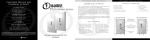
Detector description
The VT-2 voltage detector is intended to check for the presence
of AC voltage, signaling the user with an LED on. Built-in bright
flashlight with ON/OFF button and audible beeper indicator.
4
3
2
1
4
Flashlight.
Detector handle.
Flashlight power ON/OFF.
Detector clip.
Detector body.
Detector cap.
Operation
The Voltage Detector is useful for the identifying phase conductors, finding a break in a wire and detecting the presence of AC voltage at:
outlets,
switches,
circuit breakers,
fuses,
wires and cables.
Note: The voltage detector can be used to find a break in a wire:
Battery replacement
1. Disconnect the unit from the circuit.
2. Fold back the clip (4) and remove detector handle (2) by moving it
to the right side (according to the picture).
3. Replace the batteries (wrong polarity of batteries may damage detector).
4. Put the battery compartment cover.
7
①
②
③
④
⑤
①
Operating of voltage detector
Features
Non-contact detection of AC Voltage 90…1000V (50/60Hz).
Rugged, double molded case.
May be used to find a break in a wire or detect the presence of
voltage at outlets, lighting fixtures, circuit breakers, wires and
cables.
Bright LED and audible beeper indicator if voltage is present.
Built-in bright flashlight with ON/OFF button.
Convenient size with pocket clip.
An essential tool for every electrician and tradesperson.
Safety
to find a break in a phase conductor, trace the wire until the
signal stops,
to find a break in a neutral conductor, connect a load between
the phase and neutral. Trace the wire until the signal stops.
a)
b)
c)
d)
e)
f)
g)
h)
i)
j)
k)
Specifications
Indicators: LED and audible beeper
Voltage range: 90…1000V AC (50/60Hz)
Overvoltage category: Cat III 1000V
Pollution Degree: 2
Ingress protection: IP 54
Operating temperature: : -5…+40 st. C
Humidity: 80% without condensation
Battery: 2 x 1,5V batteries (AAA, NEDA 24A or IEC LR 03)
Dimensions: 177mm (length), Φ27mm (diameter)
Weight: aprox. 100g (without batteries)
Flashlight: one white LED
Version 1.0 10.04.2012