1
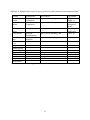
product manufactured by Fox Industries (see Appendix A for equipment list1) was selected for
use in this protocol. In addition to adhesive properties that were far superior to the other test
products, the putty-like consistency of the Fox epoxy makes it easy to use and attachments to
rocks have proven secure when initiated under a range of temperatures (5˚C - 20˚C). Numerous
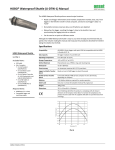
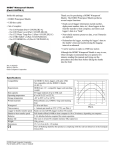
temperature sensors are commercially available, but we used the TidbiT v2 Temperature Data
Logger (Appendix A) because of its compact size, large memory and battery life (up to 5 years),
a waterproof, durable casing, and because the sensors may be downloaded in situ using an
underwater data shuttle. The TidbiT v2 has an orange faceplate, in contrast to the older TidbiT
v1, which has a yellow faceplate and is not compatible with the data shuttle.
Other materials needed for underwater epoxy installations are listed in Appendix A and include:
(1) rubber gloves (to avoid skin contact with epoxy), (2) a wire brush to clean the rock surface
prior to sensor attachment, (3) a plastic box to view the sensor underwater and ensure a good
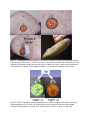
placement, and (4) metal forestry tree tags to monument the rock to which a sensor is attached
(Photo 1). For enhanced visibility, we paint a small circle on the rock using high-performance
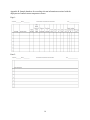
industrial grade paint (RUST-OLEUM). A GPS, digital camera, and datasheet (Appendix B) are
needed to geo-reference and photo archive the sites where sensors are deployed.
Before installing temperature sensors in streams, calibrate the sensors in a common temperature
environment as described in Dunham et al. (2005) and discard sensors with anomalous readings.
The sensors should be outfitted with a shield so that direct solar radiation does not bias the
temperatures readings. We have had good success using a small neoprene flap (3mm thick)
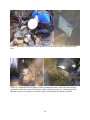
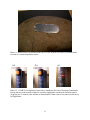
attached to the top of the sensor with plastic cable ties (Photo 2). A small weight attached to the
front of the flap ensures that it hangs over the sensor to improve shading and helps to prevent
turbulent flow from lifting the flap (Photo 3). Neoprene shields are inexpensive, durable, flexible
to allow access for underwater downloads, and periphyton quickly grows on the neoprene to
camouflage the sensor.
Sensor Installation
Considerations regarding sampling designs, or where sensor sites are established across the area
of interest, are beyond the scope of this protocol and are covered elsewhere (Dunham et al. 2007;
Isaak et al. 2009; http://www.fs.fed.us/rm/boise/AWAE/projects/stream_temperature.shtml).
Here, we assume the user has already developed a sampling design to meet their needs and
concern ourselves only with sensor deployment at an individual site.
Once at the site, search for a large rock or boulder (charismatic megaboulders are best) that will
be immobile during large floods and is easy for others to identify on subsequent site visits.
Finding a good rock is the most important step to a successful sensor installation. The best rocks
are large enough that they often protrude a foot or more above the low flow water surface and
wide enough that they can effectively shield the sensor from moving rocks or debris during
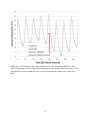
floods (the sensor will be attached to the downstream side). Ideal site characteristics downstream
of large rocks are pockets of relatively calm water with smaller substrate sizes (Photo 4). If large
rocks and cobbles are on the downstream side, similarly large substrates are likely to move there
again during the next flood and could dislodge the sensor. Finally, the rock should provide a
1
Mention of trade names does not imply endorsement by the U.S. Forest Service.
2