1
ECSS-E-20-07A Draft
4 April 2008
g
Space engineering
Electromagnetic compatibility
This ECSS document is a draft standard circulated to the ECSS TA for approval for
publication. It is therefore subject to change and may not be referred to as an
ECSS Standard until published as such.
End of TA approval for publication: 17 April 2008
ECSS Secretariat
ESA-ESTEC
Requirements & Standards Division
Noordwijk, The Netherlands
ECSS-E-20-07A Draft
4 April 2008
This Standard is one of the series of ECSS Standards intended to be applied together for the
management, engineering and product assurance in space projects and applications. ECSS
is a cooperative effort of the European Space Agency, national space agencies and
European industry associations for the purpose of developing and maintaining common
standards. Requirements in this Standard are defined in terms of what shall be
accomplished, rather than in terms of how to organize and perform the necessary work.
This allows existing organizational structures and methods to be applied where they are
effective, and for the structures and methods to evolve as necessary without rewriting the
standards.
This Standard has been prepared by the ECSS-E-20-07A Working Group, reviewed by the
ECSS Executive Secretariat and approved by the ECSS Technical Authority.
Disclaimer
ECSS does not provide any warranty whatsoever, whether expressed, implied, or statutory,
including, but not limited to, any warranty of merchantability or fitness for a particular
purpose or any warranty that the contents of the item are error-free. In no respect shall
ECSS incur any liability for any damages, including, but not limited to, direct, indirect,
special, or consequential damages arising out of, resulting from, or in any way connected to
the use of this Standard, whether or not based upon warranty, contract, tort, or otherwise;
whether or not injury was sustained by persons or property or otherwise; and whether or not
loss was sustained from, or arose out of, the results of, the item, or any services that may be
provided by ECSS.
Published by:
Copyright:
ESA Requirements and Standards Division
ESTEC, P.O. Box 299,
2200 AG Noordwijk
The Netherlands
2008 © by the European Space Agency for the members of ECSS
2
ECSS-E-20-07A Draft
4 April 2008
Change log
First issue.
3
ECSS-E-20-07A Draft
4 April 2008
Contents
Change log .......................................................................................................................3
Contents ...........................................................................................................................4
Introduction......................................................................................................................8
1 Scope .............................................................................................................................9
2 Normative references.................................................................................................10
3 Terms and definitions ................................................................................................11
3.1 Terms defined in other standards.......................................................................11
3.2 Terms specific to the present standard ..............................................................12
3.3 Abbreviated terms...............................................................................................14
4 Requirements..............................................................................................................16
4.1 General system requirements ............................................................................16
4.2 Detailed system requirements ............................................................................16
4.2.1
Overview..........................................................................................................16
4.2.2
EMC with the launch system ...........................................................................16
4.2.3
Lightning environment .....................................................................................17
4.2.4
Spacecraft charging and effects ......................................................................17
4.2.5
Spacecraft DC magnetic emission ..................................................................18
4.2.6
Radiofrequency compatibility...........................................................................18
4.2.7
Hazards of electromagnetic radiation ..............................................................19
4.2.8
Intrasystem EMC .............................................................................................19
4.2.9
EMC with ground equipment ...........................................................................19
4
ECSS-E-20-07A Draft
4 April 2008
4.2.10
Grounding........................................................................................................19
4.2.11
Electrical bonding requirements ......................................................................20
4.2.12
Shielding (excepted wires and cables) ............................................................21
4.2.13
Wiring (including wires and cables shielding)..................................................21
5 Verification ..................................................................................................................23
5.1 Overview .............................................................................................................23
5.2 General ...............................................................................................................23
5.2.1
Electromagnetic effects verification plan .........................................................23
5.2.2
Electromagnetic effects verification report.......................................................23
5.3 Test conditions....................................................................................................23
5.3.1
Measurement tolerances .................................................................................23
5.3.2
Test site ...........................................................................................................24
5.3.3
Ground plane...................................................................................................25
5.3.4
Power source impedance ................................................................................26
5.3.5
General test precautions .................................................................................27
5.3.6
EUT test configurations ...................................................................................28
5.3.7
Operation of EUT.............................................................................................30
5.3.8
Use of measurement equipment .....................................................................31
5.3.9
Emission testing ..............................................................................................32
5.3.10
Susceptibility testing ........................................................................................33
5.3.11
Calibration of measuring equipment................................................................35
5.4 System level........................................................................................................35
5.4.1
General............................................................................................................35
5.4.2
Safety margin demonstration for critical or EED circuits .................................35
5.4.3
EMC with the launch system ...........................................................................35
5.4.4
Lightning ..........................................................................................................36
5.4.5
Spacecraft and static charging ........................................................................36
5.4.6
Spacecraft DC magnetic field emission...........................................................36
5.4.7
Intra–system electromagnetic compatibility.....................................................36
5.4.8
Radiofrequency compatibility...........................................................................36
5.4.9
Grounding........................................................................................................36
5.4.10
Electrical bonding ............................................................................................37
5.4.11
Wiring and shielding ........................................................................................37
5.5 Equipment and subsystem level test procedures...............................................37
5.5.1
General............................................................................................................37
5
ECSS-E-20-07A Draft
4 April 2008
5.5.2
CE, power leads, differential mode, 30 Hz to 100 kHz ....................................38
5.5.3
CE, power and signal leads, 100 kHz to 100 MHz ..........................................40
5.5.4
CE, power leads, inrush current ......................................................................42
5.5.5
DC Magnetic field emission, magnetic moment ..............................................44
5.5.6
RE, electric field, 30 MHz to 18 GHz ...............................................................46
5.5.7
CS, power leads, 30 Hz to 100 kHz................................................................50
5.5.8
CS, bulk cable injection, 50 kHz to 100 MHz...................................................52
5.5.9
CS, power leads, transients.............................................................................55
5.5.10
RS, magnetic field, 30 Hz to 100 kHz..............................................................58
5.5.11
RS, electric field, 30 MHz to 18 GHz ...............................................................60
5.5.12
Susceptibility to electrostatic discharges .........................................................66
Figures
Figure 4-1: Bonding requirements
21
Figure 5-1: RF absorber loading diagram
24
Figure 5-2: Line impedance stabilization network schematic
27
Figure 5-3: General test setup
28
Figure 5-4: Typical calibration fixture
32
Figure 5-5: Conducted emission, 30 Hz to 100 kHz, measurement system check
39
Figure 5-6: Conducted emission, 30 Hz to 100 kHz, measurement setup
39
Figure 5-7: Conducted emission, measurement system check
41
Figure 5-8: Conducted emission, measurement setup in differential mode
41
Figure 5-9: Conducted emission, measurement setup in common mode
42
Figure 5-10: Inrush current: measurement system check setup
44
Figure 5-11: Inrush current: measurement setup
44
Figure 5-12: Smooth deperm procedure
46
Figure 5-13: Electric field radiated emission. Basic test setup
49
Figure 5-14: Electric field radiated emission. Antenna positioning
49
Figure 5-15: Electric field radiated emission. Multiple antenna positions
50
Figure 5-16: CS, power leads, measurement system check set-up
51
Figure 5-17: CS, power leads, signal injection
52
Figure 5-18: Bulk cable injection, measurement system check set-up
54
Figure 5-19: Signal test waveform
54
Figure 5-20: CS of power and signal leads, bulk cable injection
55
Figure 5-21: CS of power leads, transients, calibration set-up
57
Figure 5-22: CS of power leads, spike series injection test setup
57
Figure 5-23: CS of power leads, spike parallel injection test setup
57
Figure 5-24: Measurement system check configuration of the radiating system
60
6
ECSS-E-20-07A Draft
4 April 2008
Figure 5-25: Basic test set-up
60
Figure 5-26: Test equipment configuration
64
Figure 5-27: RS Electric field. Multiple test antenna positions
65
Figure 5-28: Receive antenna procedure
65
Figure 5-29: Spacecraft charging ESD susceptibility test
68
Figure 5-30: Susceptibility to ESD: calibration configuration
69
Figure 5-31: Susceptibility to ESD: test equipment configuration
69
Tables
Table 5-1: Absorption at normal incidence
25
Table 5-2: Bandwidth and measurement time
32
Table 5-3: Correspondence between test procedures and limits
37
7
ECSS-E-20-07A Draft
4 April 2008
Introduction
Electromagnetic compatibility of a space system or equipment is the ability to function
satisfactorily in its electromagnetic environment without introducing intolerable
electromagnetic disturbances to anything in that environment.
The space system is designed to be compatible with its external natural, induced, or manmade electromagnetic environment. Natural components are lightning for launchers, the
terrestrial magnetic field for space vehicles. Spacecraft charging is defined as voltage
building-up of a space vehicle or spacecraft units when immerged in plasma. Electrostatic
discharges result from spacecraft charging with possible detrimental effects. External manmade interference, intentional or not, are caused by radar or telecommunication beams
during ground operations and the launching sequence. Intersystem EMC also applies
between the launcher and its payload or between space vehicles.
Intrasystem EMC is defined between all electrical, electronic, electromagnetic, and
electromechanical equipment within the space vehicle and by the presence of its selfinduced electromagnetic environment. It comprises the intentional radiated electromagnetic
fields and parasitic emission from on-board equipment. Both conducted and radiated
emissions are concerned. An electromagnetic interference safety margin is defined at
system critical points by comparison of noise level and susceptibility at these points.
8
ECSS-E-20-07A Draft
4 April 2008
1
Scope
EMC policy and general system requirements are specified in ECSS-E-20B.
This ECSS-E-20-07 Standard addresses detailed system requirements (Clause 4), general
test conditions, verification requirements at system level, and test methods at subsystem
and equipment level (Clause 5) as well as informative limits (Annex A).
Associated to ECSS-E-20-07 is ECSS-E-20-06, which addresses charging control and risks
arising from environmental and vehicle-induced spacecraft charging when ECSS-E-20-07
addresses electromagnetic effects of electrostatic discharges.
Annexes A to C of ECSS-E-20B document EMC activities related to ECSS-E-20-07: the
EMC Control Plan (Annex A) defines the approach, methods, procedures, resources, and
organization, the Electromagnetic Effects Verification Plan (Annex B) defines and specifies
the verification processes, analyses and tests, and the Electromagnetic Effects Verification
Report (Annex C) document verification results. The EMEVP and the EMEVR are the
vehicles for tailoring this standard.
9
ECSS-E-20-07A Draft
4 April 2008
2
Normative references
The following dated normative documents are called by the requirements of this ECSS
Standard and therefore constitute requirements to it. Subsequent amendments to, or
revisions of any of these publications do not apply.
NOTE
However, parties to agreements based on this ECSS
Standard are encouraged to investigate the possibility of
applying the most recent editions of the normative
documents indicated below.
ECSS-P-001B
ECSS - Glossary of terms
ECSS-E-20B
Space engineering - Electrical and electronic
ECSS-E-20-06A
Space engineering - Spacecraft charging
ECSS-E-33-11A
Space engineering - Explosive systems and
devices
ECSS-E-50-14A
Space engineering - Discrete interfaces
IEC 61000-4-2-(Edition 1.2)
Electromagnetic compatibility (EMC) - Part
4-2: Testing and measurement techniques Electrostatic discharge immunity test
10
ECSS-E-20-07A Draft
4 April 2008
3
Terms and definitions
3.1
Terms defined in other standards
For the purpose of this Standard, the terms and definitions from ECSS-P-001B apply, in
particular for the following terms:
critical item
customer
equipment
item
launcher, launch vehicle
mission
requirement
safety critical function
supplier
spacecraft, space vehicle
subsystem
system
test
verification
For the purposes of this document, the following terms have a specific definition contained
in ECSS-E-20B.
conducted emission
electromagnetic compatibility
electromagnetic compatibility control
electromagnetic interference
electromagnetic interference safety margin
emission
high-voltage
11
ECSS-E-20-07A Draft
4 April 2008
lightning indirect effects
radiated emission
radiofrequency
susceptibility
susceptibility threshold
For the purposes of this document, the following terms have a specific definition contained
in ECSS-E-20-06A.
electrostatic discharge (ESD)
secondary arc
For the purposes of this document, the following term has a specific definition contained in
ECSS-E-33-11A:
electro-explosive device (EED)
3.2
Terms specific to the present standard
3.2.1
ambient level
level of radiated and conducted signal, and noise that exist at the specified test location and
time when the equipment under test is not operating
NOTE
3.2.2
Examples are atmospherics, interference from other
sources, and circuit noise or other interference generated
within the measuring set compose the “ambient level”.
antenna factor
factor that, when properly applied to the voltage at the input terminals of the measuring
instrument, yields the electric or magnetic field strength
3.2.3
NOTE 1
This factor includes the effects of antenna effective length,
mismatch, and transmission losses.
NOTE 2
The electric field strength is normally expressed in V/m and the
magnetic field strength in A/m or T.
common mode voltage
voltage difference between source and receiver ground references
3.2.4
contact discharge method
method of testing in which the electrode of the high-voltage test generator is held in contact
with the discharge circuit, and the discharge actuated by a discharge switch
3.2.5
electromagnetic environmental effects
impact of the electromagnetic environment upon equipment, systems, and platforms
NOTE
It encompasses all electromagnetic disciplines, including
electromagnetic
compatibility;
electromagnetic
interference, electromagnetic vulnerability, hazards of
12
ECSS-E-20-07A Draft
4 April 2008
electromagnetic radiation to personnel, electro-explosive
devices, volatile materials, and natural phenomena effects.
3.2.6
field strength
resultant of the radiation, induction and quasi-static components of the electric or magnetic
field
NOTE
3.2.7
The term “electric field strength” or “magnetic field
strength” is used, according to whether the resultant,
electric or magnetic field, respectively, is measured.
ground plane
metal sheet or plate used as a common reference point for circuit returns and electrical or
signal potentials
3.2.8
improper response
subsystem or equipment response which can be either inadvertent or unacceptable
3.2.9
inadvertent response
proper subsystem functional response (within normal range of limits) actuated by
electromagnetic interference, but occurring at other than the normal operational cycle,
which in turn causes improper response to the total space system
3.2.10
line impedance stabilization network (LISN)
network inserted in the supply leads of an apparatus to be tested which provides, in a given
frequency range, a specified source impedance for the measurement of disturbance currents
and voltages and which can isolate the apparatus from the supply mains in that frequency
range
3.2.11
not operating
condition wherein no power is applied to the equipment
3.2.12
overshield
shield surrounding a bundle or a shielded cable
3.2.13
passive intermodulation product
generation of a signal at frequency f = n*f1 + m*f2 from two signals at frequencies f1 and f2,
where n and m are positive or negative integers, by a passive device, usually an electrical
contact
3.2.14
port
place of access to a device or network where energy can be supplied or withdrawn, or
where the device or network variables can be observed or measured.
3.2.15
power quality requirements
requirements which define the conducted voltage noise or impedance the power user can
expect
NOTE
Noise e.g. from load regulation, spikes, and sags.
13
ECSS-E-20-07A Draft
4 April 2008
3.2.16
soft magnetic material
ferromagnetic material with a coercivity smaller than 100 A/m
3.2.17
spurious emission
electromagnetic emission from the intended output terminal of an electronic device, but
outside of the designed emission bandwidth
3.2.18
test antenna
antenna of specified characteristics designated for use under specified conditions in
conducting tests
3.2.19
unit
equipment that is viewed as an entity for purposes of analysis, manufacturing, maintenance,
or record keeping
NOTE
3.3
Hydraulic actuators, valves, batteries, and individual
electronic boxes such as on-board computer, inertial
measurement unit, reaction wheel, star tracker, power
conditioning unit, transmitters, receivers, or multiplexers.
Abbreviated terms
The following abbreviated terms are defined and used within this Standard:
Abbreviation
Meaning
AC
alternating current
ACS
attitude control system
AM
amplitude modulation
AWG
American wire gauge
BCI
bulk cable injection
CE
conducted emission
CS
conducted susceptibility
CW
continuous wave
DC
direct current
EED
electro-explosive device
EGSE
electrical ground support equipment
EHF
extremely high frequency (30 GHz-300 GHz)
EM
electromagnetic
EMC
electromagnetic compatibility
EMCAB
electromagnetic compatibility advisory board
EMCCP
electromagnetic compatibility control plan
EMEVP
electromagnetic effects verification plan
EMEVR
electromagnetic effects verification report
EMI
electromagnetic interference
EMISM
electromagnetic interference safety margin
14
ECSS-E-20-07A Draft
4 April 2008
ESD
electrostatic discharge
EUT
equipment under test
HV
high voltage
ICD
interface control document
LEO
low-altitude earth orbiting
LF
low frequency
LISN
line impedance stabilization network
MGSE
mechanical ground support equipment
PAM
pulse amplitude modulation
PCM
pulse coded modulation
RE
radiated emission
RF
radio frequency
RMS
root mean square
RS
radiated susceptibility
SHF
super-high frequency (3 GHz-30 GHz)
15
ECSS-E-20-07A Draft
4 April 2008
4
Requirements
4.1
General system requirements
EMC policy and general system requirements, and the spacecraft charging protection
program are specified in Clause 6 and Annex A of ECSS-E-20A.
4.2
Detailed system requirements
4.2.1
Overview
This clause 4.2 define the requirements for design and realization at system level. They are
the basis for definition of activities of the EMC programme to ensure space-system-level
compatibility with minimum impact to programme, cost, schedule, and operational
capabilities.
4.2.2
EMC with the launch system
4.2.2.1
General
General system requirements for EMC with the launch system are defined in ECSS-E20B,
clause 6.3.2.2.
4.2.2.2
a.
b.
Detailed system requirements
Overload capability of the spacecraft RF receivers during the pre-launch and launch
phases with or without fairing, shall be demonstrated by the spacecraft supplier.
NOTE 1
It is expected the electromagnetic environment generated by
companion payloads is assessed by the launching company and
addressed in the User’s Manual.
NOTE 2
A conductive fairing is likely to cause resonances and cavity
effects.
Spacecraft equipment shall not exhibit any malfunction, degradation of performance
or deviation beyond the tolerance indicated in its individual specification after being
16
ECSS-E-20-07A Draft
4 April 2008
exposed, even not operating, to the electromagnetic environment from the launcher
and launch site.
NOTE
c.
Most of spacecraft equipment is not operating during
launch. During the launching sequence spacecraft
transmitters and receivers (platform and payload) can be
either in OFF- or ON-state depending on the launch
vehicle.
The electromagnetic interference safety margin (EMISM) of safety critical
equipment shall be applied to equipment in ON-state during prelaunch and launch
phase and to EED’s.
4.2.3
Lightning environment
4.2.3.1
General
Protection of the space system against both direct and indirect effects of lightning can be a
combination of operational avoidance of the lightning environment and electrical overstress
design techniques.
4.2.3.2
Requirements to the space system
a.
Assessment of risk, on the launch pad inside the protected area, for the space system
and its equipment against direct and indirect effects of lightning before lift-off, shall
be performed.
b.
The spacecraft supplier shall obtain from the launching company the EM
environment imposed on the launcher payloads in case of lightning.
4.2.4
Spacecraft charging and effects
4.2.4.1
General
Mitigation of risks related to spacecraft charging results of a combination of rules and
methods preventing voltage build-up and so minimizing the occurrence of ESD, and
techniques for controlling EMI from residual ESD.
ECSS-E20B addresses management of spacecraft charging protection and system-level
performance under effects of spacecraft charging and related ESD or secondary arcs.
ECSS-E20-06A addresses charging control and risks arising from spacecraft charging and
other environmental effects on the spacecraft’s electrical behaviour.
4.2.4.2
a.
EMI control requirements to system and equipment in
relation with ESD
Analysis or tests at system level shall be performed for assessing the threat at
subsystem or equipment level.
NOTE
b.
Analysis or tests can be defined in the time or frequency
domain. They are expected to evaluate the coupling level
from the ESD source to critical points.
EMI control from residual ESD shall be performed by a combination of shielding
and passive or active filtering techniques, implemented on the main structure, at
subsystem level or inside equipment.
17
ECSS-E-20-07A Draft
4 April 2008
c.
EMI control efficiency shall be verified by test at subsystem or equipment level.
4.2.5
Spacecraft DC magnetic emission
4.2.5.1
Spacecraft with susceptible payload
As part of the EMCCP, a magnetic cleanliness control plan shall document:
a.
magnetic control guidelines
b.
emission limits to magnetic sources
c.
a magnetic budget
d.
specific test methods applied to equipments for emission measurement and
characterization
NOTE
4.2.5.2
a.
Attitude control system (ACS)
As part of the EMCCP, a magnetic budget shall be maintained providing:
1.
Three-axes components of the space vehicle magnetic dipole (component
decreasing with the inverse cube law with distance).
NOTE
Typical values lie in the range 1 Am2 or less for small
spacecraft to much more than 10 Am2 for large spacecraft.
2.
If the solar array is rotating in the space vehicle axes, separate evaluation for
the main body and the solar array (.
3.
When the space vehicle is using a magnetic sensor as part of the ACS,
evaluation of the magnetic induction at its location.
NOTE
b.
The test method described in 5.5.5 providing a dipole
model can be inadequate and replaced by a multiple dipole
model or a spherical harmonics model.
The angular deviation is the basic requirement; however,
the requirement is generally expressed in terms of
modification of the natural field strength at the sensor
location. For LEO spacecraft if the error on each axis is less
than 1 µT, the modification of the direction is kept less than
20 milliradians.
The specified maximum magnetic field value shall comprise the remanent
magnetization (magnets, electro-magnets in off-state, or residual perm-up due to
hysteresis of soft materials), the induced magnetization of soft materials by the
geomagnetic field, and the momentum of current loops.
4.2.6
Radiofrequency compatibility
a.
Spurious emissions requirements at antenna ports shall be specified for RF
compatibility purpose by the spacecraft supplier.
b.
When specifying limits and frequency ranges, the following issues shall be included:
1.
sensitivity of possible victim receiver subsystems including out-of-band
response
2.
no limits apply to transmit frequencies and information carrying modulation
bandwidths
3.
highest and lowest intentional frequency used by space system receivers
18
ECSS-E-20-07A Draft
4 April 2008
4.
4.2.7
antenna port attachments, gain/loss characteristics
Hazards of electromagnetic radiation
Assessment of hazards to electromagnetic radiation is a part of the process required in
ECSS-Q-40-02, clause 6.1.
4.2.8
Intrasystem EMC
Intrasystem EMC shall be achieved by:
a.
allocation of equipment-level EMI requirements documented in the EMCCP,
including:
1.
limits on conducted and radiated emission
2.
susceptibility thresholds
NOTE
b.
control of conducted and radiated propagation paths methods defined by clauses
4.2.10 to 4.2.13
4.2.9
a.
b.
Recommended data is defined in Annex A for equipment
and subsystems
EMC with ground equipment
The EGSE and MGSE used for spacecraft integration and ground testing shall
1.
not degrade the EMC performance of the spacecraft.
2.
have no impact on grounding or isolation.
The EGSE shall be immune to signals used for spacecraft susceptibility tests.
4.2.10
Grounding
4.2.10.1
General
As specified in ECSS-E20B, a controlled ground reference concept is defined for the space
system. Structural elements, antenna and RF reference grounds, power and signal returns,
shields and cable shields, safety grounds, EGSE grounds are considered.
4.2.10.2
Requirements
a.
A system-level grounding diagram shall be established including the EGSE.
b.
A ground reference shall be identified for each power, signal, or RF source or
receiver.
c.
An upper value of common mode voltage shall be specified considering:
1.
power quality requirements defined in ECSS-E-20B, clause 5.7.2,
2.
type of detectors and sensitivity,
3.
characteristics of analogue signal monitor receiver circuit, in accordance with
ECSS-E-50-14A, clause 5.2.2.2.d,
4.
characteristics of bilevel signal monitor receiver circuit, in accordance with
ECSS-E-50-14A, clause 6.1.2.2.2.d,
19
ECSS-E-20-07A Draft
4 April 2008
5.
d.
hazards due to fault currents internal to the space vehicle or between the
space vehicle and its EGSE.
When power and signal share common paths (wire or structure), the magnitude of
ground impedance shall be limited over the affected signal spectrum.
NOTE
Non-exclusive techniques for reducing the impedance are
decrease of common path length, decrease of wire and
ground impedance, filters on common paths
4.2.11
Electrical bonding requirements
4.2.11.1
General
Bonding requirements are a mean for fulfilling grounding requirements.
NOTE
4.2.11.2
Bonding for charging control is specified in ECSS-E20-06.
Normative provisions
a.
A vehicle bonding attachment point connected to the vehicle structure shall be
provided as a ground reference point at system level.
b.
An equipment bonding stud connected to the unit housing shall be provided as a
ground reference at equipment level.
c.
Each unit housing shall be bonded to the nearby spacecraft structure from the
equipment bonding stud.
d.
The DC resistance between the equipment bonding stud and the nearby spacecraft
structure shall be less than 2,5 mΩ.
e.
The inductance between the equipment bonding stud and the nearby spacecraft
structure shall be less than 30 nH.
NOTE
Example of formula for bonding strap inductance
calculation commonly used:
L = 200 a [Loge(2a/b) + 0.5 + 0,22 b/a]
L inductance in units of nH
a: strap length in units of m
b: width plus thickness of the strap in units of m
f.
The DC resistance between the unit housing and the vehicle bonding attachment
point shall be less than 20 mΩ.
g.
The DC resistance between the unit housing and the vehicle bonding attachment
point may be split as shown in 0.
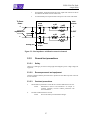
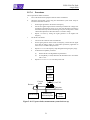
h.
Bonds shall be capable to carry the fault currents determined by analysis at system
level, without fusing, burning, or arcing.
i.
If the structure is used as the return current path, bonding provisions shall be such
that DC and AC voltage drops along power paths comply with clause
4.2.10.2.4.2.10.2c.
4.2.11.3
External grounds
The functionality of connecting grounding cables for charge equalization shall be provided
on space systems.
NOTE
Charge equalization is needed prior to implementing other
procedures or the application of power across the interface
20
ECSS-E-20-07A Draft
4 April 2008
Connector
Equipment
housing
<10 mΩ
Equipment
bonding stud
<20 mΩ
Vehicle-bonding
attachment point
Ground reference
point
Bonding strap
Main frame
Vehicle structure
Nearby structure
grounding
Figure 4-1: Bonding requirements
4.2.12
Shielding (excepted wires and cables)
4.2.12.1
General
When shielding is used to control EMC with the environment, it can be provided by the
basic space vehicle structure designed as a “Faraday cage”, by enclosures of electronics
boxes, or by cable or bundle overshields.
4.2.12.2
Requirement
Electronics units and cables external to the basic space vehicle structure shall have
individual shields providing attenuation to EMI.
NOTE
It is important to consider apertures used for pressure drop
during ascent and for outgassing.
4.2.13
Wiring (including wires and cables shielding)
4.2.13.1
Classification of cables
a.
Categorisation of harness and separate routings for wires of different categories shall
be defined as follows:
1.
applicable to critical lines as defined in ECSS-E-20B, clause 6.3.1.
2.
made on the basis of the characteristics of the signals on the wire (and hence
the interference generated), and on the susceptibility of the circuit to EMI.
b.
Wires falling into one category shall be assembled into a same bundle.
c.
Bundles of different categories shall be separated either by a separation distance of
5 cm from the outer circumference or by a metallic screen when they are routed on
parallel paths.
NOTE
Overshields or spacecraft walls can be used to fulfil the
requirement.
21
ECSS-E-20-07A Draft
4 April 2008
d.
Wires and cables shall be marked in such a manner that personnel can visually
identify the EMC category for each wire or cable.
4.2.13.2
Cable shields
a.
Cable shields shall not be used as an intentional current carrying conductor, except
coaxial cables in radiofrequency circuits and high-speed data links using coaxial
cables.
b.
Cable shields, other than overshields, shall have an insulated sheath to prevent
uncontrolled grounding
c.
Connectors used to carry shielded wires shall:
d.
1.
not use a nonconductive finish,
2.
provide contact to the equipment housing with a resistance less than 10 mΩ
through the equipment connector body as shown Figure 4-1.
Bonding of cable shields shall be as following:
1.
bonding to chassis ground is performed at both ends:
(a)
through the equipment connector body,
(b)
using a backshell that provides for circumferential bonding of shields,
or using a halo-ring.
NOTE
2.
Connection to electrical reference is performed through dedicated pins
NOTE
e.
This case typically appears in the design of detection chains
Overshields shall be bonded to chassis ground:
1.
at both ends,
2.
using a 360° direct contact or a bond strap of less than 30 nH
NOTE
f.
No grounding inside the equipment through a connector
ground pin in order to prevent any perturbation inside the
equipment.
see NOTE of clause 4.2.11.2.4.2.11.2e
Overshields should be bonded to chassis ground at intermediary points with a
separation distance less than 1m between two grounding points
22
ECSS-E-20-07A Draft
4 April 2008
5
Verification
5.1
Overview
This Clause specifies general conditions for EMC testing, requirements for verification at
system level and detailed procedures for unit and subsystem level testing.
5.2
General
5.2.1
Electromagnetic effects verification plan
The electromagnetic effects verification plan (EMEVP) provides the instruction for
conducting all activities needed to verify electromagnetic effects requirements. This
document defines the approach, methods, procedures, and specific test conditions. The
content is specified in Annex B of ECSS-E-20B. The EMEVP is the vehicle for tailoring
procedures and test conditions.
5.2.2
Electromagnetic effects verification report
The electromagnetic effects verification report (EMEVR) documents activities and report
analysis or test results in relation with the verification of the electromagnetic effects. It is
established based on the electromagnetic effects verification plan (EMEVP). The content of
the EMEVR is defined in Annex C of ECSS-E-20B supplemented by specific requirements
defined hereafter in 5.4 and 5.5.
5.3
Test conditions
5.3.1
Measurement tolerances
The tolerance shall be as follows:
a.
Distance: ±10%
b.
Frequency: ±2%
23
ECSS-E-20-07A Draft
4 April 2008
c.
Amplitude, measurement receiver: ±2 dB
d.
Amplitude, measurement system (includes measurement receivers, transducers,
cables, connectors): ±3 dB
e.
Time (waveforms): ±10%
f.
Resistors: ±5%
g.
Capacitors: ±20%
5.3.2
Test site
5.3.2.1
Overview
Shielded enclosures or unshielded sites are used for testing.
Shielded enclosures prevent external environment signals from contaminating emission
measurements and susceptibility test signals from interfering with electrical and electronic
items near the test facility.
In unshielded sites, the tests are performed during times and conditions when the
electromagnetic ambient is at its lowest level.
5.3.2.2
Shielded enclosures
a.
The enclosures shall be large such that the EUT arrangement requirements of 5.3.6
and antenna positioning requirements described in the individual test procedures are
satisfied.
b.
RF absorber material (e.g. carbon impregnated foam pyramids, and ferrite tiles) shall
be used when performing electric field radiated emissions or radiated susceptibility
testing to reduce reflections of electromagnetic energy and to improve accuracy and
repeatability.
c.
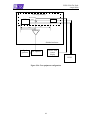
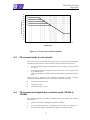
The RF absorber shall be placed above, behind, and on both sides of the EUT, and
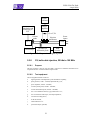
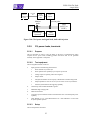
behind the radiating or receiving antenna as shown in 0.
> 30 cm
> 30 cm
EUT
RF absorber placed above, behind
and on both sides of EUT from
ceiling to ground plane
>1m
> 50 cm
Test antenna
RF absorber placed behind
the test antenna from ceiling
to floor
> 30 cm
Figure 5-1: RF absorber loading diagram
24
ECSS-E-20-07A Draft
4 April 2008
d.
Minimum performance of the material shall be as specified in Table 5-1.
NOTE
The manufacturer’s specification of their RF absorber
material (basic material only, not installed) can be used.
Table 5-1: Absorption at normal incidence
Frequency
5.3.2.3
Minimum absorption
80 MHz – 250 MHz
6 dB
above 250 MHz
10 dB
Ambient electromagnetic level
a.
The ambient electromagnetic level shall be measured with the EUT not operating
and all auxiliary equipment turned on.
b.
During testing, at least one of the following conditions shall be met:
c.
•
the ambient is at least 6 dB below the individual test limits,
•
the EUT complies with the individual test limits,
•
it is shown that recorded data exceeding the limits cannot be generated by the
EUT (emission tests) or cannot sensitize the EUT (susceptibility tests).
Background plots shall be reported for each test configuration unless all recorded
data is at least 6dB below the individual test limits.
5.3.2.4
Ambient conducted level
Ambient conducted levels on power leads shall be measured with the leads disconnected
from the EUT and connected to a resistive load that draws the same rated current as the
EUT.
5.3.3
Ground plane
5.3.3.1
General
a.
If the actual installation is known, the EUT shall be installed on a ground plane that
simulates the actual installation.
b.
If the actual installation is unknown or multiple installations are expected, then the
EUT shall be installed on a metallic ground plane.
c.
Ground planes shall be 2 m² or larger in area with the smaller side no less than
75 cm.
d.
When a ground plane is not present in the actual EUT installation, the EUT shall be
placed on a non-conductive table.
NOTE
5.3.3.2
a.
In such a case, test methods are specific and are likely to
differ from the ones in the present standard
Metallic ground plane
When the EUT is installed on a metallic ground plane, the ground plane shall have a
DC surface resistance not larger than 0,1 mΩ per square.
25
ECSS-E-20-07A Draft
4 April 2008
b.
The DC resistance between metallic ground planes and the shielded enclosure shall
be 2,5 mΩ or less.
c.
The metallic ground planes shall be electrically bonded to the floor or wall of the
basic shielded room structure at least once every 1 m.
d.
The metallic bond straps shall be solid and maintain a five-to-one ratio or less in
length to width.
e.
Metallic ground planes used outside a shielded enclosure shall extend at least 1,5 m
beyond the test setup boundary in each direction.
5.3.3.3
Composite ground plane
a.
When the EUT is installed on a conductive composite ground plane, the surface
resistivity of the actual installation shall be used.
b.
Composite ground planes shall be electrically bonded to the enclosure with means
suitable to the material.
5.3.4
Power source impedance
a.
The impedance of power sources providing input power to the EUT shall be
controlled by Line Impedance Stabilization Networks (LISN’s) for all measurement.
b.
LISN's shall not be used on output power leads.
c.
The LISN's shall be located at the power source end of the exposed length of power
leads specified in 5.3.6.6.
d.
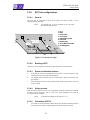
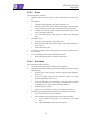
The LISN circuit shown in Figure 5-2 shall be used.
e.
NOTE 1
The LISN can be split in several cases, one per power lead.
NOTE 2
The series inductances represent the inductances of the wiring; the
series resistances represent the resistances of the wiring and of the
central protections
NOTE 3
The 50 Ω resistors result in 100 Ω at high frequency, similar to the
characteristic impedance of the line
NOTE 4
The feed-through capacitors provide a short-circuit at high
frequency and make the LISN symmetrical
NOTE 5
Connecting the regulation wires of the laboratory supply at the
LISN input in order to provide sufficiently low impedance at low
frequency is an appropriate method. The source impedance is then
dominated by the series resistances in the LISN. Alternatively, a
large capacitor (between 1 mF and 10 mF) will be used.
If no value is specified x = 2 µH and y = 0,1 ohm shall be used.
NOTE
The x and y values, respectively the inductance and the
resistance inserted in each lead are expected in the EMEVP.
f.
Magnetic coupling between inductors shall be avoided.
g.
If the return line is grounded at the power source in the actual installation (star
distribution), the return line of the LISN shall be grounded on the power source side.
h.
If the return line(s) of the actual installation is locally grounded (chassis return), the
return line of the LISN need not be provided, and the tests shall be performed with
the return(s) tied to case.
i.
The LISN impedance shall be measured at least annually under the following
conditions:
26
ECSS-E-20-07A Draft
4 April 2008
1.
the impedance, measured between the power output lead on the EUT side of
the LISN and the metal enclosure of the LISN,
2.
an unterminated power input terminal on the power source side of the LISN.
To Power
Source
470nF
to 10µF
+
x µH
50 Ω
Regulation wires
─
y mΩ
100 kΩ
Optional
1 to 10mF
x µH
y mΩ
Metal
enclosure
+
To EUT
─
50 Ω
Bonding stud
470nF 100 kΩ
to 10µF
Figure 5-2: Line impedance stabilization network schematic
5.3.5
General test precautions
5.3.5.1
Safety
Clause 4.2.7 shall apply for tests involving high electromagnetic power or high voltage test
equipment.
5.3.5.2
Excess personnel and equipment
Only the equipment and the personnel used to perform the test shall be present in the test
area or enclosure.
5.3.5.3
a.
Overload precautions
Checks shall be performed to assure that an overload condition does not exist.
NOTE
b.
Measurement receivers and transducers are subject to
overload, especially receivers without preselectors and
active transducers.
Overload condition shall be corrected.
NOTE
This can be done by instrumentation changes.
27
ECSS-E-20-07A Draft
4 April 2008
5.3.6
EUT test configurations
5.3.6.1
General
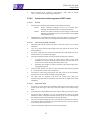
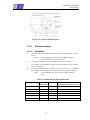
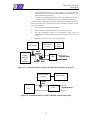
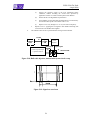
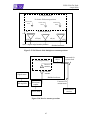
The EUT shall be configured as shown in the general test setup of Figure 5-3 and
maintained during all testing.
NOTE
4
7
For radiated tests, it may be desirable to have the LISN
outside of the shielded room.
1: EUT
2: LISN
3: Power source
4: Access panel
5: Interconnecting cable
6: Power lead
7: Bonding strap
8: Non conductive standoff
9: Grounding plane
3
7
7
7
1
1
5
7
2
5cm
9
10cm
6
8
2m
Figure 5-3: General test setup
5.3.6.2
Bonding of EUT
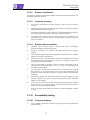
Only the provisions included in the design of the EUT shall be used to bond units.
5.3.6.3
Shock and vibration isolators
a.
EUT's shall be secured to mounting bases having shock or vibration isolators if such
mounting bases are used in the actual installation
b.
The bonding straps furnished with the mounting base shall be connected to the
ground plane.
c.
When mounting bases do not have bonding straps, bonding straps shall not be used
in the test setup.
5.3.6.4
Safety grounds
When external terminals, connector pins, or equipment grounding conductors are available
for safety ground connections and are used in the actual installation, they shall be
connected to the ground plane.
NOTE
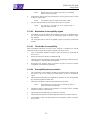
5.3.6.5
a.
Arrangement and length are specified in 5.3.6.6.
Orientation of EUT's
EUT's shall be oriented such that surfaces that produce maximum radiated emissions
and respond most readily to radiated signals face the measurement antennas.
28
ECSS-E-20-07A Draft
4 April 2008
b.
Bench mounted EUTs comprising interconnecting cables shall be located
(10 ± 2) cm from the front edge of the ground plane.
5.3.6.6
Construction and arrangement of EUT cables
5.3.6.6.1
General
a.
b.
Electrical cable assemblies shall simulate actual installation and usage.
NOTE 1
Proper construction techniques such as use of twisted pairs,
shielding, and shield terminations are determinant features.
NOTE 2
Details on the cable construction used for testing are defined in the
EMEVP (ECSS-E20B, annex B) and maintained in the EMEVR
(ECSS-E20B, annex C).
Shielded cables or shielded leads (including power leads and wire grounds) within
cables shall be used only if they have been specified in installation requirements.
5.3.6.6.2
Interconnecting leads and cables
a.
Individual leads shall be grouped into cables in the same manner as in the actual
installation.
b.
Up to 10 m, interconnecting cable lengths in the setup shall be the same as in the
actual installation.
c.
If a cable is longer than 10 m in the actual installation, the cable length in the set up
shall be between 10 m and the actual length.
d.
The cable arrangement shall be such that it satisfies the following conditions:
1.
At least the first 2 m (except for cables that are shorter in the actual
installation) of each interconnecting cable associated with each enclosure of
the EUT are run parallel to the front boundary of the setup.
2.
Remaining cable lengths are routed to the back of the setup and placed in a
zigzagged arrangement.
e.
When the setup includes more than one cable, individual cables shall be separated
by 2 cm measured from their outer circumference.
f.
For bench top setups using ground planes, the cable closest to the front boundary
shall be placed 10 cm from the front edge of the ground plane.
g.
All cables shall be supported 5 cm above the ground plane (except for
interconnecting cables between enclosures of the EUT that are higher in the actual
installation).
5.3.6.6.3
Input power leads
a.
Two metres of input power leads (including neutrals and returns) shall be routed
parallel to the front edge of the setup in the same manner as the interconnecting
leads.
b.
Each input power lead, including neutrals and returns, shall be connected to a LISN.
c.
Power leads that are bundled, as part of an interconnecting cable in the actual
installation, shall be configured in the same fashion for the 2 m exposed length and
then shall be separated from the bundle and routed to the LISN's.
d.
After the 2 m exposed length, the power leads shall be terminated at the LISN's in
such a manner that the total length of power lead from the EUT electrical connector
to the LISN's shall not exceed 2.5 m.
e.
All power leads shall be supported 5 cm above the ground plane.
29
ECSS-E-20-07A Draft
4 April 2008
f.
If the power leads are twisted in the actual installation, they shall be twisted up to
the LISN's
5.3.6.7
Electrical and mechanical interfaces
a.
Either the actual equipment from the platform installation or loads that simulate the
electrical properties (impedance, grounding, balance, and so forth) present in the
actual installation shall terminate electrical input or output interfaces.
b.
Signal inputs shall be applied to the electrical interfaces to exercise EUT circuitry.
c.
EUT with mechanical outputs shall be loaded under expected conditions.
d.
When variable electrical or mechanical loading is present in the actual installation,
testing shall be performed under expected worst-case conditions.
e.
When active electrical loading (such as a test set) is used, it shall be ensured that the
active load meets the ambient requirements of 5.3.2 when connected to the setup,
and that the active load does not respond to susceptibility signals.
f.
Antenna ports on the EUT shall be terminated with shielded, matched loads if the
RF link is not used during the test.
5.3.7
Operation of EUT
5.3.7.1
General
a.
During emission measurements, the EUT shall be placed in the operating mode,
which produces maximum emissions.
b.
During susceptibility testing, the EUT shall be placed in its most susceptible
operating mode.
c.
When the EUT has several available modes (including software controlled
operational modes), the number of modes to be tested for emission and susceptibility
shall be such that all circuitry is evaluated.
NOTE
5.3.7.2
It is expected that the customer defines or agrees operating
modes.
Operating frequencies for tuneable RF equipment
Measurements shall be performed with the EUT tuned to not less than three frequencies
within each tuning band, tuning unit, or range of fixed channels, consisting of one midband frequency and a frequency within ±5% from each end of each band or range of
channels.
5.3.7.3
Operating frequencies for spread spectrum equipment
Operating frequency requirements for two major types of spread spectrum equipment shall
be as follows:
a.
frequency hopping: measurements are performed with the EUT utilizing a hop set
which contains a minimum of 30% of the total possible frequencies, and the hop set
is divided equally into three segments at the low, mid, and high end of the EUT
operational frequency range,
b.
direct sequence: measurements are performed with the EUT processing data at the
highest possible data transfer rate.
30
ECSS-E-20-07A Draft
4 April 2008
5.3.7.4
a.
Susceptibility monitoring
The EUT shall be monitored during susceptibility testing for indications of
degradation or malfunction.
NOTE
b.
This monitoring is normally accomplished using built-intest, visual displays, aural outputs, and other measurements
of signal outputs and interfaces.
If EUT performance is monitored through installation of special circuitry in the
EUT, the modifications shall not influence test results.
5.3.8
Use of measurement equipment
5.3.8.1
General
Any frequency selective measurement receiver can be used for performing the testing
described in this standard if the receiver characteristics (that is sensitivity, selection of
bandwidths, detector functions, dynamic range, and frequency of operation) meet the
constraints specified in this standard and are sufficient to demonstrate compliance with the
applicable limits.
5.3.8.2
a.
Detector
A peak detector shall be used for all frequency domain emission and susceptibility
measurements.
NOTE
b.
This device detects the peak value of the modulation
envelope in the receiver pass band. Measurement receivers
are calibrated in terms of an equivalent root mean square
value of a sine wave that produces the same peak value.
When measurement devices other than peak detector (e.g. oscilloscopes, nonselective voltmeters, or field strength sensors) are used for susceptibility testing,
correction factors shall be determined and applied for test signals to adjust the
reading to equivalent RMS values under the peak of the modulation envelope.
5.3.8.3
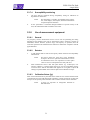
Calibration fixture (jig)
When current measurements are performed on the central line of a coaxial transmission line
a transmission line with 50 Ω characteristic impedance, coaxial connections on both ends,
and space for an injection probe around the centre conductor shall be used for calibration.
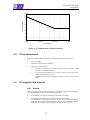
NOTE
0 Figure 5-4 represents an arrangement described in
MIL-STD-461E.
31
ECSS-E-20-07A Draft
4 April 2008
Figure 5-4: Typical calibration fixture
5.3.9
Emission testing
5.3.9.1
Bandwidths
a.
The measurement receiver bandwidths listed in Table 5-2 shall be used for emission
testing.
NOTE
These bandwidths are specified at the 6 dB down points for
the overall selectivity curve of the receivers.
b.
Video filtering shall not be used to bandwidth limit the receiver response.
c.
If a controlled video bandwidth is available on the measurement receiver, it shall be
set to its greatest value.
d.
If receiver bandwidths larger that those in Table 5-2 are used, no bandwidth
correction factors shall be applied to test data due to the use of larger bandwidths.
NOTE
Larger bandwidths can result in higher measured emission
levels.
Table 5-2: Bandwidth and measurement time
Frequency Range
6 dB
bandwidth
Dwell time
Minimum measurement time
(analogue measurement receiver)
30 Hz - 1 kHz
10 Hz
0.15 s
0.015 s/Hz
1 kHz - 10 kHz
100 Hz
0.015 s
0.15 s/kHz
10 kHz - 150 kHz
1 kHz
0.015 s
0.015 s/kHz
150 kHz - 30 MHz
10 kHz
0.015 s
1.5s/MHz
30 MHz - 1 GHz
100 kHz
0.015 s
0.15s/MHz
Above 1 GHz
1 MHz
0.015 s
15 s/GHz
32
ECSS-E-20-07A Draft
4 April 2008
5.3.9.2
Emission identification
All emissions regardless of characteristics shall be measured with the measurement receiver
bandwidths specified in Table 5-2.
5.3.9.3
Frequency scanning
a.
For emission measurements, the entire frequency range for each test shall be
scanned.
b.
Minimum measurement time for analogue measurement receivers during emission
testing shall be as specified in Table 5-2.
c.
Synthesized measurement receivers shall step in one-half bandwidth increments or
less, and the measurement dwell time shall be as specified in Table 5-2.
d.
For equipment that operates, such that potential emissions are produced at only
infrequent intervals, times for frequency scanning shall be increased such than any
emission is captured.
5.3.9.4
Emission data presentation
a.
Amplitude versus frequency profiles of emission data shall be automatically
generated and displayed at the time of the test.
b.
Except for verification of the validity of the output, data shall not be gathered
manually.
c.
The information shall be displayed after application of correction factors, including
transducers, attenuators, and cable loss.
d.
Data output of the EUT test result shall be in the form of amplitude over time (for
the time domain plots) and amplitude over frequency (for frequency domain plots),
superimposed with the EMI test limit.
e.
Units of measurement for frequency domain emissions measurements shall be
reported in units of dB referenced to 1 µV, 1 µA, 1 µV/m, 1 pT depending on the
unit defined in the test limit.
f.
For time domain measurements, oscilloscope plots shall include the amplitude
physical unit (V ou A) conversion factors V into A if not done automatically by the
oscilloscope, and the oscilloscope sensitivity, time base settings and measurement
bandwidth.
g.
For frequency domain plots, emission data shall be reported in graphic form with
frequency resolution of 1 percent, or twice the measurement receiver bandwidth,
whichever is less stringent.
h.
In the event of any emissions test result over the emission test limit above 100 MHz,
greater accuracy of its frequency shall be reported with resolution better than or
equal to twice the measurement bandwidth.
i.
Each plot of emission data shall be reported with a minimum amplitude resolution
of 1 dB.
5.3.10
Susceptibility testing
5.3.10.1
Frequency stepping
a.
For susceptibility measurements, the entire frequency range for each applicable test
shall be scanned.
33
ECSS-E-20-07A Draft
4 April 2008
NOTE
b.
Stepped scans shall dwell at each tuned frequency for the greatest of three seconds
or the EUT response time.
NOTE
c.
Stepped scans refer to signal sources that are sequentially
tuned to discrete frequencies.
Ten frequency steps per decade can be used as a basis.
Step sizes shall be decreased such to permit observation of a response.
NOTE
5.3.10.2
For receivers, it can make use of the frequency plan to
adjust the number of points.
Modulation of susceptibility signals
a.
Susceptibility test signals shall be pulse modulated (on/off ratio of 40 dB minimum)
at a 1 kHz rate with a 50% duty cycle for susceptibility signals at a frequency larger
than 100 kHz.
b.
CW test signals shall be used for susceptibility signals at a frequency smaller than
100 kHz.
5.3.10.3
Thresholds of susceptibility
When susceptibility indications are noted in EUT operation, a threshold level shall be
determined as follows where the susceptible condition is no longer present:
a.
When a susceptibility condition is detected, reduce the interference signal until the
EUT recovers.
b.
Reduce the interference signal by an additional 6 dB.
c.
Gradually increase the interference signal until the susceptibility condition reoccurs.
The resulting level is the threshold of susceptibility.
d.
Record this level, frequency range of occurrence, frequency and level of greatest
susceptibility, and the other test parameters..
5.3.10.4
Susceptibility data presentation
a.
The susceptibility criteria defined in the EMI test procedure shall be repeated in the
test report, or the “as run” EMI test procedure shall be an annex to the EMI test
report.
b.
Data showing the frequencies and amplitudes at which the test was conducted shall
be provided in graphical or tabular form.
c.
Indications of compliance with the requirements shall be provided.
NOTE
Such indications can be provision of oscilloscope plots of
injected waveforms with test data
d.
Information shall be displayed after application of correction factors, including
transducers, attenuators, and cable loss.
e.
Data shall be reported with frequency resolution of 1 percent,
f.
Data shall be provided with a minimum amplitude resolution of 1 dB for each plot.
g.
If susceptibility is observed, determined levels of susceptibility shall be recorded in
the test report
34
ECSS-E-20-07A Draft
4 April 2008
5.3.11
Calibration of measuring equipment
5.3.11.1
General
Measurement antennas, current probes, field sensors, and other devices used in the
measurement loop shall be calibrated at least every two years or when damaged.
5.3.11.2
5.4
Measurement system test
a.
At the start of each emission test, the complete test system (including measurement
receivers, cables, attenuators, couplers, and so forth) shall be verified by injecting a
known signal (as stated in the individual test procedure), while monitoring system
output for the proper indication.
b.
When the emission test involves an uninterrupted set of repeated measurements
(such as evaluating different operating modes of the EUT) using the same
measurement equipment, the measurement system test may be accomplished only
one time.
System level
5.4.1
General
Each item of equipment and subsystem shall have successfully passed functional
acceptance test procedures as installed on the platform, prior to system level EMC test.
5.4.2
a.
b.
Safety margin demonstration for critical or
EED circuits
A test performed to demonstrate compliance with the safety margin requirement
shall use one or more of the following test approaches:
1.
Inject interference at critical system points at x dB higher level than exists,
while monitoring other system points for improper responses, where x =
EMISM.
2.
Measure the susceptibility of critical system circuits for comparison to
existing interference levels, to determine the margin.
3.
Sensitize the system to render it x dB more susceptible to interference, while
monitoring for improper response, where x = EMISM.
Safety margin demonstration for something that is susceptible to a time domain
circuit (including EED’s) shall use time domain methods.
5.4.3
EMC with the launch system
a.
If the spacecraft is not powered during launch, EMC test with the launch system
need not be performed.
b.
If the spacecraft is powered during launch, the electric field radiation, including
intentional transmission, shall be measured at locations specified in the Launcher
User’s Manual
35
ECSS-E-20-07A Draft
4 April 2008
c.
In case of a transmitting spacecraft under fairing, the EMISM applied to EED's shall
be verified.
5.4.4
Lightning
Lightning protection specified in ECSS-E20, clause 6.3.2.3, shall be verified by analysis
from equipment demonstration.
5.4.5
NOTE 1
Test at system level need not be performed.
NOTE 2
The bi-exponential model defined in clause 4.2.3.2 is generally
used
Spacecraft and static charging
a.
Material use, bonding of discharge elements, thermal blankets, or metallic items
using a bond for static potential equalization shall be verified by inspection or
measurement at assembly into structure.
b.
If the bond is only used for charging control, the bonding resistance shall be
measured with a dc-current in the range 10 to 100 µA, under only one polarity, with
a 2-wires ohmmeter
NOTE
5.4.6
If the bond is only used for charging control the clauses
5.4.10.5.4.10a and 5.4.10.5.4.10b do not apply
Spacecraft DC magnetic field emission
Spacecraft DC magnetic field emission requirements shall be verified by a combination of
analysis and tests.
5.4.7
Intra–system electromagnetic compatibility
a.
For intra-system EMC tests, the support equipment shall provide the functionality of
exercising culprits and victims, and include the support equipment instructions.
b.
Wherever 0 dB EMISM is a requirement, functional tests at spacecraft level may be
accepted as a verification of EMC.
5.4.8
Radiofrequency compatibility
a.
Except for passive intermodulation products, radiofrequency compatibility shall be
verified by a test at system level.
b.
Absence of passive intermodulation products shall be verified in accordance with
ECSS-E-20B, clause 7.4.
5.4.9
Grounding
The system-level electrical grounding and isolation shall be verified by isolation and
continuity tests at system assembly.
NOTE
The grounding and isolation design is documented by the
system-level grounding diagram including EGSE.
36
ECSS-E-20-07A Draft
4 April 2008
5.4.10
Electrical bonding
a.
Except for bonding used only for charging control, the bonding resistances shall be
measured using a 4-wires method, under a pulsed DC current of 1A.
b.
Except for bonding used only for charging control, the probes shall be reversed and
re-measured to detect possible non linearities across the bonded junction.
NOTE
5.4.11
See clause 5.4.55.4.5b
Wiring and shielding
Wiring category and cable shields shall be verified by review of design and inspection.
5.5
Equipment and subsystem level test procedures
5.5.1
General
Test procedures are specified in clauses 5.5.2 through 5.5.12 for verifying emission and
susceptibility requirements at subsystem or equipment level. Table 5-3 gives the
correspondence between procedures and recommended limits defined in Annex A
Table 5-3: Correspondence between test procedures and limits
Informative limit
Annex A
Title of test procedure
Verification
Section 5
A.2
CE on power leads, differential mode, 30 Hz to 100 kHz (1st part)
5.5.2
A.2
CE on power leads, differential mode, 100 kHz to 100 MHz (2nd part)
5.5.3
A.3
CE on power leads, in-rush currents
5.5.4
A.4
CE on power and signal leads, common mode, 100 kHz to 100 MHz
A.5
CE on antenna ports
A.6
DC magnetic field emission
A.7
RE, low-frequency magnetic field
Specific
A.8
RE, low-frequency electric field
Specific
5.5.3
Specific
5.5.5
A.9
RE, electric field, 30 MHz to 18 GHz
A.10
CS, power leads, differential mode, 30 Hz to 100 kHz.
5.5.7
A.11
CS, power and signal leads, common mode, 50 kHz to 100 MHz
5.5.8
0
CS, power leads, short spike transients
5.5.6
5.5.9
A.13
RS, magnetic field, 30 Hz to 100 kHz
A.14
RS, electric field, 30 MHz to 18 GHz
5.5.11
A.15
Susceptibility to electrostatic discharge
5.5.12
37
5.5.10
ECSS-E-20-07A Draft
4 April 2008
5.5.2
CE, power leads, differential mode, 30 Hz to
100 kHz
5.5.2.1
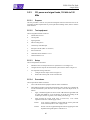
Purpose
This method is used for measuring conducted emissions in the frequency range 30 Hz to
100 kHz on all input power leads including returns.
5.5.2.2
Test equipment
The test equipment shall be as follows:
a.
Measurement receiver
b.
Current probe
c.
Signal generator with amplifier
d.
DC-current supply
e.
Data recording device
f.
Oscilloscope
g.
Coaxial “T” connector and coaxial to bifilar transition
h.
1 Ω and 10 Ω power metal film resistors with inductance lower than 100 nH
i.
LISN defined in 5.3.4
5.5.2.3
Setup
The test setup shall be as follows:
a.
Maintain a basic test setup for the EUT as specified in 5.3.6 and Figure 5-3.
b.
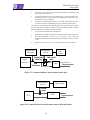
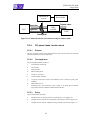
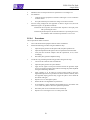
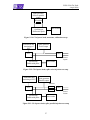
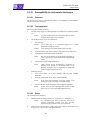
For measurement system check, configure the test setup as shown in Figure 5-5.
c.
For equipment testing, configure the test setup as shown Figure 5-6.
5.5.2.4
Procedure
The test procedures shall be as follows:
a.
Turn on the measurement equipment and wait until it is stabilized.
b.
If the EMEVP specifies to check the measurement system, check it by evaluating the
overall measurement system from the current probe to the data output device, as
follows:
1.
Apply a calibrated signal level, at 1 kHz and 100 kHz, which is at least 6 dB
below the emission limit to the current probe.
NOTE
2.
3.
A power amplifier can be necessary at 1 kHz.
Apply through the current probe a DC-current equivalent to the EUT supply
current.
NOTE 1
A DC current is applied for verifying that the current probe will
not be saturated by the EUT DC supply current.
NOTE 2
This DC current is applied through the LISN for applying the same
impedance through the probe as with the EUT.
Verify the AC current level as measured with the probe by comparison with
voltage across the 1 Ω resistor at 1 kHz and the 10 Ω resistor at 100 kHz;
also, verify that the current waveform is sinusoidal.
38
ECSS-E-20-07A Draft
4 April 2008
c.
4.
Scan the measurement receiver for each frequency in the same manner as a
normal data scan. Verify that the data-recording device indicates a level
within ±3 dB of the injected level.
5.
If readings are obtained which deviate by more than ±3 dB, locate the source
of the error and correct the deficiency prior to proceeding with the testing.
Test the EUT by determining the conducted emissions from the EUT input power
leads, hot line and return, and measure the conducted emission separately on each
power lead, as follows:
1.
Turn on the EUT and wait for its stabilization.
2.
Select a lead for testing and clamp the current probe into position.
3.
Scan the measurement receiver over the frequency range, using the
bandwidths and minimum measurement times specified in Table 5-2, clause
5.3.9.1.
4.
Repeat 5.5.2.4.c.2 and 5.5.2.4.c.3 for each power lead.
Measurement
receiver
Oscilloscope
Signal
generator
with
amplifier
Data
recorder
Coax “T” and
bifilar
transition
LISN
To power source
Current
Resistor probe
Figure 5-5: Conducted emission, 30 Hz to 100 kHz, measurement system check
Measurement
receiver
Data recorder
Current
probe
LISN
EUT
To power source
Figure 5-6: Conducted emission, 30 Hz to 100 kHz, measurement setup
39
ECSS-E-20-07A Draft
4 April 2008
5.5.3
CE, power and signal leads, 100 kHz to 100
MHz
5.5.3.1
Purpose
This test procedure is used to verify that electromagnetic emissions from the EUT do not
exceed the specified requirements for power input leads including returns, and for common
mode emission.
5.5.3.2
Test equipment
The test equipment shall be as follows:
a.
Measurement receiver
b.
Current probe
c.
Signal generator
d.
Data recording device
e.
Oscilloscope with 50Ω input
f.
50Ω power divider (6dB “T” connector)
g.
50Ω coaxial load
h.
Calibration fixture defined in 5.3.8.3
i.
LISN's defined in 5.3.4
5.5.3.3
Setup
The test setup shall be as follows:
a.
Maintain a basic test setup for the EUT as specified in 5.3.6 and Figure 5-3.
b.
Configure the test setup for the measurement system check as shown in Figure 5-7.
c.
For compliance testing of the EUT:
1.
Configure the test setup as shown in Figure 5-8.
2.
Position the current probe 10 cm from the LISN.
5.5.3.4
Procedures
The test procedures shall be as follows:
a.
Turn on the measurement equipment and wait until it is stabilized.
b.
If the EMEVP specifies to check the measurement system, check it by evaluating the
overall measurement system from the current probe to the data output device, as
follows:
1.
Apply a calibrated signal level that is at least 6 dB below the applicable limit
at 1 MHz and 10MHz or at a level allowing out of the noise reading on the
oscilloscope, whatever is greater, to the current probe in the jig.
2.
Apply through the current probe using a second wire, a DC current
equivalent to the EUT nominal supply current
NOTE 1
A DC current is applied for verifying that the current probe will
not be saturated by the EUT DC supply current.
NOTE 2
This DC current is applied through the LISN for applying the same
impedance through the probe as with the EUT.
40
ECSS-E-20-07A Draft
4 April 2008
c.
3.
Verify the AC current level, as measured with the probe by comparison with
the voltage on the T derivation.
4.
Scan the measurement receiver for each frequency in the same manner as a
normal data scan, and verify that the data-recording device indicates a level
within ±3 dB of the injected level.
5.
If readings are obtained which deviate by more than ±3 dB, locate the source
of the error and correct the deficiency prior to proceeding with the testing.
Test the EUT by determining the conducted emission from the input power leads,
hot lines and returns separately, and from each interconnecting bundle (common
mode), including the ones with power leads, as follows:
1.
Turn on the EUT and wait until it is stabilized.
2.
Select a lead or a bundle for testing and clamp the current probe into position.
3.
Scan the measurement receiver over the frequency range, using the
bandwidths and minimum measurement times specified in Table 5-2, clause
5.3.9.1.
4.
Repeat 5.5.3.4.c.2 and 5.5.3.4.c.3 for each power lead or for each bundle.
Measurement
receiver
Oscilloscope
50Ω input
Signal
generator
Data
recorder
50Ω coaxial
load
Current probe
inside jig
6dB
T-connector
LISN
To power source
Figure 5-7: Conducted emission, measurement system check
Measurement
receiver
Data recorder
Current
probe
LISN
EUT
To power source
Figure 5-8: Conducted emission, measurement setup in differential mode
41
ECSS-E-20-07A Draft
4 April 2008
Measurement
receiver
Data recorder
OR
To power source
Power lines
EUT
LISN
or EGSE
Signal lines
EGSE
Current probe
Figure 5-9: Conducted emission, measurement setup in common mode
5.5.4
CE, power leads, inrush current
5.5.4.1
Purpose
This test procedure is used to verify that the inrush current of the EUT does not exceed the
specified requirements for power input leads.
5.5.4.2
Test equipment
The test equipment shall be as follows:
a.
Two-channels oscilloscope
b.
Current probe
c.
Spike generator
d.
Data recording device
e.
Coaxial “T” connector
f.
Coaxial to bifilar transition
g.
1 Ω power metal film resistor with inductance lower 30 nH and peak power
capability.
h.
LISN defined in 5.3.4.
i.
Switching device, fast bounce-free power switch, or an actual power-controller
except if the ON/OFF command is implemented in the EUT.
5.5.4.3
Setup
The test setup shall be as follows:
a.
Maintain a basic test setup for the EUT as specified in 5.3.6 and Figure 5-3.
b.
Configure the test setup for the measurement system check as shown in Figure 5-10.
c.
Configure the test setup for compliance testing of the EUT as shown in Figure 5-11.
42
ECSS-E-20-07A Draft
4 April 2008
5.5.4.4
Procedures
The test procedures shall be as follows:
a.
Turn on the measurement equipment and allow a sufficient time for stabilization.
b.
If specified by the EMEVP, check the measurement system by evaluating the overall
measurement system from the current probe to the data output device:
c.
1.
Apply a calibrated spike that is at least 6 dB below the applicable limit to the
current probe.
2.
Apply through the current probe a DC current equivalent to the EUT supply
current
NOTE 1
A DC current is applied for verifying that the current probe will
not be saturated by the EUT DC supply current.
NOTE 2
This DC current is applied through the LISN for applying the same
impedance through the probe as with the EUT.
3.
Check the spike current as measured with the probe by comparison with the
voltage across the resistor.
4.
Perform the measurement with the current probe on an oscilloscope in the
same manner as for EUT testing and verify that the data-recording device
indicates a level within ±3 dB of the injected level.
5.
If readings are obtained which deviate by more than ±3 dB, locate the source
of the error and correct the deficiency prior to proceeding with the testing.
Test the EUT by determining the conducted emission from the EUT input power
leads, as follows:
1.
Select the positive lead for testing and clamp the current probe into position.
2.
Perform measurement by application of power on the EUT using a mercury
relay (Figure 5-11.a), the internal EUT switch (Figure 5-11 b), or the power
controller (Figure 5-11 c).
NOTE
5.5.4.5
a.
Data Presentation
In addition to 5.3.9.4, data presentation shall be a graphic output of current versus
time displaying the transient characteristics with following conditions:
1.
amplitude resolution within 3% of the applicable limit
2.
time base resolution within 10% of rise time for measurement of rise and fall
slopes
NOTE
b.
The method for application of power is defined in the
EMEVR
Rise time is the duration between 10% and 90% of peak-topeak amplitude
Two separate displays shall be provided showing respectively the initial rise time
and the full inrush response
NOTE
Typica1 time bases are 10 µs full scale for the initial rise
time and 1 ms full scale for the full inrush response
43
ECSS-E-20-07A Draft
4 April 2008
Data
recorder
Oscilloscope
Coax “T”
and bifilar
transition
Spike
generator
LISN
To power source
Current
probe
Resistor
Figure 5-10: Inrush current: measurement system check setup
Oscilloscope
Current probe
Data recorder
Fast bounce-free
power switch
Power
controller
a
EUT
c
b
LISN
To power source
ON/OFF command
Figure 5-11: Inrush current: measurement setup
5.5.5
DC Magnetic field emission, magnetic moment
5.5.5.1
General
The described test method allows obtaining a rough estimate of the magnetic moment of the
EUT (centred dipole approximation). It involves the constraint of measuring the magnetic
field at distances typically more than three times the size of the EUT.
If a better model is needed, making it possible to predict the field at closer distances or
more precisely than the centred dipole approximation allows, then either multiple dipole
modelling techniques or spherical harmonics techniques shall be used.
NOTE
5.5.5.2
a.
It is the role of the EMCAB to assess the need for using
such techniques, based on mission requirements.
Set-Up
The EUT should be set in an earth field compensated area providing zero-field
conditions for the intrinsic moment determination.
44
ECSS-E-20-07A Draft
4 April 2008
NOTE 1
This is necessary in case the EUT contains a significant amount of
soft magnetic material, as without earth field compensation an
induced magnetic moment would appear.
NOTE 2
Earth field compensation is usually ensured by 2 or 3 sets of
Helmholtz coils.
b.
A right-handed orthogonal coordinate system XYZ shall be assigned to the EUT
geometric centre.
c.
The magnetic sensor (single-axis magnetometer) shall be installed successively on
the 6 semi-axes at two different reference distances r1 and r2 from the geometric
centre of the EUT and shall measure the field projection along these lines.
NOTE
The reference distances are typically more than three times
the size of the EUT
d.
Alternatively the EUT may be installed on a turntable and rotated in front of a fixed
magnetometer, presenting each XYZ axis (positive and negative) successively
aligned with the sensor axis.
e.
The magnetic field shall be positive when orientated from the centre of the EUT
towards the magnetometer.
5.5.5.3
Test sequence
The test sequence shall be as follows:
a.
EUT not operating, initial measurements on the six semi-axes at the reference
distances.
b.
Deperm:
1.
EUT not operating, application of a deperming field in accordance with
Figure 5-12 frequency 3 Hz, maximum amplitude between 4 000 and
5 000 µT, successively on each XYZ axis of the EUT.
NOTE 1
This is usually done using Helmholtz coils.
NOTE 2
A sequence of symmetrical sine periods of increasing and
decreasing amplitude gives better results than a sine wave
modulated by exponentials or ramp functions.
2.
c.
Measurement after deperm on the six semi-axes at the reference distances.
Perm:
1.
EUT not operating, application of a perm field of 300 µT on each XYZ axis.
2.
Measurement after perm on the six semi-axes at the reference distances.
d.
Stray field: EUT operating, measurement on the six semi-axes at the reference
distances.
e.
Final deperm: repeat 5.5.5.3.b
5.5.5.4
Data presentation
For DC magnetic field emission, data shall be presented as follows, superseding clauses
5.3.9.4.5.3.9.4a through 5.3.9.4.5.3.9.4i:
a.
For each measurement distance, for each of the 6 semi-axes, the following induction
measurements in µT are plotted in tabular form:
B(+X), B(-X), B(+Y), B(-Y), B(+Z), B(-Z)
b.
For each measurement distance, mean inductions, for each axis, are computed in
units of µT and plotted in tabular form, using following equations:
45
ECSS-E-20-07A Draft
4 April 2008
BX =
c.
B(+ X ) − B(− X )
2
BY =
BZ =
B(+ Z ) − B(−Z )
2
For each measurement distance r, 3-axes magnetic moment components in units of
Am² are calculated using the following equations and reported:
Mx = 5 r3 BX
My = 5 r3 BY
Mz = 5 r3 BZ
d.
B(+Y ) − B(−Y )
2
M in units of Am2, r in meters, B in µT
Using values of Mx, My and Mz at both distances r1 and r2, values M1 and M2 of the
magnetic moment are calculated using the following equations and reported:
M1 = Mx(r1)2 + My(r1)2 + Mz(r1)2
M2 = Mx(r2)2 + My(r2)2 + Mz(r2)2
NOTE
If the EUT is a centred dipolar source, then M1 = M2.
deperm field
5000 µT
< 0.03 µT
at switch off
B (µT)
Decrease : 1 %
Increase : 2 %
- 5000 µT
time
Increase : t > 200 s
Decrease : t > 400 s
Figure 5-12: Smooth deperm procedure
5.5.6
RE, electric field, 30 MHz to 18 GHz
5.5.6.1
Purpose
This test procedure is used to verify that electric field emissions from the EUT and its
associated cabling do not exceed specified requirements.
5.5.6.2
Test equipment
The test equipment shall be as follows:
a.
Measurement receiver
46
ECSS-E-20-07A Draft
4 April 2008
b.
Data recording device
c.
Linearly polarized antennas
NOTE
the following antennas are commonly used:
d.
30 MHz to 200 MHz, biconical, 137 cm tip to tip
e.
200 MHz to 1 GHz, double ridge horn, 69.0 by 94.5 cm opening, or log-periodic
f.
1 GHz to 18 GHz, double ridge horn, 24.2 by 13.6 cm opening
g.
Signal generators
h.
Stub radiator
i.
LISN defined in 5.3.4, optional
5.5.6.3
Setup
The test setup shall be as follows:
a.
Maintain a basic test setup for the EUT as shown and described in Figure 5-3 and
5.3.6, and ensure that the EUT is oriented such that the surface that produces the
maximum radiated emissions is toward the front edge of the test setup boundary.
NOTE
The LISN should be used
b.
Check the measurement system by configuring the test equipment as shown in
Figure 5-13.
c.
Test the EUT antenna positioning as follows:
1.
Determine the test setup boundary of the EUT and associated cabling for use
in positioning of antennas.
2.
Use the physical reference points on the antennas shown in Figure 5-14 for
measuring heights of the antennas and distances of the antennas from the test
setup boundary, as follows:
3.
(a)
Position antennas 1 m from the front edge of the test setup boundary
for all setups.
(b)
Position antennas above the floor ground plane.
(c)
Ensure that no part of any antenna is closer than 1 m from the walls
and 0.5 m from the ceiling of the shielded enclosure.
Determine the antenna positions as follows:
(a)
For testing below 200 MHz:
*
*
For setups with the side edges of the boundary 3 m or less, one
position, with the antenna centred with respect to the side
edges of the boundary.
For setups with the side edges of the boundary greater than
3 m, N antenna positions at spacing as shown in Figure 5-15,
where N is the edge-to-edge boundary distance (in metres)
divided by 3 and rounding up to an integer.
(b)
For testing from 200 MHz up to 1 GHz, place the antenna in such a
number of positions that the entire width of each EUT enclosure and
the first 35 cm of cables and leads interfacing with the EUT enclosure
are within the 3 dB beamwidth of the antenna.
(c)
For testing at 1 GHz and above, place the antenna in such a number of
positions that the entire width of each EUT enclosure and the first
7 cm of cables and leads interfacing with the EUT enclosure are
within the 3 dB-beamwidth of the antenna.
47
ECSS-E-20-07A Draft
4 April 2008
5.5.6.4
Procedures
The test procedures shall be as follows:
a.
Turn on the measurement equipment and wait until it is stabilized.
b.
Verify that the ambient requirements specified in 5.3.2.3 are met and take plots of
the ambient.
c.
Check the measurement system as follows:
1.
2.
Using the system check path of Figure 5-13, perform the following
evaluation of the overall measurement system from each antenna to the data
output device at the highest measurement frequency of the antenna:
(a)
Apply a calibrated signal level that is at least 6 dB below the limit
(limit minus antenna factor) to the coaxial cable at the antenna
connection point.
(b)
Scan the measurement receiver in the same manner as a normal data
scan, and verify that the data-recording device indicates a level within
±3 dB of the injected signal level.
(c)
If readings are obtained which deviate by more than ±3 dB, locate the
source of the error and correct the deficiency prior to proceeding with
the testing.
Using the measurement path of Figure 5-13, perform the following
evaluation for each antenna to demonstrate that there is electrical continuity
through the antenna:
(a)
Radiate a signal using an antenna or stub radiator at the highest
measurement frequency of each antenna.
(b)
Tune the measurement receiver to the frequency of the applied signal
and verify that a received signal of appropriate amplitude is present.
NOTE
d.
This evaluation is intended to provide a coarse indication
that the antenna is functioning properly. There is no
requirement to measure accurately the signal level.
Test the EUT by using the measurement path of Figure 5-13 and determining the
radiated emissions from the EUT and its associated cabling, as follows:
1.
Turn on the EUT and wait until it is stabilized.
2.
Scan the measurement receiver for each applicable frequency range, using
the bandwidths and minimum measurement times in 5.3.9.1
3.
Orient the antennas for both horizontally and vertically polarized fields.
4.
Repeat steps 5.5.6.4.d.2 and 5.5.6.4.d.3 for each antenna position determined
under 5.5.6.3.5.5.6.3c.
5.5.6.5
Data Presentation
In addition to 5.3.9.4, data presentation shall provide a statement verifying the electrical
continuity of the measurement antennas as determined in5.5.6.4.5.5.6.4c.2.
48
ECSS-E-20-07A Draft
4 April 2008
Test setup boundary
Antenna
Shielded
enclosure
Signal
generator
Connected for
measurement
Connected for
system check
Measurement
receiver
Data recording
device
Figure 5-13: Electric field radiated emission. Basic test setup
Antenna
Test
setup
boundary
Ground plane
1.2m
0.9m
Floor
1m
Figure 5-14: Electric field radiated emission. Antenna positioning
49
ECSS-E-20-07A Draft
4 April 2008
Test setup boundary
Length x(m); N positions = x/3 (rounded up nearest
integer)
1m
Antenna
x/N (m)
x/N (m)
x/2N
( )
Antenna
Antenna
x/2N
( )
Shielded enclosure
Figure 5-15: Electric field radiated emission. Multiple antenna positions
5.5.7
CS, power leads, 30 Hz to 100 kHz
5.5.7.1
Purpose
This test procedure is used to verify the ability of the EUT to withstand signals coupled on
input power leads.
5.5.7.2
Test equipment
The test equipment shall be as follows:
a.
Signal generator
b.
Power amplifier
c.
1,5 to 2,7 Ω power metal film resistor with inductance lower 1000 nH and peak
power capability
d.
Oscilloscopes
e.
Current probe
f.
Differential high voltage-probe
g.
injection transformer
h.
LISN defined in 5.3.4, optional
5.5.7.3
Setup
The test setup shall be as follows:
a.
Maintain a basic test setup for the EUT as specified in 5.3.6 and Figure 5-3.
b.
Check measurement system by configuring the test equipment in accordance with
Figure 5-16, and setting up the oscilloscope to monitor the voltage across the
resistor.
c.
Test the EUT by configuring the test equipment as shown in Figure 5-17.
50
ECSS-E-20-07A Draft
4 April 2008
5.5.7.4
Procedures
The test procedures shall be as follows:
a.
Turn on the measurement equipment and wait until it is stabilized.
b.
Check the measurement system using the measurement system check setup for
waveform verification as follows:
c.
1.
Set the signal generator to the lowest test frequency.
2.
Increase the applied signal until the oscilloscope indicates the voltage level
specified by application of clause 4.2.8, verify that the output waveform is
sinusoidal, and verify that the indication given by the current probe is within
3 dB of the expected level derived from the 1 Ω resistor voltage.
3.
Repeat 5.5.7.4.b.2 by setting the signal generator to the highest test
frequency.
Test the EUT as follows:
1.
Turn on the EUT and wait until it is stabilized.
2.
Set the signal generator to the lowest test frequency, and increase the signal
level until the testing voltage or current limit specified by application of
clause 4.2.8, is reached on the power lead.
3.
Repeat 5.5.7.4.c.2 at all frequency steps through the testing frequency range.
4.
Evaluate the susceptibility as follows.
5.
(a)
Monitor the EUT for degradation of performance.
(b)
If susceptibility is noted, determine the threshold level in accordance
with 5.3.10.3.
Repeat 5.5.7.4.c.2 to 5.5.7.4.c.4 for each power lead.
Signal
generator
Power
amplifier
Resistor
Current
probe
1,5 to 2,7Ω
Injection
transformer
Oscilloscope
Oscilloscope
differential probe
Data
recorder
Figure 5-16: CS, power leads, measurement system check set-up
51
ECSS-E-20-07A Draft
4 April 2008
Signal
generator
Power
amplifier
Stimulation and
monitoring of
EUT
1,5 to 2,7Ω
Current
probe
Power
inputs
Injection
transformer
EUT
LISN
Oscilloscope
Oscilloscope
differential probe
Data
recorder
Figure 5-17: CS, power leads, signal injection
5.5.8
CS, bulk cable injection, 50 kHz to 100 MHz
5.5.8.1
Purpose
This test procedure is used to verify the ability of the EUT to withstand sinusoidal waves
coupled on the EUT associated cables and power leads.
5.5.8.2
Test equipment
The test equipment shall be as follows:
a.
Signal generator with amplitude or pulse modulation capability,
b.
pulse generator, 1 kHz – 100 kHz, adjustable duty cycle,
c.
power amplifier, 50 kHz – 100 MHz,
d.
current injection probe, 50 kHz – 100 MHz,
e.
current measurement probe, 50 kHz – 100 MHz,
f.
one or two calibration fixture(s) (jigs) defined in 5.3.8.3,
g.
one two-channels oscilloscope, 50 Ω input impedance,
h.
waveform recording device,
i.
50 Ω coaxial load,
j.
LISN defined in 5.3.4
k.
spectrum analyzer (optional)
52
ECSS-E-20-07A Draft
4 April 2008
5.5.8.3
Setup
The test setup shall be as follows:
a.
Maintain a basic test setup for the EUT as shown and described in 5.3.6 and Figure
5-3.
b.
For calibration:
c.
1.
Configure the test equipment in accordance with Figure 5-18.
2.
Place the injection probe and the monitor probe around the central conductor
of their respective jigs. The monitor probe and associated jig are optional.
3.
Terminate one end of the jig with a 50Ω-coaxial load and connect the other
end to a 50 Ω-input oscilloscope.
4.
If a current monitor probe is used, connect it to another 50 Ω oscilloscope
input.
For testing the EUT:
1.
Configure the test equipment as shown Figure 5-20.
2.
Place the injection and monitor probes around a cable bundle interfacing an
EUT connector.
3.
Position the monitor probe:
d.
5 cm from the connector if the overall length of the connector and backshell does
not exceed 5 cm.
e.
at the overall length of the connector and backshell, otherwise.
1.
5.5.8.4
Position the injection probe 5 cm from the monitor probe.
Procedures
The test procedures shall be as follows:
a.
Turn on the measurement equipment and wait until it is stabilized.
b.
Calibrate the measurement system by performing the following procedures using the
calibration setup :
c.
1.
Set the frequency of the generator to 50 kHz and apply the pulse modulation,
Figure 5-19.
2.
Increase the applied signal until the oscilloscope indicates the voltage
specified by application of clause 4.2.8.
3.
Verify that both inputs of the oscilloscope, voltage monitored on 50 ohms
and current monitored by the current probe, are consistent within 3 dB. This
is applicable only if a current probe is used during calibration
4.
Record the generator settings
5.
Repeat 5.5.8.4.b.2 through 5.5.8.4.b.4 for each measurement frequency
Test the EUT by performing the following procedures, using the EUT test setup:
1.
Turn on the EUT and wait until it is stabilized.
2.
Select a bundle for testing and clamp the current probes into position.
(a)
Set the modulated sine generator to a test frequency, at low output
level.
(b)
Adjust the modulation in duty cycle and frequency.
53
ECSS-E-20-07A Draft
4 April 2008
3.
d.
(c)
Increase the generator output to the level determined during
calibration, without exceeding the current limit specified by
application of clause 4.2.8 and record the peak current obtained.
(d)
Monitor the EUT for degradation of performance.
(e)
If susceptibility is noted, determine the threshold level as measured by
the current monitor probe in accordance with 5.3.10.3.
(f)
Repeat 5.5.8.4c.2.(a) through 5.5.8.4.c.2.(e) for each test frequency
Repeat 5.5.8.4.c.2. applying the test signals to each bundle interfacing with
each connector or all bundles taken together
The calibration need not be re-performed before testing each EUT bundle.
Ext mod
IN
External
modulation
source
Signal
generator
50Ω
Power
amplifier
Monitor probe
Jig
Oscilloscope 50Ω input
or spectrum analyser
Injection probe
Jig
50Ω coaxial load
Volt
Figure 5-18: Bulk cable injection, measurement system check set-up
Burst length
Time
Period
Figure 5-19: Signal test waveform
54
ECSS-E-20-07A Draft
4 April 2008
Ext mod
IN
External
modulation
source
Signal
generator
50Ω
Power
amplifier
Monitor
probe
Injection probe
LISN
(or EUT, or
EGSE)
EUT
Oscilloscope/
Spectrum
Data
recorder
Figure 5-20: CS of power and signal leads, bulk cable injection
5.5.9
CS, power leads, transients
5.5.9.1
Purpose
This test procedure is used to verify the ability of the EUT to withstand short spikes
coupled on EUT power leads, including grounds and returns that are not grounded
internally to the equipment or subsystem.
5.5.9.2
Test equipment
The test equipment shall be as follows:
a.
Spike generator with following characteristics:
1.
Pulse width of 10 µs and 0.15µs
2.
Pulse repetition rate capability up to 10 pulses per second
3.
Voltage output as required, positive then negative
4.
Output control
5.
Adequate transformer current capacity commensurate with line being tested
6.
Output impedance 5 Ω or less for 0.15 µs and 1 Ω or less for 10µs transient.
7.
External synchronization and triggering capability
b.
Oscilloscope with 10 MHz bandwidth or greater.
c.
Differential high-voltage probe
d.
Isolation transformer
e.
5 Ω resistor power metal film resistor with inductance lower 100 nH and peak power
capability
f.
LISN defined in 5.3.4, with added inductor for a total inductance not less than
20 µH for parallel injection
5.5.9.3
Setup
The test setup shall be as follows:
55
ECSS-E-20-07A Draft
4 April 2008
a.
Maintain a basic test setup for the EUT as specified in 5.3.6 and Figure 5-3.
b.
For calibration:
c.
1.
Configure the test equipment in accordance with Figure 5-21 for verification
of the waveform.
2.
Set up the oscilloscope to monitor the voltage across the 5 Ω resistor.
For EUT testing configure the test equipment as shown in Figure 5-22 (series test
method) or Figure 5-23 (parallel test method).
NOTE With series injection, the internal LISN capacitor at the input power
side is protecting the source.
NOTE With parallel injection, the internal inductance is protecting the source,
so a minimum value is needed as specified in 5.5.9.2.5.5.9.2f.
5.5.9.4
Procedures
The test procedures shall be as follows:
a.
Turn on the measurement equipment and wait until it is stabilized.
b.
Perform the following procedure using the calibration setup:
c.
1.
Adjust the pulse generator for the pulse width, and pulse repetition rate
2.
Adjust the amplitude of the signal to the level specified in associated limit.
3.
Verify that the waveform complies with the requirements, if not, correct
accordingly.
4.
Record the pulse generator amplitude setting.
Test the EUT by performing the following procedure using the test setup:
1.
Turn on the EUT and wait until it is stabilized.
2.
Adjust the spike generator to a pulse duration.
3.
Apply the test signal to each power lead and increase the generator output
level to provide the specified voltage without exceeding the pulsed amplitude
setting recorded during calibration.
4.
Apply repetitive (6 to 10 pulses per second) positive spikes to the EUT
ungrounded input lines for a period not less than 2 minutes in duration, and if
the equipment employ gated circuitry, trigger the spike to occur within the
time frame of the gate.
5.
Repeat 5.5.9.4.c.4 with negative spikes.
6.
Monitor the EUT for degradation of performance.
7.
If susceptibility is noted, determine the threshold level in accordance with
5.3.10.3 and verify that it is above the specified requirements.
8.
Record the peak current as indicated on the oscilloscope.
9.
Repeat 5.5.9.4.c.2 through 5.5.9.4.c.8 on each power lead.
56
ECSS-E-20-07A Draft
4 April 2008
Spike generator
Series or parallel
output
5Ω resistor
Data recorder
Oscilloscope
Differential probe
Figure 5-21: CS of power leads, transients, calibration set-up
Stimulation and
monitoring of
EUT
Spike generator
Series output
EUT
LISN
Power
inputs
Oscilloscope
Differential probe
Data recorder
Figure 5-22: CS of power leads, spike series injection test setup
Stimulation and
monitoring of EUT
Spike generator
Parallel output
Inductor
EUT
LISN
Power
inputs
Oscilloscope
Differential probe
Data recorder
Figure 5-23: CS of power leads, spike parallel injection test setup
57
ECSS-E-20-07A Draft
4 April 2008
5.5.10
RS, magnetic field, 30 Hz to 100 kHz
5.5.10.1
Purpose
This test procedure is used to verify the ability of the EUT to withstand radiated magnetic
fields.
5.5.10.2
Test Equipment
The test equipment shall be as follows:
a.
Signal source
b.
Power amplifier
c.
Radiating loop having the following specifications:
d.
1.
Diameter:
12 cm
2.
Number of turns:
3.
Wire: N°12 AWG, insulated copper
4.
Magnetic flux density: 9,5×10⁷ pT/A of applied current at a distance of 5 cm
from the plane of the loop.
20
Loop sensor having the following specifications:
1.
Diameter:
4 cm
2.
Number of turns:
3.
Wire: 7-41 Litz wire (7 strands, N°41 AWG)
4.
Shielding:
5.
Correction Factor:
manufacturer’s data for factors to convert
measurement receiver readings to decibels above one picotesla (dBpT)
51
electrostatic
e.
Measurement receiver
f.
Calibration fixture: coaxial transmission line with 50Ω characteristic impedance,
coaxial connections on both ends, and space for a current probe around the centre
g.
Current probe
h.
LISN
5.5.10.3
Setup
The test setup shall be as follows:
a.
Maintain a basic test setup for the EUT as specified in Figure 5-3 and 5.3.6.
b.
Check the measurement system by configuring the measurement equipment, the
radiating loop, and the loop sensor as shown in Figure 5-24.
c.
Test the EUT by configuring the test setup as shown in Figure 5-25.
5.5.10.4
Procedures
The test procedures shall be as follows:
a.
Turn on the measurement equipment and wait until it is stabilized.
b.
Perform the following procedure using the calibration setup for verification of
levels.
58
ECSS-E-20-07A Draft
4 April 2008
c.
1.
Set the signal source to a frequency of 1 kHz and adjust the output to provide
a magnetic flux density of 110 dBpT as determined by the reading obtained
on measurement receiver A and the relationship given in 5.5.10.2.5.5.10.2c.4.
2.
Measure the voltage output from the loop sensor using measurement
receiver B.
3.
Verify that the output on measurement receiver B is within ±3 dB of the
expected value based on the antenna factor and record this value.
Test the EUT by performing the following procedures for determination of location
and level of susceptibility.
1.
Turn on the EUT and wait until it is stabilized.
2.
Select test frequencies as follows:
3.
5.5.10.5
(a)
Locate the loop sensor 5 cm from the EUT face or electrical interface
connector being probed and orient the plane of the loop sensor parallel
to the EUT faces and parallel to the axis of connectors.
(b)
Supply the loop with such a current to produce magnetic field
strengths at least 10 dB greater than the limit specified by application
of clause 4.2.8 but not to exceed 15 A (183 dBpT).
(c)
Scan the frequency range.
(d)
If susceptibility is noted, select no less than three test frequencies per
octave at those frequencies where the maximum indications of
susceptibility are present.
(e)
Reposition the loop successively to a location in each 30 by 30 cm
area on each face of the EUT and at each electrical interface
connector, and repeat 5.5.10.4.c.2.(c) and 5.5.10.4.c.2.(d) to determine
locations and frequencies of susceptibility.
(f)
From the total frequency data where susceptibility was noted in
5.5.10.4.c.2.(c) through 5.5.10.4.c.2.(e), select three frequencies per
octave over the frequency range.
At each frequency determined in 5.5.10.4.c.2(f) apply a current to the
radiating loop that corresponds to the specified limit, move the loop to search
for possible locations of susceptibility without omitting the locations
determined in 5.5.10.4.c.2(e) while maintaining the loop 5 cm from the EUT
surface or connector, and verify that susceptibility is not present.
Data Presentation
In addition to 5.3.10.4, data presentation shall provide:
a.
Tabular data showing verification of the radiating loop in 5.5.10.4.5.5.10.4b
b.
Tabular data, diagrams, or photographs showing the locations and test frequencies
determined in 5.5.10.4.5.5.10.4c.2(e) and 5.5.10.4.5.5.10.4c.2(f).
59
ECSS-E-20-07A Draft
4 April 2008
Radiating loop
Signal source
& power
amplifier
Field monitoring loop
Current probe
inside jig
Measurement
receiver B
Measurement
receiver A
5 cm
Figure 5-24: Measurement system check configuration of the radiating system
Radiating
loop
Signal source
& power amplifier
EUT
5 cm
Figure 5-25: Basic test set-up
5.5.11
RS, electric field, 30 MHz to 18 GHz
5.5.11.1
Purpose
This test procedure is used to verify the ability of the EUT and associated cabling to
withstand electric fields.
NOTE
5.5.11.2
Additional requirements can apply beyond 18 GHz if SHF
or EHF payloads are present. These are beyond the scope of
the present standard.
Test equipment
The test equipment shall be as follows:
a.
Signal generators
b.
Power amplifiers
60
ECSS-E-20-07A Draft
4 April 2008
c.
Receive antennas
1.
under 1 GHz, not applicable
2.
1 GHz to 18 GHz, double ridge horn, 24.2 by 13.6 cm opening,
NOTE
d.
Above 1 GHz receive antennas may be not used, see
5.5.11.3.5.5.11.3b.2
Linearly polarized transmit antennas
NOTE
The following antennas are commonly used:
e.
30 MHz to 200 MHz, biconical, 137 cm tip to tip
f.
200 MHz to 1 GHz, double ridge horn, 69.0 by 94.5 cm opening, or log-periodic
g.
1 GHz to 18 GHz, double ridge horn, 24.2 by 13.6 cm opening
h.
Electric field sensors (physically small - electrically short)
i.
Measurement receiver
j.
Power meter
k.
Directional coupler
l.
Attenuator
m.
Data recording device
n.
LISN defined in 5.3.4, optional
5.5.11.3
Setup
The test setup shall be as follows:
a.
Maintain a basic test setup for the EUT as shown and specified in 5.3.6. and Figure
5-3.
NOTE
b.
The LISN should be used
For measurement system check, use following sensors
1.
Electric field sensors from 30 MHz to 1 GHz.
2.
Either receive antennas or electric field sensors above 1 GHz
NOTE
For the electric sensors and receiving antennas to be used,
see 5.5.11.2.5.5.11.2c and 5.5.11.2.5.5.11.2h.
c.
Configure test equipment as specified in Figure 5-26.
d.
Check the measurement system as follows:
e.
1.
Place the electric field sensors 1 m from, and directly opposite, the transmit
antenna as shown Figure 5-27 and a minimum of 30 cm above the ground
plane, not directly at corners or edges of EUT.
2.
Place the receive antennas prior to placement of the EUT, as shown Figure
5-28, on a dielectric stand at the position and height above the ground plane
where the centre of the EUT will be located.
For testing EUT:
1.
Place the transmit antennas 1 m from the test setup boundary as follows:
(a)
30 MHz to 200 MHz
*
For test setup boundaries ≤ 3 m (including all enclosures of the
EUT and the 2 m of exposed interconnecting and power leads
specified in 5.3.6.6.), center the antenna between the edges of
the test setup boundary, ensuring that the interconnecting leads
61
ECSS-E-20-07A Draft
4 April 2008
*
(b)
200 MHz and above.
Use multiple antenna positions (N) as shown Figure 5-28, where the
number of antenna positions (N) is determined as follows:
*
*
2.
5.5.11.4
represent the actual platform installation and are shorter than
2 m.
For test setup boundaries > 3 m, use multiple antenna positions
(N) at spacings as specified in Figure 5-27, where the number
of antenna positions (N) is determined by dividing the edge-toedge boundary distance (in metres) by 3 and rounding up to an
integer.
For testing from 200 MHz up to 1 GHz, place the antenna in a
number of positions such that the entire width of each EUT
enclosure and the first 35 cm of cables and leads interfacing
with the EUT enclosure are within the 3 dB beamwidth of the
antenna
For testing at 1 GHz and above, place the antenna in a number
of positions such that the entire width of each EUT enclosure
and the first 7 cm of cables and leads interfacing with the EUT
enclosure are within the 3 dB beamwidth of the antenna.
Maintain the placement of electric field sensors as specified in 5.5.11.3.d.1
above.
Procedures
The test procedures shall be as follows:
a.
Turn on the measurement equipment and EUT and wait until it is stabilized.
NOTE
b.
It is important at this point to assess the test area for
potential RF hazards and take precautionary steps to assure
safety of test personnel and fire avoidance.
Check and calibrate the measurement system, as follows:
1.
2.
Procedure when using electric field sensors:
(a)
Record the amplitude shown on the electric field sensor display unit
due to EUT ambient.
(b)
Reposition the sensor until the level measured in (a) above is < 10%
of the field strength to be used for testing.
Procedure when calibrating with the receive antenna:
(a)
Connect a signal generator to the coaxial cable at the receive antenna
connection point (antenna removed), set the signal source to an output
level of 0 dBm at the highest frequency to be used in the present test
setup and tune the measurement receiver to the frequency of the signal
source.
(b)
Verify that the output indication is within ±3 dB of the applied signal,
considering all losses from the generator to the measurement receiver
and, if deviations larger than 3dB are found, locate the source of the
error and correct the deficiency before proceeding.
(c)
Connect the receive antenna to the coaxial cable as specified in Figure
5-28, set the signal source to 1 kHz pulse modulation, 50% duty cycle,
establish an electric field at the test frequency by using a transmitting
antenna and amplifier, and gradually increase the electric field level
until it reaches the limit specified by application of clause 4.2.8.
(d)
Scan the test frequency range and record the input power levels to the
transmit antenna to maintain the required field.
62
ECSS-E-20-07A Draft
4 April 2008
(e)
NOTE
c.
Repeat procedures 5.5.11.4.b.2.(a) through 5.5.11.4.b.2.(d) whenever
the test setup is modified or an antenna is changed.
The ground plane tends to short-circuit horizontally
polarized fields, so that more power is needed to achieve
the same field value in horizontal polarization as in vertical
polarization.
Test the EUT as follows:
1.
2.
Procedure when using electric field sensors:
(a)
Establish an unmodulated electric field at the test start frequency by
using an amplifier and transmit antenna, and gradually increase the
electric field level until it reaches the limit specified by application of
clause 4.2.8.
(b)
Set the signal source to 1 kHz pulse modulation, 50% duty cycle and
apply the modulation
(c)
Repeat the test at all frequency tests while maintaining field strength
levels in accordance with the associated limit, and monitor EUT
performance for susceptibility effects.
Procedure when calibrating with the receive antenna:
(a)
Remove the receive antenna and reposition the EUT in conformance
with 5.5.11.3.5.5.11.3e.
(b)
Set the signal source to 1 kHz pulse modulation, 50% duty cycle,
establish an electric field at the test start frequency by using an
amplifier and transmit antenna, and gradually increase the input power
level until it corresponds to the level recorded during the calibration
routine.
(c)
Repeat the test at all test frequencies while assuring the transmitter
input power is adjusted in accordance with the calibration data
collected, and constantly monitor the EUT for susceptibility
conditions.
3.
If susceptibility is noted, determine the threshold level in accordance with
5.3.10.3.
4.
Perform testing over the frequency range with the transmit antenna vertically
polarized, and repeat the testing with the transmit antenna horizontally
polarized.
NOTE
5.
5.5.11.5
The settings needed to achieve the specified field level in
vertical polarization are reused as is for the test in
horizontal polarization.
Repeat 5.5.11.4.c.4 for each transmit antenna position determined in
5.5.11.3.e.
Data presentation
In addition to 5.3.10.4 , data presentation shall provide:
a.
graphical or tabular data listing (receive antenna procedure only) all calibration data
collected to include input power requirements used versus frequency, and results of
system check in 5.5.11.4.5.5.11.4b.2(c) and 5.5.11.4.5.5.11.4b.2(d).
b.
the correction factors used to adjust sensor output readings for equivalent peak
detection of modulated waveforms.
c.
diagrams or photographs showing actual equipment setup and the associated
dimensions.
63
ECSS-E-20-07A Draft
4 April 2008
Test setup boundary
EUT
Electric field
sensor
LISN
3m
1.5m
Antenna
Shielded enclosure
Signal
generator
Electric field
sensor
display
RF amplifier
EGSE
Figure 5-26: Test equipment configuration
64
ECSS-E-20-07A Draft
4 April 2008
Test setup boundary
N electric field sensor positions
Electric field
sensor
Electric field
sensor
1m
N antenna positions
Antenna
x/2N
( )
Electric field
sensor
Antenna
Antenna
x/N (m)
x/N (m)
x(m) = edge-to-edge boundary distance
x/2N
( )
Shielded enclosure
Figure 5-27: RS Electric field. Multiple test antenna positions
Test setup boundary
Signal
source
Connected for
system check
Receive
antenna
Transmit
antenna
Signal source
Shielded enclosure
RF amplifier
Connected for
measurement
Directional
coupler
Measurement
receiver
Power meter
Figure 5-28: Receive antenna procedure
65
ECSS-E-20-07A Draft
4 April 2008
5.5.12
Susceptibility to electrostatic discharges
5.5.12.1
Overview
The purpose of this test is to determine the existence of susceptibility to electromagnetic
effects of electrostatic discharges.
5.5.12.2
Test equipment
The test equipment shall be as follows:
a.
DC high voltage supply or an ESD generator as specified in IEC 61000-4-2-(Edition
1.2).
NOTE
b.
The discharge primary circuit is constituted of:
1.
6kV spark gap,
NOTE 1
An air spark gap or an overvoltage suppressor in a sealed
pressurized envelop can be used.
NOTE 2
An air spark gap is less stable and has longer rise time.
2.
50 pF capacitance, high-voltage capacitor with inductance less than 20 nH,
3.
47 Ω damping resistor (high voltage specification),
NOTE
4.
The value can be adjusted at critical damping depending on
value of capacitance C and self-inductance of the discharge
circuit;
10 kΩ resistors (high voltage specification).
NOTE
c.
Use of the ESD generator is less hazardous than use of the
DC high voltage supply for test operators.
Choke resistors prevent high-frequency components of
discharge from flowing in uncontrolled paths so the
discharge parameters are not dependent on length and
position of high-voltage source wires.
Monitoring devices:
1.
Two current probes, 100 A peak capability and more than 100 MHz
bandwidth,
2.
One high-voltage probe, 10 kV range, 1 MHz bandwidth,
NOTE
3.
One two-channels digital oscilloscope with pretriggering capability.
NOTE
5.5.12.3
If the probe input impedance is not high enough, it can
prevent gap arcing by lowering the available voltage.
Typical values are 100 ns pretrigger time, display window
in the range 1 to 10 µs and resolution better than 4 ns.
Setup
The test setup shall be as follows:
a.
Maintain a basic test setup for the EUT as specified in 5.3.6. and Figure 5-3.
NOTE
b.
It is important at this point to assess the test area for
potential high-voltage hazards and take necessary
precautionary steps to assure safety of test personnel.
When using an ESD generator as a high-voltage power supply as shown Figure 5-30
or Figure 5-31, it is set in the contact discharge mode.
66
ECSS-E-20-07A Draft
4 April 2008
c.
Connect the high-voltage electrode to the discharge circuit at the node between the
spark gap and the capacitor.
d.
The discharge circuit length is not larger than what is necessary to place in series the
20 cm long coupling wire, the damping resistor, the discharge capacitor, the spark
gap and the current probe.
NOTE
e.
For calibration the test equipment is configured as shown Figure 5-30, and meeting
following provisions:
1.
the discharge circuit is not coupled to the EUT,
2.
choke resistors are near the capacitor,
3.
the current probe monitoring the primary current from the ESD source is near
the damping resistor, at the capacitor side,
4.
the high voltage probe is measuring the voltage across the capacitor,
grounded at the damping resistor side.
NOTE
f.
It is important to ensure that the discharge loop is as small
as possible for achieving the transient pulse duration
objective defined in 5.5.12.4.5.5.12.4b.4.
The high-voltage probe is not meant to measure the voltage
during the discharge but the voltage reached before
discharge
Test the EUT by configuring the test equipment as specified in Figure 5-31 and
meeting the following provisions:
1.
the high voltage probe used for calibration is removed,
2.
the EUT is mounted on a conductive ground plane using the space vehicle
mount and attach points, and operated using the actual electrical harness, or
an EMC test harness of identical construction to the actual harness.
NOTE
It is preferable to use the actual electrical harness.
3.
the discharge circuit is supported 5 cm above the ground plane by a nonconductive standoff with high-voltage insulation capability,
4.
from calibration, the discharge circuit is kept unchanged in size and shape,
and tightly electromagnetically coupled 20 cm along an EUT bundle, held by
dielectric bonds
NOTE
a maximum separation distance of 1 cm between the
injection wire and the outer circumference of the bundle
under test is a condition for achieving a tight
electromagnetic coupling
5.
a current probe is monitoring the primary current from the ESD source near
the damping resistor,
6.
a current probe is monitoring the current in the EUT harness, 5 cm from the
EUT connector.
5.5.12.4
Procedure
The test procedures shall be as follows:
a.
Turn on the measurement equipment and wait until it is stabilized
b.
Perform a calibration using the calibration setup:
1.
Select the spark gap device or adjust the spark length at the voltage
breakdown to be used for the test
2.
Turn on the high voltage generator
67
ECSS-E-20-07A Draft
4 April 2008
3.
Using the high voltage probe, check the breakdown voltage value is stable
and within ± 30% from the value to be used for the test.
4.
Monitor the transient current pulse
NOTE
c.
A goal is 30A, 30ns duration at mid-height, rise time as
short as possible. Means for minimizing the rise time are
adjusting the damping resistor, reducing the size loop,
checking that both choke resistors are as close as possible
to the capacitor, and technology of the spark gap (nature of
gas and shape of electrodes)
5.
Record the last current and voltage couple, displayed with a common time
reference
6.
Repeat 5.5.12.4.b.4 and 5.5.12.4.b.5 with opposite polarity
Test the EUT as follows:
1.
Fully power the unit during the complete ESD test.
2.
Turn on the high voltage generator
3.
Establish a pulse discharge at a pulse rate of 1 Hz, with a pulse direction of at
least 15 positive and 15 negative.
4.
Record the last primary and secondary current couple, displayed with a
common time reference
5.
Repeat 5.5.12.4.c.3 and 5.5.12.4.c.4 on each bundle interfacing with each
electrical connector.
5.5.12.5
Data presentation
Superseding clause 5.3.10.4, data presentation shall be as follows:
3
a.
Provide tables showing statements of compliance with the requirement and the
induced current level for each interface connector
b.
Provide oscilloscope records taken during calibration and EUT testing procedures
c.
The requirement of 5.3.10.3 does not apply
3
3
7
6
2
1
1: EUT
2: EUT or EGSE
3: Access panel
4: Interconnecting cable
5: Non conductive
standoff
6: Grounding plane
7: HV source
4
5
5 cm
Figure 5-29: Spacecraft charging ESD susceptibility test
68
ECSS-E-20-07A Draft
4 April 2008
Spark gap
Injection
Damping
resistor
Highvoltage
Current
probe
Choke
resistor
Choke
resistor
Highvoltage
ESD sparker
or high-voltage dc power
supply
Figure 5-30: Susceptibility to ESD: calibration configuration
Current
probe
20cm
coupling
Bundle
under test
Spark gap
Choke
resistor
Injection
wire tightly
coupled to
the bundle
Damping
resistor
Current
probe
Choke
resistor
Highvoltage
ESD sparker
or high-voltage dc power
supply
Figure 5-31: Susceptibility to ESD: test equipment configuration
69
ECSS-E-20-07A Draft
4 April 2008
Annex A (informative)
Subsystem and equipment limits
A.1
Overview
There is no single method for achieving EMC.
•
Low susceptible equipment is for telecommunication spacecraft flying in a severe
EMI environment due to on board large power and possible residual ESD
•
Low emission equipment is for scientific spacecraft for preserving high sensitivity
of detectors.
Therefore, it is not possible to define a same set of limits for all equipments of all
spacecraft and launchers. The EMCCP is the vehicle for tailoring limits and test methods.
However, it is a legitimate demand of equipment manufacturers to ask for EMI limits
outside the frame of a specific project. Conducted and radiated emission limits and
susceptibility limits defined hereafter are recommended for space projects.
A.2
CE on power leads, differential mode, 30 Hz to 100 MHz
In differential mode, on each independent power bus, conducted emissions on power leads,
induced by loads, can be limited in the frequency domain under following conditions:
•
limits are in the range extending from 30 Hz to 100 MHz,
•
a maximum INB in units of dB referenced to 1 µA is a function of frequency defined
on Figure A- 1,
•
in the low frequency range the limit ICE in units of dB referenced to 1 µA (dBµA) is
function of the consumption Idc (in amperes) of the equipment on the line, see Figure
A- 2:
ICE = 80
Idc<1 A
I = 80 + 20 log10(Idc)
1 A<Idc<100 A
I = 120
Idc>100 A
The mode is called “differential” because measurement are done separately on hot
and return wires, however it comprises common mode components.
“Independent” means connected to separate power sources.
70
ECSS-E-20-07A Draft
4 April 2008
Current lim it (dBµA)
130
120
100 Adc
110
30 Adc
100
10 Adc
90
3 Adc
80
1 Adc
70
60
50
40
30
20
10
0
10
100
1 000
10 000
100 000
1 000 000
10 000 000
100 000 000
Frequency (Hz)
Figure A- 1: Power leads, conducted emission
A.3
CE on power leads, in-rush currents
The inrush current of an equipment on the power lines can be limited in the time domain
with following characteristics in order to limit the voltage transients on the power bus:
•
during any nominal change of configuration, the rate of change of current is limited
to 5.104 A/s,
•
at switching ON the rate of change of current is lower than 2.106 A/s, absolute value
of rise and fall slopes.
Specific requirements are usually defined for pulsed radars, plasma thrusters power
units.
Limits can also be specified for the following characteristics in order to achieve
compatibility with the upstream protections of the spacecraft power subsystem.
A.4
•
inrush current duration (in ms)
•
total charge (in mC)
•
inrush current slope (in A/µs)
CE on power and signal leads, common mode, 100 kHz to
100 MHz
The conducted emissions on bundles in common mode can be limited with following
characteristics:
•
limits are in the range extending from 100 kHz to 100 MHz,
•
ICE in units of dB referenced to 1 µA (dBµA) is lower than the curve of Figure A- 3,
•
the same limit is defined for all cables taken together or bundle per bundle.
71
ECSS-E-20-07A Draft
4 April 2008
90
80
Current limit (dBµA)
70
60
50
40
30
20
10
0
100 000
1 000 000
10 000 000
100 000 000
Frequency (Hz)
Figure A- 2: Common mode conducted emission
A.5
CE on antenna ports
Spurious conducted emissions on antenna ports can be limited to following values:
A.6
•
receivers 34 dBµV,
•
transmitters (stand-by mode): 34 dBµV,
•
transmitters (transmit mode):
•
harmonics, except the second and third, and all spurious emissions: 80dB
down the level at the fundamental,
•
the second and third harmonics 50 +10 log P (where P is the peak power
output) or 80 dB whichever is less.
Equipment with antennas permanently mounted are not in the scope of this
clause.
DC magnetic field emission
A.6.1
General
The DC magnetic field emission generated by subsystems, equipment and elementary
components is limited or characterized for following purposes:
•
for establishing the magnetic momentum of the whole space vehicle,
•
for establishing the composite DC magnetic field at critical locations.
The components of the magnetic emission are DC current loops, solenoids, the
permanent field of hard magnetic materials (magnets) and the induced magnetic
moment by the Earth-field on soft magnetic materials, including hysteresis.
72
ECSS-E-20-07A Draft
4 April 2008
A.6.2
Characterization
Following parameters of magnetic properties can be determined or characterized:
•
permanent induction parameters of operating EUT by determination of magnetic
induction B in units of µT under magnetic zero-field condition,
•
induced parameters of not operating EUT by determination of magnetic induction B
in units of µT when immerged in a uniform controlled field of 30 µT (calibrated in
absence of EUT) in each of 3 rectangular semi-axes, in both directions,
•
Determination of the DC magnetic field emission is performed by either
measurement or similarity.
•
Determination by similarity is applied to equipment or subsystems coming from
other programs, where re-use as it is or re-use with only little modification.
•
Assessment of the dipole model by measurement of magnetic induction B at least at
two different distances r and comparing respective products r3(m) B(µT),
NOTE
•
•
Distances in the range 0.5 m to 1,5 m can be used.
Magnitude of the magnetic dipole, (when the equipment is assimilated to a dipole)
either:
•
by its magnetic moment or
•
by the magnetic induction at some distance of reference.
When the unit is assimilated to a dipole, the inverse cube law dependence
with distance applies, the following relation (worst case) is used for the
equivalence between the magnetic moment and the induction at the
distance d:
B(T) = 2,10 – 7 M(Am2) / d(m3)
characterization of the magnetic source when the dipole approximation is
inadequate, either by:
A.6.3
•
a multiple moment model, or
•
a spherical harmonics model, or
•
the magnetic induction at the distance of measurement.
The distance of reference is specified by the EMCAB in function of the size
of the space vehicle or of the actual distance between magnetic sources and
susceptible equipment.
The magnetic induction is a rough indication that can be sufficient for some
applications.
The multiple-moment model or the spherical harmonics model is a precise
determination sometimes needed for sensitive payloads.
Specific characterization methods are implemented for the multiple-moment
model or the spherical harmonics identification.
Limit
The DC magnetic emission of subsystems or equipments can be limited at a level of 0,2 µT
at a distance of 1m from any face of the equipment.
This limit corresponds to dipole-like equipment with a magnetic moment of 1 Am2.
The limitation is achieved through a combination of techniques: current loop area
minimization and coaxial or twisted cables use, non-magnetic material use, magnetic
shields use, compensation techniques with magnets.
73
ECSS-E-20-07A Draft
4 April 2008
A.7
A.8
A.9
RE, low-frequency magnetic field
•
From a few hertz to 50 kHz, the magnetic-field radiated emissions can be measured.
•
Measurement can be performed at several distances for characterizing the accuracy
of a dipole model.
If the EUT can be assimilated to a magnetic dipole, emission limits are expressed by
its magnetic dipole momentum
•
No limit is defined at equipment level.
The measurement is only for characterization and useful to verify compliance at
system level through analysis.
Techniques for fulfilling EMC requirement at system level are an appropriate
grounding network, magnetic shields, an optimized location of equipments on the
space vehicle
RE, low-frequency electric field
•
From a few hertz to 30 MHz frequency range the electric-field radiated emissions of
units can be measured.
The frequency limits are determined by the EMCAB from payload specifications.
•
The electric field emission from the equipment is expressed in units of dB above
1 µV/m at a distance of 1 m.
•
Measurements at several distances are performed for characterizing the decay law.
•
No limit is defined at equipment level.
The measurement is only for characterization and useful to verify compliance with
system level requirements through analysis.
Techniques for fulfilling EMC requirement at system level are reduction of common
mode conducted emission from bundles, and electric shields or appropriate location
of equipments on the space vehicle.
RE, electric field, 30 MHz to 18 GHz
In the 30 MHz to 18 GHz frequency range, electric-field radiated-emissions from
equipment and subsystem including interconnecting cables can be limited under following
conditions:
•
the limit applies to:
•
non-RF equipment,
•
RF equipment connected to passive loads or EGSE, in nominal mode, at
nominal power,
•
the limit is defined by the curve on Figure A- 4,
•
the limit is for both horizontally and vertically polarized fields,
•
the limit comprises notching lines for launchers or spacecraft receiving bands not
represented on Figure A- 4.
Additional requirements can apply beyond 18 GHz if SHF or EHF payloads are
present. These are beyond the scope of the present standard.
For equipment having all internal rise times longer than 35 ns, the specified upper
frequency limit can be reduced to 1 GHz
For non-RF equipment if the emission is lower than 20 dB below the requirement
between 500 MHz and 1 GHz the specified upper limit can be reduced to 1 GHz,
with the exception of notches above 1 GHz, still to be tested
74
ECSS-E-20-07A Draft
4 April 2008
100
E-field (dBµV/m)
90
80
70
60
50
40
1,E+07
1,E+08
1,E+09
1,E+10
1,E+11
Frequency (Hz)
Figure A- 3: Radiated electric field limit
A.10 CS, power leads, differential mode, 30 Hz to 100 kHz.
•
The following levels, known to be achievable and already specified in other
standards or project specifications, are proposed for the susceptibility test on the
power leads specified in clause 5.5.7.
•
the injected voltage level is equal or larger than the level on Figure A- 5,
•
a limitation of the injected current before the specified voltage is reached is
applied:
⎯
the limit of current is 1 Arms
⎯
the voltage level when the current limit is reached is measured and
reported.
•
The current applied is reported.
•
Independent power lines are tested separately.
NOTE
•
Except in the case of structure return, for each power line, hot and return wires are
tested separately.
NOTE
•
Independent means “connected to separate power sources”
In case of structure return, the test is only applied to hot
wires
The test signal covers the [30 Hz-100 kHz] frequency range.
75
ECSS-E-20-07A Draft
4 April 2008
1,2
Voltage (Vrms)
1
0,8
0,6
0,4
0,2
0
10
100
1 000
10 000
100 000
1 000 000
Frequency (Hz)
Figure A- 4: Conducted susceptibility limit, frequency domain
A.11 CS, power and signal leads, common mode, 50 kHz to
100 MHz
•
The following levels, known to be achievable and already specified in other
standards or project specifications, are proposed for the susceptibility test on the
power and signal leads specified in clause 5.5.8:
•
the common mode level of 3 volts peak to peak or larger is applied,
•
the limit of the current induced on the bundle is 3 A peak-to-peak
•
the test signal is pulse modulated,
Square wave modulation is a particular case of pulse modulation
•
the duty cycle is depending on the carrier frequency, according to Table A- 1.
•
The same level is applied to all cables together or to bundles taken separately.
•
The common mode induced current on the bundle is reported.
•
The test signal covers the [50 kHz-100 MHz] frequency range.
Table A- 1: Equipment: susceptibility to conducted interference, test signal
Frequency range
Pulse repetition frequency
Duty cycle
50 kHz-1 MHz
1kHz
50% (squarewave)
1 MHz-10 MHz
100 kHz
20%
10 MHz-100 MHz
100 kHz
5%
76
ECSS-E-20-07A Draft
4 April 2008
A.12 CS, power leads, short spike transients
•
The following levels, known to be achievable and already specified in other
standards or project specifications, are proposed for the transient susceptibility test
on the power lines specified in clause 5.5.9:
•
a series of positive spikes, then a series of opposite spikes superposed on the
power voltage shall be applied,
•
at any time step, the voltage spike amplitude is:
•
•
⎯
+100% or -100% of the actual line voltage if the nominal bus voltage
is lower than 100 V, Figure A- 6.
⎯
+50% or -100% of the actual line voltage if the nominal bus voltage is
equal or larger than 100 V.
Level 0 on Figure A- 6 represents the DC bus voltage.
Only the positive spike is represented on Figure A- 6.
When a negative spike is applied, the absolute instantaneous transient
voltage goes down to 0, never negative
tests are performed with two spike durations, the first zero-crossing is at
T=150 ns and at T=10 µs.
Independent power lines are tested separately.
Independent means “connected to separate power sources”
120
Percentage of line voltage
100
80
60
40
20
0
0
0,5
1
1,5
2
2,5
3
3,5
4
4,5
-20
-40
-60
Normalized time (in units of T=150ns or T=10µs)
Figure A- 5: CS, voltage spike in percentage of test bus voltage
A.13 RS, magnetic field, 30 Hz to 100 kHz
•
The following levels, known to be achievable and already specified in other
standards or project specifications, are proposed for the radiated susceptibility test,
magnetic field, specified in clause 5.5.10:
•
the amplitude of the test signal is equal to or larger than the level on Figure
A- 6,
77
ECSS-E-20-07A Draft
4 April 2008
•
•
the source is located at 5 cm of any face of the EUT.
The signal test covers the [30 Hz-100 kHz] frequency range.
190
180
Limit level (dBpT)
170
160
150
140
130
120
110
100
10
100
1 000
10 000
100 000
Frequency (Hz)
Figure A- 6: Radiated susceptibility limit
A.14 RS, electric field, 30 MHz to 18 GHz
•
The following levels, known to be achievable and already specified in other
standards or project specifications, are proposed for radiated susceptibility test,
electric field, specified in clause 5.5.11:
•
the amplitude of the test signal is:
⎯
equipment in the vicinity of beams, outside of the main frame
considered as a Faraday cage, : 10 V/m,
An electric field of more than 10 V/m is applied if RF
analysis demonstrates that the expected electric field seen in
flight by the equipment is larger.
•
⎯
equipment far from main lobes and secondary lobes, outside of the
main frame: 1 V/m,
⎯
equipment inside the main frame: 1 V/m,
At RF transmit frequencies, the RS level should be tailored up; at RF
receive frequencies, the RS level should be tailored down for
receivers.
•
an AM or PAM test signal is used,
•
both horizontally and vertically polarized fields are used,
•
circular-polarized fields are not used.
The signal test covers the [30 MHz-18 GHz] frequency range
Additional requirements can apply beyond 18 GHz if SHF or EHF payloads are
present. These are beyond the scope of the present standard.
78
ECSS-E-20-07A Draft
4 April 2008
A.15 Susceptibility to electrostatic discharge
•
The following dispositions, known to be achievable and already specified in other
standards or project specifications, are proposed for the ESD test specified in
clause 5.5.12.
•
The test is performed on following equipment, including or not digital circuits:
•
units comprising high-voltage power sources,
•
units man-handled during normal operation,
This condition applies to manned-flight,
For man-handled equipment, an ESD test by the contact discharge method as
defined in IEC-61000-4-2, is more appropriated,
•
units outside the main frame of the space vehicle designed as a Faraday cage,
•
units connected to sensors, actuators, or other units located outside the main
frame designed as a Faraday cage with the exception of the solar array
power bus.
•
Specific tests defined in ECSS-E33-11 are applied to EED's.
•
Test of models expected to be or to become flight models is not performed.
ESD testing can cause latent failures of test article.
79
ECSS-E-20-07A Draft
4 April 2008
Bibliography
[1]
MIL-STD-461E, Requirements for the control of electromagnetic interference,
characteristics of subsystems and equipment, 20 August 1999; Department of
Defence, USA.
80