1
of the Rabbit 2000 chip that might be undertaken for other reasons, such as the availability of improved
fabrication technology.
Description of the Problem
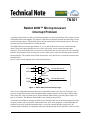
The problem has to do with the circuitry that clears a flip-flop that drives the output of the edge detectors
shown in Figure 1. When the edge detector detects the rising or falling edge that it is programmed to
detect, it sets this flip-flop. The intention was that the flip-flop would be cleared automatically when the
interrupt takes place. In some cases it turns out that the flip-flop is cleared when it should not be cleared. In
other cases the flip-flop is not cleared when it should be cleared.
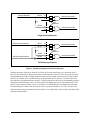
The flip-flop may be cleared spuriously because a different, lower priority, interrupt occurs nearly simultaneously (during an 8-clock window) with the occurrence of the edge that sets the flip-flop. This results in a
lost interrupt. A second problem is that the flip-flop might not be cleared when the interrupt takes place if a
different, higher priority, interrupt, is being requested nearly simultaneously (during an 8-clock window)
with the occurrence of the external interrupt. This results in a spurious interrupt after the first interrupt
because the interrupt request was not cleared. The sequences are shown schematically in Figure 2.
In either case, the problem occurs only if an interrupt request transitions during a short time period 8
clocks long. Because the fault occurs if the transition of the interrupt request line is coincident with a very
short window, the occurrence of the fault is rare. This contributed to the fault escaping detection sooner.
Ext Interrupt Req ff
8-clock window
Spurious clear of interrupt request ff
Different lower priority interrupt
(e.g., serial port) takes place
LOST INTERRUPT
Different higher priority interrupt is
requested during 8-clock window
Ext Interrupt Req ff
External Interrupt
takes place
Request ff fails to be cleared
Spurious interrupt
results
SPURIOUS INTERRUPT
Figure 2. Interrupt Sequences with Lost or Spurious Interrupts
022-0042 Rev. C
2