1
INTRODUCTION - PAGE 22
Ongoing efforts are being made
to exploit as much as possible
of a given channel capacity. One
way is to process data to be
transmitted in such a way that
redundant information is removed
before
transmission.
Another
method is to transmit more than
one channel on a radio link.
This may be achieved either in
the frequency or time domain or
a combination hereof.
The removal of redundant information is called compression.
The ratio between the size of
the original data and the compressed data depends on the nature of the data and the efficiency of the compression technique. These techniques are used
in commonly known compression
software like PKZIP, ARJ and
LHARC. Compression is used in
the PACTOR mode.
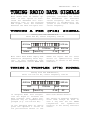
In frequency multiplex (FDM) a
carrier frequency is modulated
with a number of sub carriers
within
a
standard
telephony
channel from 0.3 kHz to 3 kHz.
Each sub carrier carries a data
signal. The sub carriers may be
amplitude, frequency or phase
modulated. The more common is
narrow shift frequency modula-
tion. Each channel is independent of the other ones and may
transmit with a different speed
or use a different alphabet or
system.
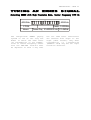
In time multiplex (TDM) each
data source is allowed access to
the aggregate channel (line or
radio link) in well-defined time
slots. To keep pace with the incoming bitstream, the aggregate
channel speed must be the sum of
the speed of the individual
channels. All channels must have
identical
speeds.
However
a
channel subdivision scheme has
been standardized so that up to
four sub channels may share one
channel.
The overwhelming majority of radio data systems will transmit
the individual bits of a codeword one after the other in serial transmission. But real-time
or high volume data systems like
digitised secure voice, computer
network access and image or file
transfer often uses parallel
transmission. The serial codewords are fed to a serial-toparallel converter and then to
the sub carrier modulators of a
FDM.