1
2
MESH CONTAINER
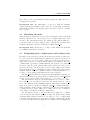
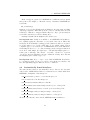
bv(ndf,numnp) Values of boundary forces and displacements for those node
variables subject to boundary conditions.
As before, the implementation inside the mesh class involves more details, but
they should be unimportant to someone who simply wants to use mesh objects.
To accommodate complex forces and displacements, there are actually three
accessors for each of the numerical arrays listed above. For example u actually
refers to the real part of the displacement; ui is the imaginary part of the
displacement, and uz can be used to get both parts of the displacement at
once. The mesh class provides methods to set and get each of these arrays
element-by-element.
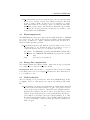
There is no array of boundary conditions for branch variables. Branch variables are supposed to describe internal state for the element, not things that
can be shared with the rest of the world (whether “the rest of the world” is a
boundary or the element next door).
2.3
Describing the geometry
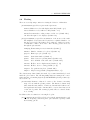
There are two primitive operations to add to the mesh geometry:
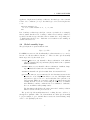
add node(x,n) Adds n nodes with positions listed consecutively in the array
x, and returns the identifier of the first node.
add element(e,etype,n,nen) Adds n elements of type etype with node
lists of length nen listed consecutively in the array e, and returns the
identifier of the first element added.
By default, both routines add one entry at a time, and the default node list
length is the global maximum nen.
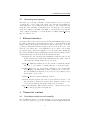
The add block methods allow you to add Cartesian blocks of elements.
These methods take the range of x, y, and possibly z coordinates and the
number of points along an edge in each direction, and construct a mesh of the
brick [xmin , xmax ] × [ymin , ymax ] × [zmin , zmax ]. It is possible to remap the bricks
later by directly manipulating the mesh x array. Each element has a specified
order, and the number of points along each edge should be one greater than a
multiple of that order. For instance, for a mesh of nx by ny biquadratic elements
(order = 2), the mesh node counts should be 2nx + 1 by 2ny + 1.
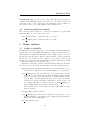
The mesh class also has a tie method which “merges” nodes which are
close to each other. The tie method takes a tolerance and an optional range
of nodes to try to tie together. If tie finds that nodes i and j in the specified
range are within the given tolerance of each other, the ix array is rewritten so
that references to either i or j become references to min(i, j).
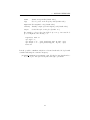
The tie method acts as though the relation “node i is within the tolerance
of node j” were an equivalence relation. But while this relation is reflexive and
symmetric, it does not have to be transitive for general meshes: that is, if xi ,
xj , and xk are three node positions, you might have
kxi − xj k < tol and kxj − xk k < tol and kxi − xk k > tol.
5