1
4) Understand how to select and operate existing three-phase or single-phase switches to
reconfigure network– operation;
5) Gain experience with power flow analysis tools, estimation methods and loss calculations;
6) Evaluate advantages and disadvantages of different network configurations.
The experiment is set up within RDAC which complements the generation and transmission
oriented Interconnected Power System Laboratory (IPSL) at Drexel University [7][8]. RDAC
consists of four modular stations that can be combined to form a distribution system with a total
of 36 buses, 16 three-phase lines, 16 three-phase sectionalizing switches, 16 three-phase tie
switches, and a number of various types of loads. A Distribution Energy Management System
(DMS) has been developed to remotely control switches, to monitor the entire system, and to
automatically acquire data with control and measurement facilities.
This paper will present the details of the network reconfiguration experiment. It begins
with a brief overview of the experiment in Section 2. In Section 3, various parts of the relevant
power hardware are presented along with the measurement and digital control hardware. The
DMS interface between the students and the distribution system is illustrated in Section 4. Then,
an outline of the experiment is addressed in Section 5, followed by conclusions.
2. Overview of the Network Reconfiguration Experiment
The network reconfiguration experiment provides students with hands-on learning
experience concerning load balancing and loss reduction techniques through a series of
experiments on different distribution systems. The experiment was developed within RDAC.
RDAC consists of a three-phase, 4-wire, 43.2 kW reconfigurable distribution system and a DMS.
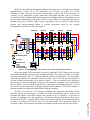
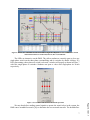
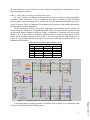
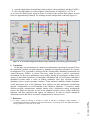
A single-line diagram of RDAC is shown in Figure 1 for a typical setup.
2
Page 10.1061.2
Figure 1. One-Line Diagram Setup of the Reconfigurable Distribution
Automation and Control Laboratory (RDAC)