1
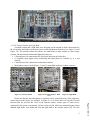
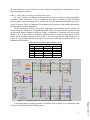
RDAC has four identical distribution stations. Each station has (i) a variable wye-grounded
autotransformer (Variac) and a 30A three-phase circuit breaker for safety; (ii) a 9-bus
distribution feeder with four three-phase sectionalizing switches and four three-phase tie
switches; (iii) six multi-phase resistive loads and a three-phase capacitor, and (iv) a Remote
Terminal Unit (RTU) with the DMS for data acquisition and digital control. Each station can run
the experiment independently with groups of three to four students. By interconnecting the four
stations using the tie switches, larger system experiments can be created for senior design
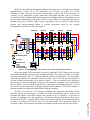
projects and research-oriented studies. A general three-phase setup for the network
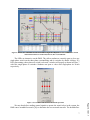
reconfiguration experiment is shown in Figure 2.
Figure 2. System Diagram for a Three-Phase Network Reconfiguration Experiment
3
Page 10.1061.3
In the experiment, 208V three-phase ac power is supplied by PECO Energy and fed to the
9-bus radial distribution system through an autotransformer. The radial system has two feeders
with four three-phase lines. To develop different network configurations, four three-phase
sectionalizing switches are embedded along the feeders. There are also four three-phase tie
switches available, though only one is shown in Figure 2. These tie switches can be hardwired
between any two buses excluding the feeder bus. It is noted that each phase of the sectionalizing
and tie switches can be controlled separately for single-phase load balancing studies. At each
bus, various resistive loads and a multi-tap capacitor can be connected. This allows students to
perform network reconfiguration under different loading conditions.
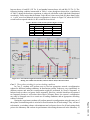
The RTU was built on a PC platform, including data acquisition and digital control
hardware. During the experiment, it controls all of the sectionalizing and tie switches and
measures three-phase and neutral voltages and currents at up to four buses. To provide an
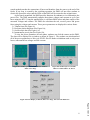
interface for students to run the experiment, a Distribution Energy Management System was
developed on the RTU. Using the DMS, students can remotely operate the sectionalizing and tie
switches to reconfigure the system. They can also obtain RMS values and phase angles of
measured voltages and currents to assist them in estimating system states and real power losses.