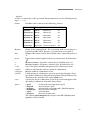
1
Algorithms
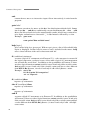
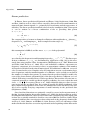
1995; Xia & Bartels, 1993). Within each individual submatrix the data are ordered as
in a serial file , and the submatrices as a whole are ordered in the same way as the data
points of a serial file . On output, the program PROSA uses for a data set with n real
data points in a given dimension a submatrix size of n ⁄ 8 (but at least 1) in the corresponding dimension. If necessary, the submatrix size in the active dimension is increased to the next integer multiple of 4 or 2 for the formats xeasy8 or xeasy16,
respectively, in order to align the submatrices at word boundaries. On input, the submatrix size in the active dimension must be an integer multiple of 2 or 4 for the formats xeasy8 or xeasy16, respectively. For the submatrix sizes in the other
dimensions there is no such condition.
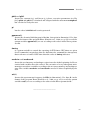
In the format real the data are stored in the binary floating point number format
of the given computer with one real data point per (32 bit) word. Data files written
with real format contain the data with full accuracy but are machine dependent. In
the format integer the data are stored in the binary integer number format of the given computer with one real data point per (32 bit) word. In principle integer format
files are also machine dependent but because most computers use the same binary representation of integer numbers, such files can in general be used on various computers.
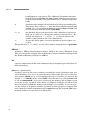
In the format swap the data are stored with inverse byte-ordering in the binary integer number format of the given computer with one real data point per (32 bit) word, i.
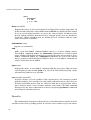
e. the 4 bytes
of an integer number are stored in the order
This format is useful to read integer data from a computer that uses inverse byte-ordering
with respect to the given machine but otherwise identical representation of integers.
For example, Bruker X32 computers use inverse byte-ordering when compared to Sun,
Convex, and NEC-SX3 computers. Text is a simple ASCII format using the FORTRAN77 format (1PE12.4) for output and list-directed (“free format”) FORTRAN-77 input.
This format is primarily designed to store small (1D) data sets for use with simple simulation programs or graphics programs such as GNUPLOT. The format xeasy8 uses a
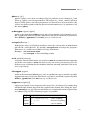
logarithmic representation of the data with 1 byte per real data point (Bartels et al.,
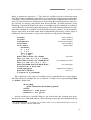
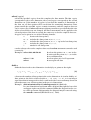
1995; Xia & Bartels, 1993). For a given data point s k the program first determines the
integer l that minimizes the expression
sk – 2
(i. e. l ≈
2log
l
[13]
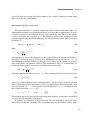
s k ) and then stores in one byte
e k = min(l + 1, 47),
= 95 – min(l, 47) ,
if s k ≥ 0;
[14]
if s k < 0.
47
46
This format can represent numbers approximately in the range – 2 ≤ s k ≤ 2 , i. e.
7
6
– 1.2 10 ≤ s k ≤ 8.4 10 with a relative error of less than 20%. The format xeasy16
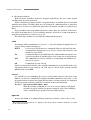
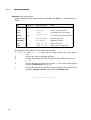
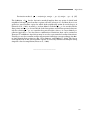
uses a 16 bit floating point format with the “exponent” e k given by Eq. [14] in the lower
valued byte and the mantissa
sk
a k = 721 --------l – 615,
2
50
if l ≠ 0
[15]