1
DIGITAL PROXIMITY SYSTEM (DPS)
Datasheet
FEATURES AND BENEFITS (Continued)
Full API 670 Compliance
The DPS was designed to fully comply with API 670
for linear range, interchangeability, standard probe
configurations, and all other details.
Reduced Spare Parts Inventory
The DPS reduces the requirements for spare parts by
allowing a single type of driver or transmitter to be
field-configured for a wide range of probe types, cable
lengths, and target materials.
Interchangeability
MX2030 probes and MX2031 extension cables are
fully interchangeable with BN1 3300 and 3300XL
5mm/8mm probe systems. Such compatibility
provides greater choice of suppliers without the need
to replace installed probes, cables, and drivers.
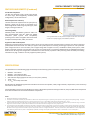
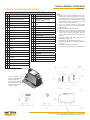
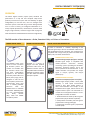
A user-generated label can be printed in the field with all device characteristics
as well as user-specific tagging and installation particulars.
Support for Older Probe Systems
Replacing a complete proximity transducer system can be not only expensive, but impractical when a machine must keep running and
probes/cables are buried inside. The ability to support older probe systems is becoming increasingly important as users push their
plant outage intervals to more and more years. Imagine being able to support not only a multitude of older probe systems, cable
lengths, and target materials, but to be able to do so with just a single driver or transmitter. MX2033 drivers and MX2034 transmitters
allow the user to change the configuration in the field for use with virtually any Metrix or BN4 proximity probe and cable (see ordering
information on page 7 and 8 for currently supported probe systems).
SPECIFICATIONS
The specifications on the following pages are based upon the following system components, target materials, gaps and temperatures2, 3:
•
•
•
•
•
•
MX2033 3-wire driver
MX2031 4.5m extension cable
MX2030 8mm probe with 0.5m cable
AISI 4140 steel target gapped at 50 mils (1.27 mm) from probe tip
Temp = 22° C
17 mARMS current loop noise floor
Specifications for MX2034 loop-powered transmitters assume the same probes, cables, target materials, temperatures, and current loop
noise floor as shown above.
Interchangeability and accuracy specifications assume the above Metrix products and target materials; they may differ when components
from other manufacturers are mixed with Metrix components4.
NOTES:
1. Registered trademark(s) of Bently Nevada®.
2. The American Petroleum Institute (API) Standard 670 defines two temperature ranges for proximity probe systems: Testing Range and Operating Range. Except as
otherwise noted, all specifications herein are for system performance at 22°C, in the middle of the API 670 Testing Range (0°C – 45°C).
3. Target materials other than AISI 4140 steel may restrict the transducer system’s linear range and other specifications. Consult the factory whenever using a non-4140
target to ensure the transducer system will be suitable for the intended measurement range and accuracy requirements.
4. A manufacturer’s interchangeability specifications are based on statistical variations against their own reference transducer system. Because the reference transducer
systems used by other manufacturers are not within the control of Metrix, interchangeability specifications for mixed systems cannot be guaranteed, but will generally
be about twice as large as when all transducer system components come from a single manufacturer. However, where known, these differences can be compensated
in the field using the transducer system’s configurability capabilities, allowing mixed system performance to meet or exceed that of a non-mixed system.
www.metrixvibration.com • [email protected] • 281.940.1802
Doc# 1087015 • REV P (October 2015) • Page 3 of 11