1
Simon Fraser University,
8888 University Dr.
Burnaby, BC Canada
Email: [email protected]
November 8, 2012
Dr. Andrew Rawicz
School of Engineering Science
Simon Fraser University
Burnaby, British Columbia
V5A 1S6
Re: ENSC 440 Design Specification for a QuickScan Mapping Device
Dear Dr. Rawicz,
Enclosed is our Design Specification Document for a Quick Scan Mapping Device, which
further describes our company’s product. We are designing a portable scanning device that
will quickly measure the area of a given room in 3D space. This device will eliminate the need
of manually measuring dimensions using a measuring tape or similar tools.
The design specification describes our implementation process of high-level requirements.
These requirements were priory PA specifications (i.e. high priority) in the functional
specification document. We will use this design document as a guide for research and
development activities. As well, we will use it for unit and integration testing as the minimum
standard of requirement.
Dimension Technologies consists of five senior engineering students: Chris Kwong, Oliver
Huang, William Chiang, Rahul Thomas, Jack Zhang. We have a wide range of abilities with
systems, electrical, and computing background.
If there are any questions or concerns regarding our document or device, please contact me
by phone at 604-807-0486 or by e-mail at [email protected].
Sincerely,
Rahul Thomas
CEO
Dimension Technologies
Enclosure: Design Specification for a QuickScan Mapping Device
DESIGN SPECIFICATION:
QUICKSCAN MAPPING DEVICE
Rahul
Thomas
Chris Kwong
Yumin Oliver
Huang
Jack Zhang
William
Chiang
CEO
CTO
CFO
COO
Managing
Director
Contact Person:
Rahul Thomas
[email protected]
Submitted To :
Dr. Andrew Rawicz-ENSC 440
Steve Whitmore-ENSC 305
School of Engineering Science
Simon Fraser University
Issued Date:
November 8, 2012
Design Specification for a QuickScan Mapping Device
Executive Summary
The QuickScan Mapping Device is a product that Dimension Technologies is developing to
assist building professionals in the industrial & residential sectors. The present rapid growth in
construction and real-estate that the world is experiencing has led to an increase in the
demand for facilities and houses. Typically, one main consideration in each of these cases is
the size and dimensions of different property areas. Dimension Technologies’ product will
solve these questions through a relatively low cost product. While other solutions have been
developed in the past, QuickScan is a standalone device that measures room dimensions in a
very short time.
This document will outline the design process and implementation process for critical
functional requirements. This document will begin by summarizing the major components of
our system. Given the complexity of the entire device, each component has been subdivided
into smaller sections to increase the document’s readability. For each subsystem, our design
considerations have been well documented indicating how we plan to implement each
specification in detail.
The QuickScan module consists of a high precision depth sensor that sends data through
various signal processing hardware and tools in order to create a 3D render of a given room or
area onto the controlling laptop. There are many features and functions that we would like to
support in order to best meet our customers’ needs. However, in order maintain a tight
schedule and budget; we have sorted out these desired features into different levels of priority.
This document will explain how we will implement high priority features.
Some of the subsystems that will be discussed in detail are:
• Mechanical Subsystem - Ranging from electromechanical devices to device
enclosures
• Electrical Subsystem - Includes power and control circuitry
• Software Subsystem - Consists of data acquisition, data processing and user
interaction
i
Design Specification for a QuickScan Mapping Device
Additionally, a test plan has been included in this document. The QuickScan device and all its
subcomponents will be thoroughly tested using the unit tests mentioned in this document.
Our proposed design features will be implemented in the final QuickScan module. The
targeted completion date is the first week of December 2012.
ii
Design Specification for a QuickScan Mapping Device
Table of Contents
1.
Introduction ................................................................................................................................ 1
1.1 Scope ....................................................................................................................................... 1
1.2 Intended Audience ................................................................................................................... 1
2.
System Overview ........................................................................................................................ 2
3.
Hardware .................................................................................................................................... 5
3.1 Microsoft Kinect ....................................................................................................................... 5
3.2 Arduino Nano ........................................................................................................................... 9
3.3 Stepper Motor - ROB-09238 .................................................................................................. 10
3.4 ROB-10267 Motor Driver ....................................................................................................... 13
3.5 Honeywell HMC5883L Triple Axis Compass ........................................................................ 17
3.6 Other Components ................................................................................................................ 19
4.
Mechanical ............................................................................................................................... 20
5.
Software Processing ................................................................................................................ 26
5.1 Data Processing..................................................................................................................... 26
5.2 Software Processing .............................................................................................................. 28
5.3 QuickScan Procedure ............................................................................................................ 30
5.4 Graphical User Interface (GUI) .............................................................................................. 32
6.
Arduino Software ...................................................................................................................... 34
6.1 Serial Communication Protocol ............................................................................................ 34
iii
Design Specification for a QuickScan Mapping Device
6.2 Arduino Microcontroller Logic ............................................................................................... 38
7.
Electrical ................................................................................................................................... 41
7.1 Circuit Design & Topology ..................................................................................................... 41
7.2 Battery Powering Considerations .......................................................................................... 41
8.
Test Plan ................................................................................................................................... 45
9.
Environmental Considerations ................................................................................................. 49
9.1 Project Disposal ..................................................................................................................... 49
9.2 Product Disposal ................................................................................................................... 49
10.
Conclusion ............................................................................................................................ 50
11.
References............................................................................................................................ 51
iv
Design Specification for a QuickScan Mapping Device
List of Figures
Figure 2.1 System Overview.................................................................................................................. 2
Figure 2.2 QuickScan Mapping Device [28][29] .................................................................................. 4
Figure 3.1.1 Kinect Sensors [14]........................................................................................................... 6
Figure 3.1.2 PrimeSense [12]................................................................................................................ 6
Figure 3.1.3 Kinect Features ................................................................................................................. 7
Figure 3.1.4 Kinect IR coding Image .................................................................................................... 8
Figure 3.1.5 Depth map (left) created from light IR pattern (right)....................................................... 8
Figure 3.2.1 Arduino Nano [3] ............................................................................................................... 9
Figure 3.3.1 ROB-09238 Stepper Motor [4]........................................................................................ 11
Figure 3.3.2 Stepper Motor Overview [22].......................................................................................... 11
Figure 3.3.3 Two Phase [22] ............................................................................................................... 12
Figure 3.4.1 Motor Driver [5] ............................................................................................................... 13
Figure 3.4.2 Phase input with Micro-stepping [20] ............................................................................ 14
Figure 3.4.3 Phase input with Micro-stepping [20] ............................................................................ 15
Figure 3.4.5 [2][3][5] ........................................................................................................................... 16
Figure 3.5.1 HMC5883L Triple Axis Compass [6] .............................................................................. 17
Figure 3.5.2 I2C Overview [18] ............................................................................................................ 18
Figure 4.1 Overview of the QuickScan device [28][29] 3................................................................... 20
v
Design Specification for a QuickScan Mapping Device
Figure 4.2 QuickScan Diagram [29] 3 ................................................................................................ 21
Figure 4.3 Operation of the two stepper motors 3 ............................................................................. 22
Figure 4.4 Pan-Tilt Enclosure [4] 3 ...................................................................................................... 23
Figure 4.5 Pan-Tilt Assembly Diagram [4] 3 ....................................................................................... 24
Figure 4.6 Motor Mechanical Diagram [4] 3 ....................................................................................... 25
Figure 5.1.1 Forward Kinematics 3 ..................................................................................................... 26
Figure 5.1.2 Sample stitch of two snapshots 3 .................................................................................. 27
Figure 5.2.1 MeshLab Output 3 .......................................................................................................... 29
Figure 5.3.1 QuickScan Procedure 3 .................................................................................................. 30
Figure 5.3.2 Illustration of QuickScan Process 3 ................................................................................ 32
Figure 5.4.1 QuickScan GUI 3 ............................................................................................................ 33
Figure 6.1.1 Arduino & Processing Synchronization 3 ....................................................................... 35
Figure 6.1.2 Stepper Motor 0 Protocol 3............................................................................................. 36
Figure 6.1.3 Magnetic Bearing Protocol 3 .......................................................................................... 36
Figure 6.1.4 Stepper Motor 1 Protocol 3............................................................................................. 37
Figure 6.2.1 Arduino Logic 3 ............................................................................................................... 38
Figure 6.2.2 Motor Control Logic 3 ..................................................................................................... 39
Figure 6.2.3 Motor Interrupt Subroutine Logic 3................................................................................. 40
Figure 7.1.1 Circuit Schematic 3 ......................................................................................................... 41
Figure 7.1.2 Wiring Diagram 3 ............................................................................................................ 42
Figure 7.2.1 QuickScan Battery 3 ....................................................................................................... 43
vi
Design Specification for a QuickScan Mapping Device
List of Tables
Table 3.2.1 Arduino Nano [3][16] ....................................................................................................... 10
Table 3.3.1 Stepper Motor Specs [4] .................................................................................................. 12
Table 7.2.1 Component Voltage & Current 3...................................................................................... 43
vii
Design Specification for a QuickScan Mapping Device
Glossary
3D – Three Dimensional
ADC – Analog to Digital Converter
CAD – Computer Aided Design
CMOS – Complementary Metal Oxide Semiconductor
COM – Communication
CPU – Central Processing Unit
DC – Direct Current
GUI – Graphical User Interface
I/O – Input Output
I2C – Inter-Integrated Circuit
IC – Integrated Circuit
ID – Identification
IDE – Integrated Development Environment
IR – Infrared
Li-ion – Lithium Ion
PCB – Printed Circuit Board
PIC – Peripheral Interface Controller
PWM – Pulse Width Modulation
PWR – Power
RGB – Red Green Blue
SDA – Serial Data line
SCL – Serial Clock
TTL – Transistor-Transistor Logic
UART – Universal Asynchronous Receiver/Transmitter
USB – Universal Serial Bus
VGA – Video Graphics Array
viii
Design Specification for a QuickScan Mapping Device
1.
Introduction
The QuickScan mapping device is a relatively low cost device that can be used by drafters
and realtors for various dimensioning applications. It will enable professionals in this area to
quickly make measurements of a given room and create a viewable file in industry standard
CAD software such as MeshLab and AutoCAD. The device will be relatively low cost and will
provide quick and accurate measurements of a desired room. Our objective is to save
professionals time and money in the measurement and floor planning process. Our design
considerations and process are outlined in this document.
1.1 Scope
This document will outline in detail how we plan to implement the requirements mentioned in
the functional specification document. Please note, we will focus on high and moderate priority
requirements and their implementations in this document.
1.2 Intended Audience
This document will primarily be used by Dimension Technologies’ team in the final
implementation of our product. Also, it will serve as a functional and design benchmark for our
working device. Specifically, the test cases mentioned will be used in the testing stage of our
development process.
-1-
Design Specification for a QuickScan Mapping Device
2.
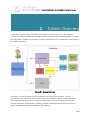
System Overview
A high level overview of the QuickScan device can be seen in Figure 2.1. The diagram
contains the major hardware and software systems that have been weaved together to create
the end product. Please note that each of these subsystems will be explained in much detail in
the following sections.
Figure 2.1 System Overview
Inherently, our overall system can be divided into functioning components. The first
component is the QuickScan device itself which incorporates the depth sensing and other
electromechanical components. The other component is the user’s laptop which will be
running Dimension Technologies’ software to enable interfacing with the main QuickScan
device; ultimately producing a viewable CAD drawing.
-2-
Design Specification for a QuickScan Mapping Device
The user’s sole method of interaction will be through the GUI that will be installed on the user’s
laptop. This laptop will have the needed QuickScan software installed. A USB connection will
be used to interface with the QuickScan device. All control parameters and other options will
be set from the GUI on the laptop. One of the parameters will be a list of COM ports the user
can select to connect to the QuickScan device. The QuickScan module can be connected to a
desired laptop through USB.
Inherent to this system is the high precision depth and RGB sensing system. We will use a
Kinect depth sensor with an integrated RGB sensor. The data that is given off by this sensor is
raw point cloud data which is then processed to create a render of the room. More
specifications of this device are given in the next section. The Arduino microcontroller will
serve as a medium between the laptop and other hardware using serial communication via the
USB.
The device will consists of two integrated motors which will enable a wide range of data
collection. The first motor is used to enable a full 360° horizontal range of acquisition. The
second motor is used for a vertical tilt to enable a greater vertical acquisition range. This motor
has a range of about 70° in both vertical directions.
QuickScan also features a battery powered capability. This is to enable maximum flexibility in
positioning the entire device in an area. The hassle of wires and other cables are eliminated.
This battery powering system consists of a rechargeable 12V battery with an on-device
regulator.
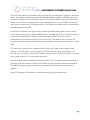
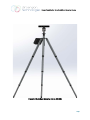
Figure 2.2 displays a 3D model of our device showing the major components.
-3-
Design Specification for a QuickScan Mapping Device
Figure 2.2 QuickScan Mapping Device [28][29]
-4-
Design Specification for a QuickScan Mapping Device
3.
Hardware
This section will identify the different hardware components that will be used in our product. These
components have been manufactured by third party sources and will be integrated into our
system. Our project utilizes the following hardware components:
•
•
•
•
•
Microsoft Kinect
Arduino Nano
Stepper Motor (ROB-09238)
EasyDriver Stepper Motor Driver
Triple Axis Digital Compass IC HMC5883L by Honeywell
The following sections will give an overview of each component, a brief technical description, and
how it integrates into QuickScan.
3.1 Microsoft Kinect
The Kinect [1] [2] is a motion sensing device that has been developed by Microsoft. It features 3D
depth sensors and an RGB camera. Its initial intended use was as a peripheral to Microsoft’s
XBOX gaming console. However, due to its unique combination of sensors, the Kinect can be use
in a variety of other applications. Figure 3.1.1 shows an image of the Kinect outlining its major
features:
-5-
Design Specification for a QuickScan Mapping Device
Figure 3.1.1 Kinect Sensors [14]
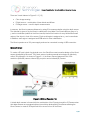
The Kinect’s depth sensing features were created by an Israel-based company called PrimeSense
[13]. The PrimeSense device with relation to the Kinect is shown in the follow figure:
Figure 3.1.2 PrimeSense [12]
-6-
Design Specification for a QuickScan Mapping Device
There are 3 main features in Figure 3.1.2: [13]
•
•
•
Color image sensing
IR light source – combination of laser diode and diffuser
IR image source – used for depth measurements
In essence, the Kinect measures distances by using IR to measure depths using the depth sensor.
The data that is given off by the Kinect is called point cloud data. Point cloud data is a group of x,
y, and z coordinates (relative to the Kinect sensor) that tell the location of every infinitesimal small
region of the object in front of the sensor. Each small region is assigned an x, y and z coordinate.
In addition, each region is assigned and RGB value for color identification.
The Kinect operates on a 12V power supply and can be connected to using a USB connection.
Microsoft Kinect:
To create a 3D point cloud of a physical room, the QuickScan uses innovative design of the Kinect
sensor developed by Microsoft. The Kinect sensor combines several technologies to effectively
collect 3D information. As shown in Figure 3.1.4, the Kinect Sensor features an 8-bit VGA
resolution (640x480) camera, infrared (IR) projector and an infrared(IR) Camera.
Figure 3.1.3 Kinect Features [14]
A virtual depth camera is formed with the combination of the IR projector and the IR Camera when
their data streams are synergized with an internal chip developed by PrimeSense allowing the
Kinect Sensor to create a 3D depth field of the scene in front of the Kinect.
-7-
Design Specification for a QuickScan Mapping Device
Figure 3.1.4 Kinect IR coding Image [30]
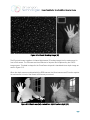
The IR project beams a pattern of infrared light beams (IR coding image) into the environment in
front of the sensor. The IR beams are then reflected on objects and is captured by the CMOS
image sensor. This data is relayed to the PrimeSense chip and is translated into a depth image as
seen in Figure 3.1.5.
When the depth camera combined with the RGB camera, the Kinect sensor can 3D motion caption
the environment in front of the Kinect at 30 frames per second.
Figure 3.1.5 Depth map (left) created from light IR pattern (right) [30]
-8-
Design Specification for a QuickScan Mapping Device
Figure 3.1.5 demonstrates, the Kinect can create a depth maps based on the light infrared pattern
captured by the CMOS IR Camera.
The drivers and interface (OpenNI) used to communicate with the intricate sensors on other Kinect
is explained in more detail in the section 5.2.
Application:
In our product we will use the Kinect for its depth sensing and RGB camera. The Kinect features a
very high precision depth sensor that can detect objects up to 10m away. Its field of view is 57°
horizontally and 43° vertically. Due to its limited acceptance angle, a rotation system is needed to
increase the range of acquisition (more on this later). Our floor plans will be created using the
depth information that is given by the Kinect.
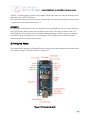
3.2 Arduino Nano
The Arduino Nano features the Atmega328 microcontroller and other necessary components fitted
into a small compact PCB board as seen in Figure 3.2.1:
Figure 3.2.1 Arduino Nano [3]
-9-
Design Specification for a QuickScan Mapping Device
Overview [15]:
The Arduino utilizes its own IDE and programming language based on C++. This makes the
Arduino much easier to program compared to other microprocessors (i.e. PICs), though still highly
flexible as users can create and integrate their own libraries developed in C++.
The open-source nature of this device means a vast resource available for developers. It its well
supported through online open-source discussion communities which provide documentation and
Arduino libraries keeping developing time low. In addition, the modular integration of many
hardware components makes the Arduino a very powerful platform and the most suitable logic unit
for our project. The specifications of the Nano are shown in Table 3.2.1:
Table 3.2.1 Arduino Nano [3][16]
Specification
Operating Voltage
Input Voltage (recommended)
Input Voltage (limits)
Digital I/O Pins
Analog Input Pins
DC Current per I/O Pin
Flash Memory
SRAM
EEPROM
Clock Speed
Dimensions
5V
7-12 V
6-20 V
14 (6 provide PWM output)
8
40 mA
32 KB
2 KB
1 KB
16 MHz
0.73" x 1.70”
Application:
The slim form factor of the Arduino Nano combined with its ease of use and serial communication
makes this the optimal component for relaying data between the computer and the other hardware
3.3 Stepper Motor - ROB-09238
As mentioned in the system overview, due to limitations in the Kinect’s acquisition range we
needed to implement a system that would enable us to reach maximum coverage. This can be
solved using stepper motors. The stepper motor design was chosen due its high level of accuracy
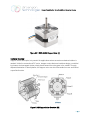
and relatively low cost. The QuickScan device makes use of two ROB-09238 stepper motors [4];
seen in Figure 3.3.1:
- 10 -
Design Specification for a QuickScan Mapping Device
Figure 3.3.1 ROB-09238 Stepper Motor [4]
Technical Overview:
Stepper motors are simple, but powerful for applications where accurate mechanical rotation is
needed. Unlike the conventional DC motor, stepper motors feature a brushless design, controlled
by phases, electromagnets (stator poles) placed around the rotary gear in the middle. Through
sequential activation of these phases, the stepper motor can be commanded to move and hold at
a specified location.
Figure 3.3.2 Stepper Motor Overview [22]
- 11 -
Design Specification for a QuickScan Mapping Device
The ROB-09238 stepper motor is a 4 wire 2 phase unipolar stepper motor capable of turning 1.8°
per step and accurate to 0.09°. Below are more detailed properties for the ROB-09238 motor:
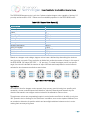
Table 3.3.1 Stepper Motor Specs [4]
Specification
Step Angle
Max Step Error
Phase
Rated Voltage
Rated Current
Holding Torque
Drive Shaft Diameter
Winding Resistance
Winding Inductance
Max Flux Linkage
Max Detent Torque
Total inertia
Total friction
1.8 °
0.09 °
2
12 V
333 mA
2.3kg*cm
5 mm
32.6 Ω
48 mH
1.8 Vs
0.016 N.M
3.5 Kg.m.m
4 Kg.m/s
Based on a stepper motor design, stepper motors have a defined step describing the minimum
turn the motor can make. Every revolution is divided into a discrete number of steps, in this case of
the ROB-09238, 200 steps (360°/200° = 1.8° per step). To rotate the stepper motor to a specific
angle, the user will calculate the number of steps it will take and manipulate the control wires to
activate the two phases accordingly as seen below.
Figure 3.3.3 Two Phase [22]
Application:
As a result of how the stepper motors operate, they are very good at turning to a specific point
accurately, at user controlled speed and direction, which are several good reasons why the
decision was made to use stepper motors instead of the alternative: servo motors.
Though servo motors are comparatively easier to control and more efficient, its ability to only turn
180° proved to be too limiting for the QuickScan. In addition, servo motor requires feedback from
an encoder to determine its position which can have slight variations between motor to motor
making their accuracy a big issue.
- 12 -
Design Specification for a QuickScan Mapping Device
With more holding torque, flexible control and continuous rotation, the QuickScan features 2 ROB09238 to control its vertical and horizontal rotation.
3.4 ROB-10267 Motor Driver
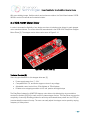
In order to increase the flexibility of our design we chose to include motor drivers for each stepper
motor mentioned above. The motor driver that was selected is the ROB-10267 EasyDriver Stepper
Motor Driver [5]. The stepper motor driver can be seen in Figure 3.4.1.
Figure 3.4.1 Motor Driver [5]
Technical Overview [5]:
Some key specifications for this stepper driver are [5]:
•
•
•
•
Power supply range from 7 – 30 V
Compatible with 4, 6, and 8 wire stepper motors of any voltage
Adjustable current control from 150mA/phase to 750mA/phase
Enables micro-stepping resolution to full, half, quarter and eighth steps
The EasyDriver features the A3967SLB stepper motor driver chip allowing the microcontrollers
such as the Arduino [23][24] to easily control 2 phase stepper motors. The EasyDriver removes the
complexity of correctly activating phases for each step and instead takes pulses into the STEP pin
to automatically increment its step. The user can easily adjust the stepper motor speed by varying
frequency of these pulses.
- 13 -
Design Specification for a QuickScan Mapping Device
In addition the driver includes a micro-stepping motor feature with built-in translator where the user
can specify full, half-, quarter, and eighth-step modes which will be explained in more detail in the
next section.
The EasyDriver requires external power to drive the stepper motor which is satisfied by a 12V
lithium ion battery. The A3967SLB also includes a current regulator that has the ability to operate in
slow, fast, or mixed current-decay modes. This current-decay control scheme results in reduced
audible motor noise, increased step accuracy, and reduced power dissipation.
Micro-Stepping:
Figure 3.4.2 Phase input with Micro-stepping [20]
- 14 -
Design Specification for a QuickScan Mapping Device
Figure 3.4.3 Phase input with Micro-stepping [20]
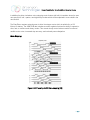
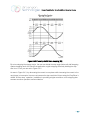
By micro-stepping the stepper motor, the user can divide the step angle further with half stepping,
quarter stepping and in the QuickScan application, eighth-stepping effectively dividing the step
size from 1.8° as you can see in Figure 3.4.2.
As seen in Figure 3.4.3, by decreasing the current to one phase while increasing the current to the
next phase in increments, the user can increase the step resolution 8 times using the EasyDriver’s
default “8 Micro-step” operation. In addition to providing a higher resolution, micro-stepping also
ensures smoother operation and less vibration.
- 15 -
Design Specification for a QuickScan Mapping Device
Applications:
Figure 3.4.5 [2][3][5]
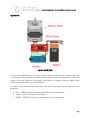
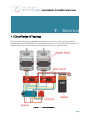
As seen in the diagram above, the 4 wires from the stepper motor controls 2 phases, where the
red and green wires represent one phase and the yellow and blue wire presents the other. The
stepper motor and EasyDriver is powered by the external 12V battery, while the Arduino Nano
receives power directly from the USB connection.
It can also be observed that the Arduino Nano uses three control pins to send commands to the
EasyDriver:
•
•
•
Blue – (SLEEP) Enables or disables the EasyDriver and Stepper Motor
Yellow – (STEP) Step input from the Arduino
GREEN – (DIR) Determines the rotation direction of the Stepper Motor
- 16 -
Design Specification for a QuickScan Mapping Device
3.5 Honeywell HMC5883L Triple Axis Compass
One of the applications that Dimension Technologies is targeting is the drafting industry;
specifically to help in the floor planning and blueprint creation process. In any floor plan one key
element is the identification of cardinal coordinates (North, East, West, and South). There were
many options that were available to us. We chose to stick with a relatively simple option: Digital
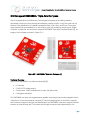
Compass. In particular, we chose the Honeywell HMC5883L Triple Axis Compass Module [6]. An
image of this compass is shown in Figure 3.5.1:
Figure 3.5.1 HMC5883L Triple Axis Compass [6]
Technical Overview:
Some of the HMC5883L’s key features include [6][25]:
•
•
•
•
I2C interface
2.16-3.6V DC voltage supply
Current draw: 100µA (measurement mode), 2µA (idle mode)
5 milli-gauss resolution
The HMC5883L is a three axis magnetometer capable of sensing its surrounding magnetic field in
3 directions. A normal mechanical compass [27] works by aligning itself to the earth’s magnetic
field, however instead of using any mechanical parts, the HMC5883L uses three magneto-resistive
sensors on three different axis. The current flow through the sensor varies depending on the
- 17 -
Design Specification for a QuickScan Mapping Device
orientation of the sensor to the earth’s magnetic field. The internal circuitry will automatically store
the data inside its registers.
The HMC5883L’s functionality includes automatic degaussing strap drivers, offset cancellation and
a 12-bit ADC enabling 1° to 2° compass heading accuracy. The HMC588L operates at a low
operational voltage range of 2.16V to 3.6V at 100µA.
I2C Protocol Overview [17][18][26]:
The Arduino interfaces with the HMC5883L with the I2C protocol and configured such that the
Arduino Nano is the master and the HMC5883L is the slave.
The I2C protocol features shared data (SDA) and clock (SCL) bi-direction lines between all I2C
devices on the bus. The SDA line communicates important data between the master and slave
devices and the SCL clock line is used to synchronize the data transfer.
Figure 3.5.2 I2C Overview [18]
Slave I2C devices come pre-configured with an ID by the manufacturer so that the master device
can communicate with more than one slave device by specifying the ID in the I2C protocol. This
allows the Arduino to communicate with several devices with only two wires.
I2C is active low meaning the values need to be put on 0V (LOW) to be considered a “logic 1”; thus
pull up resistors are required on both SDA and SCL lines so that its default state is high (3.3V).
Included in the Arduino IDE is the “Wire Library” [18] which enables a simple interface with I2C
devices.
- 18 -
Design Specification for a QuickScan Mapping Device
As the master device the Arduino Nano will do the following to request data from HMC588L
compass using the I2C protocol:
1)
2)
3)
4)
5)
Connect to HMC588L (Use ID number)
Ask for Register X
End Transmission
Wait for data response
Receive Response
The algorithm above combined with other variations of communication is implemented in an opensource library “HMC5883L” which provides a class object to easily request data from the three
axis.
To calculate the bearing, extrapolation of the HMC588L data is required. By combining the data of
2 axis of plane, we can calculate the bearing to magnetic north demonstrated by the pseudo-code
below:
heading = atan2(rawData.YAxis, rawData.XAxis);
Applications:
The small size and relatively low cost of the HMC5883L combined with the simple I2C interface
makes this device a suitable magnetic sensor for the QuickScan. The HMC5883L is attached onto
the QuickScan’s 360° rotational platform enabling mapping with magnetic north information.
3.6 Other Components
There are quite a few other components that have been integrated into our device including the
following:
•
•
•
•
12V Li-ion battery
Pan/tilt rotation cage - built by Dimension Technologies
Device enclosure and stand
Other circuitry
Each of the above components is explained in detail in the following sections.
- 19 -
Design Specification for a QuickScan Mapping Device
4.
Mechanical
The QuickScan device consists of four subcomponents; from the bottom up, they are: the tripod,
the circuitry black box, the pan-tilt enclosure, and the Kinect. Figure 4.1 shows their placement in
the overall device.
Figure 4.1 Overview of the QuickScan device [28][29] 4
The tripod used is a standard three-legged tripod, capable of extending and retracting with a
height range between 0.58m to 1.6m. The black box contains the Arduino microcontroller, motor
driver, external battery, as well as various other circuitry that are necessary for connection. The
black box will have a size of approximately 250mm by 170mm, with a thickness of 60mm. The pantilt enclosure connects between the Kinect and the tripod; the details and dimensions of the
enclosure will be explained below.
- 20 -
Design Specification for a QuickScan Mapping Device
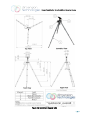
Figure 4.2 QuickScan Diagram [29] 5
- 21 -
Design Specification for a QuickScan Mapping Device
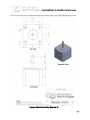
As stated in the hardware section of this document, the stepper motor we are using is the ROB09238. The body of this motor has a fixed size of approximately 42.3mm by 42.3mm by 34mm.
Shown in Figure 4.6, the enclosure has been built to allow comfortable room for the motor to sit in.
Please also note that two stepper motors are used as part of the enclosure design: the motor at
the bottom will offer horizontal rotation while the motor inside of the enclosure will be able to tilt
vertically.
Figure 4.6 Operation of the two stepper motors 7
The pan-tilt enclosure is responsible for connecting the Kinect sensor to the tripod. It will offer 360o
rotational freedom as well tilting via the two stepper motors included. The enclosure comprises of
two components: the ‘house’, where the tilt motor can be located, and the ‘stand’, where the
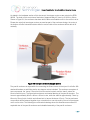
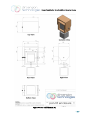
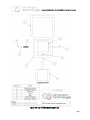
Kinect would sit upon. The figure below shows a mechanical drawing of the pan-tilt structure. The
house is approximately 60mm x 60mm x 50mm in size, while the stand is approximately 74mm by
60mm by 50mm (both of which are hollowed out to have a thickness of 5mm). The two enclosure
components will be fastened together by a nut and bolt on one side, and by the rod of the stepper
motor on the other. The following two mechanical drawings show the dimensions as well as the
exploded view of the pan-tilt enclosure and a detailed assembly of the pan-tilt enclosure.
- 22 -
Design Specification for a QuickScan Mapping Device
Figure 4.4 Pan-Tilt Enclosure [4] 8
- 23 -
Design Specification for a QuickScan Mapping Device
Figure 4.5 Pan-Tilt Assembly Diagram [4] 9
- 24 -
Design Specification for a QuickScan Mapping Device
The next figure shows a mechanical drawing and dimensions of the ROB-09238 stepper motor.
Figure 4.6 Motor Mechanical Diagram [4] 10
- 25 -
Design Specification for a QuickScan Mapping Device
5.
Software Processing
5.1 Data Processing
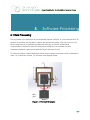
The key feature of the QuickScan is to automatically capture a full 360° of a room and since the IR
sensors on the Kinect are only able to capture the forward facing data, a full view of a room, the
Kinect camera has to be rotated horizontally and vertically. As a result, mathematical
compensation is required to adjust the virtual camera location in our software to ensure
consistency between capture points when the Kinect camera is moved.
To solve this problem, forward kinematics will be used to determine the new sensor coordinates in
frame {3} in reference to frame {0} as shown in the diagram below:
Figure 5.1.1 Forward Kinematics 11
- 26 -
Design Specification for a QuickScan Mapping Device
Frame {0} is the stationary frame of reference located in the cross section between the center line
from the rotation axis of Motor 0 and the centre line from the rotation of axis of Motor 1. When
frame {1} is located at the same location when 𝜃 = 0, and rotates on the z-axis with angle 𝜃 in
reference to frame {0}; similarly, frame {2} rotates on its x-axis with angle 𝛼 in reference to frame
{1}. Finally frame {3} is shifted up distance “L” on the z-axis in reference to frame {2}.
𝑃𝑋
The Kinect sensor's location in relation to the final platform, frame {3} located at point 3𝑃 = �𝑃𝑌 �,
𝑃𝑍
where P X , P Y and P Z are minor offset adjustments that are used fine tune and calibrate its data
capture.
The new camera coordinates 30𝑃 , affected by the vertical and horizontal rotation 𝛼 and 𝜃 are given
in the equations below:
3
0𝑃𝑥
3
0𝑃𝑦
= 𝑃𝑥 cos(𝜃) − 𝑃𝑦 cos(𝛼) sin(𝜃) + 𝐿𝑠𝑖𝑛(𝛼) sin(𝜃) + 𝑃𝑧 sin(𝛼) sin(𝜃)
= 𝑃𝑥 sin(𝜃) + 𝑃𝑦 cos(𝛼) cos(𝜃) − 𝐿𝑠𝑖𝑛(𝛼) cos(𝜃) − 𝑃𝑧 sin(𝛼) cos(𝜃)
3
0𝑃𝑧
= 𝐿𝑐𝑜𝑠(𝛼) + 𝑃𝑧 cos(𝛼) + 𝑃𝑦 sin(𝛼)
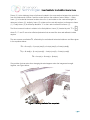
One problem that can arise from changing the axis happens when the images are brought
together, see Figure below.
Figure 5.1.2 Sample stitch of two snapshots 12
- 27 -
Design Specification for a QuickScan Mapping Device
The present view shows the joint part when two shots are brought together. It is quite obvious that
there are problems such as there are two poles when they should be put together in an overlap.
This happens due to the fact that the Kinect is perfectly in the centre of the platform when it turns.
To resolve this issue, we shall first attempt to find the centre of the Kinect camera as described in
the test plan and then through trial and error we will attempt to place the Kinect at the centre of the
platform.
5.2 Software Processing
General Requirement
•
•
•
•
•
•
•
Processing 1.5.1 this is a programming language for visual display used to process the
data retrieved from the Kinect [10]
OpenNI 1.5.4.0, this provides tools used to capture the point cloud data for the Kinect [9]
NITE 1.5.2.21, PrimeSense’s middleware which allows computers to perceive the world in
3D
Sensor 5.1.2.1, PrimeSense’s driver for the Kinect
SimpleOpenNI, this is an OpenNI and NITE wrapper for Processing
KinectOrbit, a camera control library for processing
ControlP5, this is a Graphic User Interface Library for Processing [11]
Processing Software System Overview
Processing is a open source software that is designed for visual design. The software itself is built
on Java although it has a simpler programming syntax and graphics programming model. It
includes a feature called the sketchbook which is an alternate to an IDE for organizing projects.
We are using processing to control the Kinect and to access the data that the Kinect is capturing.
In order to do this we incorporate the SimpleOpenNI library to assist us. As mentioned above,
SimpleOpenNI is an OpenNI and NITE wrapper for processing.
Processing is used to write the software that processes the point cloud data captured and then
results into a *.ply file to be viewed in MeshLab.
OpenNI and NITE
Open Natural Interaction (OpenNI) is an industry led, nonprofit organization that designs
frameworks that allow devices such as the Kinect to recognize natural interactions. One of
OpenNI’s main members is PrimseSense which is the company that designed the technology
- 28 -
Design Specification for a QuickScan Mapping Device
used for the Kinect for motion sensing. Recently they released an open source driver that tracks
these motions called NITE. With these technologies, OpenNI provides features such as hand
gesture recognition or hand control which allows you to control digital devices with your bare
hands. Also they provide features such as the full body control, which allows you to use your entire
body in a full body video game.
With the SimpleOpenNI library, we create a variable called kinect and then with it we enable its
depth sensor and its RGB sensor. The depth sensor, through the IR projectors, projects a pattern
of infrared light beams into the environment in front of the sensor. Therefore with every pixel it
captures, it is able to detect how far away that pixel is from the camera thus giving us the z
coordinate. Then going through each pixel that is being captured, the coordinate of each pixel as
well as its RGB value will be captured and will be stored separated into two vectors.
Meshlab
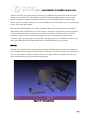
Meshlab is an advanced 3D mesh processing software. Meshlab takes the point cloud data with
all its coordinates and projects a 3D view of the coordinates. This is the software that we will use to
view our final results. A sample of which is seen in the Figure below. We will also use this to do
some post analysis for surface recreation and filtering.
Figure 5.2.1 MeshLab Output 13
- 29 -
Design Specification for a QuickScan Mapping Device
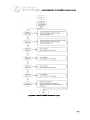
5.3 QuickScan Procedure
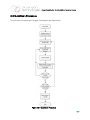
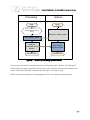
The procedure for capturing the images is portrayed in the Figure below.
Figure 5.3.1 QuickScan Procedure 14
- 30 -
Design Specification for a QuickScan Mapping Device
Since the Kinect is working with the stepper motor at certain stages of the procedure it is waiting
on the stepper motor to finish its task.
1. The first step is to initialize the Kinect. Once that is ready we check from the compass
where north is and then rotate the camera via the stepper motor to face north.
2. The next step is to rotate motor1(vertical) to its proper vertical location (upper view, straight
view, and the lower view).
3. Then motor0 (horizontal) is to be rotated to the designated degree.
4. The image is then captured with its RGB value and its coordinates.
5. The axis of the output vector is rotated to the camera view through forward kinematics and
then the RGB values and the coordinates are stored into the output vectors.
6. Next check if it has captured every view all around horizontally, if yes proceed. If not, go to
step 3.
7. Check if it has captured all the vertical views. If yes proceed to the lats step, if not go to
step 2.
8. All the data in the vectors are exported onto a *.ply in a particular format seen below.
Figure 5.3.2 depicts an example to show the procedure to which a room is being scanned.
- 31 -
Design Specification for a QuickScan Mapping Device
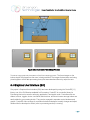
Figure 5.3.2 Illustration of QuickScan Process 15
The above image graphically illustrates the QuickScan mapping process. The three images on the
bottom depict the progress as the room is being scanned. The images that are taken are being
joined together via the data processing theory that was described above by adjust the axis
5.4 Graphical User Interface (GUI)
Our project’s Graphical User Interface (GUI) has been developed by using the ControlP5 [11]
library; one of the GUI libraries available for Processing. ControlP5 is a controller library for
Processing that can be used in authoring, application, and applet mode. Controllers such as
sliders, buttons, toggles, knobs, text-fields, radio-buttons, and check-boxes amongst others are
easily added to a processing sketch. They can be arranged in separate control windows and
groups. ControlP5 offers a range of controllers that allow developer to easily change and adjust
values while the developer’s sketch (refer to processing section) is running.
- 32 -
Design Specification for a QuickScan Mapping Device
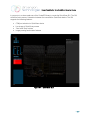
In our project, we have made use of the ContralP5 library to create the QuickScan GUI. The GUI
will be the main venue of interaction between the user and the QuickScan device. The GUI
supports the following features:
•
•
•
•
COM port selection to QuickScan device
Live image of QuickScan process
‘Start’ and ‘Stop’ buttons
Image panning and rotation features
Figure 5.4.1 QuickScan GUI 16
- 33 -
Design Specification for a QuickScan Mapping Device
6.
Arduino Software
6.1 Serial Communication Protocol
Arduino Communication:
The ATmega328 microcontroller onboard the Arduino Nano provides UART TTL (5V) serial
communication. The serial data from the Atmega328 is relayed to the FTDI USB chip to channel
data over USB by using the included FTDI drivers (included in the Arduino software) to provide a
virtual com port onto the computer. Processing can then access this virtual com port to
communicate with the Arduino.
Overview:
Before the Arduino and Processing are ready to communicate with each other, they must
synchronize and indicate that they are ready to receive data. This is important since there is a one
to two second delay when Processing is starting and any data packets out of order will affect the
communication protocol between the two modules.
- 34 -
Design Specification for a QuickScan Mapping Device
Processing
Begin
Arduino
Begin
There is a delay of 1 – 2
seconds before Processing
is ready
Waiting for “Ready” signal
Send “Ready” signal
Awaiting
Confirmation from
Arduino
Send “Read”
signal to confirm
Synchronized
Synchronized
Figure 6.1.1 Arduino & Processing Synchronization 17
Once the synchronization is established between Processing and the Arduino, Processing can
request data by sending a specified “request byte” and the Arduino will perform the desired and
confirm that the task has been completed by returning a “confirmation” byte.
Below is the protocol required for turning stepper motor 0 into a specific angular position:
- 35 -
Design Specification for a QuickScan Mapping Device
Arduino
Processing
Begin
Begin
Send “MoveMotor0”
Command with Move data
SerialEvent waiting to
receive commands
Move Motor0
SerialEvent waiting to
receive commands
Send “Motor0Finished”
Motor0engaged = false
Finished
Finished
Figure 6.1.2 Stepper Motor 0 Protocol 18
Figure 6.1.3 shows the protocol required for requesting the magnetic bearing data from the Arduino:
Processing
Arduino
Begin
Begin
Send “CompassMsg”
Command to request
magnetic bearing data
SerialEvent waiting to
receive commands
•
•
Get data from HMC588L
Process data
SerialEvent waiting to
receive commands
Send Compass Data
Store magnetic bearing
data
Finished
Finished
Figure 6.1.3 Magnetic Bearing Protocol 19
- 36 -
Design Specification for a QuickScan Mapping Device
Figure 6.1.4 is the protocol required to turn the stepper motors ON or OFF. This is an important
feature since the QuickScan’s stepper motors draw ~300mA of current each; this is required to
keep its position and maintaining a strong holding torque. However, once the stepper motors are
completed with their tasks, the motors will be turned off to preserve battery life.
Processing
Arduino
Begin
Begin
Send “Motor1ON”
Command
SerialEvent waiting to
receive commands
Turn on Motor1
SerialEvent waiting to
receive commands
Send “Motor1ON”
Finished
Finished
Figure 6.1.4 Stepper Motor 1 Protocol 20
- 37 -
Design Specification for a QuickScan Mapping Device
6.2 Arduino Microcontroller Logic
Overview:
To begin, the Arduino initializes all its components: Serial communication, HMC5883L compass,
and the two EasyDriver for the stepper motors. Then it will synchronize with Processing by waiting
for a “Ready” message before entering the main loop.
As explained in the communication protocol between the Arduino and Processing, after the
Arduino has received the “Ready” message, it will enter the main loop where the its primary
function is to run the two stepper motors.
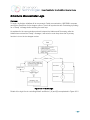
Figure 6.2.1 Arduino Logic 21
Details of the logic flow in controlling Motor0 and Motor1, (A) and (B) are explained in Figure 6.2.2:
- 38 -
Design Specification for a QuickScan Mapping Device
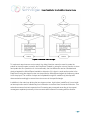
Figure 6.2.2 Motor Control Logic 22
To implement asynchronous motor control, the delay() function cannot be used to create the
pulses for the step inputs to send to the EasyDriver. Instead, by using the micros() function to store
and update the time (resolution of 4 microseconds), the time difference can be calculated and
checked against the Motor0Speed variable to determine if it is time to send another pulse to the
EasyDriver moving the stepper motor one step while the Motor0Speed adjust the frequency pulses
to the step input. The number of steps and is updated through the serialEvent() interrupt and
decremented accordingly to ensure the motor moves to the specified angle.
In addition to the main loop driving the two stepper motors, logic below (serialEvent() ) runs inside
an interrupt routine and is called every time information is received from the serial connection. This
subroutine ensures that task requests from Processing are processed according to the request
message as explained previously in the communication between Processing and the Arduino.
- 39 -
Design Specification for a QuickScan Mapping Device
Figure 6.2.3 Motor Interrupt Subroutine Logic 23
- 40 -
Design Specification for a QuickScan Mapping Device
7.
Electrical
7.1 Circuit Design & Topology
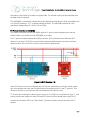
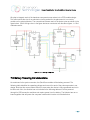
The figure below shows all the hardware components connected. It can be observed that the
Arduino Nano and the HMC5883L compass receives its power from the USB connection and the 2
stepper motor drivers and the stepper motors receive 12V from an external battery.
Figure 7.1.1 Circuit Schematic 24
- 41 -
Design Specification for a QuickScan Mapping Device
We plan to integrate each of the hardware components seen above into a PCB module design.
This will minimize the size of our electronic circuitry and aid in the placement of our circuitry
module on the physical device. The connections between each of the device pins are shown in the
figure below. (Note: Wiring colors in the figure below are consistent with the above figure. i.e. Red
indicates power)
Figure 7.1.2 Wiring Diagram 25
7.2 Battery Powering Considerations
As mentioned in the system overview, the QuickScan module will be battery powered. The
following table identifies the operating voltage and current for each of the subcomponents in our
design. Note that the current values reflect the case when the device is fully operational and not in
its idle mode. Also, the Arduino has not included in the following table as it will be powered
through its USB connection and does not require power from the battery. The Arduino has an onboard regulator that will power the compass module which is also not included below.
- 42 -
Design Specification for a QuickScan Mapping Device
Table 7.2.1 Component Voltage & Current 26
Device
Kinect
Stepper Motor 1
Stepper Motor 2
Motor Driver 1
Motor Driver 2
Voltage (V)
12V
12V
12V
12V
12V
Current (mA)
500
333
333
0.2
0.2
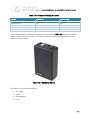
From the above table we find that the maximum total current is 1166.4 mA. Given the fairly high
value of current, we decide to use a 12V lithium-ion battery. This battery is rechargeable and
shown in the figure below.
Figure 7.2.1 QuickScan Battery 27
The battery has the following features:
•
•
•
•
12V output
3.8Ah
Rechargeable
Li-ion
- 43 -
Design Specification for a QuickScan Mapping Device
The total estimated power dissipated by the battery is:
𝑃 = 𝑉𝐼 = (12𝑉)(1.1664𝐴) = 13.99𝑊
A fairly accurate estimate of the operating duration of the QuickScan module with this battery is:
𝑇=
3.8𝐴ℎ
= 3.25 ℎ𝑜𝑢𝑟𝑠 = 3 ℎ𝑜𝑢𝑟𝑠, 15 𝑚𝑖𝑛𝑢𝑡𝑒𝑠
1.1664𝐴
It is quite clear that this battery is a good option and will enable the user to operate the device for a
fairly long time. In practice, the device would operate longer than the time calculated above. This is
because the above numbers have been calculated using maximum current values which indicate
current values in operation modes where all the devices are fully functional. In reality, there are
times where certain device will be in an idle or sleep mode, thus greatly reducing the current draw.
- 44 -
Design Specification for a QuickScan Mapping Device
8.
Test Plan
Test Plans – Arduino Serial Communication Protocol – Unit Testing
Task: Test the communication protocol and hardware functionality
Task Steps:
1. Using processing, send a message to activate motor 0 and observe if the desired
response is initiated.
2. Using processing, send a message to activate motor 1 and observe if the desired
response is initiated.
3. Using processing, send a message to activate motor 0 and motor 1 simultaneously and
observe if both motors are behaving correctly and satisfies parts 1 and 2.
4. Using processing turn ON and OFF motors 0 and 1 and observe if the desired response is
initiated.
5. Using processing, request for the north bearing data from the compass and observe if the
correct data is received.
Test Plans - Processing - Unit testing for the Kinect (without rotation)
Task: Test the depth sensor
Test Steps:
1. Place objects in front of the Kinect at different distance from it
2. Run the program
3. Check if the objects are at the right proportion
Task: Test the distance measuring feature
Test Steps:
1. Using a measuring tape to find a point that is 10 metres directly in front of the camera
2. Place an object at that location
3. Check to see if the output value is 10 metres
Task: Test for the centre of the Kinect
Test Steps:
1. Place a flat object at a fair distance (60 cm to 100 cm) from the Kinect
- 45 -
Design Specification for a QuickScan Mapping Device
2. Run the program to output the distance that is captured between the Kinect and the flat
object.
3. Use a measuring tape to measure the distance between the Kinect and the object to
determine where the centre of the Kinect is
Test Plans - Unit Testing for the Step Motor
Task: Test the precision of the step motor
Test Steps:
1. Mount a disc shaped paper onto the step motor, make sure that the centre of the disc is on
the rod of the step motor
2. Draw a straight line from the centre to its edge
3. Place a 360° protractor underneath the step motor, ensuring that the 0° mark on the
protractor matches the straight line drawn on the disc
4. Run the program to make the disc rotate at a designated degree
5. Once finished, check to see where the line on disc moved matches the value that was the
input
Task: Test precision of the step motor with the Kinect mounted on it, to see if the precision will be
affected with an object on top.
Task Steps:
1. Mount a disc shaped board onto the step motor, make sure that the centre of the disc is on
the rod of the step motor
2. Draw a straight line from the centre to its edge
3. Mount the Kinect on the disc
4. Place a 360° protractor underneath the step motor, ensuring that the 0° mark on the
protractor matches the straight line drawn on the disc
5. Run the program to make the disc rotate at a designated degree
6. Once finished, check to see where the line on disc moved matches the value that was the
input
Testing - Integration Testing
Task: Check the quality of the meshing when the different images are brought together.
Task Steps:
1. Post an image of a face on a flat wall at an angle such that only half of it can be seen by
the Kinect
2. Run the Kinect and make it turn to the direction to get a full view of the image. This will
capture two images, one with half of that face and second one with the full face.
3. Check in Meshlab to see if the images are brought together smoothly. Meaning are the two
images on the same XY plane, or is one maybe little behind or in front of the other?
- 46 -
Design Specification for a QuickScan Mapping Device
Testing case-Graphical User Interface
For GUI testing, we need to consider the following in our test cases [8]:
• Domain size of operation
• The sequences of operation
Our project GUI only contains 10 operation sets (i.e. the domain size is 10). Unlike large
commercial software, our GUI does not contain a lot of complexity, making the test process a lot
simpler.
Thus, the test case for the GUI of the project will have:
• A simple automation to test each operation according to the specification checklist below.
• End-user manual testing will be done with scope of lecture class size of student with
o White box testing
o Black box testing
General Principles
1. Every action that alters the user’s data or application’s settings can be undone
2. All application settings can be restored to their defaults with without the user having to
remember what those defaults were.
3. The most frequently used functions are found at the top level of the menu structure.
Graphical Elements Checklist
1. All multi-color graphical elements can be shown in monochrome only, where possible
2. All interactive GUI elements are easily distinguishable from static GUI elements
3. An option to hide non-essential graphics is provided
Fonts and text
1. All labels have names that make sense when taken out of context.
2. No label names are used more than once in the same window.
3. Label positioning is consistent throughout the application.
4. Static text labels that identify other controls immediately precede those controls in the tab
order.
Color and contrast
1. Color is only used as an enhancement, and not as the only means to convey information or
action.
2. The application supports all available high-contrast themes and settings
3. The software is not dependent on any particular high contrast themes or settings
Timing checklist
1. The display or hiding of important information is triggered solely by movement of the
mouse pointer.
- 47 -
Design Specification for a QuickScan Mapping Device
Documentation
1. All documentation is in an accessible format, with textual alternate descriptions provided
for all figures.
2. The documentation includes a section that covers all the application’s accessibility
features.
Test Plans - Power Benchmarks - Unit testing
Task: Measure Battery Life for QuickScan battery pack – Idle Mode
Test Steps:
1. Turn on device – ensuring battery has been fully charged
2. Do not initiate a scan process but keep the power connected to all modules
3. Measure the battery life for this idle mode
Task: Measure Battery Life for QuickScan battery pack – Normal Mode
Test Steps:
1. Turn on device – ensuring battery has been fully charged
2. Initiate first scan
3. Once scan is completed wait for 10 minutes before starting next scan
4. Perform steps 2-3 until battery is at zero capacity
5. Measure the battery life for this normal mode
Task: Measure Battery Life for QuickScan battery pack – Continuous Mode
Test Steps:
1. Turn on device – ensuring battery has been fully charged
2. Initiate first scan
3. Once scan is complete proceed to next scan with a minimal wait time
4. Perform steps 2-3 until battery is at zero capacity
5. Measure the battery life for this continuous mode
- 48 -
Design Specification for a QuickScan Mapping Device
9.
Environmental Considerations
9.1 Project Disposal
Dimension Technologies is committed to maintaining a high standard of quality and professional
integrity. This includes considerations to environmental consequences resulting from the
QuickScan module. Specifically, at the completion of our ENSC 440 project our device will be
disposed in such a manner that maintains environmental standards and proper disposal practices.
We will distribute the parts from the QuickScan module to our various team members for their own
personal interests. Any leftover parts will be correctly disposed meaning that electronic parts will
be disposed in electronic recycling center.
9.2 Product Disposal
Similar to our project disposal, in the field, customers can dispose of our QuickScan product at
any electronic recycling center. Our product does not contain environmentally hazardous
materials, thus standard electronic disposal techniques are sufficient.
- 49 -
Design Specification for a QuickScan Mapping Device
10. Conclusion
This document has extensively explained our design process and methodologies for the
QuickScan device. Each of our subcomponents has been thoroughly explained in addition to
justifying our selection of such parts. A working prototype is expected to be functional by the first
week of December.
- 50 -
Design Specification for a QuickScan Mapping Device
11. References
[1] Wikipedia Contributors. “Kinect” Internet: http://en.wikipedia.org/wiki/Kinect [Nov 8th 2012]
[2] Microsoft Corporation. “Kinect” Internet: http://www.xbox.com/en-CA/Kinect [Nov 8th 2012]
[3] Arduino Corporation “Arduino Nano”
Internet: http://www.arduino.cc/en/Main/ArduinoBoardNano [Nov 8th 2012]
[4] “Stepper Motor with Cable” Internet: https://www.sparkfun.com/products/9238 [Nov 8th 2012]
[5] “EasyDriver Motor Driver” Internet: https://www.sparkfun.com/products/10267[Nov 8th 2012]
[6] “Triple Axis Magnetometer Breakout HMC5883L”
Internet: https://www.sparkfun.com/products/10530 [Nov 8th 2012]
[7] “GUI Level Sequencing Testing”
Internet: http://www.lri.fr/~wolff/diss-proposals/GUI-levelSequenceTesting.pdf [Nov 8th 2012]
[8] “GUI Testing and Coverage Analysis” Internet: http://www.ijicic.org/ijicic-09-1178.pdf
[Nov 8th 2012]
[9] “OpenNI” Internet: www.openni.org [Nov 8th 2012]
[10] “Processing” Internet: www.processing.org [Nov 8th 2012]
[11] “ControlP5 Library” Internet: http://www.sojamo.de/libraries/controlP5/ [Nov 8th 2012]
[12] “Microsoft Kinect Teardown”
Internet: http://www.ifixit.com/Teardown/Microsoft+Kinect+Teardown/4066/2 [Nov 8th 2012]
[13] “How Kinect Works Prime Sense”
Internet: http://ntuzhchen.blogspot.ca/2010/12/how-kinect-works-prime-sense.html
[Nov 8th 2012]
[14] “How does the Microsoft Kinect work from a Technology Standpoint”
Internet: http://www.quora.com/How-does-Microsofts-Kinect-work-from-a-technologystandpoint [Nov 8th 2012]
[15] “Arduino Reference” Internet: http://arduino.cc/en/Reference/HomePage [Nov 8th 2012]
- 51 -
Design Specification for a QuickScan Mapping Device
[16] “Arduino Main Board” Internet: https://www.sparkfun.com/products/666? [Nov 8th 2012]
[17] “Tutorial: I2C and Processing”
Internet: http://www.jeremyblum.com/2011/02/13/arduino-tutorial-7-i2c-and-processing/
[Nov 8th 2012]
[18] “Wire Reference” Internet: http://www.arduino.cc/en/Reference/Wire [Nov 8th 2012]
[19] “Universal Mounting Hub” Internet: https://www.sparkfun.com/products/10006 [Nov 8th 2012]
[20] “Stepper Motor” Internet: http://en.wikipedia.org/wiki/Stepper_motor [Nov 8th 2012]
[21] “Stepper Motor” Internet: http://www.omega.ca/prodinfo/stepper_motors.html [Nov 8th 2012]
[22] “Basics of Motion Control”
Internet: http://www.orientalmotor.com/technology/articles/2phase-v-5phase.html
[Nov 8th 2012]
[23] “EasyDriver” Internet: http://schmalzhaus.com/EasyDriver/ [Nov 8th 2012]
[24] “EasyDriver” Internet: http://bildr.org/2011/06/easydriver/ [Nov 8th 2012]
[25] “HMC5883L”
Internet: http://dlnmh9ip6v2uc.cloudfront.net/datasheets/Sensors/Magneto/HMC5883LFDS.pdf [Nov 8th 2012]
[26] “Arduino” Internet: http://bildr.org/2012/02/hmc5883l_arduino/ [Nov 8th 2012]
[27] “Tutorial: HMC5883L and Ardunio”
Internet: https://www.loveelectronics.co.uk/Tutorials/8/hmc5883l-tutorial-and-arduino-library
[Nov 8th 2012]
[28] “Tripod Stand” Internet: http://grabcad.com/library/tripod-stand--1 [Nov 8th 2012]
[29] “Kinect” Internet: http://www.chiefdelphi.com/forums/showthread.php?t=102002
[Nov 8th 2012]
[30] E Melgar, C Diez. Arduino and Kinect Projects. Technology in Action, 2012
[31] Cover Photo: “Lobby Room” Internet: http://stockfresh.com/image/402224/lobby-room
[Nov 8th 2012]
- 52 -
Simon Fraser University,
8888 University Dr.
Burnaby, BC Canada
Email: [email protected]